
Scott Ashley
This transcript was generated by AI and may contain errors. It is provided to assist those who may not be able to listen to the message.
Those of you who were not here last week gave a sermon where I introduced this to an article by John Hawkins. Mr. Hawkins' article appeared in townhall.com. It's a leading source for conservative news and political commentary and analysis. He wrote this article back on April 1st, but I thought it was fitting for us to go through that material on the 4th of July weekend. The article was entitled, The 7 Reasons America Became a Great Power.
With each of those reasons, he gave a short paragraph. You can go to townhall.com, take a look at the article for yourself. But those 7 areas are this. Let me just go through these quickly. I say quickly because we're going to be going through those again in today's sermon. What he talked about, the reasons he felt America became a great power, and I would agree with his assessment. Number 1 was a Judeo-Christian ethic.
Number 2 was a powerful military. Number 3, Western culture. Number 4, geography. Number 5, industrial capacity. Number 6, a merit-based society. And number 7, a constitution that limited centralized government. We concluded this sermon last week by going through some material that Mr. Hawkins wasn't knowledgeable of by talking about where we are in prophecy, in terms of who we are in prophecy, part of the Lost Ten Tribes of Israel. We examined how God fulfilled his promises to our founding fathers of Abraham, Isaac, and Jacob. And God also built our nation through our colonial founding fathers, such as George Washington, Thomas Jefferson, and Benjamin Franklin. Last week, the sermon title was America the Beautifully Blessed.
Now today, we're going to take those same seven points. And we're going to see that as we as a nation neglect those seven areas, as we abandon those areas, twist them or distort them, what that has done for us as a nation, and it's been this way, brethren, for some period of time.
We're not talking about something that has just happened over the last few years. I think it can be argued that America has been on its decline since just after World War II, in such places as Korea, Vietnam, and other locations. But today, if you're taking notes you want something to put across the top of your paper, write this, seven reasons behind the American Empire's decline.
Seven reasons behind the American Empire's decline. And as we're going through these same seven things that we went through last week, we're taking a look at the other side of the coin. These are things for us to be watching as we're watching world news. People say, well, what do I look for? Well, these seven things are things for us to look for.
Now, qualifier here. I'm sure that some of my comments today will get some of you upset, get some of you angry. Brendan, I'm a shepherd, and as a shepherd there are times where I would just love that all I would do up here is talk about sunshine, rainbows, and lollipops. I wish that could be the case. Today is not one of those days. Today is one of those more soul-brained days. It's my job as a pastor, at times, as Paul wrote to Timothy, he said that we need to be gentle when we're dealing with the brethren.
This July marks an anniversary for me. I've been your pastor now since 1997, 17 years. Most of the sermons, Paul used to talk about his record, I'll talk about my record. Most of the sermons I've given to you have been more on the gentle side, as Paul wrote to Timothy. But we also have the example in the Old Testament, such as Ezekiel, where we are told to warn the people. And if we don't warn the people, God will take it out on us. Now, I have enough personal issues, but I don't need to add to those in terms of God saying, Well, Belisandre, here's some more that we're going to weigh against you here.
We are told as the ministry to cry aloud and spare not and tell the people their sins. Do want to read something if you want to turn to Daniel 4, verse 17. I'm going to be reading this out of the King James, Daniel 4, verse 17.
Where it says, Every four years, coming a presidential election, I trot out our sermon about voting, and why the church believes we shouldn't be involved in that. Now, some of you do. Some of you vote Republican. Some vote Democratic. I don't know. Maybe some of you vote for the Green Party or whatever you vote for. But every four years, I trot that out and give that very dutifully, because I believe very strongly what this verse says. God doesn't need our help. God will put in power, and He has put in power, Mr. Bush two presidents ago and Barack Obama this time. I believe very firmly, with all my heart, that's what God wanted, and that's what God got. You can vote one way or another, but one of the reasons I don't vote is, I don't see, we tend to, as I said in the past, we tend to vote for who he thinks best. But maybe God doesn't want the best guy in office. Maybe God wants the worst guy in office. We've had over the course of our history as Americans, we've had some really bad presidents. But that's probably what God wanted at that time in our history.
Also, you might want to turn now to John chapter 18, verse 36. John 18, verse 36. So the point I was making, brethren, is God doesn't need our help. He's going to put in power whoever He wants to. John 18, 36.
Jesus answered, Jesus Christ, who is our ultimate example, didn't get invested in the politics of this world. And neither should we. Now, I may mention that I may be saying things today that will upset some here in the room. I want you to know I love each and every one of you. But we're going to work with a couple, two or three principles here. One, as I talk about world leaders, we love the center but hate the sin. Let's keep that in mind. We love the center, hate the sin. And we love the politicians. They're people, too. We love the politicians, but we hate sometimes the policies. I think that we should all be able to appreciate that difference. I want to quote a guiding principle from Dr. Martin Luther King. In his famous, I Have a Dream speech, Dr. Martin Luther King said, I have a dream that my four little children will one day live in a nation where they will not be judged by the color of their skin but by the content of their character. I think that was a very proper statement to make, a very good statement as a guiding principle in life. Today we're going to take a look at some of the policies that some of our leaders have engineered for our country. We love our politicians as people, as human beings, as brothers and sisters in the flesh, but we may not like their policies. So I think we can appreciate all of that. Brethren, I don't know how much you watch world news, but as I was preparing this message this last week, I couldn't help but be thinking that over the years I've been a part of the church. I've been a part of the church now since the mid-60s. Many of you have as well. We have been preaching about various prophecies for generations, and now, quite literally right now, we may be seeing the formation of things we've been preaching about on a real-time basis what's happening over in the Middle East. This ISA group, the Islamic State of Iraq and Syria, Islamic States of Iraq and Syria, ISIS, a terrorist group, really bad bunch of people, so bad that even the al-Qaeda people give them a wide berth. Their territory has now expanded from Syria, their base of operations, and now they have not only portions of Syria, but about a third of the nation of Iraq. They have become a nation-state. Now, they don't have any diplomats. They've got a relatively small army, only about 10,000 people. But they have been wreaking havoc in the Middle East. Are we watching the establishment of the King of the South? Now, I'm going to get to that a little bit later in the sermon, but I do want to take a look at something. Let's take a look at it right now. Daniel 11. In Daniel 11, we have the longest prophecy in the Bible.
Very intricate, very involved prophecy. Daniel 11.
In verse 40, At the time of the end, the King of the South shall attack him, and the King of the North shall come against him like a whirlwind with chariots, horsemen, and many ships, and he shall enter the countries, overwhelm them, and pass through.
We may be seeing this King of the South being formed right now before our eyes. And, of course, there has to be a King of the North. And perhaps as this King of the South is in the process of being built, that group of nations that we know to be the King of the North, because of the policies of America right now, because we have chosen to step back as a world leader.
People like the ISIS people feel like they can step forward. People like Vladimir Putin feel like they can step forward. And because of that, we may well have the King of the North saying, you know, we simply can't rely upon the power of the United States of America anymore. We'll get into that more in the rest of the sermon. And so the reason I'm giving this sermon, brethren, is because I see that things are on the stage now. They might well be taking shape because of the actions our country is currently taking. I want to quote from our very new booklet, Seven Prophetic Signs Before Jesus Returns, toward the end of one of the chapters that says this. I'm talking about Daniel 11 here. The latter part of Daniel's prophecy of the North-South conflict describes a clash of civilizations between the leaders of a soon-coming European superpower, a revised Roman Empire, and a leader who is a successor to the Ptolemaic rule of Egypt, which is now part of the Arab-Islamic world. We now see the geopolitical conditions lining up for this inevitable clash. Here is yet another prophesied circumstance in which this stage is being set within our lifetimes. And brethren, not only within our lifetimes, right now on TV, right now in the newspapers. So, with that all having been said, let's take a look at those same seven points that made us a great nation and see why abandoning or twisting or perverting those seven points is causing the American Empire to decline. Point number one, the Judeo-Christian ethic. Let me read from the article from Townhall.com, and then I want to discuss where we are now with this issue. I quote, When people call America a Christian nation, they're referring to the Judeo-Christian morals that shaped our country. Our strong sense of right and wrong kept corruption to a minimum. Our Protestant work ethic caused Americans to be productive, and our belief in rights given by God, not government, shaped our national philosophy. Respect for Christian values is a part of the fabric of our country. It goes right back to our founding. Even if many people wouldn't realize it until it's too late, an America where Christianity isn't an important part of everyday life would no longer be an America in any meaningful sense.
Let me re-quote that last sentence, because I think that last sentence is where we're at as a nation. Even if many people wouldn't realize it until it is too late, an America where Christianity isn't an important part of everyday life would no longer be an America in any meaningful sense. As I was preparing for the message, I was doing a good bit of research on this last week, and I read an article by Gary Pegg who's written a number of years ago.
It deals with our strong sense of right and wrong in Christian values as a nation. Mr. Petty writes, he said, a survey was taken a few years ago involving people ages 15 through 35, and they revealed that most Americans can only recall two of the Ten Commandments. Just two.
An Atlantic Monthly article reported on the survey's respondents, and they said that many, when they found out what the other eight Commandments were, they weren't too happy about those Commandments.
They had clear ideas about how the Commandments might be revised in our modern time. Now remember, it's understanding and trying to live by those Commandments that made our nation great. Now people want to tinker with those.
Support was weak for keeping the Sabbath holy and for honoring one's father and mother. But Commandments they would like to include would be, thou shalt not drink and drive, and thou shalt care for the environment.
Those were things they thought should knock out some of the other ten.
Author Orion Copelman in his book, the Second Ten Commandments, claims that the Ten Commandments have outlived their usefulness.
He promotes Commandments like, maximize your time spent in flow and happiness.
Now I'm a fairly educated person, but I have no idea what you just said.
Maximize your time spent in flow and happiness. Wow, that must be deep.
And act true to your inner voice and fulfill your mission.
John Leo in a late U.S. News & World Report article some time ago, speculates that if we began to change the Ten Commandments to fit our day-to-day, here's how they might read. And he used King James' language.
Commandment number six, thou shalt not kill except during any stage of your pregnancy, or if the Pentagon says you must.
Commandment number seven, you shall not commit adultery except if you are unhappy with your personal fulfillment, and that points thee toward the new secretary in thine office.
Now, brethren, along the lines with this Seventh Commandment about adultery and about related issues, 19 states, 19 states, and more are coming, 19 states have legalized same-sex marriage. 19 states.
That's the direction this country is going. We now have an LGBT History Month, whole month, October, in a celebration of the lesbian, gay, bisexual, transgender group.
Now, can we see why this nation is declining because we no longer believe in a Judeo-Christian morality?
At least not so many of us don't, to put it that way. Too many of us don't.
Commandment number eight, according to these rewrites, thou shalt not steal but be creative on your tax return.
Let's take a look at Jeremiah chapter 5.
Jeremiah chapter 5. Take a look at a couple of prophecies here.
Jeremiah chapter 5, starting in verse 7.
How shall I pardon you for this? Your children have forsaken me, and swore by those that are not gods, when I had fell them to the full. They committed adultery and assembled themselves by troops in the harlot's houses.
They assembled themselves like troops in the harlot's houses.
Brethren, we have a comprehension about how big pornography is in this country.
We have to have a booklet on that subject now because it is such a pervasive issue in our society.
In talking to some of the young men of the church, they have told me, Mr. De La Sandro, every young man I know, 100%, every young man I know baptized in a church, has a real issue with pornography.
It is a horrendous problem.
And you know something, brethren? It's not just pornography anymore.
It's not just something that happens in some sleazy, out-of-the-way, darkened corner where you get a couple of people over in Hollywood making, cranking out these movies.
You have some of the biggest names in our nation, some of the most influential names in our nation in terms of companies, Time Warner and various other companies, renowned companies who own studios where this stuff is created.
You probably can't go to too many motels, whether you're talking about a Holiday Inn or a Mardi Inn, the big name places. They all have got your adult channels.
They've all got your adult channels, and they want those adult channels because those channels make them a lot of money.
So God says, you assemble yourselves like a group of troops in the Harlot's houses.
Verse 8, they were well-fed, lusty stallions, everyone naying after his neighbor's wife.
Shall I not punish them for these things, says the Lord? Shall I not avenge myself on such a nation as this?
God has spoken.
Let's go to Hosea 4.
Hosea 4.
Hosea 4, verse 1.
Hear the word of the Lord, you children of Israel, for the Lord brings a charge against the inhabitants of the land. There is no truth or mercy or knowledge of God in the land.
Of course there isn't. Our courts are taking that away.
The whole philosophy, this whole thing about church and state. You know, when you read what the Founding Fathers were talking about in the Constitution, over and over they were talking about God. Over and over. But the Supreme Court started making rulings about church and state, and now that's the law of the land.
But our Founding Fathers wanted us to be a country with a tremendous belief of God. But now every chance we get, let's tear out this or that in terms of the commandments of God and so forth. Verse 2. By swearing and lying, killing and stealing, and committing adultery, they break all restraint with bloodshed upon bloodshed. Therefore the land will mourn, and let everyone who dwells there will waste away with the beasts of the field and the birds of the air.
Even the fish of the sea will be taken away. God's going to really come down hard in our country. Verse 6. For my people are destroyed for lack of knowledge. America today is the most technologically advanced nation that has ever been. And yet our people will be destroyed for lack of knowledge. What kind of knowledge? The knowledge about God, the things that are important in terms of the Scriptures. So number one, things we want to watch, is how are we doing as a nation with our Judeo-Christian ethics and values?
Those are really sliding. Number two, one of the things that made us a great nation, but also the reason we're declining is our military. Again, let me read a paragraph here from Mr. Hawkins. He says, There's a lot to be said for soft power, but it pales in comparison to raw military might. The United States was not always a great military power, but once the Civil War was over, we started to assert ourselves. Since World War II, we've had the finest military on planet Earth.
That one factor does more to ensure our freedom and the safety of our allies than any other factors combined. As Reagan said, history teaches us that war begins when governments believe the price of aggression is cheap. And, brother, in that last statement is what I want to... This is the reason. We have decided to step back. History teaches that war begins when governments believe the price of aggression is cheap. With our current president, we have made decisions to step back from being the world's leader. We now say, well, let's find out what the United Nations has to say.
Let's find out what the allies want. Let's not just go out and do what we need to do. Let's take a step back. Let's take a look at Leviticus, chapter 26. Leviticus, chapter 26. There's two chapters in the Bible that talk about blessings and cursings. This is one of them. Here's a prophecy for our day today. And as I said, brethren, the pride of our power has been dismantled since the end of World War II. It's not just something that is taking place the last few years.
It's accelerated the last few years, but it's been with us for some time. Leviticus, chapter 26, verse 14. But if you do not obey me and do not observe all these commandments, and if you despise my statutes or your sole pours my judgments, so you do not perform all my commandments but break my covenant, and we drop down to verse 19, I will break the pride of your power. I will break the pride of your power. And brethren, that is true. Michael Savage, in his work Trickle Down Tyranny, said this.
Economies can be rebuilt, armies can be repopulated, but once a nation's pride is gone, it can almost never be restored. Once a nation's pride is gone, it can almost never be restored. As I said, this has been happening to this country since the end of World War II, after we saw it in Korea, we saw it in Vietnam, but we're certainly seeing it now. I want to quote from a relatively current Good News magazine article. This is written by John Ross Schroeder, as you know Mr. Schroeder died recently, but he wrote this article for the January-February 2014 Good News magazine, and the article is entitled, Why the Massive Decline in America's Prestige.
I want to quote, Foreign countries don't look at the United States admiringly in the way they once did. The nation that put men on the moon that brought an end to the Nazi threat that came through the Cold War victorious faces increasingly difficult and threatening times as we move well into the 21st century.
Today, other nations are gauging recent U.S. debacles and publicly expressing their fears in anxiety and anticipation of a disturbing trend. The Middle East remains a thorny case in point. American foreign policy in this explosive region has so bewildered and exasperated Saudi Arabia that the Saudis have been making loud noises about turning away from the United States to find more reliable partners. Now, we pay our pound of flesh to the Saudis for the oil that we get from them. We need them as an ally, but they're saying, we don't know if we can trust you anymore.
You're pulling back on everything and everywhere, we just don't know if we can trust you anymore. Continuing on with the article, after witnessing America's virtual abandoned long-time Egypt while embracing the Muslim Brotherhood in Iran, the Saudis became deeply concerned about the direction of U.S. foreign policy to the point that on November 8, 2013, the BBC reported that Saudi Arabia, seeing America wasn't serious about preventing Iran from developing nuclear weapons has reached an understanding that could call upon Pakistan for access to that country's nuclear arsenal as a counterweight to Iran's. You know, we have certain politics here at home, but when those politics are translated into foreign policy and the rest of the world sees it, then it can have devastating consequences.
But then we live, the world we live in is a very tough neighborhood. And there's plenty of bullies in this neighborhood. And if we back down, if we, for really no reason, if we just say, well, you know, we're war, we're even in these two wars, we're war, we're even, we back down, then the bullies come forward. And we're seeing that now in the Middle East. We're seeing that over with Russia.
Long-time ally Egypt, ally Egypt, seeing Washington treated with hostility after President Mohammed Morsi, who represented the Muslim Brotherhood, was deposed, announced it was seeking a military aid from Russia, because America was no longer a dependable ally. So not only the Saudis, but also the Egyptians, saying, you know, we just can't trust you guys.
Can't trust you guys. Daniel Johnson, editor of Britain's Standpoint magazine, summed up the current dilemma, stating that these things are happening, quote, at a time when the world needs its only superpower to renew its civilizational mission. Charles Krauthammer is an American syndicated columnist, author, political commentator, physician. He's also a Pulitzer Prize-winning columnist. He said, for America today, decline is not a condition, it is a choice.
Let me give you a good example of that. As I was thinking about this material and putting my notes down, something came on the news last night that really disturbed me. Really disturbed me. It's been known for some time that we are going to slash the number of troops we have around the world. Now, there are political reasons for that. I won't get into that here.
But we're slashing the number of troops we're having around the world. It used to be that America's foreign policy was we could always fight two wars someplace in the world.
Now the idea is, well, we could fight a war and a half. Whatever a war and a half is. But they were, last night in the news, they were saying that our soldiers, particularly our officers, are getting pink slips. And some of them are getting pink slips when they are in the battle zone. Now, it's bad enough to get a pink slip, you know, any time.
But if you are in some place where the lead is flying, bullets are flying, and you're an officer and you're leading our men in combat, and you get a note saying, thanks for your service, but no thanks. And you're thinking about your wife and kids back home. How do you lead your men? Well, this is an example of a choice we have made. We could have cut something else. We didn't have to cut the military, but we did. Going back to the article from the Good News, it says, and indeed, this is what we see a nation making willing choices to diminish its leadership role in the world as the current administration puts it, leading from behind.
And that's what has our allies jittery. America now is talking about leading from behind. Phil Stevens in the Financial Times said, if the experience first of Iraq and then of Libya shows the dangers of varying degrees of intervention, then Syria has revealed the awful perils that can accompany inaction. He finishes the article by saying the Middle East is burning and the U.S. is getting out. There is an element of exaggeration in this observation, but only an element. The dynamics of rising conflict and U.S. disengagement have become mutually reinforcing. The higher the fire is burned, the more Washington seems intent on turning away. Frederick Forsyth in The Daily Express said this, any suggestion that the West might now help the Syrians?
This is a little dated. It goes back to November 8, 2013. Any suggestion that the West might now help the Syrians and revolt against the tyrant Assad, except with disaster aid, is as dead as the dodo. The reason is simple. Virtually the whole of the anti-Assad insurrection has been taken over by fanatical extremists and their various allies and fellow jihadists. The West had its chance 18 months ago and finally blew it. There was a time when the rebels were winning. Inaction prevailed. Inaction prevailed.
As Reagan said, history teaches us war begins when governments believe the price of aggression is cheap. That's what our allies believe, our enemies believe. That's why the bullies in Russia, in the Middle East, in Korea, in Iran and China are now stepping forward because they see America as being weak. Regarding the ISIS people, there's a quotation here from a news source I want to read to you about where they're coming from. This is in discussion about them possibly being the king of the South.
On Sunday, an Islamic caliphate, named the Islamic State, was declared inside large portions of both Iraq and Syria. The relatively new, yet extremely violent, recently successful and fully emboldened Islamic States of Iraq and Syria is a radical terrorist group seeking to establish the caliphate, a historic Muslim state ruled by strict Sharia law that once stretched over much of the Middle East, Africa, Asia and Europe.
In the minds of ISIS, their newborn Islamic State is a fulfillment of the long-lost caliphate from the 7th century. Muslims across the globe are obliged to swear loyalty to the state and its charismatic leader, Abu Baghdadi. Now, who's this Baghdadi? We had him in custody, Baghdadi. It was President Bush who let him go. President Bush let Baghdadi go. Now, here's a guy who's got a large fold in Syria, about a third of Iraq. He wants to go next into Jordan.
He has made threats against the United States of America. We've got a base to work from now. 9-11 was done by a relatively small group of men, if they had other backing. But now there's a whole Islamic State, perhaps the King of the South, run by this Baghdadi that President Bush let go.
This Baghdadi claims that he is in the line of succession going back to the Prophet Mohammed. Now, as I was writing this, I was thinking, this might well be that King of the South. But then the more I got to hear it, listening to the news this week, I mean, we're talking about a very fluid situation here. These ISIS people went into Mosul in Iraq and they started desecrating mosques. They blew up a mosque or two. And then they said they want to march on Mecca. Now, any group of Muslims who say they want to march on Mecca and destroy Mecca and destroy holy places in Mecca, every Muslim in the world will turn against them.
So I don't know if they're going to stand down from that posture. I don't know if the rest of the Muslim world will see this ISIS group and turn on them. And so doing, they become the King of the South, but it can go either way. Very fluid situation. Very fluid situation.
But America now is seen as a weak power. Item number three. Item number three. Western culture. Western culture helped build this country, but Western culture is now tearing this country down. Last week I made mention that Western culture built us as a nation because our culture was founded upon the Bible. Bible teachings. Exporting Bibles to every part of the world in living, as best as people knew how, living by the things the Bible had to say. If you would, turn to Genesis 6, verse 5. Genesis 6, verse 5. I think this is becoming more and more true every day in this country.
Genesis 6, verse 5. Then the Lord saw that the wickedness of man was great in the earth, and that every intent of the thoughts of his heart was only evil continually. Now, we're not there totally, fully. I think you and I know that there are plenty of what we would call good people in the world, good people in this country, but more and more we see people who don't have consciences.
More and more we see just horrible morality in this nation. I remember growing up, and I'm not all that old, but I remember growing up in the standard fare of the day when you turned on the TV where racy shows like Ozzy and Harriet, you know, scandalous shows like Ozzy and Harriet, Father Knows Best, the Donna Reed Show, My Three Sons, Oh, the world was coming to an end with shows like that.
We don't have shows like that anymore. Now we've got the Jerry Springer Show. Now we've got Desperate Housewives. Now we've got Sex and the City.
Dr. Jim Black wrote a book entitled When Nations Die, and in his book he comments about ten key factors, it's a good read, ten key factors that led various empires like Greece and Rome down the road to ruin. Dr. Black says, the United States is at or near the top of all the nations in the industrial world in the rates of abortion, divorce, and births of unwed mothers. The spiritual and intellectual qualities of an American life are seriously degraded, and the soul of the nation is in jeopardy.
He sums up in his book, the lesson of history is that nations die from a lethal combination of internal and external pressures. Moral decay combined with rising violence, lawlessness, intellectual apathy leads invariably to the disintegration of the structures that make civilization possible. From ancient times to the present, the pathology of decadence is unmistakable, and in times of trouble, it is imperative that we heed these warnings.
The entire record of human history confirms that despair and disaster are the natural consequence of irresponsible self-indulgence, immorality, hedonism contribute to the death of nations, yet a number of Americans want to ignore that dark reality.
Morals make a difference. Who we are as a culture makes a difference. In our Western culture, this is one of the reasons why the Arab world, the Muslim world, is so upset with us in our culture. They see it for what it is, at least the entertainment aspect of it. They see it as being a very decadent culture, and they want to seriously get rid of us.
Okay, number four. Number four of the seven points here is geography.
Geography. He wrote, Mr. Hawkins wrote, We can't underestimate the importance of being a large, resource-rich nation that's isolated from powerful foes. Had Britain been considerably closer, it's possible we may never have been able to break away and control our own destiny.
That's true. They had a large ocean. Britain, when we fought our American Revolution, they were the most powerful military on Earth, the most powerful navy on Earth, but they were a full ocean away, a big ocean away. And that's the way God designed it.
Quoting again from his article, If we have powerful adversaries to our north and south, we may have had great difficulties when our nation was young and we were just finding our strength. If we had been closer to Europe, our homeland might have been decimated during World Wars I and II. If God had given us first choice of places to found a nation, this is where we would have ended up. Right here, protected by two great land masses, Earths and the Oceans.
Quoting from the most current, Good News. This is the Good News, July, August 2014.
It's an article by Mike Kelly, titled the article, As America Retreats, A Dangerous World Emerges.
What happens when the world's policeman hangs up his badge and gun and retires into the sunset? We're beginning to get a sobering first-hand look. Of course, he's talking about America there. After World War II, for half a century afterward, the United States played the role of the world's policeman, intervening in Korea, Vietnam, Africa, the Middle East, even the Caribbean, to thwart communist insurgencies, upstart dictatorships and other threats to peace, and a balanced world order.
By no means did America play this role perfectly, yet the free world did come to rely on the United States as the one power with the will and the might to extend itself in the cause of international justice.
Yet recent events show an America-on-the-retreat backpedaling, withdrawing, and in general on the defensive. What has happened to the nation and most other countries have looked to for leadership in dangerous times? What does it mean for the world? Over the past decade, commentators across the world have noted changes. Past Good News articles have cited respected sources such as the British news magazine The Economist, The Financial Times, Germany's Dear Spiegel, The Wall Street Journal, all of which have noted the seismic shift in America's willingness to evolve herself globally.
And, brethren, it gives me no great joy to read these things. But we need to know what's happening. We need to know that the sword is coming, that great tribulation is coming. This nation is going down, and we need to understand the dynamics of why.
Some of these things have been in the process now for generations. Yet some of the things now are escalating as we get closer to the end.
Taking office in 2009, newly elected U.S. President Barack Obama lost no time in spelling out his new vision for America's role in the world. The United States would no longer assert its authority abroad, he promised. America would play nicely in a sandbox of nations, not driving its own interests. It would rely increasingly on other nations to carry the burden of maintaining international order. Leading from behind was to become America's new role on the world stage.
Former U.S. National Security Advisor Brzezinski is just one of the many works assounding the alarm on America's retreat and its implications. In his 2013 book, Strategic Vision, America and the Crisis of Global Power, Brzezinski argues that the eventual demise of the United States as one global superpower would lead a fragmented world, one even more dangerous in the world today.
Now here's a man who knows something about politics among nations. He knows something about world power and how it works. He goes on to say that as America pulls back from its role as the world leader, that there will be realignments of both global and regional power.
Brethren, in this world, there is no such thing as a power vacuum. When we say, you know, we would go to the United Nations, we're going to look to Alice, we're going to pull back, we're just one of the nations. When we take that approach, then, as I said earlier, the bullies come out. And you can read in this phrase that Brzezinski is talking about the establishment of the beast power.
We're seeing perhaps the establishment of the king of the south, but because we are pulling back, you're going to have people like Merkel of Germany saying, you know, we just can't rely on America. We just can't rely upon them. We've got to do our own thing. We have to have our own European army. We have to be really strong militarily. And the reason being is for the decisions we're making right now.
Quoting from our Good News article, our current Good News article, nearly two years ago, in September 2012, the Wall Street Journal article focusing on Americans' inability to guide and influence global events said this. The Obama presidency has been an era of slowly building tension and disorder that seems likely to flare into larger troubles and perhaps even military conflict.
Let's take a look and go back to Leviticus chapter 26 again. Leviticus chapter 26.
You know, brother, last week we talked about the times where America was prideful of the power they had. We talked about the Great White Fleet, those 16 battleships that were painted white. And Teddy Roosevelt, back in December of 1907 through February of 1909, Teddy Roosevelt said, I want you to sail all around the world with this great fleet. I want you to enter as many ports of various countries as you can. I want people to see that we're a nation to be reckoned with.
He also had what we call the big stick policy. And he called it, defining it, he said, the exercise of intelligent forethought and decisive action sufficiently far in advance of any likely crisis. Is that what we see happening with America today, or are we always one or two steps behind the enemy?
We respond to what is taking place. Leviticus 26, verses 19 and 20. We read verse 19, I'll break the pride of your power. I want to focus on verse 20. Leviticus 26, verse 20. And your strength shall be spent in vain. Your strength shall be spent in vain. We gave our adversaries, we gave them a heads up, we're saying, we're going to be out of Iraq on this date, we're going to be out of Afghanistan on this date, and as soon as we tip our hand, our hand, our hand to the enemies, what do we find happening?
A terrorist state being formed over in Syria and Iraq. I don't know, perhaps you have got loved ones who have died over in the Middle East. I would have to think it's awful hard for people who've got family members who've died in Vietnam or family members who've installed what became of that conflict, or family members who've given their lives over in Iraq or Afghanistan. Just to see now what's taking place. Your strength shall be spent in vain. We spilled a lot of our blood, spent a lot of our treasure. Here, about a month ago, I gave a funeral service for a gentleman over in the Ann Arbor congregation, Bert McMann, and he had a military honor guard that did a portion of the funeral.
I made it a point to go up to the men who were vets, most of them were Vietnam vets, I think one may have been a World War II vet, he probably was, he was in his 90s. But these men, I said, you must hate to see what's happening to our country right now. And to a man, they all said, absolutely. Absolutely. They were in harm's way, and they don't want to see America always cow-towing to the other nations in the world and having sand kicked in our face.
Let's move on. Enough of that. Number five. The fifth reason we became a great country was industrial capacity. We talked about the great industrial capacity we had. We even talked about the bomber plant that we had over there at Willow Run Airport.
The Willow Run Ford Motor Plant, where we were putting out a B-24 bomber one an hour. And that B-24 bomber was the most used bomber in the various theaters of World War II.
Want to quote, though, something from the Financial Sense publication. The title is 20 Years of Manufacturing Decline. Now, here again is one of these things. This has not just come upon our nation suddenly. 20 Years of Manufacturing Decline. This was published in July 2013. 20 years ago, the United States of America's industrial decline was already underway. 20 years ago, it was already underway. This decline has accelerated in recent years. Readers may want to check out Justin Peirce's and Peter Schott's working paper on the surprisingly swift decline of U.S. manufacturing employment. According to Peirce and Schott, there has been a link between the sharp drop in U.S.
manufacturing employment after 2001 and granting a permanent normal trade relations to China in late 2000. The March 19, 2012 report, titled, Worse Than the Great Depression, what the experts are missing about American manufacturing decline, said this. According to this report, the decline is a share of total manufacturing jobs from 2000 to 2010 exceed the rate lost in the Great Depression. Manufacturing jobs are just disappearing in this country. We tell people, well, but we are a country now where more efficient. We've got all these robots, and this and that, and that part's true. We are a more efficient manufacturing country.
But when people start saying, well, you know, we are more of a service-oriented country. Well, you know, brethren, for us to make money as a nation, we've got to sell our goods and services, especially our goods around the world. We can't be selling waiters and waitresses. You know, we have to make something so we can sell something. Now, there's an interesting quote here. This is from an article called, The Continued Decline of American Manufacturing, by Clyde Harrington. He says, this country does not simply lack manufacturing jobs, it lacks entire industries. Entire industries are now vanishing.
He says, the situation is getting worse from year to year. I was watching a documentary on our greatest generation, the World War II generation. And of course, he was biased. He was somebody from that era. He was from the World War II era. He said, if you can give Americans today, let them use the same technology we had back in the late 30s, early 40s.
You give America that technology today, and the people who fought World War II would beat us every time out. I thought that was an interesting statement. You make it a little playing field, but you take that World War II generation, let them square up against today's generation. And the World War II generation he felt would beat us every time. I think that would bear some scrutiny.
Let's take a look at Deuteronomy 28. We've looked at Leviticus, one of the blessings and cursings chapters. Let's take a look at Deuteronomy 28. I'll be taking you just a little bit over time today, not too much. Deuteronomy 28, verse 29.
And you shall grope at noonday, as a blind man gropes in darkness, you shall not prosper in your ways. You shall not prosper in your ways. And we as a nation, you know, brethren, we are the greatest nation on earth when it comes to our economy. But we have had the worst recovery since the debacle that George Bush let us into.
We've had the worst recovery since World War II. There's a reason for that. Let's move on. Point number six. A merit-based society. A merit-based society made us a great nation. America's lack of an aristocracy, tribes, and caste helped allow the cream to rise to the top in our society. Although we certainly weren't perfect in this regard as any slave or woman throughout most of our history could tell you, we were well ahead of much of the rest of the world.
The fact that we're still regarded by the rest of the world as a land of opportunity is one of our greatest strengths. And yet, this again is one of the things we want to diminish. We seem to want to diminish as a society, a merit-based society. Poll after poll has shown that most Americans like the idea of, you know, just take money from the rich and give it to the rest of us. The Gallup poll released in 2013, I'm reading here now, stated that almost 60% of adults in America believe that wealth is distributed unfairly. Well, of course it is. Always has been, always will be.
That's what you'd have in a free market economy. Some people are going to make money, some people aren't going to make money. The question is not so much that, but what are we going to do about it? Are we simply going to take money from people and give it to somebody else? There's an old statement about socialism that at some point you run out of taking other people's money away. But let's level the playing field. None of us in this room are rich.
All of us pretty much are middle class. Let's say we've drained the rich people of all of our money. Is it fair? Because you have worked hard and you bought a home and you've kept your home up and you've got a relatively nice car and you've got retirement, you've got some nice income. Is it fair for you as a middle class person, is it fair for somebody to walk up to you and say, I want to take 20% of what you've got and give it to the guys who don't have as much?
Now, we holler about, well, take it from the rich, but what if it was us? Is that a fair principle? Is that even a biblical principle to move along those lines? I've given you this in times gone by, but again, I want to discuss this idea about how much the rich pay. The top 10% of taxpayers in this country pay 70% of the total amount of federal taxes. This whole idea that the rich don't pay their share, they pay more than their share. That's up 55% since 1986. The remaining 90% of us just pay 30% of the taxes, and 47% of all Americans pay hardly any federal tax at all.
Now, a moment ago, I was making mention why is it our economy is having a hard time getting off the floor? The first quarter of this year, our economy contracted by almost 3%. We were a negative either 2.8 or 2.9% in the hole. First quarter. Now, we had a hard winter. We've had hard winters before. But then, is the reason we're having a hard time getting on our feet economically is because the rich realize when they hear these things about the 1%ers and the rest of it, they're probably thinking, why should I invest my money?
Why should I work extra hours? Why should I help better the employment rate in sketchy by hiring people if, after all the risks I take, Uncle Sam's going to take all that I make. Why should I risk that? And I think that's what's happening in a large and large measure. So the ideology that some of us have is really hurting us. Let's move on to the very last area. Try to keep this as not so much over time. Number seven. A Constitution that limits centralized government. This is one of the things that made us a great nation, a Constitution that limited centralized government. Now we want bigger government. Let's take a look at what he said here.
Mr. Hawkins, he said, Nothing can be more fundamentally American than a deep and abiding distrust of government. That's why the Constitution was specifically designed to keep our own government from oppressing the people. This contributed mightily to our success because the bigger and more powerful the government becomes, the smaller, weaker, and poorer the people become. Our founding fathers understood this and were fanatical about small, decentralized government. The further we move from that principle, the more economic stagnation, frightening levels of debt, and potentially a dangerous tyranny we'll see from our own government.
Now we've talked, I've talked, in the past about our national debt. There are those people in this country, there are various politicians in this country, large numbers of them, who just want to kind of sweep that whole thing under the rug. Sweep it all under the rug, and yet former Chairman of the Joint Chiefs made mention that that's one of the most significant aspects of our being able to protect our people.
We've got to buy those ships, we've got to buy those planes, we've got to buy the equipment that our military needs. And if we are basically funding the Chinese military with what we owe, what we're paying out because of our national debt, and we're having to, because of our national debt, we're having to cut our troops in the field. We're taking some of the best troops we have ever had in our history, and we're telling them to go home. At a time when we see all that's happening in the Middle East, we see Iran probably coming up with a nuclear weapon.
By the way, this ISIS group, when they went into Mosul, they went into one of the universities, and they got, I think it was 80 or 90 pounds of uranium. Now, it's not weapons grade, but people are concerned that maybe they can turn that into a dirty bomb. We've got these people on the loose in this world, and we're cutting our military because our government is so big and we're so poor, we've got to make amends, we've got to chop someplace. Now, let's bring it down to where we can understand it.
An article in the National Review, this was September of 2011, so it's dated, but it'll give you an idea anyway. It says, bring in the budget numbers down the size. Let's say we're a family of four. What is our debt like as a nation in relation to a family of four? Well, here's the way the numbers will stack up.
As a family of four, we make $21,700 a year. $21,700, that's what we make. As a family of four, we spend $38,200. That means that every year, we'll spend $16,500 more than we make. Now, is that something you can do in your household? Can you spend $16,500 more than you make? Now, in addition to that, every year, that same family of four will spend $16,500 in credit card debt. So that means that in a typical year, this typical family of four will spend $33,000 more than they bring in.
$33,000 more than they bring in. And, that was just talking about year to year, and that same family of four already has credit card debt of $143,000. Is that the way you would run your family? That's why people in this country want to run our government. Just print more money. We got plenty of money. There's no debt crisis. We owe $144,000 for every family of four. We're spending $33,000 more than we bring in. But, here's the saving grace. This family of four sees a need to make budget cuts.
So over the course of a year, when they've got $33,000 more out gold than income, when they've got that $143,000 already in credit card debt, they're going to budget $385 to retire debt. That's our nation. And this is, again, one of the reasons why we can't afford bigger government. But I'm sure that you've been watching the news about the veterans scandal. This veterans scandal has been in the process of being made for generations. This is something that's not new. Various presidencies, Republican, Democrats, generations. But now it's hitting the fan. Now we're finding out that veterans, people who've served our country in war, that some of these men are dying as they're waiting to get to see a doctor.
We find that the waiting list for some of these poor fellows is 90 to 120 days. We find that the culture of the VA administration is where they'll take the numbers, they'll cook the books, and they'll make it look as though they're processing more people than they are, and because it looks good on paper, they get big fat bonuses.
Meanwhile, some of the guys are dying, some of the guys are not getting any help at all. I mean, it's become a tragic situation where both Republicans and Democrats are working together. This has been something that's been out there. Where have they been? Where has our government, Republican, Democrat, doesn't make a difference? Where have they been all these years as these poor people are suffering?
I want to quote from the Huffington Post. The Huffington Post is very much a left-leaning writing, July 10, 2014. The scandal-plagued Department of Veteran Affairs is systematically overpaying clerks, administrators, and other support staff, according to internal audits, draining tens of millions of dollars that could be used instead to ease the VA's acute shortage of doctors and nurses.
President Obama issued a... he wanted to check on this. He found that the country's biggest healthcare system acts with little transparency or accountability, with many recommendations to improve care, slowly implemented or ignored. The VA serves nearly 8.8 million veterans a year in more than 1,700 healthcare sites.
But reports say concerns by the public, monitors, or even VA leadership have been... they are totally out to lunch. They don't care. They're getting big bonuses, and they're not helping anybody. But the idea here, now we're talking about, is small government. Brother, let me ask you a question. If we can't take care of 8.8 million veterans, with a health system that is really fairly old, should be a fine-tuned machine, if we can't take care of 8.8 million veterans, how can we take care of 300 million Americans with the Affordable Care Act? How can we do that? Well, the truth of the matter is we're not doing that. All you need to do is watch the news and see the various issues that have taken place with the Affordable Care Act and how it's been failing this nation.
Just take a look at a few scriptures we'll end with. Matthew 24. I know, brethren, the things I've said today are very sobering. I wish I didn't have to discuss these things. I wish I could be doing nothing but giving you real encouraging types of messages. But again, I've got a role to play. I want to fulfill my duty as your pastor. The sword is coming. This nation is heading down, and we certainly need to be aware of that.
We need to be in our prayers. We need to be thinking about the idea. Again, I don't want to hit this overly hard, but why is it that we vote? Republican, Democrat, why do we vote? Why do we vote for the people who are ruining this nation?
Matthew 24, verse 29. Immediately after the tribulation of those days, the sun will be darkened, the moon will not give its light, the stars will fall from heaven, and the powers of the heavens will be shaken. Then the sign of the Son of Man will appear in heaven. All the tribes of the earth will mourn. They will see the Son of Man coming from the clouds of heaven with power and great glory.
This is what we were looking for. We're not looking for the next presidents. We're not looking for the next whoever. We're looking for Jesus Christ to come with power and great glory. Notice the first thing that Jesus Christ does when he comes back to establish His kingdom. 1 Thessalonians 4, verse 13. First thing He does. First thing is 4.13. But I don't want you to be ignorant, brethren, concerning those who have fallen asleep, lest you sorrow as others who have no hope.
For if we believe that Jesus died and rose again, even so, God will bring with Him those who have slept in Jesus. For this we say to you, that by the Word of the Lord, that we who are alive and remain until the coming of the Lord will by no means perceive those who are asleep.
For the Lord Himself will descend from heaven with a shout, with the voice of the archangel, with the trumpet of God. And the dead in Christ will rise first. That we who are alive and remain shall be caught up together with them in the clouds to meet the Lord in the air, and thus we shall always be with the Lord. Therefore comfort one another with these words. The first thing that Jesus Christ does as He's established His government on earth, that will replace this United States of America in our government, in our Constitution, the first thing He does, He resurrects the staff.
That's us. We are going to staff this new world government. First thing we do, let's take a look at a couple places there, and Isaiah will be done. Isaiah chapter 2. Isaiah chapter 2 verses 2 through 4. Now it shall come to pass in the latter days that the mountain of the Lord's house shall be established on the top of the mountains, and shall be exalted above the hills, and all nations shall flow to it.
Yes, we're looking at a time when God's government will be above every government on this planet, and that's what we should be behind. Many people should come from afar and say, Come, let us go up to the mountain of the Lord, the house of the God of Jacob. He will teach us His ways, and we shall walk in His paths. It's not just a matter that we'll be taught, and then go and be rebellious.
No, we're going to be taught, the people of the world will be taught, and then walk in God's paths. For out of Zion shall go forth the law, and the word of the Lord from Jerusalem. He shall judge between nations and rebuke many people. He shall beat the swords and the plowshares and the spears and the pruning hooks. The nation shall not lift up sword against nation, neither shall they learn war anymore. When you see the horrendous effects, every time I'm watching TV, there's always one of those veterans commercials where they're asking people to help with the wounded warriors.
And you see those poor men and women who've got limbs that they no longer have. You see where their minds have been destroyed, you see the wives of the husbands or the children, and your heart just breaks to see what war does to people. Finally, Isaiah 11. Isaiah 11, verse 6.
The wolf also shall dwell with the lamb, the leopard shall lay down with the young goat, the calf and the young lion and the fatling together. And a little child shall leave them. A cow and a bear shall graze, the young one shall lie down together in a land that shall eat straw like the ox. The nursing child shall play by the cobra's hole, the ween child shall put his hand on the viper's den. Don't you long to look for a world where the little children are no longer afflicted? Right now, we've got a crisis on our southern border. We've got, right now, I think, between 50 and 60,000 little children that have come across the border from Central America. They had to make their way all the way through Mexico to cross the border. And I don't know if you can relate to this or not. I can't. But their parents gave these men, these men are called coyotes, $70,000. Can you imagine giving somebody, some stranger, $70,000 and your son and your daughter, and or whore, $70,000 a head. Can you imagine giving your daughter into the hands of somebody, little girl, little boy, $70,000 or $700. And just take them up north. Take them all the way through Mexico and take them up north. $700 a head. I don't think I've got to tell you how much woe those little children have experienced at the hands of people who have hurt them. Hurt them repeatedly. Now, again, this immigration thing is the thing that's been with us for a long time. It's a thing new. But we long for a world where those poor little children are properly taken care of. Not where they come to this country. We don't know what to do with them. We've got refugee camps of little children. They're saying by September we should have about 90,000 of these little kids. We're busing them here, we're busing them there. They have three buses that we're going into, a little town in California, and the local residents didn't want them. So who's paying for this? Who's paying for this? One of the mayor of that town was asked by a reporter, he said, when did the government let you know these three buses of children are coming to your town? He said the government never did call. They just showed up. Our police officers saw them coming down the highway. And these are Spanish, for the most part Spanish kids from Central America. It was the Latino community in large numbers that turned out and said, look, we can't pay for this. It's not that Americans don't have heart. But can you pay for an extra 20 or 30 miles out of your income? So let's take a good long look at what's happening to this country. You are the salt of the earth. You are the ones who are going to make the coming kingdom of God happen. As you give yourself over to God, to Jesus Christ, as we get the word out, when we finish a job God has given us, then Christ will return and all of this will become a distant memory. Let's do the job that God has called us to do.
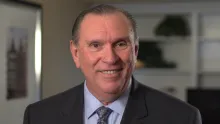
Randy D’Alessandro served as pastor for the United Church of God congregations in Chicago, Illinois, and Beloit, Wisconsin, from 2016-2021. Randy previously served in Raleigh, North Carolina (1984-1989); Cookeville, Tennessee (1989-1993); Parkersburg, West Virginia (1993-1997); Ann Arbor and Detroit, Michigan (1997-2016).
Randy first heard of the church when he was 15 years old and wanted to attend services immediately but was not allowed to by his parents. He quit the high school football and basketball teams in order to properly keep the Sabbath. From the time that Randy first learned of the Holy Days, he kept them at home until he was accepted to Ambassador College in Pasadena, California in 1970.
Randy and his wife, Mary, graduated from Ambassador College with BA degrees in Theology. Randy was ordained an elder in September 1979.
