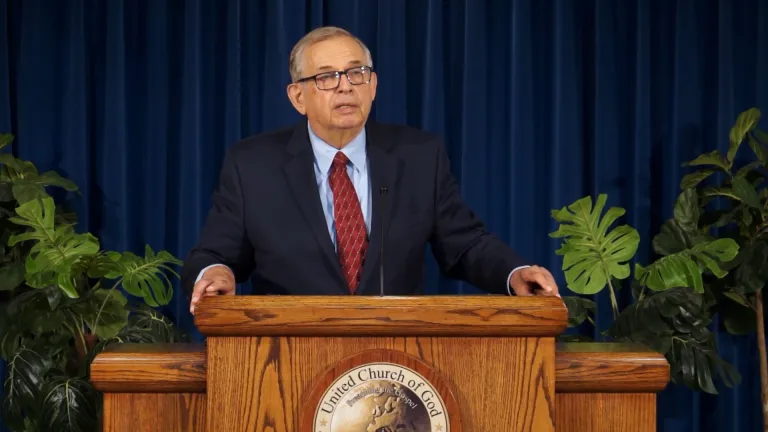

Victor Kubik
This sermon was given at the Panama City Beach, Florida 2018 Feast site.
This transcript was generated by AI and may contain errors. It is provided to assist those who may not be able to listen to the message.
Happy feast to all who are listening, viewing us online. There are many, many hundreds of people, maybe over a thousand people, keeping the feast at home, who possibly could not make it here. As they may have made it in the past, we want to be able to provide the Feast of Tabernacles for those people as well. So we are very, very happy to be here. Also, just really appreciated the special music, since it really did speak to the sermon topic that I have here today. My kingdom strong once and for all. I'm not sure if I have the words exactly right, but it repeated my kingdom strong, which was very, very beautiful. I thank the thoughtfulness for that special music today.
It's very good to see friends from long years before. I'm very happy to see Jim Lichtenstein here, who's been a friend for a long time. Going back to before, when I was a freshman at Ambassador College, and he was very kind to me. I remember very, very well his kindness. I will never forget as a student of him being very, very solicitous to freshman students. Then over the years, we have gotten to know each other even better. We have walked the Grand Canyon back and forth, and Jim was best man at my wedding 36 years ago. So it's very, very special that he was able to speak here this morning. I have very, very wonderful memories for him over the years. I just wanted to tell you about God's sense of humor first. I've been praying, God, please bring more people into the church. I would like to see more people. It's been just a very raw prayer. I would love to see growth in the church. Then I came yesterday. We came a little bit late. We had a little trouble with our door, so we left. We came here, and there was a little bit of confusion where I was to sit. There was no place to sit in this place at all. Would you believe just before services, I was out in the hallway. I had no place to sit. I thought this was a sense of humor from God. He said, you want people, you'll have people. There won't even be room for you. But I thought that just really caught my funny bone yesterday, is that when you ask for an answer to prayer, God will answer it in ways that you may not even realize. We have people here who have kept the feast for many years. I met Lola Murphy here just before services. This is our 66th feast of tabernacles. Then we have people who have kept it for the very first time. I found the feast video, the promo at the very beginning, the introductory video, of having people of all sorts in the church who have kept it for many years and people who have just kept it for the very first time, people from various ranges and stratus of life that have come into the church of God. We first of all want to thank God for this event. We praise and thank God for providing the Feast of Tabernacles for us. I also want to thank all those who have made the feast possible. There's just a lot of work that goes into organizing and making this happen. We're sort of the consumers, the ones who come at the very end and have everything all set up, the chairs and so forth, the program. I want to thank everyone. I won't name anybody because I always leave out the most important people, but I want to just thank everyone who has done their part in making this feast so wonderful. And this is a very, very special place. I do want to give a special thanks to our audio-visual crew, because oftentimes they're the ones that the only time that they get spoken to is, hey, we're not getting video, hey, we're not getting audio. And that's when they are very much noted. But they do a lot of work, especially this piece is one of the principal webcasting areas for people all around the world. We want to thank them for their technical support and for all the work they've done. A whole truck load of equipment left in Cincinnati came down here and is a crew of quite a number of men here and their families who have come here to serve in this particular way. So I do want to give a special thanks for them. I'd like to talk to you about the origins of coming to understand God, at least mine. It started in a different church and in a different language.
It started at the Orthodox Church in the Ukrainian language. My parents were immigrants, and we went to a church that was a congregation of people that had all come together from refugees from World War II. The service was mystical. We were devout. I attended every Sunday. In fact, I attended almost up to the time that I went to Ambassador College. I was serious about my religion and faith.
But on my father's and my parents' home, now we read the Bible in the Ukrainian language, and that's the language that I kind of knew it. We only spoke Ukrainian at home. My parents wouldn't allow us to speak English at home because they said, you'll always learn English. You'll learn it on the street. You'll learn it in school. But at home, we speak Ukrainian. But my father was given a Bible by his very first employer at Apple Orchard. And I remember I started looking at that Bible just out of curiosity, because it was in a different language. And I was learning English, of course, school. I was in fourth grade or so. And I picked up the Bible, and I wanted to see what it had to say. What does the Bible say in the English language? And I started reading it from the book of Genesis. And I went through chapter after chapter. All through the summer, I just studied and not studied, but just tried to read the Bible to see what stories it told. And it told me the stories about the flood. It told me the stories about Abraham. I remember so well all these graphic things that came to me. Then, about age 14 or so, I started listening to a radio program in the English language, which was called the World Tomorrow Program. And here are some of the things that were spoken of in those programs that really caught my attention, because they were quite a contrast to what I had grown up with in the church I was before. It referred to a literal return of Jesus Christ. It spoke about a millennial rule of Jesus Christ. The program itself was entitled, The World Tomorrow. It talked about a future. And it talked about the Kingdom of God over and over again. In fact, some of the passages that were very, very straightforward and very, very stark to me were such as Matthew 5.5, Blessed are the meek, for they shall inherit the earth.
And this was stated over and over again as I began to listen to the program. Now, at first I didn't listen to it. It was a program that came on K-A-A-Y, Little Rock, Arkansas, the mighty 1090, and interrupted the Ken Knight Show, which was popular music. And I basically turned it off. But then I began to hear these things, that the meek shall inherit the earth.
The meek shall inherit the earth. Blessed are the meek. And then Revelation 5, verse 10, this passage was quoted, And he has made us kings and priests to our God, and we shall reign on the earth. I thought, isn't religion all about going to heaven? Isn't it about going somewhere else from this earth? And here there are passages not spoken by this speaker, but words directly from the Bible about reigning on the earth, about inheriting the earth. And it was stated over and over again. And then in Matthew chapter 9, in the model prayer, in Matthew chapter 9, 6, I should say, Our Father, which art in heaven, hallowed be thy name. But then also, the first thing that is asked for is thy kingdom come. It's not something that's here or somewhere else, but let your kingdom come. Let your kingdom come. So already I was seeing a divergence of philosophic thought, of a very literal understanding about where we're at and who we are, and a relevant future for me. I know that I was wondering what happens to a person after they died, where did they go, and what did they see? Will they meet up with the people that they had known in their life here on the earth? Or what is it? Will we be just staring at God for all eternity? All these things troubled me at that young age. But then, when these words were spoken about the return of Jesus Christ, about inhabiting the earth, and far more, this was just the very, very beginning, it began to really make sense to me. And I began to see that what later, that what we were dealing with was a religion that was Gnostic in his thinking, which shunned the material world, and that what was taught in the Bible was very, very literal about a very, very practical, relevant world, in which we would be doing wonderful things, doing more than just staring at God or being in some type of amorphous existence, but having new spiritual bodies and being part of a kingdom. To this very day, the importance of this has remained to me as, I would have to say, the greatest truth of all. And that is the understanding of what the kingdom of God is. What the kingdom of God is.
Here's how Jesus Christ began his ministry. In Mark chapter 1, I'd like you to turn to Mark chapter 1 and verse 14, because we will see a story of clarity that I thought, this is almost too easy to understand. This does not require a theological degree. This does not require going to college for years and years. This is something that literally can be understood by anybody. Anybody who has the reading level of understanding the book of Mark, which is one of the easier of the Gospels to understand, can really see what it says just for the words that are there. Because when I began to read the English Bible, I didn't seem to be affected by all the liturgical side of where I had been before. I had a fresh new start in another language and saw it from another point of view. Mark chapter 1 and verse 14. Now, after John was put in prison, came to Galilee preaching the gospel of the kingdom of God. So we have this keynote address, we have this statement right in the beginning of the book of Mark about what the work of Jesus Christ was to be, and that he came preaching the gospel of the kingdom of God. How simple can you get? And here's what he said in verse 15. The time is fulfilled, and the kingdom of God is at hand.
So this is a reference to a special milestone in history, because here he is, Jesus Christ, God in the flesh, who will be preaching this gospel, this good news, about the kingdom of God. Then he said, repent and believe in the gospel. These two verses contain a huge amount of information.
First of all, it states that the gospel is the kingdom of God, believe the gospel of the kingdom of God. It talks about what's needed to prepare for it to be there, that you must repent, and you must believe in it, and also that the time is now. The time is fulfilled, and the kingdom of God is at hand. It's available. Now, what we do at the Feast of Tabernacles, and what we celebrate here, primarily, is the kingdom of God. So beautifully pointed out here in the special music. We are here observing, celebrating, commemorating the kingdom of God, the coming kingdom of God, thy kingdom come. And when you take a look at what the Bible has to say about that kingdom, you cannot be mistaken as to what it is and how clear it is. If you don't have a lot of cobwebs about what you had believed about it before or what filters were put on the word of God, but just straight what the word of God itself says. Now, what did that mean to people? When Christ said that the time is now, the kingdom of God is at hand, repent and believe in the gospel, the kingdom of God. What did that mean to people? What were people to think when he said, kingdom of God? What could they possibly think? Well, the only source of information that Christ could really use was, first of all, his own authority, but secondly, and perhaps equally, the scriptures, because it was the scriptures that described what that kingdom of God was. In fact, for the whole New Testament church, the scriptures were what we consider or call now the Old Testament. So what did that mean to people at that time? Now, in the time of Christ, there was a renaissance of knowledge. People knew the scriptures, or they were available. There were various sects of the Jews that professed and even argued the scriptures. So they were known. They were available. They were in the synagogues. They could be read on the Sabbath. Jesus Christ himself attended Sabbath services and would read from different scrolls. It wasn't like it was in the days of Josiah, where they even lost sight of the Bible. They had to find the Bible. They had to find the scriptures in a broken-down temple to find out even when the Passover was to be kept. Not so in the time of Christ. There was a great revival of knowledge in that period.
So what did Jesus talk about and what were some of the things that he could say about the kingdom of God? Well, you'll find it to be quite dramatic as to what he would talk about from the scriptures. Let's go to the scriptures. Let's go to Daniel chapter 2. Daniel chapter 2.
In verse 31. This is the dramatic story of Nebuchadnezzar, who had a dream and he forgot what it was. He just knew that it was very, very dramatic. And so he called in all of his astrologers and all his wise men and said, I want you to tell me what I dreamed and I want you to explain it to me. And if you don't do that, you're going to all be killed. So there was a very high motivation level, you know, at that point to tell a king to find out, get the information wherever they could about what he dreamed and what it meant. Well, none of them could figure that out. They said this was beyond their pay grade. You know, this is not what we do, except for Daniel. And Daniel was one of the counselors of King Nebuchadnezzar. To understand this is that King Nebuchadnezzar was the king of a world-dominating empire, a very powerful empire that gobbled up the Middle East, North Africa, and places all over.
He was a great king. And Daniel was one of his counselors. It's like having somebody from the church being a counselor to President Trump or to Vladimir Putin, somebody who was way up there, who was accessible to him or had the ear of that person. And Daniel certainly had the ear of Nebuchadnezzar. And so Daniel was able to decipher that dream. In verse 31, you, O King, are watching, and behold, a great image. Here's what you saw in your dream. Now think hard, Nebuchadnezzar. This great image, whose splendor was excellent, stood before you, and its form was awesome. This image's head was of fine gold, its chest and arms of silver, its belly and thighs of bronze, its legs of iron, its feet partly of iron and partly of clay. We know this story very well. This is what King saw.
You watched while a stone was cut out without hands, which came out of nowhere, which struck the image on its feet of iron and clay and broke them in pieces. Then the iron, the clay, the brown, silver and gold were crushed together and became like chaff from the summer threshing floors. The wind carried them away so that no trace of them was found, and the stone that struck the image became a great mountain and filled the whole earth. What a dream!
But he gets very, very personal now with the king. Verse 36, this is the dream. Now we will tell the interpretation of it before the king. And here's what it means. You, O king, Nebuchadnezzar, are a king of kings. For the God of heaven has given you a kingdom, power, strength, and glory.
And wherever the children of men dwell, or the beasts of the field and birds of the heaven, he has given them into your hand. You're omnipotent. You're super powerful. And as made you ruler over them all, you are this head of gold. But after that, you shall arise another kingdom inferior to yours. That's the silver one. And we know the story about the progression of kingdoms.
Verse 41, Whereas ye saw the feet and toes, partly of potters, clay, and partly of iron, the kingdom shall be divided, yet the strength of the iron shall be in it, just as ye saw the iron mixed with a ceramic clay. Now, in verse 44, it talks about this stone that came out of nowhere.
In the days of these kings, of this final part of the statue, the God of heaven will set up a kingdom. God will set up a kingdom which shall never be destroyed, and the kingdom shall not be left to other people. It shall break in pieces and consume all these kingdoms, and it shall stand forever. Now, when Christ came preaching the kingdom of God, and we'll see what he talked about it in more detail, this was in reference to what had already been written in scriptures about the genre of this kingdom. It wasn't some magic Disneyland, it wasn't some spiritual thinking, it was about kingdoms, about monarchies, about systems of government. And we get this from here because these are worldly kingdoms that are superseded by something else, not only superseded, but destroyed, consumed, and they are put in its place to rule forever and ever.
It shall consume these kingdoms, and it shall stand forever.
Inasmuch as he saw, verse 45, that the stone was cut out of the mountain without hands, and it had broken pieces of iron, the bronze, the clay, the silver, and gold, the great God is made known to the king, but will come to pass after this. The dream is certain, and its interpretation is sure. So when Christ came preaching a kingdom, it was a kingdom of these sorts, the kingdom of God versus the kingdoms of men. Daniel chapter 7 and verse 13. Daniel chapter 7 and verse 13. Here's Daniel with another dream.
I was watching in the night visions, and behold, one like the son of man, coming with the clouds of heaven. This is what Daniel sees. And we have an interesting dimension added here is that we see God the Father, and we see the one who became Jesus Christ. We see two aspects of the deity. He came to the ancient of days, and they brought him near before him, that to him was given dominion and glory and a kingdom, that this one was given all this by the ancient of days, that all people, nations, and languages should serve him, a universal kingdom over the earth. His dominion is an everlasting dominion. It's not just another reign of kingdoms, another dynasty, not another nation, but something that will last forever, which shall not pass away, and his kingdom, the one, shall not be destroyed. So people in Palestine, in the time of Jesus Christ, knew these passages. They were known by the learned people, not only here, but in many other places.
It gets even better in Daniel 7 verse 18, because not only do we have the kingdom being given to the Son, or to the one who came before the ancient of days, but the saints of the most high shall receive the kingdom and possess the kingdom forever, even forever and ever.
It's quite universal. It's quite all-encompassing. Okay, let's move away from Daniel. Daniel is one that's ultra-clear, because here we have an advisor, a counselor to the most powerful person on the earth at that time, Nebuchadnezzar, and he explains to Nebuchadnezzar what's going to happen. A progression of kingdoms. Not only a progression of kingdoms, but at the very end that there will be one who will come and crush them, this stone that appears out of nowhere, and will then overtake the world as the mountain, and it will rule forever and ever. You know, when I was reading this in the earliest, I thought, this is yet future. This is talking about what's going to happen to this world, world's kingdoms. And that's what was so exciting to me. This was so exciting to me, because it was something that would continue on forever and something that made sense. It was relevant. Isaiah chapter 9, and Isaiah is the prophet that's sometimes called the fifth gospel, because there are so many Christological references in the book of Isaiah to Jesus Christ. In fact, oftentimes when you read through the book of Isaiah, you know, you have the Messiah oratorio going through your head, because so many of the references and arias in the Messiah are from the book of Isaiah, about Jesus Christ, the Messiah.
Here's one of them, Isaiah chapter 9 verse 6. For unto us a child is born, unto us a son is given, and the government will be upon his shoulder. Not going to come as a religious person, not going to come as a force of ethics or philosophy, but the government will be upon his shoulder. And his name shall be called Wonderful Counselor, Mighty God, Everlasting Father, the Prince of Peace. Then here he corroborates and supports what Daniel said in verse 7, of the increase of his government and peace, there will be no end upon the throne of David and over his kingdom. To order it and establish it with judgment and justice from that time forward.
That's wonderful. This was a government. This is another monarchy. It's talking about people like David talking about kings. In the book of Isaiah, we can take a look at more glimpses of that kingdom. Isaiah 11, verse 9. These are passages that I'm reading here. They probably will be read again during the Feast of Tabernacles, but they are so relevant because they talk about the kingdom that we're celebrating. They shall not hurt nor destroy in all my holy mountain, verse 9, for the earth shall be full of the knowledge of the Lord as the waters cover the sea. That stone that came out of nowhere will fill the whole earth and it will be something which will give knowledge of God that has not ever been given before. And you find out who that comes from. Verse 1 of that same chapter, there shall come forth a rod from the stem of Jesse, and a branch shall grow out of his roots. The spirit of the Lord shall rest upon him the spirit of wisdom and understanding, the spirit of counsel and might, the spirit of knowledge and of the fear of the Lord. It talks about here a illustration about Jesus, about the kind of world that we're going to be in. With righteousness, verse 4, he shall judge the poor and decide with equity for the meek of the earth. He shall strike the earth with a rod of his mouth, that's that stone that's coming, to bring order, and with the breath of his lips he shall slay the wicked. This is hope for the future. This is that world that will be destroyed. It won't be reformed. It will be completely changed in this manner. It'll be complete, final, and everlasting what will take place.
And the basis of it, of the future, verse 5, righteousness shall be the belt of his loins, and faithfulness the belt of his waist, and describes a world with an entirely different nature. The wolf for six shall dwell with the lamb, the leopard will lie down with the young goat, the calf and young lion and the fatling together, and a little child shall lead them, as we had it in the world tomorrow in our seal for many, many years.
Isaiah 25. There are so many references about this mountain, about this person of righteousness. Unto us a child is born. Verse 6 of chapter 25. Isaiah 25, verse 6. And in this mountain, again, that mountain which was the stone that the mountain became, the Lord of hosts will make for all people a feast of choice pieces, a feast of wines, of leaves. Full of marrow, well-refined wines and alleys. Verse 7. He will destroy on this mountain the surface covering cast over all people, and the veil that is spread over all nations.
Now, right now, this world is completely in the dark. You know, it's just amazing how darkened people's understandings are. That'll be removed, scraped off, who people will be able to see through the haze. You know, there are 100 million Bibles produced every year. 25% of them, that's 25 million new Bibles issued in the United States alone. Now, if we could have a book that produces and is published 100,000 copies or 50,000 copies, what a success story! 25 million new Bibles go into the public every year in America and 100 million around the world in 80,000 different versions and translations. And yet, still, with all this, there's a veil over people understanding Scriptures that you and I understand. I do not apologize for understanding this. I am thankful to God that He's made these very, very clear statements understandable.
I praise Him all the time for the understanding that He has given the Church, all of us, about our future. I praise Him for that. In Revelation chapter, oh, let's see here, verse 8, He shall swallow up death forever, and the Lord God will wipe away tears from all faces, the rebuke of His people He will take away from all the earth, for the Lord has spoken. This is quoted in Revelation 21, verse 4, and we often read this at funeral services. And it will be said in that day, Behold, this is our God, we have waited for Him, and He will save us. This is the Lord. We have waited for Him, and He will be glad for us. And He will be glad and rejoice in His salvation.
This will be indeed the salvation of civilization. Right now, the doomsday clock is well within the first minute of 23 hours and 59 minutes of this birth being blown to smithereens. It really is. This world is very, very close to its end. With all the rulers that we see, all the nonsense that we see, you can't even watch the news anymore. I can't stand either Fox or CNN. Neither one. They just make me very, very tiresome. I have to turn to Sky News in England, and even them. They're blasting people here in America. It's just accusation after accusation of people, leaders, is no longer enjoyable just to sit down in the evening to watch the news. Because all you see are people arguing and people sharpening their knives against the other group. This will be the salvation of civilization, this kingdom that's coming to this earth. Revelation 11, verse 15. Tying together Daniel, tying together Habakkuk, tying together Isaiah, tying together what all the prophets have predicted. We have Revelation 11, verse 15.
Then the seventh angel sounded, and there were loud voices in heaven, saying, here's the grand finale. The kingdoms of this world have become the kingdoms of our Lord and of His Christ, and He shall reign forever and ever. Now, does it take rocket science to be able to equate this with Daniel 2? I mean, if I can understand it as a young person and you can understand it after reading Bible study courses in our booklet on the gospel of the kingdom and just take it at face value, do you understand what this is about and what this means?
And not that this special knowledge makes us special in any way. It should make us humble about what God has revealed to us and made so very clear to us and make us grateful, making us grateful that gratitude leads to hopefulness.
So many people are totally lost. They're under this haze, this covering, this veil that's cast over the earth. In Jesus' time, Palestine was ready for our Messiah. As I said, there was a resuscitation of knowledge. They knew what Haggai said, the desire of all nations is coming.
But of course, they didn't realize how he was coming or that there would have to be a time period before he would return that it was only his first coming. There were unsuccessful revolts, people who took it upon themselves to break away from Rome, oftentimes basing it upon the scriptures, saying it's time for that event to take place. They rose up unsuccessfully. But we'll see what Jesus Christ actually did.
Christ taught in his ministry, which we'll see, was about the kingdom of God. It started with what we read in Mark 1, verse 14. Time is now, time is at hand, but the kingdom of God is at hand. Repent and believe the gospel. In Matthew, in Luke chapter 6, he starts with his parables. Jesus Christ taught parabolically. He actually spoke 31 different parables, most of which were about the kingdom of God, to do two things, to provide insight to his disciples about what that kingdom was, and still be a cover, because the time was not yet for the general public, because to them it was not given to understand. But in Luke chapter 6, verse 20, he talked about attitudes, the Beatitudes. He said, blessed are you poor, for yours is the kingdom of God.
The Old Testament taught what the kingdom was. The New Testament taught what attitudes are needed to be in that kingdom. It taught a lot about the workings of the kingdom, what needs to be in our minds. But what the kingdom was, was explained already and revealed in what we had to take a look at, at just the tip of the iceberg of the scriptures of the Old Testament. The passage already quoted in Matthew chapter 13, which contains, well, pardon me, Matthew chapter 5, which is the Beatitudes. Blessed are the meek, for they shall inherit the earth, the earth. And that's verse 10 of Matthew 13.5, I should say. Blessed are those who are persecuted for righteousness' sake, for theirs is the kingdom of heaven. Matthew uses the term heaven because it was of heaven, kingdom of heaven, that came from heaven, but it was the kingdom that would be given to those who inherit the earth. The New Testament said it was accessible, that it was at hand, and what you needed to do.
The purpose of the parables, which was an important part of the teaching of the kingdom of God, Jesus reveals to his disciples in Luke chapter 8 and verse 9. Luke chapter 8 and verse 9.
Then his disciples asked him, saying, what does this parable mean?
And he said, to you it has been given to know the mysteries of the kingdom of God. And I can say that to you here, to those who have God's Holy Spirit, who came here and gave up time, at great expense, to be here with others of like mind, you came here to understand more deeply the mysteries of the kingdom of God, and we're giving them to you. The Bible gives them to you. What we're doing is celebrating that kingdom of God, the most important event of the future.
You know, I regard, you know, we talk about various things that we have come to learn, and various truths that we have come to esteem as life-changing truths. To some it's the Sabbath, in the Holy Days. To some it's understanding the meaning, the truth about what happens after death. You know, many things. But you know, to me, I'll have to say that the greatest truth has been the understanding of what the kingdom of God is. You know why? Because it encompasses all of that. It is the gospel. It is the good news. It encompasses what this world will be like. It's the salvation of this world. It's giving us a road map of the future from this world. It talks about our life beyond this, when there'll be no more tears, no more death.
It talks about it being something forever and ever. It's the most beautiful truth of all, and I praise God continually for it. And to us, it's been given to know the mysteries of the kingdom of God. This is knowledge that your neighbor does not know, cannot know until God takes away the veil of ignorance for their minds, something that they have no control over at this time. Now, if we say, why don't they get it? Why don't they get it?
You know, if we gave you just blinders, we say, why can't you see it? It's because you can't see. There's no eyesight. They're not able to visualize it.
And that's what this world is. It's in darkness. And we are very, very privileged to be, having been called out of that, out of that murkiness, out of that murkiness, out of that fog, into a higher level of understanding to where we can see that kingdom of God.
In Matthew 13, Jesus spoke seven parables about the kingdom of God. To me, these parables are fascinating because they illustrate very, very important aspects about just the workings of it. Even the proclamation of the kingdom, what happens when we do proclaim the kingdom, explains why things are the way they are even when we, as a church, the United Church of God, proclaim this kingdom. The very first of the parables is about the sower and the seed. When the word of the kingdom, I won't go through them in detail, when the word of the kingdom is spread that some of it falls on good earth, but a lot of it falls outside of the good earth.
And Satan comes up and snatches up the seeds. They don't even have a chance. And most of what we preach are to people who don't have a chance. It's out there. When we have a public appearance campaign, we send out letters to all of our Beyond Today readers, and if we can have one and a half to two percent of them show up to a public appearance campaign, that's the norm.
That's how many show up. Ninety-eight percent get the same letter. But for whatever reason, they're just not ready. But the two percent are the ones whose minds are prepared. It's the good earth that stuff is germinating in their mind of the things that are most important. Then the parable goes on to talk about two other applications of the sower and the seed. Then there's the parable of the wheat and tares. I love this parable because it explains a lot of things, basically even in my work.
We have congregations. We have wonderful people. We have people that look good. We have people who are good, you know, and so forth. And there are, you know, a terror was something that looked like wheat and grew like wheat, and it wasn't until almost harvest time that you could tell there's nothing there. And we might say, well, let's get rid of them now, that they're taking up ground.
Oh, no, no, no, no. If you tear up with tares, you might tear up a lot of good wheat with it. And so there's some operating and strategic things that Jesus Christ was telling about how to work with tares. I know full well that in the church not everyone is a good stock of wheat, but we're patient with those who are not. And God will separate at some time in the future. The wheat and the tares, a very interesting strategic parable about those who hear the word of God.
There are some who are here, who nod, take notes, and so forth, but don't have the foggiest of what we're talking about as far as coming to application in their personal life. Then there's a parable of the mustard seed of something that starts out very tiny and very, very small, but grows and fills the whole universe. The kingdom of God will eventually fill all in all.
There will be no part of the universe that will be a zone without the kingdom of God. He has another parable, a parallel one with it about the leaven. It's that when you put leavening into dough, it leavens the whole loaf. There's no part of the loaf or the dough that is unleavened after you put leaven into it. This is a good application of leaven. So the kingdom of God is going to spread and permeate everything of what the universe is. There'll be no special zone. Right now, this is not the kingdom of God. This is not the kingdom of God where we live, this planet. That's why we pray every day and are told to pray every day, thy kingdom come.
Why do we say that? Because it's not here. And we're asking God to bring that kingdom as far as our prayers are concerned, to prepare for it, to do our part.
There were two interesting parables after that, denoting value. The parable of the treasure hidden in the field and a merchant who sought pearls of great price. Both of them are about value. Both of them are about the kingdom of God as being something that's very valuable, but the treasure is something that you stumble upon. Here you are looking to buy land, and all of a sudden you find this big treasure chest of money in it, and you say, whoa, I better buy this piece of ground, because there's something very valuable there. You stumble upon it. It's unexpected.
Many of us came into the truth because it was totally unexpected.
Then there was a merchant who was seeking pearls of great price. Well, let's see, I want to buy something really nice. I'm going to buy something really nice. Not this one. No, not that one. Oh, here's what I want. And so he sells everything he's got, and he puts it upon that pearl, because it's the most valuable thing of all. He's found it. Valuable to him. Which were you? Did you stumble upon the truth? Or was it something that you were seeking? I would really like to know.
Actually, you can tell me. I put a poll up today on my Twitter feed. After services, if you could kindly go to my Twitter feed, which is Victor Cubic, one word, and I have three choices. I want to find out if you stumbled upon the truth, or if you sought it, according to this parable. Or was it both? So Victor Cubic, go to my Twitter feed. I want to hear from you. I want to hear what the difference is in the two. And there were other parables as well. Jesus Christ also gave parables where he illustrated the kingdom of God by talking about little children, which interestingly enough, Mark chapter 10, we have the blessing of little children right after the Feast of Tabernacles. In fact, the blessing of little children was done at the Feast of Tabernacles until the Feast became not as convenient a place to do the blessing of little children. It was decided to do it back in the local congregations after people returned from the Feast. In a sense, it really has to do with the meaning of the Feast and what Jesus said about little children. Mark chapter 10 and verse 14. 13. They brought little children to him that he might touch them, but the disciples rebuked those who brought them. But when Jesus saw it, he was greatly displeased and said to them, Let the little children come to me, and do not forbid them, for of such is the kingdom of God. Children represent certain very, very pristine attitudes of humility, of reverence towards parents, towards faith in their mom and dad, the way that we should regarding the kingdom of God. One of the greatest things about this Feast for us is that we're keeping it as a family. My son, daughter-in-law, and four grandchildren are with us. And boy, do I enjoy that. Just enjoy those two little boys, six years old, twin boys, just romping around, you know, and just talking. I hear the goofy little things they say, you know, they're just so innocent. They're wonderful. Maybe not as innocent as me. But anyway, it's good enough, you know. Anyway, of such is the kingdom of God. I do enjoy my two granddaughters as well, age 13 and 11. I just really do enjoy them. I really do see a spirit in them that God is looking for in us spiritually. Assuredly, I say, verse 15, to you, whoever does not receive the kingdom of God as a little child will by no means enter it. Pretty strong words. Pretty strong words. Another example. In fact, we could go to many because the Gospels, the three synoptic Gospels in John speak about the kingdom of God. Mark 12, verse 33, about the scribe. One of the scribes came, having heard them reasoning together, perceiving that he had answered them well, asked them, which is the greatest commandment of all. Jesus answered, the first commandment is to hear O Israel, Lord your God, you shall love the Lord your God with all your heart, with all your soul, with all your mind, with all your strength. This is the first commandment and the second one as well.
And the scribe said to him, Well said, teacher, you have spoken the truth, for there is one God and there is no other. And then Jesus responds to him because the scribe was very, very understanding of these principles. Now when Jesus saw that he had answered wisely, he said to him, You are not far from the kingdom of God. You are not far from the kingdom of God.
So these are things that were taught attitudes in preparing for the kingdom of God. So Jesus Christ, central theme and primary purpose of his ministry was to proclaim the kingdom of God, the literal coming of a new world order that would replace this world's orders. It would combine politics and religion in a way that will be amazing and will really solve this world's problems. Nothing else will. Nothing else will. Do you think that Donald Trump will solve this world's problems?
You know, people jump at leaders because they have some things that they do that are bravado and seem to be like the right values, but then they create other problems. And this world is so dangerous. This world is so dangerous it could come apart very, very quickly. And it will, except for that intervention by God to keep this world from destroying itself. No flesh would be saved alive. So this was a message that Jesus Christ lived for, but also was a message for which he died.
This is very important to understand about what happened at the end of his ministry. Why was Jesus Christ killed? Was it because he was a person who healed people, fed masses, and spoke wonderful things that were very interesting and even charismatic to hear, to where people would follow him for miles to have him speak. He truly was an amazing teacher who taught mostly, well, a lot by parables, but also very, very direct teaching and referred many times just from the references we have in the New Testament to the scriptures. John chapter 18 in verse 33. We have a confrontation between the government of God and the government of man. John chapter 18 in verse 33. This is after Jesus was already betrayed, had already been brought before the local leaders who knew that they could not kill him as much as they hated him and were jealous of him. But then in verse 33, Pilate entered the praetorium again, and Pilate had to handle this political situation extremely carefully. Jerusalem was a major city. He did not want a revolt. He did not want trouble in Jerusalem.
The big Roman armies were up in Antioch and in Egypt. Jerusalem did not necessarily have a huge Roman garrison like Antioch or Egypt. So he had to handle this very, very carefully.
And so he basically sticks with the basic points of civil law. Pilate entered the praetorium again, called Jesus, and said to him, Are you the king of the Jews? He didn't care about anything else Christ did. Are you the king of the Jews? Because this would mean that he was in opposition to the Roman king. Jesus answered him, Are you speaking for yourself about this, or did others tell you concerning me? Jesus answered, Am I a Jew? Your own nation and the chief priests have delivered you to me. What have you done? Obviously, this is what they had told Pilate. Hey, this person is trying to fight against you. We're of Caesar. They were hypocrites. We're of Caesar. Look, he's against you. But that wasn't the reason that they wanted... Their real reason was to kill Jesus because they hated him. But they wanted only the Romans could do that. But Jesus answered and said, My kingdom is not of this world. If my kingdom were of this world, my servants would fight so that I should not be delivered to the Jews. But now, my kingdom is not from here. Pilate therefore said to him, Are you a king then? Let's get back to the same... Let's get back to the basic question here. You a king, Jesus answered and said, And no more parables now. Turn off the parables. Turn off anything that was to be clouding the meaning. This is strait talk. You say rightly that I am a king. For this cause I was born, and for this cause have I come into the world, that I should bear witness to the truth. Everyone who is of the truth hears my voice. These words were pure sedition to Pilate or to the Roman law at that time, to proclaim yourself as king. He didn't proclaim himself as I'm just part of a new movement. We're just trying to follow Old Testament scriptures on how to obey the commandments. No, I'm a king. It's for this purpose that I was born, and this is why I am here. This is the great confrontation here between the world's governments and the government of God, right there in the very last day of Jesus Christ's life. In John 19 and verse 14, it was a preparation day in the Passover, about the sixth hour, and he said to the Jews, Pilate, behold your king. It was said with sarcasm, but at least it was something that could be noted in the record. We've got another seditious movement. Here's your king, and this is why he will die. This is why he's going to be crucified. In verse 19, Pilate wrote a title. He wrote it in his own hand or secretary as to the sentencing and purpose. And put it on the cross, and the writing was, Jesus of Nazareth, the king of the Jews. Christ died as a king.
He came to this world to be a king. He came to this world to teach the kingdom of God. He came to teach Daniel 2, Daniel 7, Isaiah 9, and many, many other places about the kingdom of God. Christ died because he preached about God's rule over the earth, taking over the rule of this world. After Christ's resurrection, the message was the same. Acts 1, verse 3. This is a very interesting one. Jesus of Christ appeared, Acts 1, verse 3, to whom he also presented himself alive after his suffering by many infallible proofs.
Being seen of them during 40 days and speaking, what did he speak about during the 40 days that he was on the earth? He spoke of things pertaining to the kingdom of God, for which he just died.
Verse 6. Therefore, when they had come together, the disciples, it was Jesus, they asked him, saying, Lord, will you at this time restore the kingdom to Israel? What were they asking? Israel was a government or it was a nation under the control of the Romans. They used to be a nation. They wanted to be their own independent nation again. And they were telling Christ, after three and a half years of ministry, is it time now to have Israel restored as a nation?
You know, Christ said, look, you don't get it. I'm talking about starting a religion, a movement, a spiritual, whatever, church.
No, Christ didn't correct them at all for that. He said instead, verse 7, he said to them, it is not for you to know times or seasons which the Father has put in his own authority. He says, no, it's not for you to know when it's going to happen. But what was going to happen was sure.
He didn't stop their understanding on them. The early New Testament church, here we could go on to many references to this kingdom of God. Verse 12, this is when Simon was baptized and when Philip went up to Samaria, when they believed Philip as he preached the things, concerning what? What was the preaching of the New Testament church? Concerning the kingdom of God and the name of Jesus Christ, obviously, who's bringing that kingdom, who'll be king of kings, both men and women were baptized. Both men and women were baptized as a result. There is no subject that I enjoy speaking about more than the kingdom of God in these terms. Next week, or a week and a half from now, we're going to India in Sri Lanka and we'll hold four or five kingdom of God seminars. You know, I love speaking about this subject. I love speaking about this subject to new people, new people who are tired, who are lost, whose fog is coming off of their minds, and to tell them about the very clear message of the kingdom of God. There's nothing more powerful. And it's this message that brought these converts, these newly baptized people, into the church, into becoming disciples here. Acts 19, verse 8. This is the workings of Paul at Antioch. He went into the synagogue, the Ephesus, and spoke boldly for three months. And what did he talk about when Paul was in Ephesus? Reasoning and persuading concerning the things of the kingdom of God. That's what Paul was doing. It's so sad about Gnosticism that came in that shunned the physical and moved off into something else and occluded the meaning of what the kingdom of God was. Acts chapter 20, verse 25. Indeed, I'll just quickly read them. I've got to move along more quickly here to finish. And indeed, now I know that you all, among whom I have gone preaching, this is a farewell message to the Ephesians, elders, whom I have gone preaching, the kingdom of God will see my face no more. That's where Paul had worked for three years. What did he do? He taught about the kingdom of God. And the very last chapters of the book of Acts, what are they about? What's the subject that's spoken of here? Acts chapter 28 and verse 23. So when they had appointed him a day, many came to his lodging. This is the Apostle Paul under house arrest in Rome. And this is not long before he was martyred. So when they had appointed him a day, they came to his lodging, to whom he explained. And what did he do? He solemnly testified, this is in Italy, of the kingdom of God, persuading them. And what was the source of information concerning Jesus from both the law of Moses and the prophets from morning till evening? He used what we know as the Old Testament to preach the kingdom of God. And if you talk about the Old Testament, you can't get away from Daniel. You can't get away from Isaiah. You can't get away from the powerful message about King David who began his throne, the 12 apostles. It's a fantastic message of a new world. It's a hopeful message. It's a wonderful message. And it's one that we are celebrating here at the Feast of Tabernacles. He's made us kings and priests, and we will rule on the earth. So when Jesus Christ was here on the earth, when he spoke in his famous Sermon on the Mount, he said, seek ye first, what?
The kingdom of God and His righteousness. That's the message. What did Christ say? Seek ye first, the kingdom of God and His righteousness. The kingdom of God from the Old Testament. Righteousness is what qualifies us, is what makes us available, makes us ready for that kingdom, because it'll be a kingdom of righteousness that will truly solve this world's problems.
And all these things will be added unto you. Let's be praying, thy kingdom come. I truly love the Church and the people that are in it, all of you. I look upon you as people who faithfully lived in this very, very corrupt world that is not the kingdom of God, who are seeking daily the kingdom of God, who have come here to celebrate the kingdom of God, who have come here to reinforce that knowledge of the kingdom of God as the central theme in the gospel of Jesus Christ. Grace and peace from God our Father, the Lord Jesus Christ, to all of you.

Active in the ministry of Jesus Christ for more than five decades, Victor Kubik is a long-time pastor and Christian writer. Together with his wife, Beverly, he has served in pastoral and administrative roles in churches and regions in the United States, Europe, Asia and Africa. He regularly contributes to Church publications and does a weekly podcast. He and his wife have also run a philanthropic mission since 1999.
He was named president of the United Church of God in May 2013 by the Church’s 12-man Council of Elders, and served in that role for nine years.
