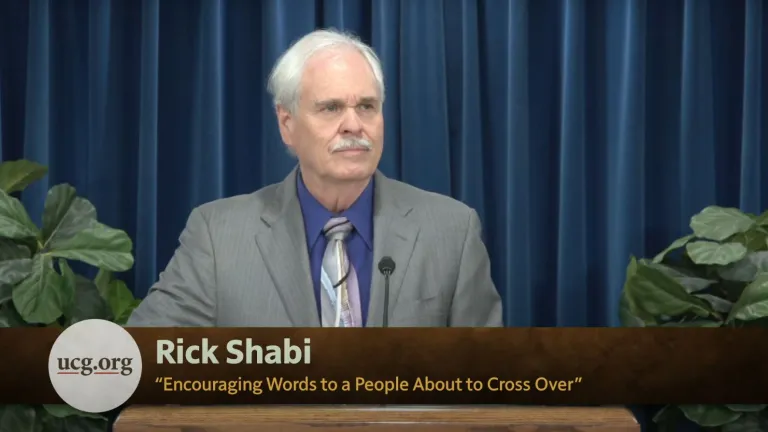

Rick Shabi
This transcript was generated by AI and may contain errors. It is provided to assist those who may not be able to listen to the message.
Well, we just observed the Feast of Trumpets. The Feast of Trumpets can have a lot of harrowing information in it. As you look at what the world is prophesied to go through before the trumpet plagues of God, what Satan puts the world through as he exacts his vengeance and does what he can to upend God's plan and destroy mankind, we can be left with the Feast of Trumpets with a lot of angst.
At the end of it, we know that the tremendous rejoicing comes from the fact that Jesus Christ will return, and that he will put an end to all the misery, strife, and devastation that the world is going to go through. Mankind, as we'll talk about on the Day of Atonement, will be humbled, they will be afflicted, they will know that they have beaten, they may not know exactly and immediately who has returned to defeat them, but they will know very soon as Jesus Christ, and they'll know him as a merciful, loving, compassionate God who is there to make their lives better.
And a whole new age will begin, as we mentioned. I mentioned on the Feast of Trumpets that there's just so much to talk about that you can't possibly get all the verses in that you want to talk about on the Feast of Trumpets. So today I want to open with just a few as I introduce what I'm going to speak about today, because it'll flow right into it. So turn with me, if you will, to Matthew 24. And we'll kind of pick it up where we left off on the Feast of Trumpets with Jesus Christ returning.
Jesus Christ returns at the seventh trump. The saints, the first fruits are resurrected at the last trump. And in Matthew 24, Jesus Christ talks about his return to earth, and he puts it in a very colorful way, if you will. If we look at verse, the right chapter here, Matthew 24, verse 27, he talks about his return. He says, For as the lightening comes from the east and flashes to the west, so also will the coming of the Son of Man be.
Well, you can picture what that's talking about. As you see lightening and it goes from east to west and it lights up the sky. And if you've seen and you've seen magnificent lightening, you just know what a dramatic and a beautiful sight it is. Well, Jesus Christ says, as he returns, he will be lighting up the sky from east to west like the lightning is there. Mankind will see it. They will know something is happening.
They may not know it's Jesus Christ. Will know it's Jesus Christ, but they may not know that it's Jesus Christ. But he will be there and he will all it says in verse 30, The sign of the Son of Man will appear in heaven, and all the tribes of the earth will mourn. Something is happening. They see this light going from east to west. They see Jesus Christ. They see these saints, the armies that it talks about in Revelation 19. They're with him. All the earth sees what is happening.
They don't know what's going on. All they know is that they are being invaded and something is there. They don't know the truth. They don't have the joy that we have by knowing what that is when Jesus Christ returns. All the tribes of the earth will mourn and they will see the Son of Man coming on the clouds of heaven with power and great glory. Just as he ascended into heaven, it says in Acts 1, so he will return.
Jesus Christ himself gave us a bit of a picture of what it's going to be like when he returns to earth, as pictured by the Feast of Trumpets. If we go back to the Old Testament, the prophecy in Isaiah, Isaiah 66, it speaks of Jesus Christ's return as well. The tribes of the earth will mourn, and indeed Jesus Christ will be there to confront, attack, and decimate.
The armies of the earth that are there to challenge him, to battle him. It talks of that in Isaiah 66, verse 15. It says, Behold, the eternal will come with fire. He will come with his chariots, like a whirlwind, to render his anger with fury and his rebuke with flames of fire. For by fire and his sword, the eternal will judge all flesh, and the slain of the Lord shall be many.
Of course, we can think back to Revelation, where it talks about how deep the blood will be and what will be the result of mankind fighting, fighting against Jesus Christ. And many of them may well know who they're fighting against, but they have set their minds just absolutely against the return of Jesus Christ. Zechariah 14. Zechariah 14 speaks of this as well. 14, verse 3. Then, then the eternal will go forth. He will fight against those nations as he fights in the day of battle. And in that day, his feet will stand on the Mount of Olives, which faces Jerusalem on the east, and the Mount of Olives shall be split in two, from east to west, making a very large valley.
Half of the mountain shall move toward the south, and half of it toward the north, and half of it toward the south. Down at the bottom of verse 5. Thus the eternal, my God, will come, and all the saints with you. That's you and me, if we endure to the end. If we do what God says to do, if we yield to him the way he says to yield, he will come, and his saints will be there with him. In the very last chapter of the New Old Testament, Malachi 4.
Malachi 4, verse 1, it speaks of that day that Jesus Christ will return as well. Malachi 4, verse 1, for behold the day is coming, burning like an oven, and all the proud, yes all who do wickedly, will be stubble.
And the day is coming which shall burn them up, says the Lord of Hosts, that will leave them neither root nor branch. But to you who fear my name, the Son of Righteousness shall arise with healing in his wings, and you shall go out and grow fat like stall-fed calves.
Christ will come. When he comes, he's not coming to destroy. He will destroy that army that's assembled there, but he is coming to heal the earth, to heal the earth physically, and to heal the world spiritually. And there will be that new age that we talked about that you and I will be part of where God will be teaching. We will be teaching people how to live the way of peace, joy, happiness, the very way of God, the way the very way of life that God expects us to be living now.
In verse 4 of Malachi 4, he tells us what to be doing in that regard. He says, Remember the law of Moses, my servant, which I commanded him in Horeb for all Israel with the statutes and judgment. As you see this day coming, and unless we have our heads buried in the sand, we see the day coming. Remember. Remember the law of Moses. Where's the law of Moses? Well, indeed, it's not Moses's law. Moses recorded for it. It is in the books of Exodus, Leviticus, Numbers, and Deuteronomy, chiefly Deuteronomy, which literally means repetition of the law.
It's where Moses was standing with the people of Israel before he would die, and right before they crossed over from the wilderness that they'd been wandering for 40 years until the time they were going to cross over into the Promised Land. The very precipice of time that you and I are on. We are here at the end of this age. I don't know how many years. I don't know how many months. I have no idea how far before the return of Jesus Christ and everything that God will bring about. But we know that we are living in the end of times. We know that we are at the beginning of sorrows.
When you read the Bible, it's crystal clear we're in these times where things are just multiplying one upon another, marching toward the prophesied end of time. We are here at the end of this age, and you and I are about ready to cross over to the time of the next age. The age of the Millennium. The age of God's Kingdom. The age where men will learn God's way. And as we are on that same precipice that Israel was on at the time of Deuteronomy, when Moses spoke those words recorded in Deuteronomy, we're in the exact same time.
And God tells us today, remember, remember the law of Moses. So today I want to talk about the law of Moses, which is really the law of God, as recorded in Deuteronomy. You know, last, seems like long ago, but last week and last couple weeks we've been in the book of Deuteronomy. We've talked about some of the end chapters in Deuteronomy and the foundational prophecies that are there on which every other prophecy in the Bible is built. God gave Moses that. He gave it as a record. He talks about the latter days and what we should do. But the other part of Deuteronomy is all foundational for our, for us as well.
I want to go through that today because God says, remember, remember that law. Remind yourselves of it. And sometimes we can go through life and life can be good and we can kind of big into just, just get away from it a little bit and get away a little further.
It's time for us to go back and look at that again. Bert mentioned in his sermonette an assignment that I gave at the end of last week's Sabbath service. It was recorded where God said in Deuteronomy 31 verses 10 and through 12, He said, every seven years at the Feast of Tabernacles, read this book.
Read the book of Deuteronomy. We won't read it at the Feast of Tabernacles in services, but it is our job to do what God said. And before the Feast of Tabernacles is over, to go back and read that book. You know, I haven't been able to get my mind off of Deuteronomy for a few weeks. As you have the the sermons we've given before, and as I was preparing this week's sermon, I could only go back to Deuteronomy as we, as Debbie and I, have been reading through the book of Deuteronomy.
I thought, I've got to talk about Deuteronomy. There's just so many things in there I want to highlight that this is a 21st century book. It's not an Old Testament book. It's as much for us today as it was for the children of Israel. That's why God said, remember it. You know, as I was putting this together and I was writing down some notes, it came back to my mind.
I thought, you know, I've given a sermon on this before. A sermon like that. But it also came to my mind that, you know, I never put that in the computer. I never, you know, usually I'll have my little verses and scriptures and a few notes that I put down to a computer, and I knew I never wrote that one in the computer.
I hand-wrote it like I do the Bible studies that we do on Wednesdays. So I knew I wasn't going to be able to find it, but I thought, you know what? We do have this YouTube archive. I didn't remember when I gave the sermon, but I remembered what the title of it was. And so, you know, Burt was mentioning some of the resources that we have. This YouTube channel that we have locally is a very good archive of every sermon that's been given in Orlando really since the time we started the YouTube channel.
So I went back through that, and I found that sermon. And I don't usually listen to my sermons, but I thought, I want to know what I said. I want to know what I said in that sermon back then. So I listened to it. And I, you know, I listened to it. And I was very surprised at the end of it, because at the end of it, there was something that I didn't remember saying before. And that was, before you come back from the Tease of Tabernacles, read the book of Deuteronomy. Deuteronomy 31, verses 10 through 12, says, every seven years, read the book of Deuteronomy before you go to the feast.
I was surprised I had said that. I didn't remember that. You know when I gave that sermon? Exactly seven years ago. Exactly seven years ago. I think God wants us to look at the book of Deuteronomy, and I think He wants us to pay attention to what is in there. The time is now for us to go back to the foundations of who we are to be, how we're to be living, what we're doing, and measure ourselves in our daily lives, our daily thoughts, our daily activities, the choices that we make, I guess what God says in this book.
It's the foundation of life. So I'm not going to go through all the book. I'm going to highlight some verses because as you go through the book of Deuteronomy, as you go through, you will be struck too that there's many things that are in this book that are really do testament concepts. They're not at all anything that the ancient nation of Israel would have understood, even when Moses said it. Today we understand it because we have the benefit of being on the other side of 6,000 years of human history. Today we have Jesus Christ who is the Savior.
We have repented. We have him baptized. We do have God's Holy Spirit, so we can understand these things that ancient Israel wouldn't, but when you read the words that God has said, it is clear that he instructed Moses and has reserved for us. This is a book for you and me today. So let's go back to Deuteronomy. Let's begin in verse chapter 4.
Deuteronomy 4. You know, I should mention, too, in line with the seven years that God said, read this book every seven years. It ties it to Deuteronomy 15, which is the year of the release of debts, something you can contemplate as you are reading through the book. And let me remind you again, as you read this book, don't just read it to fill in the time or just to check off the box that you've done it. You will get nothing out of it. Let God lead you through it. Look at the words. Contemplate the words. You know, don't wait until, you know, the Tuesday or the last day of the feast and read 31 chapters and think that you're going to get anything out of it at all. Take the time. Take the time to let God speak to you through his Spirit as you read. Okay, Deuteronomy 4 verse 1. Now, remember when he says Israel, where he's talking to us today, right? So we will, we will just, as we read Israel, he knows he's talking to you and me, all the 21st century Christians here who are standing on the brink of crossing over into another age. Now, O Israel, listen to the statutes and the judgments which I teach you to observe that you may live and that you may go in and possess the land which the Lord God of your fathers is giving you. You want to go over that land? You want to cross into that land? You want to be in God's kingdom? This is what you've got to do. There's no choice. There's not multiple options. This is what you do, what God has given us to do in clear instructions. He says, you shall not add to the Word which I command you, nor shall you take away from it, that you may keep the commandments of the Lord your God which I command you. Several times in Deuteronomy, he'll say, do what I say to do, don't add to it, don't take away it from it. So you read through it. You might think, why does God keep repeating that? And as I go through some verses today, you're gonna play, say, why does he say that? He's already said it. Well, bear in mind, God will repeat things because he wants us to get it through our heads. It is something we have to do. So as you go through the book of Deuteronomy, you're going to see repeat phrases as Moses, who was speaking to the children of Israel, and then God recorded this, reminded them, you must do this. You must do this. Don't add to the Word, don't take away from it. He says in verse 3, your eyes have seen what the Lord did at Baal-Pior, for the eternal your God destroyed, has destroyed from among you all the men who follow Baal-Pior. Over and over in the book of Deuteronomy, no other gods besides me. Only one God. Not multiple gods, not a chief God with a whole set behind us of little gods. One God. One God, as we'll see even more clearly when we get to chapter 6. Verse 4, but you who held fast to the Lord your God are alive today. Every one of you. Surely I have taught you statutes and judgments. Just as the Lord my God commanded me that you should not, that you should act according to them in the land which you go to possess. Remember, God's speaking to us. Therefore be careful to observe them. Now one of the things that we see in Deuteronomy is, you know, God doesn't use any words lightly.
And he uses adverbs a lot in Deuteronomy. Adverbs that you'll hear me say because if God says them, we should be hearing them too. Here he uses the word careful, but many times you're going to see him say, carefully observe what I've told you to do.
Diligently follow the commands I give you. Earnestly pay attention to the life you've been called to. And I will say, and completely follow it. Don't leave anything out and don't yet anything to it. Do it exactly the way God said, all of it the way God said. That's what he has called us to do. Therefore, verse 6, go bang back there, therefore be careful to observe them, for this is your wisdom. This is it. This is what we're about. This is where knowledge is. This is where wisdom is. This is how we operate. This is the way we direct our lives by what's in our minds. Be careful to observe what's in this book, for this is your wisdom and your understanding in the sight of the peoples who will hear all these statutes and say, surely this great nation, this people, is a wise and understanding people. For what great nation is there that God has God so near to it as the Lord our God is to us for whatever reason we may call upon him.
You know, in the New Testament, as well as in the Old Testament, Jesus Christ reminds us, I will never leave you and I will never forsake you. I'm always there. You may not sense that I'm there, but I am always there, and you can always call on me. Sometimes we have to remind ourselves when we're in distress or when it's a situation that we don't understand when we or anything that we go that, you know, we need to call on God. You can call on me for whatever reason, whatever it is. God is there. He knows exactly what we're going through. He is absolutely concerned about what we're doing, absolutely attentive to what is going on in our lives, absolutely there, understanding and orchestrating what goes on because he has a purpose, and it's always for our good. As we'll read a couple times as we go through, and even more times than that as you read through Deuteronomy, that God keeps reminding us what he has us do is for our good. May not always be pleasant, but it is for our good. What nation is there that has God so near to it as the eternal our God is to us? For whatever reason we may call upon him. That's you and me just as much as it was, ancient Israel. And what great nation is there that has such statutes and righteous judgments as are in all this law which I set before you this day? Only take heed to yourself, and there's the adverb, and diligently, diligently keep yourself, lest you forget the things your eyes have seen, and lest they depart from your heart all the days of your life. And he tells us, teach them. Teach them to your kids. Make sure that what you know, they know. Don't let it be just mom and dad's religion. Make sure they know what you believe, why you believe, how to live, what to do in these situations. Make sure they know that God is always with them too, and that they can call on him whenever and whatever situation they're in. There's a caveat to that, because God will answer. He will answer, maybe not instantaneously like we would want him to, but He will answer. We'll see that here in a little bit. Only take heed to yourself, and diligently keep yourself. You know what that means? Watch what you're doing. Make the choices that are right. Don't just allow yourself to make any old thing, decision that comes to your mind, the way you've always done it, the way it always has been, the way the neighbors are doing it, the way the world does it. Think about what God wants, and make that choice. Diligently keep yourself, lest you forget the things your eyes have seen, and lest they depart from your heart all the days of your life. You know, people who don't diligently live God's way of life, who let themselves drift, and who give themselves allowances to not do this, or not do that, or do that, thinking that it isn't that big a deal if they don't follow God's law completely, wholly, earnestly, carefully, diligently.
They eventually drift. Eventually they forget. Eventually they disappear. Eventually they fall away. God says, diligently keep yourself. And he says again, teach your children. Verse 10, especially, especially concerning the day you stood before the Lord your God in Horeb, when the eternal said to me, Gather the people to me, and I will let them hear my words, why? That they may learn to fear me all the days they live on the earth.
And again he says, And that they may teach their children. It's this book is our wisdom. It's the foundation of it. The other foundation thing is the fear of God. You know, we've talked about the fear of God in many, well, not recently in sermons, but several times in the past. The fear of God is the beginning, the beginning of wisdom, the beginning of knowledge.
The fear of God must be before our eyes. The fear of God, not a wrong type of fear, but a tremendous reverential fear, knowing that life and death is in his hands.
Keep his commands, the fear of the Lord. If we don't have a fear of God, we'll give ourselves permission to add to the words or take away from the words or compromise on this or compromise on that. So many people today fear so many things. Think they fear the Lord, but when you really look at the actions, when you really look at the choices that they make, you have to think, what do they fear more? Do they fear more what's going on in the world? Do they fear more COVID? Do they fear more this than they fear God? Because if we fear what we fear most, is what we will yield to. Now, I said COVID and I should have said it. We absolutely need to be cautious and diligent in what we're doing with that as we do symptoms and everything like that. But we do need to watch what it is. What are we fearing? What are we fearing? We better be fearing God first and learning to do what He says to do. He's the one to fear. How many times did Jesus Christ say, fear God? Don't fear man. Fear God. He's the one who can take away eternal life.
God gave us the commandment as Israel was standing there. You know, and they heard God thunder. They feared. God said, fear me that you do not sin, that they may learn to fear me all the days they live on the earth, and that they may teach their children. I'll drop down to verse 14. It says, And the Eternal commanded me, of course Moses is speaking, the Eternal commanded me at that time to teach you statutes and judgments, that you might observe them in the land which you cross over to possess. Got to live them the day when Israel was in the wilderness. They had God wanted them living those ways today, and they were going to live that way in the land that they crossed over to possess. When Jesus Christ returns, what will be the law of the land? We'll be teaching Deuteronomy.
What God has put here in Deuteronomy, that's what you and I will be teaching. That will be the foundation of how people live. The very same foundation you and I are to be putting in practice in our lives carefully and diligently. Watching the blessings that result when we obey God, when we don't shortchange Him, when we don't make decisions for Him, when we don't make judgments or excuses and say, God understands this and God understands that, God understands it's all here. What God understands and what He expects is here in this book. And when this age ends and the new age, the next age begins when Jesus Christ is on earth, this is what will be taught. This is when people go up to the mountain of the Lord. They will be being taught the very same thing you and I are reading today. The very same thing we're to be learning and applying in our lives today, so that we can be very sincere and very effective teachers. Let's drop down. Let's drop down to chapter six. You can read through chapter four there a little more. And chapter five, of course, is where the Ten Commandments are. I want to take the time to recite that. I think most of our young children will be able to recite the Ten Commandments for us, but it's certainly good to read those over.
Let me detour back to Deuteronomy 4 and verse 30. So again, we can see that this is a book for today, not a book for just ancient Israel in verse 30 of chapter four. When you are in distress, now distress can be in anything, right? Anything that causes us a little stress. Whenever we are in distress and all these things come upon you, in the latter days, the days that we live in now, when all these things, when you are in distress and all these things that come upon you in the latter days, when you turn to the Lord your God and obey His voice, for the Lord your God is a merciful God, He will not forsake you nor destroy you nor forget the covenant of your fathers which He swore to them. When you're in distress and when you turn to God, He will answer. The caveat is, you've got to turn to God. You have to do it His way. This is why we're wandering in this wilderness now, to learn how to let go of our way and stop clinging to it and start doing it God's way. There is a humility that has to be there and that means letting go of us, letting go of our ideas, letting go of our methods, letting go of the way we want life to be, the way we think it will be right, but doing the things that God wants and that permeates every aspect of our lives, our everyday lives as well as our spiritual lives because God gives us all the instructions on how to life, what we do at work, what we do at school, what we do at play, what we eat. He gives us all the instructions. We can have a very good life if a very good life, very close to God, if we do the things that He says. When you're in distress in the latter days, when you turn to the Lord your God and obey His voice.
One of the keys to answered prayer is you have to be doing God's will. When you ask Him to do something, God answers those who are close to Him and who are doing His will. Not always instantaneously because instantaneously an instantaneous answer isn't always the best thing for us. Sometimes we need to learn the patience and faith in God of waiting, waiting for Him to heal, waiting for Him to provide, waiting for Him to deliver. Deuteronomy 6.
This is the commandment, and these are the statutes and judgments which the Lord your God has commanded to teach you, that you may observe them in the land which you are crossing over to possess. Why? That you may fear the Lord your God, keep all His statutes and His commandments which I command you, you and your son and your grandson, all the days of your life that your days may be prolonged. A whole family thing. Working together, learning God's law, applying it into their home life, as we'll talk here a little bit in verse 6. Hero Israel.
Nope, verse 3. Therefore, hero Israel, and be careful. There's the word again. God cautions us, be careful with how you live. Therefore, hero Israel, and be careful to observe it, that it may be well with you, and that you may multiply greatly as the Lord God of your fathers as promised you. A land flowing with milk and honey. And then he says something that the Jews howled in very high esteem. A very notable verse here where he says, hero Israel, the Lord our God, the Lord is one. Now your margin, like mine, might say that the more appropriate translation of the Lord is one, because we do know that Jesus Christ and God the Father are one. That's a very New Testament concept. They are two beings, but they are perfectly united in thought and mind and purpose and plan. But the more appropriate thing is that the Lord alone is God. The Lord alone is God.
Now that has some meaning to it. That goes right back to the first commandment that says, you shall have no other gods before me. Only God. In fact, the correct translation of the first commandment there is, you shall have no other gods besides me. That means all the other little gods that we might have heaped up, the things that we listen to, the things that we turn to, the things that we will bow down to symbolically and do what they say before approaching God or thinking of Him. All those, through the course of our lives, one by one need to be put away. All those, you can read Deuteronomy 7. I'm not going to read all through Deuteronomy 7 where he talks about, burn down all those altars, take down all those poles, get rid of all of them, little by little throughout our lives to the point where we come where there is only one God in our lives. We trust Him, we know Him, we obey Him, we know that He will provide every single thing we need. We don't need any other God. We just need Him. But we also must do it the way He said. If we love Him, then we will do what He says to do. If we say we love Him and don't do the things He says, if we don't carefully, diligently, earnestly, completely obey Him, then we're fooling ourselves. We're fooling ourselves. We don't love Him unless we do what He says. So here, O Israel, the Lord our God, He is the only one. You shall love, oh, here's the very New Testament verse, you shall love the Lord your God with all your heart, all your soul, and with all your strength. Ancient Israel didn't understand what that meant. They were just keeping physical laws. God didn't give all of them the Holy Spirit. They didn't get it. You and I get it. This is the same words we read over and over in the New Testament. It's why it's a book for us today. You shall love the Lord your God with all your heart, all your soul, and with all your strength. Jesus Christ said, if you love me, keep my commandments. If you love me, do the things I say. Remember the law of Moses. Remember Deuteronomy. Go back and do it with all your heart, all your soul, and all your strength.
And these words which I command you today shall be in your heart, not just in your head that you can repeat them back in your heart. Where our heart is, that's the things that we'll do.
That's how we'll behave. We can tell someone's heart by the choices that they make in life.
They're taking God flippantly. Are they just playing with part of it? Are they really committed to God the whole way? Are we going in that? None of us are there today. There's a lot we have to learn. But that's what God wants us to become. Jesus Christ Himself said in Matthew 5, 48, become you perfect or spiritually mature as your Father in heaven is perfect.
That's a big goal. That's a big goal. That means we would need to love Jesus Christ and love God's law with all our heart, mind, and soul. Verse 7, He says, teach them... He doesn't say just teach them to your children. He says, teach them diligently to your children.
Diligently put effort into it. Make sure they get it. Make the time. Take the time.
Don't let them talk you out of it because they have video games to do or friends to see or whatever else comes up. You shall teach them diligently to your children. You shall talk of them when you sit in your house, when you walk by the way, when you lie down, and when you rise up.
Make God the most important member of your family. What you do, make sure your children know why you do it, because more and more what we do and the way we conduct ourselves is completely different than the way of the world around us. What your children learn when they go out among friends or when they go to school is completely different. Completely different anymore than what the Bible says. They need to know the difference. They need to know where the truth lies and they need to know that so that they don't get swallowed up by the misinformation, just legitimately misinformation that is in the world today. Let's drop down to verse 13.
God says you, again he repeats. How many times in Deuteronomy, I didn't count them up, but I you could look in the concorns, how many times does God say fear him? You shall fear the eternal your God and serve him and shall take oaths in his name. Fear the Lord your God and serve him.
Now, that's a foundational thing. This is a foundational book. Fear of God is a foundational trait that we must all have. Jesus Christ used this foundational verse right at the beginning of his ministry after he was baptized. Do you remember where he used that verse? Let's go back, keep your finger there in Deuteronomy 6. Let's go to Matthew 4.
In the great temptation, a temptation far greater than anything you and I have endured to date, Satan did everything he could to get Jesus Christ to turn, not turn against God, but just to not follow what God would have him do, anything he could to disregard what is in the foundational law of Deuteronomy. If we look at verse 8, the third part of the temptation there, it says, Again, the devil took Christ up on an exceedingly high mountain and showed him all the kingdoms of the world and their glory. And he said to him, All these things I will give you, if you will fall down and worship me. Very appealing thing. Jesus Christ knew exactly what lay in store for him. He understood the suffering. He understood the agony. He understood the death, a horrible death. Christ and Satan said, You know, you can just forget all of it. I'll just bow down to me and I'll give you the world. If that's what you want, just bow down to me. Very tempting, right, to have all that pain erased. Look what Jesus Christ used to resist and to retort to Satan. Jesus said to him, Away with you, Satan, for it is written, You shall worship the Lord your God, and him only shall you serve.
Deuteronomy 6 13. That's exactly the words he used. When you and I come to a point where we are faced with, well, just do this. It'll be so much easier. If you just give in, if you just give in, all this will be open to you. If you just give in, the world is yours. That's what Satan said.
Sometimes we hear the same kind of things going on beginning to say today. It's going to happen more and more. When we look at Revelation 13, I just give in. Just take the mark. The whole world will be open to you. You can shop wherever you want. You can go wherever you want. You can do everything. Just take the mark. Maybe at that time we would do well to remember Deuteronomy 6 13.
Get behind me, Satan. For there's written that you shall worship the Lord your God, and him only shall you serve. Jesus Christ used that foundational verse to do that. Let's go back.
While we're in Matthew 4, there's a couple more here in the early chapters of Deuteronomy that Jesus Christ used to resist Satan. If we look at Deuteronomy, let's look at the second one here, beginning in verse 5. The devil took him up into the holy city, set him on the pinnacle of the temple, and said to him, If you are the Son of God, throw yourself down, for it is written, he shall give his angels charge over you, and in their hands they shall bear you up, lest you dash your foot against a stone. If you really trust God, just do it. Just throw yourself. Let's see if he'll lift you up. Let's see if he'll catch you mid-air. Jesus Christ didn't give into it. He again quoted from Deuteronomy, it is written, You shall not tempt the Lord your God.
Keep your finger there in Matthew 4. Let's go back to Deuteronomy 6, and we'll see where that's taken from. Deuteronomy 6 and verse 16.
Where God instructs Moses to tell Israel to tell us, You shall not tempt the Eternal your God, as you tempted him in Massah. Now, what happened in Massah?
Well, let's turn back to Exodus 17, and let's just see, because there is a notable conclusion out of that event at Massah that God would have us remember in times when we may be tempted in that way.
Exodus 17. I'm not going to go down to verse 5. This is where the people are gathered in the wilderness. They have no water. They look around and it's a desert area. What are we going to do? Moses, why did you bring us out of Egypt? God is going to really give us water. What are we going to do? They complained. They complained. They complained. They saw God do all these miracles, but it never dawned on them that God can provide anything we need in the most unlikely way that humans cannot even imagine. Verse 5. After all this complaining, the Lord said to Moses, Go on before the people, take with you some of the elders of Israel. Also take in your hand your rod with which you struck the river and go. Behold, I will stand before you there on the rock in Horeb and you will strike the rock and water will come out of it that the people may drink. And Moses did so in the sight of the elders of Israel. So he called the name of the place Masah and Meribah because of the contention of the children of Israel and because they tempted the Lord saying, Is the Lord among us or not? Well, that's interesting. Is God really here?
Does he really hear my prayers? Does he really know what I'm going through? Does he really get that I'm feeling really, really bad or I have this financial distress or I have these relationship problems? Does he really there? I pray, but I don't get an answer. It just doesn't seem to happen.
And they doubt God. They tempt Him. Is He here or not? And that's exactly when Jesus Christ said, It's written, You shall not tempt the Lord your God. He is always with us. He is always there.
Never doubt it. It's us who moves, not God, not Jesus Christ. He is always there. Sometimes He's not going to answer in the way we want. Sometimes He's not going to answer instantaneously in the way we want. He always answers. He knows exactly what's going on. Don't doubt He is there.
The lesson out of Massa, is the Lord there or not? I hope as we go through our trials, we don't ask ourselves, well, is God there? Well, God must not be there. I think I need to do this. I think I need to take matters into my own hands and do this because I don't think God's there right now. I think He's looking for me to do something on my own. I don't think God is looking for us to do things on our own. I think God is looking for us to learn to trust in Him because just like the water out of a rock, He can provide what we need. But over the course of our lifetimes, as we wander these years in the wilderness until we cross over into the other age, the age when Jesus Christ will be King of Kings and the Holy Spirit will be extant on the earth, until that time we have to look to God and we have to perfect that in us, that we continue to grow in trust and faith. Knowing that whatever situation we're in, God can provide. There's a verse in Luke 21 talking of the end time and it says, it talks about if you're brought before kings and magistrates and God says, don't worry about what you're going to talk about or what you're going to say. The words will be given to you at that point. Don't fret about it. God will give you the words if you're close to Him. Right after He says that, He says, in patience, possess your souls.
In patience, possess your souls. You know, one of the things we have to do is learn to wait on God.
Waiting on Him, trusting Him, continually calling on Him, and believing that He will do what He says is a tremendous faith builder. If God instantaneously healed every disease we had, if He held instantaneously solved every problem we have, we would learn very little, just like the people of Jesus Christ time who He healed, but very few of them that were there on the day of Pentecost. We build faith and we build trust by waiting on God and believing that He will do it, and He will do it, little by little. And when we find ourselves in those situations, making sure we're turning to Him, turning to Him, not taking things into our own hands, not making our own plans, not doing our own things to think, oh God, bless my will. No, we ask God to do His will, not to bless our will. We're supposed to be yielding our wills to Him.
Okay, so there's a second. Let's go back to Matthew 4 and finish the Great Temptation. We'll see that in Matthew 8, where Jesus Christ... ...in Deuteronomy 8, I should say. Matthew 4 and verse 1.
Jesus was led up by the Spirit into the wilderness to be tempted by the devil, and when He had fasted forty days and forty nights, afterward He was hungry. And when the tempter came to Him, He said, If you are the Son of God, command that these stones become bread. Seems like what would be wrong with that, right? You haven't eaten?
You haven't eaten for forty days? Turn these stones into bread. Jesus Christ wasn't going to yield to Satan's desires at all or his temptations. But Christ answered and said, It is written, Man shall not live by bread alone, but by every word that proceeds from the mouth of God. I can do without food. It's not food that sustains me. It's the Word of God that sustains me. Man does not live by bread alone, but by every word that proceeds from the mouth of God. It's a direct quote from Deuteronomy 8. If we go back there, Deuteronomy 8, verse 3. Last part of that verse. It's a direct quote that Jesus Christ said. You know, when we face temptations, when we find ourselves on those precipices, it's like, Man, I really want to do this, and I really want to believe this, or I really want to do this, or I really don't want to do that. Or when we're tempted to do something that we know isn't right, we're really good to recall the words of the Bible and use those to strengthen us, to engage God in the Holy Spirit, and to resist Satan. Last part of verse 3. It's a direct quote. Man shall not live by bread alone, but man lives by every word that proceeds from the mouth of the Lord. A 21st century concept, just like the entire book is. While we're in chapter 8, let's look at verses 1 and 2. Every commandment, Moses said, repeats it, every commandment which I command you today, you must be careful to observe that you may live and multiply, and that you may go in and possess the land of which the Lord swore to your fathers, and you shall remember that the Lord your God led you all the way these 40 years in the wilderness, the same way he has led us all these years that we've been in the church living in this world, this wilderness that we've been traversing.
God led you all the way through these 40 years in the wilderness to humble you and to test you.
We have to be tested along the way. We don't grow without testing. If schools had no testing in them, none of the kids would learn. There would be no incentive. There would be no improvement.
He led you all the way to humble you, because we do come to realize that of our own selves, we can do nothing. We are completely powerless against everything that comes our way, but when we lean on God and when we cast our cares on Him, that's where the power is. That's where the answers are. To humble you and test you. He did it to know what was in your heart. He did it to know what was in your heart. You know what God wants to know is, what's here? I don't care if you can repeat back in the memorized Ten Commandments. I don't care if you can repeat back in order the seven holy days. That's important. That's good that we do, but I want to know what's in your heart.
Are you really doing what I say because it's in your heart? Or you're doing it just because you think you have to or someone's watching or whatever? You will do it because you love God, and if you love God, you'll do what He says. You'll continue to grow. You'll continue to catch yourself giving in to a sin here or there or a temptation here or there and say, no more. No more. It's God's way. It's God's way, and I will use His power to do things the way that He said. He wants to know what's in our heart. That's what it's all about. A changed person, a living sacrifice, Romans 12.2, that we give to God as we yield ourselves to Him. To know what was in your heart. He wants to know whether you will keep His commandments or not. So He humbled you. So He allowed you to hunger. So He fed you with manna, which you didn't know nor your fathers knew.
They had no idea what they were going to eat out in the wilderness. They didn't know what manna was.
God provided. They had no idea that anyone could bring water from a rock, but God provided. We may find ourselves in situations and think there is absolutely no way out of this. What do I do? Do you trust in God? Do you trust in God? Do you call on Him? Did not know that your fathers know that He may make you know that man shall not live by bread alone, but man lives by every word that proceeds from the mouth of God. Well, there's foundational. Jesus Christ used those foundational verses in the foundational temptation. Kind of an example of how we could face our temptations. But let's go back to chapter 7 and look at a couple of verses there. Chapter 7 and verse 1 says, When the Lord your God brings you into the land, which you go to possess, and He has cast out many nations before you, the Hittites, the Gurgazites, the Amorites, the Canaanites, the Parazites, the Hivites, the Jebusites, seven nations greater and mightier than you, now when the Lord your God delivers them over to you, you shall conquer them and utterly destroy them. You shall make no covenant with them, nor shall mercy to them. God delivered those seven nations to Israel. What He was saying is, don't leave them around. Completely destroy these nations because, as He goes on to say in the succeeding verses here in chapter 7, if you align yourself with them, you will start looking at their guides. You'll still start looking at the way they do things. And pretty soon you'll be adopting their customs or listening to their way of, let's do it this way, not God's way. Let's do it some different way. He says, don't do it. Get it completely out of your life. Now these were nations. Physical Israel would look at those nations and say, these nations, we can't possibly conquer them. We don't have enough men. We don't have the right armament. We can't do it. That's what the scouts did when they went into the promised land, correct? They looked at it and said, these guys are too big. These guys are too big. We can't do it. They forgot God is bigger than any army. God is bigger than any problem on earth. Today, we don't have Hittites and Amorites and parasites and all these otherites that are out there, but we do have sins that are pretty big in our lives. We do have sins that do so easily beset, that are pretty big in our lives. We have attitudes that are pretty big in our lives.
The Apostle Paul calls them strongholds, fortresses, things that we just aren't like, I don't even want to hear it. I close my mind to it. I'm not listening to it. I'm going to leave if I even hear something that would indicate that I want to hear it. Jesus Christ calls it closing our minds and closing our ears. But we have big things that we have to overcome.
We have big things that we have to overcome. I'm not going to take the time to turn to Proverbs 16 through 20. You know the verse. It says there's seven abominations that God hates. These are the things He hates. Well, He hates more than that, but those seven He really does. You've probably read in literature, heard movies about the seven, what do they call them? The seven deadliest sins.
Well, the deadliest sin, of course, the unpardonable sin, is blaspheming against God. But seven deadly sins that someone concocted, I don't know if it was for literature or whatever, what are they? They are pride, number one. Pride envy, lust, greed, gluttony, which is an excess of anything. It could be addictions, it can be anything that goes on that. Well, whatever. You probably are thinking the other ones, I didn't write them down, but those are those. You know, those are huge problems in people's lives. Those are huge for us to do to overcome pride, to overcome envy, to overcome addictions, to overcome lust, to overcome greed. Sometimes they're just built into us. Fear. I mean, fear isn't one of the things they call, but fear, right? Fear of man, fear of fear of what man can do to you is a huge thing to overcome fear of what can happen to us.
The health-wise, financially-wise, relationship-wise, what's going to happen to me if I do this? Can I really make this way work? Can I really do that? Can I really? If God says, do this, and my employer says, don't do it, will God really take care of me? It goes right back to tempting God, right? You see there? Can he make, can he provide? Certainly he can. So we have these giants in our lives that we can't conquer on ourself by ourselves, just like physical Israel could not conquer. The gurgishites, the Amorites, the Parazites, the Hivites, the Jebusites. They couldn't do it. They could only do it with God. Only you and I, only with God and his Holy Spirit, can we overcome the giants in our lives, the nations that are greater than us. Some sins we're going to battle the rest of our lives. We're going to battle them the rest of our lives, but we will overcome them, and God will see our determination to overcome them.
God says, when you start addressing it, utterly destroy them. Utterly destroy them. Don't let them, don't let them grow back again. Saul made the mistake. When God said destroy, utterly destroy the Amalekites, he left, he left a few there. And down through history, those Amalekites have come back to haunt the people over and over and over again. You know, we've done the same thing in our world today. I mean, here we are on 9-11. It's the 20th anniversary of one of the most awful, I guess, events in American history. And for the last 20 years, if you listen to the reports that are on the news, it's like terrorism is at bay. We haven't had a terror attack. For the last few years, we haven't heard much of all these things. But while we were doing things for 20 years, we didn't completely destroy. We didn't completely destroy Al-Qaeda. And what? Whoa! Lo and behold, in the last weeks, what do we hear about? Here's Al-Qaeda. They've struck. Here's ISIS. They're alive. Here's the Taliban. Here they have even a place, a territory, a nation that they have, a hotbed that they may use for whatever it is if we had just completely destroyed it. What would the world would be like? God says, don't let those sins of yours conquer you. They will destroy you. If you don't, completely eliminate them. It can't happen overnight. It takes the rest of our lives. Little by little, he says, going on here, well, actually you can write down Deuteronomy 722. I don't know if I'm going to talk about that one or not. But Deuteronomy 722, you do these things little by little, little by little. Let's go over to, now that I've looked at my clock to see where I am, let's go over to chapter 10. Chapter 10, let's pick it up in verse 12. Now Israel. Now Israel, God says, what does the Lord your God require of you but to fear the Lord your God, to walk in all his ways and to love him, to serve him with all your heart and with all your soul, to keep the commandments of the Lord into statutes which I command you today for your good. As you read through Deuteronomy, Mark how many times God says, I'm doing this for your good.
Indeed heaven and the highest heavens belong to the Lord your God, also the earth with all that is in it. The Lord delighted only in your fathers to love them and he chose their descendants after them. You above all peoples as it is this day. Therefore, verse 16, circumcise the foreskin of your heart and be stiff-necked no longer. Is that an ancient Israel verse? Could they do that? Did they understand that? No. It's a New Testament concept. This are Romans 2, 28, 29 concept. That's what we do. We circumcise the foreskin of our heart rather than the physical act of circumcision. Moses understood it. Did the rest of Israel get it when God said, I want to know what's in your heart and circumcise the foreskin of your heart and don't be rebellious anymore?
How many times did he call Israel a stubborn people? Not too long ago we talked about resistance and the resistance that we feel that's naturally part of us has to be beaten down where God is concerned. If he says, do it, we've got to learn to just do it. Not resist it. Not make excuses for it. Not think, oh, I don't have to do it. I don't want to do it. God understands. God understands. What he understands is right here. Right here. So maybe stubbornness and maybe resistance and maybe not listening is some of the things that we need to overcome in our lives to make sure our ears are wide open and our eyes are wide open as to where we are going. Let me hit one more in chapter 13. I think it's just an interesting one here. I thought I want to close with in Deuteronomy 16. But Deuteronomy 13, you know, God tests us. He says he tests us because he wants to know what's in our heart. Deuteronomy 13 is an interesting thing that I had never noticed before until we've been reading through the book of Deuteronomy. It says in verse 1, if there arises among you a prophet or a dreamer of dreams and he gives you a sign or a wonder and the sign or the wonder comes to pass, of which he spoke to you saying, let's go after other gods which you haven't known and let us serve them. So if he's, you know, the Bible talks about Jesus Christ said there will be a false prophet comes. He's going to do wonderful signs, things that may just absolutely dazzle mankind and dazzle us. And Christ says don't be deceived. Know what the word of God is. Know what this is. Don't listen to him. Listen and know the word of God. Only listen and follow the shepherd's voice.
That's what he's talking about here. You know, if he does, if you have this prophet, he comes and he's got these signs, you know, and says these things. He says in verse 3, you shall not listen to the words of that prophet or that dreamer of dreams. And notice what he says after that, for the Lord your God is testing you to know whether you love the Lord your God with all your heart and with all your soul. You know those who were in the church back in 1995, remember a situation where there was a minister who let the church and said, you don't have to do this anymore.
You can take this commandment and, you know, that's okay. We don't have to do this anymore. We don't have to do that anymore. Deuteronomy 13 verse 4 tells us, where did that come from? Was God testing us to see what was in our heart? Would we follow a man or will we follow God and will we follow the words of God?
You know, someone will long before us, you know, and Mr. Armstrong would always say, don't follow me, follow the Bible. And that's the words that should ring through in our minds today. Follow the words of the Bible. If someone says something, if I ever say something that's leading you to another God, follow the Bible. Know the Bible, and the only way we're going to do that at the end times is if we really know the Bible, because Satan is so clever. He will make it sound like this is absolutely the truth.
And if we're not close to God, if we don't know the Bible, we will fall. We will fall. We'd better be paying attention to what is going on, what we're doing with our lives, what we're watching, what we're listening, what we're feeding ourselves. Feed yourself on the Word of God, the bread of life.
Let me close here, since we're just a week away from the Feast of Tabernacles, and we'll have guest speakers here next week. I did want to talk about that just a little bit here, because, of course, here in Deuteronomy 16, we always read, you know, God gives us even the principles of offering to Him, tithing, clean meats. As you go through Deuteronomy 14, it's the law of God. It's the foundation of what we believe, and everything else in the Bible supports it absolutely.
Deuteronomy 16, verse 13, He talks about this in the Bible, about the Feast of Tabernacles. You shall observe the Feast of Tabernacles seven days, when you have gathered from your threshing floor and from your winepress. And you shall rejoice in your feast, you and your son, your daughter, your male servant, your female servant, and the Levite, the stranger, and the fatherless, and the widow who are within your gates. Observe the Feast of Tabernacles, God says. He doesn't leave anyone out.
Everyone within your gates, everyone within our gates, everyone within the congregation, observe the Feast of Tabernacles. Seven days you shall keep a sacred feast to the Lord your God in the place which He chooses. It's His choice. It's His feast. He's the one who said, this is the way to observe it. If you love Me, this is what you will do.
We go to the Feast of Tabernacles. We don't observe it at home because that's not where God has put His name for the Feast of Tabernacles. Where He puts His name at the Feast of Tabernacles is the places that God's people gathers. We don't go to the Feast of Tabernacles for a vacation. All too many times, I think, we think, oh, this place is wonderful. This is wonderful. We'll do this. We'll do that. We go to the Feast of Tabernacles because God tells us, come out of the world.
Leave your homes behind. Leave it behind. Come to where all my people are gathered and spend the seven days of the Feast of Tabernacles on the last eight great days with me. Learn what the Feast is about. Immerse yourself in the teachings of God and the Word of God. Immerse yourself in the fellowship with other people of like mind.
Participate in the activities and get a glimpse of the kingdom of the way life will be like then. You can't do that at home. You can't do that anywhere else. You have to do it where God says to go. And if we're not doing it the way God says, then we have to ask ourselves, do we love God? Do we trust Him? Do we believe Him? Does He say when He says go, go? You know, too many times anymore people will come up with excuses.
Can't do it because of this. Can't do it because of that. I have gone through the Bible. I have looked through it. I can't find the excuse where God says, if this happens to you, don't go. You know what He even says in Deuteronomy 14, where He talks about the second tithe.
Now maybe people said, it's too hard to bring the first lings of my cattle. It's too hard to bring the tithe of my grain here. He said, fine, sell it, bring the money, and do it then. If you can find a place where God says, it's okay not to go to the Feast of Tabernacles, please bring it to me. Because I would like to know that because I'm interested in everyone understanding what God's word is and doing what He said.
And if we have, money shouldn't be the issue either. If someone can't go to the Feast of Tabernacles by money because of money, see me. See me. We will make sure that you go to the Feast of Tabernacles if that's where you want to go and you know that's where you should be. So let me end there. Oh, you know, let me end in Zechariah. Let me end in Zechariah 14.
Because when we do what God says, blessings come upon us. It's as simple as that. When we do His will, He's pleased. He says that over and over in Deuteronomy. When you follow Me, I'll bless you. But if you depart from Me, watch out. Watch out. Zechariah 14 verse 16. In the Millennium, they will be keeping the Feast of Tabernacles, even though that's the age and the time we'll be picturing. In verse 16 it says, it shall come to pass that everyone who is left of all the nations which came against Jerusalem shall go up from year to year to worship the King, the Lord of Hosts, and to keep the Feast of Tabernacles. And it shall be that whichever of the families of the earth do not come up to Jerusalem to worship the King, the Lord of Hosts, the King, the Lord of Hosts, on them there will be no rain. If the family of Egypt will not come up, and in her end they will have no rain, they shall receive the plague which the Lord strikes the nations who don't come up to keep the Feast of Tabernacles. This shall be the punishment of Egypt and the punishment of all nations who don't come up to keep the Feast of Tabernacles.
Let's go to the Feast of Tabernacles. We have a day of atonement here in a few days. Let's go to the Feast. Let's keep it. Let's rejoice before God because it is the time where the time of the agony and the strife and the misery of this world ends. Go to the Feast of Tabernacles. Enjoy it. Immerse yourself in it. Immerse yourself in the teachings. Immerse yourself in the activities. Immerse yourself in the fact that we will be separate from the world and doing the things with people of like mind for those eight days as a foretaste of what it will be like when all the world, all the world worships God, all the world keeps his commands, all the world is living his way. You and I do that today. We will do that. We'll do that then, and we will see you on the day of atonement.

Rick Shabi (1954-2025) was ordained an elder in 2000, and relocated to northern Florida in 2004. He attended Ambassador College and graduated from Indiana University with a Bachelor of Science in Business, with a major in Accounting. After enjoying a rewarding career in corporate and local hospital finance and administration, he became a pastor in January 2011, at which time he and his wife Deborah served in the Orlando and Jacksonville, Florida, churches. Rick served as the Treasurer for the United Church of God from 2013–2022, and was President from May 2022 to April 2025.
