
Darris McNeely
Is Israel’s right to exist just a political debate—or is it rooted in something much deeper? Discover the biblical and historical foundation behind today’s Middle East conflict and what it reveals about God’s plan for all nations.
[Darris McNeely] Does the Jewish state of Israel have the right to exist in the land?
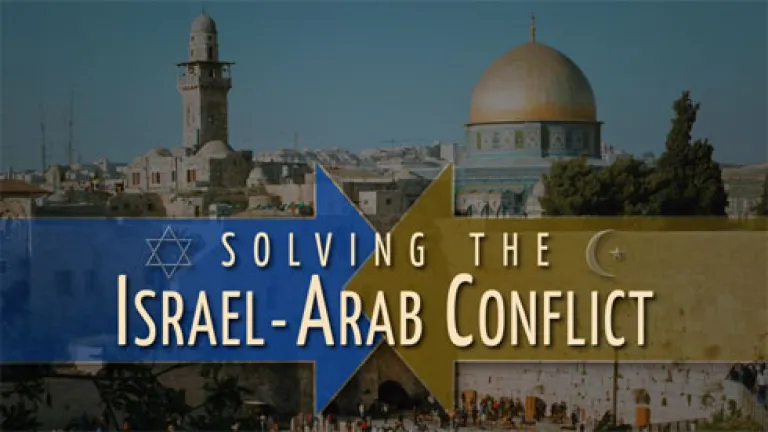
It is the question behind the chants on American college campuses and in the streets today, where they say, from the river to the sea, Palestine will be free. You've heard them. Beneath those slogans, there is a very deep, serious conflict about land, identity, and history. Many who protest Israel's existence believe the Jewish people are actually foreign occupiers, late comers to a land originally settled by Arabs. But is that true? And why is this important?
What and even why do you need to understand this? Because it's a story. A story about a flawed people with a good God. No one's perfect, but the point is that good God is someone that you want to know. That good God behind the story is someone that you can know.
So let's talk about this conflict. Arab states and many people in the world do not feel a Jewish state should exist in the Middle East as it does today. Once on a trip to Jordan, I heard a talk one night where a Jordanian senator came and he made the claim there was no temple in Jerusalem during the first century. Now that is a widely spoken fact in Arab circles. Yet archaeology tells a different story. You see, in the Istanbul Archaeological Museum, there's a stone with an inscription from the first century with a warning. It says that any non-Jew crossing into that sacred space does so at his own risk, at his own peril. It stood in the temple in Jerusalem in the first century and it's a known fact because there was a temple there. But you know what? Today, that artifact is hid from the public. It's in a storage room. I've actually seen it in that storage room with my own eyes. They don't want that truth known.
The very name that we hear, Palestine, actually bears witness to the Jews and their homeland because after crushing two Jewish revolts, the Roman Empire, renamed that entire region from Judea to what is known as Palestine. But this was done in the second century. It was an attempt to erase the Jewish identity of the land back then.
So today, to deny the presence of the Jews anciently in that land is to deny plain fact. This rewriting of reality makes you realize how far apart the two sides are today and ask whether reconciliation really can occur.
So I ask again, who owns the land?
Well, the direct answer is God owns the land. That good God that I mentioned at the beginning. That good God gave the land to Abraham and his descendants. And who those descendants are is an interesting fact.
The book of Genesis records this. And particularly in chapter 17 of Genesis, it says this as God passed this promise to Abraham. He said, I will establish my covenant between me and you and your descendants after you in their generations for an everlasting covenant to be God to you and your descendants after you. Also, I give to you and your descendants after you the land in which you are a stranger, all the land of Canaan as an everlasting possession, and I will be their God.
Interesting, in this passage, God says about Ishmael, the other son of Abraham. There were two in the story Isaac who gave birth to Jacob and to the children of Israel. But the other son named Ishmael, God says this about him.I have heard you. Behold, I have blessed him, Ishmael, and will make him fruitful and will multiply him exceedingly. He shall beget twelve princes and I will make him a great nation.
So the Arab nations who know today that they are descended from Ishmael, the other son of Abraham, you see, Genesis tells us that that family of Abraham was pretty complicated. The Bible gives us all the details and they're not always pretty. You can read them and you can understand why there is strife today in the same regions among the descendants of Abraham who was a man of faith and of the promise.
Today there is room for both people, the descendants of Ishmael, the descendants of Isaac, to make a life of prosperity and security for their people. But the same human nature that caused Ishmael and his mother to be banished from the home of Abraham, that animosity exists today.
Years of mistrust and hatred is at the heart of the story. Like I said, flawed people, but a good God.
The story goes on. After generations of slavery in Egypt, God brought Israel, the descendants of Isaac, out from Egypt and into the land of promise. But as they prepared to enter, God through Moses recounted the miracles He had performed in the laws He had given to help them create a nation built on the foundation of God's laws.
And so notice what God intended for Israel as revealed through Moses. It's in the book of Deuteronomy. See, I have taught you decrees and laws as the Lord my God commanded me so that you may follow them in the land you're entering to take possession of it. Observe them carefully, for this will show your wisdom and understanding to the nations who will hear about all these decrees and say, surely this great nation is a wise and understanding people.It's in the book of Deuteronomy.
God placed Israel in this spot, that land at the crossroads of the world, to be an example to the nations around it, as well as all those who would pass through along the ancient trade routes, the ancient highways. Israel was to be a living example of how blessed a nation would be if it obeyed God's word, God's laws. Sadly, it was not to be completely. Israel ultimately did rebel against God and the covenant, the agreement they made, they sinned, and became instead an example of what happens to a nation, to a people, even then and today, a people that turn their back on God and will not live by this word. The country was invaded, destroyed. Israel was exiled. That was their fate.
Now, I want you to look at a map. It's an old map. It was done back in the 16th century, but it was designed back then to make a theological point, not a correct geographical point. The point was by that map that the Holy Land and Jerusalem in particular was the center of the world. Notice the map. It shows Jerusalem setting where three continents, Europe, Africa, and Asia come together.
Now, while that's not literally true, it was figuratively true because the ancient trade routes of that day became invasion routes between those three continents. And they ran right through the Holy Land with the Mediterranean Sea on one side and the great Arabian Desert on the other. There was no other option. The land was right there and that made the Holy Land, as we call it, the crossroads of the ancient world, which is a primary reason that we see so many wars and battles that are mentioned in Scripture and in history.
But you see, God didn't intend it to be this way. God placed His chosen nation, Israel, in that spot for a very different reason. And the reason was not to show a way to war, but to way to peace and faith.
You see, a good God put a flawed but resourceful people, the tribes of the people descended from Abraham's son Isaac, in this promised land. He put them there because He is a good God who keeps His Word. God had grace on them and He gave them what He promised. That same God looks at all peoples and nations today with the same grace to fulfill His promises today and into the future.
So let's come forward 26 centuries to today. This land remains at the center of conflict for the world. And this building to a final crescendo with the return of Christ, notice what God says in the book of Zechariah, I will gather all the nations to Jerusalem to fight against it. Then the Lord will go out and fight against those nations.
You see, the armies of man will wage an all-out war against the spiritual army of God at the return of Christ, but it will be no contest.
The Scripture goes on to say, on that day His feet, Christ's feet, will stand with the Mount of Olives east of Jerusalem, and the Lord will be king over the whole earth.
One other Scripture in the book of Isaiah, chapter 2, tells us that the law will go forth from Zion, the word of the Lord from Jerusalem. And they will beat their swords into plowshares and their spears into pruning hooks. Nation will not take up sword against nation, nor will they train for war anymore.
Now these prophecies and this story is a big story that I can't tell completely in this one program. We have prepared a landing page with more information. You can go to ucg.org/bt490 for a study aid, the Middle East and Bible Prophecy that goes into what I'm talking about today and far more, along with other helpful study material for you there. That landing page is there for you to access and to learn the real news and the real story behind this conflict.
Jerusalem, the center of conflict, is destined to fulfill its destiny as the center of peace for the world. Until then, we're witnessing a different kind of war. Well, not just of bullets and rockets and bombs, but of ideas and ideology.
The spirit of unrest that has spread far beyond Gaza, anti-Semitism, we see rising around the world. College campuses erupt with protests, not only against Israeli policies, but against Israel's very right to exist. It's more than about land and a displaced people. It's about whether the Jewish state has a right to exist in the land or into any land in the world for that matter. That's right. What we're watching today is the rise of the same historical animosity against Jews and religion that has resulted again and again in genocide and displacement.
God says mankind does not want the knowledge of God, His knowledge, in their heart nor obey what He commands. Read it in your own Bible.
Here's what it says in the book of Romans. Although they knew God, they did not glorify Him as God, nor were thankful, but became futile in their thoughts and their foolish hearts were darkened. They did not like to retain God in their knowledge. That's the deep root of anti-Semitism. It's not just a hatred of a people, it's a hatred of God who chose a people.
This hatred has been acted out in history against the Jews. But the good God has not rejected His people and it is a sign of hope that He has not rejected all peoples and all nations.
You can get the full story of all of this looking at our Bible study aid, the Middle East and Bible Prophecy, at the landing page ucg.org/bt490.
Do that and join us next time on Beyond Today!

Terrorist attacks that shock the world also bring home the fact that the Middle East affects all of us, regardless of where we live.

Darris McNeely is a retired elder in the United Church of God. He and his wife, Debbie, have served in the ministry for more than 53 years. They have two sons, who are both married, and four grandchildren. Darris continues teaching at Ambassador Bible Center and is a member of the Council of Elders. Darris and Debbie continue to travel and keep up with the many friends and relationships around the world.