In Brief... Abortion in the News on Several Fronts
The controversy over the topic of abortion continues to boil as news of murders and stem cell research rise.
A horrifying story of murder was reported in the Chinese province of Hubei, where family planning officials drowned a newborn baby in a rice paddy-in front of its parents. The baby's crime? He was the fourth child of his parents, born in a country that has tried to enforce a one-child policy for 20 years. Various methods of enforcement have been used, including forced abortion and abortion that targets girls. The officials initially tried to kill the infant by forcibly injecting the mother with a saline solution to cause her to abort. Miraculously, the baby survived and was born naturally.
His father was ordered to murder the baby when he was born, but the father refused. A doctor cared for the infant and gave it to his parents to take home. The government officials were waiting for them when they arrived.
In the U.S., Texas Governor George W. Bush raised the highly controversial subject of partial birth abortions in his acceptance speech at the Republican National Convention. The governor promised to sign into law a federal bill that would ban the unspeakably cruel procedure, should he be elected president.
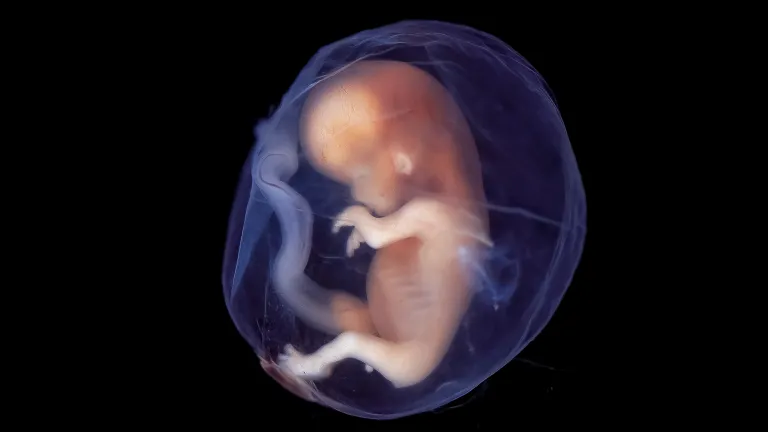
The current U.S. administration, well known for its support of all types of abortion, recently issued guidelines that would permit federally financed scientists to conduct research on human embryo cells. Scientists are supposedly justified in working on embryos to obtain stem cells, "because retrieval is conducted when the embryo is still a one-week-old microscopic ball of undifferentiated cells, long before any organs or limbs have developed." As if that means the embryo is not a human being. Representative Henry Hyde is credited with the astute observation that, "the human embryo will not develop into a German shepherd."
The executive order permitting this research was issued in the name of "saving lives," because it is hoped that stem cells could be used to grow any human organs needed for transplantation. U.S. law prohibits this type of medical research, which plainly requires taking the life of the unborn. However, the guidelines skirt the law by parsing words, saying that federal research could be conducted only on cells from embryos that "were destined to be discarded anyway." That means they will likely be the castoffs from fertility clinics. Someone other than a federal employee must "destroy" (read, "kill") the embryos.
These guidelines are destined to spark a firestorm of controversy in the U.S., as did a similar announcement that was recently made in the U.K. Many scientists want to press ahead with human cloning, due to a setback in "xenotransplantation"-transplants from a nonhuman source. The Roslin Institute, which gave the world Dolly, the cloned sheep, has been working on research into pigs-for-transplant. However, Roslin has abandoned this research in light of recent revelations that animal viruses can be transferred from donor animals to humans.
In a related story, legal reports say that an obscure case in North Dakota could effectively undo the quarter-century-old Roe v. Wade Supreme Court ruling. Most probably assume that the high court's ruling was based on "a woman's right to choose." That's not the case.
It was based upon concern for the health of the mother. Hence the potential of the North Dakota case. It's a suit brought against an abortion clinic in Fargo for a pamphlet it distributes that says no medical research supports claims that abortions cause an increased risk of breast cancer.
Actually, according to the suit, overwhelming research exists that proves a woman's health is endangered by abortion. Therein lies the potential undoing of Roe v. Wade.
Dr. Joel Brind is a professor of biology and endocrinology at Baruch College of City University of New York. He explains that breast cancer is linked to reproductive hormones, especially estrogen. A woman's risk of developing breast cancer is lowered the sooner she has her first child.
Estrogen levels increase exponentially at conception, leading to the growth of "undifferentiated" cells in the breasts, in preparation for milk production. In the final weeks of a full-term pregnancy, those cells change into a form ready to fulfill that motherly task.
However, when the pregnancy is terminated by an abortion, those cells remain "undifferentiated" and highly susceptible to carcinogens. (Curiously, when a woman miscarries, she doesn't have the same susceptibility.)
Obviously, financial and legal support for pro- and anti-abortion forces are lining up for what may turn out to be a historic case. ( 2000 WorldNetDaily.com; PRNewswire; The Guardian; The Observer; Washington Post Service; "Stem Cell Research," by Mona Charen, August 28, 2000, Creators Syndicate, Inc.)

An Article from:
World News and Prophecy: September - October 2000
Course Content

John Ross Schroeder
John died on March 8, 2014, in Oxford, England, four days after suffering cardiac arrest while returning home from a press event in London. John was 77 and still going strong.
Some of John's work for The Good News appeared under his byline, but much didn't. He wrote more than a thousand articles over the years, but also wrote the Questions and Answers section of the magazine, compiled our Letters From Our Readers, and wrote many of the items in the Current Events and Trends section. He also contributed greatly to a number of our study guides and Bible Study Course lessons. His writing has touched the lives of literally millions of people over the years.
John traveled widely over the years as an accredited journalist, especially in Europe. His knowledge of European and Middle East history added a great deal to his articles on history and Bible prophecy.
In his later years he also pastored congregations in Northern Ireland and East Sussex, and that experience added another dimension to his writing. He and his wife Jan were an effective team in our British Isles office near their home.
John was a humble servant who dedicated his life to sharing the gospel—the good news—of Jesus Christ and the Kingdom of God to all the world, and his work was known to readers in nearly every country of the world.