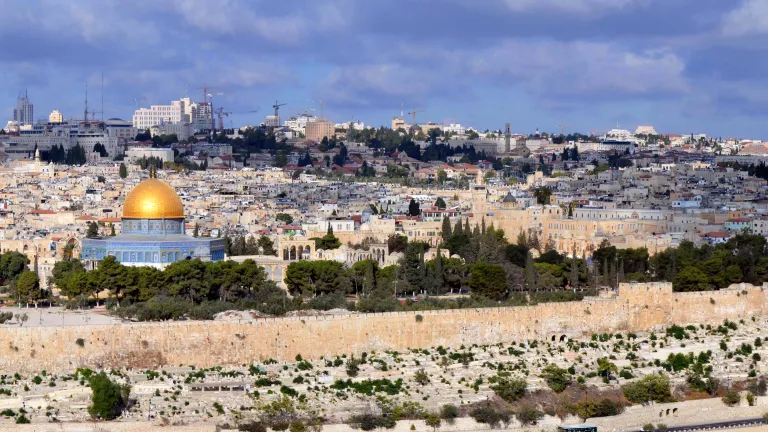
World News and Trends: Why is Middle East peace so elusive?
As pressure mounts for a peaceful resolution to the conflict between Israelis and Palestinians, it is important to understand why no easy solutions are in sight.
Much of the world press tends to blame the problems on Israeli intransigence. In the news media's view, Israel, backed by the United States, has the weaponry while the Palestinians are a suffering people that simply wants to return to its ancestral homeland. Yet it's not so simple.
A recent article by American columnist Michael Barone sums up the situation: ". . . Israel is ready to accept a Palestinian state. The problem is that the Palestinians refuse to accept the Israeli state."
Former Israeli prime minister Benyamin Netanyahu has repeatedly made the same points in interviews on American and British television programs. The former head of the Jewish state has explained the difference between the Palestine Liberation Organization (PLO), led by Yasir Arafat, and Hamas, the Palestinian terrorist organization that is generally considered more extreme than the PLO.
Mr. Netanyahu states that Hamas is consistent in calling for the destruction of the Jewish state: It says the same in Arabic to Palestinians as it says in English to the rest of the world. In contrast, Mr. Netanyahu notes, Mr. Arafat says one thing in Arabic and another in English. While appearing to show a willingness to compromise when speaking to the rest of the world, he sends a completely different message when speaking in Arabic to Arabs.
In recent months, for example, he has repeatedly called for "martyrs" (suicide bombers) to march on and liberate Jerusalem. As Israeli troops surrounded his compound in the West Bank city of Ramallah, in a series of interviews on March 29 he told Arab television reporters:
"Let those far and near understand: None, among the Palestinian people or the Arab nation, will be willing to bow and surrender. But we ask Allah to grant us martyrdom, to grant us martyrdom. To Jerusalem we march—martyrs by the millions . . ."
"We are seekers of martyrdom. We are all seekers of martyrdom. The entire Palestinian people is a seeker of martyrdom . . ."
"I may be martyred, but certainly one of our boys or one of our girls will wave the flag of Palestine over the walls of Jerusalem, over the minarets of Jerusalem, and over the churches of Jerusalem."
The destruction of Israel appears to remain the ultimate Palestinian goal. Schoolchildren in Palestinian Authority—controlled areas learn from textbooks that show "Palestine" where Israel now exists, with "Israel" nonexistent on the maps.
For many Palestinians the return of refugees goes hand in hand with the elimination of the Jewish state. If enough refugees returned to Israel, the Jewish population would be swamped. Israel's democratic system would result in a Palestinian majority that would put an end to the 53-year-old Jewish nation. Even if the numbers returning were smaller, a higher birth rate could eventually have the same result. In the interim, more Palestinians living in Israel would probably mean more violence.
Pressure from the liberal Western democracies and the world's press may endanger Israel's very existence. As Israelis themselves are quick to point out, they have fought four wars for their survival since the nation's founding in 1948. They cannot afford to lose a single one, for if they do their nation ceases to exist.
Israelis remain reluctant to surrender the West Bank for a proposed Palestinian state for two major reasons. First, many Israelis consider it part of the land God promised them in perpetuity through Abraham. Indeed, some of the very places in which the Bible records God making these promises (Genesis 12:6-7; 13:3, 14-18) are today in the Palestinian-controlled West Bank.
Second, a return to pre-1967 borders would leave Israel barely a dozen miles wide along much of its length and thus vulnerable to a potentially fatal military assault from hostile neighbors.
As long as Israel's existence is threatened and the Palestinians' hopes are thwarted, any peace agreement is not likely to last. Bible prophecies such as Luke 21:20 and Zechariah 14:1-4 show that Jerusalem and its environs will lie at the center of global strife immediately before Christ's return. Keep your eyes on Jerusalem. The "City of Peace" will continue to be a focus of world news. (Sources: U.S. News & World Report, BBC, Middle East Media Research Institute Web site.)

An Article from:
Good News Magazine: May - June 2002
Course Content

John Ross Schroeder
John died on March 8, 2014, in Oxford, England, four days after suffering cardiac arrest while returning home from a press event in London. John was 77 and still going strong.
Some of John's work for The Good News appeared under his byline, but much didn't. He wrote more than a thousand articles over the years, but also wrote the Questions and Answers section of the magazine, compiled our Letters From Our Readers, and wrote many of the items in the Current Events and Trends section. He also contributed greatly to a number of our study guides and Bible Study Course lessons. His writing has touched the lives of literally millions of people over the years.
John traveled widely over the years as an accredited journalist, especially in Europe. His knowledge of European and Middle East history added a great deal to his articles on history and Bible prophecy.
In his later years he also pastored congregations in Northern Ireland and East Sussex, and that experience added another dimension to his writing. He and his wife Jan were an effective team in our British Isles office near their home.
John was a humble servant who dedicated his life to sharing the gospel—the good news—of Jesus Christ and the Kingdom of God to all the world, and his work was known to readers in nearly every country of the world.
Melvin Rhodes
Melvin Rhodes is a member of the United Church of God congregation in Lansing, Michigan.

Scott Ashley
Scott Ashley was managing editor of Beyond Today magazine, United Church of God booklets and its printed Bible Study Course until his retirement in 2023. He also pastored three congregations in Colorado for 10 years from 2011-2021. He and his wife, Connie, live near Denver, Colorado.
Mr. Ashley attended Ambassador College in Big Sandy, Texas, graduating in 1976 with a theology major and minors in journalism and speech. It was there that he first became interested in publishing, an industry in which he worked for 50 years.
During his career, he has worked for several publishing companies in various capacities. He was employed by the United Church of God from 1995-2023, overseeing the planning, writing, editing, reviewing and production of Beyond Today magazine, several dozen booklets/study guides and a Bible study course covering major biblical teachings. His special interests are the Bible, archaeology, biblical culture, history and the Middle East.