World News and Trends: A new Middle East peace initiative: Is the time really ripe?
American Secretary of State Condoleezza Rice has described the present distress as "the birth pangs of a new Middle East."
American Secretary of State Condoleezza Rice has described the present distress as "the birth pangs of a new Middle East." Former President Bill Clinton indicated that the recent deterioration of conditions in Iraq, Lebanon and Gaza had paradoxically created a climate for "some kind of positive movement to take place" (Financial Times, Sept. 20). President George Bush recently said, "Some of the [positive] changes in the Middle East are happening gradually, but they are real" (USA Today, Sept. 20).
One journalist recently talked about "a new momentum for a comprehensive Arab-Israeli peace settlement out of the ashes of the past several months."
But are all these comments pie-in-the-sky? Are they just another manifestation of the proverbial triumph of hope over hard experience? True, even the Bible does indicate that conditions are going to come together that may produce a temporary peace that causes world leaders to say, "'Peace, peace!' when there is no [real] peace" (Jeremiah 6:14).
However, not all astute observers of the world scene would agree that substantive prospects for peace exist in the Middle East. Consider the views of Harvard historian and author Niall Ferguson. He conceives of a conflict there that could spark a global conflagration. Professor Ferguson considers the 20th century to have been the most violent in the history of humankind and sees the 21st century as beginning to move in the same tragic direction.
He wrote in the September/October issue of Foreign Affairs: "Today one region displays in abundance all of the characteristics of the worst conflict zones of the twentieth century. Economic volatility has remained pronounced there even as it has diminished in the rest of the world . . . That place is the Middle East" (emphasis added throughout).
Ferguson concluded his article with these words of warning: "The sobering possibility we urgently need to confront is that another global conflict is brewing today —centered not on Poland or Manchuria, but more likely on Palestine and Mesopotamia."
Another long-neglected source of wisdom is the Bible. It is full of forewarnings of Armageddon-like conditions that will prevail in the Middle East. Its pages foretell a series of shattering events that will end with the Messiah returning to Jerusalem, from where He will govern the earth—finally ushering in the utopian peace that mankind has so long sought for in vain. To understand how this will come about, request or download our free booklet The Middle East in Bible Prophecy. (Sources: USA Today, Financial Times, Foreign Affairs.)

An Article from:
Good News Magazine: November - December 2006
Course Content
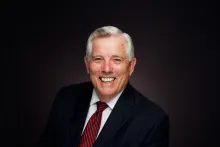
Jerold Aust
Jerold Aust has served in the ministry for 52 years, as a public speaker for 58 years, a published writer for 38 years, and is employed by UCG’s Media and Communications Services. He is a Senior Writer, interviewer, and editor for Beyond Today Magazine and has taught Speech Communication for UCG’s ministerial online program and the Book of Revelation for ABC.
Jerold holds a BA in theology from Ambassador College, Pasadena (1968), an MA in Communication from California State University, Fullerton (1995), a distance-learning Ph.D (2006), and a Famous Writers School diploma in non-fiction writing (1973). Additionally, he studied post-grad communication at University of Southern California (1995), radio, TV, voice-overs, and Public Relations at Fullerton College (1995-1996), and graduate communication at Wichita State University (1978). Jerold has taught communication at the University of South Alabama (7 years) and ABC (17 years). His published works include, Ronald Reagan’s Rhetoric: Metaphor as Persuasion and EZSpeakers: Public Speaking Made Easy in 7 Steps. Jerold's overarching goal is to share with humankind its incredible destiny!

John Ross Schroeder
John died on March 8, 2014, in Oxford, England, four days after suffering cardiac arrest while returning home from a press event in London. John was 77 and still going strong.
Some of John's work for The Good News appeared under his byline, but much didn't. He wrote more than a thousand articles over the years, but also wrote the Questions and Answers section of the magazine, compiled our Letters From Our Readers, and wrote many of the items in the Current Events and Trends section. He also contributed greatly to a number of our study guides and Bible Study Course lessons. His writing has touched the lives of literally millions of people over the years.
John traveled widely over the years as an accredited journalist, especially in Europe. His knowledge of European and Middle East history added a great deal to his articles on history and Bible prophecy.
In his later years he also pastored congregations in Northern Ireland and East Sussex, and that experience added another dimension to his writing. He and his wife Jan were an effective team in our British Isles office near their home.
John was a humble servant who dedicated his life to sharing the gospel—the good news—of Jesus Christ and the Kingdom of God to all the world, and his work was known to readers in nearly every country of the world.

