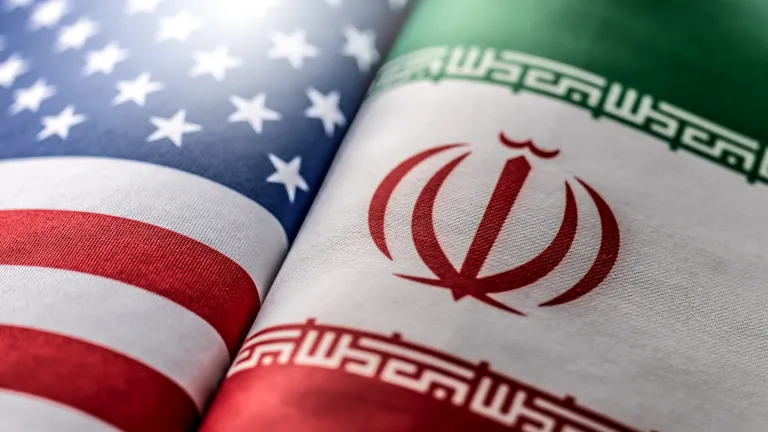
World News and Trends: America, Israel and Iran: Where are we headed?
As Israel and Iran continue to be focal points of chaos and conflict, the United States remains in the middle. Will this conflict ever be resolved?
As Iran moves inexorably toward constructing nuclear weapons, Israel grows ever more concerned about Iranian intentions. According to London Financial Times columnist Philip Stephens: "No one watches events in Iran more closely than Israel. Tehran has long been the abiding preoccupation, some would say obsession, of political discourse in Tel Aviv and Jerusalem" ("Israel Struggles to Adapt to a Changing Picture of Iran," July 3, 2009).
The United States finds itself drifting somewhere in the middle—at times confusing Israel with ambiguous announcements from administration leaders. Recent declarations from leading figures in Washington, D.C., have seriously worried Israel's leaders.
For example: "The US would extend its 'defence umbrella' across the Middle East to defend its allies against a nuclear-armed Iran, Hillary Clinton, the Secretary of State, said yesterday [July 21] ... Mrs Clinton, speaking at a meeting of [Asian] foreign ministers ... said that acquiring nuclear weapons would not make Iran more secure" (Richard Parry, "Clinton Says US Would Arm Its Allies Against a Nuclear Iran," The Times, July 22, 2009, emphasis added throughout).
Such declarations tend to cause Israel to believe that America is going soft on the stark possibility of a nuclear Iran.
The Wall Street Journal's report from Jerusalem stated that "a simmering dispute between the U.S. and Israel over Iran's nuclear program burst into the open on Monday [July 27], as U.S. Defense Secretary Robert Gates, on a visit to Israel, called for continued diplomatic engagement with Tehran, while Israeli officials repeatedly warned of a possible military strike against Iran's nuclear facilities" (Yochi Dreazen, "U.S., Israel Split on Iran," July 28, 2009).
Earlier in July, U.S. Vice President Joe Biden "signaled that the Obama administration would not stand in the way if Israel chose to attack Iran's nuclear facilities ... 'Look, Israel can determine for itself—it's a sovereign nation—what's in their interest and what they decide to do relative to Iran and anyone else,' [Biden told ABC's This Week in an interview broadcast Sunday July 5]. He added that this was the case, 'whether we agree or not' with the Israeli view" ("Biden: Israel Can Chart Own Course on Iran," USA Today, July 7, 2009).
Meanwhile, "the head of Mossad, Israel's overseas intelligence service, has assured Benjamin Netanyahu, its prime minister, that Saudi Arabia would turn a blind eye to Israeli jets flying over the kingdom during any future raid on Iran's nuclear sites" (Uzi Mahnaimi and Sarah Baxter, "Saudis Give Nod to Israeli Raid on Iran," The Sunday Times, July 5, 2009).
Recent internal events in Iran temporarily complicated the possibility of any Israeli air strikes. For a while it looked as if more reasonable Iranian voices, opposed to the fanaticism of President Mahmoud Ahmadinejad and supreme leader Ayatollah Ali Khamenei, might moderate the country's approach to Israel, America and Britain. But the massive popular reaction to this seriously questionable election result has since been ruthlessly crushed by the Iranian government.
Subsequently the recently chosen, more moderate Iranian vice-president was forced to resign. At the same time, as reported in Scotland on Sunday, the Iranian Revolutionary Guards stated, "If the Zionist regime [Israel] attacks Iran, we will surely strike its nuclear facilities with our missile capabilities" (Parisa Hafezi and Ali Akbar Dareini, "Hardliners Tighten Their Grip on Iran," July 26, 2009).
Finally, according to the Scotland on Sunday article, "Iran has repeatedly threatened to close the Strait of Hormuz, conduit for about 40 per cent of globally traded oil." If this threat is actually carried out, it's hard to see how the West would not take immediate military action.
The Middle East is a powder keg that threatens to explode at almost any time. Hostile attitudes and violent events in this troubled region are impacting the entire world. You need to understand where these continual Middle Eastern conflicts—"wars and rumors of war"—are taking us. Request or download our free booklet The Middle East in Bible Prophecy. (Sources: The Times [London], Scotland on Sunday, USA Today, The Wall Street Journal.)

An Article from:
Good News Magazine: September - October 2009
Course Content
Jerold Aust
Jerold Aust has served in the ministry for 52 years, as a public speaker for 58 years, a published writer for 38 years, and is employed by UCG’s Media and Communications Services. He is a Senior Writer, interviewer, and editor for Beyond Today Magazine and has taught Speech Communication for UCG’s ministerial online program and the Book of Revelation for ABC.
Jerold holds a BA in theology from Ambassador College, Pasadena (1968), an MA in Communication from California State University, Fullerton (1995), a distance-learning Ph.D (2006), and a Famous Writers School diploma in non-fiction writing (1973). Additionally, he studied post-grad communication at University of Southern California (1995), radio, TV, voice-overs, and Public Relations at Fullerton College (1995-1996), and graduate communication at Wichita State University (1978). Jerold has taught communication at the University of South Alabama (7 years) and ABC (17 years). His published works include, Ronald Reagan’s Rhetoric: Metaphor as Persuasion and EZSpeakers: Public Speaking Made Easy in 7 Steps. Jerold's overarching goal is to share with humankind its incredible destiny!

John Ross Schroeder
John died on March 8, 2014, in Oxford, England, four days after suffering cardiac arrest while returning home from a press event in London. John was 77 and still going strong.
Some of John's work for The Good News appeared under his byline, but much didn't. He wrote more than a thousand articles over the years, but also wrote the Questions and Answers section of the magazine, compiled our Letters From Our Readers, and wrote many of the items in the Current Events and Trends section. He also contributed greatly to a number of our study guides and Bible Study Course lessons. His writing has touched the lives of literally millions of people over the years.
John traveled widely over the years as an accredited journalist, especially in Europe. His knowledge of European and Middle East history added a great deal to his articles on history and Bible prophecy.
In his later years he also pastored congregations in Northern Ireland and East Sussex, and that experience added another dimension to his writing. He and his wife Jan were an effective team in our British Isles office near their home.
John was a humble servant who dedicated his life to sharing the gospel—the good news—of Jesus Christ and the Kingdom of God to all the world, and his work was known to readers in nearly every country of the world.