The Declaration of Independence and Intelligent Design

As America celebrates its 250th birthday, we consider the focus of its founding document on God as Creator of the world and of its underlying laws.
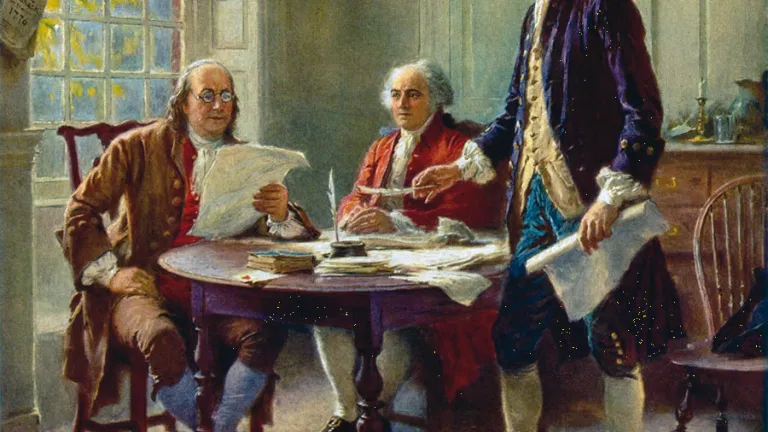
July 4, 2026 marks the 250th anniversary of the adoption of the Declaration of Independence, beginning what is now the United States of America. The “founding fathers” who signed it were 56 delegates from the 13 original colonies who came to the Continental Congress seeking freedom from tyranny.
These founding fathers believed in God and His laws of both nature and Scripture. In the Declaration, they appealed to the “Laws of Nature and of Nature’s God” for their right to establish a new nation based on those principles. In fact, God is emphasized four times in this relatively brief document of 1,320 words.
At America’s founding, “intelligent design” wasn’t a common term of the day, but the principle was regarded as scientific fact among the nation’s founders. The standard definition of “intelligent design” is “a scientific theory that holds that the emergence of some features of the universe and living things is best explained by an intelligent cause rather than an undirected process such as natural selection” (Casey Luskin, “An Introduction to Intelligent Design,” Discovery Institute, 2015).
Let’s examine four passages of the Declaration where the concept of God and His laws of nature are used and point to the principles of what is now called “intelligent design.”
1. “The Laws of Nature and of Nature’s God”
The first sentence of the Declaration of Independence says, “When in the Course of human events, it becomes necessary for one people to dissolve the political bands which have connected them with another, and to assume among the powers of the earth, the separate and equal station to which the Laws of Nature and of Nature’s God entitle them, a decent respect to the opinions of mankind requires that they should declare the causes which impel them to the separation” (emphasis added throughout).
Notice the reason for seeking independence was based on “the Laws of Nature and of Nature’s God.” These laws were principles that could be discovered and were evident by means of physical observation, mental reasoning and human conscience. They included physical laws, the tenets of morality and biblical revelation—all from God.
As one of the signers of both the Declaration and the Constitution of the United States, James Wilson, who became a U.S. Supreme Court justice, explained, “That law, which God has made for man in his present state . . . which is communicated to us by reason and conscience, the divine monitors within us, and by the sacred oracles [the Bible], the divine monitors without [or outside] us” (Introductory Lecture: “Of the Study of the Law in the United States,” ca. 1790-91.)
Wilson also defined the “Laws of Nature” in terms similar to the principles of intelligent design. He spoke in reference to “that law, by which the irrational and inanimate parts of the creation are governed,” adding that “the great Creator of all things has established general and fixed rules, according to which all the phenomena of the material universe are produced and regulated. These rules are usually denominated laws of nature.”
Not only are the “Laws of Nature” mentioned in the Declaration, but also “of Nature’s God.” The founding fathers wanted to clearly acknowledge the Author of these laws, which are the rule of life for all humankind. They also stressed that these principles—which were found through scientific observation, the laws of logic and the dictates of the human conscience—ultimately point to the Creator of all things, God.
2. “Endowed by their Creator”
Another key line of the Declaration reads, “We holdthese truths to be self-evident, that all men are created equal, that they are endowed by their Creator with certain unalienable Rights, that among these are Life, Liberty and the pursuit of Happiness.”
In addition to the laws already noted, we see there are certain “self-evident” truths that can be derived through careful analysis, rigorous logic and divine revelation. They were, in a sense, saying you can find evidence for these principles in the “book of nature” as well as in Scripture.
As John West points out in his 2026 book Endowed by Our Creator: The Bible, Science, and the Battle for America’s Soul: “Reason and revelation were not antagonists in the view of America’s founding generation. They were equally given to us by God, and when properly used, they both pointed to the same truths. The Declaration does not claim otherwise. Instead, it proclaims that America’s political system will be based on key truths about human nature that it goes on to identify, and that regardless of how those truths are ascertained (whether through reason or revelation), they are to be held by Americans as ‘self-evident’—that is, they are to be regarded as foundational principles on which our government rests . . . This view that reason and conscience as well as the Bible point in the same direction was not the invention of a secular age of ‘Enlightenment.’ It had deep roots in both the Bible and Christian theology.”
These delegates believed—although did not perfectly exhibit this belief—that God endowed human beings with “unalienable” (or permanent) equal rights, where no person is born superior to another and human life should be respected. This is a foundational principle in the Bible.
“So God created man in His own image; in the image of God He created him; male and female He created them” (Genesis 1:27, emphasis added). This statement is fundamental to the laws about respecting human life. We also find this high value of human life in the Sixth Commandment, which forbids murder. Further support for the intrinsic value of life is spelled out in the consequences of violating this command.
Genesis 9:6 states, “Whoever sheds man’s blood, by man his blood shall be shed; for in the image of God He made man.” The dignity of life is given by the Creator God—not by a government or from a source like blind evolution. It should be held as sacred.
West further brings out that Thomas Jefferson, the Declaration’s main writer, used the principle of intelligent design to prove the equal rights of humankind—that no one had an inherent right to rule over others.
As West states: “The Founders did not think that the truths of human equality could be known only through the Bible. Nature itself proclaimed the ways in which men were equal, and we could ascertain these truths through our observation of the world around us. A few weeks before his death, Jefferson wrote a correspondent: ‘The general spread of the light of science has already laid open to every view the palpable truth, that the mass of mankind has not been born with saddles on their backs, nor a favored few booted and spurred, ready to ride them legitimately, by the grace of God.’”
Following life, liberty is another right the founding fathers thought was self-evident through observation, critical thinking and the Bible.
God did not create slaves in the Garden of Eden, but instead free human beings capable of independent thought. The Bible calls God’s law “the perfect law of liberty.” As James writes, “But he who looks into the perfect law of liberty and continues in it, and is not a forgetful hearer but a doer of the work, this one will be blessed in what he does” (James 1:25).
While the founding fathers supported the biblical premise of human freedom in word, it’s important to acknowledge that some did own slaves in their personal lives. Yet the Declaration’s principles helped pave the way for the abolition of slavery later on.
The last part of the phrase in this portion of the Declaration is “the pursuit of happiness.” This is also a biblical principle, with happiness as a desired outcome in Ecclesiastes 2:26: “God gives wisdom, knowledge and happiness to the person who pleases Him” (New International Reader’s Version). As we see here, true happiness comes only through following God.
3. “The Supreme Judge of the World”
The Declaration of Independence further states, “We, therefore, the Representatives of the United States of America, in General Congress, Assembled, appealing to the Supreme Judge of the world for the rectitude of our intentions, do, in the Name, and by Authority of the good People of these Colonies, solemnly publish and declare, that these United Colonies are, and of Right ought to be Free and Independent States . . .”
Here, the founding fathers appealed to the Supreme Judge of the world for support of their just cause. They recognized what the prophet Daniel told King Nebuchadnezzar about who really oversees the affairs of the world—God Almighty. The same king was later told in a dream, “This decision is by the decree of the watchers, and the sentence by the word of the holy ones, in order that the living may know that the Most High rules in the kingdom of men, gives it to whomever He will, and sets over it the lowest of men” (Daniel 4:17, emphasis added).
4. “Firm reliance on the protection of divine Providence”
This founding document of the United States of America concludes, “And for the support of this Declaration, with a firm reliance on the protection of divine Providence, we mutually pledge to each other our Lives, our Fortunes and our sacred Honor.”
The beginning of the declaration invokes God as the divine lawmaker and Creator. It ends by beseeching His protection in the terrible ordeal ahead for the people of the new nation—several grueling years of incessant battles and many setbacks. They persevered with great courage and faith in God and prevailed. George Washington, commander of American forces at the time and later the country’s first president, fervently believed in the God of Scripture and the God of nature. Adapted from his Circular Letter to the States of June 8, 1783, “Washington’s Prayer for the United States of America” states:
“I now make it my earnest prayer, that God would have the United States in his holy protection, that he would incline the hearts of the Citizens to cultivate a spirit of subordination and obedience to Government, to entertain a brotherly affection and love for one another, for their fellow citizens of the United States at large, and particularly for their brethren who have served in the Field, and finally, that he would most graciously be pleased to dispose us all, to do Justice, to love mercy, and to demean ourselves with that Charity, humility and pacific temper of mind, which were the Characteristicks of the Devine Author of our blessed Religion, and without an humble imitation of whose example in these things, we can never hope to be a happy Nation. Amen” (original spelling throughout).
Indeed, may that same Divine Author and evident Ruler of the world acknowledged by the signers of the Declaration of Independence continue to provide His holy protection.

An Article from:
Beyond Today Magazine: July–September 2026
Course Content

Mario Seiglie
Mr. Seiglie was born in Havana, Cuba, and came to the United States when he was a child. He found out about the Church when he was 17 from a Church member in high school. He went to Ambassador College in Big Sandy, Texas, and in Pasadena, California, graduating with degrees in theology and Spanish. He serves as the pastor of the Garden Grove, CA UCG congregation and serves in the Spanish speaking areas of South America. He also writes for the Beyond Today magazine and currently serves on the UCG Council of Elders. He and his wife, Caty, have four grown daughters, and grandchildren.
Stay up to date
Get new articles every week in your inbox and quarterly print issues in the mail.
Subscribe for freeor log in