Follow Me: Vision Beyond the Moment

As we reflect on the freedom sought at America’s beginning 250 years ago, we also focus on a far greater revolution to bring ultimate freedom to all humanity—through the ultimate indispensable Man.
This year’s Fourth of July marks the 250th anniversary of the official founding of the United States of America. The commemorated event remains one of the greatest geopolitical interruptions in human history, and its aftershocks of liberty continue to influence the entire globe to this day.
Representatives of 13 colonies of the British Empire collectively signed a point-by-point divorce paper from the throne of Great Britain—the Declaration of Independence. This is when most folks in America and people abroad assume “the fireworks of war” commenced, but they would be mistaken.
The conflict actually began more than a year earlier at Lexington Green and Concord Bridge in Massachusetts on April 19, 1775. Ralph Waldo Emerson would colorfully frame it 62 years later as “the shot heard round the world” (“Concord Hymn,” 1837). The American men on the battlefield had been separated for more than a year from their wives, families, small business needs and crop harvesting. Their heartbeats echoed with questions: Is my presence in this hardship really worth it? And why should I remain engaged against the trained soldiers of the greatest military of the Old World?
The Declaration of Independence was not just for the British monarch and Parliament and for the leaders of other countries. These men on the battlefield desperately needed to hear it. And on its approval, General George Washington immediately ordered it to be read to all troops under his command. His order fit with the biblical principle in Proverbs 29:18: “Where there is no vision, the people perish” (King James Version).
Let’s note a few excerpts from this famous document in its context and then ask ourselves what we might learn and internalize in our ongoing quest to heed the invitation from Jesus Christ of “Follow Me” (Mark 8:34).
Words of commitment and consequence
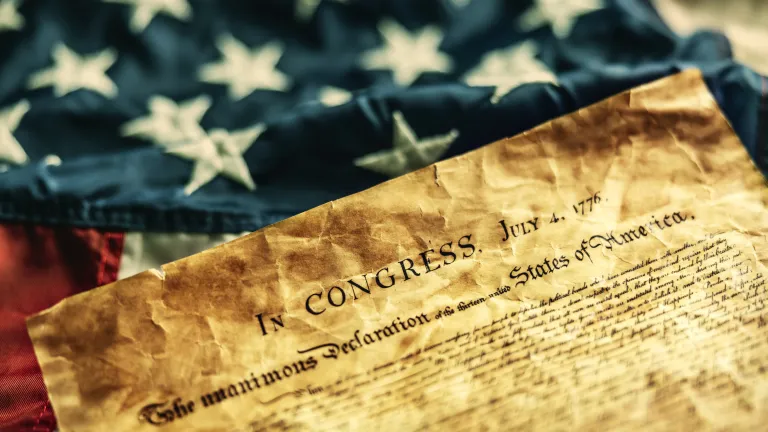
Following the heading “In Congress, July 4, 1776 The unanimous Declaration of the thirteen united States of America,” it opens: “When in the Course of human events, it becomes necessary for one people to dissolve the political bands which have connected them with another, and to assume among the powers of the earth, the separate and equal station to which the Laws of Nature and of Nature’s God entitle them, a decent respect to the opinions of mankind requires that they should declare the causes which impel them to the separation.
“We hold these truths to be self-evident, that all men are created equal, that they are endowed by their Creator with certain unalienable Rights, that among these are Life, Liberty and the pursuit of Happiness . . .”
At the conclusion, the soldiers would have heard this committed intention of the representatives who signed it: “And for the support of this Declaration, with a firm reliance on the protection of divine Providence, we mutually pledge to each other our Lives, our Fortunes and our sacred Honor.”
Words and pledges have meaning. A number of the signatories would personally face struggle and loss of everything over the course of the American Revolution.
The greater revolution from Above
The revolution that gave birth to the United States pales beside the greatest interruption so far in human history. Beyond a revolution from the norms here on earth, it is far more directly connected with revelation from Above. It begins with a plain-stated declaration in Mark 1:14-15, describing One named Jesus, who “came to Galilee, preaching the gospel [or good news] of the kingdom of God, and saying [declaring!], ‘The time is fulfilled, and the kingdom of God is at hand. Repent, and believe in the gospel.’”
Jesus Christ declared that a new world order is at hand—and that we must seek after and receive a mind and heart that fits it. The Kingdom is the reign of God, His sovereignty over mind and heart and will, and over creation. It involves sonship to God and brotherly relations with man. In its fullness, it will encompass all nations. It is the future!
But whenever a human life is brought into harmony with the Father’s purpose it is the present. Having the opportunity of accepting, receiving and reflecting God’s love in return to Him, His Son and all humanity is good news, even in times of trial and challenge. This focus on the Kingdom of God is beyond all question the main subject of Jesus’ teaching (see our free study guide The Gospel of the Kingdom).
The framers of the Declaration of Independence spoke of “Nature’s God” and the “Creator,” and the Bible reveals that this God is both the Father and the One through whom the Father created everything, the Word who became Jesus Christ: “. . . The Word was with God, and the Word was God . . . All things were made through Him, and without Him nothing was made that was made. In Him was life, and the life was the light of men” (John 1:1-4). And yet from those heavenly heights “. . . the Word became flesh and dwelt among us, and we beheld His glory, the glory as of the only begotten of the Father, full of grace and truth” (John 1:14).
Sacrifice for freedom
Speaking frankly, in becoming flesh Jesus had “skin in the game” for you, me and all humanity. He gave His life to be put to death by those He created. The only perfect human being ever to live would become “despised and rejected by men, a Man of sorrows and acquainted with grief. And we hid, as it were, our faces from Him” (Isaiah 53:3).
How could He forgive the unforgivable? What did “the captain of [our] salvation” (Hebrews 2:10) envision beyond this lonely moment of earthly rejection?
Consider in John 1:14 where we read that the Word “dwelt among us.” The word “dwelt” has its roots in the Greek word skenoo, the verb form of the word meaning “tabernacle” or “tent.” In essence, He “tented” or “camped” on earth far from His heavenly home to give His all for our cause—freedom from sin’s woes to live in eternity with Him.
The indispensable Man
More than 50 years ago, author James Flexner wrote a biography on George Washington subtitled The Indispensable Man. It was this man who wanted his troops informed of the “what and why” they needed to sacrifice for something greater than themselves. This same man from Virginia was the linchpin that kept the newly formed republic intact during eight years of warfare. He was the same one who formed the mold of the U.S. presidency when he stepped away from power and went back home. Of course, this man, though deemed indispensable, had human frailties just like us.
In fact, there is only one truly indispensable man ever to live in human flesh. One who left His home, stepped away from all power, came below and started a sacred revolution based on divine revelation. One who is God, who became a man. His name, a name above all names, is the Lord Jesus Christ (Philippians 2:9-11). The Son of Man, the Son of God, continues to bid us welcome with the words “Follow Me”—the One who, as He said in John 14:6, is the way, the truth and the life!
When “No More” Will Be Forever
What declarative statements does Holy Scripture offer to us as disciples of Christ that we might heed His invitation of “Follow Me,” even as we endure hardship as a good soldier of Jesus Christ? (See 2 Timothy 2:3.)
Below is a brief list, giving only the beginning of an extensive roll call of the differences between the age of human misrule and the eternal realm of God the Father and Jesus Christ to come, when these “no more” statements will become reality. Let’s check them off one by one as we ponder this future for not only us, but all of God’s creation.
• No more tears! (Revelation 21:4). With one exception—tears of joy!
• No more war! (Isaiah 2:4).
• No more death! (Revelation 21:4, 1 Corinthians 15:24-27).
• No more sorrow! (Revelation 21:4).
• No more pain! (Revelation 21:4). Be it physical, mental or emotional.
• No more night! (Revelation 21:23; 22:5). Exterior and interior darkness will be extinct! There will be no dread. The glory of God will give light to all!
• No more shut gates! (Revelation 21:25). Remember the closed-up Garden of Eden after Adam and Eve sinned? Now the obedient will be given the right to the tree of life, as the invitation goes out to “Come . . . Come . . . come”! (Revelation 22:14, 17).
Dive Deeper
To learn more about being a sojourner traveling to the Kingdom of God, request or download our free Bible study guides The Gospel of the Kingdom and Jesus Christ: The Real Story.

An Article from:
Beyond Today Magazine: July–September 2026
Course Content
Robin S Webber
Robin Webber was born in Chicago, Illinois, in 1951, but has lived most of his life in California. He has been a part of the Church of God community since 1963. He attended Ambassador College in Pasadena from 1969-1973. He majored in theology and history.
Mr. Webber's interest remains in the study of history, socio-economics and literature. Over the years, he has offered his services to museums as a docent to share his enthusiasm and passions regarding these areas of expertise.
When time permits, he loves to go mountain biking on nearby ranch land and meet his wife as she hikes toward him.
Stay up to date
Get new articles every week in your inbox and quarterly print issues in the mail.
Subscribe for freeor log in