Revelation Part 53

Israel's history is marked by suffering and deliverance, while the Church has endured persecution throughout the centuries. Acts 14:19-23 reminds us that “through much tribulation” we enter the Kingdom of God.
In Revelation 12, we are given a different perspective on the events of the tribulation. The previous chapters have focused primarily on God's judgments and the events leading to the establishment of His Kingdom. Now the narrative shifts to reveal what the adversary has been doing behind the scenes. Satan will gather his evil forces, both spiritually and physically, and make a desperate attempt to overthrow Jesus Christ in an epic battle. This conflict will reach its climax during the final period of the tribulation, culminating in Satan's defeat and his eventual imprisonment during the millennial Kingdom, as described in Revelation 20.
John is inspired to record the central characters in this end-time narrative. There is the woman, representing God's true Church and spiritual Israel; the male Child, representing Jesus Christ, the Messiah, and Head of the Church; and the dragon, who will be identified as Satan himself. These characters are introduced to explain the spiritual conflict taking place throughout the end-time events.
Revelation 12:1-7 contains three connected scenes. The first is the birth of the male Child, who is destined to rule all nations with a rod of iron. The second concerns the dragon's hostility toward the woman and her children. The third is the Child being caught up to God and His throne. This section is an interjection into the prophetic narrative. It provides critical background information, develops the identities of the principal characters, and connects Old Testament prophecies with the future events described in Revelation.
Revelation 12:1 describes a woman clothed with the sun, with the moon under her feet and a crown of twelve stars on her head. The imagery recalls the symbolism associated with Israel in the Old Testament (see Genesis 37:9-11). In the context of this chapter, the woman represents God's people, understood as spiritual Israel and the true Church.
The woman crying out in labor and pain in Revelation 12:2 connects with the imagery in Isaiah 66:7-11 and can be understood in relation to Jesus Christ, the physical nation of Israel, and spiritual Israel, the Church. Jesus faced persecution from the beginning of His life and had to flee to Egypt to escape Herod's attempt to kill Him. Israel's history is marked by suffering and deliverance, while the Church has endured persecution throughout the centuries. Acts 14:19-23 reminds us that “through much tribulation” we enter the Kingdom of God.
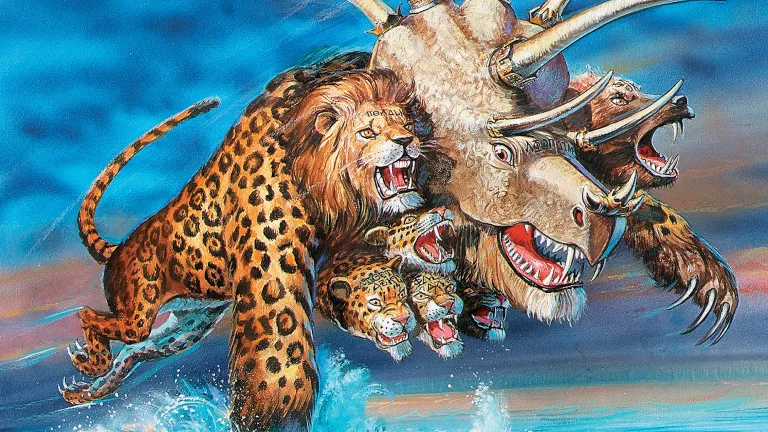
In verses 3-4, John sees a great fiery red dragon representing Satan. The dragon's red color suggests war, bloodshed, and destruction, while its seven heads, ten horns, and seven diadems portray counterfeit authority and power. The seven heads have been interpreted as seven successive empires, from Egypt through Rome to a final empire, or as a group of major powers existing at the end of the age. Revelation 17:12 identifies the ten horns as ten kings who receive authority for a brief time and make war against the Lamb, but Christ ultimately overcomes them. As Duncan cites from The New Bible Commentary Revised, the dragon represents Satan as the spiritual adversary, while the beast of Revelation 13 acts as his earthly counterpart. The diadems symbolize Satan's attempt to claim authority that rightfully belongs to God. Matthew 4 illustrates how Satan offers worldly power in exchange for worship, tempting people to accept influence and success at the cost of obedience to God.
The dragon's tail sweeping a third of the stars from heaven in verse 4 represents Satan's influence over rebellious angels. Job 38:7 uses star imagery in connection with heavenly beings, while Revelation 1:20 also uses stars symbolically for angels. Scripture describes angels as God's messengers, ministers, and protectors in passages such as Matthew 18:10, Hebrews 1:14, Daniel 6:22, and 2 Kings 6:16-17. Revelation 5:11 portrays an enormous heavenly host, reminding us that the spiritual realm is far greater than what human beings can see. Although these passages do not establish an exact number of angels, they emphasize the reality and scale of the unseen spiritual world. Isaiah 14:12 and Ezekiel 28:11-19 also contribute to the biblical themes of pride, rebellion, corruption, and downfall, while Ephesians 6:12 reminds us that our struggle is not merely against flesh and blood, but also against spiritual forces of evil.
Verse 4 says,
"And the dragon stood before the woman who was ready to give birth, to devour her Child as soon as it was born."
This reveals Satan's continuing desire to destroy God's chosen people and prevent His plan from being fulfilled. This pattern appears in Pharaoh's decree to kill Hebrew baby boys in Exodus 1, although God preserved Moses and later delivered Israel from Egypt. It appears again when Herod attempted to kill the young Jesus in Matthew 2, but Jesus was protected and God's promises continued toward fulfillment. Satan also seeks to devour God's word in people's lives, as Jesus explains in the parable of the sower in Mark 4:3-23. Through persecution, temptation, and distraction, Satan tries to turn people away from the truth. The woman, therefore, connects Jesus Christ, physical Israel, and spiritual Israel, all of whom are represented within the broader story of God's people facing opposition from the dragon.
UYA Team | uya@ucg.org
United Young Adults (UYA) primarily serves the 18–32-year age group for the United Church of God. There are three main areas of contribution to the lives of young adults: Promoting Spiritual Growth, Developing Meaningful Relationships and Making the Most of Your Talents. The Know Your Sword series is a daily expository message introducing God’s Word from a trusted perspective.