
Don Ward
This transcript was generated by AI and may contain errors. It is provided to assist those who may not be able to listen to the message.
The title is Attitude Formation. Or we could call it, What is your attitude? And what is attitude all about? So let's define the word attitude. This is a posture assumed by the body in connection with an action. In other words, it could be your attitude. They can talk about the attitude of an airplane as the nose up. Is it down? What about you? Are your shoulders slumped? Are they upright? Or whatever. But that's not what we're talking about. We're talking about your feeling, your mood, your spirit. Attitude has to do with manner of acting, feeling, thinking that shows one's disposition, one's opinion. One's opinion. Their mental set.
I would equate a good attitude with a perfectly teachable heart.
Do we have a good attitude? Do we have a perfectly teachable heart?
Psychologists have identified three components of an attitude. Belief or knowledge. The cognitive component, which we'll talk more about having to do with what you think and the way you think. Feelings. The emotional motivational component.
And then the tendencies to act in a particular way. It's like your habits. Performance component on the basis of the intellectual and the emotional. And it's really difficult to separate these because what you think and also how you feel in the emotional sense and your life experience will to a large degree determine your attitude. Attitudes like concepts serve as a guide to future behavior.
The Bible equates attitude with your spirit. The Bible identifies moods of the spirit.
And what do we mean by mood of the spirit? Well, the word mood is from Middle English, which is derived from the Old English mod spelled with one O-M-O-D.
So it's derived from the Old English word mod spelled M-O-D, which means mind-soul courage.
Attitude having to do with mind-soul courage. Your very being. In approaching a boss or an authority, a figure one might ask, and I know a lot of people do that. They come to the secretary or the child might come to the mother and say, well, is dad in a good mood today? Or what about the boss? Is he in a good mood today? I really need to ask him something. And I don't want my head to be bitten off. You know, what kind of mood is he in today? Mood is similar to the Greek word that is spelled M-U-T, meaning mental disposition, spirit, courage. Today it means a particular state of mind or feeling. The predominant or pervading feeling. For example, happy, sad, angry, sullen. What is your mood? You could think of it in the terms of the lens through which you see your life unfolding. Your attitude. Your mood. Your attitude sits along your other major personality components. The goal and the mood. The goal and the mood. The goal is where you want to go. The mode has to do with method. How are you going to get there? Your goal is what you most deeply want out of life. What you desire, both in general and in given any given situation. And your mode is how you're going to go about that. Are you going to go about it cautiously, boldly, aggressively? What will be your, as I say, modus operandi? How are you going to try to get where you want to go? To some degree, your attitude shows your interpretation of life experiences. Your individual life and how it takes on meaning in general. How you make sense out of reality.
The scriptures describe an upright spirit, a wounded spirit. Let's go to Proverbs 18, verse 14. Proverbs 18, verse 14. This thing about spirit, about attitude, is so very important because it is a mixture of the intellectual and the emotional. It is a mixture of the mind and emotion and life experience. In Proverbs chapter 18, verse 14, the spirit of a man will sustain his infirmity. In other words, if you have this courageous kind of attitude and spirit about you, when the trials of life come against you and the storms of life beat up on your door and your ship of life, you'll be able to stand if the spirit of a man is right. The spirit of a man will sustain his infirmity, but a wounded spirit who can bear. And of course, there are a lot of people that walk around with wounded spirits. They have been hurt in so many different ways. They have had so many injustices become their way. Or maybe it's just time and chance, whatever it is, that life has been made very hard for them. And it's difficult for them to stand. The scripture also talks about a hardened spirit. Look at Deuteronomy chapter 2, verse 30. And at times, God seems to take a hand in things, and if people don't respond to him in the correct way, he may harden the heart. There may be no vision, no revelation from God. There were periods of time in Israel's history in which there was no revelation from God. He just sort of hands off for a season. It would be a frightful thing, hands off by God, and we could ask ourselves, is God really involved in my life? In Deuteronomy chapter 2, verse 30, But Sihon, king of Heshbon, would not let us pass by him. This is Israel on the way to the Promised Land. For the eternally God hardened his spirit and made his heart obstinate that he might deliver him into your hands as appears this day. And the eternal said unto me, Behold, I have begun to give Sihon and his land before you, and began to possess that you may inherit the land.
And so there are times when God can and does harden the heart as he has done in the historical sense. Now we go back to Proverbs chapter 16. In this case, it should be a memory scripture for all of us. How much value does God place on controlling your spirit and your attitude? We could all ask ourselves that. How important is it? How valuable is it? In Proverbs 16 and verse 32.
Proverbs 16 and verse 32. He that is slow to anger is better than the mighty, and he that rules his spirit, his attitude, his approach toward life, the affairs of life, he that rules his spirit, than he that takes a city. Now forward to Proverbs 25. So you see, those who are able to rule their spirit in the sight of God is mightier than the great general who maybe devises the plan and they gain a great military victory and take the city.
But God is looking on each one of us individually, and in our hearts and minds with regard to what our attitude and spirit is. In Proverbs 25 verse 28, he that hath no rule over his own spirit is like a city that is broken down and without walls. It's just open to everything.
Anything goes, anything can come in, anything can go out. Like a city with broken down walls. Not only must we control our spirit or attitude, but we must learn to develop the right attitude and spirit. So why do we have the attitudes that we have? First, let's examine some environmental and psychological explanations for attitude formation.
Attitudes can be formed and learned by direct example. We basically learn to approach things in the way that our parents, the people around us, approach things. So by direct example, through instruction, it seems that people, they hate pop tests. Don't give me the test before you give me the lesson, but in life it seems that we're anxious to go out and experiment and do the thing before we get the lesson.
So attitudes can be formed through instruction if people will listen, formed by your thoughts and by your interaction with others, your life experiences. But perhaps attitudes are shaped more by those that are around you than anything else, as we've already indicated. Parents, friends, peers, social contact, the media, the whole of you, the whole mix of life serves to shape and form attitudes. Here are some factors that shape attitudes. One, need for social approval.
The old, they won't like me if I don't hold this attitude. So I get on the train in Cincinnati going to my gate, and here comes this guy. He has a high mohawk and it's purple. And then his lady friend who's with him, he has some kind of weird hairdo and it's pink.
They seem to be really happy.
So I don't know who likes them because of their hair, but man's greatest fear, and this has been written about dating all the way back to the days before Christ, one of the man's greatest fears is social ostracism to be cast out, to not be a part of the group. We see this in John chapter 9.
John chapter 9 is basically taken up with the affairs, the events surrounding Jesus Christ healing a young man who was born blind. And all of the things that have happened surrounding that, how the people were so amazed, and eventually the religious leaders got involved and they began to question different people. Well, how did this happen? And eventually they questioned the parents with regard to how this happened. So we look at John 9 and verse 17.
They say unto the blind man again, What sayest you of him that he hath opened your eyes? He said, he's a prophet. But the Jews did not believe concerning him that he had been blind and received his sight until they called the parents of him that had received his sight. And they asked them, saying, Is this your son who you say was born blind? How then does he see?
His parents answered them and said, We know that this is our son and that he was born blind, but by what means he now sees? We know not, or who hath opened his eyes, we know not. He is of age. Ask him, he shall speak for himself. These words spoke his parents because they feared the Jews, for the Jews had agreed already that if any man did confess that he was Christ, he would be put out of the synagogue. And if you were put out of the synagogue in that culture, you were a pariah. You were an outcast. Basically, no one would have anything to do with you.
These words spoke his parents because they feared the Jews, for the Jews had agreed already that if a man did confess he was the Christ, he'd be put out of the synagogue. Therefore, said his parents, he is of age. Ask him. And of course, the discussion ensued, but the point is clear about the fear of social ostracism. We go to Matthew 24 and the Olivet prophecy and the events unfolding. Jesus Christ is answering the questions that were posed by his disciples, the sign of your coming in the end of the age. And one of the first things he talks about here in verse 9, then shall they deliver you up to be afflicted, shall kill you, shall be hated of all nations, for my name's sake. See, we haven't come to the point in our message of challenge to the people of this world, to the point that we're getting much of any outside persecution. Generally, all of the problems in the churches, churches of God for the past several decades, have basically come from within. I don't know if you've ever thought about that much.
And then shall many be offended and shall betray one another. See, you'll be hated of all nations for my name's sake. Of course, we begin to see in some of the news items talks about persecution, that people who profess to believe in Christ, Christians, are suffering in various parts around the world. Some are being put to death. And there's countless thousands have been put to death since the time of Christ at the present time. Whether they were, quote, true Christians or not, but for their profession, that they believed the message of Christ as deceived as they might be in whatever aspect of it. Then shall many be offended and shall betray one another and shall hate one another. And many false prophets shall arise and shall deceive many. And because iniquity shall abound, the love of many shall wax cold. See, the iniquity shall abound. This once again shows this part about we want to be accepted by the crowd. We want to be accepted by the crowd. Everybody else is doing it. Well, his parents are letting him do it. His parents are letting her do it. Why can't I do it? Because iniquity shall abound. The love of many shall wax cold. Whereas the Bible says we ought to obey God and not man. That's Acts 5.29.
Another reason has to do with prejudice, the attitude toward other people. If you grew up in an environment where the parents or the neighborhood or wherever you live is, let's say, they're prejudiced in the racial sense. Let's say they're prejudiced in the religious sense.
See, for a long time, basically all the presidents of the United States professed to be Christians. And by that, and by the profession, mainly Protestant Christians. We eventually had a Catholic elected president, John F. Kennedy. And the presidents after that basically professed to be Protestant Christians. But a lot of people have an attitude, a frame of mind, because of a person's religion. And I guarantee you that in this community in which you live, when they know that you are a member of the Church of God, they view you in a different way. Well, they may be friendly, they may be this, and they may be them. That's fine. But when it really gets down to it, how many of them have ever taken up a seat in our congregations? Very few.
It might be attitude has to do with social and economic status. You're not a blue blood from New England. I mean, how could you ever? You haven't attended Harvard or Yale or any of the Ivy League schools. You were educated in one of these community colleges and one of these state colleges. I mean, who are you? So there are all kind of different attitudes that are formed in the prejudicial kind of sense, prejudice. Stereotypes. People have various attitudes. Oh, he is an athlete. He must be a bonehead. Actually, if you were to sort of cut a rim off his head, golf balls would fall out. There are no brains in there. Just...
Or let's say that he's really involved in computer technology. He is an IT guy. Well, he has to be a geek. I mean, he's a geek. Well, even at Best Buy, they have out there geek squad.
So there are that kind of things. The stereotypes. Name a profession. And the lights may go on. Oh, he's a medical doctor. Well, let's build an altar right here and let's worship him. Intolerance for ambiguity. Those who see black and white only. Those... And then you have those who only see gray. Well, he's so wishy-washy. You don't ever know where he stands. Or he is so dogmatic.
You know, I don't want anything to do with him. Or he is so liberal. Similar attitudes, personalities, and other characteristics have been identified as the most powerful basis for friendship and shaping attitude. They mutually reinforce each other's attitudes. And you hear the old cliché, birds of a feather flock together. And boy, did we find it out at Ambassador College. It's like they can... It's some kind of... It's almost like they all wear a certain perfume. And you can sniff it out. And they come together. And here we got this group, and we got that group, and we got this group. Similar personalities, similar beliefs.
So, to a large degree, people generally say, well, I know his attitude based on the company he keeps.
Then we have parental training, of course, which is very important because we learn attitudes and we learn methodology to a large degree in the family. Media exposure.
The research now says that the number one socializing force today is peers and media, with parents ranking on down, maybe in the top 10. I think fathers weigh down like number 10. As far as a socializing force, influence, in shaping a person's attitude, the socializing aspect of their lives. Also, the view of oneself. And people play all kinds of games and viewing themselves. Such as, you know, we have had a family member, no matter what you might say, oh, I'm ugly, or oh, I'm this, or oh, I'm that. And nothing you say can change it. Or one that might say, oh, I'm not worthy, as often an excuse to continue as they've always been. Some might feel guilty because they know they should change. Some take on an attitude of irresponsibility.
The world owes them a living. I'm not responsible. I mean, after all, we've got all these leaders in charge here. And if I elect them, I get a new cell phone. I mean, that's the depth of the thinking that some people have. Some take on the attitude of the world's against me. So there's no need to try. Some take on the attitude, oh, I'm just a martyr here. I'm just a pawn on the chessboard of life. I don't really count for anything. I mean, they just grind me up and spit me out. Or there are other types as well. I have here where this researcher has identified seven types of behavior or seven types of attitudes. Some are apathetic. Of course, apathy is addressed in the Bible and most aptly identified with being lukewarm or we call it laecia.
They are listless and uninterested, willing to let the spinning world carry them along whichever way it will. They are sort of like the pawns on the chessboard of life.
Move me around. I don't really care much. Others are flighty, interested in many things, but only for fleeting moments. They often are involved in something with high spirit, but with equal spirit and in short order they abandon it for another adventure. Just flitting around, no really roots anywhere. Some are very uncertain, seemingly unable to make up their minds about the many choices with which the world continues to face them with. Sort of like me looking for coffee at the supermarket. I can't find or toothpaste or whatever, but that's stupid.
Then there are very inconsistent ones. Persons involved in many things that are mutually inconsistent, if not mutually destructive. Unlike their flighty compatriots, they may have patterns in their lives, but if so, the patterns tend to be incompatible. One thinks of the student who is alternately generous and selfish, or who is hardworking this week and totally without energy the next week. Others at the end of the continuum might aptly be called drifters. For these persons, there's a pattern of behavior characterized by planless and unenthusiastic drifting from this to that, like humans without power or rudder in the sea of life. Just drifting around, sort of following the path of least resistance. A large number are over conformers. And of course, we have the world is filled with ease today. Not having a clear idea of what they want to do with their lives, they take the road of conformity, accommodating themselves the best they can to what they perceive to be the dominant viewpoint of the moment. They are other-directed, and they are passionately subservient to the group. Some are over-decenters, not occasionally in reasoned dissenters, but chronic, nagging, and irrational dissenters.
Of course, we had a decade of that in the U.S. and since then, since the 1960s, with the over-decenters and the hippie movement and the various demonstrations against the establishment, the United States has never been the same, and it never will be the same again, that opened the door.
This behavior pattern is, of course, no more independent of others than is that of the over-conformer. And finally, we note a group of posers or role players, persons who cover their lack of clarity about what life is for by posturing in some role or other that is no more real for them than a made-up cardboard image. One thinks of the class clown or the bully on the block as often being of this type. Each poser adopts a counterfeit existence to conceal his lack of a real one.
To really have thought about life and what it's all about, there are very few people in today's world that have. The Bible talks about the natural way of man, and of course, it talks about God's way.
In Jeremiah 17.9, and I know we used to have this, it seemed that so many sermons back in the 60s and 70s, eventually the minister would get around to reading Jeremiah 17.9.
You don't hear it much today. In Jeremiah 17 and verse 9, the heart is deceitful above all things and desperately wicked. Who can know it?
Of course, God knows it. You look at verse 10. I, the eternal, search the heart. I try the reins, even to give every man according to his ways and according to the fruit of his doings. It goes on explaining that. Of course, God knows your heart. He knows your thoughts. He knows your intent. The word of God, as it says in Hebrews 4, verses 12 onward, is sharper than a two-edged sword, dividing us under the thoughts and intents of the heart of man. So, based on this, the heart is deceitful above all things, desperately wicked. Who can know it? From that, we would say that we can't trust our own thoughts when it comes to how are we going to direct our lives? We need instruction. We need revelation. We need help.
The Bible speaks of the influence of Satan with regard to mind and spirit. So, we go now to Ephesians 2. Let's go there. Ephesians chapter 2. Ephesians chapter 2 verse 1, And you hath he quickened, made alive, who were dead in trespasses and sins. Wherein in times past you walked according to the course of this world, according to the prince of the power of the air, the spirit, the attitude, the mind frame, the spirit that now works in the children of disobedience. So, there is that attitude. And we have talked about Satan broadcasting in moods and attitudes, among whom also you all had your conduct in times past in the lust of your flesh, fulfilling the desires of the flesh and of the mind, and were by nature the children of wrath even as others. So, you have that influence to shape your mind, your heart, your attitude. The way we process information from whatever source is very important. What do we mean by the way we process information? We process information according to the way we view ourselves, our life, our experience, our view of others, and our view of our situation. So, when the information comes in, we examine it in view of all of these factors, and we form an opinion or an attitude about it. And if you've had so much negative experience in your life, you may think almost immediately, well, there's going to be a negative outcome. So, what do you want to base your attitude or mood on? What do I want to base my attitude or mood on? Do you want to base it on this world's system? Satan is the god of this world. We hear it often. We can quote 2 Corinthians 4 for that Satan, who is the god of this world, has blinded them. We can read Genesis 3.1, which says that the serpent was more subtle, meaning more deceitful, than any beast of the field, and he deceived Eve. We can quote John 8.44, that Satan was a liar and a murderer from the beginning. We can quote Revelation 12.9, that that old serpent, Satan the devil, who is deceiving the whole world, and that he is before the throne of God, verse 10, slandering the people of God night and day.
We can read that this world's system will not last. Let's read that in 1 John.
So if a system that is basically led by Satan the devil and those who refuse to listen to God, if that's what's shaping your attitude and view toward life, you are definitely a loser, and you will be a loser now and in eternity. In 1 John chapter 3, actually, I want two, I'm sorry. 1 John chapter 2, verse 15, Love not the world. Do not love this system. Neither the things that are in the world, if any man love the world, the love of the Father, is not in him. For all that is in the world, the lust of the flesh, the lust of eyes, the pride of life, is not of the Father, but is of the world, and the world passes away in the lust thereof. But he that does the will of God abides forever. So we need our attitude to be shaped and formed by the will of God. So we can ask ourselves, is our attitude based on the will of God?
But attitude and frame of mind and view of life is very complex, and there are many factors, as we've already noted, that come into play with regard to this. Hopefully God is at the forefront. The truth of God is revealed in the Bible. The Church of God, your parents, your brothers, sisters, your friends, the peer group, the ministry, your teachers. Some want to base their attitude and mood on Satan's way, on Satan's way or on the way of their peers. And some insist on basing their attitude on the mistakes of others, because some people have had a very negative experience, or friends have had negative experience in the Church. They want to say, oh, we know what that's like. And so they have an attitude that is formed, that is really not accurate, but it's based on what somebody else has said or what somebody else has experienced.
Some want to base their attitude and mood on the mistakes of others, but do you want a right attitude and spirit in the sight of God? So we can ask ourselves, what is most important to us? An attitude, a heart, a mind that pleases God, or an attitude and spirit and heart that pleases man.
So let's look at Psalm 51. Psalm 51, David's repentance psalm after some horrible mistakes in his life, adultery, murder, and Psalm 51. Beginning in verse 7, Purge me with hyssop, and I shall be clean. Hyssop was a powerful cleansing agent. In the Bible, the powerful cleansing agent, for example, in John 15, it says, You are clean, but not all. You are clean through the words that I have spoken to you. It talks about in Ephesians 5, by the washing of the water of the Word. So the Word is like a cleansing agent of the heart and the mind and the spirit. But you have to bathe in that. Wash me, and I shall be whiter than snow. And so the water we to be washed in, the old song says, Ask the question, Are you washed in the blood of the Lamb? Of course, it is through the life essence, blood symbolic of life, through the sacrifice of Christ, that our sins can be remitted. And then, as we experience initial conversion and repentance and forgiveness, then we are to be washed in the water of the Word. Make me to hear joy and gladness, that the bones which you have broken may rejoice. Of course, that is symbolic. But David had to be broken in a way that he would come to listen. Hide your face from my sins, blot out my iniquities, create in me a clean heart, O God, and renew a right spirit within me, a right frame of mind, a right heart, a right attitude. So do we want to be of an excellent spirit, as was Daniel. Let's go down to Daniel, the book of Daniel, chapter 5.
Daniel is spoken of very highly. He is classed in, though Job, Daniel, and Noah be in it, they would only save themselves. He is viewed as one of the ones that God showered so much favor upon in the historical sense. As you recall, Daniel was taken captive by the Babylonians.
He was schooled in all the learning of the Chaldeans, and yet remained faithful to God. And through all of his trials and tests, from the lion's den to whatever. In Daniel, chapter 5, he's now apparently quite old. We look at verse 12. They call for Daniel. Well, we should read verse 11. There is a man in your kingdom in whom is the Spirit of the holy gods. And in the days of your father, light and understanding and wisdom, like the wisdom of the gods, was found in him, whom the king Nebuchadnezzar, your father, the king, I say, your father, made master of the magicians, astrologers, Chaldeans, and soothsayers.
Daniel was over all of them. For as much as an excellent spirit, or you say he had a great attitude, he had an excellent attitude. And knowledge and understanding, interpreting of dreams, and showing of hard sentences, and dissolving of doubts, were found in the same Daniel, whom the king named Belteshazzar. Now let Daniel be called, and he will show the interpretation. Then was Daniel brought in before the king. The king spoke and said unto Daniel, Are you that Daniel, which are of the children of the captivity of Judah, whom the king of my father brought out of jewelry?
I have even heard of you, that the Spirit of the gods is in you, and that light and understanding and excellent wisdom is found in you. Now go to chapter 6. So Daniel interprets the handwriting on the wall. You've been weighed in the balances and found wanting, and today your kingdom is going to end, or tonight. And another occasion, Daniel 6, it please Darius to set over the kingdom 120 princes, which should be over the whole kingdom, and over these three presidents of whom Daniel was first, that the princes might give accounts unto them, and the king should have no damage.
Then this Daniel was preferred above the presidents and princes because... Why? An excellent spirit was in him. I mean, he just radiated this spirit, this attitude. And the king thought to set him over the whole realm. And of course, you know the story about the jealousy and how he wound up in the lion's den, because he prayed as he always prayed. So how can you or I change our attitudes? Here's what psychologists say. Most social psychologists now believe that attitude and beliefs are organized basically according to the principle of consistency.
The consistency principle as applied to attitude states that the attitudes held by a particular individual are mutually supportive and do not conflict with each other. That is, they make sense to the person in a logical or psychological fashion. I would say in today's world, so much of it is in a... to coin a phrase may be a misperceived psychological fashion of wanting to please whomever it is around them from whom they get their cues as to their worth or acceptance.
That is, they make sense to the person in a logical or psychological fashion. Consistency also refers to the tendency of individuals to segregate liked objects from disliked objects and to structure their thoughts in simple black and white terms. If a set of attitudes held by a particular person is viewed by him as consistent, it would be difficult to change any single member of the set because changing one attitude will make it inconsistent with all others in the set. And believe me, you come to see this in the church with regard to various mindsets. At once, a person gets a particular thing in their mind with regard to what the Bible says or doesn't say or the way things have been done or not been done.
It is very difficult to move to a different mindset or frame of mind. The person finding this inconsistency unpleasant will resist attitude change. According to the Consistency Principle, you're likely to change one of them to bring out consistency. Inconsistency is seen as a primary reason for attitude change. Inconsistency must be resolved because it is disturbing to see one's own attitudes as inconsistent with each other. If we take this, let's take it for example of preaching the gospel. If you challenge people on heaven and hell, it goes back to the belief that you have an immortal soul.
So if you challenge a person to the depth of their being with regard to, do you have an immortal soul and you try and use whatever evidence is there, both scripturally and whatever you can do in the rational sense, to the point that you challenge them to the point that they doubt it is inconsistent with what they have always believed, you may get them to look at it in a different way.
And of course, I think that's where things are not meshing up. And it is difficult for us, those of us who are older, who did not experience the internet, the cell phones, and all this information that is available to everybody in today's world, we didn't have that. And so it was much easier when we heard a message that challenged the way we had always looked at things, to say, hey, this is inconsistent with what I believed, it may stimulate you enough that you'll look into it. That's what happened to me on several fronts.
It is disturbing to see one's own attitudes as inconsistent with each other. You are now likely to change the attitudes in such a way as to bring about a state of consistency. The basic law of attitude change is that change follows from a state of inconsistency where you are challenged enough, whatever word you want to use, and proceed toward a state of consistency.
So if you come to believe you don't have an immortal soul, then you would come to believe that you don't burn forever, never, and hellfire.
You should create a state of inconsistency in that person's mind, usually by presenting him with some new evidence against his beliefs. Maybe that's where we are failing to some extent. Evidence that is so strong, that is so compelling, that is so challenging that you don't have a rebuttal. You can't regret it.
Actually, persuasive communication such as speeches, TV commercials, and newspaper articles sometimes fail to change attitudes despite what seem to be optimal conditions. The best example of this is the failure of the anti-smoking campaign to decrease cigarette consumption in this country. Now, cigarette consumption had been decreased quite a bit, and a lot of it had to do with restrictions that were placed on it by the government. It is still one of the leading causes of lung cancer.
This is despite some very clever and dramatic TV spots, the barrage of newspaper and magazine articles warning on the cigarette packages and ban on TV cigarette ads.
The major problem, obviously, is getting the audience to attend to the message. Smokers probably pay less attention to the anti-smoking ads and obtain less information about the harmful effects of smoking. So if they hear another thing that happens with so many people, their mind is already made up. We don't reach a lot of young people, especially when they get into their teens, because something has turned. It's like a switch has been turned off. And before they even go, they have made up their minds. I'm not going to listen to this.
They sort of might have heard it, but they don't really hear it in their minds and hearts.
One major problem, obviously, is getting the audience to attend to the message.
As for the warning on the cigarette pack, the odds are that it is perceived, rarely, if at all. The fact that we want others to see our behavior as consistent implies the operation of a second principle. The approval of certain people can act as a strong reward, or conversely, the loss of approval can be punishing. Our behavior to a large measure is a product of those social factors. They guide what we do and what we learn. More often than not, control of social rewards and punishment resides in the hands of family, peers, and close associates. These are the people who are capable of delivering immediate reaction of approval or disapproval to one's behavior. The phenomenon is more general than that. However, human history is replete with examples of the control and authority that an authority figure can exert. So many of these gangs, and gangs now pervade the whole United States of America. There are gangs in East Texas, from LA, East Texas, East Coast, wherever you want to go. And there are people at the Apex, authority figures, that if you want to be a member of this gang, it may be that you have to drink this potion, it might be that you have to perform this robbery, it may be that you have to commit some kind of crime against a person's person, that is, to injure him, to hurt him, or even kill him. And people will commit almost any act at the command of authority, even an act which is objectively inhumane to another person.
So we see tremendous inhumanity in today's world. But what does God say? So let's summarize this from the Word of God.
As a man thinks in his heart, so is he. Let's go to Proverbs 23 and verse 7.
Proverbs 23 and verse 7.
For as he thinks in his heart, so is he.
Eat and drink says he to thee, but his heart is not with you.
The Bible basically equates heart with the seed of thought. And the old saying of, so a thought, reap an action, sow an action, reap a habit, sow a habit, reap character.
But in attitude formation, it's not just the cognitive thinking aspect. It also involves the feeling aspect of your being and your experience, what you have experienced in life. Now back to Proverbs 4 and verse 23. So the Bible places great emphasis on what will go into your mind and heart. In Proverbs 4 and verse 23, keep your heart with all diligence, for out of it flow the issues of life. So remember the Proverbs 1632, that he that rules his spirit is mightier than a man who takes the city. And so much of it is up to the way we view the world.
And I am convinced in those very formative years, even going back to the time of birth, and maybe even in the womb, those first few years of how the parents approach life and what they're exposed to begins to really shape how a person is going to be and how they're going to react.
Now let's notice Philippians chapter 4. The Bible not only warns us and tells us what to do with regard to our frame of mind and shaping our mind and heart. It tells us what to put in there. There is not some kind of magical way that things are being magically be put into our minds and hearts. Even though if we grant that Satan broadcasts in moods and attitudes before we are held responsible for a thing, it must somehow come to a level of awareness in which we make a decision that I'm going to go this way or that way. We'll get to in just a moment. In Philippians chapter 4 and verse 5, Let your moderation be known unto all men, the eternal is at hand. Be careful or anxious for nothing, but in everything by prayer and supplication with thanksgiving, let your request be made known unto God in the peace of God.
There are two types of basic peace in the Bible. The peace with God, which you make at repentance and conversion, and the peace of God, which passes all understanding, shall keep your hearts and minds through Christ Jesus. See, you can have the kind of positive attitude, mind and heart.
Finally, brethren, whatsoever things are true, whatsoever things are honest, whatsoever things are just, whatsoever things are pure, whatsoever things are lovely, whatsoever things are of good report. If there be any virtue, if there be any praise, think on these things.
So that's how God says what you're to put into your mind and into your heart.
Now, it ties in with our view and understanding of the Word of God. See, the Word of God and the Spirit of God are necessary to really change one's attitude.
So it ties in with Hebrews 11.6.
Those who would come to God must, first of all, believe that He is, and that He is a rewarder of those who diligently seek Him.
So when people come to see that the way they are approaching life is not working, as we have already noted, they are more apt to seek something else.
People in our current culture, so many of them, are crying out. They see that what's going on in this world is just not working.
But what are we offered in turn? We're offered, quote, political kind of solutions. If we improve and you fill in the blank, things will be better, and they never get down to the heart and the mind.
Now let's go to 1 Corinthians 2. In the broad sense, there are two sources of knowledge, human knowledge and the knowledge of God. Now God gave us a mind to think with that we can, as they say, put two and two together. We can think, we can reason, but apart from the spirit of God and the spirit in man, it's limited to the physical realm. So we have the knowledge that is limited to the physical realm. There is the potential of having the knowledge that is revealed, that comes from God. In 1 Corinthians 2, verse 10, But God hath revealed them, these wonderful things of verse 9, but God hath revealed them unto us by his Spirit.
For the Spirit searches all things, yea, the deep things of God. So that dimension of revealed knowledge. For what man knows the things of a man, that is the physical realm, save the Spirit of man which is in him, and even so, the things of God knows no man but by the Spirit of God.
So there are two broad classes of knowledge, that of the human realm and that of revealed. Now we have received not the Spirit of the world, but the Spirit which is of God, that we might know the things that are freely given to us of God.
So now you look at Psalm 119.
So how do you know the things of God? Well, the Word of God reveals those things to you. How do you know right from wrong? Well, God reveals to us right from wrong.
In Psalm 119, verse 9, How shall a young man cleanse his way by taking heed thereto according to your word? How shall a young man cleanse his way by taking heed thereto according to your word? With my whole heart have I sought you or let me not wander from your commandments. Your word have a head in mine heart that I might not stand against you. Then it says in Hebrew, that I might not stand against you. And then it says in Hebrew, that I might not stand against you. Then it says in Hebrews, that God writes His law, His mind, His Word on our hearts and minds so that we may have a new conscience, a new knowing within, so that our attitude is shaped by the Word and Spirit of God. So when all is said and done, there are only two paths that can be pursued.
The way of death or the way of life?
Well, Deuteronomy 30.
Deuteronomy begin in verse 15.
Deuteronomy 30 verse 15.
Deuteronomy 30 verse 15.
See, I have said before you this day, life and good, death and evil. Those are not there. When all is said and done, those are the two choices that humankind has.
You're either going to choose death or you're going to choose life. You're going to choose to have your attitude, your heart, your mind, your inner being molded by the Spirit and Word of God or the ways of this world.
In that I command you this day to love the Eternal, your God, your Yahweh Adonai, I'm sorry, your Yahweh Elohim, to walk in His ways and to keep His commandments and His statues and His judgments.
That you may live and multiply and the Eternal, your God, shall bless you in the land where you go to possess it.
But if your heart turn away so that you will not hear but shall be drawn away and worship other gods and serve them, I'd announce unto you this day that you shall surely perish and that you shall not prolong your days upon the land where you go to possess it over Jordan.
I call heaven and earth to record this day against you that I have set before you life and death, blessing and cursing, therefore choose life that you and your seed may live.
That you may love the Lord, your God, and you may obey His voice, that you may cleave unto Him, for He is your life and the length of your days that you may dwell in the land which the eternal God swore unto your fathers to Abraham, to Isaac and to Jacob, to give to them.
Now we go to Ephesians chapter 6, if we have heard so often, if you make the right choice you're going to follow God, then He has a coat of arms, a coat of armor. It is not seen. It is not physical.
By which you can attain the victory. You can gain the victory. You can have the mind, the heart, the attitude of God Himself.
In Ephesians chapter 6, Finally, my brethren, be strong in the Lord and the power of His might.
But on the whole arm of God that you may be able to stand against the wiles of the devil, for we wrestle not against flesh and blood. See, that's one thing that basically the people of the world never come to realize. They think that their enemy is the other human being. That person across the border, that's my enemy. That person that doesn't believe, as I do, about Allah.
He's my enemy.
I want to kill him. See, that's the mindset of Satan the devil.
When we come to understand, we wrestle not against flesh and blood, but against principalities, against powers, against the rulers of the darkness of this world, against spiritual wickedness in high places. We don't really understand the extent of the influence of Satan the devil on the affairs, the events in this world.
How are you going to win the victory?
Wherefore take up unto you the whole arm of God that you may be able to withstand in the evil day, and having done all to stand, stand therefore! That's the way it should be punctuated.
Having your loins gird about with the truth, which is the Word of God, having on the breastplate of righteousness, all of your commandments are righteous, your feet shod with the preparation of the gospel of peace, you're ready to fulfill the Great Commission to take the gospel to the world, one of the main reasons God raised up the church.
Above all, taking the shield of faith, whereby you'll be able to quench all the wicked in practical terms. What does that mean?
That means that regardless of what Satan throws against you, all of the fiery darts of doubt and fear, superstition, and whatever he can wage, whatever he can fire toward you, will be deflected by this shield of faith, because you know and you know that you know that God will deliver you.
Take the helmet of salvation, which in 1 Thessalonians 5.8 is defined as hope. The big picture burning brightly in your mind, hope. Paul writes in one place, we're saved by hope.
That you know that you are going to receive a crown of life.
And the sword of the Spirit, which is the Word of God, bring always with all prayer and supplication in the Spirit and watching thereunto with all perseverance and supplication for all saints.
So you put on that whole armor of God. Your mind, your heart, your attitude will be shaped. Now, you look at 2 Corinthians Chapter 10.
2 Corinthians Chapter 10 about waging this spiritual warfare in the world.
2 Corinthians 10 Verse 3.
See, we just have read here the various implements in this armor.
For though we walk in the flesh, we do not war after the flesh for the weapons of our warfare are not carnal but mighty through God to the pulling down of strongholds. What are the strongholds? Those attitudes, those frames of mind, those vain imaginations that it talks about in the next verse that war against the truth of God.
Nobody loves me. Nobody cares. This is more than I can bear. Whatever it is, that's not what God says.
Casting down imaginations and every high thing that exalts itself against the knowledge of God and bringing into captivity every thought to the obedience of Christ and having in a readiness to revenge all disobedience. You come to hate it. You don't want it that way when your obedience is fulfilled.
You see, when we come to that state of mind, when our attitude is framed in such a way, there will be nothing that can defeat us. Now, finally, let's go to Romans 8.
Starting on Tuesday of this week, I'll be conducting a WebEx class for the ministry that are signed up for this class on the epistles of Paul.
We'll start in Romans. In Romans 8, verse 31, verse 31, What shall we say to these things of God before us who can be against us?
If that were to sink into the very depth of our being, that would be the principle thing that shapes our attitude, our mind, our heart, our approach.
No matter what all these external factors are that we have enumerated, talked about, if you come to understand that, of course, it says, if God be for us, not willing that any should perish, all should come to repentance.
I would say He is for us.
If God be for us, who can be against us?
He that spared not His own Son but delivered Him up for us all, how shall He not with Him freely give us all things?
Who shall lay anything to the charge of God's elect? It is God that justifies.
What did it require for us to be justified?
The death of Jesus Christ and faith in the sacrifice of Christ.
Who is He that condemns?
It is Christ that died, yet He rather that has risen again, who is even at the right hand of God, who makes intercession for us. So we have God on our side. We have Jesus Christ praying for us.
Who shall separate us from the level Christ? Shall tribulation or distress or persecution or famine or nakedness or peril or so'er as it is written? See, here's the state in mind and heart and the attitude.
How do you come to this?
As it is written, for your sake, we are killed all the day long.
We are accounted as sheep for the slaughter.
To come to that state where you are so humble and contrite.
Why?
Knowing all these things, we're more than conquerors through Him that loved us. For I am persuaded that neither death nor life nor angels nor principalities nor powers nor things present nor things to come nor height nor depth nor any other creature shall be able to separate us from the love of God, which is in Christ Jesus, our Lord.
So, brethren, we can have that assurance. Our hearts, our minds, our attitudes can be filled with that assurance. And we can have the kind of attitude and heart that God wants us to have and overcome everything that is placed in our path.
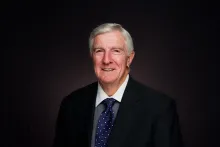
Before his retirement in 2021, Dr. Donald Ward pastored churches in Texas and Louisiana, and taught at Ambassador Bible College in Cincinnati, Ohio. He has also served as chairman of the Council of Elders of the United Church of God. He holds a BS degree; a BA in theology; a MS degree; a doctor’s degree in education from East Texas State University; and has completed 18 hours of graduate theology from SMU.
