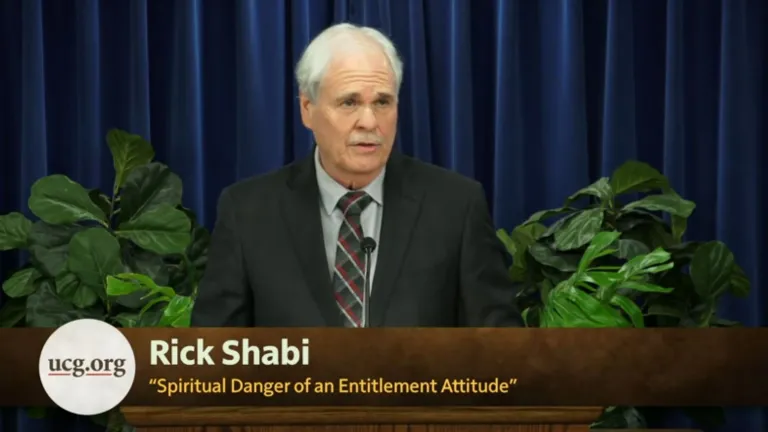


Rick Shabi
This transcript was generated by AI and may contain errors. It is provided to assist those who may not be able to listen to the message.
Thank you very much, Joy, and good afternoon to everyone. Nice to see you. We've been battling some congestion and cold and kind of headachy feelings for about, probably about three weeks or so. They don't get us all the way down, but they kind of linger, and some stomach difficulties as well. So that keeps us honest and open and nearby certain facilities. Anyway, we've it's nice to see you this Sabbath day. We are on the mend. We're feeling better, and I hope you are all staying healthy and well. I talked to Mr. Smith, Ed Smith the other night. He had just gotten back from the hospital, and I thought, well, just give him a try, see if he calls. I thought maybe his wife would answer the phone, just say he's doing all right. He answered the phone. He ended up talking to him for 20 minutes. I didn't want to overly tire him out, but he said he was doing fine at that time, and he appreciated just the call. I told him that I had seen my brother in California, and he had worked with my brother as a deacon in Oklahoma when my brother's first pastorate. So he always had an affinity toward my brother, and so I told him that my brother had asked about him when we were in California, and my brother's son that he used to call partner when they were together. They were buddies, you know, in Oklahoma. So he's now 50, my nephew. So I told him that they asked about him, and he was very pleased about that. ABC is going very well. We have about 32 students. Joy is married to David Jones, one of our ABC students, and we appreciate the class. They are studious. They are interested in learning. They are coming out of their shell. Takes a few months before they can feel safe enough to ask questions and get involved a little bit more. But it's a pleasure to teach them. They have good attitudes and good hearts, and we're certainly working with them to try to convey to them the precious knowledge of God as we see it in the Scriptures and try to bring it across to them so that they may be able to use that when they grow, when they finish in May and go back to their home areas and be able to be examples of God's way and also to be able to teach it if necessary and certainly to help others with it.
I'm planning on a trip to Arizona sometime in February and to talk to all the education task force. Most of them live out west, so I'm going to go out there for, and of course, February, Arizona in February. It kind of like makes good sense. But anyway, it's not for that reason.
A lot of them are in that general area, so we will be going out there for a meeting, face-to-face meeting, which they haven't had for a long time. So we'll be able to sit on and talk about lay plans to get things done regarding brochure or books for the feast for the young people and different projects that we've been working on. So we will get together face-to-face and make sure we're following them through and not just pie in the sky, blue-sky-ing it and just, you know, talking and not doing anything.
So I want to talk about that. So we'll be going out there in February. And of course, been working diligently with Whitney's been a big help here at the home office. She's putting together a brochure for the Winter Family Weekend and a number of the individuals. We have about 35 wonderful individuals who are willing to help put this on. It's something that is there are lots and lots of details.
And so we have about 35 who are key people. They'll be asking some of you to help out because we'll probably have right now we're up almost to quota. We reserve 200 rooms at Great Wolf Lodge. We have to have at least 160 of those. We're almost to the 160 rooms. And once we reach that plateau, then we can go up to 200 if need be. So but at least if we reach that, we won't be charged for the other 40. But if we don't at least reach 160, we're in trouble. So and we tried to save brethren money by having everybody put it all on the master bill by it saves them the sales tax, the 6.5, whatever it is.
It doesn't save you the occupancy tax and it doesn't save you the lodging tax, which are put on usually in almost every every hotel. But it does save you a lot. And so it's it's coming along nicely. They're very amenable up there working with us, busily trying to plan out.
We have five. We will have five speakers, five for teens and five for the adults speaking Sabbath morning at 10 o'clock and 11 o'clock. There'll be two teen speakers at 10 and three adult speakers. And I mean, there won't be teen speakers, but they'll be speaking for the teens. And pro and then at 11 o'clock, we'll have three seminars for the teens and two for the adults.
So we'll have five going on in the morning at 10 o'clock and 11 o'clock on Sabbath morning. We'll have a Bible study with a, what is it, a dessert social. On Friday night, Mr. Fentchel is going to do the Bible study. And on Sabbath, we have Mr. Greg Thomas coming down from up in the Cleveland area.
He gives wonderful messages. You'll love his messages. So he's going to be speaking from speaking on the Sabbath. He'll give the main sermon that day. Plus, we'll have music and announcements and so on. So it should be really, really nice. All Ambassador Reunion will take place there. And all of you will be invited. We're not going to shunt you off somewhere. You're welcome to go to services there.
So we will have, I think, room for over 1,300. Right now, we're looking at maybe 800 to 1,000, maybe 1,200 total coming. And we have a number of young people already signed up to come. So it's going to be a very nice time. We have sports facilities that everything's in the same area. So whether it's volleyball or whether it's basketball, they're all in the same area.
And we even have indoor football and indoor, what is it, speed away. And we also have indoor teens can play. So two real, I mean three real large fields, indoor. So they're all in that same vicinity. So you take your kids over there, they could play speed away. You could be at the basketball or volleyball. And you could meet up together afterwards. You don't have to be going to three or four different places.
So we're very pleased about that. And we're excited to put it on. And Cincinnati, I think, is going to have a very good showing this coming year for this particular event, the Winter Family Weekend, 2011. So we appreciate all the help everybody's been given. If you're still planning on making your reservations there, you should get in there and make them while you can at Great Wolf Lodge. I think it's it's wfw at ucg.org. But I may be wrong. Check with Richard Kennebecke and give it to you.
Thanksgiving is a wonderful time of the year. It's probably the major holiday that we can all participate with our family, whether they're in the church or out of the church, because it's a time when we can get together. It's a national holiday that has not the pagan implications that some other holidays tend to have. And so we're able to get together. And it was one that I've loved all my life.
We can be thankful to God for the physical blessings that He's given. We can be thankful to God for the spiritual blessings that He's given to us. And I was thinking about my most memorable Thanksgiving. My most memorable Thanksgiving was 1968. My wife and I had been childless for five years. We thought we probably would never have any children. And during that year, my wife conceived. And just before Thanksgiving, about four days before Thanksgiving, my wife gave birth to our first-born daughter, Jan. She's sitting here, which we considered one of the biggest blessings that we ever had, because now we could keep that first Thanksgiving as a family. And not only that, but my dad and mother lived in Pittsburgh, and they drove up with my younger brother and sister. And my brother Dave was in Akron at that time, and he and his wife and son came. So they all came up that first Thanksgiving after my first daughter was born. And it was just something that was very special to us. My wife was over 30 hours of labor, and she finally, with the help of doctors, they turned to Jan, and she was able to be born. But it was a time that I was very grateful and thankful that we had a daughter, a child, after thinking that we would never have any children. So it was a blessing that we were so grateful for. Colossians 3 and verse 15 tells us that we need to be thankful. Colossians chapter 3 verse 15, he said, Paul writes, he said, by the way, Paul is such a grateful person. You read through Paul's writings. He's constantly thanking people or promoting them or telling what a good job they did or how happy he is for them or how thankful he is for them and how much gratitude and how grateful he is for this and that and the other thing. But in Colossians 3, 15, he put it this way, and let the peace of God ruin your hearts to which also you are called in one body, I'm reading out of Old King James, and be you thankful. The title of this sermon is, Be You Thankful.
Now to be thankful, there are three aspects to being thankful. In order to fulfill this command or this instruction from the Apostle Paul in the Word of God, we need to have three aspects of gratitude, of three aspects of thankfulness. And I'd like to share those three aspects with you.
The first one is our attitudes. Our attitudes. We live in a world that is described by the Apostle Paul as being unthankful. He talks about all the characteristics in 2 Timothy 3 verses 1 and 2, but one of them he points out, he says, this is an unthankful end time generation.
These people are not thankful. Sometimes I've given people the business. You've paid your check or you've paid for your bill. And I end up saying thank you because they didn't.
Something's wrong. I just gave them business and they didn't even thank me.
We live in a society and in a world that feels entitled. Well, I deserve this. What took you so long? I remember one movie where the statement was, how was it put? I almost had to wait. When somebody was going to serve her something, she said, I almost had to wait. So the entitlement, I deserve this. Well, it's about time. I'm entitled to this. That's the kind of a society we're living in.
Not everybody is ungrateful, but there are a lot of ingrates in this world.
Deuteronomy chapter 8, God warns us. God warns us about it. Deuteronomy chapter 8, he talks about our attitudes. When blessings come, what is our attitude toward them? Well, I deserved it. Well, my own hands did it. Of course I'm going to get it. Other people say, well, of course I deserve that. Deuteronomy chapter 8 and verse 7. We read, For the Lord your God brings you into a good land, a land of brooks of water and of fountains and depths that spring out of the valleys and the hills, a land of wheat and barley and vines and fig trees and pomegranate, as a land of olive oil and honey, a land wherein you shall eat red without scarceness, and you shall not lack anything in it, a land whose stones are iron, and out of whose hills you may dig brass. You have lots of ore in the hills. And when you have eaten and are full, then you shall bless the Lord your God for the good land which He has given to you. Verse 11. Here's attitude. Beware that you forget not the Lord your God in not keeping the commandments, His commandments and His judgments and His statutes, which I command you this day. Verse 14. Then that your heart will be lifted up and that you forget the Lord your God, which brought you forth out of the land of Egypt from the house of bondage. And verses 17 and 18. And you say in your heart, My power and the might of my hand has gotten me this wealth. I deserved it. I did it.
See, there's an attitudinal problem here. They thought they did it. It was all about them.
And unfortunately, in our world, a lot of times it is about us instead of having an attitude of gratitude, as we'll see it comment a little bit later.
And verse 18. But you shall remember the Lord your God, for it is he that has given you power to get wealth that he may establish his covenant, which he swore to your fathers as it is this day.
I'm going to talk to you about three examples in Scripture that I think illustrate the kind of attitude that we need to have. An attitude that says, why me? An attitude that says, who me? An attitude that says, why do I deserve these blessings?
Why do these things come my way? And I think of Moses. When God asked Moses to go lead his people out of the land of Egypt, you know what Moses said? Why me? Why me? You can find that in Exodus 3, verses 10 and 11. When the apostle, when Saul was picked to be king. You know what it says about Saul?
There was nobody taller. There was nobody more handsome than Saul in all the land of Israel.
And you know what they said later on about him? When God came to him to say, we're going to make you king. You know what he said? Who am I? Who am I? And what is this? My tribe. It's the littlest tribe. It's small. You want me?
That was an attitude that said, I can accept things. It was an attitude that was grateful. It wasn't an attitude of, well, I deserve it. Well, it's about time you recognize I'm tolerant and everybody and more handsome. I should be the king. It was an attitude of humility.
And the third one I'd like to share with you is that of Solomon. King Solomon.
When he took over, it said he loved the Lord his God. He loved God so much. And he tried to walk in the ways of David. He had a few little foibles here and there, but God still accepted him.
And God said, Solomon, I want to give you something. I want to give you a blessing.
Ask for anything you want. And Solomon said, give me an understanding heart that I may take care of your so great a people. Because who am I? Who am I to be able to take care of so great a people as yours? Give me the wisdom. Give me the good judgment that I may help take care of them. Because who am I? Those are the kind of attitudes that we need to have in order to be thankful. Because it's not like somebody gives you something. Well, I deserve that. When you're at a restaurant, they bring you. You ask, could I have another napkin? They bring it to you. About time you bring it here.
How do you thank them? I've been shocked. I think the waitresses seem shocked. Did I say thank you every time? May I have the ketchup? Thank you. They're shocked.
What am I? Just there for everybody to wait on me? Yes, they are. They're there to wait on me.
Should I recognize it? Should I appreciate what they do? Yes, I should appreciate it.
Do I have it coming to me? When I ask for something extra, can you put a little extra blue cheese on? Do I have it coming to me if they say, sure? And they bring it to me. Well, it's supposed to do this. Or do I thank them? See, the attitude of, I expect this. I'm entitled to this. Well, I'm glad you recognized that I needed something. I'm glad that you came to me. Those kind of things do not allow you to be thankful.
A grateful heart starts with an attitude. And it's an attitude that recognizes that James 1, 17, every good and every perfect gift comes from God. It's an attitude that says, you know what, I don't deserve this. But I'm grateful that it came my way. I was very thankful to Feast this year. I'll share a personal story. I was supposed to be business manager in Escondido, and I went in to sign up to get, you know, let them see my signature card or find my signature card so I can open an account there. They already had an account so I can access it. And when I said, here I am, I showed them my driver's license, showed them my, wrote my signature, whatever. And they said, we don't have it. Oh, no, not what I would do. I called Peter Eddington in Hawaii because I didn't have Gerald Seelig's number. He gave it to me. And I called Gerald Seelig. Gerald Seelig talked to them back and forth, back and forth. They're looking on the line and looking to see this Gary Enty and who is this guy trying to get into this account. And Gerald Seelig already said, yes, he should be there. I've sent you his signature card. You should have it on file. They couldn't find it, couldn't find it. Is this lady's busy looking it up? I was grateful that there was trouble. You know why? She found two IRA accounts that I had with that bank. Not that one, but the general bank that I had forgotten I even had. $8,800. Not bad. I didn't even know I had it!
I moved from Canada. Last number they had last addressed. She said, whoa, you're from Canada, right? I said, no! I don't live in Canada anymore. I haven't lived in Canada since 1999.
She said, well, they've been trying to send you statements and they keep coming back.
She said, you have two IRA? I said, I do. She said, yes. Forgot in the move. I forgot that I had these. Probably started them even when I was living in California. But she said, yeah, you have two of them there. So when I got back here, I checked it out and they factor a lot of rigmarole to make sure they knew who I was. They sent me and sure enough, I had two accounts. So thank God for even a bit of a hassle. Without that hassle, I would have never known. They probably would have sat out there and then they would have probably said, this guy's dead. Let's just give this money to the government or whatever. But now they know I'm not dead. Now, it was a blessing. I thank God. I said, I'm so thankful that there was a problem today. Attitude. I didn't expect it from anywhere.
And there it was. Quite a blessing. Philippians 4 and verse 6. I read James 1, 17. Every good and every perfect gift comes from God, from above, comes down from the Father of lights with whom is no variableness or shadow of turning. Philippians 4 and verse 6. And by the way, don't hit me up for alone because I can't get that money anyway for about two years because it's locked up in CDs for two years. So Philippians 4 and verse 6. But it is mine. Mine, mine, mine!
I didn't deserve it. I was humble about it. But it's mine now. Okay. Philippians 4 and verse 6.
We read this, Be careful for nothing, but in everything by prayer and supplication with thanksgiving. Look through the Psalms. The Psalmist, David, and other Psalmists, they were filled with praise and thanksgiving to God. Thank you, God, for this. Thank you, God, for that. I give you thanks. Everybody deserves to give you thanks. Thank you, God. There's so much in there. And he says here, Everything by prayer and supplication with thanksgiving, let your requests be made known to God in everything. It's interesting. I have a quote here about an attitude. Matthew Henry, the famous scholar, was once accosted by thieves and robbed of his purse or his wallet. He wrote these words in his diary. Here's an attitude.
Let me be thankful first, because I was never robbed before.
Second, because although they took my purse, they did not take my life. Third, because although they took my all, it was not much. And fourth, he was thankful. Because it was I who was robbed and not I who robbed.
See, there's an attitude. You have an attitude about things. You have an attitude about what you receive. You have an attitude about what happens to you in life and what happens to me in life. Chinese proverb, and that, by the way, came from 15,000 quotations from Li Tan. That was number 13179. Here's number 6606 from 7,700 quotes. This is before he expanded his book. Chinese proverb says this, When you drink from the stream, remember the spring.
When you drink from the stream, remember the spring. The attitude has to be, I appreciate everything that comes my way, but who am I that this should come to me? Who am I, and what am I, that this should happen to me, this nice thing?
Not, I'm entitled to it, or I'm sure glad you recognized to bring me something. I deserve it.
I tell you, that attitude is out there. If you want to be truly grateful, you must have a grateful attitude, a grateful heart.
Next, point number two. Point number one is our attitude. Point number two is our thoughts.
Our thoughts. We must consciously think about what is happening and what is going on in order to truly be thankful. In fact, I have a quote that's called, Think and Think.
It's often been pointed out that thinking precedes thinking. When we are presented with a gift, it is because we think of its significance and meaning that we are led to express appreciation.
This person went out and picked this gift dot for me. This person thought enough of me to do this thing. What a nice gesture. Again, thinking about it leads us to think.
So it's an attitude. I'm not deserving of this, but thinking about what's happened causes us to think. What enters the thoughts that are entertained by Christians that lead to being thankful or thanksgiving? Somewhere in our thinking there should be thoughts of God. Perhaps we should start there. Thank God! What a train of thoughts that should start when we think of Him. Power, wisdom, goodness, grace, love, care, law, Holy Spirit, Church of God, Gospel of the Kingdom, hope. There are lots of things that we can thank God for if we only take time to think. He said, when Paul traces the downward path of mankind, he begins by saying that men, quote, when they knew God, they glorified Him not as God, neither were thankful.
They forgot God. They forgot the blessings that He gives. That's Romans 1.21. Men were not thankful that they had a revelation of God. Indeed, they sought to suppress that knowledge and to evade its power. This comes from number 131.92, by the way. Think and thank, it's called.
Continuing. In the light of these thoughts, we should be led to think of our responsibilities. We're now responsible to live for God's glory. Redeemed, we should serve Him faithfully. We should recognize our responsibility to be thankful. And from our lips, there should come a daily song of praise. Why is it, then, that we are not more thankful? The truth probably is that we don't stop to think. The cares and riches of this world choke out the plant of gratitude, and our lives become unfruitful. Thanksgiving is thus really the product of careful cultivation. As we'll see, you actually have to learn to be thankful. It doesn't come naturally.
You have to actually learn to be thankful. He says, we are now, sorry, why is it, then? The truth is, we probably don't stop to think. Continuing, he says, Thanksgiving is a product of careful cultivation. It is the fruit of deliberate resolve to think about God, think about ourselves, our privileges, and our responsibilities. By giving thanks, we make manifest the fact that our lives are not controlled by the imperious cares and concerns of this life. We give testimony to the fact that the material things do not dictate the horizons of our soul. We understand that takes thought. That's what he's saying. Let me read to you another comment. This one's really excellent. Comes from Canada, believe it or not, when I was up there in 1999, the last Thanksgiving I was in Canada. There are thanksgivings around October, and they had an article entitled, Gratitude Can Be a Life-enhancing Skill. Apparently, Oprah Winfrey had this author on her show, and she talked about the her name is Sarah Bann-Breathnack's book called Simple Abundance. In this book, she recommended that a nightly journal in which you list five things to be thankful for that day. Every day, five things to learn to be thankful. She goes on to say, they simply had to be things you noticed outside your own small in the scheme of things, rather small issues, rather things that you would be feel grateful for. She goes on to say, there's nothing trivial about training yourself to develop an awareness of the world around you, to recognize what is good in it, to be consciously thankful. So you have to think about what's going on in order to be thankful. Or you just take it as comes along. You're just taking life as it comes along. She said, as a priest, Brian Hogan, Dean of Theology of St. Michael's College, puts it, gratitude is a habit that has to be learned. It doesn't come naturally. It does not come naturally. Children, further in the article, it's from the Toronto Star, by the way, Sunday, October 9th, 1999. Children have to be taught to say thank you as a simple act of good manners. But with age, recognition of what others do for you shows an understanding that most things in life are privileges and not rights. Expressing gratitude goes way beyond common courtesy. It's a mental health check, as well. One of the characteristics of a sociopath is the inability to feel, much less be thankful or register gratitude.
You have to be able to engage empathetically with other people in order to do that.
Now, here's the last part of this article I'm going to share with you. For everyone else, being able to give thanks for specific things and to specific people, being able to see the big picture of life, not just your tiny, sometimes messy corner of it, can be immeasurably beneficial to your emotional well-being. Recognizing when people do something for you, thinking about it, and thanking them can have positive results to you emotionally. He says, authentic gratitude does enormous good for those who feel and express it and those who receive it. It says, Toronto psychiatrist Erwin Wolcov. But he quickly adds, the emphasis has to be on authentic. It can't be plastic. Thank you very much for giving that to me. Thank you very much. I appreciate that. That's about as genuine as, what, artificial flowers. Oops, we have those up here. I'm sorry. They're genuine. That's okay. They're beautiful. They're beautiful artificial. That's about as genuine. They're not geni— I think they're artificial. Are these artificial? Do I have it right? Yes. Sorry. Betty. Anyway, they're beautiful. And they save the church a lot of money from having to buy new ones every week.
But again, the key is it has to be authentic. The whole study showed that when you do this— and they're even training managers to be more thankful. I remember when our younger daughter worked for a firm outside the church. She had worked for the church for a number of years, just as a young worker. And she did excellent work. Hardly ever did anybody ever say thank you.
She went to work for an outside firm as a receptionist, and she helped out. And virtually every day, somebody came by and thanked her. Every day. She was shocked. Dad, I did. These people like me. These people were nice to me. These people say— And what a shame, because you see, the attitude some of us have taken with people is if you do good, that's expected of you. If you do bad, then you'll hear about it.
How unproductive that is. When people do good, we should thank them for it. But oftentimes, we don't. Philippians 1, verses 3 and 4, you'll notice what the Apostle Paul said. He does this in others of his books as well. Philippians 1, verses 3 and 4, I thank my God upon every remembrance of you. When I sit down and think about you, when I sit down and access my memory of what was done and what you've done, I thank my God for you. What a nice statement to be made. I thank my God for you. Verse 4, always in every prayer of mine, for you, for you all, making requests with joy.
I'm so happy that you're my congregation. That's what he was saying. I'm so happy that you're God's people. What a blessing to have someone like that. Philippians 2, verse 19.
Philippians 2, verse 19, the Apostle Paul was not afraid to point out the merits of people, and I take that to be a grateful attitude. Notice Philippians 2, 19. He said, I trust in the Lord to send Timothy shortly to you, that I also may be of good comfort when I know your state. I'm going to send Timothy. Notice what he says. He could have just stopped there. I'm going to send Timothy to you, and he'll let me know what you're doing. All right, let's move on. Notice what Paul didn't do. He didn't stop there. He said, for I have no man like-minded who will naturally care for your state. I don't know of anybody who's as good as he is in caring for people. Now, you talk about praise and appreciation. There it is. He said, for all seek their own, not the things which are of Jesus Christ, but you know the proof of him that as a son with love, he's like a son to me. What a nice compliment, again. He has served with me in the gospel. Again, Paul was thinking about Timothy, what he did, how he was, and he was able to bring him up, to lift him, because Timothy knew that Paul was pleased with him as a result. He said, him therefore I hope to send you presently as soon as I see how it will go with me. Verse 24, but I trust in the Lord that I also myself will be able to come shortly. I hope I'll get out of prison soon. Yet I suppose it necessary to send to you Epaphroditus. Another one. He didn't stop with just Timothy. My brother and companion and labor and fellow soldier, but your messenger, and he that ministered to my wants. I want to tell you, he did such a bang-up job. Is he thankful? Is he grateful? Is he thinking about? Could he have just said, I'm grateful to Epaphroditus, rather. I'm grateful for him and let it go at that. No, he kept on. He said, he longed for you all with full of heaviness because you had heard that he was sick. He was worried about you, worrying about him. Again, thoughtfulness, the thinking about others, brought praise and appreciation. For indeed he was sick near unto death, but God had mercy on him and not on him only, but also on me. Lest I should have one sorrow after another. Once again, he praised him, didn't he? He appreciated him. Why? Because he thought about him. He didn't just stop with, oh, by the way, Epaphroditus is here, and he's getting better. Oh, by the way, I'm going to send you Timothy and he'll tell me about your state. No, he thought about them, and he brought appreciation and praise their way. Psalms 103 and verses 1 and 2 tells us, don't forget the benefits that God gives us. Psalms 103 verses 1 and 2, don't forget the blessings and the benefits that God gives. That takes thought, doesn't it? It takes remembrance. It takes activating our brain. Psalms 103 verses 1 and 2, bless the Lord, oh my soul, and all that is within me, bless his holy name. Bless the Lord, oh my soul, and forget not all his benefits.
If you don't forget his benefits, that means you're going to count his blessings. By the way, I took the liberty. I know I gave this particular document out a couple of years ago in the Cincinnati A.M. and in the Cincinnati North Church. It's entitled, Count Your Blessings.
And all it is is just some thoughts and questions you might like to ask each other around the table at Thanksgiving if you want to. It says, what is your greatest blessing from God? What is your greatest blessing from your family? What is your greatest blessing from your church? What do you consider the greatest blessing in your personal life? What is the greatest blessing from your friends? What is the greatest blessing at your workplace or school? What is the greatest blessing for your country? From your country. So you could talk about those things. I have them, they're in orange, by the way. They're on the table right out here as you go out the door. If you'd like to get them, I did about 45. So if you want one, fine. You don't need to have it. I just thought I'd share it with you. It's a way of not forgetting the blessings that God gives to us.
I want to share with you one more scripture, Psalm 8, verses 3 to 9. Psalm 8, verses 3 to 9.
Notice David's attitude and thought. He said this, When I consider your heavens, the work of your fingers, the moon and the stars, which you have ordained. So he thought about it. Well, I think about the heavens. How did those get up there? How did they shine? How does the sun shine every night? How does the sun keep burning and never burn up? How does it send heat to us from 93 million miles away? That's hot! How do we have a hot summer day? 93 million miles away is the source. How do you do that, God? He said, When I think about these things, he said, Then I say, verse 5, verse 4, sorry, When I think, What is man that you're mindful of him? What am I? Who am I? Go back to the attitude part. And the Son of man that you visit him. For you made him a little lower than the angels and have crowned him with glory and honor. You made him for a short time lower than the angels, but you've given him hope, as Mr. Kennebec brought out in his sermonette, to keep hoping for that kingdom. You've crowned him with honor and glory. You made him to have dominion over the works of your hands. You've put all things under his feet, all sheep, oxen, yes, and beasts of the field, the fowls of the air, fish of the sea, whatever passes through the paths of the seas. O Lord, our Lord, how excellent is your name and all the earth. When I think about God, when I think about what he's done, when I think about what he's given, that's what David is saying, I think, who am I that he should do all this? Who am I that I recognize this? So it takes thought. It takes thought. And it takes thought of little things.
Are you thankful for a cup of water after the Day of Atonement?
We were in Zurich, Switzerland for the Day of Atonement, meant several years ago. We were there with another couple and their family. And after Atonement, and I spoke there, after services we wandered to this place to eat. We got there much after sunset, and we sat down and all we wanted was bottled water. I think we ran up a bill because it was expensive. A hundred dollars worth of bottled water for that table. They just gave you these little bottles. Most of us were doing like two at a time to get them done. We were so thirsty, I was thankful for that first taste. And then what about that first cup of coffee if you're a coffee person? That first cup of coffee afterwards is time to be thankful, time to be grateful. Little incidents that happened to you, or large incidents that happened to you. You have to think about them. Blessings, promotions on the job, good job successes, protection in time of a storm. How much do you think and thank God for those?
Thankfulness, gratitude, appreciation. I want to read you one comment. It's a story entitled the story of two angels. There's a legend about two angels who were sent to earth to gather up the prayers of men. One was to fill his basket with the petitions of mankind. The other was to gather their prayers of thanksgiving. Some time later they went back to the father's house.
One had a basket heaped high and running over with the innumerable petitions of men. The other returned with a sad and heavy heart, for his basket was almost empty. The thanks of men were heard but rarely on earth. Even though the angel had searched diligently, do not let us forget the thanksgiving side of our prayers. Thankful, being thankful, thinking about things that happen and being able to then carry on and be thankful. The Apostle Paul appreciated the brethren in Colossae. He appreciated what the Macedonians did and they're taking up, even though they were poor, that they were still giving an offering to help the poor saints in Jerusalem. He praised them. He appreciated them. He thanked them. Number three, and I only have three, our words. See, we have to have our attitudes, then we have to have our thoughts. It's not good enough just to think good thoughts. Oh, I think good thoughts about that person, but I never tell them. How many times has somebody really done a nice job at special music and you've gone to them and you said, well, it was a really good job, but you didn't go find them out, search them out, and tell them. How many times have somebody done something nice for you and you thought, what a nice thing they did, but you never told them thank you? It's important to say words. Words mean a lot.
Thank you. Don't just say it or think it, say it. An attitude of gratitude will lead you to say it.
Say those words. 2 Thessalonians 2.13. 2 Thessalonians 2.13. It tells us always, always. 2 Thessalonians 2 and verse 13.
But we are bound to give thanks always to God, and most in the scriptures, most of the thanks is directed toward God. He's the one that engineers things. He's the one that brings about blessings. But there are times when people are thanked. There are times when people are thanked.
We should not neglect either. While the bulk of our prayer is over a hundred times, you'll find thanksgiving and thankfulness and so on listed. And when you find it, you'll see most of it is directed toward God absolutely and absolutely right. And this Thanksgiving Day, while we may enjoy football and may enjoy turkey and may enjoy pumpkin pie and may enjoy whatever other candied sweet potatoes or whatever else we have, we should never forget to give thanks to the one who made it all possible. And that's God. We should never forget the country that has yielded so many of those blessings as a result of God's blessing to it. We should never forget. He says, always to God for you, brethren, the loved of the Lord, because God has from the beginning chosen you to salvation through sanctification of the Spirit and belief of the truth. I am thankful for you, and I thank God for you. What a blessing. What a kind statement. I thank God always. Proverbs tells us a word fitly spoken. A word fitly spoken is like apples of gold and pictures of silver or apples of silver and pictures of gold. I can read it. Proverbs 25, 11. In other words, it's beautiful. It's tasteful, and it's beautiful, and it's choice. Now, there were 10 lepers.
Luke 17. There were 10 lepers who waited on Jesus to come by, and they said, Lord, have mercy on us. And he healed them all. But only one returned to say, thank you. You know what Jesus Christ, the Son of God, you know what his reaction was? Weren't there 10 of you? And only one has returned to say thank you. You might say Jesus Christ was disappointed because those nine did not say thank you. Now, let's say from the giving standpoint, never give in order to get a thank you. Sometimes you say, well, I gave this to them. They never even thanked me.
You know what? If it was right and proper to do, you do it. If thanks comes back, great. But you're doing it out of the love of God because it's the right thing to do. You don't say, well, see if I ever do that for them again. They're not very thankful. That's a carnal attitude. Now, they're at fault for not being thankful, but you're at fault if you gave it to get thanks.
Give it to give. And if the thanks come, great. If they don't come, you would have done it anyway.
But on the flip side, we need to be saying thank you. We need to say thank you a lot more than we do. And if our attitudes are right, I don't deserve this. And if we're thinking about what actually happened and what transpired, we can more naturally say thank you. We can more naturally use those words.
Psalms 100, verse 4. Psalms 100, verse 4. We find we're supposed to enter God's gates with thanksgiving. Psalms 100 and verse 4.
Psalms 100 and verse 5. Enter into his gates with thanksgiving. Enter into his courts with praise. Be thankful to him and bless his name.
Say it. Thank you, God. Thank you for all you do. Thank you for your blessings and be specific. Thank you for taking care of me. Thank you for letting me find $8,800. I lie not. I hadn't received anything from them in 12 years.
And when we moved, I probably forgot that I even had it out there.
What a blessing! Physical material, I know. But still, what a blessing, because if I hadn't, they hadn't. And if that lady hadn't done a search on my name, and she didn't even have to tell me. She said, did you know you have two IRA accounts? I said, no. She gave me the number. Here's how much you have.
So I came back. I looked and called them and said, do I have a account out there with you? And she said, oh yeah, yeah, but we can't tell you access it for you unless you give us this information. And finally, they put me to the right person. They accessed it, and they gave it to me. And they've sent me copies of the most recent statements. And they've got my new address, which this lady changed for me. She didn't. She was like a God send to me, too. She didn't have to tell me any of that, because it really had nothing to do with the signature. So what a blessing. Again, think about it. Have an attitude, and give God the thanks in everything, in everything.
I want to share with you one final quote. Find it here. General George Patton, and this is number 6592. The story of the angels is 6593.
A soldier in the American Third Army was sent to a rest camp after a period of active service. When he returned to his outfit, he wrote a letter to General George Patton and thanked him for the splendid care he had received. General Patton wrote back that for 35 years, he had sought to give all the comfort and convenience he could to his men, and added this was the first letter of thanks that he had received in all his years in the Army. One letter in 35 years that said, thank you, thank you. I ask you, how many thank yous have you missed saying?
How many? You know, it's like, oh by the way, three weeks ago, I think you did a special music engine. Thank you. It's a little bit late. A few weeks ago, you looked really nice. Thank you.
It's a little late. See, if you don't think about it, you won't say it. And if you feel like they owe me anyway, I mean, come see, come saw, whatever happens, happens, you know, just live life and let it go. I'm okay, you're okay kind of thing, and I don't notice what goes on. If you don't have an attitude of gratitude, and if you don't think about it, you'll never say it.
Proverbs 3 and verse 27, I only have a couple more scriptures to finish up the sermon, so I'll get you out after about an hour of speaking, and you'll be able to have a little extra time to prepare for the pizza. Proverbs 3 and verse 27, we read this, Withhold not good from them to whom it is due. Now, if you think about it, and if you have an attitude, I didn't deserve this, if you think about it, then you are able to say what? Thank you.
You're able to say thank you to those who deserve it. Withhold not good from them to whom it is due, when it is in the power of your hand to do it. Each one of us has it in our hands to say, or in our throats, in our vocal cords, to say thank you. Thank you. That's all it takes.
Sincerely. Thank you very much. I appreciate that. It was a very good job you did.
That's plastic. But say thank you and mean it. That's what God wants, not fakery.
Finally, two more scriptures. This is the last one in this section, and I'll wrap it up. Romans 16. The Apostle Paul practiced what he preached, where he talked about people being thankful and always being thankful. But in Romans 16, verses 3 and 4, he says thank you to 28 people by name, some of whom you never hear of again in the scriptures, because they never were in the scriptures any other place. Names that we cannot even pronounce properly. Greek names, in most cases. Roman names, perhaps. But he says in verse 3 of Romans 16, greet Priscilla and Aquila, my helpers in Christ Jesus, who have for my life laid down their own necks, to whom not only I give thanks, I give thanks to them, but also the churches of the Gentiles.
Now he says in verse 5, likewise greet the church that is in their house, salute my well-beloved Epinatus, who's the first person he goes on to say greet Mary, and he goes on to talk about Andronicus and Junia. He talks about Amplius and Urbane and all the others. Thank you.
Twenty-eight people, God let scriptures be used up to show us that being grateful, specifically grateful, is a good thing. It's a good thing. So this coming Thanksgiving, and every day for that matter, be you thankful. Have an attitude of gratitude.
Think of what's happening and say the words. Thank you.
Gary Antion is a long-time minister, having served as a pastor in both the United States and Canada. He is also a certified counselor. Before his retirement in 2015, he was an instructor at Ambassador Bible College, where he had most recently also served as Coordinator.
