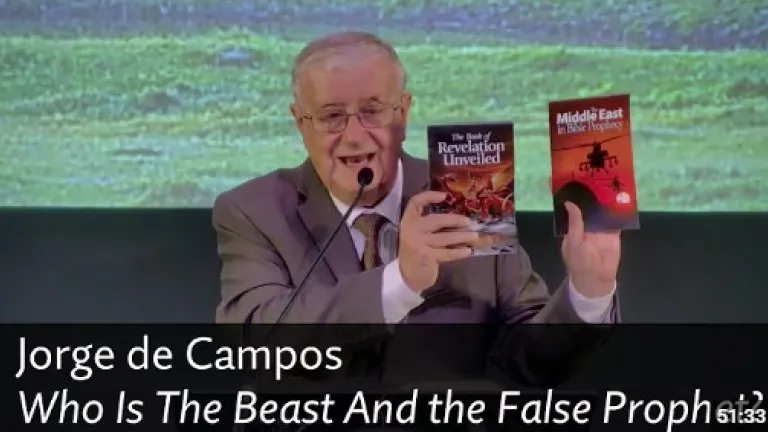

Jorge de Campos
This transcript was generated by AI and may contain errors. It is provided to assist those who may not be able to listen to the message.
Well, good evening, brethren! Here we are today covering our 12th study on the Book of Revelation.
We are going to take today a slightly different angle in the study.
But let us first do a little bit of a review of what we have covered so far. We have seen in chapter 4 of Revelation a setting of God's throne in heaven.
And then in chapter 4, we saw the question being answered about who is worthy to open a scroll that contains the seven seals. In this combination of these two chapters, and obviously who is worthy is Christ. But in the combination of these two chapters, we saw angelic beings playing a role in the administration, in the angelic realm and the God's authority. We saw 24 thrones, 24 elders in white robes and golden crowns. We saw that in 4 verse 4. It says, around the throne, we have 24 thrones. And on the thrones, I saw 24 elders sitting clothed in white robes, and they had crowns of gold on their heads. We also see they worship God. We see that in Revelation 4 verse 10. And it says that 24 elders fall down before him who sits on the throne, and worship him who lives forever and ever, and cast their crowns before the throne, saying, you are worthy, O Lord, to receive glory and honor and power, for you created all things, and by your will they exist and we are created. So Christ created according to the Father's will, by his will. But we can see these elders. It says, they fall down, in other words, they prostrate, they fall down, and they worship the Father. And then we see in chapter 5 verse 8, we see again, it says, now when he had taken the scroll, the four living creatures and the 24 elders fell down before the Lamb. And then a little later, it says, they sang a song, and then it says, worthy is the Lamb, or slain. We see that in verse 12. And then in verse, and it says, and to him who sits on the throne and to the Lamb, forever and ever, and other is honor. And then it says, then the four living creatures said, Amen, and the 24 elders fell down and worshiped. Now here's an interesting little detail. My Bible has next to him a little number, which happens to be a 2, and then next to that number says, the majority version omits him who lives forever and ever. So the majority version, then I looked on a version here of the majority version. I've got Yah, and I looked at Revelation 5 verse 14. Interesting, it says, and the 24 living creatures said, Amen, and the 24 elders fell down and worshiped. And therefore, Yah, it's talking about worshiping Christ. So Yah, we see in chapter 4, worshiping God the Father, and in chapter 5, washing the Lamb. Then we also looked about those living creatures around the throne of God. We looked at them, and we saw that they were full of eyes, and they had six wings.
I briefly explained that in Isaiah 6 verse 2, it shows Seraphim having six wings.
The vision of Isaiah was around about the time of Israel's captivity. So it was long before Judah's captivity, some 130 years or so before that. Then we go into Ezekiel, where it shows also four living creatures with four wings. The interesting thing that I mentioned in the previous study is that the ones around God's throne had six wings, and these in Ezekiel 4 have four wings. So it is a fairly possible deduction that they're not the same. Anyway, on the throne appears a figure like a man. So we went through that last time, and then we can see that in Ezekiel chapter 2, that that figure like a man spoke to Ezekiel. And when we look at scriptures like John 1 verse 18, 537, 644, and 1 John 4 verse 12, we can conclude that obviously he was not the father because he says no man has talked or seen the father, but obviously they saw God and therefore he was in the form of God, which was the word which emptied himself. And also we know in John 1 18 that it was Christ that came and revealed the father. So that explains that little background there. Then in Ezekiel 10 and Ezekiel 11, we see a description of the vacating of the temple with God's Shekinah glory.
Basically, we see there was a lot of sin, and this was before, just before the temple was destroyed and before Judah fell down, but we can see God removed his protection and the glory of God leaves the temple. Then we can see it moves onto the Mount of Olives, and then from the Mount of Olives goes up to heaven. So there is a description there of that. And so there's a lot of things described there among angels and things like that. And I mentioned previous time that we do have a Bible study guide entitled Angels, and it talks about different kinds of angels. You can download it on a website using this link, but if you have the hard copy run about from pages 29 to 36, it covers a little bit more about that. Then on the last study, as a conclusion, we then went into the white horse. That's Revelation 6, verses 1 and 2, which is the first seal. We also then quickly looked at how there will be false Christs. Many will come in Christ's name and will bring false teachings. And this obviously represents false religion, false Christianity, and many false Christs. So we went through that.
Then we also went through Corinthians, 2 Corinthians 11, that it says, no wonder, because they disguised themselves as a apostle of Christ, because even Satan himself disguises himself as an angel of light. So one has to be very careful what some people see and say. So we've got to be very careful with that. But anyway, one point I emphasized, and I want to re-emphasize, is that once the seal is open, it remains open. It's a scroll. You open the first seal, and you open the second seal, and so on. And then as you open the seal, part of the book opens, and then as you open the second seal, further rolls down, and so on.
And once the seal is open, it remains open. Now this is, I believe, something important for us to take note of, because this represents that this horseman, which has been riding his horse throughout the ages, and throughout the ages representing since the false apostolic church has been going and preaching false Christs, and will continue to ride until Satan is overthrown. So this white horse is symbolic of false religion, and this false religion will keep going until Christ's coming. And really what it means is that these seals, as they open, certain events unfold, and those kind of events keep running until the very time of Christ's coming. So that is an important point. Once the seal is open, it remains open. Now this seal, as I mentioned, which represents false Christianity, it actually is represented by Daniel 7 verse 8, which is this little horn. So let's just turn to Daniel 7 verse 8. Just read there. And it says, I was considering the horns, and there was a little horn, another horn, a little horn coming up among them, before whom three of the first horns were plucked out by the roots, and there in this horn were eyes like the eyes of a man, and a mouth speaking pompous words. So we have here a false minister, a false minister, a false, basically a false religion. Now this little horn, in this chart of showing the reign of Gentile kingdoms, is this little horn, Yah, of Daniel 7, this little horn. And last Bible study, we stopped Yah. What we're going to be doing today, God willing, is we're going to go back into Daniel until this very point. So that is what I intend to do today, is to actually go back in this chart and discuss a few things of this chart, and then that's where we'll conclude today. So as far as the book of Revelation itself, today I don't plan to make great progress, but what we plan is to address this section of this chart showing prophecies of the reign of Gentile kingdoms. While, St. Yah, I just want to highlight a few interesting dates, because we've got a column Yah explained in, and events for folding history, and obviously you'll get us in the handouts that you will receive that I'll put on the website, but I just want to add a few little things, Yah. Just of interest, during the spirit of the Roman Empire, which is from 31 BC of the previous era, or before the current era, so for 176 AD, or the current era, that was the time of the Roman Empire, and it then ended up having two divisions, West and East, and the one we will follow of particular interest is the West side, because, as we'll see, it's where the Catholic Church is, and a lot of the revival of the Holy Roman Empire, which follows down after this, which will be in future study, in the future, the Book of Revelation study, that's what we will cover in the future. But this Roman Empire, they are interesting. I just want to mention a few things later on in the Roman Empire as Christianity came about being accepted by the Roman Empire, because Christianity had been, let's call it, perverted already. In the year 325 of the current era, or AD, Anno Domini, that's when there was the Council of Nisaya, as you probably remember. So it was towards this time frame of the Roman Empire was still in existence before there was the fall of the Roman Empire, which is the Stanley wound. So that was before that. But at this time, this is when the persecution in the Church started for 1260 years. So if you add 1260 years to that, you end up to the time frame of the beginning of the Protestant Reformation.
That means that once there was that Protestant Reformation, it was like, let's call it, fighting inside the Catholic Church, because some were protesting against it, and allowed God's Church, which was in hiding, to start to come out. And I went through that part when I covered the letters to the seven churches. I went through that side of the history of God's Church. So that is an interesting point. Now, another interesting point to remember, is that the Council of Nisaya basically wanted to agree on three things, but they only reached agreement on two major things. One of them was that, or rather, they were both around the point of not Judaizing Christianity. Therefore, one of them was for the people, for the Christians, not to keep the Sabbath, but keep Sunday. So that became what basically is the mark of the beast. And secondly, was not to keep the Passover on the 14th of Nisan, but keep the Passover on what we call Easter Sunday. So basically, the two things that were agreed at the Council of Nisaya, was the change of the law from Sabbath to Sunday. That is a change of the law. So it says when it talks about the attempt to change times and the law and things like that. That's what they tried to do. And the other thing was of Passover, because instead of keeping the Passover at the anniversary, they changed it to a Sunday. Now, interesting enough, I don't know if you ever noticed, but this is just another interesting point. The Passover, using the Hebrew calendar, which you believe is the correct calendar, because that was handed over.
That was the calendar the Sanhedrin used, and then it was promulgated by Hillel II in AD 385, which I'll cover to you in a moment. But back to Passover on the 14th, as you probably noticed, there is never using the Hebrew calendar, which I believe is the correct, and we in the church believe is correct. That is a whole different subject. But anyway, there is never a Passover on a Sunday. Never. Which means you never have the ceremony of the Passover on a Saturday night. That is very interesting. But the Catholic Church changed that, that they have Easter Sunday, and therefore they do Easter Sunday, which is Passover.
Basically, just changing the word from Passover to Easter, but that's an English thing. In Portuguese, Easter Sunday is called Passover Sunday. There's no word for Easter in Portuguese, so that's just an interesting point. So, that was the change of the Council Niseya. From there onwards, true brethren were persecuted, and therefore they were persecuted for 1260 years until there was the weakness that started showing, or the cracking of that strength, of that whip of the Catholic Church. Therefore, the Church of God started coming out of the hiding, of hiding out of the mountains, and things like that.
As I mentioned, I covered that before. The other interesting point is, they wanted to, in the Council Niseya, agree on three things, but they only agreed on those two things. The third thing that did not agree, but was agreed in the Council of Constitu Nöpli in 381, was that they should follow, because they had two doctrines about who is Christ, and one was an Arianism, saying that Christ was an angel, Michael, or the doctrine of the Trinity, both incorrect.
But that was the dispute between one of those two, and in AD 381, the false teaching of the Trinity was the one that was then, from then onwards, enforced by the Catholic Church. Now, because of this desire not to judaize, Christians were still knowing when to keep, for instance, the Passover, because the Jews were telling the Jewish people, and therefore the Christians, when the Passover was. At that time, in AD 385, God inspired the Sanhedrin to publish or to proclaim the rules of that working out the calendar, which until then had been kept as a secret, inspired some of the calendar experts to go out to the different regions, like to Persian and to others, to the dispersion, and to tell them how to work out the calendar, because that was done, because God inspired it, because immediately after that, the Roman Empire was upset with the Sanhedrin for telling the Jews when the Passover was and God's early days, and therefore they disbanded the Sanhedrin.
Therefore, before the Sanhedrin was prohibited by Roman law, God inspired the leader of the Sanhedrin, which was Hyli the second, to proclaim that information out to the dispersion. That's how the Hebrew calendar came out to be a calendar which was no more held secret by the priesthood, because the Sanhedrin had the authority to that, because it was the Sanhedrin that put out the calendar during Christ's time, and Christ never disagreed to it.
So that is just some interesting notes I'll put in there for you. Now, the other interesting things is there are three little kingdoms that come up here, and these three kingdoms are plucked out. As you read here in Daniel 7 verse 8, it says that these three horns were plucked out by the roots, because these kingdoms were kingdoms that believed in Arianism, in other words that Christ was an angel, and they pulled and ripped that out to actually bring in the false Christianity through the Catholic Church, which would then bring in the Trinity.
So that's how that happened. And from there onwards, for 1260 years till 1814, is the time of that revival of the Holy Roman Empire. So when we read a number like 1260, it does not have to be the same time period. So some people say, well, this 1260 is exactly the same time period as that 1260. No, it isn't. And we'll see that verse specific one. We'll see it in the next Bible study. Verse 1 here, we saw it when we covered the seven letters to the church, the letters that Christ wrote to the church. So anyway, let's look a little bit further with that preamble, the reign of the Gentile kingdoms.
The reign of the Gentile kingdoms is important. Why? Because the prophecies are about the reign of the Gentile kingdoms. And you say, well, but it doesn't talk about some of the being important Gentile kingdoms like, for instance, China. Yeah, because the focus is on the Gentile kingdoms after the fall of Judah. After Judah went through the dispersion into Babylon. So the Gentile kingdoms that came up around that period, in fact, from the fall of the kingdom of the north, which was Israel, and the kingdom of the south, which was then Babylon. So it basically concentrates from there from Babylon until Christ's coming. That is the focus of these Gentile kingdoms. And it's talking about the kingdoms that had a prophetic impact on Israel.
And that's why there is that focus on these specific Gentile kingdoms. I remember when I was young, people would ask me, oh, but there's no mention here about Egypt. And Egypt was an important kingdom. Why? Because it's a focus from the period that Judah ceased to be a nation until about the time, until Christ's coming. So that is the focus, the reign of the Gentile kingdoms. Now Daniel 2 is an important key to the understanding of biblical prophecy. Now Daniel 2, as you know, is Nebuchadnezzar's dream of this image, of this statue.
It is very important. Now, in Daniel we have a very comprehensive, encapsulating world history narrated by Daniel. In fact, he was inspired by God to do that, sure. But it covers the history of this Gentile world. The key points, key milestones of the Gentile world, up to Christ's return. So from about 600 years before Christ, that was around about the time of the fall of Judah, when they went into captivity to the present day. So, verse Daniel 2 gives us a general structure. Think about it. It gives us a skeleton.
A skeleton, things about it, gives us a framework of the development and government of ancient and future kingdoms, which will have an important impact on biblical prophecy. You see, it's the key basic framework. Now, if we don't have this image of Daniel 2, then people misunderstand many biblical prophecies, because then they start saying, well, Revelation 17 or Revelation 13, and they want to plug it in, or they want to plug it there, or they want to plug it there, or they want to plug it there, but it does not hang into this framework of Daniel 2. Daniel 2 gives us the framework, a continuity that is important for us to understand. That's why I say it is an important key for biblical prophecy. Now, it's not the only important key. There is another extremely important key to understand prophecy, and that is the understanding of who is Israel and who is Judah. Who is Israel and who is Judah? Who is Ephraim? Who is Manasseh? Who are those lost ten tribes? And who is Judah? If we don't understand that, we also get lost in prophecy. So, understanding the framework of the Gentile kingdoms and understanding who Israel is, not just Judah, because a lot of people today think, well, Judah is Israel. Yes, Judah is part of Israel, like for instance, Texas is part of the states, but you can't say the whole state is just Texas. Maybe the Texans would like to say that. I don't know. Sorry. I'm just joking. Anyway, so the point is it is important to understand two things here. To understand biblical prophecy is the framework of these Gentile kingdoms that impact biblical prophecy, and there is a continuity because it's an image, it's a statue from head to toe. There is a continuity. You can't have the feet or the toes out there separated from the statue. There is a continuity from the head right down to the toes. And then that is important for us to understand so that when we look at the toes, we don't say, oh well, it's this nation now or that nation there. No, it has to be part of this continuity from the head all the way down to the toe. That is important for us to place this prophetic understanding of the nations of the future. And likewise, it's important to understand who is Israel and is Judah, because this image of the Gentile kingdoms is not talking about Israel and Judah. It's talking about the Gentile kingdoms.
So that's why it's important to understand those two points. Right, so now let's look at Daniel 2. And if you turn to verse 32, it says, this image's head was of fine gold. Right, so we have a metal, gold. Then it says, its chest and arms of silver. Now we've got a second metal, silver. And then it says, its belly and thighs of bronze. A third metal. Another point is the quality or the value of the metal is going down, because gold is of a higher value than silver, and silver is a higher value than bronze. And iron is also a lower value than bronze.
Its legs of iron and its feet partly iron and partly clay. So we can see there are four metals here.
And then it says, in verse 34, and you watched while a stone was cut without hands, which struck the image on its feet of iron and clay and broke them into pieces. And yes, we know this represents Christ. Christ's coming.
The stone is Christ, but it's the kingdom of God and will destroy these gentle kingdoms completely.
So the image that King Nebuchadnezzar saw was composed of four types of metal, which correspond to four great empires. You see, there are four great empires, gentle kingdoms.
And when we try and say, oh well, the feet belong to this other nation, you know, it has to fit within this image, within this continuity of these empires. That is key.
That is key. So let's continue in verse 37. Then it says, you are king or the king of kings, for the God of heaven has given you a kingdom, power, strength, and glory.
And wherever the children of men dwell, or the beasts of the field, and the birds of heaven, He has given them into your hand, as made your ruler over them all. You are the head of gold.
You are the seed of gold. Babylon, it's defined here who is the first kingdom. It's Babylon, it's the Chaldean empire. Babylon is the head, and from it flows the rest of the body of the statue.
That is the clue. That is such an important clue. So Babylon is the head of gold, run about the years 625 to 538 BC. Babylon then was destroyed by the Medes and Persians. This is the chest and arms of silver. Can you remember about about the writing on the wall in Daniel 5? I can't quite remember the top of my head.
But in Daniel 5 it says, many, many, tickle Upharsin. That's where it is. So it's the days are counted, and the next day they fell down. So that it shows it following the head was the Medes and Persians, which is the chest of silver. And then we read, for instance, there were prophecies of Isaiah 44, 28, and 45 verse 1. They were written about 700 BC. King Cyrus would allow the Jews to return to Jerusalem and rebuild the temple, and that was fulfilled in 538 BC. So this is what the Jews coming back, or a few of the Jews coming back, many of them stayed in Babylon.
We read, for instance, about Esther's story during the time that they were in Babylon, which demonstrates God's power by preventing Satan's inspired genocide of the Jews during the Persian Kingdom, because they wanted to... Satan wanted to wipe out all the Jews. Why?
Because if Satan would wipe out all the Jews, then there would be no descendant from David, which would be Christ, and there would be no establishment of God's Church, and ultimately it would impact prophecies about the coming Kingdom of God. But God intervened, and you can see time and time again. It is so interesting when some major events are to happen.
A few, sometimes a few hundreds of years before, Satan is architecting things to create a stumbling block towards something else, thinking about it. So, Yah is a point where Satan was architecting something, and he failed to try and impact the Jewish people, because the prophecy said that out of Judah there will be a king, and he wanted to impact that. But that was frustrating to him. The story of Esther and Purim covers that how that was prevented. Very interesting.
For instance, there was also the... remember we talked about Gnosticism, and how ideas came in from Babylon. There were Babylonian pagan ideas, which were then adopted by Greek philosophy, and those Greek philosophies started a way of twisting things, and that approach created, let's call it, false imagery, started from Babylon, about Christ and the birth of Christ, and things like that, which then was adopted by the Catholic Church to create false holidays, and pagan days, and all that. Satan planned these things years, sometimes centuries, in advance. It just shows how subtle he is, and how careful we need to be. Then, from that, then we have the situation of Alexander the Great, which brought in the Greek culture, and that became predominant, and that is the belly and thighs of bronze. Then that led to the actual Greek empire, which Alexander died because it was a very quick victory. Then, when he died, there were four divisions, like north, south, east, and west, but there were two main ones that prevailed, which was the king of the north and the king of the south.
Now, there were a number of struggles between these two kings, north and south, which are described in Daniel 11. So, if you look at Daniel 11, it's probably the most detailed prophecy in Daniel 11 about the king of south pushing against the king of the north, and various attacks and counterattacks and attacks and counterattacks. Now, we have a booklet called The Middle East in Bible Prophecy, which I really recommend you to read. There is a section there that covers in detail an explanation of this prophecy of Daniel 11. It goes practically verse by verse, explaining Daniel 11 from pages 22 through 27. So, here in this Bible study guide, there is a section here entitled The Four Empires of Daniel 11 and of Daniel's prophecy. Those are the four empires, but specifically gets to a point. So, it's covering what I'm covering, yeah, these four empires, but then it gets to a point on page 22 where it starts talking about Daniel 11 in great detail. And so, I strongly recommend you to that. And also, there is a section after that, by the way, while I'm here, that talks about Islam, fundamentalists, and how Islam came about to be, and the Sunnis, and the, now I forget the names of the two groups, but anyway, the Sunnis and the the others. Okay, so there were two groups they were always fighting and goes into an amazing amount of detail, which is actually very, very well described. I strongly recommend you to study that booklet, understand a little bit more the prophecies of Daniel 11, specifically, yeah.
Then we see, according to prophecies, that the northern kingdom took predominance. So, remember, I mentioned the Roman Empire, there's the East and the West, but yeah, is the northern kingdom taking predominance, and that is the bronze kingdom, which lost to the period of 250 to 300 years, and was then supplanted by the fourth kingdom, which was the Roman Empire, which is described as a kingdom of iron, which describes the harshness of that kingdom. Very harsh, very hard, and that kingdom lost the good nearly 500 years, 400-odd-plus years.
So, Babylon is the head. Babylon is the start. Now, Babylon represents two key things, two key things.
A financial system and a religious system, which basically continues today to this very day, and therefore, it has a lasting impact like old. There is a financial, perverted, bad financial system that has basically started in Babylon, and it's still continuing today. Sure, modernized and all the other things, but it continues the total day.
And likewise, there's a religious system that started in Babylon, and yes, it's been adapted, modified, syncretized, Gnostic-sized, and all the other things, but it is the same pagan system that started in Babylon. So, that's why it talks. Babylon, mighty city over her, the merchants of the earth will weep and mourn. They have done business even in the souls of man, even in slavery and selling people's lives and things like that. We read that in Revelation 18. This system migrated from kingdom to kingdom, from Babylon to the Medes and Persians to Greece to Rome, and lost still today.
The very basics of this system, of its financial system and its religious system, was the fuel, the engine that drove Europe through the Dark Ages. And that's why there is what they call old money in Europe. A lot of wealth out there that people don't understand, some old money out there. And that was fueled by these businesses that even involved the souls of men. Over the centuries, as we know, millions of people have died in Europe because of this Babylonian system, which has persisted until today and will soon be resurrected. You see, that's why we need to understand the statue image of Daniel 2, that King Nebuchadnezzar saw, because there is a continuity all the way to the feet, which is still iron, Roman Empire, but mixed with clay.
So, this image of Daniel 2 helps us identify the King of the North, and therefore the beast power in today's world scene. That is so important to understand that. So, Daniel 2 is directly related to Daniel 7, because the head of gold is the lion of Daniel 7. The bear of Daniel 7 is the chest and arms of silver. The leopard, which is Greece and the Alexander the Great, and the four kingdoms that came out of it, north, south, east, and west, are the leopards. That's Greece. So, you can see the leopard has four heads, north, south, east, and west. Then you have the bear, which is five, and you got the lion, that is six. So, we got a total of six heads. Then there is a seventh head, which is the fourth terrible beast, strong as iron, which is the Roman Empire.
That has ten horns, and we can see these ten horns are sequential one after another. Not immediately one after another, but one comes and then another. These horns came up. The first three were plucked by the roots, as we saw early on. So, what do we have is a beast with seven heads and ten horns.
That is in Daniel 7, and that is in Revelation 13. In Revelation 13, the beast has seven heads and ten horns.
These seven heads, one plus four plus two plus one, seven heads. It's the same beast that comes from Yah on Revelation 13. This beast suffered a deadly wound. Revelation 13.7, representing the fall of the Roman Empire in A.D. 473. So, what do we have? Going back to Daniel 7, that little horn. So, let's go back to Daniel 7, that little horn, and we're going to read verse 8. I was considering the horns, and there was another horn, a little one, coming up among them, before whom three of the first horns were plucked out by the roots. And there, in this horn, were eyes like the eyes of a man, and a mouth speaking pompous words. This little horn is also described in verse 24 and verse 25. So, let's read verse 24 and verse 25.
The ten horns are ten kings, which shall arise from this kingdom.
And another shall arise after them, which shall be different from the first ones. He shall subdue three kings. That's the little horn, you see. He shall speak pompous words against the Most High. So, it is a religious entity. He shall persecute the saints of the Most High. Yes, he did, for 1260 years. The Catholic Church did that, right? And it will happen again, but then it will be for three and a half years during the Great Tribulation.
Not 1260, but three and a half years. And he says, and he shall intend to change times and law. Oh, yes! Changed Sabbath to Sunday. Changed Passover on the 14th to Easter Sunday. Then the saints shall be given into his hand for a time, times, and half a time. That is 1260 years during that period. But Yah is dual, because now he's also talking about the time of the year, where it will be for three and a half years during the Great Tribulation. Now he's the duality. You see, so because in one place of the Bible talks about time, times, and half a time, you can work that out. In some places it's 12-1260 days.
Another place is 1260 years. And you've got to read the context and see where it fits. I also showed you that 1260 for the Church is a time period, but for the resurrection of the Holy Roman Empire is a different time period, but it's also 1260. And that we'll discuss in the next study.
So we have this false Church, which in Revelation 17.5 talks about Babylon the Great, the mother of the Holids. Let's just read this. I'm quoting it correctly. Revelation 17.5. Revelation 17.5. It says, Mystery Babylon the Great. Yeah, it is a mystery. Why? Because this Babylon has persisted to today. And it's the mother of all. It's why? Because it's got all these little churches that spawned from it, but they basically still keep Sunday. They basically still follow the Catholic Church and of the abominations of the earth. So this woman, this church officially takes its position of power and authority after plucking out the first three horns, which are these kingdoms which believe in Arianism. Arianism, which is the belief that Christ is an angel. And they bring in another false doctrine after it, which is Trinity, which is another false doctrine. Therefore, this is important. That's why the woman in Revelation 17, which is this woman that comes up as part of this horn, little horn, this woman only rides the beast from this time period onwards. You see, because this woman, the Catholic Church, and its sponsorship of government and the formation of what they called the Holy Roman Empire that came after this, was only only from this time forwards did this woman ride the beast. This beast. That explains why the woman of Revelation 17 only rides the beast from Yah onwards. And that explains why the symbology in Revelation 17 is now a little different. And we'll look at that in the next study.
So, where we started today and where we conclude is basically repeating, and this is, as I'm coming to a conclusion today, is that we covered that the first seal is false religion, false Christianity. We also covered nothing to be surprised because even Satan dresses himself as an angel of light, deceiving mankind. I also mentioned that once the seal is open, it remains open. So this first seal remains open.
This false Christianity remains open until Christ's coming, until Satan is overthrown, symbolized by the Day of Atonement.
And that is the little horn. So that little horn is that first seal, that white horse, that came up and it continues until Christ's coming. This false religion, influencing the beast power, that's government, is one of the leading causes, not the only cause, but one of the leading causes of wars. How many wars have occurred that are religious wars? How much famine has occurred because of religious wars? How many diseases have developed because of religion? And how much death has occurred because of this false religion? And so what do we have in this Babylonian system, which is religious and financial, and because of this religious influence and the secular financial and the two working together, so many evils have occurred in the world. You just have to look today.
People are lying or cheating or giving fake news, and I don't know what else. Why?
For power and money. And they'll deceive anyway. And if needs be, they'll come to a point, they'll use religion to deceive people, and that will come. So brethren, that finishes today's study.

Jorge and his wife Kathy serve the Dallas (TX) and Lawton (OK) congregations. Jorge was born in Portuguese East Africa, now Mozambique, and also lived and served the Church in South Africa. He is also responsible for God’s Work in the Portuguese language, and has been visiting Portugal, Brazil and Angola at least once a year. Kathy was born in Pennsylvania and also served for a number of years in South Africa. They are the proud parents of five children, with 12 grandchildren and live in Allen, north of Dallas (TX).
