


Roy Holladay
This transcript was generated by AI and may contain errors. It is provided to assist those who may not be able to listen to the message.
As I mentioned in the announcements, we're going to begin in the Book of Colossians, so you might turn to the Book of Colossians in your Bible. This is probably, once you get past the Book of Galatians, one of the more misunderstood books in the Bible, along with the Book of Romans. So I thought it would be very important for us to understand, to especially the first two chapters of this book.
Once you get into chapters 3 and 4, it's not as difficult. You should have two handouts today. One is on the background of the Book of Colossians. If you don't have these handouts, hold your hand up, and we'll make sure that someone passes it to you. And the second handout is of a number of the slides we have here in the PowerPoint presentation. You don't have all of them because we didn't copy all of them, I guess is the main reason.
Let's take a look here to begin with the background of the Book of Colossians. What I've done, I've brought up a couple of slides here. If you notice, this first one is the tale of the ancient city of Colossae, viewed from the north. This is where the city used to be. As you can see, there's not much left. This is the site of Colossae also, the lower city viewed from the former Acropolis, looking south.
Just to give you an idea of the general area where this was. Cities come and city go. It's hard for us to realize that a city like New York City could, a thousand years from now, if time went on, might not even exist, or would be covered over and completely rebuilt upon. We'll get to this as we go through the book. Take a look at your outline. I'd like to go through this very quickly just to set the theme for the book. Paul is the author of the book, as you'll find in chapter 1, verse 1. It says, Paul, an apostle of Jesus Christ by the will of God and Timothy, our brother.
Then verse 23 says, indeed you continue in the faith, grounded in steadfast, and are not moved away from the hope of the gospel, which you heard, which was preached to every creature under heaven, of which I, Paul, became a minister. So the internal evidence in the book clearly shows that Paul is the one who is writing and speaking here.
Chapter 4, verse 18. This salutation by my own hand Paul. So we have three references here in the book where Paul refers to himself. Now, in point 2 here, we have the testimony of the early church, including a lot of the key religious figures such as Irenaeus, Clement of Alexandria, Tertullian, Origen, Eusebius, Confirms. That Paul, in other words, they give credence to the fact that Paul was the one who wrote this particular book.
Additional evidence for Paul's authority comes from the book's close parallel with the book of Philemon, which is universally accepted as having been written by Paul. Both were written around 60 to 62 AD, while Paul was a prisoner in Rome. If you remember, Paul went to Rome. He was a prisoner. He's own hired house for two years. While he was there, he wrote the prison epistles. You have this being one of those prison epistles. So while he was a prisoner in Rome, he wrote this. You'll notice in chapter 4, verse 3, just some of the scriptures that show this.
Chapter 4, verse 3 says, Meanwhile, praying also with us, that God would open to us a door for the word to speak the mystery of Christ, for which I am also in chains. So he clearly says he was in chains. Verse 10, Aristarchus, my fellow prisoner, greets you. And then verse 18, this salutation by my own hand, Paul, remember my chains. So Paul, even though he was able to rent and have his own hired house, was still in chains.
Now, there are a number of names mentioned in the book, which are mentioned in both books. Timothy, Aristarchus, Acrepus, Mark, Aprophus, Luke, Onesimus, Demus, all of these appear in both books. Now, Colossae is a name for the city, or Colossians is a name for the city of Colossae.
It was also to be read in the neighboring church of Laodicea. Notice verse 16, When this epistle is read among you, see that it is read also in the church of the Laodiceans, and that you likewise read the epistle from the Laodiceans. How many of you have read the epistle of the Laodiceans? It's not included in the Bible, is it? So Paul wrote many letters as we find internal evidence in the Bible that are not included in the Bible. Only the ones that were picked out by God to be included as Scripture are included in the Bible.
So he wrote other letters. Colossae was a city in Phrygia in the Roman province of Asia, which is part of modern Turkey, about 100 miles east of Ephesus in the region of the seven churches of Revelation. The city lay alongside the Lycus River, not far from where it flowed into the Meander River. The Lycus Valley narrows at Colossae to a width of about two miles, and Mount Cadamus rose 8,000 feet above the city.
Colossae was a thriving city in the fifth century BC when the Persian king's Xerxes marched through the region. Black wool and dyes were important products. In addition, the city was situated at the junction of the main north-south-east-west trade routes. By Paul's days, however, the main road had been rerouted through nearby Laodicea, thus bypassing Colossae and leading to its decline in the rise of the neighboring cities of Laodicea and Hierapolis.
Now, if you might remember when Paul, excuse me, when John wrote the letter of the book of Revelation and he addressed his letter to the Laodiceans, what did he say about them?
They were prosperous and increased with goods and thought they had need of nothing. So by that time, they had become a very wealthy city, whereas Colossae had gone the other direction. There may have even been destroyed by this point. Let's notice here the slide I have. I don't think you'll find this on your handout. It was the city of Phrygia on the Laocas, which is a tributary of the Meander River. It was about 12 miles from Laodicea, near the great road from Ephesus to the Euphrates and was consequently of some mercantile importance. It does not appear that Paul had visited the city when he wrote the letter to the churches there. Notice chapter 2, verse 1.
Chapter 2, verse 1, I want you to know what a great conflict I have for you and those in Laodicea, and for as many as have not seen my face in the flesh. So they had not seen Paul before, but he is writing to them. Now, he expresses in his letter to Phylemon his hope to visit it on being delivered from his imprisonment. From Colossians 1.7.4.12, it has been concluded that Ephepus was the founder of the Colossae church. This town afterwards fell into decay. The modern town of Chonas, or Chornum, occupies a site near its ruins.
Now, Adam Clark says that this city perished by an earthquake short time after the date of this epistle we have the testimony of Eusebius. So Colossae actually was destroyed by an earthquake and ceased to exist as a functioning city. Then, Robinson's word picture says the tributaries of the Lycus River brought a Calcarcius deposit of a peculiar kind that choked up the streams and made arches and fantastic grottos. In spite of this, there was much fertility in the valley with two other prosperous cities some 10 to 12 miles away, Hierapolis and Laodicea.
So here's a map that shows us, if you'll see here at pinpoints, Colossae over in the area we would call Asia Minor, area of Turkey today.
And then Paul's letter to the Colossians was written from Rome. So you can see where Rome is and then you can see where Laodicea and Colossae in that area is.
Okay, with that in mind, let's go on with our write-up. It says, although Colossae's population was mainly Gentiles, there was a large Jewish settlement dating from the days of Antiochus the Great. Colossae's mixed population of Jews and Gentiles manifested itself both in the cosmopolitan of the church or the composition, I should say, of the church and the heresy that plagued it. The church in Colossae began next page during Paul's three-year ministry in Ephesus in Acts 19. His founder was not Paul, who had been there, but Epiphorus, who apparently was converted during a visit to Ephesus and then likely started the church in Colossae upon his return home. Several years after the Colossian church was founded, a dangerous heresy arose to threaten it, one not identified with any particular historical system. It contained elements of what was later known as Gnosticism, and we will see Gnostic teachings and ideas all through this book.
Gnosticism taught that God is good, but matter is evil, that Jesus Christ was merely one of a series of emanations descending from God, and being less than God and that a secret higher knowledge above Scripture was necessary for enlightenment and salvation. They believed they, the Gnostics, had this special illumination. So they say that the Scriptures are not enough, need more. The Colossian heresy also embraced aspects of Jewish legalism and also rigid asceticism. It also called for the worship of angels and mystic experiences. Ephrath was so concerned about this heresy that he made a long journey from Colossae to Rome, where Paul was a prisoner. The letter was written from prison in Rome, Acts 28, sometime between 1662 AD and is therefore referred to as a prison epistle. Ephesians, Philippians, Philemon, Colossians. These are all prison epistles. It may have been composed almost contemporaneously with Ephesians and initially sent with that epistle and Philemon by Tychagos. Now you'll notice it says Colossians 5, 7, through 8. There is not a fifth chapter in the book of Colossians. That should be Colossians 4. You might want to make that change. I had printed all of these up and I noticed that, so I went back and made the change in the computer, but it doesn't help you on the paper. Colossians 4, 7, through 8, where we read this. Tychagos, who is a beloved brother and a faithful minister and a fellow servant in the Lord, will tell you all the news about me. I am sending him to you for this very purpose, that he may know your circumstances and comfort your hearts, and with him will be Onesimus, a faithful and beloved brother. Now you'll remember in the book of Philemon that Onesimus was a runaway slave, and Paul writes the book to Philemon, who apparently lived in Colossae. So he wrote the letter to warn the Colossians against the heresy they faced and sent the letter to them with Tychagos, who was accompanied by the runaway slave Onesimus, back to his master Philemon, a member of the Colossean church. Epiphras remained behind in Rome, perhaps to receive further instructions from the Apostle Paul. Okay, now with that in mind, let's go back to chapter 1.
Chapter 1.
And we will begin here.
Chapter 1, verse 1. Paul, an apostle of Jesus Christ by the will of God, and Timothy, our brother. To the saints and faithful brethren in Christ who are in Colossae, grace to you and peace from God our Father and the Lord Jesus Christ.
Now, the word apostle, Paul establishes right away his authority, his credentials. He's not just any ordinary person, he's an apostle.
An apostle is one sent with authority. He was a herald, anciently, who was sent by a king with a message. And he would go into a town, have a publicly proclaimed the message, and people would listen because he was the representative of the king. Now, Paul was a representative of Jesus Christ as king of kings and Lord of lords. And so, therefore, he came proclaiming a message, a message about a soon-coming kingdom, the kingdom of God. You'll notice in verse 2 it talks about saints.
The interesting thing about that is we're saints now. They were saints then.
You didn't have to die, wait years, have two miracles affirmed before being declared by the pontiff that you are a saint. No, you are a saint. All of you are saints if you have God's Holy Spirit. The saint is one who is set apart. Now, his greetings here, grace to you and peace, 13 out of the 14 epistles that Paul writes, he begins them this way. The only one that he does not begin is the book of Hebrews. Every one of the other ones he does. Now, beginning here, as we'll begin in verse 4, we have a summary of how the church was raised up.
Continuing on to verse 3, he says, We give thanks to the God and Father of our Lord Jesus Christ, praying always for you. And I think it's significant. And all of these epistles Paul keeps saying, I pray for you always.
I think every time I read through some of these, it puts me to shame. Because Paul didn't go to an area, leave and forget the people. Now, he knew a lot of the people, he knew the leaders, even though he hadn't met them personally here, he knew about them, some of them he had met. And so, therefore, he's praying for them. Now, verse 4, Since we heard of your faith in Christ Jesus and of your love for all the saints, now, you notice this verse implies that what Paul knew about them, he had heard. He didn't know it from firsthand experience, but he had learned through others. That's why he uses the term heard. Now, notice their reputation. Would be that we, as a congregation, had this reputation. What is a reputation? Well, I've heard of your faith in Christ Jesus and your love of all the saints. So, they had love for each other and faith in Christ, or in God. Going on in verse 5, It says, Now, it is interesting to notice here, it says, The hope which is laid up for you in heaven. Some people read that and say, well, okay, when we die, we go to heaven. But that's not what this says.
It says, There is a hope laid up for us in heaven. Now, what is that hope that's laid up for us in heaven?
Well, I've copied 1 Peter chapter 1, verses 3 and 5 for you.
And again, we do this to save time.
So, you can see it, and I can read it. Notice verse 3.
So, our inheritance is reserved there.
And you and I, who are kept by the power of God through faith for salvation, ready to be revealed in the last time.
So, what is the Scripture reveal that when Christ comes back, what's going to happen?
Well, you and I are going to be given a spirit body. That's part of what we're going to inherit. We will inherit the kingdom of God. We will be part of the family of God. We will receive a spirit body. And then, we will be given a reward.
That reward will be based upon our overcoming. And so, depending on how we overcome what we do, you find that God will reward us. Now, we're not going to go up to heaven, but we're going to be here on the earth, kings and priests, and we will reign with Christ on the earth.
So, he's talking about this hope that is laid up for us in heaven. Now, the word gospel here says the truth of the gospel.
As we know, John 1717 says, thy word is truth.
Now, the truth of the gospel, the word gospel simply means good news.
And so, it's the good news about what?
Well, about the kingdom of God. Actually, the word was used in classical Greek to express the good news of victory in a battle. When a general would come back, he would toot his horn, and he won the victory.
Well, the gospel is about the fact that Christ is going to be victorious, as we heard in the program beyond today. When he comes back to this earth, he's going to put down all the warring nations and set up his government. He is already victorious over Satan the devil, and he will conquer sin. And ultimately, he will conquer death. And so, we find that there is good news.
Now, verse 6, talking about this good news, this message of hope, it says, which has come to you, as it has also in all the world. And it is bringing forth fruit, as it is also among you, since the day that you heard it, and you are the grace of God in truth.
Now, notice it says, it has come into all the world.
Now, does this mean that by this time, every Chinaman had heard it?
People in Borneo, I don't even know if there were people in Borneo at this time. But what it's talking about is that the gospel had been preached in what was known at that time as the civilized or the known world. You have to stop and think, what happened to the other apostles? Where did they go? Well, you don't hear much of the other apostles after the book of Acts, the first few chapters. You read about John, you read about James, you read about Peter. But where did the other apostles go? Well, they're recorded in Greek history. They went over to India. They went up into Europe. They went into Britain. They went down into Egypt. They went all over the known world. They went especially where the Ten Lost Tribes were, and they preached to them.
And so the gospel had been spread. Now, many people think, well, the fact that the gospel went to the Gentiles is because of Paul. And they think Paul brought a different gospel than Christ brought, which is a total fabrication. But what they don't realize, because it's not recorded, for us just to read in the book of Acts, is that the other apostles also went all over the world, preaching the gospel at that time. So the gospel had gone to the entire world. Notice the principle that is brought out in Romans 10. If you're going to preach the gospel to the entire world, how do you do it? Well, as we read here in Romans 10.14, How then shall they call on him in whom they have not believed? And how shall they believe in him in whom they have not heard?
And how shall they hear without a preacher? And how shall they preach unless they are sent, as it is written? How beautiful are the feet of those who preach the gospel of peace, who bring glad tidings, that's the gospel, good news, of good things. But they've not all obeyed the gospel for Isaiah, says the Lord, who has believed our report. So what you find is that the gospel is preached. And the only way the gospel can be preached is that God sends preachers, apostles, evangelists, pastors, and different ones to preach.
Now, you'll notice here it also states that this message had gone out into the world and was bringing forth fruit. While Isaiah 55 verse 11 says, So shall my word be that goes forth of my mouth. It shall not return to me void. Once God speaks, it's not going to return to him void. But it shall accomplish what I please, and it shall prosper in the things which I send it. So once the word of God the gospel was going out and being preached, it was producing fruit. People were being converted, their lives were being changed, churches were being raised up. And so there was fruit being born.
Now, the gospel is not hidden as the Gnostics claimed.
You see, the Gnostics had the idea, these false teachers, that there was a special fund of knowledge. And if you were really going to understand and have access to God, you had to understand what they taught.
Now, Paul in chapter 1 and 2 of the book of Colossians totally debunks that and knocks it in the head, as we shall see. But let's go on here. We'll get into this very quickly. Verse 7 says, As you have learned from Epiphras, our dear fellow servant who is a faithful minister of price on your behalf, who declared to us your love in the Spirit. So he came along and he declared to Paul their love, their attitude, and so on. Now, verse 9, For this reason we also, since the day we heard it, do not cease to pray for you. So notice what Paul prays about. We pray for you and ask that you may be filled with something, filled with Gnostic understanding and knowledge. No. Filled with the knowledge of his will, whose will, God's will, in all wisdom and spiritual understanding. Now, let's analyze this a little bit. It says that you may be filled. The word there means to fill full, just like you take a glass of water. This glass of water is two-thirds full. Now, if it were full all the way up to the top, you could say it's filled full. So that's what Paul is saying here. He wants them to be filled full of the knowledge of his will. Now, the word spiritual in the Greek modifies both wisdom and understanding. Not just spiritual understanding, but spiritual wisdom and spiritual understanding. Now, here, when he talks about the knowledge of his will, he is beginning to address here point blank the Gnosticism. What he's saying is that you don't need some other knowledge. All you need is the knowledge of God's will, spiritual knowledge, spiritual wisdom, and spiritual understanding. God's word, once you understand it, will fill us with all knowledge, complete knowledge. We don't need some type of secret knowledge. See, the Gnostics had this quote-unquote secret knowledge. They said that there were eight levels of angels that you had to go through to reach God, and you had to go through each one of these angels. And then finally, the idea was to try to get your quote-unquote immortal soul back to the star you came from. Well, number one, you don't have an immortal soul, but you don't have to go through a series of emanations or angels to reach God. We go through Jesus Christ as our high priest, and He's made access to the Father for us. Now, let's notice here, wisdom is the ability, talking about spiritual wisdom and spiritual understanding.
Wisdom is the ability to accumulate and organize principles from the Scriptures. Now, I think this is the first slide I gave you here on the handout.
I figure you can look the Scriptures up, but you find wisdom is the ability to accumulate and organize principles from Scripture, and understanding is the application of those principles to daily living. Whenever we give a sermon, just illustrate, what do we do? I could give a sermon on the Sabbath to say how to keep the Sabbath, which I plan to do here shortly.
I can go through and I can pull all the Scriptures in the Bible to talk about how to keep the Sabbath. So, what is that? Well, that's accumulating and organizing principles from the Scriptures. And then understanding is applying those Scriptures to you in your daily life so that you can then live by them. What good is it to have them unless you know how to live by them?
Now, beginning in verse 10, we have four action words that are mentioned.
Notice these, that you may have a walk, so we're told to walk worthy of the Lord.
Word walk means how you live, how you walk. It doesn't mean short and long steps. It means how you live your life, that we are to live our lives worthy of the Lord, fully pleasing Him. So, everything that we do is to please God. And being fruitful in every good work, so you and I are to produce fruits, and those fruits that we produce are, suppose, to produce good works, and increasing in the knowledge of God.
So, as we go along, we don't have to increase in Gnostic knowledge, but in the knowledge of God, the complete and full knowledge of God.
Again, the spiritual knowledge of God from the Scriptures is what we need. Now, when it says we're to walk worthy of the Lord, Lightfoot, in his commentary, mentioned something very interesting.
That the end of all knowledge, or you might say the end result of all knowledge, is conduct, he said. Or, knowledge is supposed to influence your conduct, how you conduct yourself, how you live.
And all things we are to be pleasing to God.
So, verse 10 is a verse that you can read, and there are several actions in this verse that we are told to do. Now, notice verse 11.
We come across a fifth action word, strengthen with all might.
So, you and I are to be strengthened, spiritually speaking, brethren.
We don't have the strength to obey God, to keep his commandments, to obey, to do what he requires of us. Where does that strength come from? Well, it comes from God. It comes through the Holy Spirit.
The word here in the Greek, when it says strengthen with all might, is the Greek word dunamis. It's the same word that dynamite comes from, and it's talking about force or power. Our strength is spiritual, and it comes through the Holy Spirit.
So, we are to be strengthened with all might, according to his glorious power. So, you and I, then, are to have that power, the power of God, the might of God, dwelling within us, with all patience and long suffering.
Do you know the difference between patience and long suffering? They seem almost synonymous.
Patience looks more to enduring through difficult circumstances.
And we all have difficult circumstances, don't we, from time to time. It could be a health problem. It could be a financial problem. It could be, who knows, whatever it is, difficult circumstances. Whereas, long suffering looks at enduring difficult people. So, you can have long suffering. You learn to suffer along with other people.
And you find that the expression is used that way in the Bible, that we should be able to suffer along with others and have patience in the trials and the tests that we go through. Now, verse 12, there's a sixth action described here, giving thanks.
So, we are to give thanks to the Father who has qualified us to be partakers of the inheritance of saints in light. Now, there are several things mentioned here.
Giving thanks means to express gratitude to God. This should be a continuous action on our part, giving thanks. Giving thanks isn't something you do once and you forget about it.
It's not like saying, well, you women don't say, well, I wash the dishes once.
We hope not. You wash them every day. Or you clean the house once. Or you change the sheets once.
No, the same thing is true when it comes to God. We give thanks to God continuously. It's a continual action. The word qualify here is interesting.
It's from Thayer's definition of the word qualified, means to make sufficient or to render fit, to empower, to give adequate power, to perform duties. So, who is it who qualifies us to be Christians, to obey, to serve, to submit, to do the things that God has called us to do?
Well, it's God. And how does He do it? Well, He's qualified us to be partakers of the inheritance of the saints in light. Now, you find light and darkness are used by Paul here in the book of Colossians. And light and darkness not only are Christian terms, but they're Gnostic terms. The Gnostics claim that they had the light. Nobody else did.
And Paul explains the true origin of light, which is God is the source of light.
And then he shows that Satan is the source of darkness. Light does not come from the Gnostics. It comes from God. So, what we find is, you know, he uses these analogies here.
And he talks about the inheritance of the saints in light. Now, you and I are joint heirs with Christ. Romans 8, 17. I didn't put that down, but Romans 8, 17 in Hebrews 1, verses 2 and 3, you and I are going to inherit all things along with Jesus Christ. Now, verse 13, He has delivered us from the power of darkness. So, who is the power of darkness? Ephesians 6, 12. Ephesians 6, verse 12. For we do not wrestle against flesh and blood, but against principalities, against powers, against the rulers of the darkness of this age, against spiritual hosts of wickedness in heavenly places. So, the powers of darkness are Satan and his demons. And you notice here that Satan is referred to as the prince of the power of the air in Ephesians chapter 2 and verse 2.
So, he is the influence that influences people into deception, darkness, symbolizing blindness, deception, light symbolizes understanding, be able to see the light. I see the light. So, this is what he's talking about. Now, he goes on to say here, and he has delivered us from the power of darkness and translated us into the kingdom of the son of his love. Okay. You and I have been translated. The word translated means to transfer into.
We have been translated or removed from Satan's kingdom. You have to stop and realize at one time, before conversion, we were all the slaves of sin and Satan the devil. Now, we've been removed from that and we become a part of God's kingdom. He is the one who delivers us. The word deliver means to draw to oneself or to rescue. So, you and I have been rescued from Satan's kingdom, from darkness and translated into the kingdom of God. So, we find that this takes place, as verse 14 says, in whom we have redemption through his blood and the forgiveness of sins.
You and I become a citizen of the kingdom of God and it is through Christ's sacrifice. The word redemption here, we have redemption through his blood, means to deliver by payment or a ransom and it was used of freeing slaves from bondage. So, it's like buying a slave and freeing them from their bondage. You and I have been freed from the bondage of this world, of Satan's system, of his way of life, of the sins that have helped us captive through Christ's sacrifice.
When it mentions here his blood, it's referring to his sacrifice for our sins and we have been forgiven. As you'll see here, the word forgiveness is a Greek word. From two words, it means to pardon our grant remission of a penalty. What is the penalty that you and I have been under?
What is the wages of sin? The wages of sin is death. So, we have that penalty removed from us. Our sins are forgiven and we're no longer under the death penalty, but we're now a son of God with the hope of the resurrection and eternal life in God's kingdom.
Now, with that in mind, we begin to get into the heart and meat of this chapter, verses 15 through 20.
We have another section here. Notice, I've copied a lot of this for you in your handout, but let's read this.
This is sort of a summary. I'm giving you a summary statement here. A part of the Colossian heresy was the denial of the deity of Christ. One of the most common teachings was that of docetism.
That is the teaching that Jesus and Christ are not the same person.
You see, the Gnostics could not believe that Jesus was God in the flesh, because they could not comprehend that God would come and live in the flesh. So therefore, they said that the Christ, remember when Christ and spirit, and he was baptized of John, descended on him like a dove? They say that's when the Christ came and descended on the Jesus.
And so you've got the Christ and the Jesus, but before he died, the Christ leads.
And it was the Jesus who was the man who died. The Christ did not, they say. Well, there's only one problem with that, because whoever died was resurrected, and he's in heaven right now. So now you've got the Jesus in heaven and the Christ in heaven and the Father in heaven. And of course, then they would say the Holy Spirit. Of course, they believe in the Trinity, which the Bible does not teach. We know that God's a family. But what you find is that they had this teaching. Many other Gnostics believe that Christ was a spiritual being who entered into the man Jesus, but withdrew before the crucifixion. And it was only the Jesus who died on the cross. Others of them, though, taught that Jesus never came in the flesh.
He was not really born in the flesh. He only appeared in the flesh. That the one who appeared, taught his disciples, really wasn't there. He just appeared.
And just like in the Old Testament, when the God of the Old Testament would appear, he could appear, disappear. He wasn't there permanently. He hadn't been born as a baby.
They saw him, but he could disappear. Well, that's how some of them thought.
This section defends the deity of Jesus Christ, as we will see here. So let's begin in verse 15.
Verse 15, he is the image of the invisible God, the firstborn, over all creation. Let me read down through verse 18 here.
It says, For by him all things were created, that are in heaven, that are on earth, visible and invisible, whether thrones or dominions, principalities or powers, all things were created through him and for him.
He is before all things, and in him all things consist.
He is the head of the church, or the body of the church, who is the beginning, the firstborn from the dead, and in all things he might have preeminence. Now, we could stop right here and probably spend two or three Bible studies if we wanted to, but we're not going to. Now, you may think so before we get out of the section, but let's pick it up here in verse 15. You'll notice the word for image. The Greek word for image is icon, from which the English word icon derives. It means a copy or likeness. Jesus Christ is the perfect image, the exact likeness of God the Father.
What did Christ tell Thomas? If you have seen me, you have seen the Father. So, he had the perfect likeness of the Father, and we're talking here in a spiritual image, in his character, in his way of life. If the Father had been living on the earth instead of Christ, he would have lived the exact same way that Christ did. He would have kept the commandments and obeyed. Notice Hebrews 1.3, talking about Christ being in the brightness of his glory, and the expressed image of his person. Jesus Christ was the expressed image of God's person. 2 Corinthians 4.4, whose mind the God of this age, that Satan the devil is blinded, who do not believe, lest the light of the gospel of the glory of Christ, who is the image of God, should shine on them. So, we find that Christ is an exact copy of the Father.
Now, you'll notice here in verse 15, he says, he is the image of the invisible God, the firstborn over all creation. He's not just a created being who's in a long chain of angels. See, that's what the Gnostics felt, but the supreme being over the whole universe.
As verse 16 says, he created all things. Verse 17 says, he existed before all things. Now, the Greek word for firstborn, I'll give you the short summary of it, and we'll come back to it, can refer to one who was born first chronological. I'm the firstborn. I was born 15 minutes before my twin sister, so I'm the firstborn in the family, but there were second born and third born, and so on and so on down the line. So, it can refer to one who's born first chronologically, but also refer to preeminence in position or rank. In verse 15, it's referring to preeminence in position or rank. He is the firstborn. He has a preeminence over all creation.
Now, I'd like to quote to you from the doctrinal paper, and if you have a computer, I don't know how many of you go to our webpage, but on our webpage are study papers that have come out. You can go and you can look up the study paper on born again. I'm going to read from the paper on born again. Study paper. The resurrection birth from born again doctrinal paper. The hope of every Christian is to obtain eternal life through the resurrection of the dead.
How and when Christians will enter the family and kingdom of God has been revealed to us by the example of Jesus Christ. It is through the resurrection of the dead.
As Paul declared, our faith is in vain if there is no resurrection. 1 Corinthians 15, 14, and 17. He mentions before in verse 13, but if there is no resurrection of the dead, then Christ is not risen. So Christ is risen, therefore there is a resurrection. I mean, this is Paul's rationale. But Christ rose from the dead and he is the firstfruits of those to be resurrected. Verse 20, 1 Corinthians 15. It is through the resurrection that man will be changed from mortal flesh into immortal spirit. This resurrection from the dead has yet to take place. It is a future event.
As Paul wrote to the Colossians, Colossians 1, 18, he is the head of the body, the church, who is the beginning, the firstborn from the dead. Now, verse 18, the same word is used, but here it means firstborn. Now, why do we know that? He is the firstborn from the dead.
It's appointed to all men once to die. We're all going to die, and if there's no resurrection, we're like Rover. We're dead all over. I mean, we're gone. But there is a resurrection, and we will be resurrected. And so, Christ was the first. He set the example.
Here we see that Christ was firstborn from the dead. He is called the firstborn because he was the first to be spiritually resurrected.
Up to this point in time, he is the only one born of human flesh who has gone through the process. He has preeminence as a result of that, but others are to follow.
Romans 8, 29, for whom he foreknew, he also predestined to be conformed to the image of his son, that he might be the firstborn among many brethren. He's the firstborn, but there are going to be many brethren born of the resurrection. Christ was the first, but the rest will follow. The relationship of Christ to those who follow is that of a brother.
Hebrews 2. All kinds of quotes, eight or ten quotes from the Old Testament, about where he calls us brethren. He's not ashamed to call us brothers. So we are his brothers. We are the sons and daughters of God.
Now, let's go back here to the word firstborn. Pro-tak-tokos, or prototakos. I know it's not taco, but the Greek word. In the Greek, this word can mean either firstborn or preeminent. Firstborn or preeminent.
Now, the word prototokos is also used in relationship to God's creation, referring to Christ's supremacy over it. Jesus Christ cannot be both creator and creature.
So the fact that he created everything, he can't have created himself. He is the creator. In Colossians 1.15, he is placed above his creation when he is called the first born of every creature, or better still, the one preeminent over all creation.
Be a better translation. In verse 15, he is the image of the invisible God, the one who has preeminent over all the creation. The next verse makes it adequately clear for by him, where all things created, meaning that he himself is not part of the creation.
In Colossians 1.18, we have the use of the word archae and prototokos together in regard to the resurrection.
He, Christ, is the head of the body of the church, who is the beginning of the first born. In Greek, word archae is the beginning, the first born from the dead, that in all things he might have the preeminence.
The word archae means the first cause, the originator. So when it says here that he is, in verse 18, is the beginning, it doesn't mean beginning in that he was the first one that the Father created. That's not what it's saying. He is the first cause, the originator. Hence, archae is the clause, or in the clause, who is the beginning, means he's the principal cause or originator. He is the one whom the Father used to create all things and to make all things.
And it is parallel to prototokos in the clause, first born of all creation, in chapter 1, verse 15. Both of these expressions assert Christ's supremacy and preeminence over creation. Recall that the Colossian church was being threatened by incipient Gnosticism. And in effect, to explain the presence of sin in the universe, this movement taught that the material universe was created by a kind of lesser God and not the highest essence of the deity. You see, they could not think that God himself, being so holy, would actually create matter. Matter being evil in their eyes or polluted. So they kept having these emanations, what they called angels. And as the emanations got further and further away from God, finally, they were down here, low enough, they could create matter. Going on, it says, God was a Pleroma, a fullness from whom a succession of lesser beings called eons, this is what the Gnostics thought, emanated. The spiritual purity of these beings diminished with each lower order of their existence. So further down the scale, they got less spiritual. Finally, an eon, far enough removed from the original arcade, a deity, created the material universe. The Gnostics taught that Christ was only one of these eons.
And if he did the creating, guess what? He'd have to be one of these bad guys in their eyes. So they didn't have a very high opinion of Christ. If Paul then says that Christ is the creator of such a universe, some might therefore believe that surely he could not sustain any relations to the new creation. So Paul must say that Christ is supreme in redemption as well as in creation. So the Apostle Paul very logically presents his arguments here.
As we read here in verse 16, that all of the creating was done through Christ under the authority of the Father. It says, for by him, by Christ, all things were created that are in heaven, that are on the earth, visible and invisible, whether thrones or dominions or principalities or powers. All things were created through him and for him. So that shows that he created everything. The word visible would refer to matter, things that you can see, things that are visible, the universe. We can see stars out there, suns, the moon, the earth. Invisible can include things like walls, energy, forces that we have no knowledge of. Invisible would also include thrones, dominions, principalities or powers and would also include the angels. In other words, Christ is not an angel because he created the angels. He is more powerful than the angels. The false teachers had incorporated into their heresy the worship of angels, including the lie that Jesus was just one of them and that he was a spirit being created by the Father.
And you know that there are those today who believe that Christ is a created being.
We've had people leave the church today over that doctrine, believing that Christ is a created being. And what you find is that he is co-eternal and co-existed with the Father.
Now you find all things were created by him.
All things is a well-known philosophical phrase that means the entire universe. Notice Hebrews 1-2 that Jesus Christ is there of all things. And that can be very easily translated, the whole universe.
And Hebrews 2-10, for it was fitting for him for whom are all things, and by whom are all things, and bringing many sons to glory.
Now verse 17, let's see if we can't finish up through verse 18. Now quit. Verse 17, He is before all things, and in him all things consist.
So Jesus Christ was before all things.
Now I can prove to you that the angels were created before the earth and physical matter.
So he existed before the angels were created. He has always existed.
He is the one who is referred to in the Old Testament as the God of the Old Testament. The spokesman, the word, the Logos.
And in the Old Testament, the word for God, Yahweh, or Yahweh, meaning the Eternal One, that refers to both the one who became Christ and the one who is the Father.
So therefore, he has existed forever. And the word consist means literally to hold together, to sustain it. To sustain it.
Jesus Christ, by his power today, holds everything together.
Now that's power.
Now you can try to pick a piano up.
And I can't hold the end of a piano up. It's quite heavy. And I can't hold it for long, even if you were able to pick it up. But Christ sustains everything. All the stars, moons, everything out there. He upholds it and keeps it functioning and running.
So it shows you the power of God. Then in verse 18, he is the head of the body of the church.
So Jesus Christ is the head. He's over the church. The church is his body. He's the head of it.
The beginning.
And again, the word beginning is R-K. And it means the person or thing that commences the first person or thing in a series of a leader that which originates the active cause.
He is the first born from the dead. He is the first one to be resurrected, brought back to life, and he shows us that it is possible to do so. Why that he might have preeminence, the Bible says, and the word preeminence there means to literally become the first being or being first. He has preeminence over everything.
Outside of the Father, Jesus Christ is over everything and will be for all eternity. We read in 1 Corinthians 15, when he has put down all enemies and the last enemy to be destroyed is death. Then he will submit himself to the Father.
And so we find that he is over all.
Okay, that brings us to verse 19. So the next Bible study, we will pick it up in verse 19. Thank you.
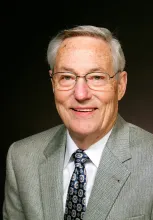
At the time of his retirement in 2016, Roy Holladay was serving the Operation Manager for Ministerial and Member Services of the United Church of God. Mr. and Mrs. Holladay have served in Pittsburgh, Akron, Toledo, Wheeling, Charleston, Uniontown, San Antonio, Austin, Corpus Christi, Uvalde, the Rio Grand Valley, Richmond, Norfolk, Arlington, Hinsdale, Chicago North, St. Petersburg, New Port Richey, Fort Myers, Miami, West Palm Beach, Big Sandy, Texarkana, Chattanooga and Rome congregations.
Roy Holladay was instrumental in the founding of the United Church of God, serving on the transitional board and later on the Council of Elders for nine years (acting as chairman for four-plus years). Mr. Holladay was the United Church of God president for three years (May 2002-July 2005). Over the years he was an instructor at Ambassador Bible College and was a festival coordinator for nine years.
