
Don Ward
This transcript was generated by AI and may contain errors. It is provided to assist those who may not be able to listen to the message.
The title of the sermon today is Communion with the Holy Spirit. Communion with the Holy Spirit. We talk a lot about God's Spirit, but do we really understand and take seriously with awareness? Those two words are key with awareness, the various works of God's Spirit. We have an opening prayer for almost every service, and many other events. We ask that God's presence be there. God's Spirit. John 4, 24 states that God is Spirit, and those who worship Him must worship Him in Spirit and in truth. In the preceding verse, verse 23, it says that He seeks such to worship Him. It is through God's Spirit that He does His awesome works of power. It is through His Spirit. The Holy Spirit is the essence of God. Like your essence, if we want to speak in those terms, is flesh. God's essence, which is invisible if He desires it so to be, to the naked eye. Look at Zechariah 4, verse 6. Zechariah has given these great visions in chapters 3 and 4. We have one verse here that we want to focus on and emphasize. In Zechariah 4 and verse 6, Then He answered and spoke unto me, saying, This is the word of the Eternal unto his rubbable, saying, Not by might nor by power, but by my Spirit, says the Eternal of Hosts. They were in the process of building what is called the Second Temple, or the Restoration Temple, they being Zerubbabel, Joshua the High Priest, and the two prophets on the scene, Haggai and Zechariah. And, of course, much of their work of that Restoration Temple pictures that which has become the Spiritual Temple. The Spiritual Temple is not made by hands, but the most important point I want to emphasize here now is, Not by might nor by power, but by my Spirit, says the Eternal of Hosts. Now, note Psalm 104 and verse 30, back a few pages, Psalm 104 and verse 30, with regard to God's Spirit. You know, people who go around saying that God is a Trinity and the Holy Spirit is a person, I really can't even grasp that because, in essence, you're saying that God is separated from His Spirit? How could God be separated from His Spirit and the Spirit be a different person? If God is Spirit Himself and if God's Spirit is Holy, you get what I'm saying? In Psalm 104 and verse 30, You sin forth your Spirit. You sin forth. God does great works with power. In Genesis 1 it says that the Spirit of God moved upon the face of the waters. You sin forth your Spirit. They are created. You renew us the face of the earth. Now look at Galatians 4 and verse 6. Now we come to something spiritual with regard to God's Spirit directed toward us. It would be so easy. In fact, I've read over this verse many times, and it just yesterday hit me with an impact that it had not hit me in the past.
In Galatians 4 and verse 6, And because you are sons, because you are sons, and we could add daughters. The Bible is basically written in the masculine gender, but in most cases where it's men or sons, it can also be daughters or women. And because you are sons, God has sent forth the Spirit of His Son into your hearts. He has sent forth the Spirit of His Son, the Spirit of His Son into your hearts, crying, Abba, Father. Now Abba is an Aramaic word that has the connotation of Daddy, of a close, loving relationship between Father and Son. Abba, Daddy, Father. If God views us as sons and heirs, we must needs view Him as loving, gracious, and merciful. He is our heavenly Father. He is our spiritual Father. Because you are sons, God has sent forth the Spirit of His Son into your hearts, crying, Abba, Father. And thus we should have a closer relationship with our heavenly Father than we do with our Father of the Flesh. So today let's examine the question of how involved is God and Christ and the Holy Spirit, which is the essence of God and Christ. How involved are they in the activities of humankind? How involved are they in your activities of your life?
The power of the Holy Spirit is not limited to imparting intellectual knowledge. The Spirit of God can come upon a person and impart to Him or her great wisdom, talents, and strength. 1 Samuel 10.6 says, The Spirit of God came upon Saul and he became a different man. Then later, I believe it's 1 Samuel 16.10, it says that because of Saul's sins and rebellion, the Holy Spirit departed. See, the Holy Spirit came upon him. In the book of Judges, you'll see at least seven times where it says, And the Holy Spirit came upon, one person was Gideon, another was Jetha, and there were at least five others. The Holy Spirit came upon them, and it imbued with them with great power. In the days of the Old Testament, when the Spirit came upon a person, it was not necessarily the Spirit of Begettle as we think about it today. The Holy Spirit came upon Saul, he became a different person. Even when David was anointed king over Israel, it says, And the Holy Spirit came upon him. Right then, that's what it says when he was anointed.
The Holy Spirit imparts personal, or can impart, special talents and abilities to people, as I have noted there. Christ told the apostles that he would send them a comforter. In the Greek, that word is paracletos, sometimes we call it paracletos, but it's paracletos.
And it is identified as the Holy Spirit. So let's look at John, first of all, John 16, verse 7. In John 16, Jesus Christ is in the midst of instructing the apostles before he is betrayed, and then the mock trial and crucified in the daylight hours of the 14th on the day of Passover. The 14th is the Lord's Passover in John 16, verse 7. Nevertheless, I tell you the truth. It is expedient for you that I go away, for if I go not away, the comforter. Now, this word comforter, paracletos, means one alongside. One alongside.
It means comfort, it means helper, it means advocate, it can mean it has a wide range of meanings. But here, John calls it the comforter, one alongside, one who helps fight your battles.
For if I go not away, the comforter will not come unto you, but if I go, I will send him unto you. And the reason it's him is because comforter is masculine, it's not a person. Now, you look back at John 14.26. The comforter is identified here as the Holy Spirit.
John 14.26. Note what the Holy Spirit will do. But the comforter, which is the Holy Spirit, whom the Father will send in my name, it shall teach you all things and bring all things to your remembrance, whatsoever I have said unto you. Of course, they spent, they being the apostles, spent three and a half years with Jesus Christ, listening to him in various venues throughout Judea. And they remembered so much of those things and wrote those things down for us. Now we can have those, we do have those things right before us, and we can read them.
So the Holy Spirit, the comforter, the one alongside. Now let's look at 2 Corinthians 13.14.
What are we to do with this? What is this about? Communion with the Holy Spirit. Well, here we're going to see that Paul prays in his clothes here of this epistle to the Corinthians, his second epistle. The second epistle to the Corinthians was quite an epistle. The Corinthians had treated Paul so very poorly in so many different ways, and he makes an appeal to them throughout this epistle. In 2 Corinthians 13 verse 14, The grace of the Lord Jesus Christ, the divine favor of the Lord Jesus Christ, and the love of God, and the communion of the Holy Spirit, the communion with the Holy Spirit be with you all. Amen. The Greek word translated communion is koi non eo. It means fellowship. It means association. It means community. It means joint participation to share what one has with another. So how often are we consciously aware of the Holy Spirit? The comforter, the one alongside.
It seems that oftentimes we speak more often of the influence of Satan the Devil, the prince of the power, the heir of the Spirit that now works in the children of disobedience, than we do the communion of the Holy Spirit. We talk about Satan broadcasting in moods and attitudes.
We don't want to commune with that, but we talk about it, it seems, a great deal.
Satan is a spirit being, and there is a spirit of this world, a spirit that we do not want to be a part of. Look at 1 Corinthians 2.12. 1 Corinthians 2.12. It almost seems like that this... Of course, Paul is using a contrast here between the spirit of God and revelation and the spirit of this world.
The Corinthians were divided on so many different things. A great rhetorical question in 1 Corinthians 1.13, where Paul asks the question, is Christ divided? Then he talks about how some say that they are of Cephas, some say that they are of Apollos, some say they are of Paul, and some even say they are of Christ. Then he says that the Greeks seek after wisdom, and the Jews seek after a sign. But then he says, you see your brother, and you see your calling, brother. Not many noble, not many mighty are called, but God has chosen the poor of the world and the weak things of the world to confound the mighty. Then he gives the anecdote for that when he comes on the scene in his preaching. You look at chapter 2, verse 1, And I, brethren, when I came to you, came not with excellency of speech or of wisdom. Well, he didn't try to mimic the wisdom of the Greeks, declaring unto you the testimony, the witness, the record, the maturia of God. Then he talks about how we know the things of God through Revelation. Now, in contrast to that, verse 12, Now we have received not the spirit of the world, we have not received the spirit of the world, but the spirit which is of God, if it is of God, surely it can't be separated from him, but he can send it forth, that we might know the things that are freely given to us of God. I think sometimes we get the idea that God has sort of handcuffed himself, just letting everything drift along according to the plan of Satan and his devil and his demons. Of course, they are out to try to wreck the plan of God. We seem to be in such a period of time right now in which God is seemingly taking a hands-off approach. And from time to time, that does happen. Look at Isaiah 29, verse 10. Isaiah 29 and verse 10.
In Isaiah 29 and verse 10, Do you hear any wisdom coming from the leadership of the land today? It seems to me this verse is fitting. The Lord hath poured out upon you, the spirit of deep sleep hath closed your eyes, the prophets and your rulers, the seers, hath he covered. And the vision of all has become unto you as the words of a book that is sealed, which men delivered to one that is learned, saying, Read this, I pray thee, and he said, I cannot. It is sealed. You look at Hosea chapter 5. Hosea chapter 5, and probably this is the time leading into the time of the Great Tribulation, and is the time, I would say, of the Great Tribulation in Hosea chapter 5. Daniel, Hosea. In Hosea chapter 5, and we'll read 14.
In Hosea 5 verse 14, For I will be unto Ephraim as a lion. I've said this often, and I hope you remember Ephraim oftentimes is used generically for all ten tribes, the northern ten tribes, and that's the intent here.
For I will be unto Ephraim as a lion, and as a young lion, to the house of Judah. And so you have the northern kingdom and the southern kingdom included in this. For as I, even I, will tear and go away, I will take away and none shall rescue him. I will go and return to my place, till they acknowledge their offense and seek my face. In their affliction they will seek me early. Of course, you see that scene there in Revelation chapter 7, where you see the great multitude that no one could number stand before the throne of God.
And the question is asked, well, who are these? And it says, these are they which have washed their robes, and the blood of the lamb made them white, and they have come out of great tribulation. There should be no chapter break here. Come, they will be sayings. See, they seek my face in their affliction, they will seek me early. And the ellipsis here should be, and they'll be saying, Come and let us return unto the Lord.
For he hath torn and he will heal us, he hath smitten, and he will bind us up. After two days will he revive us, and the third day he will raise us up, and we shall live in his sight. Then shall we know, if we follow on to know the Lord, his going forth is prepared as the morning, and he shall come unto us as the rain and the latter rain and former rain unto the earth.
And then this plea, O Ephraim, what shall I do unto you, O Judah, what shall I do unto you? For your goodness is as the morning cloud. Of course, even in the hot months here in Texas, in June and July, you get up and you see all these fluffy, dark-looking clouds.
As the sun comes up, and by eight or nine o'clock, and surely by ten, they're gone, as the morning cloud and as the early dew, it goes away. Therefore, have I hewed by the prophets, I have slain them by the words of my mouth, and your judgments are as the light that goes forth. For I desire mercy and not sacrifice. Can any of you explain what that means? I desire mercy and not sacrifice. And the knowledge of God more than burnt offerings.
See, in order to obtain mercy, you have to understand the plan and purpose of God. And that through the plan and purpose of God, when you are called and you are convicted, and you repent, you cry out for mercy, for forgiveness. See, mercy, in the ultimate sense, cannot be extended until repentance takes place. Now, there is long suffering, and sometimes people confuse long suffering with mercy. Long suffering has to do with bearing with something or somebody for a long time. Mercy has to do with forgiveness. So I desire mercy and not sacrifice. See, I desire that repentance and exercising judgment, mercy, and faith. More, you can sacrifice animals all day long. But if it's not accompanied with repentance, it amounts to nothing.
But even in those times in which God may seal the close of the eyes, as apparently He has done in the leaders of the world today, that does not mean that God is not in control and that He is not keenly aware of every thought and every action we take. Look at Psalm 139. We want to get really personal with what we're talking about here today, because we're talking about communion with the Holy Spirit.
There are times when it seems like God has gone away, but with those who have His Spirit, that is not the case. In Psalm 139, verse 17, How precious are your thoughts unto me, O God? Have you ever thought about what God thinks about you? Well, I wonder how He or she is doing today. How precious also are your thoughts unto me, O God?
How great is the sum of them! If I should count them, they are more in number than the sand. When I awake, I am still with you, communion with God. God's power, His Spirit, pervades the universe, and He is above all and overall and can be in us all. Now look above at verse 17. We want to look above now at verse 7. Psalm 139, verse 7, Where with shall I go from your Spirit? God is omnipresent. That means ever present. He is everywhere. Where shall I go from your Spirit, or where shall I flee from your presence?
If I send up into heaven, you are there. If I make my bed in the grave, behold, you are there. If I take the wings of the morning and dwell in the uttermost parts of the sea, even there shall your hand lead me, and your right hand shall hold me.
If I say, Surely the darkness shall cover me, even the night shall be light about me. Yea, the darkness hides not from you, but the night shines as the day. The darkness and the light are both alike to you. For you have possessed my reigns, you have covered me in my mother's womb. I will praise you, for I am fearfully and wonderfully made.
Marvelous are your works, and that my soul knows right well. See, God is present. So I don't think that we are as aware of God's Spirit, His power, and His presence in our lives as we could be and should be. Are we unwittingly, unknowingly quenching the Spirit of God by not acknowledging God's presence in our lives through the Holy Spirit? 1 Thessalonians 5, 19 says, everybody should be able to quote it, "...quench not the Spirit." Don't spirit in that sense as light has likened unto a fire, which we'll talk a little bit more about when we get to 2 Timothy 1.
Quench not the Spirit. Don't put it out. The lamps of the ten virgins—you know the story well, we refer to it so often—thyve or foolish, the lamps were going out. The Spirit was being quenched. Note Ephesians 4 and verse 23. Ephesians 4 and verse 23. And some people will read this verse and say, oh yeah, that makes God this and the other one that I'm going to read.
In Ephesians 4, 23, it says, and be renewed in the Spirit of your mind. That's one of our goals here today, that each one of us be renewed in the Spirit of our mind that we become filled with zeal.
The church is going nowhere until a membership is filled with zeal, is my view. And the church is raised on—what is our chief product? What is it that we have? We have the truth, the pearl of great price. We have the purpose and plan of God. We understand it. Now, there are a lot of books you can read and a lot of great literature out there—I guess you'd call it great— that you can receive instruction from and some good thoughts at times and may trigger some good thoughts. But when it comes down to who is God, what is God, what is His purpose, who is man, what is man, what is His purpose, they don't understand it.
Now look at verse 30, and grieve not the Holy Spirit of God. That doesn't mean that the Holy Spirit is a person, because it is the Spirit of God. It is from Him and from Christ. Grieve not the Holy Spirit of God, whereby we are sealed under the day of redemption, when we are resurrected as glorious, radiant spirit beings.
We know that God imparts gifts to us through His Spirit. In 1 Corinthians 12, Paul lists several of those gifts. The most important part of that, as turned to 1 Corinthians 12, is what he closes it with. With regard to those gifts, that is the purpose for those gifts. Let's read a couple of verses here leading up to that in 1 Corinthians 12. Verse 4, there are different or diversities of gifts, but the same spirit. It is the same spirit that imparts the gift.
There are differences of administration, but the same Lord. There are differences of operations, but it is the same God, which works all and all. Now, a very key verse, but the manifestation of the Spirit is given to every man to profit everybody. And we all have different gifts. Let's look at verse 12, which says something similar. For as the body is one, and hath many members, and all the members of that one body, being many, are one body, so also is Christ.
Now we read verse 11. But all these works that one and the self-same spirit, dividing to every man, severly as he will, and for the purpose of profiting everybody. So we need to pray fervently, that God will give us the gifts that are necessary for us to carry out what he has called us to do. In addition to these gifts, God can give you the spirit of meekness, humility, peace, joy, and much more.
We all need to pray fervently that God will give us the gifts of the spirit, so we can be more profitable servants in his service. God can be far more active in our lives if we meditate on his name and seek his face. Now we're getting down to the nitty-gritty of communion with the Holy Spirit.
I try to maintain a running dialogue with God throughout the day. Of course, there are times when you're not, but in your downtime, and they say the average person talks to himself or herself 70% of the time. Well, talk to somebody else. I'm especially aware of God's spirit when I open the pages of the Bible and begin to study and prepare a sermon or Bible study. Let's note the words of the psalmist. In Psalm 119, verse 97, we have been set to music.
We sing it from time to time in the hymn service. In Psalm 119, verse 97, the hymn title, O, How Love I Thy Law, do we really? In Psalm 119, verse 97, O, How Love I Thy Law, it is my meditation all the day. How can it be your meditation all the day if you're not aware of it? I mean, if it's not in your mind or in your thoughts.
It is my meditation all the day. You, through your commandments, have made me wiser than my enemies, for they are ever with me. I have more understanding than all my teachers, for your testimonies are my meditation. I understand more than the ancients because I keep your precepts. I have refrained my feet from every evil way that I might keep your word. I have not departed from your judgments, for you have taught me how sweet are your words and my tastes, yes, sweeter than honey to my mouth.
Through your precepts, I get understanding, therefore I hate every false way. Your word is a lamp into my feet and a light into my path. See, that's talking about real communion with the Spirit and Word of God. Remember the John 6, 63, the words I speak, they are spirit and they are life. Jesus said, and we read in John 14, 26, which says, the Holy Spirit will teach you all things. Now, we look at John 14, 23, 16, 23. I'll get it right in a minute. In John 16, 13, we read this recently, maybe the last time I spoke here.
Remember we read today, verse 7, I will send you the comforter. Verse 13, how be it when it, the Spirit of truth, has come, it will guide you into all truth, for it shall not speak of itself, but whatsoever it shall hear, that shall it speak. It hears the truth, and the truth is contained in the Word of God. You can read it, you can hear it, you can listen to it, hear it. It can be preached, it can be taught, and He will show you, or it will show you things to come. So once again, we talk about Satan broadcasting and moods and attitudes and all of that, but God is so much more powerful than Satan. God is overall and above all. Now here are some scriptures that should make us aware of some of the communion of the Spirit. I'm going to give these references. I'm not going to turn to them if you want to write them down. Luke 4, verse 18. This is an amazing scripture. It is in the account where, after Jesus was baptized, He went back to His home area, went to the synagogue on the Sabbath, and He took the scroll, and He began to read from Isaiah 61. And He read certain verses, well, certain words, about a verse and a half, and He sat down. Luke 4, 18. The Spirit of the Lord is upon me because He hath anointed me to preach the gospel to the poor. He has sent me to heal the brokenhearted, to preach deliverance to the captives, and recovering of sight to the blind, to set at liberty them that are bruised. The Spirit of the Lord is on me, said Jesus.
John 14, 17. Even the Spirit of truth, whom the world cannot receive, because it sees Him not, neither knows Him, but you know Him, for He dwells with you and shall be in you.
John 16, 13. We've just read, when the Spirit of truth has come, it will show you things to come. Now, an amazing Scripture. Look at Acts. Let's turn there to Acts 8 and verse 39. Acts chapter 8 and verse 39. You remember the story of Stephen gave his great, powerful sermon in Acts chapter 7, and as a result of that sermon, he was stoned, and they laid down their clothes by one named Saul, who became Paul. And a great persecution, Acts 8, came upon the church, and many of the members were scattered abroad. And among them was the deacon Philip. Philip went up into Samaria, and he preached and taught, and many were converted. And the apostles, at least two or three of them, came up and laid hands on them so they could receive the Holy Spirit. Philip was a deacon. His preaching was so powerful that many people were turned to God and Christ. Now, we're breaking in on the thought of Acts 8 and 39. It's talking about what the Holy Spirit can and has done in Acts 8 and verse 39. This is a story about the Ethiopian eunuch, and after Philip taught with the Ethiopian eunuch, he decided to baptize him. Verse 38, And when they were come up out of the water, the Spirit of the Lord caught away Philip, that the eunuch saw him no more, and he went on his way rejoicing. The Holy Spirit took Philip up out of the water just after he baptized the Ethiopian eunuch. Quite an amazing story. So let's note what the Spirit that was on Christ and that same Spirit see as in us. It's in a prophecy back here of probably the most concise. Look at Isaiah 11. Communion of the Holy Spirit. This ties in with what I read from Luke 4.18, where Jesus, when he stood up in the synagogue, read from Isaiah 61, and he said, The Spirit of the Lord is upon me. Look at this, what was prophesied with regard to the Spirit that would be on the Lord. In Isaiah 11.2, when there came forth a rod out of the stem of Jesse, that poetic, figurative speech, Jesse begot a son named David, I mean named David, and from that son a branch shall grow up out of his roots. And of course, Jesse and David are in the genealogical background of Christ. And the Spirit of the Eternal shall be rest upon him.
And we read Luke 4.18, The Spirit of Wisdom, Understanding, The Spirit of Counsel, and Might, The Spirit of Knowledge, and the Fear of the Eternal.
Now, what is that Spirit going to do? What can it do for you? What can it help you and I do? And shall make him of quick understanding in the fear of the Lord, and he shall not judge after the sight of his eyes, neither reprove after the hearing of his ears. But with righteousness shall he judge the poor, reprove with equity for the meek of the earth. And he shall smite the earth with a rod of his mouth and with the breath of his lips. Shall he stay the wicked?
So we need to pray earnestly that God will give us some of those gifts. We know God oftentimes allows severe trials to come up on us in order to forcefully get our attention. So hopefully we will think on his name and seek his face.
That's one of the first things. So many examples in the Old Testament. When the big trials came, what did they do? They turned to God, sack and ashcloth and fasting. You look at Malachi 3.16. Malachi 3.16, what's called the last of the minor prophets, the Jews viewed the minor prophets as the 12, as one book.
What are we talking about? When severe trials and troubles come.
We want communion with God. How?
In Malachi 3, the great rhetorical question of Malachi is verse 17. You are weirded the Lord with your word, yet you say, where in have we weird him? Because when you say, everyone that does good in the sight of the Lord, everyone that does evil is good in the sight of the Lord, and he delights in them. Or, here's the great rhetorical question, where is the God of judgment? And the question is answered in verse 6. For I am the eternal I change not, therefore sons of Jacob are not consumed. So God is where he's always been. Jesus Christ the same yesterday, today, and forever. But while those things are going on when they are questioning God, when they are questioning whether or not God is righteous, you look at verse 13 and then we lead into what we need to do. Your words have been scouted against me, says the eternal, yet you say, what are we spanking so much against you? Well, where's the God of judgment? That's the greatest question. You have said, you want to know the answer to that? You have said, it is vain to serve God, and what profit is it that we have kept his ordinance, and that we have walked mournfully before the eternal post? And now we call the proud, happy, yes, they that work wickedness are set up, yes, they that tempt God are even delivered. That's what you're saying. Then, when that's going on, then they that feared the eternal spoke often one to another, and the Lord hearkened and heard it. And a book of remembrance was written before him for them that feared the eternal and that thought upon his name. We read the scripture from Psalm 139, verses 17 and 18, that his thoughts were ever toward us. I should count the number of them. They're more than the sand on the seashore. And they shall be mine, says the eternal host, in the day when I make up my jewels, and I will spare them as a man spares his own son. Perhaps the greatest lesson we all need to learn is how to view and endure trials. If we really believe that God is in control, if we really believe that he rewards those who diligently seek him, if we really believe that all things work together for good for those who love God and are called according to his purpose, we can make great progress toward coming to understand the really deep things of God. And that's one of the things I'm trying to communicate today. This life is temporary. It is transitory. The real life is the life of the Spirit that Paul writes about in 1 Corinthians 15. In verse 19 of 1 Corinthians 15, Paul poses a question and says, If we have hope only in this life, we are of all men most miserable. We know that there is a better life coming. When all is said and done, God, our loving Father and Jesus Christ, are the source of peace and comfort. And invariably, the prayers of the saints will be answered, and God will give you strength. There have been many times in my life when I felt so weighted down, that when I went to bed, I didn't think I could face the next day. How could I face the next day? And how would I have enough strength? So you cry out to God and ask Him to hold you in His arms and give you peace and comfort. And then what is His answer? Look at Lamentations 3. Lamentations comes after Jeremiah. It's between Jeremiah and Ezekiel. In Lamentations 3, verse 22. It is of the Lord's mercies that we are not consumed, because His compassion fails not. They are new every morning. Great is your faithfulness. So we sing the song.
The Lord is my portion, says my soul, my life essence. Therefore will I hope in Him. The Lord is good unto them that wait for Him, to the soul that seeks Him. It is good that a man should both hope and quietly wait for the salvation of the Lord.
God has the power to influence our hearts and minds. Say it again. God has the power to influence our hearts and minds. Surely Satan can broadcast the moods and attitudes. God has the power to influence our hearts and minds through prayer and study and meditation. Look at Isaiah 57, verse 15. Isaiah 57, verse 15. Isaiah 57, verse 57.
For thus says the high and lofty one that inhabits eternity. He inhabits eternity. He's always been, He always will be. Whose name is holy, I dwell in the high and holy place with Him, also that is of a contrite and humble spirit, to revive the spirit of the humble, and to revive the heart of the contrite ones. And just as you saw in the scripture of the day, to this man, well, I look, he that is poor in spirit and trembles at my word. Paul writes in Philippians 4.13, I can do all things through Christ who strengthens me. Satan wants us to doubt God. He wants us to believe that God is unfair. Satan wants to confuse our thinking so that we'll be filled with self-pity and despair. There is no person who ever lived in the flesh that suffered more than Christ. But we will never find him feeling sorry for himself, wallowing in the pity pits in a defeated state of mind. But on the other hand, I'm sure that from time to time he was grieved and disappointed because of their lack of faith. And so there is a time, as Solomon writes in Ecclesiastes 3, there is a time and a season for every purpose under heaven. Look at Matthew 23, verse 37, of Christ lamenting over Jerusalem and the people therein. In Matthew 23 he talks about how they had killed all the prophets that he had sent to them.
He enumerates some of that. And then he comes to the end of this lament.
Matthew 23, verse 37, O Jerusalem, Jerusalem, you that kill the prophets and stone them that are sent unto you, how often would I have gathered your children together even as a hen gathers her chickens under her wings, and you would not. Behold, your house is left unto you desolate. For I say unto you, you shall not see me henceforth till you say, Blessed is he that comes in the name of God. Behold, your house is left unto me desolate. In other words, the Spirit of God has left you.
Christ was not some wild-eyed religious fanatic. He prayed that if it be the Father's will, let this cup pass from me, but nevertheless your will be done. Christ was in perfect harmony with the Father. God can stir up our spirit to do all kinds of great works. He stirred up the spirit of the people of Judah who had returned from captivity in Babylon to build the temple. Now, there were two prophets on the scene. Turn to Haggai. Haggai is between Zephaniah and Zechariah. Haggai chapter 1. He stirred up the spirit of the people through these two prophets.
See, they had returned from Babylon in 538 B.C. and now they were down to 520 B.C. and the house of God had not been built. So these two prophets come on the scene along with Zerubbabel and Joshua. You look at Haggai 1.14. And the Lord stirred up the spirit of Zerubbabel, the son of Shealtel, the governor of Judah and the spirit of Joshua, the son of Jossedek, the high priest, and the spirit of the remnant of the people, and they came and did work in the house of the Lord of hosts, their God.
See, God can stir up the spirit. Now, how does that apply to us today? Well, this very admonition that's there is given to us in a personal sense. We want to look at 2 Timothy 1 and verse 6. Back a few years ago, this has been quite a few years ago, maybe five or so, I gave a presentation at the GCE, General Conference of Elders, titled, How to Set Yourself on Fire and Light Up Your Congregation.
Or you could reverse it and say, How to light up yourself and set your congregation on fire. Either way works.
There was a presentation well received, it was based on this scripture. See, God stirred up the spirit of those people, and one of the few times that God's people really responded to the prophets, and they built the Restoration Temple, which was symbolic and pictured the temple to come, the spiritual temple. 2 Timothy 1.6, Wherefore I put you in remembrance that you stir up the gift of God which is in you by the putting on of my hands. Putting on of my hands after you are baptized, you receive the Holy Spirit putting on of my hands.
For God has not given us the spirit of fear, but of power and of love and of a sound mind.
Now this word that is translated to stir in the Greek is a six-syllable word. In English, it's translated, it has a connotation of like you're striking a match, you're friction, you're trying to light a fire. An adzo puer eo, an adze puer eo. See that several times, quick. It means to kindle up, to inflame one's mind, strength, zeal. It is similar to the action required to start a fire. You know the old Boy Scout thing? Get out and strike the rock, rub the sticks together until you actively kindle a fire. It requires effort. It requires effort. You don't kindle a fire with primitive sticks. And even if you have a match, you have to use friction to start it. At times, I think we are osmotic Christians. Now, last sermon I talked about assembly line Christians. Today we're talking about osmotic.
That is, just passively sit and think that God's Spirit will ooze into our minds as we sit and do nothing. I just listened. That was nice. I listened. When I took no action, I didn't use any kindling wood. I didn't really stir up anything. Osmotic is the passage of fluid from a region of high fluidity concentration through a semi-permeable membrane to a lesser region of concentration. For example, the synovial fluid that surrounds the knee. You have that fluid, and as the knee needs it to lubricate the joints, the bending of the knee, through an osmotic process, that synovial fluid passes into the cavity of the knee.
God, who is Spirit, doesn't just, without any effort on our part, pour His Spirit into humans with a low concentration of Spirit into our minds with no awareness or effort on our part. When we receive the laying out of hands, we have gone through repentance, faith in the sacrifice of Christ.
We've been baptized. We can see clearly, we just read it, and were commanded to stir up God's Spirit by actively how? Like we talked about from Malachi 3. Think on His name. Speak often, one to another. A word fitly spoken, like apples of gold and pictures of silver, or something like that. God has given us powerful spiritual weapons to wage war against our human weaknesses and the wiles of the devil.
He's alongside with His Spirit. He is in us. Are we aware? 2 Corinthians 10, we read about these weapons of our warfare. 2 Corinthians 10, verse 1. Now I, Paul, beseech you by the uniqueness and gentleness of Christ, who in presence and base among you. Paul was a weakly pitiful looking thing, apparently. Of course, some of the Corinthians said they were of Apollos.
Apparently Apollos was a very handsome guy and a polished speaker and really charismatic and all of the things that Paul wasn't. There's a verse in here that you can look up. This is off track. In one place here it says Paul was coming to a certain place and he said, I would ask Apollos to come meet me there, but he would not. He refused. So I think the rift there was more than just some saying I am of Apollos.
Now I, Paul, beseech you by the meekness and gentleness of Christ, who in presence and base among you, but being absent and bold toward you. But I beseech you that I may not be bold when I'm present with you that confidence where will I think to be bold against some which think of me as if we walked according to the flesh. And of course all of us, no matter what office or whatever we hold in the church, we are but flesh.
We fight the same battles. But God does set people in the church as it pleases him and he gives gifts to people that are different one from another. For though we walk in the flesh, we do not war after the flesh. For the weapons of a warfare are not carnal but mighty through God to the pulling down of strongholds. Now strongholds are those things that come on the mind that grip us, that cast us into the negative pittypits of despair, or doubting God, or any other negative thing that you can talk about. Casting down imaginations, that which comes into the mind, and every high thing that exhausts itself against the knowledge of God, and bringing into captivity every thought to the obedience of Christ.
We're admonished to put on the whole armor of God in Ephesians 6. We've heard it many times. So, as we close here today, ask yourself, I ask myself, is God's spirit my comforter? Am I aware, are you aware, of God's spirit in you and with you, walking along beside you? In Genesis 5, it talks about Enoch. Enoch walked with God 300 years. Enoch walked with God for 300 years. I would imagine that was quite the communion. So, I hope today will be a day of awakening for all of us.
We will be renewed in the spirit of our minds. We will realize that God's spirit is with us and in us. We know the verse, Romans 8, 31. If God be for us, who can be against us? So, brethren, as we face the trials of life in these trying and troublesome times, let us heed the words of the Apostle Peter, and the Apostle Paul, and Jesus Christ, and God, all of those that have gone before, and claim the promises of God.
I will never leave you. I will never forsake you. Lo, I am with you to the end of the age. In one place, it talks about the comforting words, leaning on the everlasting arm, leaning on the everlasting arms of God, standing on the rock. So, let us continue to build on the rock of our salvation, Jesus Christ.
And let us realize that God has given us the earnest of the Spirit, whereby we cry, Abba, Father. So, let's move forward in full assurance of faith, and realize there is one alongside.
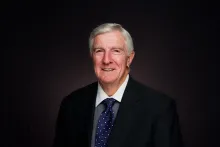
Before his retirement in 2021, Dr. Donald Ward pastored churches in Texas and Louisiana, and taught at Ambassador Bible College in Cincinnati, Ohio. He has also served as chairman of the Council of Elders of the United Church of God. He holds a BS degree; a BA in theology; a MS degree; a doctor’s degree in education from East Texas State University; and has completed 18 hours of graduate theology from SMU.
