
Paul Moody
A curtain was established in the Old Testament designed to block access. At Jesus Christ's death, that curtain was torn and we now have the opportunity to enter boldly to the throne of God.
Well, good afternoon and happy Sabbath! And thank you, Mr. Werner. Spring has definitely sprung. I love it when the flowers are out, the red buds are starting to come, and that also means, a few weeks from now, Passover season. I don't know how your house operates. Ours, this is about the time we start looking at where's the leavening in the freezer and the pantry to start winnowing it down. So then in a couple weeks, it's, well, who's going to do the cars? Me. Who's doing the other stuff? Jan. And then I'll try to do a little bit more. But it's like the responsibilities for deleavening. We also know this is a time of year, considering, examining ourselves, asking God to show us who we really are. Now, both these things are really good. But as far as thinking about the Passover, what do you think is lacking from what we've just talked about? So far, it's a focus on us. Leavening, deleavening, examining. That's missing the most important part. Jesus Christ. Passover, the Passover Lamb, Jesus Christ is a very important part as we celebrate the spring holy days. The physical can teach the spiritual. No doubt, examining and deleavening, those are important things. But today, I'd like to place the emphasis on Christ's sacrifice as our Passover Lamb. Today's title? The curtain. We'll examine the curtain both before Christ's life and death, and then after, and consider the application of this curtain with the spring holy day season. From God's holy day plan booklet, there are two sentences I'd like to read. Jesus's sacrifice was the pivotal event in God's plan to save humanity. This important event laid the foundation for the remaining annual holy days. It's the most momentous step in God's plan. So point number one, the barrier. Think of the barrier reef, the barrier. Please turn to Exodus chapter 26. Let's get introduced to the curtain or the veil. This is a curtain or a veil that separated the Holy of Holies on the temple mount. Initially, the tabernacle, eventually, the temple mount. So Exodus chapter 26. Let's start in verse 31. And you shall make a veil woven of blue, purple, and scarlet thread and a fine woven linen.
The commands given here, God wanted everything to be done with the best of the materials, beautiful artwork, artsmanship, blue, purple, scarlet thread, and a white, fine, woven linen. It shall be woven with an artistic design of the caribim. You shall hang it upon the four pillars of acacia wood. I was from the UCG commentary. It says acacia wood is a light, strong, and beautiful wood.
It has to be strong. The weight of this curtain is going to be amazingly heavy that we'll talk about momentarily. Durable, resistant to insects and disease is the acacia wood. That God is very specific on the building plan. You shall hang it on the acacia wood, overlaid with gold. Their hook shall be gold upon four sockets of silver. You shall hang the veil from the clasps. Then you shall bring the arc of the testimony in there behind the veil.
The veil shall be a divider. That word divider, separator, barrier, there's a separation now. So behind this veil, behind this curtain, let's continue reading, you shall place the mercy seat upon the arc of the testimony in the Most Holy. So this barrier, this curtain is being described, and we'll get into a little bit more details momentarily.
A huge curtain is a barrier. Behind the barrier, the mercy seat, picturing the very throne of God. How many times could people go in to behind the curtain in Old Testament time? Zero! Well, you could say one, the high priest, can go in at atonement. But as far as everybody else, they could go in once, but they're going to be carried out. Because you don't go into the Holy of Holies behind the curtain, that's a barrier. Josephus, who had seen this curtain, wrote, it was a Babylonian curtain embroidered with blue, fine linen, scarlet, and purple. We heard that. It was truly wonderful. It had an image of the universe. The scarlet seemed to signify fire by the fine flax the earth, the blue, the air, the purple, the sea.
So here's all of these colors on this curtain. Now, how big was the curtain? We don't exactly know, but we have a couple of reasons why we can say we think we know. So at the tabernacle when it was first made, it was approximately 30 feet by 30 feet. So imagine 30 feet wide. This room, thanks Mr. J-Fit, 38 feet. So if you take four feet off of each edge, just a little bit beyond the stage on each side, that's 30 foot.
That's the width of the curtain. The height of the curtain for Solomon's Temple and and then Herod's Temple, we believe it was 60 feet tall. This is a 12-foot ceiling. So five of these ceilings is the height. That's a huge curtain. Jewish tradition, it took 300 priests. Now, they might not have been that strong, but 300 people to lift the curtain? Wow, that's heavy. It was also supposedly four inches thick, either three and a half to four inches.
It's the width of the palm. So you have a curtain that's this thick, this wide, just beyond the stage, and five of these ceilings tall. That's the size of this curtain in the New Testament time. So point number one, the barrier. Point number two, the tear. Please turn to Matthew 27. Matthew 27, and we'll start in verse 45. So Matthew 27 and verse 45. This is a section that will be read many times this Passover season.
We'll be starting this mid-story, but let's just do just a quick recap. So Christ would have been up all night. He would have been before Annas and Caiaphas and then Pilate, then the scourging. Some people die by the scourging themselves. And then at 12 o'clock noon, so in verse 45, it says the sixth hour, so 12 o'clock noon was when Jesus Christ was nailed onto the cross.
He was on that cross for three hours. I was on the treadmill this week, and I thought 30 minutes seemed pretty long. How long would three hours of just incredible horrific pain have been on the cross? Take this one other angle. Reading through the Exodus commentary, if any of you are staying up with that, I applaud you.
I think that's great. Something jumped out to me about the ninth and the tenth plague. What was the ninth plague in Egypt? Darkness. How long did it last? Three days. Then what happened on the tenth plague? Firstborn killed, Passover lamb slain. In effect, play those things. Three days versus here we go. From the sixth hour until the ninth hour, there was darkness over all the land. That's almost like the ninth plague for three days. And about the ninth hour, Jesus cried out with a loud voice, saying, Eli, Eli, lama sabachthani, that is my God, my God, why have you forsaken me?
Let's jump down now to verse 50. Jesus cried out again with a loud voice and yielded up his spirit. And then behold the veil. That's the same curtain. This 30-foot wide curtain, 60 feet tall, four inches thick. How does a curtain that's four inches thick get torn? It's a miracle. Well, Christ did so many miracles when he was alive. Wouldn't it make sense there'd be miracles happening at his death? So the earthquake happened. Rocks were split. That temple, the veil, so let's go back to verse 51, the veil of the temple was torn in two.
It wasn't just like a little tear. Top to bottom. Four inches thick of fabric, 60 feet of fabric torn at the moment of Christ's death. That's amazing. Now I was talking with my wife. I almost got a curtain. I was going to try to tear it. I thought, boy, I'd be really foolish if I couldn't tear it on on stage. It just also might have been a little awkward. But imagine a curtain being torn that's that big, that thick at that moment. Then there's the earthquake. Rocks were split. Graves were opened.
Many bodies of the saints who had fallen asleep were raised coming out of the graves after his resurrection, and they went into the holy city and appeared to many. A little side note, Acts chapter 6 verse 7, if you'd want to look at it, many priests became converted in the early New Testament church.
How many priests would have seen that temple curtain split and then say, hmm, there just might be something with that. Maybe I should look into this a little bit more. We don't know. So that was point number two. Point number three, the open door. And here's the exciting, really great part of Passover for us. Hebrews chapter 9 and verse, or chapter 10, sorry, Hebrews chapter 10. We'll start in verse 19.
So Hebrews chapter 10 and verse 19. Now remember, the Holy of Holies was not accessible to anybody throughout the year, although they could go in once but not come out, only the high priest one time per year at atonement. What would the high priest do with atonement? He would bring in the blood from a bowl and a ram. So there was blood involved. The high priest could go into the Holy of Holies. And he was a little bit scared. One of the commentaries I read said, the high priest had this long list of instructions for what they had to do and what they had to wear and how everything had to be just right. And it was with a little trepidation, maybe, that they would go behind that veil or that curtain on the day of atonement. And so to counter that, how many times are we told to go boldly into and before the throne of God? So Hebrews 4 talks about go boldly to the throne of mercy. But this is another way that it said in Hebrews chapter 10, and let's start in verse 19.
Therefore, brethren, having boldness to enter the holiest. So this is signifying we can be bold now to go into the holiest, the Holy of Holies. And how can we go there? Is it the blood of rams and calves? No, it's by the blood of Jesus Christ by a new and living way which He consecrated for us through that veil, through that curtain. Christ's death rent that curtain four inches thick, 60 feet tall, torn in half, to now open and provide access for each of us to the very throne of God.
He consecrated for us through the veil that is His flesh and having a high priest over the house of God. Let us draw near with a true heart and full assurance of faith, having our hearts sprinkled from an evil conscience and our bodies washed with pure water. So the exciting news that isn't a surprise for any of us, but it's nice to be reminded. The Holy of Holies before Christ's death, off limits. Under construction sign, don't go and cannot pass go. Do not get $200. There's no way to go into the Holy of Holies. At Christ's death, a curtain that was four inches thick was torn in two. And with Christ as our high priest, the blood of Jesus Christ, we now can access the very throne of God directly. Now, we've probably, many of the older people here, let's say, have played the telephone game. This is a game we played at camp northwest a while back. And you say something to somebody and each person has to say it to somebody else. By the time it makes its way around the circle, nobody got even close to what was said at first. Well, in a way, there used to be like a translator of the telephone game was the high priest was the intermediary. Now there's no intermediary. The carpet or the curtain is torn. We have access boldly to go directly to the throne of God. When Christ says, asking my name, Christ is there at God's right hand saying, asking my name, the veil's open. You have entrance to then access and talk directly with God. Spurgeon has a quote, for believers the veil is not rolled up, but it's rent or it's torn. The veil wasn't unhooked and carefully folded up and put away. The divine hand took it and tore it from top to bottom. It can never be hung up again. That's impossible. Between those who are in Christ Jesus and the great God, there will never be another separation.
A little side note, it's with this context and just a few more verses is the often quoted verse of, don't forsake the assembling of ourselves together as a manner of some but exhort one another. So we should be exhorting one another when we meet, when we visit, and we can have it with this context of what a special, amazing blessing we have that that 60-foot, four-inch curtain was completely torn. So it is good for us to be eating up to leavening now, not later, preparing to de-leaven and examine ourselves, but I encourage us to focus on the real reason of Passover. It's Christ's sacrifice is our Passover lamb. We can ask for a deeper understanding and appreciation of what that means, and as you read these verses over the next few weeks, consider the curtain, the veil. How in Old Testament times it was a barrier. It was a barrier that separated everybody from the throne of God, with the exception of the high priest one time a year. Consider the tear. Christ's absolute sacrifice and at his death, the miracle, with one miracle being the huge tearing of that curtain. And then also know that we can now boldly enter through the open door.
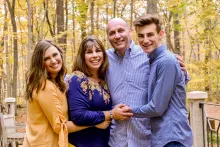
Mike Cook is a deacon serving in the Cincinnati East congregation with his wife Jan (Antion), daughter Samantha, and son Josh.
