
Frank Dunkle
This transcript was generated by AI and may contain errors. It is provided to assist those who may not be able to listen to the message.
Well, indeed, what beautiful, beautiful praise to our God above. I'd like to develop a message this afternoon based upon some of the things that have proceeded with the blessing of the children, and in a sense built upon the final message that Mr. Zajac brought us. I'd like to begin by sharing a story with you. I'm sure at one time or another we've done this as parents or grandparents, kind of wondering what our children are doing, and looking in through the bedroom door, or maybe seeing what they're doing on the dining room table, whatever. There was a little boy who was working hard on a drawing, and his daddy asked him what he was doing. And the reply came back that he was drawing a picture of God. Well, his daddy said, you can't do that, buddy. You just can't do that. Nobody knows what God looks like. But that didn't deter the little boy. He just kept on going. This was one little act of beaver. He was not going to stop. And he kept on going, and after a while, with great satisfaction, he looked up, and he said, matter of factly, they will in a few minutes know what God looks like.
And I like to build upon that cute little story, because when I do share stories, I like to hopefully move them to a point. If we're honest with ourselves, others, and most of us, we all draw pictures of God, especially in our imagination. Because this message today is not only going to be focused on the children, the teens, and the young adults, but I hope to bring all of you in, because all of us, in that sense, are indeed the children of God. Many of us, even if we're in our seventh decade, we're all just simply recycled teenagers. So I hope that this message is going to apply to everybody, and not just the little guy, the little boy, or those that we've blessed, or some of the young people that I'm going to be directly speaking to today, but that this message will be a blessing and an encouragement to each and every one of you. Because, again, we all draw pictures of God. We all have lines. We all have rhythms that are happening in our mind. Sometimes we draw a picture of God sitting on His throne. Other times, we draw pictures because of life's circumstances of God's back to us, and perchance in our mind, at least, thinking that He's walking away from us.
At other times, when things are going well or our faith is deep and confident, we see a picture or draw a picture in the mind or in our heart of God approaching us. Sometimes we draw a picture of God not being on a throne, but being on a couch, asleep. And we wonder if He's ever going to wake up because we don't think that, for one reason or another, that He has answered our prayers.
And so all of us have this situation of drawing pictures. And that leads me to the title of this message today, and that is simply this, Developing Your Picture of God. Developing Your Picture of God. We blessed little infants today. We have committed them to God. We have other young people that are here today that are in grade school or high school. We have young adults that are in college. And as any faith community, as any set of grandparents and parents and friends, we would pray and hope that they would buy into that which we understand as the product of God.
And what He shares with humanity, which is the gospel of Jesus Christ and the kingdom of God. A gospel that speaks of repentance. A gospel that speaks of faith. A gospel that speaks of grace.
A gospel that speaks of reward. A gospel which speaks that God will never leave us nor forsake us. So how do we, in a sense, encourage our young people as they begin drawing their picture of God? How do we have them buy into this? And what is it to understand? When we buy a car, a vehicle, we will often open up the compartment and we will pull out the owner's manual that is on the first day rather than when we're stuck on a freeway on the side and wondering why we didn't pull it out two years before to know how the car works.
And that, oh, by the way, how novel it does need oil in the tank. So let's pull that owner's manual out today and understand what it is that God is asking some of you young people here to buy into and to understand. So the bottom line comes to this if you're ready to go, friends. It's simply this. Number one, how do you picture God?
How do you picture God? And number two, even more importantly, is how does God picture you? How does God picture you? So let's talk about this a little bit and understand. When we talk about growing up, growing up is an exercise that is not necessarily easy for any human being. Growing up, when I think about it, because I like to think that we go back to the concept of a seed, that a seed is developed and comes basically into a baby, and then that baby is given birth. Now, just when you think about it, going through the birth canal, there's a lot of shoving, there's a lot of pushing as you come out of a dark world into a world of light and noise, and everybody grabbing for you and everybody wanting to hold you.
It can, in a sense, for that moment, be somewhat of a traumatic experience. But that's only where it begins, because just the very concept of a seed and of a child growing up means, no, when you plant a seed in a ground and you pack it down, the very essence of that seed becoming a vegetable or a fruit or a tree means that it's going to be pushing up a lot of soil in its life.
And that little life of the seed that's six inches to a foot down underneath, it's going to be moving a lot of soil as it comes up to the light of day, isn't it? That means you're going to be facing a lot of pressure, there's going to be weight, there's going to be substance, there's going to be things coming at you that you're not necessarily ready for.
And the question is not as to whether or not you're going to feel the pressure of the soil above you. The question is then, how are you going to package it? And some of us, no matter what our age, we are still trying to determine how to package the soil of life with the seed of God that He has placed in us. So we look at that, and we understand that, especially with our young people, just being any young person, it's always exciting and rewarding and fun because it's your day in the sun, it's your time of life.
You are that fresh coat of paint that comes every 25 years in the world of humanity. So this is your day, this is your time. But especially for those that are young people in this way of life, you that are young Christians, because you have a double challenge.
You're finding yourself, you're making your way, you're finding your steps. And yet at the same time, they're different than the steps that are taken by young people on the outside, because just like your parents, you pray that prayer that God's will be done in heaven as it is done on earth.
So you're having to find that balance, you're having to find that footing, unlike other young people that may not have religion, but have this way of life as to how you, in turn, even as a 12-year-old or 14-year-old, hear me, please, because I'm talking to you, and those that are in college, you don't have to wait until you're 35 or 40 or 50, number one, to glorify God. Glorifying God is why human beings were made, is to glorify God in thought, word, deed, and motive.
And number two, that you right now can be a blessing. You can be a blessing to your family, you can be a blessing to your school, you can be a blessing on the job, wherever you are, with the values that you uphold. So we're going to talk about that a little bit. We're going to talk about what we're learning as young people, is to recognize that growing up is not an event, it's a process.
I know that we have certain stages of life where we know when you're 16, is it 16 still where you can get a driver's license? Right? Fifteen and a half you get the old driver's permit, and you scare your parents to death as you drive them around Pasadena Freeway. That's what I did with my folks. Pasadena Freeway hasn't changed in 50 years, trust me, it's a roller coaster ride. And then you get to an age where you can vote, and then you get to an age where you drink, and then you can vote, and then you get to the fun ages later on, like 50, when you get cheaper coffee at McDonald's, and you get a letter from AARP, and then at 55 other things happen, and then, you know, things are just always happening all the way through life, aren't they?
So what I'm going to be talking about today is not going to be an event. The picture, here's the thought I want to share with you, friends, the picture that we want to look at is simply this. We don't want to confine ourselves to an 8.5 by 11 sheet of paper in drawing our picture of God, because God's bigger than that paper, and God has a purpose for you that's bigger than that.
And we need to recognize that really what we need in growing up before God, whether we're 15 or 55 or 65, is we need a full mural of life. We need a full canvas to allow God to draw his picture in our mind and our heart. Because if you just squeeze God into one event or one year or one decade, you have almost, you of all people will be disappointed. God is going, we're going to be in school. Are you with me? We're in school for the rest of our life.
You just graduate from the American education system at age 18, and some of you like it so much you keep on going to college. But to recognize we're always going to school until the day we die. We're always learning as the children of God. So I'd like to, for a few moments, I'm going to try to truncate this message down because of the blessing of the children.
And that is simply, we're going to look at how others have drawn pictures of God and maybe learn some lessons from that that I hope will be valuable to you. First of all, I'd like to start with a young person who grew up in this way of life. I've had the privilege, and I look upon it as a privilege, of having grown up as a Christian Sabbatarian since I was about ten and a half years of age.
We didn't know there was a church. We just kept the Sabbath at home. We were trying to honor God's commandments to the degree that we understood it. Later on, we would come into what is called the Church of God community. But this way of life that you and I practice as covenant people moves even beyond the time of Christ. God goes back to another covenant people and a man that followed the call of God, and he had ancestors. The man's name was Abraham, and he had ancestors, and he had one whose name was Jacob, and he was a young person that grew up, quote-unquote, Are you with me?
In the church. I have a few questions maybe to expand your mind on Jacob for a moment. Can you imagine the pressure of being Jacob? What was it like to be Jacob and coming from the line that he came from? Imagine the pressure that you felt that your grandfather was Abraham, i.e., father of the faithful.
What are then, if you thought, then, okay, and who is your daddy? My father is Isaac, the son of promise. And then when you went to school there, you know, on the other side of the sand dune and Canaan, people would ask you, well, what do your relatives do for a living? And you might say, well, they live in tents, they move around a lot, they pray, they build altars, they count stars, they even sacrifice the sun on occasion, or almost do.
How do you explain that to other young minds? How did Jacob take that in as a young person? And how would he have explained that to those that came into his life? Jacob, from the very beginning of his life, drew certain pictures of God that were not really what God had in store for him all along. And perhaps that was due to his personality, perhaps that was due to a certain protectionism of his person.
And yes, do I dare say because of his carnality. And to recognize, probably most importantly, and that is that God is going to deal with each and every one of us, one on one, at one time or another in our life. And if I can make that point loud and clear, that might be one of the loudest points I'm making about how to draw your picture of God, is to recognize that God is going to deal with each of us individually, one on one.
And there's a very important reason why. God simply does not have grandchildren. You do not hear about the grandchildren of God, the grandchildren of Israel. What you do here is children. God is in the process of establishing immortal children of God, not great grandchildren, not great, great grandchildren.
There's got to be a touch point. There's got to be a contact point. Just as much as we went through the blessing of the children, where Jesus said, permit the little children to come to me, and He did pick them up, there was that contact. And God is going to want contact with each and every one of us in our lives. And at times, maybe contact in a time that we're not prepared for, or we wonder why He's doing it, or is this the time now?
But God, being God, is going to deal with each and every individual that's made in His image and His likeness at one time or another. And it's very interesting that Jacob grew up talking about the God of Abraham and Isaac.
He made it His grandfather's God. He made it His parents' God. But God was still drawing His picture. See, Jacob had drawn His picture of what God was about, but God had a different picture in store for Jacob.
Let's just talk about Jacob for a moment. And you know what's really interesting? I just thought of this, and that is simply this. Do you know what the number one given name for boys is in America today? It's Jacob. It's very interesting as society is going one way how popular that biblical name is. It's a strong name. It's a valiant name. It's a dynamic name. It's an oak tree name. But no matter if you're an oak tree or not, God is going to choose to whittle on you one way or another.
And what is very interesting about Jacob is simply this. Two things. And that is simply this. Number one, His parents did cast a mighty big shadow on Him. It really did. And you know what? Parents, grandparents, uncles, family members do cast shadows on the next generation. And I truly believe that's very important. It just depends upon what kind of a shadow that you're casting.
Our children, just like Ezra and the other little one up here, that dominate... Shoo! Never both of them. Okay, is that when you look at that, they are all eyes, and they are looking at us. In that sense, as adults, these big presences, we're almost like a God with a small G to them. We're the big guy.
We're mama. We're everything to them. And I think I know, and many of you know our girls, Laura Beth and Julianne and Amy Jo, we were that to them, for those of you. And you were with your children. They looked to us. But there comes a time when they have to move away like everything else in life and move away from the shadow that we cast on them of a way of life.
And that they must intimately be involved with God. Number two, Jacob from the womb knew that God's way was a blessing. Let's just talk about it for a moment. Just for sake of time, I think enough of us are familiar with the story that Jacob was a twin. He was a twin of Esau. And they almost came out of the womb together. One's got to come out before the other, and it was Esau.
But what was it about Jacob? What's the story about Jacob? Who can out there remind me? What was Jacob doing in the womb before he came out?
You look like a religious audience, so I can ask this of you. Somebody help me. David, nice and loud. He grabbed the heel grabber. Yes, he grabbed the heel grabber. You know, I'm coming out first. In that sense, it's almost as if Jacob, in some unique way, wanted that birthright. And we understand the power of birthright in the communities of old, and that things, the blessings, passed down to that first born birthright. And there was Jacob grabbing poor Esau's heel, trying to get ahead of him.
There was something inside of his psyche that he knew about the blessings of God, that there was something about God, that there was a blessing, there was a grace. There was a favor factor. There was something incredible that he wanted. But one difficulty. He knew God had something to give, but Jacob wanted to do it his way. You know, later on in Jacob's life, it's very interesting, and I think most of us know the story over in Genesis, where Esau comes off the field.
Esau is a hunter, and he's famished. He's been out there. You know, there's no McDonald's at 6th and Broadway out there, you know? And he's not been eating. And he comes in, and you can just see Jacob. Aha! What have we here? We have a starving brother. He didn't say, come on down, you know I've been making this meal for you all day long, and I know you're famished. No, he said, I'll tell you what, I'll cut a deal with you. You give me the birthright, and I'll give you the Campbell Soup.
I'll give you the porridge. I'll give you the broth. It was a set up. There was something that Jacob understood, down deep inside of him, about the blessing of birthright. But he wanted to do it his way. Later on, just a chapter or two over, we know the story. Here is Isaac. You know, Isaac, who was the son of promise, the joy of Abraham and Sarah's life, and now he's an old man, and he's about to die, and he's in the tent, and he's blind. And what does Jacob do with Isaac? That's where the expression literally comes to pull the wool over somebody.
He puts the woolie garment on his leg. There's the old limbo phrase. What's the old line from limbo? How low can you go? Well, that's exactly how low Jacob went. He went so low that he went in looking like the werewolf. He put on a fleece on his arm to have his father mistakenly think that he was Esau to get the hands laid on him and to get the blessing, to get the birthright.
There wasn't anything that Jacob was not going to do to not obtain that birthright. But then there's something else that happened along the way, and we find that over in Genesis 32. Join me if you would there in Genesis 32. It's the story of Jacob wrestling the messenger from God, and we find that over in Genesis 32.
Let's pick up the thought in verse 24. Now, there's one thing that you have to understand. Friends, are you with me? We sometimes mistakenly think, as we haven't read the story and seen everything that goes on before this chapter, we think of those Renaissance pictures of Jacob, this strapping, young, virile, dynamic, muscular man. Every, you know, with that Renaissance art, with the adoration of the human body, with every muscle rippling, fighting the messenger from God. And you see this young man, you go, wow, this guy is determined.
No. Are you with me? Jacob had to be a grandfather. Jacob was probably 55, 60, 65 years old when he was doing this. Remember, he left his family on the bank of the river. He saw his troops were coming his way. He had his children. He had his grandchildren. He went on ahead, and then we had this. Notice this.
Then Jacob was left alone, and a man wrestled with him until the breaking of the day. Many of us believe that this was, in a sense, what we call a theophany and or a God appearing. Now, when he saw that he did not prevail against him, he touched the socket of his hip.
And the socket of Jacob's hip was out of joint as he wrestled with him. And he said, let me go for the day breaks. But he said, I will not let you go unless you bless me.
This is what he'd been doing since the womb.
He thought he had been wrestling with Esau in the womb. He thought he had been hoodwinking Esau in the forest. He had even been trying to wrestle away the birthright from Isaac. And so often we spend so much of our life, hear me, friends, we spend our life thinking that we're wrestling with flesh and blood, rather than what we're actually doing is we're wrestling with God. And he said, let me go for the day breaks. But he said, I will not let you go until you bless me.
So he said to him, what is your name? And he said, Jacob. And he said, your name shall no longer be Jacob. And it's about time for Jacob to have a name change when you recognize that his name meant usurper and eelcatcher. Sometimes, as John brought out at the Feast of Tabernacles, sometimes it's good to have a new name. And he was about to get a new name here. And he said, your name shall no longer be called Jacob, but Israel, for you have struggled with God and with men and have prevailed.
And then Jacob asked him, saying, tell me your name. And I pray. And he said, why is it that you ask my name? And he blessed him there. So Jacob called the name of the place Peniel, for I have seen God face to face, and my life is preserved.
One thing I want to share with you young people that are out here right now. Those that hear, and I was listening acutely when I was 10 or 11 years old in a Church of God congregation. And I was listening acutely when I was in high school and college, and it is simply this. You will continue to wrestle with God all of your life to one degree or another, because God is going to continue to tool and to die and to shape and to mold you.
And the picture that you are today is going to ultimately be framed by the picture that he wants you to be. That's just the way it goes. But here's the one thing that I want to share with you. The question is simply this, is to accept God's blessing. To accept Him, the one thing that we need to picture, that when we draw our picture of God and we give it our title, is simply this, is our Heavenly Father.
That is the one title that God wants us to remember, no matter what happens in our life. Because things are going to happen in our life. You and I are in a world that we're pushing up soil. It's not that we're not going to push up soil. It's how we're going to package it. And we have to learn how to package that. And to recognize that our Heavenly Father would have it no other way. And to recognize what He's doing for us. The question is, though, when will we begin to put that name on the picture that we're drawing?
And when will we abide by it, which is the most important thing? Somebody once asked Mr. Herbert W. Armstrong. They asked him simply this. He said, was Job ever converted? Was Job ever converted? And Mr. Armstrong thought about it for a moment. This is a Mr. Armstrong story, which is always kind of fun to bring out sometimes. He said, he thought about it for a moment. He said, yeah, he was, but it took him 42 chapters.
To get to Job 42 and verse 5, I have heard of you by the hearing of the ear, but now my eye sees you. I have a question for our young people, because you have the beautiful opportunity to write your own story. You don't have to be a heel catcher. You don't have to take away somebody else's blessing.
Hear me, please. You don't have to take advantage of somebody else to experience God's love and to experience Him personally and intimately. You don't have to deny your parents or fool them or do what Jacob did with Isaac as he lay a dying. God wants to bless you. God wants to bless you. That's the most important thing. And to understand that. And to understand, like Jacob, where would it be without Jacob?
What we learned from Jacob is God's patience, God's great love. That God knew exactly where He wanted to have Jacob, and He already had that picture lined out. He knew He had a picture of where He wanted Jacob to become Israel. It's just that Jacob had to get there and be tooled and died. Here's one thing I like to tell each and every one of our people. And it's been a thought that's been on my mind recently. I'm just speaking off the cuff of my heart right now. And that is simply this.
When you come into this world, and when I came into this world, you were special, and I was special. Oh yes, each and every one of us is made in the image of God, just as I mentioned during the blessing of the children. But what I would like to say to all of our young people, whether they're 12 years old or 22 years old, or some of you recycled teenagers, each and every one of us is like a snowflake. Each and every one of us is like a snowflake. Did you realize that there is no snowflake like any other snowflake?
They are, in a sense, all individually wrapped and delivered from the sky above. Just like our human prints, that's why the FBI takes hand prints, because you recognize people by their fingerprints. Each and every one of us, yes, we all have hands, but all of our fingerprints are differently.
They identify our personhood, our individuality. And so often what happens as we come into life, that we have this burst of life, this seed of being. But unfortunately, the storms of life, the heat, the light, the bugs, the cold, they begin to wear on us.
And that joy of youth, that innervation of young people, that fresh coat of paint over a time period of life, with things coming at us, begins to wear away. It becomes tired, it becomes worn, and sometimes it becomes cynical. Because we've been drawing all the wrong pictures, and then we give them to God, and those were not the pictures that He had of us at all.
I like to, I'm just talking individually to all of you, especially the young people today in this time. Maintain your individuality. Recognize that you are like a snowflake. You are very, very special. You are different than everybody else that has ever lived. You are different than the 7.5, excuse me, the 7.6 billion people that are living now.
There is never going to be anybody else, anybody else, like you. And yet what happens is we come out as an individual that God rejoices in, because He rejoices in diversity. That's why we look at the creation. There are going to be all sorts of pressures to make you conform, to box you in, to make you a yellow pencil.
Celebrate and embrace who and what you are and can be for God Almighty and Jesus Christ. You do not have to go 42 chapters to get there. Oh, there'll be lessons in chapter 42, but there'll be a lot lighter as they go along the way. I'd like to share some wisdom with you for a moment, some thoughts that I've written down, because I did want to shorten this today. There are some things that have been on my mind, and I'd like to just share them with you for a few minutes here. Because I think the most important thing that we can do as those that are older is to give people realistic expectations of life. I said that as we grow and as we develop and that seed of God is in us, whether the seed of life humanly or the seed of God's Spirit, any seed is going to go towards the light and it's going to push soil. It's not that you're going to push soil, it's how you're going to package it. That makes all the difference. Let me share some thoughts with you for a moment. Some things that we need to come to grips with. The first thing that I'd like to share with our young people is simply this. Number one, it's going to go very quickly.
Number one, you will receive one body, one body in this lifetime. You may like it, you may hate it, you may wish that you had a different body. The red-haired person is going to want to be a blonde. The blonde is going to want to be a brunette. Trust me, as you get older and you're a man, you just want hair.
And everybody today is trying to reshape and remold you into a conformity. When God said, you're a snowflake, you're an individual, some people are tall, some people are medium, like myself, some people are a little bit wider, some are a little bit thinner.
We all come in different shapes in the image of God.
No matter what body you receive, accept it. Embrace it. Take care of it. The greatest wisdom that comes down through the ages, I think both in Scripture and even in other philosophies, is simply this.
The key to life is acceptance. To not accept life and accept who and what you are, and always wanting to be something else or somebody else, is simply quicksand. And you will sink into it. Acceptance is a great key of life.
You will learn lessons. Just ask Jacob. You will learn lessons. No matter what age you are, whether you're 12 or 22 or 64, being me, you are enrolled in a full-time and formal school, and it's called life. Each day this school is in session. Each day you will have an opportunity to learn lessons.
You may like the lessons. You may not like the lessons. You may think that they are irrelevant. You might even think that they're stupid. But I want to share something with you. Every day there will be lessons for us to learn.
Number three. Number three. You can change mistakes into lessons. Mistakes do not need to remain mistakes. Mistakes do not need to remain mistakes. Remember many, many years ago in a Bible study, a man that was speaking said, you know there's a misnomer that they often say that experience is the best teacher. He says they're dead wrong. They're flat wrong. Experience is not the best teacher.
He said obedience. Obedience is the best teacher.
We know where the other thing goes. You just have to look at the story of Adam and Eve.
I have a question for you. May I?
Are you with me? Have you ever gone down the 210 freeway and seen somebody in an automobile without a steering wheel?
They're having an experiment. I'm going to drive today without a steering wheel. Isn't this exciting? No, it's not exciting. And it might be a free fall for them for a while, but you know what's going to happen at the end.
Steering wheels are good in life, and God gives us by His Bible, by His law, He gives us a steering wheel. That doesn't mean that we're not occasionally going to have an accident. It doesn't mean that we're not going to bump into a curve. It doesn't mean that we're not going to have a flat tire of human nature. It doesn't even mean that at any time in our life that we're not going to have a crash.
But we're always brought back to center, we're brought back to a steering wheel, we're brought back to a set of values that you and I value. I've got a wallet here. I've got a $20 bill. You ready?
Ready? Here it goes. Not.
We would never do this with a $20 bill. Why wouldn't we do this, Paul?
It's valuable. Especially when you're as old as you are, Paul. No, just teasing. When you're as old as I am, you know. It used to be when I was a kid, I'd see a penny, you know what I would do? I'd kick it. It was so much fun kicking pennies when I was seven years old. Now, the more I get towards 70, I'm picking up every penny on the street. It's going into my savings.
What God has made you as a snowflake, as an individual seed to His glory and to be a blessing to people, you would never want to tear that up. And that's why God says whatever He's given you, your body, your mind, your soul, your personhood, you treat it as valuable as I just did with this $20 bill.
That's very important.
You can change mistakes into lessons. Growth is a process of trial and error.
Failed experiments are just as much a part of success as anything else.
And there will be failures and there will be mistakes. All of us, I hope, are still studying about Thomas Edison in our public school system.
Edison is known as one of the great minds of all times and one of the greatest inventors in American history.
And so we think of the bulb, we think of the light, we think of the film projector, we think of, you know, just so many things that you can name off that aren't coming to my mind right now.
But you know how many accidents he had? You know how many failures he had with his men there in New Jersey in the laboratory? It wasn't that he didn't make mistakes, but he didn't let them keep them down and he learned from them.
Babe Ruth, and I was not born during Babe Ruth's time or when he was playing.
But we often think of Babe Ruth in American lore that Babe Ruth, we always thought of the babe swinging for the fences.
But when you swing for the fences, you're also going to take a lot of strikes. But I have a question for you. What is he remembered for? His home runs or his strikes? You will make mistakes. When you learn from your mistake, it becomes a lesson.
Ask God to be there for you to understand that. I want to go to point four. I've just got two more.
A lesson is repeated until it is learned. A lesson is repeated until it is learned.
It will be presented to you in various forms through different people.
Today we live in a throwaway society. A throwaway society. We want to go to the next gadget. Sometimes we want to go to the next person.
Today we have a situation where people are not satisfied, so in that sense we recognize that they don't even try marriage.
Or in marriage, perhaps it's not working, so they're going to go with somebody else. Some other person.
Rather than recognizing that, it's until you learn the lesson on the ground and have the steering wheel of God's way of life in your hand.
And knowing that God will never leave you nor forsake you. And that He is there to make you a success and not a failure.
We'll stop turning over jobs or people.
When you've learned it, you're not done. There will just be another lesson waiting for you the next day.
Point number five, and I'll conclude. Simply put. There is no better than here.
There is no better than here. When you're there, it always seems it's better there. If I was only there, if I was in that school, if I was in that congregation, if I only had that pastor, if I only had those parents, if I only had that kind of equipment, if I only had this, if I were there, it's not how life works.
There is no better. There is no better than here. So often, and here's a point of wisdom, so often we say, Oh, the grass seems so much greener over there. It seems so much greener over there. So I just need to hop the fence.
I just need to jumpity-jump and go over the fence, and then I'll be there in the green. No, no, no. No, no, no.
When you jump the fence, that which was green becomes brown, because the desert was inside of you. You need to make there here. God resides here. God has called each and every one of us to be his snowflake, planet with his seed, the steering wheel of his law.
Each and every one of us can have that blessing that I read about today in Numbers.
So at the end of the day, I have a question for you. What kind of a picture are you drawing of God in your mind?
You may see him. You may see Jesus Christ at his right hand. The most important picture that you can draw of God in that sense, and I'm moving beyond the image thing of the second commandment. Don't take me too far on that. But just the picture is simply this. Do you see yourself in that picture right by him too? Because that's the picture that God would draw of Mary and Sally and Peggy and Anne and Sam and Joe and Tony. He pictures you in his picture. When you draw that picture, when you have that understanding that he wants you as close to him in that picture, as little Ezra was to me as I was holding him up here today, you've got the right picture of God. You keep it there in your heart. You move with it. You grow with it. You push that soil up, and it will help you package that soil better as we move forward in life. Look forward to seeing all of you at the social this evening.
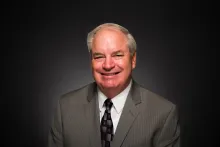
Robin Webber was born in Chicago, Illinois, in 1951, but has lived most of his life in California. He has been a part of the Church of God community since 1963. He attended Ambassador College in Pasadena from 1969-1973. He majored in theology and history.
Mr. Webber's interest remains in the study of history, socio-economics and literature. Over the years, he has offered his services to museums as a docent to share his enthusiasm and passions regarding these areas of expertise.
When time permits, he loves to go mountain biking on nearby ranch land and meet his wife as she hikes toward him.
