

Robin S Webber
This transcript was generated by AI and may contain errors. It is provided to assist those who may not be able to listen to the message.
I'm not going to be giving you a lot of Greek or Hebrew today. I'm not going to go into the future. In the prophecy, we'll leave that to God and give Him the pieces. But we're going to talk about you and me today with some of the challenges that have either faced us, will face us, and or in the future, we will, as Mr. Snyder mentioned, we're going to need to gird up our loins. We're going to need to be prepared for what comes our way. It may not just be satanic, as was mentioned there in Ephesians, but it could just be something that we have to learn how to deal with. And that's what I want to share with you this afternoon. In this message, I want to get as much of it in as possible. I will probably paraphrase some of the scriptures, and I'll give the scripture note, but just for the sake of time so that you can get ready for the memorial service, etc., etc.
But if you'll stay with me, we're going to be in through this together, and I think it'll all work out all right. You know, one of the biggest things that we have to do in life is to make decisions. And that's what I'm going to be talking about today. Two words if you're taking notes. Decisions and choices. Decisions lead to the choice that you make, and life is made up of decisions, decisions, and decisions. And preparing for decisions, making decisions, and living with the results of those decisions is the cutting edge of life. And God has given us this wonderful mind. He's given us this persona. He's also given us that new mind. He's given us that new spirit to make better decisions, to make godly decisions, to make holy decisions. And our ability to make wise choices versus bad choices is ultimately, I want you to hear me real carefully, making bad choices or good choices is ultimately what shapes us. It will shape us. We will, to one degree or another, we will live with our decisions. Just think about some of the things that happen. Let's just look at some proverbial talk here for a second. We make decisions every day whether we should cross a bridge and or whether we should burn that bridge behind us. We also beyond that, a third option is, in patience, go down the river of life and cross at a different sector, the river that lies ahead of us that is coming our way.
Some of us need to learn to say no. And some of us need to learn to say yes. Some of us say no too often to matters that come our way. And sometimes we say yes too much to matters that come our way. And so we need to think about all of this. Most of you are, frankly, right now, making a decision.
And you know what that decision is? Can we talk? And that is whether I really want to invest in what Weber is about to talk about. Will I invest or will I pass it over? So I can appreciate that you're making a decision right now as to whether this is for me or not for me. And I want to share something with you to help you in your decision.
I'm going to give you a gentle push. Yes, it is. And it is for me as well because what I'm going to be talking about in some of the chapters that we're going to go through in decision making are something that many of us are facing right now. And you, one of you, when we have about 70 people out here, is that I know right now some of you are at critical mass in making decisions. And they all come at us in different ways, and we'll be discussing that in a moment. So I'd like to quote Leroy Brownlow. I haven't changed from 30 years ago. Leroy Brownlow happens to be one of my favorite devotionals. He's a gentleman that wrote, Today is Mine. And I'd like to quote from his entry of March 4th.
Hear me, please. Life is a journey of decisions, and the person who can't make them has a hard trip ahead. All along the pathway of life are stalled persons stuck between yes and no.
And I also realize beyond what Mr. Brownlow mentions is not making a decision, being indecisive, can also be making a decision that will have results down the line. And sometimes it comes too late in the game to where we go through that could've, would've, should have. And that's why we're giving this message today. For you that are taking titles, allow me to share the title of my message, Making Wise Choices.
Making Wise Choices Towards Holiness. What I'd like to do right out of the chutes is simply this. Allow me to give and put forward a guiding principle right out there. It is a spiritual and moral compass by which as children of our Heavenly Father and by disciples of Jesus Christ, that we can walk the walk in the footsteps of holiness.
Let me just put this out very quickly for you if you want to take a note. Firstfruits put first things first. That's where we're going to go with this. Firstfruits put first things first. And to realize that when we don't consider what we do first, we waste ourselves on issues that are not important, that are not valuable for us to grow in grace and knowledge. That waste our time and the time of our families and those that we love.
When we don't consider that, we do waste. And frankly, we get involved in things that are not worthy of our life's devotion. Just not worthy. And they take up space in our mind, rent free, because we also make a choice not to deal with making that decision. And so we'll talk about that as we go along. I would like to read to you a scriptural underlay from Proverbs 4, 18-27. Allow me to just let it soak into you for a moment. I'm going to read it out of the NIV translation, which I think makes it a little bit clearer.
Proverbs 4, 18-27. The path of the righteous is like the first gleam of dawn, shining ever brighter till the full light of day. But the way of the wicked is like deep darkness. And they do not know what makes them stumble. Allow me to share this. Perhaps not only the wicked, but all of us, as we live this life. They do not know what makes them stumble. My son, pay attention to what I say. Listen closely to my words. Do not let them out of your sight. Keep them in your heart. For they are life to them and find them and health to a man's whole body.
Above all, above all, everything, guard your heart. For it is the wellspring of life. Put away perversity from your mouth. Keep corrupt talk from your lips. And let your eyes look straight ahead. Fix your gaze directly before you. Make love bowl. Pass for your feet. And take only ways that are firm. And we're going to try to firm up in the course of this message. Do not swerve to the right or the left.
Keep your foot from evil. Notice the emphasis on guard your heart. What Scripture out of the Proverbs is instructing us, and Scripture is merely God-breathed, it is simply this, that we are to place a governor on our heart so that we build on matters that are worth our life's devotions. And I say that quite sincerely. Now, humanly, which I just said to guard our hearts, that can seem a little scary at first, but because you go to Jeremiah 10.23 and it says, There is not a man who knows to direct his own steps. So you almost say, Lord, beam me up, get me out of here.
I want to off-terra firma. But at the same time, to counter that, is to remember that we are not alone. Isaiah 13, verse 21, I was discussing it with one of the gentlemen out here, one of our newer folk, Scott. I see Scott back there. Is that Scott? Oh, you didn't walk out on me when I gave you the title. Good. Okay. So anyway, Scott is still here. We were talking about when I used to write, This is the Way.
And for anybody that's ever grew up in the church, especially in the early 1960s, you go to the Feast of Tabernacles. Ray was with me up in Squall Valley, and his... Ray Lee. Sorry, Lee. And Ray, his younger brother.
And that, you know, we'd always hear these messages that one day you're going to be in the Millennium, and you're going to hear a voice. And the voice is going to say, This is the Way. Walk you in it. And that's exactly what we have here. We have the Breath of God in print, for Scripture is indeed God-breathed. We have the prompting of God's Holy Spirit, the very presence, the very presence of God the Father, and Jesus Christ in our hearts, by the essence of the Holy Spirit, to guide us. But it's one thing to know it's there, but it's another thing to use it, to allow it to govern our actions. So we're going to get into some of this. What I'd like to do right now, if you want to jot a note, just to stay with me. Just stay with me, and that's simply this. We're going to review some squeeze plays of human nature. Have you ever felt a squeeze on your life?
You're all looking. Am I the only one? Where you feel like you've got the squeeze, and we're not talking about... See, we have a bunch of guys here. You'll remember this back in the 50s, 60s. I don't know if they still do that. Remember you were in school, and you used to have the old squeeze? You know, they'd squeeze your arm both ways. And you would just, you know, try to see how long you could take, and this isn't bothering me. Now, that's the best. Forget it. Now, you think I'm going to scream like this? Last thing you wanted to be called back in the 50s and early 60s, but just see. No, so you just take it. You're screaming inside. You know, you're crying. No, I'm not going to show how I feel. Well, that's good for nine-year-old boys. But we do feel the squeeze plays of life, and I'd like to go over a few of them. I'm going to give you the title. I've got about five we're going to go through rapidly, with Bible examples, to implore you not to go down this path. Then I'm actually going to give some takeaways at the end, what we call STA, specific takeaways, that we can take out of this room today, which to a degree will build upon Gary's fine foundation as far as praying to God. Number one is living in the moment for the moment. Living in the moment for the moment. How does that play out in the Bible, and what example might we utilize? Well, I'm going to go to a classic case, and that's the story of Esau. You might want to jot this down. I'm going to paraphrase it. In Genesis 25, 27 through 24, we know that we have the two brothers, and we have Jacob cooking the stew, or whatever he was doing at the campground, and Esau has been out there hunting and hunting, and has not been able to eat, and he comes back, and he is just exhausted. Just exhausted. Tired. He is hungry and exhausted unto death. You know the story. I know the story. And in that moment of exhaustion, in that moment of where the urgent, the urgent, the urgency of the moment, overtook the vitalness of God's gift to him, of having had the birthright as the oldest son. And in that moment, he forsook his birthright. He considered, he made a choice, he cut through and made a decision, that living in the moment was more important than having that birthright.
Interesting.
Now, living in the moment has certain momentary satisfaction. When you live in the moment, whatever it might be, you can feel intensely satisfied. You can even feel, once again, powerful. You can feel that you are in control. But let's remember something. When we live in the moment, the future will catch up. And there is a future beyond that moment. Now, before we judge Esau too harshly, let's ask ourselves, what have we been willing to trade recently as those granted a birthright of being first fruits?
Being a first fruit is something that you don't... You want to say, thank you, Lord, every day. Being a first fruit is an incredible blessing of those that have come to know that God the Father sent Jesus Christ and know Jesus Christ, keep the commandments of God, and strive, even in our imperfection, to live a life. And now, not even in the future. Thank God there's a future for all. But we're being trained now. We're being honored not because of who we are, but because of who God is. You don't want to give up on that birthright. That's a birthright. Jesus is the first of the firstborn, absolutely and always. But we are coming right behind Him. We need to kind of look at that and recognize that. Let's ask ourselves, do we find ourselves willing to negotiate anything based on how we feel? Question. There's a lot, you know, Jacob, as we know, was a character. I wouldn't want to run into him in a dark alley. But that we negotiate all day, if not with somebody else, and we can be negotiating ourselves in that inner tank in our mind as to what we're going to do. We can be negotiating, as Gary brought out in his fine message, about the world that is around us. How far do we enter? How much do we ask for God's protection? But let's look at that. And to recognize then that when we look at all of this, to recognize that our families, our bodies, our integrity can get mixed up in deal-making. A la Jacob. But I've got good news. Good news today. Who needs some good news today? Mario, they're awake. The hands went up. I was worried. Okay. Good news. You have not been called to share a log and sit on a log with Esau. God has more plans for you. But you've got to know the book. Let's go to the second squeeze play. Being impatient. Being impatient. Who? Me? When's the sermon over? Oh, it just started. Oh, I'm sorry. Okay. Being impatient. We find a classic case of that, and you might want to jot this down. 1 Samuel 13, verse 5. And carried over to chapter, verse 7 and verse 14. That's where Samuel had instructed Saul to go ahead of him to be ready for a battle, and that he would come seven days later. But that the instruction was you wait until I arrive before you take the next step.
This is called one of those chapters of waiting on the Lord. Instruction from one of his servants. Waiting on the Lord. And sometimes God doesn't count as we count. Now he said seven days, but it's interesting. Later on, Samuel comes and Saul did not wait.
He made a choice. Now, Samuel had said that I'll be there in seven days, but God was working out something. But what he did say specifically was you wait until I come. Samuel came. Saul had offered up a sacrifice. You'd think, wow! Wonderful! Fantastic! No. Samuel was not pleased. He knew that God was not pleased. And what happened there, think about this for a moment. A ritual was performed.
Saul the king had a sacrifice. That is a ritual. But he did not obey the word of the prophet, his own prophet, God's prophet, who said to wait. What is the lesson of when we're making choices and decisions? It's simply this, if you want to write it down. Ritual is not the same as obedience. Ritual of and by itself, while perhaps admirable, is not obedience.
And that was what God was having play out here. And because of that decision, they say, man, give me a break, you know. King Saul, hello? At least he did a sacrifice. But it was not his to sacrifice. It was not his time. He was told to wait. And from that moment on is when Samuel said, the kingdom, which could have been yours, is now going to be taken away. A new line would come up. David would ultimately be king, as it says in that set of scripture in 1 Samuel, a man after God's own heart.
What does that tell you, and what does that tell me? When faced with a difficult decision, don't allow impatience to drive you to disobey God. When you know what God wants, follow His plan regardless of the consequences. Let's go to another squeeze play when it comes to choices and decisions. What seemingly is inconvenient? You know, I'd like to, but that's inconvenient.
I'd like to, but how's that going to affect me? You might want to jot down Ruth 4.1-3. We're going to just paraphrase this again so I can kind of keep you with me rather than lose you in scripture. You can look it up later. This is the famous story of Ruth. It is a story of which begins in Judges, a time when every man, at the end of Judges, when every man did what? That which is right in whose? His own eyes. We know the story of Ruth, the Moabite Damsel that is brought back to Bethlehem.
And finally, there's something that has to be done. Her husband died. She was left childless. And that takes you back to the old Levorite law, that if a woman is widowed without child, then the next of kin would take her into the family and would have a child by her. A little different than today, I understand. But that was the instruction at that time, because that was a part of the socio-economic community system at that time to provide for the widow, and to provide that the name of the family would not die out.
So, you know the story. It's Ruth 4, and guess what? It's already happened that Boaz had the nighttime talk with Ruth. You know the story. She came up, and he spread his garment over her as a symbol that he would do what he could. But there was somebody between him and her being a kinsman that was near.
So, what does this is fun? This is where you smile. So, what does Boaz do? He's at the gate of the city of Bethlehem. And please, that's not Los Angeles. It's a small village. But he's at the gate. That's where the negotiating and all the deals were made in any village, as the elders and the older men would be there. And guess what? Boaz is there, and he sees his kinsman and says, Hi neighbor!
Knowing where he hopes it's going to go. He says, Hi! You heard about Ruth, our kinswoman. And what are we going to do with her? You can have this, and you can have that. And you know the guys, the kinsman, he says, Mmm, sounds pretty good. But then Boaz, he puts in the slider. This is coming right, he says, But if you do take a part of her possessions, then you have to marry her.
Huh? What's the wife going to say at home? And or, amoebitis? Are you kidding me? And he bailed out of it. It wasn't convenient.
The reason why I'm sharing this, sometimes God is going to call upon you and me, men and women here, to do things that seemingly, in the moment, are not convenient. I'm not talking about moving towards human nature. I'm talking about God's holiness. How do we get there in this lifetime, in striving for God's holiness, becoming as God, in that sense, holy, as He is holy. We're going to do things that are inconvenient to our human nature. We are going to do things that are asked of us that are inconvenient in society.
We're going to be asked to step out on faith that God knows what He's doing. And that's what Boaz did. He was not looking at what was inconvenient, but again, what does God say? And He performed His duty. As Boaz did that, He did the right thing. Kind of reminds me of what used to be on radio, Dr. Laura Schlesinger. She'd always say at the end of her programs, Now go out and do the right thing.
He did the right thing. In doing the right thing, in you doing the right thing in Westminster or Stanton or down in Cyprus or maybe over here in Placentia or all parts here in this area, when you do the right thing, you do not always know how God is going to use that, even though it seems for the moment, for the need. But to recognize that when Boaz took, as an older man, took this young lady, little did he realize that out of that relationship, from them coming together would ultimately become the Christ child.
That from that decision at a gate in Bethlehem, which was a small town surrounded by grain fields, house of bread, that from that decision, God would bless that. The rest is history. Never underestimate some of the challenges and choices that come to us that seem inconsequential. And the most important thing, and you can look up Ruth for later, we'll never know who that man is. We do not know the name of the kinsman. Have you ever noticed that?
An opportunity came to him, which was, Wow! But we don't know his name. But we do know the name of Boaz. Boaz was called to be a light of how to make choices and decisions. God has not called you and me to be extras in this story. He's called us by name and knows us by name as to what we are going to do. Let's go to another part of this. I'm going to go to a couple more as we go through the Bible. Another squeeze play. Thinking that the grass is greener on the other side. Thinking that the grass is greener on the other side.
We think of the classic case, again, in Genesis 13, if you want to jot that down, Genesis 13, 5 through 13. The story of Abram, the story of Lot. And the story that Lot, the nephew, actually for his servants, chooses what looks to be green. What looks to be green. And the rest is history.
It looks good. It looks like it's going to be profitable. And that is where you are going to pitch your tent. You're going to pitch your thoughts. You're going to pitch your family because it looks greener. It looks for the moment it captures your attention.
And this is good. What's the story behind that? What's the story about those that seek prosperity today? And we always hope more for our families. We always hope more for our life's dead. But we also need to recognize that prosperity we desire can both entice and enslave us. If our desires are not in line with God's directives.
And even if we are strong enough to resist the pulls of such a move, our families may not be that strong. Lot would be kidnapped. He would ultimately lose his wife. He would lose his son-in-laws. His daughters would go with him, but the result of that was incest. One decision began to catapult and knock down all the dominoes into a story of despair. The grass, even though it might appear so, is not always greener on the other side. As we might say today, not everything that glitters is gold.
If you don't believe me, if you don't believe the story of Lot and Sodom, then just ask Adam and Eve about the tree of good and evil that glittered that looked like gold. Maybe it had gold leaves.
You've got to remember that the tree of life, we go, the tree of life did not look like a porcupine cactus. It didn't look like it needed water for a year just to get it growing again. It was beautiful. It was wonderful. It was luring. It was green pastures. Look what it's going to do for me. Yeah. Look what it did for them. The grass always will look greener on the other side.
It's not. One more, and that is seeking to satisfy right... no, two more. Seeking to satisfy right desires in wrong ways. Seeking to satisfy right desires in wrong ways. I'm going to share the story with you. You can jot it down. It's the story of Uzzah. When I say Uzzah, I always want to almost say, oh, oh, because of what happened to Uzzah.
Does everybody know the oh, oh that happened to Uzzah? Am I talking to the right crowd? Stay glued to your seats. We'll fill in the blanks here. Okay. Uzzah. David had a right desire. He wanted to bring the Ark of the Covenant that had been recaptured by the Philistines. He wanted to unite all of Israel, the house of Saul, with his house. And Jerusalem is going to be this center of unity between the tribes. They could all come up to Jerusalem, but we needed the Ark of the Covenant. They'd gotten it back from the Philistines.
David was excited. Let's bring it on. So he said, I'm going to make it easy for Uzzah and the boys, and I'm going to send out a cart. A cart with an ox or a donkey carrying it. Now, I have a question. This is not multiple choice. It's either true or false. Okay. I'm not making it hard. How many of you think that would humanly have been a good desire for the man that was after God's own heart?
Oh, Mario, they're trained. The hands aren't going up. You're already there. Okay. Next point. Next one. No. No. Uzzah, you know what happened. The Ark on the cart began to... It was going downhill, and it began to go this and that. And what did Uzzah do? One of the drivers? He must have gotten the electric chair.
It was over and out. You do not touch the Ark. Now, what did David do wrong? Who can tell me? What did David do wrong? Yes, Leonard.
Absolutely. Absolutely. It was the responsibility of Levites to transport the Ark. And it was to be on poles, not in a cart, with wooden wheels, or maybe even at that time iron wheels around the wooden wheels. But going downhill, you might hit a bump. You might hit a curve. You know, the donkey might have an episode. And it over goes the Ark. See, God knows how to do things. We just have to trust Him. Now, was it a good desire? I would say, yeah, He had a good desire. But He did not make the right decision, the choice, as the way to bring it. Bottom line about all of the Steer Friends here in Garden Grove. Our choices, our decision-making, will not only affect us, but it does affect others. Families, communities, congregations, children, grandchildren. By the way, I'm a great-grandfather now, not just a great-grandfather, now I'm a great-grandfather. It's been that long. It will affect all that we come into contact with. Let's go to one more, then some good positives. We also then, last but not least, probably the biggest squeeze on human nature is simply this. The squeeze of peer pressure. The squeeze of peer pressure. Simply put, what everyone else is doing or wants to do. Even though, you know, down deep, down deep, that what they want is a wrong decision on their part. Most of us that grew up in our time, I'm not sure what they do today, but, you know, we always wanted to do something as a kid. Well, Johnny's doing that, you know, in the neighborhood. Johnny's doing that. The Smiths are doing that. The Joneses are doing that. And what did our parents often used to tell us when we were growing up? You're not the Smiths. You're not the Joneses. My father, many of you knew my dad. He'd say, you're a Weber, and this is how we do it in the Weber household. Probably one of the greatest, probably absolutely one of the greatest impacts of peer pressure following the crowd takes place in 31 A.D. It's the Roman governor that is in Jerusalem during the high days to keep a handle on everything, because this is when the Jews could get very Messiah oriented and want to revolt against Rome. And of course, then, he has, before the crowd, he has two individuals. He has Barabbas, which means son of the father. And on the other hand, he has Jesus, who is the son of God. There's a lot of God things that are happening up here on stage, left to right. A decision has to be made. The crowd makes the decision. Crucify him! Crucify him! But Pontius Pilate comes back to his credit when you read the history. He's not really a very good governor, a nice guy. He says, but I find nothing wrong with this man. Nothing. But because of the crowd, because of the sheer pressure, Jesus has taken away. And what does he do? What does Pontius Pilate do when he gets with his wife? And they're all alone in his office. He gets a bowl. And he washes his hands of what? As we say, he washes his hands of the matter. In our lives, even today, if we feel the peer pressure of the crowd, if we want to do what everybody else is doing, I have a suggestion for all of you. Pull up a chair by Pontius Pilate. But recognize you will also have to have a big pail of water for yourself, because you will keep on washing your hands again and again and again. Because you want to be a people pleaser, a crowd pleaser, go with the gang when God has called you to be a first fruit who puts first things first.
Now, those are the squeeze plays. Where do we go from there? I'm going to give you just three quick points I think we conclude here in about 10 minutes. Now that we've examined the squeeze plays of human nature, we're going to focus on some sure ways of making right choices. Point number one, by maintaining an eternal perspective day by day. By maintaining an eternal perspective day by day. An eternal perspective that begins with, are you with me? You might want to jot this down. In the beginning, in the beginning, in the beginning of every day, to do what Gary mentioned about praying. In the beginning of the day, with every motive that is embedded in our heart, with every thought that comes from that motive, with every word that comes from that thought, with every action that comes from our words, with every deed that comes from our actions, just go back to this. Do a Genesis thing. Are you with me? Because we're a new creation. This is how I'm going to do life. In the beginning, I'm going to have an eternal perspective. I'm not going to be able to do it by myself, but I'm going to be able to do it with God's Holy Spirit. Covey, in his work on principle-centered leadership, puts it this way. An accurate map is a good management tool, but in a wilderness, you can get lost, especially when everything looks alike. A compass is a leadership and an empowerment tool. He likens enduring principles to a compass. He stated business people and individuals who fail lack an internal moral compass. He states that we must develop our value system with deep respect for true North principles. We have to have that inner moral compass and tap into what God has literally... Are you with me, friends? He has literally, by the new birth, implanted his essence into our life to give us that heart, mind, and push us to do right. He's not going to drag us into doing it. Wouldn't that be so much easier for all of us if God would just drag us or push us into holiness? Oh, I sound so carnal in doing that. You're all looking at me bad, but it would be a lot easier, wouldn't it? But that's not how God does it. God is not going to drag us into righteousness. He's not going to push us into righteousness, but He is going to lead us. He is going to guide us. For as many as are pushed? No. For as many as are dragged? No. For as many as are led by the Spirit? The same are the sons of God. So we take a look at this. I submit to each and every one of you that we have that true North principle. Matthew 6, 33. Seek you first the kingdom of God. That's the true North principle. That's the destiny that God wants you and me to experience with Him for eternity.
Seek you first the kingdom of God. Kama. And His righteousness. You don't receive one without the other. And even with what we do here on earth at times, doing as much as possible with the right decisions, you know what happens? We're going to falter.
So we don't enter on our own righteousness. We enter upon the righteousness of Jesus Christ imputed to us and by the grace of God that He sees you and me doing what we can do. You know, if I can go over here for a moment, if you've got your camera, I'm just going to move right here. You know, it's like this. What God wants us to do is as we seek first the kingdom of God and His righteousness.
You know, we don't enter into the kingdom of God on our own merit. It's only by His grace. It is only by His favor.
He alone opens the door from the other side in eternity. But what He wants you and me as His children to do, He wants us to see leaning on that door. He wants to see us that we really get it. And that we are striving in this human framework to make right choices, to make right decisions. So we lean on that. And then finally, when He sees our heart, just as much as David was a man after God's own heart, but wow!
A few stories with David. But God saw something that we don't see.
And David one day is going to be given a responsibility to do over all the trials that are in the wonderful world tomorrow.
So where does that leave us then? True North Carolina.
And to have that compass. You know, some things are worth having.
You know, I think about, you know, some of us, I see some of you. I was your pastor 30 years ago.
I'm so pleased to see all of you in the spirit that is in Garden Grove. What do we call it here now? Las Vegas? What ever?
Pardon? Orange County. You see, being the pastor of Las Vegas is really cool because what is said there is, you know, what is said there stays there. So I can say whatever I want. No, just joking.
And you know, if you ever go over and visit the Las Vegas brethren, they have the best handshake in the world. You know what that is? It goes like this. You know, you and I will go like this. They go like this. They just start cranking, you know, like the machines, you know, just go back and forth. Anyway, fun. Some things are worth waiting for. I have a question to submit to you.
And that is that if Jacob, who was snoockered by somebody more carnal than he was in his story, by Laban, he worked for Rachel for seven years. And then the old man said, no, not quite enough. Another 14. If we, if Jacob sets the example and the desire and the oomph to work for a human being for 14 years to be wife to him, look at that example. Because we are being offered so much more with the kingdom of God and being bequeathed with his righteousness and to strive to be holy as he is holy. Because we're to be betrothed. We are betrothed. We are espoused. We are engaged. To Jesus, the Christ, now exalted. Number two. Talk to God about the decisions that face you, just as Gary brought out. Talk to God about the decisions that face you. It takes tremendous, I want you to stay with me. You might want to jot this down. It takes tremendous strength to bend our knees, to bow our heads, to explore our hearts and open our ears with God as our guide. But that is the essential key to making right decisions. I'm going to repeat that again. It's not enough to bend your knees. You can say, oh man, I'm really doing good. God, I am down on my knees. You can bend your knees all you want. Yes, you can. And we've done it at time, but we have not been in that true approach to God. God, I bow my heart. Prayer is a heart issue.
You can bend your knee all you want, and that's the good first step. But to bow our heart, to truly make it subservient to the guidance of God to help us will make all of the difference. Absolutely.
He alone can help us determine our future and guide and hold us up.
Heartfelt prayer. Heartfelt prayer can do three things. If you want to jot it down, here we go. Heartfelt prayer. Hearts that are bowed. Hearts that are humble. Hearts that want to be humble. That want to do mercy. That want to be kind.
Heartfelt prayer can, number one, clarify any problem you are facing. Can clarify. Clarify. And then meditate upon that. Number two, clarify God's great love and power for you, as Gary brought out.
And number three, clarify the job that you have to do yourself. Oh, you mean I've got something I've got to do with it? Yeah, it is.
Jesus, as the rabbi, if you ever go back into the Gospel, you'll always recognize that He would do what only He could do, but He would ask His disciples to do what they could do. It's called a partnership. It's called a partnership. God will always do. Just think of Moses, the first Moses, not the second Moses, Jesus. But on the banks of the Red Sea, what did God tell Moses to tell the people? He said, tell them to stand still. He gave the chosen people that were in training a simple instruction, which is the hardest thing to do when you think you're about to lose your life.
Stand still.
And then He opens up the Red Sea and does only what He can do.
This same God that opens doors and opens hearts is with us in this same way. And then He tells the people, okay, one moment He says, stand still.
Then He says, Moses, tell the people to do it. Tell them to get to moving. Will they move? Or are they going to balk like a donkey on the sands of the Red Sea? They move.
Look at that as a partnership that you are in training with God to make right choices.
Number three, right choices come from asking the right questions. Right choices come from asking the right questions.
All of us make hundreds of decisions every day, and most decisions are not going to be a matter of right or wrong, like what to eat or what to wear, but some decisions carry more weight.
The greatest challenge we face today is we have so much information coming at us that is boggling up our mind.
Know what you need to know.
When you're making a decision, I'm going to leave you with this.
Take a breath for a moment. These are the specific takeaways for you to consider.
I will just read from my notes and allow them to not just fall on your ears, but to fall on your heart.
Number one, there's only three. Does this action help my decision, my choice, my personal witness, that Jesus Christ lives in me and loves me?
And that, in turn, I will make this decision because I love Him and He is my motivating desire for others to know, others, an example, for others to know the way to happiness.
Number two, is what I plan against any specific command in Scripture and would thus cause me to sin.
Not only what I choose to do, but also what I choose, perhaps, not to do.
In Scripture, it's very interesting, there are sins of commission and there are sins of omission.
Just think again of the kinsmen at the gate in Bethlehem. That was a sin of omission. It's what He didn't do.
And, in a sense, what He did too, because He did that, but it can work both ways.
And last, but not least, ultimately, all the previous questions lead to this one. Does it allow me to glorify God? Does it allow me to glorify God? You see, ultimately, as a Christian, it's not about you, but what God is doing in and through you.
But, you've got to allow it, you've got to know it.
I'm going to share one story with you and I'm going to conclude Mr. Siegle so we can get going.
Very famous story out of the time of Alexander the Great.
I was telling Susan this morning. Probably legend, but what a great story. The principle is still there.
There was a city in Asia Minor called Gordium.
And in Gordium, and we're not quite sure how it was, whether it was between wagons or between pillars or whatever, but there was a rope that was tied into knots in the middle. Some of you will know this story.
And it was said that the individual, and these knots would be gigantic, you know, just...
I have had enough time with my old tennis shoes. Have you ever gotten a knot in your tennis shoe and you're pulling it apart?
You've almost destroyed it. You have to go to the store and buy new tennis shoes to do the knot.
Is that only me? I'm sorry. Okay. So anyway, the point is this.
The person that unties that knot and frees it will become the ruler of Asia.
Well, Alexander the Great comes in and he's told the legend and he's told the story.
He's a lucky young guy. He's only in his 20s. And so what he does is this.
He thinks about it, I'm sure. He's looking at it.
What does he do? Does he start going like this, you know, with his little Macedonian fingertips?
No. He plays doctor. He says, scalpel!
They put a sword in his hand. You know the story. He puts a sword in his hand. And he goes, woom!
It pops! The rest is history.
He eventually would rule from Thrace, which is in northeastern Greece, all the way to the banks of India.
God has given us, and you and me as firstfruits, a sword. It's called the sword of the spirit.
A little bit further down in Ephesians 6, Gary. The sword of the spirit.
We get caught up doing this and this and this and this and this and this and this. When God has given us a powerful instrument to cut through, to make right choices, to come right decisions, so that we can become holy as God is holy.
Look forward to visiting afterwards.
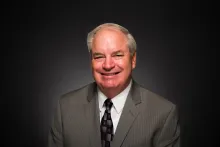
Robin Webber was born in Chicago, Illinois, in 1951, but has lived most of his life in California. He has been a part of the Church of God community since 1963. He attended Ambassador College in Pasadena from 1969-1973. He majored in theology and history.
Mr. Webber's interest remains in the study of history, socio-economics and literature. Over the years, he has offered his services to museums as a docent to share his enthusiasm and passions regarding these areas of expertise.
When time permits, he loves to go mountain biking on nearby ranch land and meet his wife as she hikes toward him.
