
Don Ward
This transcript was generated by AI and may contain errors. It is provided to assist those who may not be able to listen to the message.
When you think of your Heavenly Father, what is the first thing that you think of? Do you think about His power and authority? That He is constantly judging you? Or do you think of a warm, loving, eager-to-listen, personal Father? Do you picture yourself walking side by side with Him, hand in hand?
Him holding your hand, you holding His hand. I remember walking with my Father. Sometimes I would follow Him in the furrow, trying to put my foot in His footprint. Sometimes He would have me come in front and hold the crossbar on the plow stock and plow along with Him. I thought that was great until I got to be 10 years old when I did it by myself. But anyhow, it was nice. There's no feeling quite like that of the warmth and security. Just to know that your Daddy is there, He cares for you, and you feel safe.
Do you picture a being that you can walk with, talk with, continually that you feel safe with? Or do you think of your Heavenly Father in a distant sense, one who is judging and systematically and mechanically dishing out punishment? Let's note some of the most comforting and encouraging scriptures in the Bible. This is to some degree a follow-up on the sermon last week on encouragement, and surely it is the season that we need to be encouraged. In Psalm 139 and verse 13, when does God begin to think about us? When does He begin to care about us?
In Psalm 139 and verse 13, for you have possessed my reins. In other words, God is our Creator. He's our Father. He has known us from our mother's womb, as He says here, for you have covered me in my mother's womb. I will praise you, for I am fearfully and wonderfully made. The wonder of the human body, the wonder of the human mind. No computer will ever duplicate the human mind. The human mind created the computer.
And the computer can do marvelous things, but the computer is not a human being created in the image of God. Marvelous are your works, and that my soul, my life essence, knows right well. My substance was not hid from you when I was made in secret and curiously wrought in the lowest parts of the earth. Of course, man initially was made from the dust to the ground, and God breathed into Adam the breath of life, and he became a living soul. Soul is what you are. You are a living, air-breathing creature. Soul is used for animal life. It is used for human life.
And it is, in fact, life essence, life potential. For example, Matthew 10.28 says, Fear not him who is able to kill the body and not able to kill the soul, life essence. No one but God can take your ultimate life potential from you. But fear him who is able to destroy both body and soul, life potential, and get in a fire. Man can take your life, your physical life, but man cannot take your ultimate potential for life. That my soul knows right well, curiously wrought in the lowest parts of the earth, your eyes to see my substance yet being unperfect, and in your book all my members were written, which in continuance were fashioned when as yet there was none of them.
You were as good as if you existed before you existed, because in God's mind he knew what he was doing. How precious also are your thoughts unto me, O God! A little bit strong one! How great is the sum of them!
If I should count them, they are more in number than the sin. When I awake, I am still with you, and God is omnipotent, ever present. In Matthew 11, we've talked about Matthew 10, 28. Well, maybe let's read Matthew 10, 28 there, though I've already referenced it. Let's read the context there. Matthew 10, verse 28. With regard to what we're talking about, God's love, care, and concern for us, but the ultimate where we're going with this is developing a relationship with God in which you know Him and He knows you, and you have a personal relationship with Him that is far more intimate than you could ever have with a human being.
I had an intimate relationship with my father and mother. You had perhaps an intimate relationship with your father and mother. You have an intimate relationship with your wife and your husband and your children. But a relationship that is so personal, so intimate, so close that it exceeds all human relationships. In Matthew 10, verse 28.
God has this great love, care, and concern for all of His creation. But the very hairs of your head are all numbered. Fear you not, therefore, for you are of more value than many sparrows. Once again, just showing how God cares for each one of us.
And then in Matthew 11, verse 28, forward a page perhaps in your Bible, Matthew 11, 28, "'Come unto me, you that labor and are heavy laden, and I will give you rest. Take my yoke upon you, learn of me, for I am meek and lowly in heart, and you shall find rest unto your souls, your life essence, your being. For my yoke is easy, and my burden is light.'" Can you have a personal close intimate relationship with such a one? The one that says His thoughts ever toward us. The one who says that not even a sparrow falls to the ground unless he's aware of it. The one who says, the hair on your head, the hairs are numbered. Now look at 1 Peter chapter 5, verse 6.
One of the things that we do is that we try to bear our own burdens. We try to carry it ourselves. And here we are, this is placed in the sense of a command with regard to what we should do. And it's one of the most difficult things. And I know that there is a time to be laden with trials and tribulations, and we feel down or whatever we feel. But notice what this says in 1 Peter 5, 6. "...Humble yourselves therefore under the mighty hand of God, that He may exalt you and do season, casting all your care upon Him for He cares for you. Be sober, which should be translated, be wakeful, watchful. Be vigilant, because your adversary, the devil, as a roaring lion, walks about seeking whom he may devour or destroy, whom resist steadfast in the faith, knowing that the same afflictions are accomplished in your brethren that are in the world." God has promised that He will never leave us, that He will never forsake us, and He's always there, ready and willing to help us out. We go back now to Deuteronomy 4 and verse 29. Deuteronomy 4 and verse 29.
God is ever watchful. He is ever wakeful. He is on duty, as they say, 24-7.
In Matthew 4, 29, "...but if from there you shall seek the Lord your God, you shall find Him.
If you seek Him with all your heart, with all your soul, when you are in tribulation and all these things will come upon you, even in the latter days, if you turn to the Lord, if you turn to Yahweh, the Eternal One, your God, your Adonai, and shall be obedient unto His voice." That should be where I said Adonai. That should be Elohim.
Capital G, lowercase o-d, your Elohim.
So how do you think God views you? Does He know you?
Or do you keep Him at arms length? I think some people sort of keep God out here because they're afraid to make a commitment. Well, if I get close, maybe I have to do what He says to do.
So let's keep Him at arms length out here. Push Him away and say, oh yeah, but do you believe in God? Oh yes, I believe in God, but I don't believe in the Bible. Well, God is Spirit. God is invisible.
Those who worship Him must worship Him in Spirit and in truth. How do you know what's truth? Can you just come to spiritual truth on your own through human reasoning?
There have been four great systems that have tried to answer the great questions of life.
Of course, first system there in the Garden of Eden was the truth of God. God revealed Himself to Adam and Eve and gave them instructions on how they should live their lives. The second system that has tried to answer the great questions of life is false religion headed by Satan the Devil. The third system is philosophy. How many books have been written trying to answer the great questions of life? And the fourth system, the system that now has captivated the minds of the so-called intelligentsia elite, and that is the scientific method.
But how do you come to know God? And does He know you? And do you try to keep Him at arm's length, or do you try to really seek Him as we read from Deuteronomy? Let's go to Genesis chapter 18 and see the example of Abraham. God knew Abraham. Abraham had an intimate relationship with God, so intimate that he would even go sacrifice his own son. He trusted God, believed God to that point. He so believed that God always had his best-interested heart that he would even do that. The context of this is that God said He was going to intervene in the situation with Sodom and Gomorrah. And so in Genesis chapter 18 and verse 17, and the eternal said, Shall I hide from Abraham that thing which I do? Seeing that Abraham shall surely become a great mighty nation, and all the nations of the earth shall be blessed in him.
Now, I've covered this several times. How shall all the nations of the earth be blessed in Abraham? It is through the fact that Abraham's seed, Jesus Christ, died for the sins of the whole world. Just because you are of Israelite-ish descent or you a Jew or whatever, doesn't make you better than anybody else. You look at Genesis chapter 12, Genesis chapter 12, where the promises were initially given to Abraham after he left Ur of the Chaldees, journeyed into what we call now the some call Palestine, but the land of Israel.
Verse 2 of Genesis 12, And I will make of you a great nation, I will bless you, and make your name great, and you shall be a blessing. I will bless them that bless you, curse them that curse you, and in you shall all families of the earth be blessed. How? Is it because I'm a physically a descendant of Israel or of Abraham? Now look at Galatians chapter 3, verse 14. Galatians chapter 3 and verse 14. This is a bit of a side trip on this, but it is so important because the world of fundamentalism goes around speaking of this, and yet they profess to preach Christ from a physical point of view. Galatians 3 and verse 14. That the blessing of Abraham might come on the nations, the ethnos, through Jesus Christ. That the blessing of Abraham might come on the nations through Jesus Christ, that we might receive the promise of the Spirit through faith. Now look at verse 26. For you are all the children of God by faith in Christ Jesus.
For as many of you as have been baptized into Christ have put on Christ, there's neither Jew nor Greek, there's neither bond or free, there's neither male nor female, for you are all one in Christ Jesus. And if you be in Christ, then are you Abraham's seed and heirs according to the promise.
Look at Romans chapter 9. Romans chapter 9. Now we have some that have gone into the ditch of, if you're not of the seed of Abraham, we've had some in this area, the so-called identity group, that if you're not of the seed of Abraham physically, you cannot inherit the kingdom of God. You cannot be saved if you're not of the physical seed. Notice what Paul writes in Romans chapter 9.
Verse 6, Not as though the word of God had taken non-effect, for they are not all Israel, which are of Israel, neither because they are the seed of Abraham are they all children, but in Isaac shall your seed be called. Why in Isaac? Because Isaac was born of faith. Abraham and Sarah were of passed away the age of childbearing when the promise was made to them, but in faith they believed and conceived. That is, they which are the children of the flesh, these are not the children of God, but the children of the promise are counted for the seed. If you be in Christ, then are you Abraham's seed, and errors according to the promise. Now back to Genesis chapter 18.
Maybe your Bible will just flip open right there. In Genesis 18 verse 18, seeing that Abraham should surely become a great and mighty nation, and all the nations of the earth shall be blessed in him. We've just seen how that will be, how it's fulfilled. For I know him, that he will command his children and his household after him. See, I know him. We could ask ourselves, does God know me? Does he know me in the sense that he can trust me and give me great responsibility? Does he know that I am faithful in all his ways? I know him, that he will command his children and his household after him, and they shall keep the way of the Lord, to do justice and judgment, that the eternal may bring upon Abraham that which he has spoken of him. In your seed, that is through Christ, all the nations of the earth shall be blessed. Now look at James chapter 2. James chapter 2, the terminology that is used here with regard to Abraham. In James chapter 2, in verse 23, the scripture was fulfilled which said, Abraham believed God. That's in the case of especially offering Isaac up. He believed God. He had already received Isaac as a figure from the dead, as good as dead in Abraham's mind, but of course God intervened. He didn't have to carry out the act. He believed God, and it was imputed. It was reckoned to his account for righteousness, and he was called the Friend of God. Can God look at each one of us and say, you're a friend of mine, and can we look at God and say, you are my friend? Do we have that kind of close relationship with him? See, God has promised to never leave us, to never forsake us, to always be there.
Look at now 2 Timothy chapter 2 verse 19. 2 Timothy 2 and verse 19.
Nevertheless, the foundation of God stands sure, having this seal, the Lord knows them that are his. And hopefully each one of us can say that God knows us that we are his. And let everyone that names the name of Christ depart from iniquity. But in a great house, and the great house being spoken of here is the temple of God, the church of God, but in a great house, there are not only vessels of gold and silver, using the analogy of the temple, physical temple, but also of wood and of earth, and some to honor, and some to dishonor. If a man therefore purge himself from these, he shall be a vessel unto honor, sanctified, and fitting for the master's use, and prepared unto every work.
So once again we ask the question, does God know you? Do you know God? Do you have a personal relationship with him that exceeds all relationships that you have?
All relationships that you have? Let's look at the word relationship for just a moment.
Relationship, the state or character of being related or interrelated, connection between two or more beings. Of course, we're talking about a relationship with a spirit being, invisible. We have not seen God, per se, but we know that he exists, and we know he is there. We have many proofs and testimonies in the Bible itself.
So a relationship is a connection between two persons. If it's a godly relationship, it's proceeding directly from God, toward God and of God. And we must never forget that in every relationship at least one other being is present. I guess you could say, well, I have a relationship with myself, and a person needs to have a healthy, I guess you could call it relationship with himself and view of himself. But what about our relationship with God? God is a jealous God, and you're either for him or against him. So you can't play this game. So many people, and a lot of the young people that grow up in the church, they have this notion that they can sort of tread water and be in the middle ground, not really making commitment one way or the other. But one of these days, I'm really going to make the commitment. Of course, we have read in recent times here from Ecclesiastes, remember your youth, remember your creator in the days of your youth before the evil days come on. And one of the things that we're trying to get across to parents, and I'm trying to sell it in the council as it were, and I hope it extends to the whole church with regard to this thing about relationship from cradle to the grave.
Organizations may come and go, ministers may come and go, lives, whatever it presents to you, may come and go. But your relationship with God must never go. It must come, it must be developed.
And if that relationship with God is what it should be, there will never be any excuse for you to depart from the faith or for anyone else if they have developed that relationship, and if they really believe it, if they really act on it.
So I hope, based on what we say here today, that each one of us develops a much closer, deeper, personal relationship with our Father and with Jesus Christ and each member of the body of Christ.
God needs us. Some people say, I've heard ministers, elders get up and say, well, God doesn't need us. Well, God doesn't need us in the sense that He would still be God, but He says not willing that any should perish, but that all should come to repentance. Do you need your children? I would say that you would probably answer, yes, I need my children.
If God so loved us that He gave His only begotten Son, then I would say that He needs us. He wants us. He desires us to be in His family. So God has provided a means whereby we can have a relationship with Him forever in a family setting. You know, this is the time of the year when people began to become discouraged, even though they try to build it as the season of joy and all of that.
Of course, the Catholic Church adopted the Way of the Pagans in the Saturnalia, this festival, when today is the shortest day of the year. Today is the day in which the journey, the Son, begins to make its journey back toward the north in the northern hemisphere, the shortest day of the year. The pagans worship Saturn, and Saturn didn't do the work, apparently, after the flood. It didn't do the work that it used to do before the pre-flood.
There's a lot of things happened at the flood. The depths of the earth were broken up, and a lot of things happened. But anyhow, the pagans would celebrate the new birth, as it was, of the sun going back and, once again, lighting up the earth. And the customs of Christmas, or the customs of the pagans, were somehow incorporated into, quote, the birthday of Christ. And actually, it was the birth of the sun and the pagan gods.
So we're at that time of the year, in spite of all of the frivolity and all of that, that some say, and I don't know what it verified by research, in the total sense that there are more suicides in this period of time, any other time. You heard in the opening prayer that it is a very dangerous time, that's for sure. People tend to swing from high to low, especially people who do not have a close relationship with God on a continuing basis. You have weather changes and seasonal changes. Earlier in the week, you thought it was spring.
By in the morning, you'll think it's winter.
The days are short, the nights are long, and so it is a different period of time. Now in a agrarian society, short days, long nights, good. After the Feast of Tabernacles, harvest was in an agrarian world in the ancient world. They could sit by the fire, they could discuss, they could talk, they could hopefully...they didn't have the Bible to read as we have today. But it was a time of resting and getting to know each other. Whereas in today's world, loneliness is epidemic in the Western world, even among married couples. Married couples go into the restaurant, sit down.
They hardly look at each other. They may get out their cell phone and check their messages, but there's very little communication taking place. In fact, this age has been characterized as the lonely age.
Our society today treats day and night basically the same. The longer you can keep them all open, the longer you can keep the stores open, the quicker you can get them open. That's what we want to do. This time of year, people tend to get sick more often than they do during the regular during other periods of the year. In fact, this is called the flu season.
About as soon as I go into CVS, have you had your flu shot? I said, no, I don't want to get sick.
She was taken back.
I know some people that have had their flu shot. Of course, there are different flu shots. There's one that just inoculates you against one certain virus, and then there's another that inoculates you against several viruses. By the way, this whatever they call it, H12 or 2H2 or something, there have been already this year two or three people to die from that in Greg County.
I'm just saying it is a time of year in which a lot of people get sick. You might want to do a routine visit to the doctor for a check-up or whatever it is, and you'll find the waiting room is filled with sneezing and coughing people.
If we develop a close personal relationship with our Father, we will have the faith and strength to be more than conquerors through Jesus Christ, our Lord.
Let's turn to Romans 8. In the Bible study this week, I asked, what does Romans 8.31 say?
And not a person of the 24 in the room raised her hand. And I sent him to the corner to be punished in Romans 8.31.
What shall we say then to these things, if God be for us, who can be against us?
He that spared not his own Son, but delivered him up for all, how shall he not with him also freely give us all things? Who shall lay anything to the charge of God's elect? It is God that justifies. Who is he that condemns? It is Christ that died, yea, rather, that is risen again, who is even at the right hand of God, who also makes intercession for us.
Who shall separate us from the love of Christ?
Shall tribulation or distress or persecution or famine or nakedness or peril or sword?
Well, if you don't have this relationship that I'm talking about, there have been people who have been separated, so-called, I don't know if they were ever in the faith or not, over whether or not you could eat a banana. That's a fact that's happened in this area. There have been all kind of people that have departed from the faith for various reasons, from somebody said, this is what's happened to me, or whatever it is. But that never changed a word in the Bible, and it never changed who God is and what our relationship should be with Him.
Now, the key verse, and sort of one of the pivotal verses of the whole Bible, is this verse 36, which is so very difficult for any of us to come to. For as it is written, for your sake we are killed all the day long, we are accounted as sheep for the slaughter. In plain language, what this is saying is this. Anything that we get above death is a gift, because the wages of sin is death.
Knowing all these things were more than conquerors through Him that loved us, for I am persuaded that neither death nor life nor angels nor principalities nor powers nor things present, nor things to come, nor height nor depth nor any other creature, shall be able to separate us from the love of God, which is in Christ Jesus our Lord.
So the first step we want to be aware of with regard to this relationship. Let's go to 1 John chapter 4. 1 John is the only place in the Bible where you just have the statement made, just clearly three words, God is love, twice. 1 John 4.8, 1 John 4.16. In 1 John chapter 4, 1 John chapter 4, and verse 8, He that loves not knows not God, for God is love. And you heard about that in the sermonette. Verse 16, And we have known and believed the love that God has to us. 2 John chapter 6. Here's the relationship. It dwells in God, God in him.
This relationship is like if you were to put your hands together, and some force would meld them together, inextricably linked together, not possible for it to be separated.
Sort of like what we read from Romans 8. What shall separate us?
And love dwells in God, and God in him. Herein is our love made perfect, that we may have boldness in the day of judgment, because as he is, so are we in this world. There is no fear in love, but perfect love casts out fear, because fear hath torment. He that fears is not made perfect in love. We love him because he first loved us. If a man say, I love God, and hates his brothers a liar, for he that loves not his brother whom he hath seen, how can he love God whom he hath not seen? And this commandment have we from him, that he who loves God loves his brother also.
So God makes the first step in this wanting a relationship with us. He made the first step in creating us. Then he made further steps in revealing himself to humankind through the ages.
He's made a step to us as we spent considerable time in a Bible study recently in the first few verses of 1 Peter, that foreknown, that he has foreknown us, and he has called us into his marvelous light. So God has made the first step in developing this relationship. Now, let's look at Matthew 7. What are we to do in our response to him?
Of course, we are to repent and exercise faith in Christ for the remission of sins that are past.
And continually, you look at Matthew 7, verse 7, and it says also in James, For everyone that asks receives, and he that seeks finds, and to him that knocks, and shall be opened.
Or what man is there of you, whom if his son asks bread, will he give him a stone?
Or if he asks a fish, will he give him a serpent? Or if you, then, being evil, know how to give good gifts unto your children, how much more shall your father, which is in heaven, give good things to them that ask him? As long as my daddy was alive, I knew that I could call him anywhere, any time. And so much as was in his power, he would try to fulfill whatever my request was. And so, what about our Heavenly Father?
He cares for us, I would say, far more than any earthly father. Will he also respond in like manner? So, God has made the first step toward us. Now we must respond. We must ask. We must seek.
We must knock. Let's go to Proverbs chapter 2. And Proverbs chapter 2 talks about seeking here, about seeking wisdom. Wisdom is personified in Proverbs chapter 8. But to give an idea of the things that you seek in seeking God, ask, knock, seek. Ask God. Ask God.
Pray to God. One of the things that it talks about with regard to the armor is to pray without ceasing. Pray always. Pray without ceasing. God reveals His character, His being through His words. The words I speak, they are spirit, they are life. And so, when we want to seek God, we talk with Him. And then, in like manner, we let Him talk to us. Proverbs 2.1, My son, if you will receive My words and hide My commandments with you so that you incline your ear unto wisdom and apply your heart to understanding, yes, if you cry after knowledge, lift up your voice for understanding, if you seek her as silver and search for her as for hid treasures, then shall you understand the fear of the eternal and find the knowledge of God.
The Weather Channel presents a program, I think it's called Prospectors, where these people go out, usually in the mountains of Colorado, Nevada, that area, Wyoming, and they search for precious gems. And they go through all kinds of things of fighting the elements, the altitude, the whatever, the dust, the rain, the snow, and they search for these precious gems. So, in like manner, are we, you know, David writes about My heart pants for you, living God, as the deer pants for the water.
For the Eternal gives wisdom out of his mouth comes knowledge and understanding.
He lays up sound wisdom for the righteous. He is a buckler to them that walk uprightly.
He keeps the paths of judgment and preserves the way of his saints.
If you do these things, then shall you understand righteousness and judgment and equity, yes, every good path. When wisdom enters into your heart and knowledge is pleasant under your soul, discretion shall preserve you, understanding shall keep you. Ask, seek, knock.
Chapter 3 of Proverbs, verse 5, Trust in the Eternal with all your heart, lean not into your own understanding, in all your ways acknowledge him, and he shall direct your steps. Seek, ask, knock.
Another way to develop this relationship with God is to think on His name. Remember what we read from Psalm 139? That His thoughts are ever toward us, so are our thoughts ever toward Him.
So let's go to Malachi. Malachi chapter 3, the last Malachi, the last book in the Old Testament. Malachi is a book. It's written as a dialogue, as a conversation between God and Israel, or God and any of us. It's written in the form of a dialogue, but it's really a monologue where God is doing the talking and giving the response of the people based on their actions. They weren't literally saying this, but through their actions they were saying this. The great rhetorical question of Malachi is verse 17 of chapter 2. Where is the God of Judgment? You know, look at all the things that are going on, and look what's happening. Where is the God of Judgment? Of course, Malachi 3.6 is to a large part the answer to that. I am the Eternal, I change not. Therefore, you sons of Jacob are not consumed. Where is God? Well, He's where He's always been, because He's long-suffering, merciful. The sons of Jacob are not consumed. But a part of that answer of where is the God of Judgment? He talks about in the first couple of verses there in this chapter of sending John the Baptist and Jesus Christ. Time after time, Israel accused God of being unfair. Unfair. And I think that's one of the greatest tests that we have to go through as human beings, and oftentimes we are treated unfairly. So we look at Malachi 3.13, Your words have been stout against me, says the Eternal. Notice this dialogue, but it's a monologue.
Your words have been stout against me, says the Eternal. Yet you say, What have we spoken so much against you? You have said, and they said it through their actions, it is vain to serve God, and what profit is it that we have kept His ordinance, and that we have walked mournfully before the Eternal of Hosts? And now you call the proud happy, yes, they that work wickedness are set up, yes, they that tempt God are even delivered.
So it seems that people who may be in our view don't do the right thing, yet it seems they're the ones that are extolled, they're the ones that are exalted. You know, where's fairness in all of this? Where is the God of judgment?
Then, when this kind of thing is going on, and I believe this prophecy is for the time in which we live, then they that feared the Eternal spoke often to one another, and the Eternal heard it, and a book of remembrance was written before Him for them that feared the Eternal, and that thought upon His name. Now, why would you think upon His name? God has several names, and these names reveal His character and His being. Three of the primary names of God in the Old Testament, El, and when you see all caps G-O-D, that's El, it means the strong one. Another primary name is Yahweh, that's in the Old Testament, it's all caps L-O-R-D, the Eternal, the I-M that I am, and Adonai, when you see uppercase L, lowercase O-R-D. Now, one of the, perhaps the major compound word is Eloim, which is a plural of El, and it's Eloim, and when you see capital G, lowercase O-D, that's Eloim. In each one of these names, and there are many other names of God that are used in compound. Yahweh Shalom, and Yahweh Nisa, and all kinds of words. Yahweh Ravikah, God our peace, God our banner, God our healer. So think on the names of God, who He is, what He is, His being. That helps to enhance the relationship. You know how important it is to God? He made a book of remembrance for those that thought upon His name. And they shall be mine, says the Lord of hosts, in the day that I make up my jewels, and I will spare them as a man spares his own son that serves Him. Sort of sounds like to me, and that maybe spares them from what? Spares them from trial, tribulation, maybe great tribulation. As a man spares his own son that serves Him, then shall you return and discern between the righteous and the wicked, between Him that serves God and Him that serves Him not. So learn to think on God's name, and learn to think as God thinks. Now how do you learn to think as God thinks in developing this relationship? Go to Psalm 119. Psalm 119 contains so many action verbs in which the author of Psalm 119 is saying, make me try me. It's like, throw me in there and make me do what I need to do. In Psalm 119, in verse 97, we're talking about relationship. You talk to God, and you say, oh, how love I love the Word of God. You just love the Word of God, because the Word of God tells us who He is and what He is, what is His purpose, the same for man. Oh, how love I thy law is my meditation all the day. We're talking about relationship. How does God talk to God? God talks to you. How does God talk to you? Through His Word. You, through your commandments, have made me wiser than my enemies, for they are ever with me. For I have more understanding than all my teachers, for your testimonies are my meditation. I understand more than the ancients, because I keep your precepts. I have refrained my feet from every evil way that I might keep your Word. I have not departed from your judgments, for you have taught me. How sweet are your words unto my taste, yes, sweeter than honey to my mouth, though through your precepts I get understanding. Therefore, I hate every false way. Your Word is a lamp unto my feet and a light unto my path. See, this enhances the relationship. It reinforces all of the positive things that we have read up front about God. God's thoughts are not His thoughts. It helps us to learn to think as God thinks. Look at Isaiah 55 verse 6. Isaiah 55 verse 6. This harkens back to what we read from Matthew 7. Isaiah 55 verse 6. Later, we're going to read at the conclusion that God is knocking on your heart's door.
And of course, if you harden your heart and say, more convenient day, as did the Roman ruler, at least appointed by the Romans, then you harden your heart so many times, then your conscience becomes seared. Seek you the Lord while He may be found. Call upon Him while He is near. Let the wicked forsake His way and the unrighteous man his thoughts, and let Him return unto the eternal, and He will have mercy upon Him and to our God, for He will abundantly pardon. For my thoughts are not your thoughts, neither are your ways my ways, says the eternal. But if you meditate, as we read from Psalm 119, on the Word of God, then you learn to think as He thinks. And the relationship is enhanced, for as the heavens are higher than the earth, so are my ways higher than your ways, and my thoughts than your thoughts. So if you want to raise the level of thought and thinking, then the Word of God. His Word is an expression of His thoughts. Let's go to Psalm 19 now. Psalm 19. We have read from 119, but now Psalm 19. Psalm 19.
We're talking about enhancing your relationship with God through the Word of God, through communication, two-way communication.
Psalm 19 verse 7. The law, or the Word of God, is perfect, converting the soul, the testimony of the Eternal is sure, making wise the simple, the statues of the Eternal are right, rejoicing the heart. The commandment of the Eternal is pure, enlightening the eyes. The fear of the Eternal is clean, enduring forever. The judgments of the Eternal are true and righteous altogether, more to be desired of they than gold, yes, than much fine gold, sweeter than honey and the honeycomb.
So this absorbing oneself in the Word of God, meditating on it, two-way communication. People cannot develop a relationship with each other unless they communicate with each other and spend time with each other. Time is the substance that life is made of in our physical realm.
Now, this last verse here is one of my favorite verses, the last verse in this chapter. It was about the time that I was, as we say, coming into the knowledge of the truth, though at that time we were teaching and coaching in a high school. And it was the Sunday school teacher, what do they call it? BTY or YTB or something, teacher at night in the Baptist Church, and began to read and study the literature from the church.
And the newspaper handed this every day on the front page, the verse of the day.
This particular verse really struck home to me, and I cut it out and I pasted it on the calendar on my desk, and I'm sure I looked at it several times every day. I need to do that again.
In Psalm 19, verse 14, let the words of my mouth and the meditation of my heart be acceptable in your sight, O Lord, my strength and my Redeemer.
And all the things that are contained in that verse, that is a very powerful and weighty verse.
So through the Word of God, we become familiar with His essential qualities, His characteristics, His works, His rights, His truthfulness, His faithfulness, and you could go on and on.
And we can talk with God in a very personal way. Notice in Numbers, chapter 14, if we could develop a relationship similar to the one that Moses had with God, and you'd say, well, I'm not Moses, and I've not been chosen this or that or the other.
But in Numbers, chapter 13, Israel was journeying toward the Promised Land, had come quite close.
So they sent out 12 men to spy off the land with regard to going into the land, what they would be facing. And they went there, and they saw the Anakim, the giants, and they had chariots.
And so Ten came back, oh, they're giants and chariots and all of that. There's no way Joshua and Caleb came back with a positive report, the bounty of the land and the good land and all of that. But the Ten had stirred up the people to the point that they were ready to stone Moses and Joshua and Caleb and Aaron. And so God had even come to the point and saying, you know, I'll just start over with you, Moses. So let's read this in Numbers 14 and verse 10.
But all the congregation made stone them with stones, and the glory of the Lord appeared in the tabernacle of the congregation before all the children of Israel, and the glory means his presence. And the eternal center to Moses, how long will this people provoke me, and how long will it be before they believe me, for all the signs which I have showed among them, parting the Red Sea, raining manna down from heaven, giving them water, and on and on the miracles were.
I will smite them with the pestilence, disinherit them, and will make of you a greater nation and mightier than they. Oh boy! That you would talk about appeal, it would seem to most people to ego.
And Moses said unto the Eternal, Then the Egyptians shall hear of it, for you brought up this people in your mind from among them, and they will tell it to the inhabitants of the land, for they have heard that you, Eternal, are among the people, and that you, Eternal, are seen face to face, and that you, that your cloud stands over them, and that you go before them by day in a pillar of cloud, and at night a pillar of fire. Now if you shall kill all these people as one man, then the nations which have heard of your fame will speak of you saying the Eternal was not able to bring the people into the land which he swore unto them before he hath slain them in the wilderness. And now I beseech you, let the power of my Lord be great according as you have spoken, saying. And so Moses quotes back to God what Moses, what God had said to Moses concerning his being. The Eternal is long suffering of great mercy, forgiving iniquity and transgression, by no means clearing the guilty, visiting the iniquity of the fathers upon the children to the third and fourth generation. Pardon I beseech you the iniquity of this people according unto the greatness of your mercy, and as you have forgiven this people from Egypt even until now, and the Eternal said, I have pardoned according to your word. I mean, you talk about a relationship, a close relationship to come boldly before the throne of God and to say to God, you know, this is what you said. You said you are a long suffering and that you are great in mercy, forgiving iniquity, and on and on. The Eternal said, I have pardoned according to your word, but as truly as I live, all the earth shall be filled with the glory of the Lord. That's, of course, in the millennium.
Because all these men, which have seen my glory and my miracles, which I did in Egypt in the wilderness and have tempted, tested, tried me ten times and have not hearkened unto my voice, surely they will not see the Promised Land. Brethren, we have the same opportunity.
Now, notice in Hebrews chapter 4, we're talking about relationship.
Can we talk to God? Can we come boldly before Him?
I mean, it needs to be done consistently and continually, not just when we are in trouble or when we are in great need. Hebrews 4, 14, "...seeing then that we have a great High Priest that is passed into the heavens, Jesus the Son of God, let us hold fast our profession. For we have not a High Priest which cannot be touched with feelings of our infirmities, but was in all points tempted, tested, tried like as we are, yet without sin. Let us therefore come boldly unto the throne of grace, that we may obtain mercy and find grace to help in time of need." And you have that relationship. You can go there.
God wants us to offer up to Him continually the fruit of our lips, the sacrifice of our lips, and to praise Him and to realize and thank Him for what He's done for us. Forward now to Hebrews 13. Hebrews 13.
Hebrews 13 verse 13, "...let us go therefore forth, or let us go forth therefore unto Him, without the camp, bearing His reproach. For here we have no continuing city, but we seek one to come." Hebrews 13.15.
"...by Him therefore let us offer the sacrifice of praise to God continually, that is, the fruit of our lips, giving thanks to His name.
But to do good and to communicate, forget not, for with such sacrifices God is well pleased." So we praise God, we thank Him, we think on His name, we meditate on His Word, we must put on the whole armor of God, especially faith and hope. Hope is that big picture burning brightly in our minds concerning the Kingdom of God. If we have hope only in this life, we're of all men most miserable. But we see the Kingdom as Abraham saw that city not made with hands afar off. But if we see that Kingdom, that city, continually in our mind and in our hearts, and if we have that relationship with God, we will never fail. So we are to put on the helmet of salvation, the helmet of salvation, which is the big picture burning brightly in our minds and hearts. Now let's look at Revelation chapter 3. What does Christ say to us today? Revelation chapter 3. We're to ask, we're to seek, we're to knock, we're to draw nigh to God. Now notice what Christ says. Revelation 3.20. Behold, I stand at the door and knock. If any man hear my voice and open the door, I will come into him and will sup with him and he with me to sup.
Now you're in a relationship, you can really share some intimate moments, like sitting down a meal together, but to sup in the spiritual sense, I will sup with him and he with me. To him that overcomes will I grant to sit with me in my throne, even as I also am overcome and have sat down with my father in his throne. He that hath an ear, let him hear what the Spirit says unto the churches.
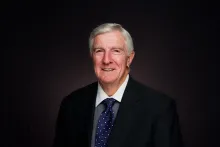
Before his retirement in 2021, Dr. Donald Ward pastored churches in Texas and Louisiana, and taught at Ambassador Bible College in Cincinnati, Ohio. He has also served as chairman of the Council of Elders of the United Church of God. He holds a BS degree; a BA in theology; a MS degree; a doctor’s degree in education from East Texas State University; and has completed 18 hours of graduate theology from SMU.
