
John Elliott
This transcript was generated by AI and may contain errors. It is provided to assist those who may not be able to listen to the message.
The United Church of God presents Anthony Waslkopf with a sermon titled, Effective Reflection. It was recorded July 13, 2013, in Toronto, Ontario. There are any number of us here today, perhaps most of us, who appreciate art. As we have opportunity, maybe during the Feast of Tabernacles, when we travel a little bit, or even locally, we'll go to an art museum. And there are any number of museums we can take advantage of, perhaps even in our immediate neighbourhood, but during the Feast it's always interesting and valuable to find out where the closest museum is, art museum, and walk through it and admire what's there, particularly if it's real art. There are things called art today that really aren't artistic and it's in the mind of the beholder, it would seem. Famous statues bring to mind any number of famous statues, some of which you may have in your own home. For instance, the bust of Beethoven appears on many pianos in many homes. Maybe you have him in your home situated on your piano, a much smaller version of his real self, because it's usually his head and just the top part of his shoulders and nothing to play the piano with, but nevertheless it's Beethoven, and we recognise him as such, having seen him many times. That's a famous statue. Another famous statue, not as common in people's homes by replication, is that of David, with his arm broken off, David by Michelangelo. Some of us have seen it for real, that is the genuine article. Others of us have seen that versions of it. But Michelangelo's David is another very famous statue. And then, I think this qualifies as the statue is Abraham Lincoln, the Lincoln Memorial in Washington, D.C., a massive representation of Abraham Lincoln. Some of us have seen that, and it is remarkable to behold. His likeness is clear. Then there is the United Nations statue that you will recognise. It's appeared in our publications as a front cover photograph, or even an article within the magazine photograph. That's the Swords to Plowshares statue in the United Nations, a magnificent one, illustrating, of course, Isaiah Malachi. And who donated it to the United Nations? The Soviet Union, of all the nations.
They donated that statue, a time when men will beat their swords into plowshares. And, of course, it will happen. Not too far down the road, there is the Brock monument that some of you will have seen. I remember going to see the Brock monument, I think, for the first time, and one of the first times, when the Feast of Tabernacles was observed at Art Park. Some of us will remember those days when the Feast was kept along the Niagara River and Niagara Falls for many years. And then, for a short time, we went to Art Park. And right across the street, across the border, is Lewiston. And there, a very tall monument called Brock's monument, and the very top of it is General Brock himself. And you can climb up to the top. Inside, or it used to be able to do so. If you have been out west and visited Banff, and especially Banff Springs Hotel, and driven in front of it, you can see there is a statue there of Van Horn, who was Van Horn while he was famous for the railroad and the various hotels. He's there in statue form to be observed. Then, of course, there's the famous Mount Rushmore with Presidents of the United States. Remarkable how the sculptor sculpted a massive mountain without making any oopses. A lot of us, when we paint or sculpt, occasionally will say, oops, and then we'll fix it. But if you make an oops when you're using dynamite, how do you fix that? But what a remarkable result with all those famous Presidents. And then the statue I want to leave you with to consider.
By Rodin, who made his first small plaster version around 1880. The first large-scale bronze casting was finished in 1902, but not presented to the public until 1904. And it became the property of the city of Paris, thanks to a subscription organized by Rodin admirers and was put into the, or in front of the pantheon in 1906. And that is called the Thinker. If you remember that statue, here he is. I have a picture of him here, but I can't show it to you. Too tiny. But here he is, hunched over a little bit, and he has his chin on his somewhat clenched hand, right hand, and his other hand on top of his elbow.
And clearly this individual is in deep, deep thought. He is reflecting, and it's called the Thinker. The first cast sculpture can be found in front of Greymire Hall at the University of Louisville in Louisville, Kentucky. It, in Paris, first displayed at the St. Louis World Fair in 1904. Open your Bible, please. We have a question for you.
Come with me, and turn to First Peter, chapter 1. And we'll begin reading in verse 10. This will be a sermon without the usual SBS. It'll be more inductive than deductive, and again, I appreciate the announcements and the sermonette today and special music, air conditioning, all the blessings we have of this day. First Peter, chapter 1, verse 10, where it says, Searching what or what manner of time? Sometimes a person is lost, and people look for an individual because maybe their life is in danger. We don't know what's happened to a child or even sometimes a senior citizen. And there's a search party. We had an occasion where, at a teen function some years ago in British Columbia, we found out after the fact that after the mountain had been cleared, one of the skiers, a young teen girl, had been left behind. She had skied off a trail. Everyone had gotten back to the lodge. It's 10 o'clock at night. It's after dark, and she's missing. And a search party had to be organized to go find her, and thankfully they found her alive. There are searches, and there are searches. Sometimes you're searching for something in the Bible. Searching what? Or what manner of time? The Spirit of Christ, who was in them, was indicating, when he testified beforehand, the suffering of Christ and the glories that would follow. Verse 12, 1 Peter, chapter 1, To them it was revealed that not to themselves, but to us. They were ministering the things which now have been reported to you through those who have preached the gospel to you by the Holy Spirit, sent from heaven, things which angels desire to look into. So since angels desire to look into this matter of salvation, the suffering of Christ, how much more should we be needing or wishing to look into that? And as I said during announcements, why we always rejoice at another opportunity, another avenue to preach the gospel to Canada through Beyond Today. Australia has that opportunity, the U.S. has it too, of course. Verse 13, therefore, so we, if you remember geometry or was it mathematics? Therefore, what does this all mean? Therefore, since we know what we read previously and understand it and are convicted by, therefore, what should we do? Gird up the loins of your mind. What a strange expression. We don't use that language today. What does it mean? How are we to understand that? Gird up the loins of your mind. Be sober and rest your hope fully upon the grace that is to be brought to you at the revelation of Jesus Christ. Remember when I worked in the personal correspondence department, sorry, mail reading department, that's prior to personal correspondence in Pasadena, California, in 1969, 1970, that someone wrote, sent in a little booklet. It was a tract. You remember there have been many tracts published through the years, and the tract was entitled, America is Laughing Itself to Death. And it had the two masks that you would see in drama theaters, one smiling and the other frowning. America is laughing itself to death. That was 1969, 1970. Where are we today? What kind of humor do we hear today, or see today, portrayed in Hollywood as anything sacred anymore? Illusion-maging announcements today about Toronto speaks volumes, doesn't it?
Be sober. Therefore, gird up the loins of your mind. Other versions of the Bible, pardon me, put it this way. Brace up your minds. Or, therefore, concentrate your minds with the strictest self-control. Or, therefore, prepare your minds for action. Or, therefore, gird your minds for action.
Be aware of your mind, in other words, and do something with it. The following description appeared in a book called Love is a Fallacy by Max Schulman. And it just gives a portrayal of what a hope will help to serve a purpose.
Cool was I. And logical. Keen. Calculating. Perspicacious. Acute. And astute. I was all of these. My brain was as powerful as a dynamo. As precise as a chemist's scale. As penetrating as a scalpel. And think of it, I was only 18.
Remember how sharp you thought you were at 18 or 19 or 20? And then we become 25 and 30 and 35. Love is a Fallacy by Max Schulman. How sharp do we feel today when it comes to mental acumen? 2 Peter 3. 2 Peter 3, verses 1 and 2. Beloved, that is a beautiful term, and there are occasions where at a ceremony we are talked to or referred to by the speaker is dearly beloved. And in that setting it's a sobering one, isn't it? Beloved, I now write to you this second epistle, this second letter, in both of which I stir up your minds by way of reminder. From time to time our minds need to be stirred up, to be invigorated. If you do any baking and you have a big pot or bowl and you have to stir, well, sometimes it says don't stir, fold. There's a difference between folding and stirring, or you can over-stir. Or these days, well, the child growing up, I remember being given a bowl by my mother saying, okay, beat this, or make butter by hand. Beat that! Three hours later you're still hoping for butter.
And then there was this wonderful invention of the electric egg beater, or the electric mixer, which takes all the fun out of stirring.
Stir up your minds by way of reminder. After you have attended church for any number of years, it's most unusual that you will learn anything brand new, but you'll be reminded of what you once knew that you'd forgotten. And it goes from the back of your mind to the front of your mind. That's important. Stir up your pure minds. Minds have to be pure, and even pure minds need to be reminded, invigorated. And verse 2, that you be mindful of the words which were spoken before by the holy prophets and of the commandments of us, the apostles of the Lord and Savior, knowing this first, and so on. That you be mindful of the words which were spoken before by the holy prophets. What are people mindful of today? What are you and I mindful of? What are our minds typically filled with? What is the average Torontonians' mind filled with? Or Ontarianians' mind filled with? Or Canadian mind or North American mind filled with? It was an interesting article. I thought it was potentially very significant. It takes authorities in the right direction, at least. It's entitled, This is Your Teen Unmindfulness. Toronto Star, May 21, 2012. Teenagers who learn mindful behavior benefit from increased self-control and well-being. Teenagers who practice mindfulness, a technique that involves focusing on what is happening in the moment and being aware of and accepting emotions, benefit from increased self-control. Mindfulness is a useful strategy for teenagers because it allows them to think through their emotions as opposed to reacting impulsively. That's a very important concept. How many people these days function, react, operate impulsively? How many people are impulsive buyers? How many of us have committed the error of going shopping on a hungry stomach?
I remember, still a bachelor, living in Monroe, no, Ruston, Louisiana, fasting one day and going shopping. For my groceries and buying various odds and ends and the next day wondering, why did I buy this? Why did I buy that? Well, because I was famished and it seemed like a good idea at the time. So never shop on an empty stomach. Your mind won't be analyzing things correctly. Hebrews, Chapter 10. Hebrews, Chapter 10.
And we'll read verses 15 and 16 of Hebrews, Chapter 10.
But the Holy Spirit also witnesses to us, for after He had said before, the Holy Spirit, meaning God's power, or another way of describing the Holy Spirit is God in action.
But the Holy Spirit also witnesses to us, for after He had said before, verse 16, Hebrews, Chapter 10, this is the covenant that I will make with them.
Christians, God's people. After those days, says the Lord, I will do something. I will do what? I will put my laws, excuse me, where? Into their hearts. And in their minds, I will write them. Where the greater God says, with the new covenant, this is what is to happen to us as we are baptized, as we are preparing for baptism. And after we are baptized, for the rest of our lifetime, where God, through the power of His Holy Spirit, puts His laws into our hearts and into our minds.
There He will write them. Where was God's law written originally? On tables of stone. By the very finger of God. Where was it written subsequently? Well, on vellum. And papyrus. And paper. You remember a few years ago, we had a fundraiser in the Church of God, essentially, at Ambassador University, and we were selling bronze plaques with the Ten Commandments on them. And in some people's homes today, when I visit them, they'll have on the wall the Ten Commandments.
On a bronze plaque. Beautiful to see. Where does God want the Ten Commandments written today? In our minds and in our hearts. When we were given memory work in school, elementary school, or junior high, or high, or university, and the teacher said, Class, I want you to learn this by mind? Or did she say, he said, I want you to learn this by heart? Where it becomes a part of us. Where we internalize it.
This is especially the case with music. Where if something is learned, set to music, you can remember it's so much better, it's so much longer. But how does this happen? It doesn't happen automatically.
It doesn't happen through osmosis. Sometimes you hear or see a commercial saying, learn a foreign language easily right in for this course or that course, and it only costs $500. And after you have this course, you'll be able to learn a foreign language easily, effortlessly.
You take, you put a tape, sorry, CD, sorry, MP3 player beside your bed, put a little speaker in your pillow, go to sleep, and wake up in the morning, and voila, you can speak Spanish. I mean French. Does it work that way? It takes a lot of work to learn a language as an adult. It takes a lot of practice and internalization. We had a remarkable German teacher in Ambassador College. In school, I studied two years of French in junior high, four years of Ukrainian. I quit French because there were students who studied four years of French in the school where I went to, and after four years, they couldn't speak anything.
They had no conversational capacity. They could read French on a cornflakes box, but that's as far as it went. I could already speak my own language, so I thought at least I could learn grammar and authors. But in Ambassador College, we had a remarkable German teacher who came from Canada originally, from Vancouver.
The first day he walked into class, I can remember what he said. Stenze auf. We looked at each other and said, what's he saying? We haven't studied German yet. Stenze auf. Stenze auf. Unscreibenze deine namme en die Tafel. That's the first day of German class in 1966. And his concept was, speak in German so your class begins to think in German, as opposed to translating, thinking, how do I translate this? He got us to think in the language from day one.
It was an effective way of doing it. Sadly, I studied only for two years and I've forgotten. Haber alesfogesen. It's all gone. It's gone. Because languages, German, any language is complicated. But that was the concept, to get you thinking in the language, as opposed to thinking in your own language and then translating. World of difference. The thinker. Think of the statue. Luke 2. Luke 2. Ordinarily we come across this a lot in December. Early, mid, late December. Luke 2. 15. So it was when the angels had gone away from them into heaven, that's headquarters for angels, that the shepherds set to one another.
Luke 2. 15. Let us now go to Bethlehem and see this thing that has come to pass, which the Lord has made known to us. So the shepherds decided to act on the knowledge that they had received. Verse 16, Luke 2. And they came with haste, and they found Mary and Joseph and the babe lying in the manger. Now, talking about making haste, I should mention, and I'm not sure if it was mentioned, I don't think it was today, that Mr. Horlick today is in New Brunswick.
He went there yesterday to visit the church. He's conveying greetings from all of us, returning tomorrow. And Edwin Van Pelt is in Montreal visiting the brethren there, and we're all here, and others are visiting in different locales as we go back and forth this time of year. They came with haste. Verse 16. So not...they weren't taking their time. They saw there's urgency important here. They came with haste, and what did they find? They found Mary and Joseph and the babe lying in a manger.
Not your usual location for a newborn infant. We heard of a new one being born recently, and some folks here are now grandparents, and congratulations once again to them. We rejoice with one another when this happens.
Verse 17. Now when they had seen him, they made widely known the saying which was told them concerning this child, capital C, child capital B, babe, in the previous verse. So they spread the word. They spread the news. And then verse 18. Sorry, verse 19. But Mary kept all these things. And all those who heard it marveled, verse 18, of those things which were told them by the shepherds.
It made an impact. And then verse 19. But Mary, the mother, kept all these things, and did what? And pondered them. Where? In her heart. She was a thinker, and didn't easily dismiss what had happened or what happened in her life. She didn't just say, ah, well. Wooded Winston Church will say that most men, when they stumble across the truth, will quickly get up, brush themselves off as if nothing had happened to them, and quickly continue on their way.
That does happen. So she was quite a different person, an unusual person, a remarkable person, wasn't she? Mary kept all these things, didn't let them slip or slide, and pondered them in her heart. Something was posed here in a source book I had come across. When it comes to two individuals, briefly, of two different individuals with the same awkward experience, which of the two will have the best memory?
The one who thinks things over, that is, he thinks over his experiences, and then weaves them into the most systematic connection with each other. That individual will have the best memory. If something new happens, he learns something new, he'll try to connect it to something he already knows, so it sticks with him. That's the way Mary was. She kept all these things and pondered them in her heart. Have you ever been at your desk, constructively pondering, when the boss came in and said, Get back to work. Pondering these days isn't considered to be that important. But it was at one time, societally, you could see somebody on the porch, on the rocking chair, rocking back and forth with a stick, and they're whittling.
And they're wasting time, because they're not even making anything substantial. They're whittling. They're just whittling. But they're thinking of the day, what had happened, reflecting on the day, what they learned. It's important to do that. It's not valued so much today. It used to be the last couple of verses, still please, in the same chapter. Let's see, let's start in verse 49. And he said to them, Why did you seek me? Why speaking to his parents, namely to his mother, because she did the talking in the previous verse.
Why did you seek me? Did you not know that I must be about my father's business? It's an interesting thing to have a family business. When the son or the daughter or the children inherit the family business and take over. And more often than not, what happens is they ruin the family business. And mom and dad or grandpa worked so hard to make it a thriving concern. It quickly is scuttled. I must be about my father's business.
Verse 50. But they did not understand the statement which he spoke to them. They as a couple. But they did not understand the statement which he spoke to them. Verse 51. Then he went down with them and came to Nazareth, and was subject to them. And his mother kept all these things in her heart. What a remarkable description of a remarkable lady, the mother of Christ. Earl Nightingale once said, who's Earl Nightingale? Some of us may remember Earl Nightingale around for many, many years on the radio. He said, you and I become what we think about most.
You and I are motivated every day and move by our currently dominant thoughts. We move only in the direction of that which we dwell on. In the balance of the sermon this afternoon, I want to give you five steps. For effective reflection, effective pondering, or effective meditation. How to meditate effectively. This has nothing to do with Maharishi, Mahash, and Yogi. Transcendental meditation. That's not the real thing. The scripture actually promotes and defies and advocates and requires the real thing. It's one of the big four.
We have through the years, we've advocated daily prayer, daily Bible study, daily meditation, and regular fasting. It's one of the big three for daily spiritual growth, spiritual development, part of our daily devotion to meditate. Step one. Five steps. Step one. Pray for God's guidance. When you decide, okay, it's been a while since I've meditated, so I think I'm going to meditate. Before you do, pray for God's guidance. God has the power to direct our thinking processes.
But we have to ask Him for His help in that particular way. Psalm 19, please. Psalm 19, we'll look at verses 9 through 14 for step one. Pray for God's active guidance in your meditation devotional, your meditation exercise. Psalm 19, verse 9 says, the fear of the Lord is clean, enduring forever. Godly fear is essential for clean living. When Toronto was Toronto the good, it had a whole lot more Godly fear than it has now.
We have very little left anywhere in Canada for that much, or North America, or anywhere on planet Earth for that much. Psalm 19, latter part of verse 9, the judgments of the Lord are true and righteous altogether. These are the lesser laws under the commandments. They appear in, for instance, Exodus 21, 22, 23.
The judgments of the Lord are true and righteous altogether. So these lesser laws, the Ten Commandments, are of course at the heart of the law of God. But then there are lesser laws that are also highly applicable. And they're described in verse 10, more to be desired are they than gold. Yes, than much fine gold. The price of gold just went up.
It spiked significantly. Oh, good. Our investments are going to pay off. If I had gold, but if you acquire gold, then where do you store it? And if anyone else finds out you have it, then what? Ah, you don't buy the real thing. Buy the gold certificate. But then how many people have bought a piece of the cross, a piece of the wooden part of the cross?
But if you assemble all the parts, you get a lumberyard. Because how do you know that there really are really genuine gold bricks for every certificate that is sold? And the gold you buy, the bar, how do you know it's real gold? If you put it in the safety deposit box, I'm told that banks can confiscate those safety deposit box contents if the government says, we want to take all the gold we need it for the good of the country.
That's been known to happen. So I'm not saying you should sell your gold, if you have any. But looking at the value, the intrinsic value, more to be desired, because you have the judgments of God, you have God's law and understanding of the value, validity, and importance of more to be desired are they than gold? Yes, than much? Fine gold! There's gold, and there's gold. Sweeter also than honey and the honeycomb. If we had honey lately out of the honeycomb, there's honey and there's honey.
Or you get a nice jar of, and it's got a picture of the honeycomb and the bee, and it comes right from the apiary, and you open it up and it tastes... Ah, this is the way I remember honey tasting when I was a child, we may think.
God's law, God's judgments are that wonderful, that meaningful. They should have that impact on us. Verse 11, Moreover, by them your servant is forewarned, and keeping them there is great reward. Who can understand his errors? Cleanse me from secret faults. Keep back your servant also from presumptuous sins. Let them not have dominion over me. Then I shall be blameless, and I shall be innocent of great transgressions. Verse 14, Let the words of my mouth...he's asking God this... And we should too, let the words of my mouth and the meditation of my heart be acceptable in your sight. O Lord, my strength and my Redeemer. We want God the Father to be in charge of our thinking processes.
We don't want Satan the Devil to infuse his ideas. We don't want human nature to somehow intrude. And it is possible. Somebody was saying some years ago when they were an ambassador college student, that they had a thought in mind to go and kill Mr. Armstrong, to kill the head of the college, head of the church. And they realized, this is not a thought from God. This is not the Holy Spirit. This is Satan speaking. And so they rebuked that spirit, and of course it went away. So step one, pray for divine guidance. Ask God to guide and direct the thinking processes that you and I will have at the time we choose to meditate. That's step one. Step two, take time to do it. Our lives are so busy that we don't take time to do what's most important. But if we don't take the time to meditate, probably we'll never do it. It was my habit through the years, as a younger man, to, especially when traveling, and I used to do much more driving then than I do now, but to nearly always have something in the vehicle that was instructive. Tapes, courses, or at the very least, listening to the CBC for its instruction. It was instructive in those days. But now, you know what I do when I drive most of the time? I don't turn on the radio. I just enjoy the silence and enjoy the quiet and think and reflect on what has happened or what is going to happen. Genesis 24. Beginning to read in verse 59. And probably you do too. Although a lot of people these days are plugged in, unnoticed. And you can be walking along on a walking path and say hello to someone, and if they have earbuds, they don't even know you're there. Because they've excluded the outside world. Occasionally, there are people who are still engaged because they leave the volume low. But you meet the most interesting people when you go for a walk. I'll come back to that. Genesis 24, verse 59. So the sent away Rebecca, their sister, and her nurse, she didn't go by herself, and Abraham's servant and his man. And they blessed Rebecca, her family did, and said to her, Our sister, may you become the mother of thousands of ten thousands, and may your descendants possess the gates of those who hate them. And then Rebecca and her maids arose, and they rode on the camels and followed the man. And so the servant took Rebecca and departed. A long, long journey, alleviated by all of the comforts of camel travel. Have you ever been on a camel ride? Have you ever talked to a camel? If you go to African Lion Safari, remember at the feast, going to Marine Lane and Game Farm, and seeing the various animals there, and not sure if they were a church member or not, saying, Don't get too close to that camel, they spit. So we stepped back and waited, and sure enough, right through the mesh fence, the camel did expect to rate at the person admiring the camel. But they're a comical creature. The way they get down, the way they get up the sports camel, or the economy camel, and the way they walk, because they don't have the same stride as a horse does, but it was a form of conveyance, and it worked. So off they went on this long and tedious journey, but they were used to it, they were prepared for it. Now Isaac came from the way of Beir L'Hara'i, for he dwelt in the south.
In Isaac, verse 63, Genesis 24, Isaac went out to meditate in the field, in the evening, and he lifted his eyes and looked, and behold, there the camels were coming.
Isaac was a man who took time to meditate. When did Isaac meditate? In the evening. Where did he meditate? In the out of doors.
One of the finest places and ways to meditate is in the evening, going out for a walk, or in the morning, going out for a walk, and thinking about the day, as it's going to be, or thinking about the day as it was, reflecting on what was accomplished.
It's very interesting going for walks. If you go by yourself, you think more. If you go with your spouse, you reflect in a different way. You can bump into someone, and you meet some of the most interesting people.
It's instructive to see who these days as a couple will hold hands, and who doesn't.
Often, occasionally, once in a while, you'll see an older couple. They're still clearly in love, and they're holding hands. I saw a site yesterday I had never seen before. It was a younger couple holding hands as they were coming down the street.
I had never seen the site before. A younger couple holding hands because he was on a skateboard, both feet, and she was walking beside him.
Very romantic in an unusual way. I've never seen that before. I've been meditating about that ever since.
What does this mean? What does this signify?
How do we define meditation? I haven't done that for you yet. There's been some allusions to it. It's often misunderstood as something difficult or mysterious or somehow Eastern practiced by isolated monks or mystics. But it's simply focused thinking. To concentrate. To concentrate means to come to the center of something. When you think about a problem over and over in your mind, what is that called? That's called worry. When you think about God's Word over and over in your mind, that's called meditation. If you know how to worry, you already know how to meditate. Almost you can make that particular transposition.
Step 3. Choose a specific subject. Step 1. Pray for God's divine guidance. Step 2. Take time to do it. Schedule a time and a place where it is most effectively done. Step 3. Choose a specific subject. Pick an area, a topic in which you want to achieve better or increased or improved understanding. Psalm 119. Psalm 119. Let us begin there in the verse of the 119th Psalm.
Psalm 119.
Oh, how I love your law! It is my meditation. How often? All the day. So here is King David, a man after God's own heart, who said of the law of God, Oh, I love, I love your law! It is something I think about all day long. Now, you and I cannot study the Bible all day long. We can pray off and on during the course of a day, but we can't kneel all day long. We can't at home before we go out to work, wherever we are, but we can meditate off and on most of the day and reflect on God's law, for instance.
Verse 98, You, through your commandments, make me wiser than my enemies, for they are ever with me. And then verse 99, I have more understanding than all my teachers. There is a reason for it. What is the reason? For your testimonies, meaning the Scripture, are my meditation.
David was a man after God's own heart and meditated a great deal. I suspect that when he had his spiritual departures, it was when he had stopped praying and stopped studying and stopped meditating. So it's important to have a topic. You cannot simply say, okay, this evening at eight o'clock, I'm going to meditate.
And you find a place and you sit down or you're going for a walk and you think, okay, I'm going to meditate. About what? Don't know. Don't know. I'll see what comes to mind. Minutes go by. Nothing seems to be coming through. And we say, hmm, I've achieved perfect mental sterility. Nothing is coming. It's important to have a subject or a topic or an objective. And it's dangerous to do this, although King David says, I meditate on your word in the night watches. Meaning he couldn't sleep at night.
And so instead of counting sheep, he would meditate on God's word, on God's greatness, on God's works. He would do that in the night watches. But be careful, because in the night our minds are not as clear as they should be. And you begin to think in slightly exaggerated ways, such as maybe hokey-pokey is really what it's all about. And you look at that clock and you can't sleep and you're counting sheep and you're tired and you're starting to panic and you've got to get up early and mind can play tricks on us.
So be careful about meditating in the wee hours of the morning. But choose a topic. You could meditate about what was said in the sermonette today, about some of the thoughts that were shared in the announcements today. And choose that to think about. But it's important, though, to think. In the tune, pros and cons came out of the paper. Has the following. Do you think too much? Maybe I don't think enough.
Next square. Or maybe I think too much about the wrong things. He asks, do I think enough about the right things? Maybe I need balance. The things I need to think about. And then there's a blank. What was the question? Do you think too much? Not very funny, but it's meaningful. Meaning, thought today isn't valued as it once was. To meditate, to ponder, to cogitate, to reflect isn't valued as much as it once was.
It was at one time. Step four and then step five. And it was getting warm in here. Stick to the subject. That's step number four. And look at James chapter one verses one through five. Stick to the subject. Choose a specific topic for step three and then step four. Stick to the subject.
James chapter one verses five through eight. If any of you lacks wisdom, an effective meditation requires wisdom. If any of you lacks wisdom, let him ask of God who gives to all liberally and without reproach, and it will be given to him. James chapter one verse five, not verse six. But let that individual ask, how in faith, with no doubting, for he who doubts, is like a wave of the sea driven and tossed by the wind.
Have you observed waves on the lake, on a windy day? Waves on the sea, on a windy day, how they're tossed back and forth? Let not that man suppose that he will receive anything from the Lord, and we'll stop in verse eight. That individual is a double-minded man, unstable in all his ways.
We have to stay on topic. One of the things that counselors are taught when they are taught counseling or therapy, working with a client, is tracking, and that is to stay on a particular subject till it is brought through to a conclusion. There are some people who will go here, and then go there, and go over here, and go over there, instead of staying with something, to bring it through to fruition.
We have been taught in certain instances the importance of visualization. You've heard about that. It's a type of meditation, and it has some value. To visualize where you want to be, to visualize a goal that you want to accomplish. For instance, crossing the finish line. So if you want to lose a few pounds to get svelte and trim again, you picture yourself triumphantly standing on the bathroom scale, and there in the display window is your ideal weight.
Visualization. And if you visualize that often enough, long enough, hard enough, it will happen. Will it? They did a study group at the University of California. A group of students were asked to spend a few moments each day visualizing themselves getting an A on an exam. That was group one. Group two were asked to visualize, not the final mark, but to visualize themselves studying hard for the exam.
Which group do you think got the better grade? The one that visualized themselves studying hard for the exam, not the ones who were visualizing, I'm going to get an A. So visualizing ourselves doing the things we need to do to accomplish our goal is better than visualizing the accomplishment itself. Does it happen in the church? Oh, yes. Because in certain elements of the church, the visual goal is the place of safety.
You have to visualize yourself as being in the place of safety, and you'll be there. As opposed, visualize yourself serving God, obeying Him, walking in Christ's footsteps, and then you'll be protected, wherever that may be. You don't have to visualize the place of safety, because that's not what's going to get you there. Step number five. Avoid vain speculation. Stay away from questions which have no answers. Avoid vain speculation. 1 Timothy 1. 1 Timothy 1. Verses 1-4. 1 Timothy 1, verse 1. Paul, an apostle of Jesus Christ.
2 Timothy, a true son in the faith, grace, mercy, and peace from God our Father and Jesus Christ our Lord. As I urged you, when I went to Macedonia, remain an emphasis that ye may charge some that they teach no other doctrine. And verse 4, what to avoid? Nor give heed to, or shun, nor give heed to fables and endless genealogies which cause disputes rather than godly edification which is in faith. There's vain speculation. There are many references in 1 and 2 Timothy to avoid vain speculation. And there are people who have majored in vain speculation, such as, where is the place of safety? Exactly. And how do you get a reservation? Let's make a booking. Just to be sure that we have enough there to take care of our needs after we get there. I remember having lunch one day with Herbert Armstrong. Didn't have many occasions with him. This goes back quite a few years ago. Some of you may not even know who Herbert Armstrong was, but he was pastor general of the church many years ago. And somebody brought up to him and used the term, referring to an evangelist who was traveling a lot then around the world, and the term that he would use, and I enjoyed his speaking. He could speak for four hours and I would be interested for four hours. In any case, he used the term place of final training. You may remember.
And when Armstrong heard that term, he got angry. He exploded at the table. Why are we teaching the place of final training? I was a little surprised that he didn't approve of that particular emphasis. Some have tried to figure out when Jesus Christ is coming back. And some of my pastorates, there have been some members who were certain that even though the scripture says, no man knows a day or the hour, there are some people who think, yes, that applies to most people except me, because I figured it out. And he had massive charts and time flow depictions of prophetic events, and he was certain that he could figure out when Jesus Christ was going to return. And nothing could be done to dissuade him. So much stopped going to work. He didn't have time to have a job. He was too busy studying prophecy to arrive at when Christ would return. How sad. He's now deceased. He died as a relatively young man. How many angels can dance on the head of a pen? Vain speculation. There's a lot of things we could speculate about vainly, having to do with any number of topics. Avoid vain speculation. It was Mark Twain, I believe, who said, what bothers me about the Bible is not what I don't understand about it, but what bothers me about the Bible is what I do understand about it. That's where we need to focus our thoughts and our attention. What we do understand about it. Joshua, chapter 1.
Joshua, chapter 1.
We'll read just a few verses from this highly instructive chapter in this particular regard. After the death of Moses, it's right in chapter 1, verse 1. After the death of Moses, the servant of the Lord, it came to pass that the Lord spoke to Joshua, the son of non-Moses assistant. Moses, my servant, is dead. Now therefore arise. Go over this Jordan, you and all this people, to the land which I have given them, the children of Israel, every place that the soul of your foot will tread upon. I have given you, as I said to Moses. Dropping down to verse 6, God instructs Joshua, who is succeeding Moses, as follows. Be strong and of good courage. For to this people you shall divide, as an inheritance, the land which I swore to their fathers to give them. As God's people today, we similarly are told to be strong and to have good courage. Then in verse 7, he kicks it up a notch, emerald lifestyle. Only be strong and very courageous. How? To what effect? To what purpose? That you may observe to do according to all the law which Moses, my servant, commanded you. Do not turn from it to the right or to the left, because there will be a benefit. That you may prosper wherever you go. Verse 8, a little more definition, this book of the law. Genesis, actually, is a viticus number, Deuteronomy, the Pentateuch. And by the way, we use R. K. Harrison's introduction to the Old Testament in Pentateuch class at ABC. And R. K. Harrison was instrumental in the translation of the RSV, originally from Scotland, I think, and it came to the University of Toronto.
This book of the law shall not depart from your mouth, but you shall meditate in it. That is the whole Bible, the Old Testament, New Testament, the whole holy writ, the book of the law, which means instruction. Shall not depart from your mouth, but you shall meditate in it. Think about it day and night. To what effect that you may observe to do according to all that is written in it, for then, if you do this, if you meditate and it becomes a part of you and you apply it, what will happen? Then you will make your way prosperous and you will have something special. You will have good success. Remember the booklet years ago, The Seven Laws of Success? Excellent, excellent booklet. One who studied the Word of God. It's like having a meal. And it's important to learn how to eat with some comprehension. And I've learned this from my spouse. Typically men are not that astute. I speak for myself. Women are, you may be astute, maybe you're a chef. We have some people who are. But I've learned from my spouse to be more aware of what I eat, so that you look at it first and then you enjoy the aromas. And then with each bite you think, okay, now what are the flavors? What was used? What spices? What are the ingredients as opposed to freshen, as opposed to essen? If you're familiar with German, you can ask someone the distinction between those two words. There is an important distinction. So as a people of God, when we study God's Word and we ingest it, that's one thing.
But digesting it is something else, and that's where meditation comes in. Meditation is we're digesting what we have taken in. We're taking the time to understand it. And I think of carnation milk. Remember carnation milk? What they used to have as their motto?
The carnation milk comes from contented cows.
And you have this magnificent picture of a cow in a pasture, and it's a Guernsey or a Jersey cow. And it's eaten all day long, and it's laid down somewhere, comfortable. It's got its hoofs tucked in under her and her tail swishing back and forth. And she's lying down there very contentedly chewing her cut. Not a nice sight necessarily, especially when she goes in for another batch. Because you have to swallow it and burp it back up again. But she's chewing her cut very contentedly. And there's a term for that. It starts with an R, ruminating. And certain animals are ruminants to have multi-compartmented stomachs. They would be handy at potlucks, but not so for human beings. Although as a child I used to think that no matter how much I ate for the main course, the compartment for desserts was always empty until it was time to eat the dessert. Nice theory, doesn't really work that way.
So meditation is a form of rumination. We ruminate on what we learn, on what happened, connected to what we already know, to try to internalize God's ways and God's laws and to increase our awe and wonder of our Creator God and of His Son. And in so doing, we will have, with God's blessing, good success.
Thank you.
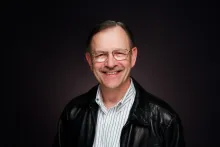
Tony grew up in a small town in Saskatchewan and became a member of the Church of God as a teenager as a result of listening to a radio program on CFQC Saskatoon starting in 1962. Today he and his wife, Linda, wear multiple hats in UCG including working at the UCG-Canada National Office, serving on the Canadian national board and pastoring several congregations. They have served in various pastorates in the United States and Canada.
The Wasilkoffs have two grown children (Paul and Cheri), a daughter-in-law (Coreen), a son-in-law (Jared Williams), four grandsons (Logan, Anthony, Jayden and Colton) and a granddaughter (Calista). They enjoy staying in touch with their grandchildren as much as possible in person and failing that, via the remarkable features of Skype.
