

Don Ward
This transcript was generated by AI and may contain errors. It is provided to assist those who may not be able to listen to the message.
26 days from now or so, we'll be kneeling down to wash one another's feet and taking the Lord's Passover. So we must, at this time, rehearse the requirements, the essentials, for taking the Passover. So the Bible study today will be dedicated to that.
So we'll be going into several different facets and essentials for taking the Passover. The need for the Passover actually began with Satan and the demons. Satan and the demons introduced sin into the universe. And then Satan, of course, seduced, deceived Adam and Eve. And Adam and Eve made the wrong choice. And human beings have been making the wrong choice ever since.
And as we know from Romans 6.23, the wages of sin is death, but the gift of God is eternal life through Jesus Christ, our Lord. As Adam and Eve were being cast out of the garden, God gave them the promise of a Redeemer in Genesis 3.15, and also gave them many messianic promises through the prophets through the centuries. So we go back today to get a bit of the historical foundation to Exodus 12, where God instituted the first Passover.
The first Passover. Passover has a great theme of freedom. The Israelites were freed from Egypt, symbolic of sin and death, where they were literally in physical servitude. And Egypt symbolizes sin and death in the spiritual sense. So the first Passover was instituted to deliver Israel from Egypt. Do you remember the story how that Abraham had a son of promise, Isaac, the promises given to Abraham through your seed?
Of course, that seed is Christ, as in Galatians 3.15-16. Through your seed, all the nations of the earth would be blessed. The promise was passed on to Isaac, and Isaac passed it on to Jacob. Jacob had 12 sons, which became the 12 tribes of Israel. Jacob's son, Joseph, first son by Rachel, was dearly beloved by Jacob, and Jacob favored Joseph over the other brothers.
The other brothers hated him and eventually sold him into captivity. And Joseph winds up as second in command in Pharaoh's court, because Pharaoh had a dream, and Joseph was able to interpret the dream about the seven lean years and the seven fat years, the seven fat years coming first, to store up grain for seven years, and so they did. And so, in the land of promise in Palestine, they called today, the famine was on the land, and Jacob sold.
Jacob sent his sons down into Egypt to buy grain, and eventually Jacob and the whole family went into Egypt, and you know basically the story. So that's a brief account of how Israel winds up in Egypt. And after about 200 years, different pharaohs had come on the scene. Of course, Joseph was now dead a long time, and they were in servitude. In Exodus chapter 12, and earlier in Exodus, God had called out Moses, and Moses had been supernaturally protected as a child, and Moses at the age of 40 fled because he had killed an Egyptian and buried him in the sand because he saw an Egyptian and an Israelite fighting, and Moses killed the Egyptian, and fled for his life, and he spent 40 years in the wilderness, 40 years as probably as a shepherd to some degree, and then God calls him to lead Israel out of Egypt.
In Exodus 12.1, the Lord spoke unto Moses and Aaron in the land of Egypt, saying, This month shall be unto you the beginning of months. Now, there's been controversy with regard to, did God reveal the sacred calendar? Personally, I believe that he did. The various nations had some form of calendar, because I believe it doesn't necessarily make it true, but I believe the evidence points there. We have some ministers in the church who do not believe. At least I've heard one or two way back in the early days who said that they thought that God just designated that. Well, if I don't think Moses was keeping up with this, why would God have to say this?
This month shall be unto you the beginning of the months, the beginning of the sacred calendar. It's the spring of the year. It shall be the first month of the year to you. Speak unto all the congregation of Israel, saying, In the tenth day of this month they shall take to them every man a lamb according to the house of their fathers, a lamb for an house, and their instructions with regard to the family could go together.
Verse 5, Your lamb shall be without blemish, a male of the first year. You shall take it out from the sheep or from the goats. Of course, this lamb typified, that which was to come, Jesus Christ, the Lamb of God, who would die for the sins of the world. And you shall keep it up until the fourteenth day of the same month. The whole assembly of the congregation of Israel shall kill it in the evening. That means each one of the households, they didn't just kill one lamb.
And they shall take of the blood and strike it on the two side posts and on the upper door posts of the houses, wherein they shall eat it. So each household, and as I said, as it says here, you might be able to have two households go together, depending on the size of it. Verse 13, And the blood shall be a token under the houses where you are. And when I see the blood, I will pass over you. And the plague shall not be upon you to destroy you, when I shall smite the land of Egypt.
Of course, the plague was to be the death of the firstborn, where the blood was not on the door posts of the houses. The firstborn would die if they did not have the blood. And in verse 29, And it came to pass that at midnight the Lord, some people talk about the death angel. It does not say death angel. Angel is not in here. It says, The Eternal, the Yavir, smoked all the firstborn in the land of Egypt, from the firstborn of Pharaoh that sat on the throne of the firstborn of the captive that was in the dungeon, and all the firstborn of cattle.
And Pharaoh rose up in the night, he and all his servants and all the Egyptians, and there was a great cry in Egypt, for there was not a house where there was not one dead. Verse 27, That you shall say it is the sacrifice of the Eternal's Passover, who passed over the houses of the children of Israel in Egypt when he smoked the Egyptians and delivered our houses, and the people bowed the head and worshiped.
The people went and did as they said, and then, where the blood was not sprinkled on the doorpost, then the people died. Today, the blood of Jesus Christ is sprinkled on our hearts. Let's go now to Hebrews 9. Hebrews 9. Hebrews compares the Old Covenant with the New Covenant, showing that the elements of the New Covenant far surpasses the elements of the Old Covenant. In Hebrews 9, you basically have a summary of the things that were done away with through the Old Covenant, or in the Old Covenant.
There's been controversy among some about what I'm about to say now, and it's obvious, and we'll get more to this later, but you can put it in your thinking. When the law is mentioned in the writings of Paul especially, there, of course, is the Mosaic law, whereby they approach unto God under the terms of the Old Covenant.
And then there is the immutable spiritual law of God, the eternal law of God, the very basis of the New Covenant that abides continually and forever. So what was basically done away with through the Old Covenant is in Hebrews 9.9.
Let's read 8. The Holy Spirit this signifying that the way into the holiest of all was not yet made manifest while as the first tabernacle was yet standing. Now, one of the things that you find in the book of Hebrews, of course, as we said, a comparison contrast between the Old Covenant and the New Covenant. Under the Old Covenant, it was only on the day of the Atonement that the high priests could go into the holiest of all. Whereas under the New Covenant, we can live in the Holy of Holies because we have the blood of Christ sprinkled on our hearts 24, 7, 365, and 4th days of the year. We can enter into the holiest of all and appear before the throne of God, which was a figure, that is that tabernacle in that holy place, was a figure for the time then present in which were offered both gifts and sacrifices that could not make him that did the service perfect as pertaining to the conscience, which stood only in meats and drinks and different washings and carnal ordinances imposed on them until the time of Reformation.
So when Jesus Christ came on the scene and He died on the stake, was resurrected, ascended back to heaven, then this old covenant ends and those kind of sacrifices are no longer necessary.
But Christ being come as a high priest of good things to come by a greater and more perfect tabernacle, not made with hands. So we're a part of that building that is to say not of this building, that is to say not of this building, not of the earthly tabernacle, but it is the tabernacle that the Lord pitched as you read in Hebrews 8 verses 1 and 2, building not made by hands.
Neither by the blood of goats and calves, but by his own blood, he entered in once into the holy place, having obtained eternal redemption for us. For if the blood of bulls and goats and the ashes of an heifer sprinkling the unclean, sanctifies the purifying of the flesh, how much more shall the blood of Christ, who through the eternal spirit offered himself without spot, to purge your conscience from dead works to serve the living God?
So Jesus Christ came on the scene and he paid the price. Now continuing in chapter 10, we'll follow up on what I said earlier about living in the holy of holies, verse 19.
Having therefore, brethren, boldness to enter into the holiest by the blood of Jesus.
See, there's great similarity between Passover and atonement.
By a new and living way which he had consecrated for us through the veil, that is to say, his flesh. So there's Dublian Tandres there, dual meaning, as the French say, in that the veil was rent and the court between the Jew and the Gentile was done away with.
And both Jew and Gentile now have access to Christ through his sacrifice. And he gave his flesh. And having a high priest over the house of God, let us draw near with a true heart and full assurance of faith, having our hearts sprinkled from an evil conscience and our bodies washed with pure water. So they sprinkle the blood of bulls and goats on the doorposts and the eternal passed over the house where the blood was sprinkled.
Today, the blood is sprinkled on our hearts, and our sins are passed over, removed as far as the east is from the west from us.
Now in 1 Corinthians 5, 1 Corinthians 5, 1 Corinthians is a great book to read and study in preparation for the Passover. It has, to some degree, an unleavened bread theme. Many think that it was written during the days of unleavened bread. The Corinthians had an incestuous fornicator among them and were doing nothing about it. In essence, they were saying, oh well, that's his business, what he does doesn't bother me, that's up to him, I'm not going to get involved.
And so he continued in fellowship until Paul wrote this letter and said, you've got to put him away. And the reason you're putting him away is not because you hate him, don't love him, it's because you do love him, care for him, and that maybe after he's put away in verse 5, to deliver such a one unto Satan for the destruction of the flesh, that the spirit may be saved in the day of the Lord Jesus. So in 2 Corinthians 7, we see that this one has repented, he's come to himself, and Paul is saying, receive him back into fellowship.
Then Paul says, purge out therefore the old leaven. The old leaven in this case is the leaven of iniquity and wickedness sin, as in the case of the incestuous fornicator.
Get rid of the spiritual leavening. See, when you come to Passover, we talk about unleavened bread being the time of symbolizing putting out leaven. But actually, when you come to the Passover, you should have already examined yourself, repented, exercised faith in Christ, and you're ready for unleavened bread to partake of that with the unleavened bread of sincerity and truth, filling up with the Word of God. Purge out therefore the old leaven.
That you may be a new lump as you are unleavened. I take this to be as you are unleavened. They surely weren't unleavened spiritually, that they had put the physical leavening out of their homes.
And so we put out the physical leavening each year a reminder to search every nook and cranny of our houses, which is symbolized in what we're to do spiritually. For even Christ our Passover is sacrificed for us. Therefore, let us keep the feast, not with old leaven, not that old spiritual leavening, neither with the leaven of malice and wickedness, but with the unleavened bread of sincerity and truth.
So Jesus Christ went in our place and our stead, turned out of Romans 3.
Remember from our study of mastering the book of Romans what the first two chapters of Romans is about.
The first two chapters, chapter one focuses on the Gentiles, taking them to task.
Chapter two focuses on Israel, the Jews, taking them to task. And then Paul begins to summarize and bring things together in chapter three, and he comes down with a summary statement in verse 23, Romans 3.23. Romans 3.23, Paul writes, For all have sinned and come short of the glory of God, Jew and Gentile, no exception.
Being justified freely, why do we need to be justified? Because the wages of sin is death, and if you're going to pay, if you're going to have the scales balanced, then you need to be justified. Somebody needs to pay the penalty for you. Being justified freely by His grace.
Grace in the Greek is chirus, means divine favor. Being justified freely by His divine favor through the buying back power, redemption, that is in Christ Jesus. So Jesus Christ buys us back from sin and death through His sacrifice, as in verse 25. Whom God, the whom is Jesus Christ, whom God is set forth to be a propituation. Perpetuation means one who goes in another stead. He went in our stead to be a propituation through faith in His blood. So we didn't have to go. We exercised faith in the sacrifice of Christ upon repentance to remove the sins that are passed, to declare His righteousness. God has been faithful, and He has kept His word from the Garden of Eden to the present time, for the remission of sins that are passed through the forbearance of God. Long suffering, not willing, that any should perish. To declare, I say at this time, His righteousness, that He might be just and to justify Him who believes in Jesus. So that's a brief summary up front of Old Covenant Passover, New Covenant Passover. So now we get into more details. What are the essentials for eating and drinking the Passover and washing feet?
I've listed here, and this is not an exhaustive list, but five essentials. One, reconcile to God. That's first, reconcile to God and Christ. We'll look at these in more detail.
Reconcile to God and Christ means we exercise judgment, mercy, and faith. We go before God and judge ourselves. How do we judge ourselves? Through the Word of God. The Bible is our spiritual mirror. Sharper than a two-edged sword, dividing the sun to the thoughts and intents of the heart of man. And if we sin, we ask for forgiveness. And He says He is faithful and just to forgive us of all unrighteousness, upon repentance and faith. And He'll remove the sin from us. Then He requires us to go walk in faith, go and sin no more. Reconcile to our neighbor, and we'll spend some time with that. It means that there is a disagreement, an offense, or if you think someone has ought against you, go to your neighbor. The weakest point, the two great weaknesses in the Church of God, 20th century and into the 21st, is centers on this. That is, failure to exercise judgment, mercy, and faith with our brethren.
Third, discerning the physical body and life of Christ that was given for our sins.
Without Him, we would still be in our sins, understanding that He died for the sins of the world, but He died for me individually. He poured out His life essence and commended His life essence in the hands of the Father. Fourthly, we must discern the spiritual body of Christ, the Church, which is similar to number two of being reconciled to your neighbors. So we have to be reconciled to every member of the body of Christ. As we shall read later from 1 Corinthians, when we eat the Passover and take it, we're saying that we are one bread and one body.
One bread and one body. And we must understand the need to keep the feast, and this gets in the Feast of Unleavened Bread, with sincerity and truth. For one to be reconciled to God, you have to be convicted of your sins, repent of your sins, exercise faith in the sacrifice of Christ, be baptized, and receive the Holy Spirit. Now, those of you who are taking the Passover have already gone through these steps, but we rehearse these each year and examine ourselves and renew that covenant in a sense. And we search ourselves and see if there be any leavening.
Of course, this requires giving up self, being led by the Spirit of God, and looking into the Word of God to see if there's anything there. Let's go back to John chapter 6. John chapter 6 is called the Bread of Life chapter, where in this case, Jesus compares and contrasts the bread, the manna that Moses gave in the wilderness with himself. He calls himself the Bread of Life. In John chapter 6, in verse 30, the Jews say, well, what sign do you show that we may believe on you? And then they said, the Jews in verse 31, Jesus said, Jesus said, that Jesus gave you not that bread from heaven, but my father gives you the true bread from heaven. For the bread of God is he which came down from heaven and gives life unto the world. Then said they unto him, Lord evermore give us this bread.
So, John 6 is definitely a place you would want to read and study in preparation for a Passover. In verse 44, one we're familiar with, "...no man can come to me except the Father which has sent me, draw him, and I will raise him up to the last day." In verse 51, Christ says, "...I am the living bread which came down from heaven.
If any man eat of this bread, he shall live forever, and the bread that I will give is my flesh, which I will give for the life of the world." And the Jews strove among themselves, saying, "...how can this man give us his flesh to eat?" And then Jesus said unto them, ...verily I said unto you, ...except you eat the flesh of the Son of Man, and drink his blood, you have no life in you.
Whosoever eats my flesh and drinks my blood has eternal life, and I will raise him up at the last day." So the 11 bread represents the body of Christ that was given for us, that literal body, and his life's blood was shed for us. Now in verse 63, which I refer to, hopefully, in every sermon, it is the spirit that quickens, that makes it alive. So here's how you eat and drink spiritually on a daily basis. It is the spirit that quickens, the flesh profits nothing, the words that I speak unto you, their spirit and their life.
So here, the Word of God is equated with spirit and life. Now let's note the specific instructions that Paul gave for taking the Passover. Let's go to 1 Corinthians 11. If you recall, Paul was taught personally by Jesus Christ in the Arabian Desert. We think it was for a period of about three years. Jesus Christ appeared to Paul in one place when he's defending his apostleship. He says, Have I not seen the Lord?
Of course, one of the things that the Corinthians were saying, they were saying, Paul's not really an apostle. He hasn't seen the Lord. And Paul said, Yeah, I have seen the Lord. In 1 Corinthians 11, we begin in verse 17. The first several verses here sets the stage for what the Corinthians were doing. They were not prepared. They had not reconciled themselves to God in a proper way. They were not reconciled to their neighbors in the proper way. They were not discerning the physical body of Christ that was given for their sins in the proper way. They were not discerning the spiritual body, the members of the Church of God in the proper way.
And they did not really understand or practice obeying the Unleavened Bread of sincerity and truth. So 1 Corinthians 11, 17. Now in this that I declare unto you, I praise you not that you come together not for the better, but for the worse. Now the coming together, as we shall see, is for the Passover. For first of all, when you come together in the Church, I hear that there be divisions among you, and I partly believe it. For there must be also heresies among you that they which are approved may be made manifest among you.
God allows heresies. God allowed Satan to draw a third part of the angels. He did not step in and stop it. So through the centuries, God has allowed heresies divisions to test our faith and to see where we really stand. When you come together, therefore, into one place, this is not to eat the Lord's Supper. Now you may see certain churches say, well, we're going to have the Lord's Supper. How can you get around this?
This is not to eat the Lord's Supper. What they were seemingly doing here was mixing love feast, which was a great custom at some gatherings, mixing love feast with the Passover. It wasn't a potluck, as we do, and everybody pushed their food out, and you can partake of what everybody brought. No, you brought your own, and if you were rich, you could have fine wine, and I guess you could have fine cuisine and all that. And some of them who were bringing wine or whatever liquor they were bringing were getting drunk, getting drunk at the Passover.
Now, I'll hold your place and look at Jude. It essentially says the same thing in 2 Peter, but I'm just going to read Jude. Verse 12, I believe it is. Jude, just before Revelation. In Jude's epistle, verse 12, these are spots in your feast of charity, or your love feast. When they feast with you, feeding themselves without fear, clouds they are without water, carried out about of winds, trees, whose fruit withers, without fruit twice dead plucked up by the roots.
So that's probably why they were doing it. They were combining these love feasts with taking the Passover. And Paul says, this is not for the Lord's Supper. Verse 21, back in 1 Corinthians 11, For in eating everyone takes before his own supper, and one is hungry, and another is drunken.
Could you imagine being drunk at the Passover? Yeah, that's pretty difficult to imagine. What have you not houses to eat and drink in? Or despise you, the church of God, and shame them that have not? See, they weren't discerning the spiritual body, the church of God, and the brethren. They were ignoring them. What shall I say to you? Shall I praise you in this? For I have received of the Lord. Paul says, I got this directly from Jesus Christ. I have received of the Lord that which also I delivered unto you, that the Lord Jesus, the same night in which he was betrayed, took bread.
And when he had given thanks, he broke it and said, Take ye, this is my body, which is broken for you, this due in remembrance of me. And we read from John 6, Unless you eat this bread and drink this blood, you eat of my body, drink of my blood, symbolized by the bread and wine, you have no life in you. And when he had given thanks, he broke it and said, Take ye, this is my body, which is broken for you, this due in remembrance of me. So the Passover is a memorial of death. It is a very somber occasion.
In verse 25, After the same manner also, he took the cup when he had supped, saying, This cup is the new covenant, the Greek 4 testament is diaticae, and it should be translated covenant. This is the new covenant in my blood. This do you as often as you drink it in remembrance of me. For as often as you eat this bread and drink this cup, you do show. And this word in the Greek means to announce, to declare, to make known the Lord's death. So you are recognizing and saying, I recognize that Jesus Christ died for my sins, and that without him the death penalty is still on my head. Wherefore whosoever shall eat this bread and drink of this cup of the Lord, and axios, and that word in axios, and it's spelled as follows, A-N-A-X-I-O-U-S. He who eats and drinks and axios, what does an axios mean? Well, in the old King James it says, unworthily. So there have been church members who have labored through the years, oh, I'm not worthy to take the Passover. None of us are worthy. None of us are worthy to take the Passover. If we were to receive justice, we would all get the death penalty. But because of God's long-suffering mercy, his grace, the sacrifice of Christ, we can have life. So what does this word mean? This word means irreverently. So whosoever eats and drinks of this irreverently shall be guilty of the body and blood of the Lord. And the Corinthians were eating and drinking of it irreverently, to the point that some were even getting drunk, and they were causing divisions in the church. So Paul warns them not to take the Passover irreverently because they'd been doing just that. Whosoever shall eat of this bread and drink of this cup irreverently shall be guilty of the body and blood of the Lord. But let a man examine himself. Doximazō means to test, to prove, to scrutinize, to see whether or not a thing is a genuine thing, like he would take whether the gymnast might take his glass there and look at a gem, to determine whether or not it's the real thing, to really examine, to scrutinize. For he that eats and drinks, in the text, that is the text from which this is translated unworthily, is left out in this verse. For he that eats and drinks, eats and drinks, judgment, Krima, K-R-I-M-A, to himself, not discerning the body. And in the text, Lord is left out in this verse. So in the text, like in the Byzantine text, or the Texas Receptus, he that eats and drinks, eats and drinks, judgment to himself, not discerning the body. If you put it in there, it really doesn't change anything. Look at the word discerning. The word discerning, the Greek word is diacrino, D-I-A-K-R-I-N-O. Diacrino in Greek means all the way through. For example, diameter, all the way through the circle. Diacrino, all the way judgment, all the way through. So you have to discern the physical body that was given. Jesus Christ died for us, gave his body and his blood. And you have to be aware of your brethren and have the proper love, care and respect for them, and be reconciled to them as well.
Now in verse 30. Verse 30 is a verse that I fear and tremble with. I'm a person who's had a lot of physical ailments. I guess you wouldn't call him sick, but it sure is debilitating. One of the things that they are doing at this hospital that I'm having a surgery in is that if you have the surgery early in the morning, they'll probably get you up in the late afternoon. And the next day, you're to get up and dress and sit in a recliner all day and take a few walks, not lying to bed. They never said, you're not sick, but you sure are wounded. I added that.
See, the failure to discern the Lord's body has serious consequences, or it is failure to discern the body. See, of course, Jesus Christ gave his literal physical body, and the church is called the Body of Christ. And God lives in his temple. You are the temple of the Holy Spirit. 1 Corinthians 3, 16. If any man defile the temple, him will God destroy. For this cause, failure to discern, and also to take it irreverently. For this cause, many are weak and sickly among you, and some are dead. And the reason is, if you won't judge yourself, and if I won't judge myself and do what God says to do, then he's going to chase us. He's going to judge us. He's going to step in. And he allows trials to come upon us to the point that hopefully we would humble ourselves and examine ourselves and say, what's happening here. Now, that is not to say we had a discussion in the Council of Elders meeting about the health care packages that the church offers. The church is self-insured, up to $110,000. Now, one little stay in the hospital, such as I'm going to have, is going to be at least $30,000. And so, in the GCE this year, we're going to have a session. Melvin Rhodes is going to present it because, you know, Melvin contacted this deadly bacteria, at least in some cases it's deadly, and his big toe has been infected, and he's still not totally rid of it to this day. And he's going to talk about, we need to take care of our bodies for many reasons. But, you can do everything perfectly, and still, and you can discern this and all this, and you can still get sick. The sins of the fathers were passed on to the third and fourth generation. And so, some of the weaknesses that we have in our genetic material makes us susceptible to various diseases. And virtually every family in here, if you look back at your mother and father on both sides, their mother and father, your grandparents, and then you go to the great-grandparents, and the offspring of three or four generations, you're probably going to find heart disease, diabetes, osteoporosis, cancer, and it goes on. And so, the peoples of the world are very degenerate, in a sense, and their genetic material is not the best to begin with.
So, this is not to say that every time you get sick, it's because you've done this. You may have done the best you can, and some of the most devout, and some call them health nuts, that I've ever known, they were, as we used to say, a matchstick or cigarette paper, lean and thin, died of a heart attack. But this is what it says, for if we would judge ourselves, we should not be judged.
But when we are judged, we are chasing of the Lord. And it says in Hebrews 12-6, if we are not chasing, because God chases everyone He loves, it says if we're not chasing because we're all partakers, we all have needed it from time to time. But when we are chasing of the Lord, we're chasing for a purpose.
And one of the main purposes here is that we should not be judged with the world. Judgment is now in the house of God, and if we won't judge ourselves, then God chases us. Wherefore, my brethren, when you come together to eat, wait for one another.
He goes back then to the context of what the irreverence is about, and what they were failing to do. And if any man hunger, let him eat at home, that you come not together unto judgment, and the rest will I set in order when I come. So we should see here that we have to be reconciled to God, and have to be reconciled to our brother.
Now, this reconciliation to a brother is quite a serious matter, as we see here. And this failure to exercise judgment, mercy, and faith, I think, is one of the great difficulties we have had in the church through the years. I have spoken on judgment, mercy, and faith in the Big Sandy area. I would say at least a dozen times. I've given this same Passover preparation message in the Big Sandy area, probably seven or eight times, I don't know, maybe five or six. And the whole church, we would not have had, and not seen, the things that we have seen through the decades, if we really came to that point where we really understood this matter of reconciliation.
So if we fail to reconcile with God and brother, and judge ourselves, then God is going to step in, as it says here, and judge us. Now let's notice in Leviticus 19 and verse 17. Leviticus 19 and verse 17. This is very sobering, and it is tough. You talk about strong meat. This is it, my brothers and my sisters. And it's not easy, because it requires becoming a living sacrifice and giving up self. And that is very hard to do.
If we see our neighbor's house on fire, we might be quick to grab a bucket and put water on it. If we see someone who is in need of food, we might be quick to go buy some groceries and put it on the front porch or wherever. If we see someone sick, we may be quick to take them a meal. And all of that's good and should be. But the very weightier matters of the law of judgment, mercy, and faith, and that of human relationships is where it is made or whether it is failed.
Make or break, as they say. In Leviticus 19.15, You shall do no unrighteousness in judgment. You shall not respect the person of the poor nor honor the person of the mighty. But in righteousness shall you judge your neighbor. Some people want to go around quoting Matthew 7, which says, Judge not that you be not judged, for whatever judgment you met out should be meted unto you. Okay, that's true. But if you judge righteous judgment, God won't criticize you. He goes on to say in Matthew 7, Get the beam out of your eyes so you can get the mode out of your neighbor's eye.
So you have to look at yourself first, examine yourself, and make sure that you've done what you need to do, and that you are spiritually grounded, founded, and ready to do this. But it says, you shall judge righteous judgment. In righteous judgment shall you judge your neighbor. And Matthew 7 is not a contradiction. You shall not go up and down as a tail-bearer among the people, neither shall you stand against the blood of your neighbor.
I am the eternal. You shall not hate your brother in your heart. Notice how this hate is equated. You shall not hate your brother in your heart. You shall in any wise rebuke your neighbor. And not the King James translation, the Old King James is not correct. The correct translation is, and not bear sin for him. In other words, you shall in any wise rebuke your neighbor so that you do not bear his sin.
That is pretty heavy. You know from Genesis, the account of Cain and Abel, where Cain slew his brother Abel, God came looking for Cain, and he said, Where's your brother Abel? He said, I don't know. Am I my brother's keeper? And the resounding answer in the Bible from Genesis to Revelation is, Yes, you are. The two great commandments, Love God with all your heart, mind, and soul, Love your neighbor as yourself. And in fact, we could turn there. Philippians 2, verse 3-4 says, Esteem others better than yourself. Boy! How many times have I failed that?
How many times have you failed that? Now, you look at that verse 17 again. You shall not hate your brother in your heart. You shall in any wise rebuke your neighbor and not bear sin for him. Now we go to 1 John. John, the Apostle of Love, the one who was leaning on Jesus' breast during the time that they were taking the Passover.
You know, the way they took the Passover is not like Leonardo da Vinci's Last Supper picture. They were not sitting at a table. There might have been a little round table about that high out in front, but they were all lying on the floor, reclining like this, and you might lean over like that onto your neighbor. Leonardo da Vinci's picture is fiction, and so is the movie that is made about it. But anyhow, in 1 John, John is called the Apostle of Love, the one whom Jesus loved, and if you really understand what John wrote, in the spiritual sense, it is probably the most mature and requires the most courage and sacrifice of any of the Apostles' writings.
In 1 John 3, 11, For this is a message you have heard from the beginning, that we should love one another, not as Cain, who was of that wicked one and slew his brother. And why did he slay him? Because his own works were evil and his brother's righteous. Jealous! Jealous the envy of one of the other great enemies of the Church of God and the brethren. Marvel not my brethren, if the world hates you.
We know that we have passed from death unto life because we love the brethren. And the one that loves not his brother abides in death. I mean, the death penalty is on you. Two great commandments. But now we get to verse 15, and this harkens back to Leviticus 19.17. Hereby, whosoever hates his brother. Now remember what Leviticus 19.17 says? You shall not hate your brother. You shall in any wise rebuke your brother and not bear sin for him. So if you don't rebuke him, you are hating him according to the Bible. I didn't write it. And hopefully we all are sobered by the Word of God and begin to understand more and more.
And I think we are beginning in the greater church of God sense. By that I mean greater church of God sense. I don't know. I'm talking about... maybe I should have just said United. I'm not sure. But I sense in United. I mean, this family weekend we had here back in February, I mean, you could just sense the synergy and the unity, as it were, of the spirit of the people who were assembled here and how excited they were and how they cared for one another and how appreciative they were.
And on and on we can go. And we have that sense of this kind of energy. But if we don't really follow up in the actual actions of it, it will die. So we have to understand it to the depth of our being and try to practice it.
Uso hates his brother is a murderer. And you could put Leviticus 19.17 out there. And you know that no murderer has eternal life abiding in him. That's what the apostle of love writes, inspired by the Holy Spirit. Whosoever hates his brother is a murderer. And we know that no murderer has eternal life abiding in him. Hereby we perceive the love of God because he laid down his life for us.
We ought to lay down our lives for the brethren. Judgment, mercy, and faith with our brothers. Very difficult. That's how you become really a living sacrifice in the spiritual sense. Now we go back to Matthew 5. Sermon on the Mount. Verse 17. Matthew 5.17, Think not that I am come to destroy the law or the prophets. I am not come to destroy, but to fulfill. For verily I say unto you, Till heaven and earth pass, one jot or one tittle, Shall not pass from the law, till all be fulfilled.
Whosoever therefore shall break one of these least commandments, And shall teach men so he shall be called the least in the kingdom of heaven. But whosoever shall do and teach them, Shall be called great in the kingdom of heaven. For I say unto you, Except your righteousness shall exceed the righteousness of the scribes and Pharisees, You shall in no case enter into the kingdom of heaven.
Now we just take the case of the Pharisee and the public and that example of going up in the temple to pray. The Pharisee starts off extolling himself and thanking God that he's not like other people. I fast twice in the week, and I pray, and I give this, and I do that, and I thank you I'm not like this publican here. And then by contrast, the publican, not so much as lifting his eyes to heaven, judges himself and says, Lord, have mercy on me, a sinner.
And Jesus says, Who do you think went down to his house justified? Well, of course, it was the publican. So you see here, the righteousness shall must exceed that of the scribes and Pharisees. Verse 21, you have heard that said that, Time of old you shall not kill, and whosoever shall kill shall be in danger of the judgment. But I say unto you that whosoever is angry with his brother without a cause shall be in danger of the judgment, and whosoever shall say to his brother Rechah, shall be in danger of the counsel Sanhedrin.
But whosoever shall say, You fool, shall be in danger of hellfire. And one of the reasons for this, we had a man a few years ago who wrote a paper on this about how serious this is. And basically the line of thought that he followed on this was that because we're all made in the image of God, with that God-ordained potential of being, sons of God and the family of God, that to call anyone created in the image of God a fool, he's in danger of the hellfire.
Therefore, if you bring your gift to the altar, and there remember that your brother has ought against you, leave there your gift before the altar, go your way, first be reconciled to your brother, then come and offer your gift. This is what God says to do. Now let's go to James. Last two verses of James. James is really a treatise, what you might call a New Covenant treatise on the law.
There are over 70 command statements in the epistle of James. James 5 verse 19. Brethren, if any of you do err from the truth, and one King James has convert, the Greek word here is epistrepho. Obviously, we cannot convert in the sense of conversion from physical to spiritual. E-P-I-S-T-R-E-P-H-O, epistrepho, it means to turn about. If you can get him to see the error of his way. If anyone errs from the truth, and one turns him about, let him know that he which turns him about, or turns the sinner about, from the error of his way, shall save a soul from death, and shall hide a multitude of sins.
You know there's that verse of 1 Peter 4.8 that says, love covers a multitude of sins. And we maybe sometimes say, well, I love him, I'm praying for him. Maybe you sort of like the Corinthians, and 1 Corinthians 5 had the ancestors fornicator. Maybe some of them praying for him, but they didn't really say anything to him. They gloried in it. Paul said, it's like, doesn't bother me. He can be as unrighteous as he wants. Like my aunt once said, I don't get sick, she was a registered nurse. She said, I can, I can, you know, I can sit down on a dead cow and eat my meal, and it wouldn't bother me.
Boy, I think it might bother me. It's like, well, I can come in here with sinners all day. Doesn't bother me. In the church, out of the church. Paul says, and see how foolish this is. Paul says, a little leaven leavens the whole lump. So therefore, get rid of the old leaven.
So, taking this into what we read from John, so if we really love him as we love ourselves, if we discover sin in our own being, what do we do? Well, we try to get rid of it, repent of it, cast it out, exercise faith in Christ, and go and sin no more.
You can't just say, I love you. Because we go back now to 1 John 3, where we left off. 1 John 3. We left off in verse 16. Now verse 17, 1 John 3, 17. But whoso has this world's good, and sees his brother have need, and shuts up his vows of compassion from him, how dwells the love of God in him? And now, brethren, we get down to where the rubber meets the road. We are quick, and it's good, to take care of the physical needs oftentimes, but the spiritual need is greater, and requires greater sacrifice in the mind and spirit.
And so, when we come to take the Passover and wash one another's feet, and washing one another's feet, we're saying, in essence, I'm humbled myself to the point that I'm willing to lay down my life for you.
You look at that verse 16. Again, hereby we perceive with the love of God, because he laid down his life for us, we ought to lay down our lives for the brethren.
And it's in this arena of judgment, mercy, and faith, in reconcile to brother, and the ministry of reconciliation, that through the centuries, have caused so much difficulty, so much heartache. As in the 1 Corinthians 12, and the analogy that Paul uses of the body, he comes down that there be no schism in the body, and we might have the same love, care, and concern, one for another.
I know that I've failed in many times. I've tried to do better. I've tried to repent of it through the years. But all of us can do much better. And in so doing, it will strengthen us so much spiritually.
See, the time is coming like it talks about in Matthew 24. It says, the time is coming when they will betray one another.
Father against mother, children against mother, father against wife, wife against father, that kind of thing. Because iniquities shall abound, some people will try to save their own skin. But those who are bound together, as Christ wants us bound together, will be able to stand.
In Revelation 12, notice this. The three great things here that is listed with regard to how overcome Satan.
In verse 10, the accuser of the brethren is before the throne of God day and night, accusing the brother. This word, accuser, is slandering.
And then you look at verse 10 at the last part. For the accuser, the slander of our brethren is cast down, who slanders them, accuses them before our God day and night. So when you're doing that, obviously you're doing the devil's work. It's right out of the Bible. And they overcame him, that is the devil, they, the saints, overcame him by the blood of the Lamb. So they are continually going to our Passover, repenting of their sins, exercising faith in the sacrifice of Christ, and determined to continue to walk in faith. And by the word of their testimony, they did not compromise, they did not back down, they stayed faithful to the Word of God, and they loved not their lives until the death. So they were willing to give their lives for the truth. And one of the great commendations of the Church of Philadelphia, if you go back to Revelation 3, Revelation 3, one of the great commendations for the Church of Philadelphia, verse 8, Revelation 3.8, I know your works, behold, I have set before you an open door, no man can shut it, for you have a little strength, and have kept my word, and have not denied my name. Kept my word, not denied my name. Finally, brethren, let's go to 1 Corinthians 10, the great capstone scripture. In 1 Corinthians, as I said, it's a place we ought to read during Feast of Unleavened Bread, John 6, 1 John, in preparation for Passover. So keep in mind all we've said here today, reconcile to God, reconcile to your brother, discern the literal body of Christ that was given for us without His sacrifice, our sins could not be forgiven, we still have the death penalty on us.
Discerning each member of the body of Christ, not taking the Passover irreverently, and that we are willing to live by every word that proceeds out of the mouth of God the unleavened bread of sincerity and truth. And so when we come and wash one another's feet, and we take of the cup, we eat the bread and drink of the cup, here's what we're saying. 1 Corinthians 10-15, I speak as to wise men, judge you what I say. The cup of blessing which we bless is it not the communion of the blood of Christ. The bread which we break is it not the communion of the body of Christ.
I mean, we actually enter into a covenant of sacrifice with Him as described in Romans 6, symbolized by baptism buried and raised the newness of life.
So it is the literal communion. It is not transubstantiation as the Catholics teach, that it becomes the literal body, flesh, and blood. No, it is symbolic. But in the spiritual sense, we have this communion with God in Christ 24-7, and that His Spirit, the very life essence of God in Christ, is in us through the Holy Spirit. For we being many are one bread and one body, for we are all partakers of that one bread. And that's what we're saying, that's what we're affirming, when we come and take the Passover. So brethren, in the next 26 days or so, let's be prepared so that we can come here and we can take it in the way that God has instructed us to take it.
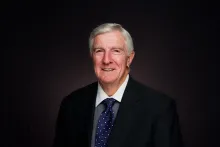
Before his retirement in 2021, Dr. Donald Ward pastored churches in Texas and Louisiana, and taught at Ambassador Bible College in Cincinnati, Ohio. He has also served as chairman of the Council of Elders of the United Church of God. He holds a BS degree; a BA in theology; a MS degree; a doctor’s degree in education from East Texas State University; and has completed 18 hours of graduate theology from SMU.
