

Robin S Webber
This transcript was generated by AI and may contain errors. It is provided to assist those who may not be able to listen to the message.
It's a beautiful, beautiful song. Wish you could all know Mark and know Teah, be able to hear Mark sing in person. He's like a songbird, a troubadouring God's praises, delightful people.
Chris, I was getting a little bit worried. I thought we were going to have a sermon on prophecy, kind of where the heavens pause. I was kind of wondering if that song was going to come after a while. Between the sixth and the seventh seal, I thought we were right there in prophecy. It was a work of faith. Thanks for holding on and David coming up and helping him. Okay, it's fun to have fun. Everybody feeling kind of cold out there right now, or is it warm? Do you want the visitors to leave so we have more room, more oxygen for ourselves? No, we want to keep you visitors. It's all right. Reminds me of that old story. You know, the guy down there in the South, he was really given a what-for sermon, preaching brimstone and fire, just one of those sermons. And he just looked around and said, he's pounding the podium and he says, you know, there's going to come a time when it's really hot. And he turned off the air conditioning just to get the effect to the people. And then he said, you know, there's going to be a weeping and there is going to be a gnashing of teeth. Little lady raised her hand. I said, what if you don't have teeth? Teeth will be provided.
So just remember that if you need an attitude adjustment in the next 15 to 30 minutes, if it gets a little warm. I didn't say the message is going to go 15 or 30 minutes. We're going to stretch your faith here a little bit today. And we're going to talk about a few issues that I hope will be relevant to Christianity, to this festival, and to ourselves. Today we observe a festival of faith, and it's called the Day of Atonement. And like all the biblical festivals, it is based upon sacrifice and offering. The principles, the foundational steps, are laid out there in the Old Testament. Today we no longer sacrifice bullocks, goats, or lambs, as the ultimate sacrifice of Jesus Christ is now laid in place. The groundwork, the heart work, is there for you and me to be able to follow, to be able to have that ultimate Atonement with God the Father. Today I want to talk to you about sacrifice and offering, but perhaps in a different way than you came prepared for, and that's good. You might say, but wait a minute, we just took up the collection. We just took up the offering. Is he going for more? Absolutely. Because some of us in this room, well-intending Christians, under the New Covenant, believing in Jesus, believing in the Father, believing in the Kingdom to come that we're going to be rehearsing over the next couple of weeks, still have something that you're holding on to, that you have not offered up to God. That is not allowing us to have that ultimate Atonement with the deity, with the Godhead. And that's what I'd like to talk about today. There's a four-letter word that is mentioned far too often on the tongues of the saints. Perhaps we don't mouth it, but we say it in so many ways. We say it in our body language. We say it in what we don't express. We say it in clever ways, because otherwise people would know that we're perhaps becoming too direct. But it dominates everything that we talk about, and it reaches out to others. That's what we'd like to talk about today. As Christians, at times we are either too clever or we are ourselves under too much self-denial to recognize the issue that is at hand that we need to, on this day, offer up to God. You say, but wait a minute, Mr. Weber, I thought Jesus did it all. That's why he is the Christ. That's why he now sat down, as it says in the book of Hebrews, and he is the sacrifice. Yes, absolutely. But there are things that we also, friends, we need to sacrifice. We also need to give up, and we also need to offer. Too many of our words, too many of our life's actions, are dominated by a four-letter word. Now, if you're a little bit like me, when I was growing up in the 50s, if I uttered a four-letter word at home, there was a bar of soap waiting for me. Anybody that knows my mother knows what a diligent, disciplinarian she is. That's where my teeth are so clean, still. No, just teeth. There was a bar of soap awaiting me, and she did not hesitate to use it. So many of us would never think of uttering a four-letter word, at least to the crowd around. But there is that word, and it's a word just as offensive to God as all the other little four-letter words that you can dream up, or you've said when you've hit your finger with a hammer.
It's spelled this. Are you ready to write it out? Here we go. This is the interactive portion of the service. Are you ready? F. Where's it going? E. A. R. Fear. Fear is a four-letter word that Christians mouth far too often in their actions, in their language, and what we share with one another, and we share with the world. And that's what I like to talk about here in the course of this message on the Day of Atonement. And what better topic to discuss on a festival of faith than the enemy of fear that keeps us from the full Atonement with God Almighty.
We have often thought of, and you've heard messages before this, that we often say that faith and fear are opposites. But I want to take it one step further, please. Faith and fear are not only opposites. They are opponents. They are enemies, one to another. And they are ultimately not to coexist in the Christian that wants to have a full Atonement with God the Father and with Jesus Christ. Why do I raise this subject today here on the Festival of Atonement? A couple of reasons, because I think it's relevant. We live in a world that is fearful, seems to be moving in a certain direction. You hear it around the water cooler at work. You watch it on the television when you go home at night, whether on the networks or on the cables. This is happening. That is happening. And where you might be on one part or the other of the political landslide, look what they're doing. Look what they're doing. And there's just a lot of anxiety that is going on out there right now with the major issues that are happening, be it the subject of government programming and or be it the subject of international politics, where we look around the world, we see what's happening. Our attention is on the Middle East, as is so often, it seems, as the fall festivals always come, that there's a rattling. There's something occurring over there in the Middle East and the troubles that seem to be coming out of the nation of Iran. And recognizing that our world, to one degree or another, is probably, I didn't say is, but probably is going to be very shaken up within the next four to six months because of some of the geopolitical happenings that are over there. So that's troubling. We can become like that little child inside of us and we can kind of be scared and say, well, what's going on and where is this world going to?
And fear can come out of us. Some of us are not only afraid of the the age that we live in, but we are afraid of the age that we are. Some of us are not getting any younger folks, including yours truly. Growing old is not always as golden as it's been coined. Growing old humanly can be really scary stuff. Your get up and go has got up and went.
You're just not the same gal. You're not the same guy that you used to be. You're wondering if people really care. You wonder if your your life has really been worth living as you've taken up time and space on this globe. This globe. And we can become fearful and we can become troubled. Some of us say, well, neither of those fit me yet. We'll give me time. We'll make it a three-hour sermon. We'll get you all in here in a moment. Some of us are perhaps fearful or troubled because we just don't feel like we're measuring up. We're not measuring up to our parents or grandparents. We're not even measuring up to God Almighty that sent his Son down to us, that died for us, that we might have atonement with him. And what fear does is slowly brings us back in a shrinking mode that pushes us back and back and back from being everything that God has called us to be. That Jesus lived and died and was resurrected so that we could be. So we want to talk about that today. Let's hit it head on for a little bit. I'm not one that has never not dove into the fear pool. We're all there. We've all been in it. We all know what it's about. But we need to talk about it. We need to talk about it so that as we move forward from this festival of faith, that more than sharing our gospel of fears, for that is what we do at times because it dominates our conversation, we can indeed spread the gospel of Jesus Christ and the kingdom of God. Before there are two things that will come out of us. I've noticed it as I visit all of you, as I visit other congregations. People are either spreading the gospel of self or they're spreading the gospel of the kingdom. How often are we sharing what God is doing rather than what we are doing? Now that doesn't mean to go silent on all the blessings that God gives us or the fun things that we want to do even like during the peace coming up. We're not talking about being a deadhead, but we're talking about what dominates our conversation, what dominates our hearts. What are we sharing not only one with another, but with our community, with our neighbors, with our co-workers, with our non-member mates? What do they know about us? Do they know us as a person full of joy? Do they know us as a person full of faith? Or do they know us as a Burt Larr? How many of you remember Burt Larr? Okay, you'll all know him in a moment. Or how many of you remember the cowardly lion out of the Wizard of Oz played by Burt Larr?
That's not called us to be a cowardly lion. He's called us to be disciples of the lion of Judah. So let's talk about this a little bit. I'd like to share a thought with you as how this kind of came into my mind many, many, many years ago. And I'd like to just share the story of one man, because that's why we live in Brie. You might be able to encourage others. I was a young pastor at the time, and I had been called over to anoint an individual named Garth Ward-Rott, some of you that were in Pasadena today. So remember Garth. Garth had called me over to be anointed, just as many of you have called a minister to come over and anoint you at one time or another. And I had known Garth for years and years and years. He was kind of just a somebody that you knew in the Pasadena area. And he invited me over, and the door opened. His roommate let me in and said, Garth, in that room. As I went to the room, I looked up, and there was a banner that has forever struck me since, and I cannot get it out of my mind. And I'd like to share it with you. It was one of those bumper stickers that you oftentimes see on the back of trucks or you see on the back of cars. And it just said simply this, worry is a responsibility that God hasn't given me. Worry is a responsibility that God hasn't given me. I thought that was kind of cool, kind of neat, kind of right to the point, captured on just a bumper sticker over his apartment door. But allow me to tell you why it impacted me so. You see, Garth was blind. Garth had been blind since he was three years old.
If anybody should have been worried, Garth should have been worried every day that he left that apartment with his red and white stick that we see so often with individuals that are blind, that he knew kind of where he was going, but he didn't know what was going to be in his way. All the dips, all the bumps, all the curbs, all the drivers that were not looking, all the rude people that might bump into him, all the tin cans that he might step over and slip, all the wet floors that he didn't see. If anybody should have worried, Garth should have worried, and yet he had that bumper sticker. Worry is a responsibility that God hasn't given me. Allow me to share another thought about Garth. Garth, with everything that had happened in his life by about the age of 40, came down with cancer of the spine. And in that world of darkness was a man that did not reach out but reached up, called me again, and would call me again in times in the hospital to anoint him. In this lifetime, God did not choose to heal Garth Wardrobe, either with sight and or with healing him from the cancer. But to my knowledge, Garth Wardrobe never took that sign down off his ceiling above the door to the entrance of his bedroom. I have a question for you, friends, on this festival of faith. This is why we're talking about it, in which we are to be at one with God. I have a question for you. Is worry a responsibility that you're holding onto, thinking you're doing God a favor? When my friend Garth Wardrobe's sign said, worry is a responsibility that God has not given me. The bottom line is worry, doubt, and fear are earth-growing. They are not heaven-sent. Until we deal with these issues, we cannot come into the full atonement that God desires of each and every one of us. Jesus answered this. Join me, if you would, in Matthew 6, verse 25. Now, why did Jesus bring this up? Because, well, he was not only the Son of God, but he was indeed the Son of Man. Like you, like me, he was also invested in this human tent.
He was one of us. He understood us. And he brought this out in Matthew 6, verse 25. Join me there, if you would. Therefore, I say to you, do not worry about your life. Why did he say that? Well, he said, because he's the Christ. He was supposed to say things like that when he was on earth. They sound good. They sound godly. Let's understand that the Bible is so often written from just one way. In other words, it's almost like a one-way conversation on a telephone. I'm sure you've met people like that sometimes, too, and conversing with them, where it's all coming one way. But what you have to understand is that, whether it be in the writings of Jesus or in the writings of Paul, the conversation has already come to them over the phone. And now they are answering back. This is the answer, not to the questions, but to the doubts and the worry and the threats that are happening out there. And by the way, if you thought I'd missed you, I also, not only the doubters and the worriers, you say, well, I don't worry and I don't have fear. I just fret. Well, I want to bring the fredders in, too. Okay? This message is also for you, that fret. It doesn't say, blessed are the fredders. If you're a fredder, it would go this way. Blessed are the fredders, for they shall indeed inherit more fret. They're not going to inherit anything more than what they have invested in. Therefore, I say to you, do not worry about your life, what you will eat, or what you will drink, or about your body, or what you will put on. Is not life more than food and the body more than clothing? Then Jesus says, look at the creation. And this is a fascinating scenario here. In the book of Romans, Paul, under God's inspiration, says, look at the creation to understand the nature of God. But it is here that Jesus focuses on the creation to notice the attributes of God. His love, His care, His concern. Look at the birds, therefore they neither sown or reap nor gather into barns, and yet your heavenly Father feeds them. And are you not more value than they? And which of you, by worrying, can add one cubit to His stature? So why do you worry about clothing? Consider the lilies of the field, how they grow. They neither toil nor spin, and yet I say to you that even Solomon, in all of his glory, was not a raid like one of these. Now if God so closed the grass of the field, which today is, and tomorrow is thrown into the oven, will He not much more clothe you? You of little faith. Therefore, do not worry. I have found in my lifetime, and maybe you can measure your lifetime with mine, friends, that 90% of what I worry about never comes to pass. And if it does come to pass, 90% of the time, it doesn't come to pass the way that I thought it would. So I have used all of my life's values and energy, mental, spiritual, and emotional dynamism towards something that really there is, indeed, no dividend in. Jesus said, don't worry. You know, when I when I call Jackie Smith, I always like calling Jackie because she's got this song on her on her cell phone. Don't worry. Be happy. Now we've all heard that kind of calypso kind of song, but you know there's a purpose of that, and we that are especially here today ought to understand that. And I say, Mr. Weber, wait a minute. You have not even gotten to Leviticus 16 yet.
How many of you know that there's two goats in Leviticus 16 mentioned?
Oh boy, I've got to give that sermon, and I can see that the rest of you don't raise your hand. You got me. The challenge is this in the body of Christ. It's not what we know, and it's not just the information that we have. For that will go to the grave with us and stay down there. It's as to if whether or not we are acting upon it as if indeed we are sanctified, as if indeed we have been redeemed, as if our sins have been paid for by the blood of Christ, the ultimate sacrifice.
Not the goat that died out in the wilderness. That was but a type with a great anti-type.
You knew to come here today to this building. You knew to come here today to rejoice, to sing, to give God, your God, my God, an offering. You know what it says in Leviticus 16.
My question to you to get deeper is, with all of that said, what are you worrying about? Why are we underlining our life with the red marker of fear? Why do we at times act as if the things that are happening around us are to be such a surprise, when God says that it would be that way until He came? Why do we fill up our tongues, fill up our letters, fill up our emails with doubt, with worry, with fret, with frustration? When God has called us to be at one minute with Him and to be on the foundation of faith, confidence. Now, as I say all of this and as I guide us into this message, please understand something. Christians are indeed to be concerned. You might want to jot that word down as a reference. No difficulty being concerned. Concerned is good. I hope I'm a concerned Christian. I hope I'm a concerned husband. I hope I'm a concerned pastor for each and every one of you.
Being concerned and being worried are two different worlds, and we'll talk about that a little bit later. Let's go a little bit deeper here for a moment. I just want to move through some scriptures for a moment. We're not going to go to all of them. You jot them down. You can look them up later. You're not going to go out and eat anywhere for about four or five hours, so you got the time. You can feast on the Word of God. But when you go through the Bible, did you realize that over 350 times, God says, don't be afraid? Don't be afraid. 350 times. I know of churches that have cemented either doctrine or understanding in just one verse in the Bible. And sometimes you say, well, you know, if God says something once, that's pretty important. If He says it twice, that's vital. 350 times? I think God is saying something loud and clear. You cannot truly be at one-ment with Me until you give up, until you offer those things that you fear, that you doubt, that you stew upon. I need to bring in the stewers, too. That you fret over, that block My Spirit and you experiencing My love that I want to give you. Because the two can't coexist. For, indeed, faith and fear are not just simply opposites. They are enemies. Let's talk about some of the wonderful things. You know, when you go through the Scripture, you just think about it from Genesis to Revelation. God says, don't fear. Jot down Genesis 15 in verse 1. As God goes in to make covenant with Abram, the man of faith, in Genesis 15 in verse 1, you can go look at it later. Here is our human example, not just simply our spiritual example in Christ, but the man of faith, the father of the faithful. God said, don't be afraid. You're about to enter covenant with Me. And God said to Him, do not be afraid. Fear not. In Exodus 20 in verse 20, when God was making covenant with not just an individual, but an entire group of people. God said, Moses, tell them, don't be afraid.
Later on, as those people crossed the river, went over the Jordan, Moses was now dead. Joshua was now going to lead them. That's one of the first things that God told Joshua. Please jot this down. Joshua 8. You can look it up this afternoon. Verse 1. He said, don't be afraid. Now, why is that so important when you talk about Joshua? Let's talk about this for a moment. Susan brought this up to me several days ago. Got to give credit where credit is due. And she was reading it somewhere else. So that's good. It came from somewhere. But it's very interesting. Do not be afraid. Let's remember, as the covenant people crossed the river, and they came up against Jericho. Yeah, they had to do a little bit. They had to walk. They had some time with the shofars and the tambourines and making some music and walking around Jericho for seven days and then seven times on the last day. And a kind of party time outside the walls. Then what did God do? The walls came, as the old song says, they came a tumbling down. They did, didn't they? Now, they had to do a little walking, but that was good for them. They lost some weight. But the rest of Canaan was not a cakewalk. They had to plow through Canaan city by city, acre by acre. It was not as easy as Jericho had been in any stead. God did the same for the early the early church. Many, many miracles up front. You know, just kind of like booster rockets to launch the church. A lot of the major miracles are up front, just like the major miracles up front for the Israel of old. But also, just like the Israel of old, God would tell them, do not be afraid. As Joshua led Israel into Canaan, he said, don't be afraid. In the Gospels, as they open up, the angel of the Lord comes to an old Jewish guy. His name is Joe, otherwise known to you as Joseph, who was betrothed to this young Jewish named Mary. Mary had come to him, and Mary had said, Joseph, I have some news for you. Sit down. Yes, yes, my daughter. Because he is, Joseph is most likely an older man. And he says, yes, Mary, we're looking forward to the wedding coming up. What's going on? Well, I just want you to know that I am with child, and the child is God's. What do you think? I don't know how many people try that in San Diego.
Now, it was said that Joseph was a good man. He was a just man. He had two choices. He could have either stoned her. That was within his privilege. And or he could have, being the nice guy Joseph was just simply put her away. But the angel of the Lord came to Joseph. And he just said one thing.
Don't be afraid. You are a part of something that is so much bigger than you. You will not necessarily understand it all right now, but be of good courage. Matthew 24 verse 6. Let's go over there for a second. More in the Gospel. In Matthew 24 verse 6. Here's Jesus speaking to the apostles on the Mount of Olives. And he says, you know, one thing about Jesus, you've got to give him credit. He was always so, so honest. He had blunt. He held no prisoners when it came to what was going on ahead. And you will hear of wars and rumors of wars. See that you are not troubled.
Don't be troubled, for all these things must come to pass. But the end is not yet. But I talk to people at times, and you know, humanly, these things that are happening around us are discouraging, are tumultuous, are exciting as our nation is changing, as the world is changing, as we see the United States going this way, as we see the world rising around it, as we see the issues over in the Middle East, as we see many things coming to a focus that many of us have been talking about for 50 or 60 years. It's well to be focused on it, but are we focused in faith, and or are we focused in fear? Jesus plainly said, don't be troubled. I talk to people to say, can you believe what's going on? I mean, and all that comes out of them is fear, and not the faith that, yes, this is troubling, but it's on schedule. It is going to occur. Hebrews 13 and verse 6.
Hebrews.
So we may boldly say, the Lord is my helper. I will not fear. What can man do to me? This was not a new thought by the author of Hebrews. He was quoting from the Psalms. He was quoting from David. But notice that 1 plus 1 equals 2. The Lord is my helper.
Not Fox News. Not CNN. Not MSNBC. Not the Wall Street Journal.
I'm trying to hit left to right. I'm trying to be fair and balanced.
Not a politician. The Bible says, don't put your trust in the sons of men. And then when trust gets broken, everybody goes, oh, can you believe it? The Bible just plainly says, don't put your trust in the sons of men. But if we have that confidence, God says, he won't be afraid. Now, when I'm saying all this, let's understand where Mr. Weber is coming from. I'm not saying that naturally and humanly we're not going to have butterflies. But as we have experienced these testables of faith through the year, God tells us to put those butterflies in formation.
Get them in order. Give them to God. Recognize that you and I have been called for a purpose that is divine, that is supreme, that moves beyond time and space, moment and matter, that we have been given favor, that we have been sanctified, that we have been set apart, that we've been called to the atonement that I read about earlier. Join me if you win Revelation 1. Then I want to go through a chapter and one other chapter. Then we'll conclude. Revelation 1. I said from Genesis to Revelation. Here we are, the beginning of the book of Revelation. Revelation is written to that first audience in 85 to 90 AD. And, man, let me tell you something. They are going through something. That was an incredible time under the reign of Domician. Christians were being martyred. The world was in turmoil. Domician was indeed a type of the beast. Notice what it says here. The encouragement from the beginning. Verse 17, Do not be afraid. I am the first and the last. I am he who lives and was dead, and behold, I am alive forever. Amen. And I have the keys of the grave and of death. Write these things which you have seen and the things which you are and the things which will take place after this. Jesus is saying to those people that were about to give their life. And that is the context of what's occurring in Revelation 1.
And they are beginning to say, I don't know if this whole thing was cracked up the way I thought it was. Maybe it's time to parachute. They get a bit like Woody Allen. Woody Allen says, I don't mind dying. I just don't want to be there when it happens.
And so Jesus had to firm them up, man them up, woman them up as Christians, and say, look, life, death, it's one kingdom to me. For you, two worlds. For me, one seamless kingdom. I was dead. I am alive. And basically what he's saying, if I can bring it down to California parlance, get it?
Don't worry. Don't fear. Whether it's about martyrdom or whether as we age and we age, and we aren't able to do what we were able to, used to be able to do, even in our age, it is to the glory of God. Because if we were all running around like 18 or 19 or 21 year old kids, we wouldn't be thinking about God. We wouldn't be thinking about the kingdom. All we'd be thinking about is mirror mirror on the wall. Who is indeed? Well, I ask. You know, that's where we would be. As our eyes sag, along with us everybody, as our hair blows away like gone with the wind, as our hair goes gray, it is but for a purpose. Not to make us feel bad about ourselves, for that's your decision, not mine. But that we might give God glory. That's what it's all about. Join me if you would in 1 John 4. 1 John 4 is a wonderful chapter about atonement. Verse 1, Beloved, do not believe every spirit but test the spirits, whether they are of God. Now, in principle, and the focal point as this was being written, because of the problems that were in the early church was basically as Christians to, you know, kind of be wary, kind of be looking around. Just don't, you know, check your brain in at the door and believe everything that's coming your way because somebody says that they're a preacher. But let's take it at a second level. Beloved, do not believe every spirit but test the spirits, even your own. How many of you ladies out there will get out the old toothpick from time to time to test the brownies, to test the meatloaf, and sometimes to test your husband, not just teasing. We use the old toothpick just to see how well done it is. Well, let's use the toothpick regarding the faith that is in us on this festival of faith. By this you know the Spirit of God, every spirit that confesses that Jesus Christ has come in the flesh of God, and every spirit that does not confess that Jesus Christ has come in the flesh is not of God. And this is the spirit of Antichrist, which you have heard was coming and is now already in the world. Now, as I said, there's an overall principle here. I'm going to do a variance from it talking about what we're talking about today. It says, every spirit who confesses Jesus Christ came in the flesh, that there was indeed the incarnation. If we truly believe that God gave his son in Bethlehem, really believe it with all of our being and all of our might, and it absorbs our total escape in this human scape. Our words, our actions, our thoughts, our feelings one towards another, our confidence in the future, even as we grow older or this world grows weirder.
We'll not be moved. You are little children and have overcome them because he who is in you is greater than he who is in the world. The people out there, they're in the world. Therefore, they speak as of the world and the world hears them. And I am saddened by the frustration that's out in the world. The angst that is out there is people see this nation being riveted as they see the world being rocked. It's not as if we have cold water in our veins and we're not worried about our countrymen and we're not concerned about what's going on, but we've got to keep the eye of our heart on God and what he is doing. Beloved, let us love one another for love is of God and everyone who loves is born of God and knows God. Now, when we talk one to another in the true community of atonement, that doesn't mean that we don't confess our faults one to another in the proper sense. That doesn't mean that we don't share our concerns and even in that sense, our fears and low caps.
But that should not dominate where our mind and where our heart is if we are at one with God. If we truly believe that those two ghosts in the book of Leviticus were put out there 1500 years before Christ came to be that type of the great anti-type that God sewed together the old covenant and the new covenant and this seamless story about the love of God to us. If we believe all of that, then our actions are going to show it. You cannot be more than you are, right? You cannot be more than you are. And love, notice what it says here. If you'll come down here to verse 18. There is no fear and love, but perfect love cast out fear because fear involves torment, but he who fears has not been made perfect and love.
Fear and love ultimately cannot coexist. Now, I want you to really take this home with you, okay? Stick it in the pocket and really remember this verse. Fear and love cannot coexist because notice what it says. We love him because he first loved us. And if someone says, I love God and hates his brother, he is a liar for he who does not love his brother, whom he has seen. How can he love God whom he has not seen? And this commandment we have from him that he who loves God must love his brother also. So, I'll look up here for a moment. This is the PowerPoint section of the sermon. This understands I am the PowerPoint. It's simply that, unfortunately, the love starts with God. It proceeds from him, not because he had to, not because he needs to, because it was his desire. It just moves from him. That's what makes him God. And that love was visited upon us by his selection of us at this time, called as one's out of season, as firstfruits, not because of who we are, but because of what he is. And as we experience that love, we come to be overwhelmed by the abundance and the magnitude of it and the reason for it, because humanly, there is no reason why God should love us. Humanly, there's no reason. Sometimes we say, well, well, God loves us because we know we're kind of nice, nice people. We're pretty good.
We're really all right. We're not as bad as, well, I'm not pointing at you. I'm putting three people down, just teasing. No, you know, go this way. Let's remember something, and I hope you'll focus on this during this festival season, coming up. Let's remember something. God did not send his son to this earth to make good people better. He sent his son the ultimate atonement, the ultimate sacrifice, to make dead people be able to live. When you understand that and recognize that God has already passed through that sequence for us, why do we, of all people, need to be afraid? You know, God has a wonderful world in store for us. As your pastor, I'd like to just have you focus on it here for a moment as we wrap up. Join me, if you would, in Revelation 21. The reason why I want you to look at Revelation 21, we're just going to read a few verses here, but I want to set the stage.
The Bible says in Romans 12 and verse 21, we must replace the evil with the good. Paul in the book of Philippians in chapter 4 said that, you know, if you're going to think on anything, think on this. Those things that are lovely, those things that are just, those things that are pure, those things that are upright. Why did Paul say that? Paul was familiar with how Greek oratory went, and the Greek orator was not only had to determine what he was going to speak about, but then he had to, the second step was he had to fill himself.
He had to be so, like an actor, has to fill himself with a role in that sense to make it in modern-day parlance. So the first thing that the Greek orator had to do was to pick the subject, to study the subject, and then he had to fill himself with the subject, that it was so much that he could be no less and no more. Paul understood, as God does, that we make choices, that we're either going to think on those things that are this way of this world or that way of God's kingdom.
And I'd like to say that one way, friends, to replace the bad air is to put in the good air of the promises of God, of that ultimate atonement when God is going to choose to tabernacle with humanity. Let's just read this for a moment. Now I saw a new heaven and a new earth, for the first heaven and the first earth had passed away, and also there was no more sea. And then I, John, saw the holy city, new Jerusalem, coming down out of heaven from God, prepared as a bride adorned for her husband.
And I heard a loud voice from heaven, saying, Behold, the tabernacle of God is with man, and he will dwell with them, and they shall be his people, and God himself will be with them and be their God. And God will wipe away every tear from their eyes. There shall be no more death, nor sorrow, nor crying. There shall be no more pain for the former things. The world of fear has passed away. See, God sees things as if they already are. When you go through this marvelous message of the Christ through John, he's basically telling us just a few basic things.
Sorrow is to be forgotten. Sin is to be vanquished. Satan is going to be put away. He's going to be bound just as much as that goat of old in Leviticus 16 bound and put away. Satan is going to be bound. Darkness is going to come to an end, and the temporariness of time is going to melt into the everlasting eternity that God has in store for us. What I want us to focus on, that you've never seen before, because I always like to leave somebody something that maybe they've never seen before.
Notice what it says. Also, there shall be no more sea. Can I ask one of you out there? I didn't do this to Redlands a couple days ago, but I'll throw it out to you. Why is there not going to be any more sea? Can somebody tell me what that means? Skip, I've got news for you. There's going to be no surfing in the new heavens and the new earth.
This could be bad for you. No more sea. Have you ever just focused on that word, no more sea? Because I know all the words just kind of...they just roll out. They're just so magnificent. But no more sea. Can I share what I think I know about it? So we can include the sermon quicker? Okay, thank you. Because I don't want you to be afraid out there that I'm not going to finish. Have to understand that when the book of Revelation was written, it was written to the audience of antiquity.
The ocean was not a friend. People feared the sea. Even back to the time of the Egyptians, the Egyptians themselves did not know what to do with the sea. For if the Nile was indeed the mother of Egypt, even that greatest of all rivers was simply swallowed up by the sea. It was vast. It was unfriendly. People of old, when they traveled, they did not cross the sea, like you and I might. But what they did is they hovered along the shores. Hovered along the shores because they were afraid of venturing out into the waves.
That's why it's very interesting that many of Christ's greatest miracles occur on water to show us that even God controls the waters and controls the sea. But also to understand that seas separate people. They don't allow us to come to at what meant. Seas were meant to provide gulfs or did provide gulfs that created fears, worries, doubts, threats. And when you see Revelation 21 and the destiny that is set before us, friends, we see an entire eternal society coming together with God, Pavernackling, and its mist that brings everybody together.
And there is ultimate at what meant there is no longer any gulf. There is no longer any worry of distance. There is no longer any worry of ocean or water or sea or anything that is going to keep us apart from the love of God, which is manifested on this, the festival of atonement, of a sacrifice that is not only for you and me, but for the countless millions that are yet to come along as that veil is brought down and Christ does come to this earth.
And for the very first time, every human being is going to have an opportunity to be atonement with God. Is that not just awesome? Can our faith not be greater than our fear? Can our hope not be larger than our threats? Can our desire not be greater than those little, dreadful thoughts that come along and take us away from the plan and the purpose of God? A atonement is a beautiful festival. It's a festival of faith. You gave an offering about an hour ago.
I want to share a thought with you as you leave this room today. There's one more thing that you need to offer up to your God as you prepare for the next festival. Offer up your fears. Offer up your doubts. Share with Him your threats. Put them right at the foot of His throne and grab on to that ankle of faith that is at His right hand, the one in which the nails went through, the one whose blood atoned us and brought us into oneness with God.
You hold on. Hold firm. Be faithful. Don't worry. Be happy.
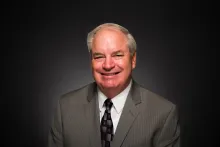
Robin Webber was born in Chicago, Illinois, in 1951, but has lived most of his life in California. He has been a part of the Church of God community since 1963. He attended Ambassador College in Pasadena from 1969-1973. He majored in theology and history.
Mr. Webber's interest remains in the study of history, socio-economics and literature. Over the years, he has offered his services to museums as a docent to share his enthusiasm and passions regarding these areas of expertise.
When time permits, he loves to go mountain biking on nearby ranch land and meet his wife as she hikes toward him.
