

Robin S Webber
This sermon was given at the Oceanside, California 2019 Feast site.
This transcript was generated by AI and may contain errors. It is provided to assist those who may not be able to listen to the message.
I told you I have a lot of fun during the feast because on this, the eighth day message, we go serious. Because indeed our calling is indeed a gift from God, but it is indeed a serious calling. It is the calling of a lifetime. It is the calling of eternity. And I'd like to share that with you today. I'll give you my title right up front so that you have no mistake as to where I'm going to be taking you for the next few minutes. The title of my message is simply this here on the eighth day, and it is this, the fellowship of eternity. The fellowship of eternity. But before we mention it again, I'd like to give you some introduction thoughts. I'd like to acquaint you with a gentleman who is well known in historical and psychological circles. His name is Victor Frankel. Victor Frankel was a concentration camp survivor who wrote a landmark work in 1946, just one year after World War II. And it's entitled, if you want to jot it down because it will be a theme of what we're moving towards, it was entitled, Man's Search for Meaning. Man's search for meaning. And perhaps that's why you began to heed the call of God and be a follower of Jesus Christ back in 1955, 1965, 1975, 1985. Do I hear 95, 2005, or just this year that you were being called by God? And you had a great question. What is this life about? Why was I born? And why do some of these things continue to happen and are occurring in this world today? Frankel wrote to this in 1946, especially after the experience that he had been through. Being a psychologist, he was studying his environment even as he was in the midst of it in a concentration camp. And he shared his first-hand observations on life and death, molded by his personal experience at the Auschwitz death camp. He considered why some captives survived while others died. He pondered why were there some that seemingly had good health, were intelligent, and seemingly had survival skills, but they didn't survive, while others seemingly lacking these attributes endured and they lived. He concluded, Frankel, that the single most significant factor for survival was a sense of a future vision. Those surviving had a conviction. There was a mission to perform. There was some important work— are you with me?—to do. Some important work yet to do. Frankel's analysis is crystallized by the godly admonition that we find in Proverbs 29 and verse 18. I think I first heard it about 56 years ago as a young teenager. God's words are still there, and I'll just say it out of the King James Version, Proverbs 29 and 18, where there is no vision.
The people perish. Where there is no vision, the people perish. A quote by Oliver Wendell Holmes, a 19th century Supreme Court justice, underlines this thought that is in the Bible, and it simply goes like this. What lies behind us, what lies behind us, and what lies before us are tiny matters. Are tiny matters compared to that which lies within us. And that is what I would speak to you today about what lies in us, what this eighth day is about, and to recognize and come to understand the tension, the tension that taught wire of the Spirit that lies between today and what we hoped for and what we heard about during this, the special music that we just heard.
With this said, what lies within us, allow me just to get it right out here for all of you, and you may be hearing the very first message that you ever heard in a Church of God service. But allow me to say this, what is that revelation and what does it begin with? Number one, very simple, like Dicing of a Pie, three ways. Number one, we believe in a living God. We, the people of God, believe in a living God. He is alive. It is one of the great themes of Scripture. He is not made out of wood. He's not made out of ivory. He's not even made out of a smartphone.
We worship the living God. You will find that message and that theme so and throughout the tapestry of the Scripture. We worship a living God. We find that from the words of the law through the words of Revelation. Number two, we believe in His Word. There is power. There is power and there is conviction when we read the Word of God. Number three, we believe that God is true, this sovereign and this loving God. Some peoples of old and antiquity have had gods that were sovereign, but they were not loving.
We worship a God that is both sovereign and loving, and we believe that He is in faith. We believe that He is true to His promises.
Today on this solemn eighth day, high day, we are here gathered together to hear the Word of God.
And my goal, as has been the goal of all these wonderful gentlemen that have had the opportunity to come up and speak to you in this brief time that we have together, that we will never have together again quite this way with this audience. As I hope that in the course of this message that we'll be able to do three things. Number one, that we will inform you about the Word of God. Number two, that we will inspire you about the Word of God. But, number three, to simply be informed and just simply to be inspired is not enough. We are here to be transformed. We are not just simply here on the eighth day to be stretched. We are here to be transformed. Do you realize that God has called you in this time and in this age and out of this world that we might be a new kind of human being? That we might be a new kind of man? That we might be a new kind of woman? And we are individually called. We are individually called by God the Father. He specializes in individual callings. But then He puts us into this community at large that is only known to Him. It's called the body of Christ.
The body of Christ. So we're not just simply called to be a new man, a new woman, a new creation in that sense. But we're called to be a new type of community. A new bonding that takes effect as a microcosm of what God is going to bring to this world, as we've heard with the millennium and on beyond that. Let's talk about this God that is calling us.
Isaiah 57.15. Join me if you would there for a moment. Let us open up the scripture together. Isaiah 57 in verse 15. Come with me if you would. In Isaiah 57.15, who is this loving and who is this sovereign God? In Isaiah 57 in verse 15, there is a description of Him.
It speaks of Him, for thus says the high and the lofty one, who inhabits eternity, whose name is holy. He not only exists, He's not only outside of time and space, He's not just simply sovereign, but He is loving, He is holy, and I dwell in the high and holy place. With Him, this is who He bids to be neighbor with Him, with Him who has a contrite and a humble spirit to revive the spirit of the humble and to revive the heart of the contrite ones.
So we find here that God is a God that inhabits eternity. Allow me to give you a brief definition of eternity, and we'll be building upon this a little bit later. The word here is a very, very small Hebrew word, but the word speaks to—here's the word—continuity. In other words, there is no beginning, there is no ending. We heard about that the other day from Mr. Kubik about the different kingdoms that we study in Western civilization. We go from the Chaldees to the Persians to the Greco-Macedonians to the Romans.
They come, they go. They rise, they plateau, they fall. A vacuum is created. A domino falls. Another one comes. This is a different kind of realm. This is a different kind of society. This is a different kind of age. This will be forever. And forever already exists because God does inhabit eternity, but the good news that we have today is He wants to bid us welcome and invite us.
But there are some scenarios along the way that I want to share with you today. Number two, let's go to Ecclesiastes 3 and verse 11 as we discuss eternity. Ecclesiastes 3, the book of wisdom, and it's right after all the—there's a time to sow and there's a time to reap. And for we that are baby boomers, remember the folk rock group the birds used to sing this back in the 60s.
But in the book of Ecclesiastes 3 and verse 11, let's take a look here because it's important. It says, He, that speaking of God, has made everything beautiful in His time. And He has noticed, speaking of those that are made in His image and His likeness, it says that He has noticed put eternity in their hearts except that no one can find out the work that God does from the beginning to the end. It's a fascinating Scripture. It says that He places the Spirit of eternity in the heart of a human being. But what I'm here to share with you today, dear friends, is simply this.
What we experience today is not the world that God prepared for us. The world that we are going to go out on the freeways of Southern California or jet home to is not the world that God intended for those that are made after His image and His likeness.
I dare say today, please hear me, I will not apologize, this world is not home. This is not home. This is not where the Father has nestled. He prepared a home for man. I can say, well, this world is not our home. And we've heard how He has a better world for us. We've heard that during the feast. We've heard that today on the eighth day. And we can say, well, that's kind of a religious cult, and they're kind of fanatical, and they've got fantasies about a better world.
Sounds like an escapist kind of group of people. But I'm here to tell you that we are not the escapist. Our father Eve and our mother Eve were the escape artists. They made choices from the very beginning that the rest of us have had to deal with, and in our own way, with our own contributions since the Garden of Eden. Sometimes people will say, well, you know, and we've all done this as we get older.
And that's simply this. Well, it sure isn't like it used to be. Sure wasn't like it when I was a kid. You know Solomon was saying that 3,000 years ago about his children. Sure isn't like it used to be. Look at the kids I'm leaving this to. Look at the world. But brethren, the world has been dysfunctional since Eden.
When you reject your parent, you've got problems. A God that wanted to be worshiped, wanted to have a relationship, wanted to be their God, and for Adam and Eve to be his family, to walk and to talk amongst them. It wasn't God that created the fantasy. God created paradise, and they rejected it. They wanted to escape. They wanted to be the big God when they were the little gods with a small g and replace the throne of God in their hearts.
Brethren, we are here to reverse that cycle based upon the grace of God, based upon the Spirit of God, based upon the Word of God, so that you and I can enter into reality in that eighth-day experience. Let me share for a moment, and Mr. Martin touched on this for a moment, about the powerful meaning of the eighth day.
We do call it the eighth day in the United Church of God. Why do we call it the eighth day? Why do we assemble today? What is our focus? Where is our attention? It is to stir our hearts to the fulfillment of God's purpose as to why a sovereign and loving God created man. This festival's name does not come without reason. One of the first things I learned as a young person attending a Church of God ceremony is God names things for what they are.
There is a purpose for names. So, why do we call this the eighth day? You might just want to jot this down. I'm not going to go through a lot of scriptures. God specifically names things for what they are for a purpose. He mentions the eighth day. When you think about the mention of the eighth day in Scripture, it is a day that personifies and signifies a consecration, a setting apart. Something as holy is happening. When you go through the Scriptures, you'll find that it is when things were committed to God by a covenant people. It might be circumcision. Circumcision occurs when? On the eighth day. The dedication of the tabernacle, even the dedication of the temple, the millennial temple in the book of Ezekiel, occurs on the eighth day.
The dedication of the priesthood would occur on the eighth day. The dedication of the firstborn, both of animals and grain, were on the eighth day. So the eighth day points to something that God is yet to bring in fullness. It points to a realm. It points to a realm. I didn't say it points to a time because we're dealing with eternity, but it points to a realm. When a community of the immortal children of God exists in an environment in which only holiness abounds.
Only that, hear me please, I make no mistake as I preach to you and teach you, make no mistake only holiness will abound in the eighth day. In its ultimate conclusion, only holiness will abound. That which is sacred, that which is committed to God will be present to experience eternity. Fred Clark the other day spoke on the overlay of the holy days on Genesis 1.
And you notice how he said as God developed and developed, he said, good, and then he said very good. But then it wasn't until he began to deal with the Sabbath that he said it became holy. He put his presence in it. What we need to recognize, brethren, is that the great theme of Scripture, the great theme of Scripture is simply this.
It is tight, it is sown through and through from the book of Leviticus to 1 Peter. Be you holy. Not just good, not just very good, but you be holy as I am holy. Just jot these verses down, please. Leviticus 11 verse 45.
1 Peter 1, 15.
The word there is hagios in the Greek in 1 Peter. That means that which is separated by God for divine purpose. And I've already mentioned the purpose that we're being separated for, to be the immortal children of God, to exist in eternity with God the Father and Jesus Christ.
That's where we're headed. That is the vision. Having that locked in our minds is the answer to what Victor Frankel was trying to determine almost 70 years ago. But my concern as a fellow Christian and as a brother to each and every one of you, as also a pastor, is to recognize that sometimes that unfortunately even humanly even the covenant people of God, even the covenant people of God that have been called to serve the living God, can travel through life like the living dead. And not be aware. Not be aware how they can live in the light of eternity now, the light of eternity, and spiritually fully live in the present beyond the moment, leaving our past behind.
Having a presence that will glorify God and be a blessing to other people in this world that is cluttered with time and space. So again, what is the message about? It's entitled, The Fellowship of Eternity. And my goal in all of this, dear friends, is simply this.
It's to share with you my thoughts. Hopefully they're godly thoughts. Hopefully they're out of the Scripture. But I've come to understand that over the years in my experience in the church that eternity is not a destination. It's a way of traveling. And they hear it now.
Eternity is not just in the future because God has placed the Spirit in us. Unforgedly humankind knows there's a gnaw. There's a scratch down deep inside.
And they try to get to it. They try to scratch that itch. But they do it in all the wrong ways. And they go down all the wrong rabbit holes. They want what God desires for them, but they don't do it the godly way. And we have not been called to be the walking dead. We have not been called to be so close and yet so far. We have been called to experience God. We've been called to experience that kingdom of God now. And not just simply to project it on the future. And so often what happens is people, because they're waiting and projecting and projecting and projecting and projecting and projecting as if it's something out there, is to recognize that we're to begin to experience it now in type. And I think what happens sometimes is people don't fully understand what eternity is. I'd like you to turn with me to John 17 to get a working definition. It's one that I've come to center on and focus on over these last couple of decades. I used to get up on an eighth-day message, and I would explain eternity. I would use mathematics. I'd kind of blow out people's minds. I'd stretch them with a rubber band and to where you couldn't stretch. I was dealing with mathematics, dealing with eternity. That's not really a good combination. And then I came to recognize God began to, in my mind, to recognize that I was looking for love in all the wrong places, just like the old country song. I came to understand through reading the Word of God and lodging on it what eternity is.
It's not just a destination, but it's a way of traveling. And it's not what, but who you are traveling with in our present time. Notice if you would in John 17, the Gospel thereof. John 17, some of Jesus' last revelation to His disciples on that night that He was betrayed.
And Jesus, in verse 1, spoke these words and lifted up His eyes to heaven and said, Father, the hour has come, glorify Your Son, that Your Son also may glorify You, as You have been given authority over all flesh, that He should give eternal life to as many as You have given Him. Now, verse 3, definition, the one that I hold on to dearly. And this is eternal life, that they may know You, the only true God and Jesus Christ, whom You have sent. In this verse, I came to understand, began to internalize, and began to embrace that eternity is not just merely the lack of time and space. It is not just a destination, but it's a relationship. That is what God has called us to. We've heard that during this piece. It is a relationship. It is a relationship that, I'm going to use the word here, of intimacy. Of intimacy. The very words that are mentioned here speak to that. There's two words in the Bible.
In Hebrew, in the Old Testament, the word yada speaks to intimacy. It says that Adam knew Eve.
Now, we have a family audience here. I'm not going to go too far with that.
But to recognize what we're talking about is an intimacy of two becoming one. Of two becoming one. That is intimate. That is personal. That is an incredible relationship that God designed in marriage. When we come to the Greek, in the New Testament, the word there is ganosko. Ganosko. And the word ganosko, it's very foundational. It indicates a close, a warm, and even a passionate, passionate intimacy combined with head knowledge producing an edge in one's life. It's out of Vine's commentary. Producing an edge, an intimacy. You see, the scripture as a todo is the story of the Exodus. It's the story of the deliverer God calling a people that were not a people out of bondage. He called Israel of old and said, you're going to be a kingdom of priests. Even while you're in slavery, I'm going to take you across river to a promised land. And every generation since then of covenant people have always thought that they are on the edge of God's promises. That today is the day. And God would say to Israel, as he says to the Israel of God today, that are you and myself. He says, I will be your God. You will be my people. You will be my people. You will have a relationship with the Creator. And not only the Creator, but the deliverer. Have you ever noticed in the first commandment of the Bible it says, what does it say in Exodus 20? That you will worship only the God. I am the Lord your God, which brought you out of what? The land of? Oh, that's not really good. I've been working with you for eight days. I am the Lord your God, which brought you out of the land of? Oh, we're back in Oceanside. Okay, I thought it was east of the Mississippi. Okay. He revealed Himself. He revealed Himself as the deliverer, a people that were not a people. And then He inspired Moses to give them a family scrapbook.
He says, this is the God that called you out, the God that was in the beginning. He is not only the deliverer God, He is the creator God. He is the God that was before all of the gods of Egypt. Have you ever noticed that? All the creepy crawly things that are in Genesis 1?
He said, this is the God. He created what man is worshiping. You have been called into relationship with the God of creation. And He's creating a family. He wants to be intimate. He wants to be personal. He wants to be your God. He wants you to be His people. The great theme of Scripture. Join me if you would. Let's wander down to Scripture here to John 17 and verse 20 about Christ's prayer. Jesus speaking, I do not pray for these alone, but also for those who will believe in Me through their word. That's talking about, guess who? You and me. Even on that night in the service of the bread and the wine, our Savior was thinking about you and me today, thinking about those that were coming along. And what does He say? That they all may be one as you, Father, are in Me and I in you, and that they also may be one in us, that the world may believe that you sent Me. You talk about all tied up in relationship. I would say that's pretty tight.
I'd like to introduce the thought here for a moment of fellowship, so stay with me. Sometimes in the Church of God community, we think that God has given us the 11th commandment. You know what that is? Thou shalt fellowship, because God's people are warm and friendly. You never want God's people to go too far into the coffee room, because if there's an emergency, it's going to be really hard to pull them out because they're fellowshiping. That's good, and that's beautiful. But God has called us to a much richer fellowship, and it revolves around a word that I'm going to spell for you, and it's simply this. K-O-I-O-N-I-A. I'm going to dare to pronounce it, Kona-ne-ah. That's the fellowship that God has called us to. It's having things in common. It's having a partnership. It's having a fellowship, and God is calling us to experience them, not just the kingdom of God. The kingdom of God is going to be a realm even beyond the millennium. That is a realm, and that is going to be a byproduct. But what God wants us to have—are you with me, friends? He wants us to have that relationship bonded. He wants us to experience Him throughout eternity. Are you with me? Eternity. And He wants to experience us, what we bring to the family, our personality, our smile, our heart, that will by then not just be very good, not just very good, but holy. That is what it's about.
We've often said that a picture is worth a thousand words. We saw that, especially with Mr. Moody's presentation on Gona. And we can picture the kingdom. We can picture laws. We can picture territory. We can picture subjects. But the great picture and the focus of the kingdom that God, our Father, has given to us to hold onto is Messiah, is our Lord, is the King of Kings, that Jesus Christ came to this earth as God in the flesh, Emmanuel, with us, that we might have a sure picture of what the kingdom is about. Could you imagine having a kingdom without a king? All of the effects that Mr. Moody mentioned the other day are impossible, totally impossible, unless we focus on the great centerpiece of the saving work of God the Father, which is Jesus Christ, the King, the relationship, and what it's about. Now, I've got to tell you something, friends, right now, and some of the kids that are listening, because you hear about all this kingdom talking for seven days. I want to tell you something, kids. Listen up, as we say in the Marine Corps. It is going to be so neat. It is going to be so cool. It is going to be so wonderful. But here's the difficulty. We just don't have the equipment right now to experience it. We don't have the equipment in full to experience what God is calling us to, to His glory. We get tidbits. We get appetizers. We get what we can handle right now in the human sphere. But when we are a bit welcome into eternity, you know what I'm going to guarantee we're going to have the equipment. We're going to talk about that in a few minutes. So let's talk about this. How do we go from today and into the future? I'd like you to go to Colossians 2. Join me, if you would, in Colossians 2. In Colossians 2, let's pick up the thought in verse 9. Colossians 2 and verse 9. And let's rewind for a moment and go back to what Mr. Kubik was talking about the other day in his message, about the stone that is made without hands. Do we all remember that? We were all awake during that time, even though the lights were out.
He spoke, the dream of Daniel was that a stone came from above, a stone that was made without hands. And it smashed the image of the beast. And we read about that. We might have discussed that on the Feast of Trumpets, the intervention of Jesus Christ. You see, that's great! That's wonderful! The kingdoms of this world are coming down. But did you realize that that sovereign God and His centerpiece, Jesus Christ, that stone that is made without hands, that stone that was disallowed by man later on, that stone that then was allowed by God and now sits at His right hand, also has a work in you. Sometimes it's really neat that Christ is going to work on all the kingdoms and He's going to be the stone to smash Him. But that's why I want to take you to Colossians 2, and let's notice verse 11. In Him you were also circumcised, notice, with a circumcision made without hands by putting off the body of the sins of the flesh by the circumcision of Jesus Christ.
See, it's one thing, if you're with me, to have information about what God is going to do the kingdoms of this world. And we say, go get Him, God. But God does not only have business with the kingdoms of this world, He also has a work that He's working in each and every one of us, that our kingdom will become completely surrendered, completely surrendered to His active living and loving will in us. Let's just talk a little bit about, as Mr. Helge did the other day. Hello, Ralph. Just a little broad, remembering how we were baptized. John 644 tells us that Jesus speaking because He and the Father are seamless, as Mr. Love brought out. He says, no man can come unto Me unless first the Father draw Him. You know, when God says something once, it's kind of important, but He says it's twice. He might also jot down John 6 and verse 65, the same thought. And so we are called by God the Father. And seemingly in the Scripture, it is a prerogative that He holds to Himself. He is the great sire of the universe. He is the one that selects His children in time and what time and for what purposes that He alone may know. But also, when you go to Colossians 3, and you may still be there, go to Colossians 3 and verse 12, notice what He speaks of about these children. He says, therefore, as the elect of God, we've been elected by God. We are holy. We are beloved. We're special. We are the apple of God's eye. We are the apple of God's eye. Those that are elected, selected, chosen, and are beloved in this time and age are the firstfruits of God. Now, God is—excuse me—Christ is the first fruit. But then, like our elder brother, we become those firstfruits, those that are offered up to God.
As a living offering on a daily basis. How incredible is that? But even with that spoken, even as that's spoken, even with the high calling that you and I are given, just like ancient Israel, covenant people sometimes suffer from the same spiritual diseases, that too often we can be guilty of playing at Christianity when God has called us to be elected, to be chosen, to be beloved. And again, brethren, I'm here to tell you as one pilgrim to another, this world is not home.
Home is yet to be, and our homing device needs to be on eternity. We have to have and draw the same lines as God does and make sure that our goal post is here. You see, this world is not home. And it kind of reminds me of the story. I wasn't going to bring it up. It just came. The story of this man that was visiting this rabbi, it was over in Europe, and this American tourist had gone over to visit this rabbi, and he finally knocked on the door, went up two or three stories in an old, old, old house, and kind of knocked on the door, and somebody opened it up. And it was an American tourist. He wanted to visit this world-famous rabbi, and the rabbi said, come in, my son. And so the gentleman put down his suitcase for a moment, and looking around, he said, kind of slim digging his hair. There was not much furniture. There was a cot on the floor, and there was one chair, and there was a table. And the American tourist looked at the rabbi, and he said, sir, excuse me, but where is everything in your house? And the rabbi looked back at him and says, I'm just like you. I'm just passing through. I'm just passing through. And sometimes, brethren, even members of the body of Christ, put up too much furniture of this world, become too permanent, rather than recognizing that we are pilgrims. We are God's pilgrims. We're not just the pilgrims that have the funny muskets and the buckles on their shoes and the gray and the black clothing that we celebrate at Thanksgiving. We are a pilgrim people. We are the people that have been called out of the slavery of sin. We are the people that have been given a greater promise than ancient Israel. Ancient Israel was promised that they could cross river, and they would land into a land of milk and honey. But today, brethren, I'm here to remind you that the one that has led us out of slavery is that greater Moses, is that second Moses. And the Exodus story continues, and we continue to move towards that, that which is the ultimate promised land in which we will abide forever, face to face, with God the Father and with Jesus Christ. They will embrace us.
We will internalize them even more, and we will have nothing, nothing at all, separate us from them. But it just doesn't happen. I have a question for you. I'd like to take out a piece of paper. I'm going to give you a test right now. Go ahead, take out a piece of paper. I know you are a cooperative group. Go ahead, take a test. I was a teacher for 16 years, so I'm used to giving tests. Don't get too nervous. You know I like to have fun.
We are about to take the duck test. You know what the duck test is?
There you go. I didn't say the duck test. The duck test is where you put tape on your mouth and see if you can talk still. No, we're not doing that one. We're going to take the duck test.
The duck test is like this. If it looks like a duck, if it swims like a duck, it quacks like a duck. And if it quacks like a duck, well then it is probably a duck. The test implies that a person can identify an unknown subject by observing the subject's habitual characteristics.
Now, my question with that foundation. What does God see from above? What do people see below? And how do you see yourselves? And I'm not talking about being a duck. I'm talking about you being elected, you being chosen, you being beloved, you having the faith of Jesus in you, the faith towards God Almighty, and a keeper of the commandments. When people see you, your spouse, your children, your grandchildren, your neighbor, your coworker at work, your fellow student, what do they see? What do they see? I hope they don't see a duck. For me, they say they see a robin. That's bad enough. What do they see? Do they see a Jesus follower? Do they see a Christ-like individual? Do they see a light in an ever-shrinking, ever-darker world? Do they see something? What does Jesus see at the right hand of God? He says there will be people that will come to me in the future and say, Lord, Lord, and they'll have to say, no, no, no, excuse me, I never knew you.
You see, when Christ comes back through the clouds and comes to this earth, He's going to be looking, and He will know the people that look like Him, not only in the outside, but the inside. And yes, we will fall. Yes, we will stumble. Yes, we are in this world of time and space. Yes, we still have to wrestle with ourselves just as much as the Apostle Paul did, but He will know that we are leaning forward. We are leaning towards the Father. We are pressing on that door. We're not running the other way. And even as we run towards God the Father, even as we run towards Jesus Christ, yes, we will stumble. But He will be there to pick us up.
I'd like to have you join me in 1 Corinthians 4, verse 9. 1 Corinthians 1, verse 4.
I thank my God always concerning you for the grace of God which was given to you by Christ Jesus, that you were enriched in every thing by Him in utterance and all knowledge. Even the testimony of Christ was confirmed in you so that you come short in no gift, eagerly waiting for the revelation of our Lord Jesus Christ, who will also confirm you to the end that you may be blameless in the day of our Lord Jesus Christ. God is faithful by whom you were called into the fellowship into the koneah of His Son, Jesus Christ our Lord. We were called into that fellowship. Christ was to be our partner. The same Christ that said, I am the way, I am the truth, I am the life. That Christ that bid you welcome how many years ago and you followed. Whatever happens this year, dear friends and your family, you always remember that the first thing that Jesus ever tells a disciple, just like Peter, is to follow me. You hold that near, you hold that dear. He will always ask you to follow me. And God the Father has given us the Christ to follow. And then always remember, no matter what happens later on in life, when you think He's ditched you, you ever had that feeling? When you think that you're all alone, you will remember that He will appear not in your time, but His time. And He will again ask you one thing. It's very simple. I'm glad it's not a long sentence. He'll say, follow me. That is the first thing. That is the last thing. That is the always thing that Jesus will say. He will never ever abandon us as that good shepherd. Are you with me? And are you ready to remember that for the rest of this year, for the rest of your life? We're not here to just have fun and games, brethren. I had a lot of fun with you during the announcements. Our calling is serious. Our calling is everything. Our calling is about eternity. Our calling is about imbibing and experiencing and relating with God the Father and Jesus Christ forever and ever and ever. This is serious business. It's not for sissies.
It's not for the sunshine patriots, as Thomas Paine would have written in common sense. It's for people that realize that we just simply can't do it alone. We don't have the equipment. So God gives us the equipment of His Spirit. Philippians 2 and verse 1, join me if you would there, for one again, another aspect of fellowship. Philippians 2. In Philippians 2, and let's notice verse 1, let's go here to verse 1. Therefore, if there is any consolation in Christ, any comfort of love, if any notice, the fellowship, the intimacy, the relationship of the Spirit, if any affection or mercy, fulfill my joy.
The fellowship of the Spirit, to follow Him, He who is the way, the truth, the life, and to recognize that the things that are going to come our way are to help us grow towards eternity. You know, it's very interesting with the Apostle Paul. He was always imbibing of the fellowship of the Spirit. In fact, Philippians is a prison epistle. You talk about being caught in time and space and being squeezed. He ever felt squeezed in life, health, economics, marriage, whatever it might be. Paul was squeezed. But you know, it is amazing. I want to share something. It's amazing that Paul never, even when he is in prison again and again, put in there by the Romans, he never said that he...are you with me? He never said that he was a prisoner of Rome. Never!
Because he was chosen. He was elected. He was a beloved. He always said, I am a prisoner of the Lord. I am a prisoner of Jesus Christ. He recognized that once God had touched him, that God would not let go. And that in his way, for one reason or another, Paul being Paul, who's kind of a human volcano, God had to work with him with those unseen hands to mold and to shape him. Not just to preach and to teach to others, but to mold and to shape him. That he might be a more effective communicator of the Gospel, of the good news of Jesus Christ and the kingdom of God. That same spirit has come upon us. We have been invited into that kingdom experience when we took out the four ladies. Raise your hands, please, if you're still here. One, two, three, four. Did I baptize five people? No, I thought it was four. Keep waving. That's good. When we baptize these individuals, we take them out. And let's remember what we were called into. We go out and we say what? We say, and your name is. And then we say, have you repented of all of your sins?
They say, yes. And then we say, and have you accepted Jesus Christ as your Lord and as your master? And they say, yes. And then we say, because you have accepted, because you have repented of all of your sins, which is the breaking of God's holy and righteous law, and because you have accepted Jesus Christ as your Lord and as your master, I therefore, as a servant of that Christ, am going to baptize you not into any church, sect, creed, or denomination of this world. But I'm going to baptize you in the name of the Father and of the Son and of the Holy Spirit.
Then we'll say, do you understand that? And they say, yes. And we say, amen. And then they go down figuratively in death. And they rise up figuratively in the type of resurrection. And then, as we heard this morning, they have the laying on of hands. But that's just the beginning. And remember your beginning. I remember my beginning. Let's talk about that for a moment. But that was only the inauguration of the kingdom experience in you at that time. It was just a beachhead. It was just the beginning. It was not the end, like a commencement. It is the inauguration.
My father, Jack Weber, some of you knew him. My father died about five weeks ago. 98 years old. Minus, 98 years old, minus one month. And it was a good death. And it was a blessed death. And my wife and I were so blessed at the end. I could spend hours just telling you all the blessings we had, spending those last days with my dad in our living room and honoring our father, and honoring a marine, and honoring a veteran. My father, in 1942, so much like your father's, was pulled out of life after a depression. And he was in the Marines, and he made three beach landings. You'll recognize some of the names. Invaded three islands in the South Pacific down to the Solomons. There's Guadalcanal. That was not a picnic. There was, there was Palaloo. You read about that. That was not a picnic. And then there was Bougainville on Cape Breton. Three landings, along with so many others. The Navy said that they cleared it out. They'd bombed the island. Everything would be all right. That's why the Marines in the Navy always have a little laughter, kind of a laughter between them, because the island was not always bombed out real well, because those islands were coral. So the bombs would just kind of ricochet off the coral. So you'd have 4,000 Marines landing at once, and then you'd see 6,000 of the other side coming at you. Not too exciting.
But a beachhead was established, just like some of your fathers were over at Omaha or Utah, over at Normandy. But the beachhead is just the beginning. And for you that were just baptized yesterday, or for we that are continuing to develop of all of our baptism, I have a question for you as you go home. Yes, the Kingdom of God in part has come upon us. And yes, God has established His beachhead in your heart. But here's my question to you, and I speak to you and to you and to me.
What unconquered territory do we yet have in our life that we have not allowed the pervasive, loving, guiding, dynamic force of the Holy Spirit to help us to surrender to God?
God does not want a part of us. He does not want a third. He does not want a half. He wants the whole thing. You say, well, why is that? That sounds pretty selfish. I'll tell you why, because God Almighty sent His Son, and He gave His whole life, His whole life, and nothing but His life. He who was uncreated, He who is the Word, He who is our Savior, He who is our High Priest, He who is the Lamb of God, whole for whole, part for part, existence for existence.
That as the Apostle said, it is no longer me, but it is Jesus Christ that dwells in me. Brethren, if the body of Christ is to be not only the representation of the kingdom of God, but the reflection individually and as a whole, this is where we need to be as people, as active Christians. One thing I'd like to share with you is Philippians 3.10, and we're going to wind up here in a moment.
Once I get going, I've got to turn my battery down. I'm sorry. Philippians 3, verse 10, it speaks that I might know Him, speaking of Christ, Paul speaking, and the power of His resurrection and the fellowship of His sufferings being conformed to His death. A part of the fellowship of eternity is that we must walk through the door of the fellowship of suffering. That is the spiritual equilibrium of the Scriptures. The great equalizer that frames our calling by our Heavenly Father is that through and by Jesus Christ is simply this. Are you ready? Before we bear a crown, we must bear a cross.
Before Jesus Christ places that spiritual laurel wreath of victory on our heads, we must also bear a cross. Not His cross, not His cross, not the instrument of His death. That is special in that sense. For the one that was on it was special. But all followers must, in that sense, come to this fellowship of suffering. It says in Hebrews 5 and verse 8 that Jesus learned obedience by the suffering that He endured. He very openly said this, dear friends, He said, if they have done it unto Me, they will do it unto you. You say, oh, He's talking about the guy in front of me because I've been watching him. He really needs it. No, He's talking about all of us. Nobody escapes this. Before we bear a crown, we must bear a cross. And it is not something strange. It is a part of that circumcision of our hearts. It's a part of that circumcision of our hearts. But the fellowship of the Spirit is a beautiful thing, and I want to share it with you. Join me if you would in Hebrews. In the book of Hebrews, you know, so often, the time when we're young, we hear about the aspect, or we read and we learn the 23rd Psalm. The Lord is my shepherd. I shall not want. In other words, who could want another? This is what God has supplied.
And why is that? I want to refresh you from the very beginning of my message. I mentioned that we worship the living God. And we also worship the living Christ. It's very interesting. Sometimes people will become enamored with the book of Revelation and try to work it and move it around just like a jigsaw puzzle to make sure that God is doing things just like they think. But one of the great threads that goes through the book of Revelation, maybe you've never noticed that, maybe you're new to the Word and just opening it up, is that in the book of Revelation, the word lamb is used 28 times. We just heard that in the song. 28 times the term the Lamb of God is mentioned in the book of Revelation. He is not only the Lamb of God. He is not only the sacrifice that is in our stead, but He is also our High Priest. The message of the Day of Atonement is not only that Jesus the Christ is now ascendant and is at the right hand of God for you and me. He is going to be there for all humanity one day, one time. The activity that we read in Leviticus 16 where the priest goes in and out, in and out, and washes and washes and washes in and out, and sacrifices in and out, you know, it just shows the activity that our Savior and our High Priest is doing in heaven right now for you and me. Join me if you would in chapter 4 verse 14. Seeing then that we have a great High Priest who has passed through the heavens, Jesus the Son of God, let us hold fast our confession. Hold fast! Not to a dead corpse, not just to a lamb that is furry, but to the Lamb of God. Not just died, not just resurrected, but is now ascendant and is in the presence of God at His right hand. He is not only our quiet Savior, He is our active, dynamic advocate, our intercessor, He is our older brother, He is our High Priest.
Are you with me? He never stops on your behalf. And when we pray to Him and say, Father, you know, after all these years, I stumbled again, and please forgive me of my sin, He doesn't say just like that. He doesn't defend our sin. We sin, we sin. But He says, Father, this is your child. This is my little brother. This is my little sister.
And remember that moment on the altar of Golgotha, when my blood flowed, and they believe in that blood. They believe that you sent me. You are the living God. And now I am the living Lamb of God, and I'm at your right hand. And you said, Father, that you would never leave them nor forsake them.
And I believe that with all my heart. I've had opportunity over the years, and I'm going to share something even though the daughters are here. Years ago, I came down from camp. I had to visit a lady. She was dying.
I visited more than one dying person over 45 years.
And this woman was very special, just a very quiet supporter, lovely lady. And from the Central Valley, I'll just say she was an Okie. Now I can say that because I pastor Okies. There you go. Even though I'm a Yankee. I love them. They are rich. They are wonderful people. They are the salt of the earth. And I found out that this woman had congestive heart failure.
And what you do, you don't normally say a prayer at the door. You count to three, and you walk in, and you hope that God will give you the wisdom to speak to a person that's about to die. I was informed that it was going to get tough for her. There was going to be a rough little avenue for a while. She wasn't going to be able to breathe. And if you've never been able to breathe, that's really scary. Not be able to catch your breath or even to expand your lungs up and down.
Walked over, looked down.
We began a conversation. It was short.
And when you become a participant in the fellowship of suffering along with our brethren, you come to realize that all of your wise answers melt in the sun.
You recognize that somebody is going to die.
And I remember just talking to her. I said, I'm not going to be going through what you're going through. And I know it's going to be downright scary.
There's going to be just a couple of minutes, just a couple of minutes, and you've just got to hold on. Because on the other side, there is going to be glory. On the other side is a world that is so incredible that our Savior died for you and for me. You don't want to sugarcoat this stuff, do you? We live in a world of time and space. But we've got to cling to those promises. As it says in Philippians 3, 12, you can look at it later, it says, to hold on to those things that Christ has asked us to hold on to. And the most important thing that we find here in verse 14, seeing then that we have a great high priest who has passed through the heavens, Jesus, the Son of God, let us hold fast our confession. What is the confession of those that are down through the ages as the covenant people of God under the new covenant? It's spelled out in Philippians 2, in verse 12. Jesus Christ is Lord. That is what we are to hold on to. He is Jesus. He is salvation.
Christ, He is Messiah. He is anointed. And He is the Lord of our life. We that are here as the body of Christ, have in a sense moved through and typed that feast of trumpet's experience where we have unconditionally surrendered our hearts to God the Father through Jesus Christ. We've said, it's yours, Father.
This is now your territory. My life is your life. You live in me. But that's just the start. And we still are able to go before this high priest who cannot sympathize with our weakness, but was in all points tempted as us.
That concludes 2 Corinthians 4. I'm just going to take you a moment over. I'm sorry. 2 Corinthians 4.
1 Corinthians 4.
And verse 16.
Please hear me. These will be the last words in any message that you'll hear, other than the song that's going to follow. And I want to share this with you, brethren, as one that is on the pilgrimage with you. But we are not alone. We read to know that we are not alone.
And I do not know what God has in store for Susie and me tonight, tomorrow, this coming year. Neither do I know what God has in store for you, other than you are called, you are chosen, you are elected, you are special, and God wants to have a relationship with you in eternity.
So He asks us to teach us to number our days, as the psalmist says, and it is very possible for Christians to lose heart, even though our inward man is perishing, yet the inward man is being renewed day by day. For our light affliction, which is but for a moment, is but for a moment, just like Olita Graham in Delano, California.
That's light? Are you kidding me? She couldn't breathe. But in comparison to the glory that God has in store for Olita and for you and for me, it is but for a moment.
It is working for us a far more exceeding and eternal weight of glory. And while we do not look at the things which are seen, but at the things which are not seen, for the things which are seen are temporary, but the things which are notice not seen are eternal.
To conclude with, I spared you three pages of notes.
To conclude with, I will leave you with this. Stay with me. Have you ever been at an airport? And or have you ever been at a bus depot? Or have you ever been at a train station?
You're looking at your clock and you're waiting. You're looking at your clock and you're waiting.
And you throw out a phrase, well, when's that jet coming? When is that train coming? When is that bus coming? But is that what you're really waiting for?
Are you waiting for the jet to arrive? Are you waiting for the plane to arrive, the bus to arrive, the train to arrive, etc.? Is that fulfilling? Are we just simply waiting quote-unquote for a kingdom existence to arrive, a kingdom something that we can somehow wrap our arms around and and say the kingdom? Or when that jet arrives, when that bus arrives, when that train arrives, are you waiting for somebody to step off that jet?
Are you waiting for somebody to step off that train?
You're waiting for somebody to come out the door. It's kind of really neat sometimes when you see families that are waiting. And they all start going like this. You know that they see somebody that they love. What are you waiting for when it comes to the kingdom of fact? And there are so many effects of the millennium and of eternity. But what is the most important thing that we are looking for? We're looking for somebody to arrive. We're waiting to see Jesus Christ. We're waiting to see our Father.
We're waiting to see our loved ones, aren't we? God the Father and Jesus Christ. We're waiting for them to step out of eternity, to work with all of humanity as we heard this morning, and to say, we bid you welcome. Thou good and thou faithful servant, enter, enter into the joy of the Lord.
Enter into that world of Revelation 21, 22, in which there will be no more night.
There will be no more pain. There will be no more sorrow.
There will be no light other than the light of the Lamb. There will be no temple because God's presence, their personage, that unapproachable light that Paul speaks about in Timothy, will vanish. And we will behold the manner of love that God has for each and every one of us. And God promises that we shall see Him as He is. Are you ready for that? Are you preparing for that? Will you join me in the fellowship of the Spirit and prepare this coming year, tonight, tomorrow, next week, next month, all that time to be worked with by our hearts, by the hands that are unseen, that ultimately we will not just simply be good, we will not just simply be very good, but because we have not manifested our righteousness to God, but have imbibed and implored the righteousness of Jesus Christ that stands at the right hand of God now, that we will enter into eternity. And indeed, you and I will have the incredible privilege, dear friends and fellow believers, to be able to see that holy city, the New Jerusalem, come down from heaven. We that have practiced citizenship now in this world of time and space, to enter eternity. You don't want to miss it. You want to be there. You want to sacrifice. There should be nothing that you should not, not at all, surrender to God the Father and Jesus Christ. For at the end of the day, the good news, the gospel of Jesus Christ and the kingdom of God has been the greatest gift that this boy from Newport Beach has ever received. A little girl that grew up in the Midwest in the farm fields of Ohio, my wife, received. You that might have grown up in Gotham back in New York, Brooklyn, Staten Island, Queens, Manhattan, have ever received. You that have grown up in the Great Lakes, on the shores of the Great Lakes in Toronto, have ever received. Let us continue to hold dear, to hold fast, to hold on. Whatever comes our way, you hold on. You hold dear, and you hold on to God the Father's dear son, Jesus Christ. He's got a big, big arm, a big, big hand, and it will always be there to guide you, as you heed His call to follow me into eternity.
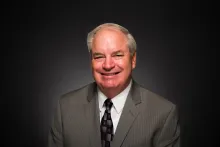
Robin Webber was born in Chicago, Illinois, in 1951, but has lived most of his life in California. He has been a part of the Church of God community since 1963. He attended Ambassador College in Pasadena from 1969-1973. He majored in theology and history.
Mr. Webber's interest remains in the study of history, socio-economics and literature. Over the years, he has offered his services to museums as a docent to share his enthusiasm and passions regarding these areas of expertise.
When time permits, he loves to go mountain biking on nearby ranch land and meet his wife as she hikes toward him.
