
Randy Urwiller
This sermon was given at the Oceanside, California 2014 Feast site.
This transcript was generated by AI and may contain errors. It is provided to assist those who may not be able to listen to the message.
For those of you that may be taking notes tonight, don't take notes. Because I've got all the notes for you when you leave. Okay? I'm an old-school teacher. Now, you might want to jot down a few things at the time, but I'll have the notes. I'll have the good stuff for you at the end, okay? And the ushers will pass that out. I had the opportunity for how many years was it in Pasadena? Have you ever tried to teach 14-year-old boys anything, much less the Bible? I had that opportunity for about 10 or 12, 15 years, in Pasadena. Remember when you were a young person and you'd be passing notes for your girlfriend in school, or pulling the pigtails, or this or that, and you didn't think the teacher saw you? Teachers see everything. Even in a church school, like Imperial schools. You know, it's really interesting, and it's a highlight. Sometimes I remember, years and years ago, some of those young people, they were 14, 15, 16 at the time, I said, Please remember this. Sometimes, somewhere in the future, we will be meeting again. We will be seeing you at a feast of tabernacles, somewhere across this nation. And that is such a joy, and sometimes you see somebody, sometimes they've remained in the way, and or sometimes it's the return. And to be able to see somebody like that just makes you so happy to see them. And it makes you realize that what you said to them 20, 22, 24 years ago came to pass. This evening, I have a subject for you, and this is going to be a work of faith, because I'm not going by a clock for you, not me. And that we'll try to conclude this on time. In fact, if somebody has a clock, maybe I should have one. Somebody have a watch here? Take a watch. It is one? Oh, thank you. Okay. We better do this first. Faith Without Works is dead. Okay, so let's do this. We're going to cut this three-hour message down to 40 minutes, just for you.
Does somebody have a hand watch? I don't know. There you go. There you go. Howard, I'm fine. I'll go better by a hand watch. I'll go better by a hand watch. Thank you. Oh, I've got a hand watch, too. Oh, I like this one. Okay. Okay. Just ask, Roy. I do have, in all seriousness, I do have a message for you this evening, and I think it will certainly tie in with this, the Feast of Tabernacles.
And the title of the message is simply this, The Good and the Godly King. And that's the message that I'd like to bring to you this evening. One of the most powerful ways that the Scriptures teach us is through the matter of contrast. And I'd like to share some contrast with you just in the beginning to see how much we can be appreciative of the good and the godly king, the king of our lives and the king of the world tomorrow, Jesus Christ.
But before we get to him with the capital H, we need to come back into the world of man for a second. And you can see me, if you would, in Deuteronomy 17. Let's open up the Bible in front of us here tonight, all together as a church family. And let's look at Deuteronomy 17 and verse 14. And this was written before Israel was going into the land. They were about to become a settled nation. And Moses understood, and God also, looking at the future, understood there'd be a time when Israel would want to choose a king unto themselves.
And as any good father, as any good god would do, he wanted to tell his chosen people as to what king they ought to have. We find this in Deuteronomy 17 and verse 14. When you come to the land which the Lord your God is giving you and possess it and dwell in it, and say, I will set a king over me, like all nations that are around me, you shall surely set a king over you whom the Lord your God chooses, and one from among your brethren.
And you shall set as king over you, you may not set a foreigner over you who is not your brother. Very important, as we're going to continue tonight. But he shall not multiply horses for himself, nor cause the people to return to Egypt to multiply horses. For the Lord has said to you, you shall not return that way again.
Neither shall he multiply wives for himself, lest his heart turn away, nor shall he greatly multiply silver and gold for himself. Also it shall be, when he sits on the throne of his kingdom, that he shall write for himself a copy of this law in a book, from the one before the priest the Levites. Number one, he had to copy the law that is in the scripture or in the book. And number two, it had to be the one that was from before the priest, specific, the Levites.
And it shall be with him, and he shall read it all the days of his life. So it had to remain with him, and he was to read it all the days of his life, that he might learn to fear the Lord his God, and be careful to observe all the words of this law and these statutes, that his heart may not be lifted up among his brethren, and that he may not turn aside from the commandment to the right or to the left, and that he may prolong his days in his kingdom, he and his children in the midst of Israel.
Wow, this is wonderful! Wouldn't we want to have this kind of king with this kind of regimen that would mold and shape him? But now let's go about two or three hundred years in the future, because this came to pass, and we could join the thought in 1 Samuel, in 1 Samuel 8, because it came to that time when they were going to choose the king, and Samuel was a little concerned. And we notice the judge Samuel speaking to Israel in 1 Samuel 8, verse 4.
Then all the elders of Israel gathered together and came to Samuel at Ramah, and said to him, Look, you are old, and your sons do not walk in your ways. Now make us a king to judge us like all the nations. We want to be like everybody else. I know that. We remember when we were young, we told our parents that. Everybody else is doing it, and your parents would say, What?
Well, I don't care what everybody else is doing. This is what we do in our family. And you try to use that on your parents, and it didn't work. And guess what? Life has a return and fair play, and your children and grandchildren have used that on you, too. It comes around, doesn't it?
We want to be like everybody else. Then he said, Displease Samuel in verse 6. When they said, Give us a king to judge us, so Samuel prayed to the Lord. And the Lord said to Samuel, Heed the voice of the people, and all that they say to you. For they have not rejected you, but they have rejected me, that I should not reign over them. So he came back and said, Basically, let's go down to verse 10. So Samuel told all the words of the Lord to the people who asked them for a king.
And he said, This will be the behavior of the king who will reign over you. He will take your sons and appoint them for his own chariots, and to be his own horsemen. And some will run before his chariots. And he will appoint captains over his thousands and captains over his fifties.
And will set some to plow his ground and reap his harvest, and some to make his weapons of war and equipment for his chariots. And, frankly, by the way, verse 13, he will take your daughters to be perfumers, cooks, and bakers. And he will take the best of your fields, your vineyards, and your olive groves, and give them to his servants. And he will take a tenth of your grain and your vintage, and give it to his officers and servants.
And he will take your male servants, your female servants, your finest young men, and your donkeys, and put them to his work. And he will take a tenth of your sheep, and you will be his servants. And you will cry out in that day, because of your king, whom you have chosen for yourselves. And the Lord will not hear you in that day. So here we have a situation of what God said you ought to be looking for, but then Samuel comes along and takes it a step further.
Folks, this is most likely what's going to happen, so be prepared. And you know, actually these words were not only instruction, but they were in a sense of prophecy, because even when you look at the men of Israel that reigned over Israel, let's just take for a second the aspect of Saul and David and Solomon. Just take Saul and David and Solomon. It spoke here, you know, down the line that they would have, in a sense they would deal with even get thousands of horses.
You know, when you think about Saul and David and Solomon, I'm going to give you a really long legacy and just sum it up in a common denominator. Saul, you might say, seemingly had a thousand o'os. Saul was an uh-oh, what have I done now? Especially when he saw Samuel coming towards him. And he'd go, uh-oh, what is it this time? So Saul, in that sense, was the uh-oh king. But then you have David who comes along, and his thousands were the thousands of people that died under David, because they wanted to have a king.
And then when you think of Solomon, his thousand was a thousand women. And not only a thousand women, but when you go, just join me for a second in 2 Chronicles 9. Just a little verse, because it said he's going to want horses, and he's going to want to multiply horses. And God was saying, you don't want somebody like that, but you notice in the account in 2 Chronicles 9, verse 25. Notice what it says here. Solomon had four thousand stalls for horses and chariots, and twelve thousand horsemen, whom he stationed to the chariot cities, and with all the kings.
So this all came to pass. It all came to pass. Sometimes we think in the Gentile kingdoms, we think of how the Gentiles ruled. And we think of King Nebuchadnezzar, oh, as he strolled in his palace, oh, look at everything that I have done. And probably, as I mentioned in one of our congregations, that is probably where the first selfie occurred.
It was King Nebuchadnezzar. He had his little camera up there, and let's get the palace. Okay. Oh, look what I have built. Of course, you know that that grin turned into fangs, because it was in that hour that he went down for seven years. The bottom line is not only in the Gentile kingdoms, but also, unfortunately, even amongst the covenant people, that men can, in a sense, take power and use it wrongfully.
As was mentioned today, the old adage, we talked about adages today. Absolute power corrupts, and absolute power corrupts absolutely. And that is why the Scriptures tell us in Psalms 146 and verse 3, Don't put your trust in the sons of men. And yet, that's all of our natural desire. As men and as women, we want to have heroes. We want to have champions.
There's something in the human mind that wants to exalt people. And so, we need to understand that. But here we are during the Feast of Pappernacles, to understand the contrast between the men of this world, even well-intentioned men, and what God has in store for us in the wonderful world tomorrow. The good news is, this evening, that I want to share with you, is that Scripture clearly points to a departure, an abrupt departure, from the rulers of this world.
Whether they be of Gentile, or whether they be of covenant people, something is going to occur. Join me if you would in Daniel 2, verse 44. In Daniel 2, verse 44. And let's notice something very important here.
In Daniel 2, verse 44, which is one of those great Scriptures that fills in the picture so much. It says here, and in the days of these kings, the God of heaven will set up a kingdom which shall never be destroyed. And the kingdom shall not be left to other people. It shall break in pieces and consume all these kingdoms. And it shall stand forever. And as much as you saw that the stone was cut out of the mountain without hands. So this is something extra human, not of this earth. The mountain made without hands, in that it broke in pieces. The iron, the bronze, the clay, the silver, the gold. The great God is made known to the king. What will come to pass after this? The dream is certain. The interpretation is true. When you go back up here to verse 44, you see two specifics. Number one, this kingdom shall not be destroyed. Now let's remember the sequence of Daniel 2. You go with the different elements of the image that's there, from the gold down to the iron. And there's this successiveness of the kingdoms. You go from Babylon to Persia to the Greco-Macedonian to the Roman. One kingdom supersedes another kingdom. Just as in the last 500 years, you've seen the kingdoms pass from Castile to France to Britain today to what we call at this stage Pax Americana, the American reluctant kingdom, as it were. And you have this succession, but it's saying everything is going to stop here. Everything's going to stop. The government will no longer be in human hands. Not again. And, number two, this one will last forever. Anybody that's ever been a history major, studied history, recognizes that most kingdoms, no matter how great they are, basically have a shelf life of 200 years. 200 years at their greatness. And then they begin to evaporate. You begin to see the seeds of destruction. Now, with that stated, then, we look at something here, and we recognize that a kingdom is going to come to place. Chapter 19 of Revelation. Revelation 19.
Let's pick up the thought here. Because this introduces, then, who that stone is in the book of Daniel. And we're going to pick up the thought in Revelation 19, verse 11. Now I saw heaven open and behold a white horse. And he who sat on him was called faithful and true. And in righteousness, he makes and judges and makes war. Amazingly, most people do not make war in regards to righteousness. But this war will be a righteous war. And it gives the attributes of him. In verse 14, it says, The army is in heaven, clothed in fine linen, Follow him on a white horse. And then we come down to finally in verse 16. And he has sat, and he has on his robe, And on his thighs a name written, King of kings and Lord of lords. King of kings and Lord of lords. We're very familiar with that when it comes to the hallelujah chorus. Now, what we're going to look at now for the remainder of this study is the contrast between the kings of this earth and what I would like to call this good and this godly king that is going to come to this earth. The one thing we want to understand is this. He is going to be the king of kings and the Lord of lords of all the earth in the future. Now, let's bring it personally to us. He is the Lord, and he is the king of our life today. And what we're going to do is we're going to go through some principles now and understand how we can be like and emulate that good and that godly king, the king of kings, Jesus Christ himself. Because we're being called to, as we've already heard, we're called to be rulers under Jesus Christ. I know that is utterly amazing to think about, but we are. We are being called to rule under Jesus Christ. All you have to do is go to Matthew 25 and the parable of the Talons. And when he's speaking to his followers, he says, Well done, thou good and thou faithful servant. Because you've been faithful over this, you are going to rule. Not rule the way of the Gentiles, not rule the way of stacking the harem with wives, stacking the stables with horses, stacking the graveyards with bodies. But you're going to rule in a different way. You're going to rule like the good and the godly king. So let's look through the Scriptures a little bit about this good and godly king. Let's go to Isaiah 9. And we're going to apply some of this to this coming week that we're going to be spinning together. We're going to learn some lessons here. But let's take an overview for a moment in Isaiah 9 and verse 6. Unto us a child is born, and unto us a son is given, and the government will be upon his shoulder. And his name will be called, Wonderful Counselor, Mighty God, Everlasting Father, Prince of Peace. And of the increase of his government and peace, there will be no end. And upon the throne of David and over his kingdom, to order it and establish it with judgment and justice, from that time forward, even forever, the zeal of the Lord of Host will perform this. Now, when you look at this, you see where it says, and the government will be upon his shoulders. That means God the Father is going to place the responsibility upon the shoulders, as it were, of Jesus Christ. You know, when you think of Greek mythology, and some of our high school students are studying probably Greek mythology, is that you hear about Atlas, and how Atlas had the world on his shoulders, and that was a heavy weight. But what happens is, in literality, God the Father is going to put the government upon the shoulders of Jesus Christ. He is prepared. He is ready. He is the Father's beloved.
God the Father has ultimate confidence and trust in what Jesus Christ is going to do. It says the government will be upon his shoulders. Notice that it is wonderful. Often times, when we experience human government, even when it is well-impended, it is less than satisfactory. This is going to be wonderful. Now, why is it going to be wonderful? We are going to break this down now. Remember, when we were back in Deuteronomy 17, one of the qualities that God was looking for in a king for his covenant people would be this.
Number one, that he might learn to fear. That means to respect and to honor, and to be careful to observe all the words, the laws, and the statutes. That is why he would take the book. That is why he would copy it down. That is why he would carry it so that he would learn to fear God. Join me now on that big sub-point. Number one. Number one, that he might learn to fear God. Let's go to Isaiah 11. Scriptures that we often read during this, the Feast of Tabernacles.
And let's understand why Jesus Christ is going to be the king of the world tomorrow. And we have that confidence and faith in him today. And we give our lives over to him because he is the Lord of our life. Isaiah 11, these are some of the qualities that come from reading the Word and applying it.
There shall come forth a rod from the stem of Jesse. And a branch shall grow out of his roots. And the Spirit of the Lord shall rest upon him. Remember, the government is going to be upon his shoulders. And notice what this says. The Spirit of wisdom and understanding. The Spirit of counsel and might. The Spirit of knowledge and of fear and or of respect of the eternal. This Messianic prophecy describes the good and the godly king that would come along.
And his delight is in the fear of the Lord. And he shall not judge by the sight of his eyes, nor by the hearing of his ears. But with righteousness he shall judge the poor. And decide with equity or with fairness for the meek of the earth, the humble, the lowly. Now let's just take a look at this for a moment, because this is so much theory or so much words.
We need to be applying this specifically during this week. This is what I call in a message, this is takeaway. This is takeaway. This is our homework and our heartwork during the Feast of Tabernacles. Picture yourself in a motel room, maybe with a roommate. I have a permanent roommate. Others of you may be sharing lodging with people.
Restaurants, hallways here in QL and Center, telephone calls, text messages. Let's just think about this for a moment. Are we ready during this week to apply a spirit of wisdom in human relationships? In human relationships by how we approach people, how we talk to people, how we don't talk about people? That's a spirit of wisdom. How often is it that we talk about a person rather than talk to a person?
The shortest distance between two dots is a straight line. I was really bad at geometry other than that theorem. Person here? One person. Person here? Another person. That's a way of solving something? What's the Bible say? Go to your brother. So we go to our brethren, but we don't go to our brother. Am I the only one that's noticed that? Straight line. Shortest distance between two dots is a straight line. But what we tend to do, we tend to be like ancient Israel.
Around, we go around and share everything that we think about that person other than the person himself. Am I the only one that's ever noticed that? You're looking at me like I'm the only unconverted person in this room. I've just added to your prayer life. It says, with wisdom and understanding, we're going to be having people coming to us this week that need love, need encouragement, need answers. Are we going to understand them before seeking to be understood?
Are we going to share our ears and share our hearts with them, as God the Father and Jesus Christ do with us? Are we going to use the knowledge of the Bible? It says, the spirit of knowledge. Knowledge comes from the Word of God. How often do we so often share all of our home-baked recipes of life and our three cents of wisdom, rather than with a brother or sister open up the Scripture and look for the answer in Scripture? All other answers fall short.
To open up your Bible and say, let's look for this. I know this is important to you. Let's talk about it. Let's look at it. It says, the delight is in the fear of the eternal, and he shall not judge by the sight of his eyes. All of us, another adage, you shall not judge a book by its cover. Yet how often do we use our eyes to judge a matter? To look at a person and evaluate a person upon how they look and or look for the moment, rather than to look for the best in an individual.
It says here, notice that we are not to judge by the sight of his eyes, nor decide by the hearing of the ears. These are things that we can put into immediate practice this week, and learning to be groomed as the good and the godly King. These are things that we can do. Let's go to Isaiah 42.1, Isaiah 42, verse 1. Why Jesus Christ is the good and the godly King. Isaiah 42 and verse 1. Notice what it says here. Behold my servant, whom I uphold, my elect one, and whom my soul delights.
I have put my spirit upon him, and he will bring forth justice to the Gentiles. He will not cry out, nor raise his voice, nor cause his voice to be heard in the street. Notice verse 3. A bruised reed he will not break, and smoking flax he will not quench, and he will bring forth justice for truth, and he will not fall nor be discouraged, till he has established justice in the earth, and the coastlands shall wait for his long.
When you look up here at verse 3, the way that it reads in the New Living Translation, it says this, that he will not break the broken reed. He will not break the broken reed, neither will he snuff out a candle. He will not snuff it out. There is this quality of sensitivity, gentleness, kindness, patience. Sometimes we see somebody that is just, do I dare say, at the edge. This is a person that does not need to be piled on. Or just like a candle that is just to go out. No, it's already going down. And to ask God, even during this, the Feast of Tabernacles, to give us, literally, that same spirit of sensitivity as the good and the godly King that he is going to place over all of the earth.
To be frank, sometimes we are not sensitive. Can we talk? We are not sensitive. Because we are moving forward with our own story, with our own ideas. And sometimes then we come in upon people and we come in, boom! And sometimes, like in March or April, when you have the cold air coming down from the north, and you have the warm tropical air coming up from the south, what are you going to have? Especially in Texas. You're going to have a tornado. And that's what happens with people.
Sometimes, if you ever notice, people kind of get together. Have you ever noticed that most, like, how many of you flew here to the Feast? Well, I've got some news for you. Most accidents happen on take-off and landings. You're already here, so don't worry. Most accidents happen on take-offs and landings. Once you're up there, it's okay. But have you also noticed that, isn't that where most accidents and fractures happen in relationships?
Are on take-off and landings at your home sometimes in the morning, or when you come home at night, or when you're not prepared, you're not sensitive, you're not thinking about moving into the life of another individual, or maybe you come from the parking lot after marching down the hill for a mile I hear, and you move into that hallway, and you run into Sun Bay, and kaboom.
Don't mean to. You didn't plan it. It's just a kaboom. That's a Hebrew word for kaboom. You know, just kaboom. You got it. You're not thinking. You're not preparing yourself. And sometimes we wonder, then, why we even have challenges in our relationships in the church. We need to be like this good and this godly king of the wonderful world tomorrow.
Notice Isaiah 11 and verse 9 in this regard. We were back there for a moment, but let me share this. I thought Isaiah 11 and verse 9. It says here the difference is going to be, it says, They shall not hurt or destroy in all of my holy mountain, for the earth shall be full of the knowledge of the Lord as the waters cover the sea.
The Word of God is going to permeate this earth, because the living Word, Jesus Christ, is going to be that good and that godly king. Now we're going to go up to Jerusalem, as it says in Isaiah 2 and in Micah 5. Let us go up, and He will teach us His ways, and we will walk in His paths. Now, one reason why Jesus Christ is going to be appointed as the king of the wonderful world tomorrow, and because He is that Lord of our life and that King of our life today, is He's like that King that was mentioned to be back in the book of Deuteronomy.
Have you ever noticed that Jesus Christ carried the Word of God in His heart in every situation? I would suggest before age 30, He was reading the Word of God. He knew that Word of God. Join me, if you would, in Matthew 4 and verse 4. In Matthew 4 and verse 4, that famous story of the temptations, in Matthew 4 and verse 4, let's notice what it says here.
We know that the adversary was buffeting Him and trying to tempt Him. And I think we know that famous response that came back from Jesus Christ again and again. Matthew 4 and verse 4, where it says, but He answered, speaking of Jesus Christ. It is written. It is written, man shall not live by bread alone, but by every word that proceeds from the mouth of God. Down in verse 7, it is written again, you shall not tempt the Lord your God.
Verse 10, again, where it says, excuse me, for it is written, you shall worship the Lord your God, and Him only shall you serve. Each time Jesus, when it came to a situation, did exactly what God inspired Moses to say it would be for a good King to be. That He would go to the law, and that law would help Him to respect God and always keep God in the forefront.
Most importantly, when you look at verse 10 here, where it says, it is written, you shall worship the Lord your God, and Him only shall you serve. Can we say that of King Nebuchadnezzar? Can we say that all the time of King Saul? All the time of David? All the time of Solomon? And these men had wonderful attributes as well, all of them. But they were human. And that is why Jesus Christ alone is that good and that godly King. And we need to understand that. He never took His mind off the goal that was set before Him.
He has been appointed by God the Father to be the Lord of our life and the King of the wonderful world tomorrow. He does not allow anything to distract Him from that. Solomon got distracted. Saul got distracted. David got distracted. Today, Mr. Suckling said, we cannot afford to become distracted. We are to be keepers of that which was revealed in the garden, so that we can ultimately be in that garden of eternity that is mentioned in Revelation 21 and 22.
Luke 23 and verse 46. Then we'll go to the next point. In Luke 23 and verse 46. Notice what it says here. And when Jesus had cried out with a loud voice, and here He's on a cross. He's about to die. He says, Father, into your hands I commit my spirit. Jesus Christ not only knew, but He was committed. Commit it! We, in turn, during this feast, all of us, need to rehearse. Perhaps we need to be restored, and that's what the feast is for. To be committed to following the footsteps of that good and that godly King.
Point number two. As was mentioned back in Deuteronomy, the reason why a king was to take the book that the Levites had, record the book, and carry it with him, is that he was not to be lifted above his brethren. He was not to be lifted above his brethren at all. Let's think about this for a moment. In regards to Jesus Christ, Jesus Christ Himself, having read the book, and having been given a commission by God to come to this earth, never forgot where He came from above, and He never forgot those that were below. What is it again with power and with position and responsibility? You've seen it in your lifetime, maybe in the workplace. I've had times even seen it, unfortunately, in the church, that people start out with all of the best intentions. But then they get the bug. They get distracted. They begin thinking it's about them rather than God. They think it's about them rather than the brethren that they serve. And the focus goes off. Jesus Christ never forgot that focus, the focus of a servant, and that He was one of the people. Abraham Lincoln had this very famous phrase. He said, you know, there must be something about the common man that God really likes, because He made so many of them. And Jesus Christ, that's why we love Him. He's us. He's us. And He remembers us. And He remembers that He was not only the Son of God, but indeed also He was the Son of Man. All of us at one time or another have been bumped out of a responsibility, bumped out of an opportunity. Something's happened in our life. That's how Christ came to this earth. There was no room at the end. That's how it started, this commonality so that He could understand what we are going through. But beyond all of that, beyond all of that, something that's really unique about Jesus Christ. Join me if you would in John 15-16.
In John 15-16. I'm going to show something that's really totally unique about how He approaches us.
And how, if I can make a comment, I'll make the comment after this. John 15-16. It says, But I chose you and appointed you that you should go forth and bear fruit. But actually I want to go up to verse 15. No longer do I call you servants, for a servant does not know what his master is doing. But I have called you friends.
For all things that I heard from my Father, I have made known to you. This was radical in the Jewish community of that day because a rabbi was a vaunted teacher. He was Rabbi Rabboni. He was an exalted one. He was a teacher. And people, as you were, you know, sat at their feet to learn.
And Jesus Christ said, I no longer just don't think of me teacher. I'm going to call you my friends.
My friends. How different than the governments of this world. How different than the kings of this world.
That Jesus, the Christ, does not constrict, but He expands His realm to you and to I. Let's take another thought here. Join me if you would in Hebrews 2, verse 10.
Hebrews 2, verse 10, let's notice it.
Are all of one? For which reason? He is not ashamed to call them brethren.
Saying, I will declare your name to my brethren. In the midst of the assembly, I will sing praise to you.
We're brethren. Remember why the kings of old were to read the book. That they would not become too exalted, too puffed up. Forget their roots. Forget that they're flesh and blood.
Forget and not forget that, you know what, at the end of the day, they've got to take a shower, too, like everybody else.
They have to realize that their stockings or their socks get stinky like everybody else.
That they have, at times, bad breath, like everybody else. That their hair might fall out almost like everybody else.
That they are, in a sense, everybody else.
But what happens is, when you get in a position of responsibility, you begin to get all the people, oh, you're doing just such a wonderful job. I don't know how the world turns without you being in charge.
People that are in positions of responsibility begin to get what we call, it sounds like an insect, sycophants.
People around them, oh, this is wonderful, you're wonderful. It's never been this way. The last guy was a jerk. And now, everything, and pretty soon, you know, a human being cannot help but be a balloon.
That's why you have to have a good wife to pop you.
I've been popped for 41 years. I'm just like popcorn. And I need to be popped.
Absolutely. And Susan was given to me by God to help me to be the best person that I might be to serve others.
And I'm still learning along the way. What I'm saying is that Jesus Christ, as that good and that godly King, has that relatable factor.
He knew before Abraham Lincoln would say that, oh, God, you know, there must be something about the common man that he likes because he made so many of them. Jesus was a man of sorrows. Jesus was a man that was born in an often dark place away from the lights of civilization.
Jesus Christ is one of us. And even in heaven above, he says, these are my brethren.
Let's understand that. John 15, verse 13. John 15, verse 13.
But it makes Jesus Christ that good and that godly King. John 15, 13. Greater love has no man than this than to lay one's life down for his friends. You are my friends if you do whatever I command you.
I think all of us recognize the friendship of Christ and what he did for us. And this was not just theory. This is what he did. He did lay down his life for each and every one of us in this room.
We, in turn, in learning to be like that good and godly King, must learn to lay down our life.
And it's not always dramatically as Christ on a cross or Joan of Arc on a stake in France. Laying down our life sometimes is moment by moment.
Need by need, deed by deed, heart by heart, situation by situation. Allow me to share a story with you in dealing with the dilemma. According to an old legend, a man became lost in his travels and wandered into a bed of quicksand.
Confucius saw the man's predicament and said, it is evident that men should stay out of places such as this.
Next, Buddha observed the situation and said, let that man's plight be a lesson to the rest of the world.
Then Muhammad came by and said to the sinking man, alas, it is the will of God.
Jesus appeared and said, take my hand, brother, and I will save you.
Never fall for the line that there are many roads to heaven and that all religions are not relative.
There is something totally unique, spectacular, heavenly, divine, revelatory of this which you and I are a part of and keepers of that way.
There is a difference between Christianity and the way of life that we practice and that which others have chosen to follow at this time.
Jesus remembers his brethren. Join me if you would in John 10, verse 14.
John 10, verse 14, it says simply this, I am that good shepherd, and I know my sheep, and I am known by my sheep.
Verse 27, my sheep hear my voice, and I know them, and they follow me, and I give them eternal life. Think of the quicksand, and I look at verse 28, and I give them eternal life, and they shall never perish.
Neither shall any one snatch them out of my hand.
My father has given them to me is greater than all, and no one is able to snatch them out of my hand.
Because he continues to give us his hand.
Maybe during this Feast of Tabernacles you didn't know that you were going to be here this year.
Maybe you had chosen to go back and walk a different way, then all of a sudden the Spirit of God prompted you, prompted you to return, to return to this way, and allow Jesus Christ to be the Lord of your life, to allow our Heavenly Father to say, Son, it's time that you be about my business once again. And you're here.
When God puts his hand on you, you can't get away from it.
In his time and his way, his Spirit will draw you back.
Oh, brethren, there's such a contrast between the ways of this world and the ways of the rulers of this world.
I want to read you a brief poem. We're going to go five more minutes because I led that song. Sorry.
But I want to read... Actually, this is from a poem by Charles Ross Weed, who was a Christian missionary in the early part of the 1900s.
But I've titled this, The Great and the Grand Difference.
I don't know if you realize it or not that both Alexander the Great and Jesus Christ both died at age 33.
But it's how they went about conquering that makes that grand and that great difference.
Jesus and Alexander died at 33.
One lived and died for self. One died for you and me.
The Greek died on a throne. The Jew died on a cross.
One's life, a triumph seemed. The other but a loss.
One led vast armies forth. The other walked alone. One shed a whole world's blood. The other gave his own.
One won the world in life and lost it all in death.
The other lost his life to win the whole world's faith.
Jesus and Alexander died at 33.
One died in Babylon. The other on Calvary.
One gained all for self. One himself he gave.
One conquered every throne. The other every grave.
The one made himself God. The God made himself less.
The one lived but to blast. The other but to bless.
When died, the Greek forever fell his throne of swords.
But Jesus died to live forever, Lord of Lords.
Oh, yes. Jesus and Alexander died at 33.
The Greek made all men slaves. The Jew made all men free.
One built a throne on blood. The other built on love.
The one was born of earth. The other from above.
One won all this earth to lose all earth and heaven.
The other gave up all that all to him might be given.
The Greek forever died. The Jew forever lives.
He loses all who gets and wins all things who gives. Jesus Christ and Alexander died both at age 33.
Which leads me to the last point, short and simple.
Remember back in Deuteronomy, it says that if you will read this word, if you will be my servant, if you will not be distracted, it says that he may prolong his days of his kingdom.
Let's think about that for a moment. We're gone through the Feast of Trumpets.
We're here during the Feast of Tabernacles.
Philippians 2.
Right under that famous phrase where it says, Let this mind be in you, which was also in Christ Jesus.
And we notice in Philippians 2.
In Philippians 2, and let's pick up the thought in verse 3.
I need that little kid to come up and tell me what page Philippians is on.
Where is he when I need him?
Until I went to Ambassador College.
You've got to have fun with these things.
Philippians 2. Let's pick up the thought actually down here in verse 3. Let's go to verse 11.
And being found in appearance of verse 8, As a man, he humbled himself, and became obedient to the point of death, even to the death of the cross.
Therefore God also has highly exalted him and given him the name which is above every name, that at the name of Jesus every knee should bow of those in heaven and those that are on earth, and those that are under the earth.
And notice in that every tongue should confess that Jesus Christ is Lord to the glory of God the Father.
When you look at this, you recognize that God the Father is going to raise up, and did raise up Jesus Christ, sending his Son back to this earth, and that this is going to be a kingdom unlike any other kingdom.
It will not be left to human hands. It is going to last forever, and Jesus Christ is going to be a Lord.
In Hebrews 1 and verse 8, to solidify this point, again let's notice, But to the Son he says, Your throne, O God, is for ever and ever.
A scepter of righteousness is the scepter of your kingdom. Forever! Forever! Why? Because Jesus Christ is that good and that godly King.
To understand that. And one thing that is really incredible, Jesus Christ, is he never forgets what God has assigned him to do.
Jesus Christ was incredibly humble as he walked on this earth as the Son of Man.
He now reigns above in all glory and exultation as the Son of God, divine, a member of the Godhead.
And yet I want to share something with you. We'll probably touch on it a little bit on the 8th day, but let's go to 1 Corinthians 15. 1 Corinthians 15.
And notice why God the Father loves Jesus Christ so very much.
In 1 Corinthians 15 verse 27.
When it's all said and done.
Verse 26. The last time that will be destroyed is death.
For he has put all things under his feet, but when he says all things are put under him, it is evident that he who puts all things under him is accepted.
Now when all things are made subject to him, that the Son himself will also, notice, be subject to him who has put all things under him, that is, that God may be all in all.
As incredible as Jesus Christ is, even as divine deity, as a member of the Godhead, uncreated, when it's all said and done, as we understand the Scripture, that when all has been done that God has given him to do, he is going to hand over the kingdom to God the Father.
We have that belief that Jesus is subordinate to God the Father.
He did that as the Son of Man.
He said, not my will, but your will be done. And he does that in the future as, again, uncreated, at the right hand of God, all things subject to him.
I have a question. How do you think Saul would have done with that?
How do you think David would have done with that? How do you think Solomon would have done that with that?
I think we have an idea of what Nebuchadnezzar would do with that.
You've got to know in your heart of hearts and have faith and confidence what Jesus Christ would do.
For, indeed, as the book of Hebrews says, he is the same yesterday, today, and forever.
Let's learn the lessons of this story tonight, brethren. Let's learn that we need to read the book.
You and I are going to have an opportunity as we leave this hall, or maybe even this hall tonight, to begin to practice the attributes of that good and that godly King.
Is it any wonder that the great creed of the early church was that Jesus Christ is Lord?
Jesus Christ is Lord. That word is kyrios, out of the Greek.
It means master. It means master.
And recognize that we can have complete confidence that we can place our lives into this realm, into this kingdom, into, as Isaiah says, this government with confidence that it's going to be wonderful.
And that you and I, by practicing these attributes, can be a little bit and a little part of wonderful. Not for ourselves, but that God above, God the Father, might be glorified in our actions.
Amen and Amen. It's over. Just a little bit longer because of that song I led.
Got good news for you. The other half of the message is in those notes.
So, Mr. Spitz has them out there, and I also have that poem for you.
For those of you that want to read through again, the poem. And the actual saying, hey, thanks for coming. Appreciate it. We're going to see you tomorrow morning.
We'll see you at noon. Churches at noon. The doors will be open at 11. Thanks for...
Shall we have him sing again next year again? You like that? Okay, good. Thank you. Thanks for coming.
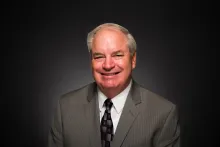
Robin Webber was born in Chicago, Illinois, in 1951, but has lived most of his life in California. He has been a part of the Church of God community since 1963. He attended Ambassador College in Pasadena from 1969-1973. He majored in theology and history.
Mr. Webber's interest remains in the study of history, socio-economics and literature. Over the years, he has offered his services to museums as a docent to share his enthusiasm and passions regarding these areas of expertise.
When time permits, he loves to go mountain biking on nearby ranch land and meet his wife as she hikes toward him.
