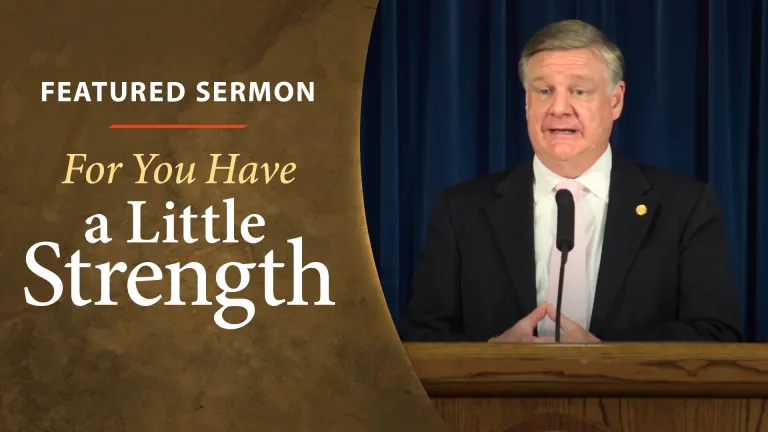

Joe Dobson
This transcript was generated by AI and may contain errors. It is provided to assist those who may not be able to listen to the message.
Over the last several weeks, we've been covering what the theme of our last conference was, which was dealing with the weightier matters of the law. And of course, you know, we started off with a summary of all of that. I mean, how important it is that we realize that God does require us to obey. He requires us to honor His laws and His words. But beyond that, as Jesus told the Pharisees, the weightier matters of the law are judgment, coming to understand, make right judgments, coming to properly know how to judge, and then mercy, which is an incredible attribute of God, an attribute that He requires of His children.
That's what we covered last weekend. How important, how significant that is. And then, of course, the third one that we read in Matthew is faith. Now, I plan to give a sermon about faith, and it would involve or include walking humbly with our God, because that's the description that we find in the Old Testament about what does God require? Well, to do justly or justice, and to love mercy, and to walk humbly with our God. Now, I say I'm planning to give that, but I'm not going to give that today.
So those of you have already written that down. I had to ask several up in Fulton this morning. Okay, now you can scratch that out. And I do, in a sense, want to talk about faith. Faith is an incredibly huge topic, and you could go, perhaps, from almost any section of the Bible and talk something about living by faith.
But it is such a large topic. I want to digress a little, and yet I am going to focus on faith. As we study an incident that happened in the history of Israel during the time of the Judges, and this is with one of the Judges named Gideon. Gideon is one of the Judges who was listed in the Book of Judges. He is actually somewhat early in the line of Judges, and yet he's existing during a time when Israel, in many ways, is pretty much off track.
Joshua, who followed Moses and who had a good knowledge of much of what had happened coming out of Egypt after he died, things didn't go quite so well. Things continued to, in a sense, decline. Israel wasn't really focused on God. And I think we'd have to say, even though, when you go back to the Book of Hebrews and you read in the Book of Hebrews chapter 11, when you read the listing of people of faith, you see Abel and Enoch and Noah, and you see Abraham and Isaac and Jacob and Joseph, and you see Moses, and then you see kind of a hurried discussion of Gideon and Rahab and Jephthah and, I think, Samson and Samuel and, of course, David.
Now, obviously, all of these individuals were people of the Old Testament, people that God chose to deal with in a long time ago. And yet, in a sense, many of them were major figures in the Old Testament, and yet some of them seemed to be relatively minor.
I think you'd have to say Gideon wasn't terribly prominent judge. And actually, even as we read through what we're going to in Judges 6 and 7 and 8, we're going to find that Gideon did learn to have and express faith in God. And I think we have that example for us today. And yet, you find that, you know, he kind of got off track as well.
You find he was a flawed in a number of ways, he had a certain amount of fear, he was afraid, he had some apprehension, he had some not only fear, but he doubted whether God could really or wouldn't really do what he said he would do. And yet, the example is one that I think we can draw some lessons from for us.
And so that's what I want to do today. In the book of Judges, it covers a time frame in Israel that you could only describe as being somewhat dark, somewhat troubling. Because even though God intervened from time to time, the people weren't really that receptive.
They, you know, it actually covers, as I said, from the time of Joshua after Moses, and all the way up until a time of the priest Eli, and little Samuel, who came to him as a little boy, and then ultimately the kings of Israel, Saul and David, Solomon, the lines of Cain, the kings of Israel, and Judah. And yet, so this was an earlier time, and yet a time that's described in the last verse of the book of Judges. Judges, chapter 21, there's 21 chapters, I didn't count up how many judges there were, but you see it appears that God simply would intervene when he felt like it was necessary. And yet, the summary statement that we have in Judges, chapter 21, verse 25, is kind of explaining the whole time frame. In those days, there was no king in Israel, and all the people did publish right in their own eyes. See, that's not a formula for success. That's not a formula for focusing on God. That's not a formula to be able to overthrow the enemy. See, they had been entered and been given the land of promise. They should have been prospering. They should have been enjoying an abundance. They should have been enjoying the blessings of God. But when everybody does what's right in their own eyes, you don't have anything but catastrophe. Actually, if you drop back a few pages to Judges 17, you see a very similar verse in verse 6. Judges 17, verse 6, in those days there was no king in Israel, and all the people did what was right in their own eyes. Again, this was a, in a sense, a characterization of the people of Israel here at this early time. And yet, as I mentioned about Gideon, God delivered Israel through Gideon. See, so is the focus on Gideon and his faith? Or is the focus on what God can do no matter what the circumstances?
I think we would say the focus is really on God, because whenever you, and we're going to go through this and read some of it, and you can easily read these three chapters later today or tomorrow if you would want, but the whole story is more about God and having faith in God, and how that actually Gideon did express faith in God, but he also seemed to have some other failings, and it seems that even toward the end of his life things were kind of out of control, and yet the one thing we have recorded, as far as I know this is all we know about Gideon, at least in the Bible, is that he expressed faith in God during that fight with the media nights. And so God delivered Israel through Gideon, and then we will think about some lessons that could apply to us today, to apply to our Christian lives, because I think there are some very direct things that we can learn. So let's go back to chapter 6 of Judges. Judges chapter 6, starting in verse 1. The Israelites did what was evil in the sight of the Lord, and the Lord gave them into the hand of Midian for seven years. Okay, this is obviously very dark seven years. You know, they are supposed to have been coming into the Promised Land. They were supposed to have been blessed. They were supposed to have been thriving, and yet in this setting, you know, because of their disobedience, because they ignored God, God allowed Midian to overthrow them. In verse 2, the hand of Midian prevailed over Israel, because the Israelites provided for themselves hiding, and because of that, and because the Midians, the Israelites provided for themselves hiding places in the mountains and caves and strongholds.
And see that, so this is describing a struggle, struggle between the people of Israel and the people of Midian. And in verse 6, it says, thus Israel was greatly impoverished because of Midian, and yet in verse 6, it says, the Israelites did something they didn't often do. They actually cried out to the Lord for help.
Now, that's something we certainly could say, well, that's what we need to learn to do. Whenever we find ourselves in distress, whenever we find difficulties in our lives, whenever we're faced with trials and tests, we need to cry out to the Lord. And that's, of course, what Israel did. And it says in verse 7, when the Israelites cried to the Lord on account of the Midianites, the Lord sent a prophet to the Israelites, and he said, this says the Lord, the God of Israel, I led you up from Egypt and brought you out of the house of slavery, and I delivered you from the hand of the Egyptians and from all of those who oppressed you, and I drove them out before you, and I gave you their land, and I said to you, I'm the Lord your God. And yet in the very last sentence of that verse 10, it says, but you have not given heed to my voice. See, even though what, you know, and this was not too far removed, too far being several scores of years from actually coming out of Egypt, they were in the wilderness, as Eric was discussing regarding Exodus 16. You know, one of the things that God did during the time they were in wandering in the wilderness was feed them. Feed them with manna, feed them with quail, provide them the water that they needed. All of those, in a sense, were types of what ultimately we would learn to be focused on trusting God, believing in Jesus Christ, really understanding what the bread from heaven was all about. So here you find that because of their disobedience, the Israelites were in this plight. Now, in verse 11, you see the beginning of the description of God calling Gideon. Now, this, in a sense, seems kind of unusual. You would think it would look down, he would take a look at, you know, who are the leading people here in the land of Israel, who might be able to help us get out of this, and yet, of course, that's not the case. That's not what's going to happen at all. In verse 11, the angel of the Lord came and sat under an oak that belonged to Joash, who was the father of Gideon, and his son, Gideon, was being outqueed in the winepress to hide from the Midianites.
And so was Gideon big and huge and strong and mighty and powerful and a extensive warrior. Well, no, he was timid, he was afraid, he was oppressed by this opposing army, and it says, the Lord, the angel of the Lord, appeared to him and said, The Lord is with you, you mighty warrior. Now, that's an incredible statement.
Whenever you see what Gideon was doing, he was back hiding in the cave, beating out the grain, so they had something to eat, something to eat, and yet God intervenes and said, The Lord is with you, and you are to be a mighty warrior. This quote was not what Gideon had in mind, but it's what God was certainly going to do. So Gideon answered and said, But sir, if the Lord is with us, then why is all of this happened to us? Where are all his wonderful deeds that our ancestors recount to us, saying, Didn't the Lord bring us out of Egypt? But now the Lord has cast us off and given us into the hand of Midian. Gideon actually did correctly understand the history. He knew that it had been passed down to him. It hadn't been that long ago. He was aware of what God had been able to do and how he'd gone through, had the Israelites go through the Red Sea. And yet in verse 14, the Lord turned to Gideon and said, Go in this might of yours and deliver Israel from the hand of Midian. I hereby commission you. And so not only was Gideon selected for this job, he was selected for a job and then he was given a mission. He was given a commission of what he was to accomplish. And he responded in saying, But sir, or Lord, how can I deliver Israel? My plan is the weakest in Manasseh and I'm the least in my family. And the answer to that, the Lord said, Well, I'm aware of that. I know who you are. I know your family. I know the limitations. I know you know Manasseh was not the largest tribe and know I know you are somewhat very, very restricted here in your own in your own house. But he says in verse 10, I will be with you and you shall strike down the Midianites, every one of you. So you know, it's obvious whenever you think about how it was that God intervened in Gideon's life, you know, he wasn't exactly sure that God knew what he was doing.
But clearly, you know, God did know what he was doing. He knew how he was going to do it. He knew what he was going to accomplish and how it is that Gideon would actually grow. And whenever he says, don't worry about it, I am with you.
See, whenever we face some of our trials and traumas and difficulties and struggles, you know, we don't want to forget that, you know, God is with us and he's able to help us even as obviously he's going to help Gideon. Now, in verse 17, you see the first part of the, in a sense, a discussion between Gideon and with God about how are you actually going to do that? I'd really like to have a little more sign to know that you will help me. So he said, I now, if now I have found favor with you, please show me a sign that it is you who speak with me. Do not depart from here until I go and get my present or gift and I'm going to bring it back to you. And he said, I'll stay. And so you see an interaction with the angel who was sent to talk to Gideon and to Gideon and him, in a sense, having apprehension, having fears, having, in a sense, a realistic view of what it is that's happening. I'm not very strong. I don't have a lot of might. I really need some reassurance here. I need to be encouraged. I need to be uplifted. And so, as you, I know, know, if we drop down to the end of chapter 6, Gideon asked God to perform a couple of miracles with some fleece. In verse 36, Gideon says to God, in order to see whether you will deliver Israel by my hand, as you have said, I'm going to lay a fleece of wool on the threshing floor, and if there is dew on the fleece alone and it is dry on the ground, then I will know that you will deliver Israel by my hand. And in verse 38, it just says, and it was so. And when he rose early the next morning, he squeezed the fleece. He wrung enough dew from the fleece to fill a bowl of water.
Now, I don't know how big of a fleece it was, but how much dew, you know, it looked like you'd had to water it with a watering hose to get enough water on that fleece to be able to wring it out and fill a bowl of water. And yet, that's exactly what happened. And then Gideon said in verse 39, don't let your anger burn against me, but let me say one more thing. Let me please make trial with the fleece one more time. Let it be dry only on the fleece and on all the ground let there be dew. And verse 40, God did so that night, and it was dry on the fleece only and on the ground there was dew. So here you see a couple of examples of Gideon slowly being convinced, actually slowly growing in his faith or belief that God was actually intervening in his life. That God had really called him to deliver Israel. That God was going to perform some kind of miracle because, you know, the odds were really stacked against him. And we're gonna find as we go here into chapter 7, and I'm not going to read through all of this because it would take too much time, but you're certainly welcome to read it. It's very, fairly easy reading. You can see exactly what happened. You can see how God looked at the situation and, of course, how Gideon did. See, what we find is that, in a sense, Gideon was starting out with a army that was about 32,000 men, and he was facing an army of the Medianites of about 135,000. And so what is that? About one to four. Odds weren't very good. They were actually pretty bad to begin with. Now, if you had, you know, you had as many soldiers as they had, then you might think, I've got a chance in this battle.
And yet, even as at the very beginning of this, you know, it was only a one in four chance that he would be able to be victorious with the army that he had. And yet, as you know, God began to thin down Gideon's army. He says in verse 2 of chapter 7, the troops with you are too many. Too many for me to give the Medianites into your hand, because Israel would only take the credit away from me, saying that our own hand has delivered us. And so here he goes into a discussion with him. He sends away quite a big crew. There was about 10,000 left, and God said, no, that's way too many still. And so later, he runs them down to the water, and he ends up with a group of 300. The Lord said in verse 7, with the 300 that lapped, I will deliver you, and I will give the Medianites into your hand.
And so, what have the odds gone from? They'd gone from one to four, which wasn't good odds at all. Now it's gone from one to 450. Now, he had so few people, 300, now that there was no chance that he could be victorious, and take any credit, surely. He couldn't take any credit. He probably really wondered, and yet, see, even though God had done the two different miracles with the Fleece and with the Dew, now he tells Gideon, I'm gonna reassure you a little more. Verse 9, that same night, the Lord said, Get up, attack the camp, for I have given it into your hand. But if you fear to attack, I want you to go down to the camp with your servant, and you shall hear what they're saying. And afterward, your hand will be strengthened to attack the camp. And so here God tells him, No, okay, I want you to do one more thing. I want you to go down, and I want you to sneak down and listen to what's being said in the camp. And so in verse 13, when Gideon arrived, there was a man telling a dream to his friend, and he said, I had a dream, and in it a cake of barley bread tumbled into the camp of Midian, and came to the tent and struck it so that it fell, and it turned upside down, and the tent collapsed. And it sounds like something you'd see on MASH. I don't know if any of you watch that. I still do. It's better than a little bit of the other stuff on TV. But some of the shenanigans, if they're in a tent, you know, is to pull the tent down. And this was the dream that this man was saying. And as Comrade says in verse 14, you know, this is none other than the sword of Gideon, the son of Joash, the man of Israel, and into his hand God has given Midian and all the army. And so not only did he do a couple of miracles, he also sent him down and told him what they were talking about in the Midianite camp. And Gideon's faith was growing. He didn't have a lot of faith to begin with.
He had a lot of fears and a lot of doubt. But whenever God began to reassure him, when he began to encourage him, when he began to show him what he was going to do, in verse 15 Gideon heard the telling of the dream and its interpretation and he worshiped God. He worshiped God and returned to the camp.
He was now excited. He was thrilled because he was confident now that God was going to give them a victory. And so in verse 16, after he divided his 300 men into three companies, he put trumpets in their hands of all of them. He put empty jars with them and torches inside the jars and then he told them what to do.
You know, they were going to be able to scatter all over around the whole camp of Midian. They were going to go down. They were going to, at his direction, blow the trumpets. They were going to smash up the pottery. They were going to make it sound like there's, you know, a horrendous huge army out here. And they're, you're going to frighten the Midianites. And so in verse 22, they did that. They blew the 300 trumpets. The Lord said, every man soared against his fellow the Midianites and against all the army. And the army fled. The men of Israel pursued them.
And so they overthrew, you know, again, 300 to 135,000. You know, they had quite a disproportionate armies. But God caused it to appear that there was much more.
And then he interfered and caused them actually to, in a sense, fall upon themselves. And so the enemy was clearly confused. They killed each other. They fled. And even some of the other heads of Midian would be chased down by some of the Gideons or some of the other Israelites. And they would be given a complete victory. Now in chapter 8, and again I'm not wanting to read through all of this, and you could read this if you'd like, I'd like to just point out, after this great victory, after this deliverance, you could say that God had delivered Israel out of Egypt. Yes, they knew that. But here you could say God had delivered Israel out of the camp of the Midianites. He had done that against all odds. And Gideon was the one who was expressing faith in God that God would actually do what he said. In chapter 8, you kind of see a summary of Gideon's life. Verse 22, the Israelites said to Gideon, rule over us you and your son and your grandson, and you have delivered us out of the hand of the Midianites. See, this is what they came to him afterward and said, well, we want you to be our ruler. We want you, you know, to lead us. And yet Gideon said to them, I will not do it. I will not rule over you. My son will not rule over you, but the Lord will rule over you. See, that was his advice. That was his guidance. And actually, you can read here how that it looks like Gideon made some type of an idol, even.
And that doesn't make sense with what he had just seen, but it says in verse 28, the Midianites were subdued before the Israelites. They lifted up their heads no more, and the land had rest for 40 years in the days of Gideon. See, it appears that God had rescued Israel from this tremendous army. And they had come to Gideon and wanted him to be their king, and he seemed to be, again, reluctant to do that. And he said and made the statement in verse 23, the Lord has got to rule over you. See, this was actually what was missing throughout the whole time of the Judges. And even as you get into the book of Samuel, 1 Samuel, and you see Eli and then Samuel, and then Samuel being led to Saul. You see that whenever the people requested that Saul would be their king, God told Samuel, you know, don't worry about that, Samuel. I'm gonna set him up as a king. He's gonna have all kinds of problems and difficulties, and yet they're not rejecting you, Samuel.
They are rejecting me. They're rejecting my rule over them. And this is actually what Gideon, he told them they should do. Now, it doesn't appear they did it, and you read throughout the, you know, the rest of the accounts of the Judges, and most of them are off base much of the time. And it appears Gideon may have been off base as well at times, but in this one incident, and this is what is highlighted in the book of Hebrews, Gideon was a person of faith, and that faith was in God. That faith was in God delivering them in a very impressive way. And so we want to ask, what are the lessons? What are the lessons for us as the Church of God? You know, this, I think it's an interesting story. Sometimes it's maybe not, you know, fully explained, and whenever we read through it, it's it's not it may be as clear as it could be or should be. But there are three things that I want to mention about this that I think you could make a correlation between this account of Gideon's faith and Israel being delivered by God and what we need to do in the Church of God today. The first thing is simply it's obvious that God selected Gideon for this mission. You know, we read that. He came to his house. He told him, you know, I'm gonna be with you and you're gonna be a mighty warrior. Now he didn't see how that could possibly be done. He said, I'm the weakest of the entirety of my clan and my clan is the smallest. And yet God says that doesn't make any difference. That doesn't make any difference at all. If the Lord is with you, then you'll be able to achieve the mission that you've been given. And even though, you know, the odds started off bad and they became even worse as far as the number of soldiers, you know, we can, I think, take from this that Gideon was given a mission by God. And the same thing is true for all of us who have been drawn into the Church of God today. You know, to all of us who have been drawn by the Father to know Jesus Christ and to be a part of the body of Jesus Christ and to have purpose in our lives and to have a mission. See, what is our mission? Our mission is to proclaim the kingdom of God. Our mission is to do the work that God says has to be done before Jesus comes back. And see, Jesus is going to come back and we're going to have to do the job. We're going to have to achieve the work. So we have a mission. And so we want to keep that in mind. Just as Gideon was selected and called and he was not able to do the job, he was given a mission. And the same thing is true for all of us in the Church today. Here in 1 Corinthians 1, in 1 Corinthians, and we've discussed this some over the last few years about different of the books of the New Testament and the writings of the Apostle Paul, here in this book of 1 Corinthians, a book written to the people who lived in Corinth, the congregation that was in Corinth, a congregation that Paul knew very well.
God had used him to raise up that church. He had used him to go and to teach them about the kingdom of God, about Jesus Christ. He had been used to proclaim the gospel and people were actually drawn. They were baptized. They were given the Holy Spirit. And yet when you read 1 Corinthians, you see, well, they're still pretty scrambled. They're still suffering from a lot of problems. And actually you find 1 Corinthians to be one of the most corrective books in the New Testament, because there were so many things that Paul needed to answer and give instruction to this congregation about. But the first thing you see is in 1 Corinthians is that he told them, you shouldn't be divided. You shouldn't be.
You should all be pulling in the same direction. Chapter 1 verse 10, I'd appeal to you brethren by the name of our Lord Jesus Christ that all of you be in agreement and that there's no division among you, but that you're unified in the same mind and in the same purpose. He said this is imperative. If we're going to be the people that God has called us to be, if we're going to achieve the mission that God has called us to do, then we need to be united. We need to be pulling in the same direction. He actually over in chapter 3, he says in verse 4, when one of you says, I belong to Paul and another says, I belong to a palace, are you not merely human or are you not just simply carnal? That's just total carnality to not pull together behind the head of the church, Jesus Christ. Actually, back to chapter 1 verse 13, in a sense, a thematic verse for this book, he asked the question, is Christ or has Christ been divided? And he goes ahead to describe people kind of following one another. Maybe we should back up to verse 11. It's been reported to me by Chloe's people that there are quarrels among you, my brethren. What I mean is that each of you says, I belong to Paul or I belong to a palace or I belong to Peter or I belong to Christ and then he says, has Christ been divided? He says that type of division is not going to allow you to achieve the job that God has called you to do. We want to be unitedly building each other up and achieving the work that God has called us. And of course, if we drop down to verse 25, we see the connection between Gideon being very limited, very young perhaps, although I don't think it says exactly what his age is, at least being very weak and being small as far as his people. It says in verse 25 here of chapter 1, for God's foolishness is wiser than human wisdom and God's weakness is stronger than human strength. The power that God is able, why is it that Gideon was able in faith in God to route 130,000 men with 300? Well, the strength of God is what caused that.
But Paul here tells the Corinthians in verse 26, consider your calling, brethren, have it not many, not many of you were wise by human standards or according to the flesh, not many of you are powerful, and not many of you are of noble birth.
But God chose what is foolish in the world to shame the wise, he chose what is weak in the world to shame the strong. God chose the low and despised in the world, things that are not to reduce to nothing, things that are. And then he describes why. Why am I doing that? Why am I drawing into the Church of God what he would in other places call infants, he would call babes. Here he describes us as being weak, not the mighty, not the powerful, but he says the reason is in verse 29, so that no one might boast in the presence of God. See, that's exactly what God told Gideon when he said, well I've got 32,000 men, and God says, well that's way too many. We're gonna have to lower this. You'll just take credit for any victory I give you with that. And this is exactly what he's telling us here in 1 Corinthians, so that no one in verse 29 may boast in the presence of God. He is the source of your life in Jesus Christ, who became for us wisdom from God in righteousness and sanctification and redemption in order that is as it is written, let the one who boasts simply boast in the Lord. If we want to give credit to someone for anything that we're doing that is upright, that is just, that is honorable, then we can give praise to God. We can give thanks to God, but he says, I want you to proclaim the gospel. I want you to proclaim the mission of taking the gospel around the world. See, is that an important message to give to the world? It certainly is. It is the message that has to be given to the world. Because, see, what's gonna happen? Well, this age is gonna come to a close. In a kingdom, a kingdom, a government, a rulership is going to be set up on earth that has a wide territory. Not just a little area there in Israel and not just here in the United States. It's going to be a whole globe deal. The entirety of the earth is going to be covered by the kingdom of God. Now, who is going to be the... who will be the people? Who will be the subjects? Well, not just a few of the people that God is dealing with like he is today and like he did with the Israelites of old. He says, I'm gonna open that up to the whole world. The people all over the earth are going to come to know Jesus Christ as the head of the church, as the king of the kingdom, and everyone is going to learn to worship. And what kind of law will that give? Well, there's going to be a universal law for around the world. And there is going to be a guidance given. See, that's why it's important to proclaim the kingdom of God. Now, as we know, it's in a sense of witness. It's in a sense of witness that many are not going to heed. And yet, we would certainly think that as Jesus intervenes and establishes his kingdom on earth, that many people's hearts will be changed. Many people's minds will be purified because right now, they're corrupted. You know, we have been corrupted. We have been involved in that, and God thankfully brought us out of that. So, the first thing that's obvious is that God selected Gideon for his mission, even as he has called us today with a purpose in mind, a mission to be accomplished. The second thing we could learn from Gideon's experience was simply that Gideon was flawed. You know, he needed faith training. That's what he needed.
Did he start off having a great deal of confidence and faith in God? Well, it certainly doesn't look like it. He asked him for this favor and that favor, and then finally, God said, if you really are going to do this, I want you to go down here in the dream. Know that the enemy realizes, you know, we're going to be overtaken. See, that's the thing that we can certainly see. That Gideon needed encouragement. He needed reassurance. He needed his faith bolstered, and I think one of the ways that we describe that today, even with the trials and tests that we go through. You know, and as you know, with our prayer lists that we send out weekly, there are many different people who have different needs, even physical needs, that we are concerned about. But see, we're also given, sometimes, we're given answers. We don't always get responses back, and maybe we don't always know how things resolved, but many times we do hear back that something is improved, something is better. Those are things that are offered as encouragement.
They're offered as reassurance. They're, in a sense, a part of our faith training.
And so, I want us to look at the book of Ephesians. This is another one of Paul's books. It's on over a few pages from where we were. Ephesians is a book that's written to the church in Ephesus. Again, a church Paul was very familiar with, one that he loved, one that he was concerned about, one that he wanted to help. He wanted to encourage them. They seem to be doing, at least it appears, from what is written, they seem to be doing well. They didn't have some of the difficulties that the people in Corinth had, but he told them in Ephesians 4 that, I want you to endeavor to keep the unity of the Spirit in the bond of peace He says, being unified is important. And then he would later say in that same chapter that all of us need to grow up to the stature, the fullness of the stature of Jesus Christ. And so he said, that's what I'm telling you you should do. But what I want to look at is in chapter 1. Chapter 1, in essence, Paul is giving some encouragement. He's helping them with their faith. He's trying to reassure them and pick them up and remind them of what God has done for them. He said, I don't want you to get bogged down in the day-to-day physical existence that you have. I want you to be reminded of what it is that God has done for you. And whether that is recently in the last few years or whether that was 50 years ago, God has done what Paul is writing about here. He says in verse 15, I have heard of your faith in the Lord, the Lord Jesus, and your love toward all the saints. And for this reason, I don't cease to give thanks for you as I remember you in my prayers. So he said, I'm wanting to encourage you. I'm wanting to reassure you. I'm wanting to help you, even as Gideon was helped by the different things that God did for him. He says in verse 17, I pray that the God of our Lord Jesus Christ, the Father of glory, may give you a spirit of wisdom and revelation as you come to know Him. See, that was a process.
He says, I understand you're in a process of growing in faith, that your faith is being trained. But he says in verse 17, that he may give you a spirit of wisdom and revelation as you come to know Him so that with the eyes of your heart enlightened, you may know what is the hope to which you have been called. What are the riches of His glorious inheritance among the saints, and what is the immeasurable greatness of His power for us who believe, according to the working of His great power?
See, God put this power to work in Jesus Christ when He raised Him from the dead and seated Him at His right hand and heavenly places far above all rule and authority and power and dominion above every name that is named not only in this age but also in the age to come. And He's put all things under His feet. He has made Him, again talking about Jesus, He has made Him the head over all things for the Church, which is His body, the fullness of Him who fills all in all.
See, now, just as Gideon needed encouragement, just as he needed to be reassured, this is what Paul was trying to do for the people there in Ephesus. He was trying to tell them, I'm thankful for your faith, I pray about you daily, I am encouraged to see you, I want to remind you that God called you and enlightened your mind and that if you keep it that in mind then you will have a surety of hope in the kingdom that Jesus Christ is going to bring to the earth.
And right now, even now, He is your King, He is your ruler, He is the head of the Church. So, Gideon wanted to be encouraged and I would hope, you know, that we can see how Paul was wanting to encourage, how he was wanting to reassure, you know, this particular congregation of the Church of God in Ephesus. The last thing we'll mention, and this is what Gideon said in Judges chapter 8.
He said, I'm not going to rule over you, my sons are not going to rule over you, but the Lord needs to rule over you. I believe that's Judges 8.23. He says, it's not men who are going to achieve this, the Lord is the one you've got to keep your eyes on. And so, I want us to turn a few more pages here to Colossians, another of the congregations that Paul was intricately involved in raising up. A group of people that he was familiar with, that he loved, that he cared for.
And he, in a sense, wanted to continue to remind them that you've got to be reminded to keep your eyes on the real leader of the church, Jesus Christ. Here in Colossians chapter one, we might start in verse 11. Again, it seems that he starts each of these books that he is writing to a congregation. He mentions certain things, sometimes credentials, then he mentions some encouragement. He might mention things they need to work on as well. But here in verse 11 of chapter 1 of Colossians, may you be made strong with all the strength that comes from his glorious power, and may you be prepared to endure everything with patience while joyfully giving thanks to the Father who has allotted you, or enabled you, excuse me, enabled you to share in the inheritance of the saints in light.
He has rescued us from the power of darkness, transferred us into the kingdom of his beloved Son, in whom we have redemption, the forgiveness of sins. See that again, he was wanting to be encouraging, he was wanting to be uplifting, he was wanting again to point them to their success as Christians would be to have their eyes on Jesus Christ as the ruler.
Then, in talking about Christ in verse 15, it says, he is the image of the invisible God, the firstborn of all creation, for in him, or by him, all things in heaven and earth were created. Things visible and invisible, whether thrones or dominions or rulers or powers, all things have been created through him and for him. And he himself is before all things, and in him all things hold together.
He, again talking about Jesus, is the head of the body, the church. He is the beginning, the firstborn from the dead, so that he might come to have first place in everything. For in him all the fullness of God was pleased to dwell, and through him God was pleased to reconcile to himself all things, whether in earth or heaven, to make peace through the blood of his cross.
Again, this was Paul's way of keeping people reminded that their faith in God is real, it is genuine, that they have to have their eyes on Jesus as the head of the church. And he says in verse 21, you who were once a strange and hostile in mind, doing evil deeds, so he always made that contrast, you know, I brought you out of the pollution through the deception that Satan had begun with Adam and Eve, I brought you out of that. You who were hostile doing evil deeds, he has now reconciled in his fleshly body through death so as to present you holy and blameless and irreproachable before him. You know, is God for us? Does he want us to be a part of his divine family? Well, it's absolutely sure. He wants us to be glorified with Jesus Christ. Now, that's what Jesus said in John 17. He said, Father, restore to me the glory that I had with you before the world began. And see, he talks about all of us as spiritual individuals growing in his nature by his Spirit, that we can be glorified with him. And he gives a provision here in verse 23, provided that you continue securely established and steadfast in the faith without shifting from the hope that was promised by the gospel that you heard, which has been proclaimed to every creature. I, Paul, am a servant of that gospel. See, that was what Paul wanted them to know. And that, of course, I think is what God wants us to learn, even from reading about a story that is recorded in account of a rescue that God made in Israel at the hands of Gideon. So he delivered Israel. He brought them through.
And Gideon's faith is what is recognized there in Hebrews 11 that I think we can use as an example for us. So what are we to do today? Well, we're to recognize our dependence on God. We are to actively be engaged in faith training. Whatever it is, whatever issues we go through, whatever trials or tests, you know, those are problems. Yes, we have to face those problems. But those problems occur so that we will be reminded of our need to have faith in God. God is able. You know, He is not limited in any way. He is able to help us. He may not do exactly what we do, but He will do what is good for us. And of course, as He tells us, you know, we want to look to the Lord, look to Jesus Christ as the head. That's where the real power is. God is working in and through us. He's doing that to help us overcome.
And just as God told Gideon, see Gideon had no idea how he could overthrow this huge army. And we may think, well, how can I ever succeed? Well, He told Gideon in Judges 6-12, if the Lord is with you, then you will be able to succeed. You will be.
He says, I am with you, and you can be a mighty warrior. And that's what I think all of us can take from the book of Judges and this example of Gideon. And certainly, you know, in Gideon's case, a few plus God was better than an innumerable multitude of the enemy. And in our case, a faithful few plus God is better than many without him. So we'll talk about faith more, but I thought it might be good to go over, you know, this example of Gideon today, because it is connected to faith, but we want to keep it in mind as we continue to grow with the help of God.

Joe Dobson pastors the United Church of God congregations in the Kansas City and Topeka, KS and Columbia and St. Joseph, MO areas. Joe and his wife Pat are empty-nesters living in Olathe, KS. They have two sons, two daughters-in-law and four wonderful grandchildren.
