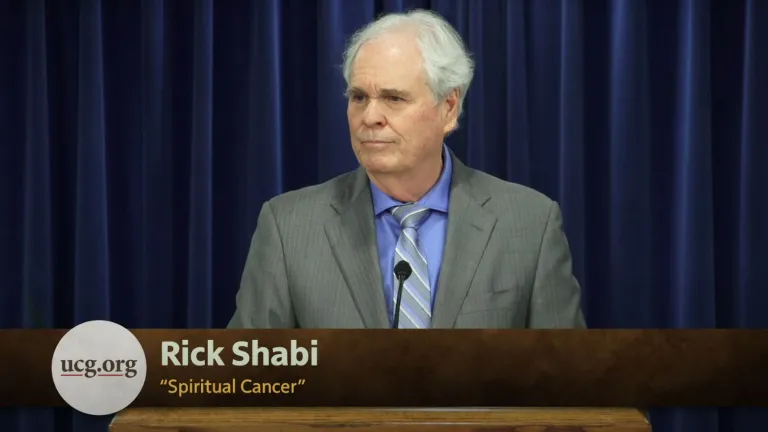


Rick Shabi
This transcript was generated by AI and may contain errors. It is provided to assist those who may not be able to listen to the message.
If you had one week, if you had just one week to live, how would you spend it? How would you spend it? Who would you see? What would you do? Would you spend that week doing all the things that you like to do, eating all the foods that you like to eat, going through all the entertainment that you like, and just filling up life with the things that you enjoy doing? Or would you want to leave a legacy for the people that you left behind, an example for them? What are the type of things that you would say? What are the type of things that you would think about? Would you be more focused on your death or more focused on the kingdom of God? Those are all questions. None of us will know probably exactly the day we're going to die. But if we knew that within the next week we were going to die, what would we do? What would we think about? How would we handle it? As we approach the Passover season, we have a Savior who was facing that very same reality. He knew that He was going to die within the next week. He knew exactly how He was going to die. He knew the time. He knew what was going to precede it. And it was going to be an awful death. And it was going to be an awful time. People were going to try to murder His character as well as His body. And He left us a record, God left us a record, of what His last week was like, the things that He did, the messages that He gave us. And as He approached that final Passover, when He was alive as a human being, He left us some messages that as we look toward the next week and the Passover that we might consider as well. Let's go to John 12. John 12. John 12 and verse 1. John says, Then six days before Passover. Passover is the fourteenth of Abib. This would be the eighth of Abib. Some commentaries say maybe the ninth of Abib if Christ was looking toward the first day of Unleavened Bread. I think it's probably the sixth of Abib because—or the eighth of Abib because it was six days before what He was going to accomplish and complete on the Passover. That was the eighth of Abib. Today, in God's calendar, is the eighth of Abib. So we can look six days until the Passover, and we have a record of what Jesus Christ did. And on that time, as they looked at that week that Jesus Christ was going to, at the end of it, die, be the ultimate sacrifice for all of mankind, He had spent three and a half years talking with people, walking with disciples, teaching them, setting them examples, healing all sorts of people who came to Him for healing, and accomplishing everything that He needed to accomplish. We'll take a break.
Very good. Thank you. He has spent three and a half years working with His disciples. He had been through Judea. People had heard Him talk. It hadn't all been received with positive accord.
There were many people who were upset by the things that He said. But here He was six days before He was going to die. And there were going to be some on that very night, this night, some notable things that happened to Him, orchestrated by God, if you will. Let's go on in verse 2. Well, I'll read the whole verse of one here.
Then six days before the Passover, Jesus came to Bethany, where Lazarus, who was, who had been dead, whom He had raised from the dead. There they made Him a supper, and Martha served, but Lazarus was one of those who sat at the table with Him. And Mary took a pound of very costly oil of spikenard, anointed the feet of Jesus, and wiped His feet with her hair.
And the house was filled with the fragrance of the oil. So as that night began, Mary did something that we wouldn't do necessarily today, but in Old Testament times, if you anointed someone and you poured oil over them, you anointed their feet, it was a sign of honor. Now, a corollary account in Matthew 26 and in Mark 12, I think it is, is there's another account for Jesus Christ, and that time the woman, it doesn't name Mary, but it names a woman who poils oil over His head.
In Old Testament times, that was the way a king was anointed. But here, Jesus Christ, as He explains what's going on, because there is some, there is some objection to what is going on there that we'll get back to here in a minute, but in verse 7, as they say, why is she doing this?
Why is she wasting money on this? Christ said, leave her alone. She kept this for the day of my burial, for the poor you have with you always, but me, you don't have always. And they didn't know what He was talking about, but here He was telling them, she's anointing me for my burial. In another account, we can look at He was being anointed as a king.
And He is indeed our Savior. He indeed died for our sins. He died that we could have our sins forgiven, resurrected that we could have eternal life. And He is our King, our soon-coming King, and He is our Savior. And as God orchestrated and had this, you know, it was time for Jesus Christ who spent the three and a half years doing His ministry and doing it perfectly, living a perfect life.
It was time for Him to be glorified in the eyes of the people, and that's exactly what happened that night. Now you'll, as you read through the Scriptures, you'll see there's just three, some in commentaries will say, just two times Jesus Christ was anointed. This is one of them. There is one in Matthew 26 that looks like a similar occasion, but on that one, oil is poured over His head, and it comes after it says, after two days was the Passover, not six days before.
The other time is back in Luke 7 at the beginning of His ministry. In Jesus Christ, it was an anointed to go out and preach the gospel to all nations, the gospel of repentance.
He did just that. Let's go back to Acts 10. You can keep your finger there in John 12. We'll come back and visit that here in a minute. But back in Acts 10, and we'll pick it up in verse 36 at the beginning of the sentence here. This is Peter talking, and he's, of course, talking about Jesus Christ. It says, The word which God sent to the children of Israel, preaching peace through Jesus Christ, He is Lord of all, that word you know, which was proclaimed throughout all Judea, and began from Galilee after the baptism which John preached.
After John came preaching a gospel of repentance, Jesus Christ began His ministry, and He preached a gospel. That's when it began. How God anointed Jesus of Nazareth with the Holy Spirit, and with power, who went about doing good and healing all who were oppressed by the devil, for God was with Him. He was anointed to go out and preach good tidings, glad tidings to the poor, to proclaim liberty to the captives, the things that He said there in Luke 4 as He began His first time speaking in the temple.
And now He was being anointed to be Savior. Now He was anointed for His burial. Now He was anointed to be King, the King that He would come back and return. You know, as Jesus Christ faced death at the end of that week, He knew what was happening, but He wasn't totally focused on that death.
He was focused beyond that death. He was focused on the Kingdom. He was focused on what was going to be. He was there to finish and complete the mission that He came to earth for, but He was focused on the Kingdom as well, and the time that He would return and establish His Kingdom. So three times Jesus Christ was anointed, God orchestrated that. It was a message to the people that were there. They didn't get it at that time, but let's go back to John 12, because that's one of the things that happened that night.
And I'm sure as Jesus Christ made the comment to Mary, She's anointing me for my burial, maybe they thought, What does He mean by that? What does He mean there? He's anointing me. She's anointing me for my burial, and that you will not have me with you always. But that wasn't the only thing that had happened. As a result of that occasion when Mary used some very costly anointing oil to pour over Jesus' feet, it raised some objection from some, notably one, in the audience there that night.
Verse 4, chapter 12 of John. But one of His disciples, Judas Iscariot, Simon's son, who would betray Him, said, Why was this fragrant oil not sold for 300 denarii and given to the poor? Well, He's saying, Wow, if we're going to spend all this money, shouldn't we be giving it to a noble cause? Well, the word sounded right. But in verse 6 it tells us this.
He said, Not that He cared for the poor, but because He was a thief, He had the money box and He used to take what was put in it. So we kind of get a glimpse into what Judas was like. Judas. He's a very tragic character in this last week of Christ's life. And here He has pointed out for what He is, and we have revealed to us a weakness that Judas has. And Judas, this is something that was with him that he just never overcame.
He spent the same three and a half years walking with Jesus Christ. He spent the same three and a half years listening to His words. He saw the same examples that the other disciples saw. He saw everything that He did. He had an opportunity to relate to Him, follow Him. But Judas had this fault, and he was very interested in money. You know, Jesus Christ said back in Matthew 6 that you can't serve God and you can't serve money. But that was his obsession. And as he was the treasurer, he had an opportunity to take some of those things.
And if you can't imagine, you know, being in the ministry with Jesus Christ and then actually stealing from the box that was there for Him. But he did that.
You know, Judas, that night, it began something in him that was going to finish him as well. Jesus Christ was going to complete his ministry. And Judas, who had this fault that he never, ever overcame. He carried it with him, never, never, apparently, even maybe he tried to overcome it. But that night, it set something in motion. And as we'll read later in Matthew 26, when it was only two days of the Passover, he decided he was going to betray Jesus Christ for money.
He made a choice. I'll choose money over God. It's a pretty sad choice when you think about it and what he had determined to do that day. I will choose money over God. But it was something that his life was pointing in that direction. He never interrupted it. He never took the time to examine himself and say, I won't let this happen anymore. I won't allow this same weakness that has been defining me for all of my life to find me anymore. And in the end, that weakness that was never addressed is the thing that killed him. The thing that killed him, physically, certainly, because when he realized what he had done, he was sorry. He never repented in biblical repentance, but he went out and he hanged himself. But beyond that, God says Judas was a son of perdition.
When we read about a son of perdition, it means that he is beyond redemption. Beyond redemption, Judas had a fatal flaw. Judas had a fatal flaw that he never addressed during his lifetime, never during the time that he walked with Jesus Christ. He just let it continue to build and grow in him and it finally strangled the life out of him. Not only his physical life, but his eternal life.
You know, the same thing can happen with us. And I think as this happened six days before the feast, you know, as Judas made a decision that night, you know, made a decision that night and had an opportunity, perhaps. I know what the Bible says and he was prophesied he would do that.
But then three or four days later, he was going to make the decision. I'm following through with it. I will betray this man. I'll take the 30 pieces of silver over him. Through the course of his life, he developed a spiritual cancer and he never took the steps to eliminate that cancer.
Now, any of us, if we get a diagnosis of cancer, we kind of look at it as a death sentence, right? Because you hear that word and you think it's an awful diagnosis to have. Now, we can do a couple of things, you know, with cancer. We can give up. We can kind of keep living our lives in exactly the same way we always lived them and the cancer will eventually eat us up and destroy us.
Or we can take steps. We can look to God for healing. He can heal. We can change lifestyles.
We can do the things that we need to do in order to interrupt the cycle that we have put ourselves on with some of our choices in many cases. You know the Bible talks about cancer, too. There is a place back here in 2 Timothy. Let's turn there. 2 Timothy 2. 2 Timothy 2 and verse 16.
Paul, writing to Timothy, says, Shane, Shun, profane and idle babblings.
Just walk away from them. Some arguments or some discussions you get into, they're just not going to go anywhere. They're just profane. They're just idle babblings. For Shane, profane and idle babblings, for they will increase to more ungodliness. And their message will spread like cancer.
Now, one thing about cancer is if it's contained in one place, very treatable. But one of the things it does is if it's left untreated, it will grow, and it will metastasize, and it will invade other parts of the body. It will eventually kill you. Here's what the concordance talks about, the word translated cancer there. It's pronounced gangrene, if you will. I guess similar to the gangrene we have today. This is how they define it from the concordance. It says, it's a disease by which any part of the body suffering from inflammation becomes so corrupted that unless a remedy be seasonably applied, the evil continually spreads, attacks other parts, and at last eats away the bones.
That's what happens physically. It's an awful disease. Even more awful if it's spiritual cancer.
If that cancer grows, and we allow it to continue to live in our body. If we don't take steps to eliminate it by examining ourselves, identifying it, and making the determination with God's help, just like in physical cancer, that he can heal that cancer. That we can give up, and we can we can have him remove that weakness, that fault, that sin in us. Judas never did that. Judas allowed it to grow. Judas, through his life, he continued to allow that cancer to grow. It killed him. It took him over, and it killed him. And the same thing can happen to us. It doesn't have to be money. It can be anything else that is something that separates us from God. Something that we know isn't true.
Something that we could have caught earlier if we were doing some self-examination.
Judas had an opportunity here, as he was faced with this day, to look at himself and say, what am I thinking? Would I really consider turning Christ in? Maybe he considered it.
He said, yes, I will. Yes, I will. And it's interesting that it's that week that that's pointed out to us. You know, as we look forward to the return of Jesus Christ, there are a number of things that that will occur in our lifetimes.
There's a first back in Revelation. Revelation 22 that I think mirrors what happened to Judas here in the last week of Christ's life.
That may happen, well, will happen, I think, to all of us in one way or the other before the return of Jesus Christ and as that is impending. In Revelation 22 and verse 7, it says this, Christ speaking, it says, Behold, I am coming quickly. Blessed is he who keeps the words of the prophecy of this book.
Behold, I'm coming quickly. In that day, it was the time of his death was coming quickly. Now I, John, saw and heard these things, and when I heard and saw, I fell down to worship before the feet of the angel who showed me these things. And the angel said to me, See that you don't do that, for I am your fellow servant, and of your brother and their prophets, and of those who keep the words of the book, worship God. And he said to me, Don't seal the words of the prophecy of this book, for the time is at hand. He who is unjust, let him be unjust still. You know, there was a time in the timeline of Jesus Christ's life, one week before, Judas, who was unjust, he was unjust still. It was almost, it was too late at that point. He had lived his life, he had followed Christ, he was unjust, and he was unjust still. Could there be a time coming from us on how we live our lives, how we take the time that God has allowed us to live with his Holy Spirit, guiding us, directing us, correcting us, hoping that we will see the things that he sees, letting our eyes open to who we are and what we need to become? Well, there come a time when he says, let the unjust be unjust still.
He who is filthy, let him be filthy still. On the other hand, he who is righteous, he who has lived his life in a state of repentance, he who has lived his life following God, allowing God to correct him, allowing God to mold him, a go and becoming closer and closer to God through the time of his life. He who is righteous, let him be righteous still. And he who is holy, let him be holy still. You know Peter says in 2 Peter 4 17, maybe it's 1 Peter 4 17, judgment is now on the house of God. God is watching what we're doing. Those who he has called, those who have said we will follow him, those who have repented and been baptized, he is watching what we are doing.
What are we doing as we walk with God these 10, 15, 20, 50 years that we have had? Are we using the time wisely, like 11 apostles whose heart became closer and closer to God? Or are we playing a game and we're just kind of allowing some of the things that have that are problems in our lives to continue to multiply because none of us want to have a cancer diagnosis. None of us want to hear about someone down the road that they never killed that spiritual cancer. They never allowed God to take that from them. Judas is a tragic figure in this time, a son of perdition, a son of perdition, who let us learn the message that was given there on that first night, six nights or six days before the Passover. And a lot happened in that one little ceremony that we read about there in John 12. Let's go back. Let's go back to John 12. John 12. We see that that evening Christ was anointed for his burial, another account later on in the week, or maybe it's the same account as King.
And as the time was there, says in verse 9 of John 12, a great many of the Jews knew that he was there. They were there in town because it was the Feast of Tabernacles, or the Feast of the Days of Unleavened Bread that was impending. Three times a year they came to Jerusalem for the Days of Unleavened Bread, for the Feast of Weeks, and for the Feast of Tabernacles. And then occasion on the next morning, the morning of the 8th of Abib, it says in verse 12, the next day, the next day a great multitude that had come to the feast, when they heard that Jesus was coming to Jerusalem, took branches of palm trees, and went out to meet him and cried out, Hosanna, blessed is he who comes in the name of the Lord, the King of Israel. Then Jesus, when he had found the young donkey, sat on it as it is written, Fear not, daughter of Zion, behold your king is coming, sitting on a donkey's colt.
There he is, the night before he had been anointed, the next day, as the crowds come out, as God orchestrated or inspired that event, Jesus Christ is proclaimed King. Proclaimed King.
The coming Passover Lamb, the ultimate Passover Lamb. In verse 16 it says, the disciples did not understand these things at first, but when Jesus was glorified, then they remembered that these things were written about him, and that they had done these things to him. You know, when Jesus Christ, that night after the last Passover, he told them the Holy Spirit would come to them, and it would bring to mind the things that they had seen that had occurred. And as they thought back on these incidents this last week of his life, it began to make sense they were able to put it all together in the whole, the whole busyness of that week. It might have been lost if they never went back and recounted it again, if they had never thought, what about that time? What about Mary anointing him? What about the crowds they gathered together and laid palm branches before him and welcomed him in and said he was king? The same crowd, the same Jerusalem that five days later said, Crucify him. Crucify him. But that day they said, anoint him as king. He's our king.
And in just five short little days, the tune changed in Jerusalem. They had time to think, you know, we need to reflect on our lives, and as busy as that last week of Christ's life was, our lives can be busy all the time. We need to make sure that we take the time to reflect on what is going on, to understand what's going on. Take the time, as Paul tells us, to examine ourselves and look at life, look at ourselves honestly. Because without that, we would never understand and God won't. God won't bring to remembrance unless we take the time to allow those things to, to be recognized in our minds. So as the day goes on, Jesus Christ says some interesting things here. Down in verse 23, he prophesies about his death. There he is six days before. The crowds are all seeing him. They're gathering in Jerusalem for the days of another bread. They came to see him. And verse 23, you know, as some came up to say, we want to see, we want to see Jesus Christ. And verse 23 says, Jesus answered them, saying, The hour has come, that the Son of man should be glorified. Most assuredly I say to you, unless a grain of wheat falls into the ground and dies, it remains alone. But if it dies, it produces much grain.
We talked about that when we talked about the parable of the soils. The seed has to die in order for it to produce fruit. Jesus Christ was saying, I'm the seed. I will lose my life, but much fruit will come of it. If anyone serves me, he says, let him follow me. And where I am, there my servant will be also. If anyone serves me, him my father will honor.
Then he says, Now my soul is troubled, and what shall I say? Father, save me from this hour, but for this purpose I came to this hour. He knew who he was facing. He was telling them what was going to happen. They didn't grasp it. Father, glorify your name. Then a voice came from heaven, saying, I have both glorified it and will glorify it again. Therefore the people who stood by and heard it said that it thundered. Others said, an angel has spoken to him. Jesus answered and said, this voice didn't come because of me, but for your sake. Listen to the words I say. And God accented those words with his voice, the thunder, or whatever noise they heard there. This is my son in whom I am well pleased. This is my son. Hear him. Listen to the words. Verse 31, he says, Now is the judgment of this world. Now the ruler of this world will be cast out. And we know who he's talking about them. He would have the victory over Satan. He would displace the God of this world.
And if I am lifted up from the earth, verse 32, and I, if I am lifted up from the earth, will draw all people to myself. This he says, signifying by what death he would die. He told them what would happen. God tells us, I won't do anything unless I tell my prophets and my people first what will happen. They heard the words. They didn't get it. We need to have our attention in tune to what God says. Pay attention to the signs. Pay attention to what's going on. Don't be lulled to sleep. Don't get caught up in everything that is going on around. Keep your focus on what God has called you for. And on that day, that eighth day of Abib, he predicted his death. And he came into Jerusalem and was welcomed in as a king. And then you can take the time to read through the rest of John 12 and see some of the words that he says over here in John 12. And as we move into John 13, he's at the Passover evening. But let's pick up the rest of the six days before Passover, the week at the end of which Christ would die in Mark 11. Mark 11.
The first 10 verses there are Mark 11. If you look at verse 10, you see we're right at the place that John leaves off his account. Jesus Christ has come in to the triumphal entry into Jerusalem.
In verse 10, they proclaimed him king. Verse 11. Following that day, Jesus Christ, or following that time, Jesus went into Jerusalem and into the temple. So when he had looked around at all things, as the hour was already late, he went out to Bethany with the 12. At the end of that day.
Notable things happened on that day, on the evening before, as well as on that day. And at the end of the day, he went back out of the city. In verse 12, now the next day, when they had come out from Bethany, he was hungry. And on the way back to Jerusalem, a most unlikely event, you would think, was six days before that God would put here in the account of what Jesus Christ would do. Says the next day he was hungry. In verse 13, and seeing from afar a fig tree having leaves, he went to see if perhaps he would find something on it. When he came to it, he found nothing but leaves, for it was not the season for figs. In response, Jesus said to the tree, let no one eat fruit from you ever again. And his disciples heard it.
Now you might look at that and say, why was that recorded in the Bible?
This is where commentaries help. Commentaries don't help much of the time for spiritual understanding, but commentaries help in understanding the background of what life was like back in the time of Jesus Christ. You know, I don't know very much about fig trees. Someone gave us a fig tree. And when I looked in the commentaries to see what is it that God was trying to show, why would this happen? Why would this happen be recorded in the Bible, a simple event in the week leading up to his death? What message was he giving to us? Let me read to you what Adam Clark has to say, the commentary about the fig tree. He says, When our Lord saw this fig tree by the wayside, apparently flourishing, he went to it to gather some of the figs, being on the wayside it wasn't private but public property, and any traveler had an equal right to its fruit. As it was not yet the time for gathering in the fruits, and yet about the time when they were ready to be gathered, our Lord with propriety expected to find fruit on that tree. But as this happened about five days before that Passover on which Christ suffered, and the Passover that year fell, he says on the beginning of April, it's been asked, how could he expect to find ripe figs in the end of March? Answer, because figs were ripe in Judea as early as the Passover.
Besides, the fig tree puts forth its fruit first, and afterward its leaves. Now, this fig tree that we had, I found it interesting that it had all these figs alongside of it and no leaves, just a very few leaves, and I thought, what's wrong with that fig tree?
When I read this, I thought there was nothing wrong with the fig tree. It was doing exactly what it was supposed to do. It produces its fruit first, and then the leaves appear. So when Jesus Christ looked at that fruit tree and he saw the leaves that were there, he thought, it's a mature tree. It's ready to be picked. He went over there and he found no fruit. No fruit. On a tree that was indicating it should have fruit. It was time for it to have fruit. And so when he saw it, he said, let no one ever eat of your fruit again, or let no other fruit come on you again.
Let me continue with what Adam Clark says. He says, indeed, this tree in the climate, which is proper for it, has fruit on it the year-round. As I, and he recounts in his commentary there when he's been in Jerusalem and seen the figs ripened at that time, the summer begins in March. The harvest is at the Passover. Therefore, as our Lord met with this tree five days before Passover, it's evident that it was the time for ripe figs. They just typically didn't harvest them until after the wave sheaf offering. So when he saw that tree, he knew what it should have had. Now we can take the spiritual analogy of it, right? He wasn't just talking about a physical tree there, but there's a spiritual lesson that he wanted us to learn, that he made evident to the apostles when they came back later and thought about it.
That tree had leaves. That tree should have borne fruit. That tree deceived me. That tree, I cursed, and that tree would never bear fruit again.
Now we know, and as the apostles probably thought back on it when Jesus Christ was giving his words after that last Passover, when he was talking in John 15 about, this is how we glorify the Father, that we bear much fruit, and that we know the fruits of the Holy Spirit, what God is looking to see upon us as we grow and as we spend the time walking with His Spirit and having it let us, that He expects to see the fruits of the Spirit, love, joy, peace, long suffering, gentleness, goodness, meekness, faith. He expects to see those, and as we're here for five years, ten years, twenty years, fifty years, He would look at a mature Christian that has leaves on it, that looks good, that looks the part, where's the fruit? I want to see the fruit. Back in Matthew, keep your finger there in Mark 12, let's go back to Matthew 7. In verse 19, in the Sermon on the Mount, Christ says this, Matthew 7, 19, every tree, now we know He's not talking about physical trees here, every tree that does not bear good fruit is cut down and thrown into the fire.
But God expects us, as we're growing, to be producing fruit, not just to look good, not just to say the words, not just to appear that we're a ripe tree, but that when He looks at us, He sees the fruit. And if He doesn't see the fruit, His words are pretty harrowing.
The same thing that He pronounced on that fig tree, He may pronounce to His people. In verse 20, He says, therefore by their fruits you will know them, not by their words you will know them, not by their position will you know them, not by the way they present themselves will you know them, by their fruits you will know them.
Look at who they are. Look at what there is. See if that tree, that tree is producing fruit.
So if we go back to Mark 12, that's not the end. That's not the end of the fig tree.
Go back to Mark 12.
On this ninth day of Abib, when Christ cursed the fig tree, the next day, as He comes back into town, the fig tree appears again. And that's not Mark 12, it's Mark 11. Mark 11 and verse 20. At the end of the day that He cursed the fig tree, we'll come back to the rest of the day in a minute, says, when evening had come, He went out of the city. Now in the morning as they passed by, they saw the fig tree dried up from the roots. And Peter, remembering, said to Him, Rabbi, look, the fig tree which you cursed is withered away.
How did that happen so quickly? In one day, in one day, it's just gone.
And then Christ gives a lesson in that. Five days before He's crucified, Jesus answered and said to Him, Have faith in God. Words that we could always say, right? Have faith in God. Believe in Him. For surely I say to you, whoever says to this mountain be removed and be cast into the sea, and doesn't doubt in his heart, but believes that those things he says will be done, he will have whatever he says. You know, that doesn't happen a lot of the time.
But He quantifies when we pray to Him. He says, when you pray, if you have no doubt, if you believe with all your heart, not if you pray with, I sure hope God does this.
I sure hope that when I come before Him and I ask Him to heal this disease or this affliction, I sure hope when I cast this care or burden on Him, I sure hope that He listens and that He removes it from me. I sure hope He does. That's doubt. It says, believe. Believe it.
Don't hedge your bets, as I often say. Believe God. That takes faith. And He says, so much faith. You know, if you ask these things, if you believe in Me, if you've learned over your life, believe in Me. Have faith in Me. Jesus Christ speaking, have faith in God. Whatever you ask, I'll do. Have no doubts. Verse 24, therefore I say to you, whatever things you ask when you pray, believe that you receive them and you will have them. Believe. There's that word, believe, that keeps coming up. It's more than just, I hope, I think. Better than a 50% chance it'll happen.
Believe it. And He left the apostles a very dramatic example. I said to that fig tree, die and it died. Believe. Believe and have faith. And then He goes on to say in verse 25, and whenever you stand praying, if you have anything against anyone, forgive Him that your Father in heaven may forgive you your trespasses. Isn't it interesting that before Passover, He broaches the subject of forgiveness in the very same context where He's talking about the fig tree and the miracle that happened there. Forgive others. And as we approach Passover, you know, Matthew 5.23 says, when you're going to the altar, if you have anything against your brother or vice versa, go and be reconciled to Him. Now, reconciliation isn't always possible. Reconciliation takes two people to want to reconcile, but you know what? We can all forgive.
In our hearts, we can forgive and not harbor any grudges. Because if we don't forgive, what happens to us is the same thing that happened to Judas. Hebrews 12, 15 makes it very clear. If we harbor that bitterness, if we let grudges develop, if those continue to multiply, it will bring bitterness and it'll be the end of us. It'll be the cancer that kills us.
Don't let that cancer ever develop. Not with anyone else in the church, not with your family members, not with anyone. Forgive. That's the message that we have. And one of the messages of these Holy Days is forgive. You may not be able to be reconciled because the other person won't reconcile. That's not your problem. Your problem is, and what you need to do, is forgive. And in your heart, forgive. You know, I always remember, if anything ever happens to me and I have an issue with someone, I always make myself remember. Jesus Christ hung on that stake and He said, Father, forgive them. They don't know what they do. And I think if He could sit there suffering the way He did and He could say, forgive them and not be bitter for them and still be dying for them and giving His life and spiked up all the things that they did, who am I to ever have anything that anyone could do to me that I couldn't forgive? And we all need to feel exactly the same way.
Forgiveness must be part of the season that we're in. Forgiveness must be part of what it is. And as Jesus Christ used that fig tree as an example and of testimony, forgiveness must be part of these holy days and this week leading up to the holy days as well.
So Christ used that fig tree for a number of messages and lessons that we can learn here about what He wanted to have people remember as He lived His last week. But let's go back. Let's go back to the day before. That we're going to find out is the 10th of Abib here. As I count things, some commentary says it's the 11th, others will say another day, but somewhere in this six day period. If we go back to Mark 11 earlier in the count back in verse 15, we see that they came to the fig tree, they passed by it, and it says in verse 15, they came to Jerusalem. Then Jesus went into the temple and began to drive out those who bought and sold in the temple and overturned the tables of the money changers and the seats of those who sold doves. And He wouldn't allow anyone to carry wares throughout the temple. And He taught, saying to them, is it not written, My house shall be called a house of prayer for all nations, but you have made it a den of thieves.
Now, if this was the 9th of Abib, it would have been the preparation day for the Sabbath, it would have been the Fridays, the 10th would have been the Sabbath that week. Understanding what we proved last week, when the Passover was, and that week of crucifixion and everything, this would have been the preparation day for the Sabbath. Jesus Christ goes into the temple, He looks at it, what is He doing? Now, some commentaries will tell you that this might have been the 10th. I don't think that the Jews would have had their tables and all their wares set up on the Sabbath day. I think this was probably the preparation day. What is the lesson He's telling us? Because He goes in there, and He isn't just kind of mincing words. He isn't just saying, you know, I don't think you should really be doing this. I think you should be taking down the tables. But He makes it clear this is not of His, not at all what He expects. And He's telling us, don't mix. Don't mix merchandising. Don't mix money with religion. Don't mix the common with the clean. Don't mix those things. The temple and the temple of God is supposed to be a pure place, a place where purity reigns and a purity of purpose. And yet the Jews had taken, they had taken the temple, a place where God dwelt and they turned it into a place where they could make money. They would sell wares, they would do the things that were there. And you remember reading about the Pharisees. It was more important to them, the gold, that they could garner. They were more interested in the gold than the substance of God because they liked their treasuries. They liked, they liked being able to accumulate those things. And there's a danger for any church, any church, when they start mixing money with there. Now, of course, God ordains, God ordains tithing and everything like things. It takes money to operate. Even Jesus Christ had the treasury there. But He's saying, I'll provide.
Don't be turning my house into a house of merchandise. And as we look at the world around us, we see that all too common in the world around us, don't we? When you look and you turn on the Sunday morning shows, you see evangelists who always at the end of it had their hand out. You can buy these sermons, you can buy these books, and some of them get very, very wealthy off of the things they sell, making merchandise of the things of God. God said, freely receive, freely give. And His Church should be freely receiving, as they freely receive, freely giving, and not looking at prophets, making sure that what we do and God provides for us we use judiciously. But learning the lesson, learning the lesson that Jesus Christ said here, my temple is a spiritual house, a purity of purpose. And He left a message here. The scribes and the priests who heard and saw what He did that day, they took note of what He did, because here was something they hadn't seen before. He was upsetting the apple cart, if you will. He was upsetting all the carts in the temple that Jesus describes, and the chief priests heard it. And they saw how they might destroy Him, for they feared Him, because all the people were astonished at His teaching.
Look what He did. That makes sense. That makes sense. How did we turn the house of God into a house of merchandise? It is a place for spiritual healing, spiritual growth, spiritual education. And so He did that on the preparation day. Interesting, I didn't read this in a commentary, but I remember someone years ago, somewhere, saying, you know, it's interesting that God, Christ did this as He was coming up on the days of Unleavened Bread. It's almost as if He was cleaning His house on that day. But He had to go in, and that house had to be Unleavened, and had to take the sin out of that house. Now, whether the Jews continued to do what they always did is their business, but, you know, Jesus Christ left a notable example for us that day.
So, in verse 19, it tells us, after He had done that, another day full of lessons, when evening had come, He went out of the city. And then the next morning, and this may be the Sabbath, as we've already read through the account of the fig tree, it's dropped down to verse 27. After they passed by the fig tree, in verse 27, it says, they came again to Jerusalem, and as He was walking in the temple, the chief priests, the scribes, and the elders came to Him. So it was kind of like you and I walking around Sabbath services, and all the people were there at the temple. They were gathered together, and here comes the elders, here comes the scribes, here comes the chief priests. And they ask Him a question, and He responds to them, and the conversation doesn't go anywhere. But down in verse 12, He says something to them. He says something to them. Let's read through what He says in chapter 12 on that 10th day of Abib, on that perhaps Sabbath that they were gathered together. He says, a man planted a vineyard, and set a hedge around it, dug a place for the wine bat, and built a tower. And he leased it to vine dressers, and went into a far country. Now at vintage time, He sent a servant to the vine dressers, that he might receive some of the fruit of the vineyard from the vine dressers. And they took Him and beat Him, and sent Him away empty-handed. Again He sent them another servant, and at Him they threw stones, wounded Him in the head, and sent Him away shamefully treated. And again He sent another, and Him they killed, and many others, beating some and killing some. Therefore, still having one son, His beloved, He also sent Him to them last, saying, They will respect My son. But those vine dressers, said among themselves, This is the heir. Come, let us kill him, and the inheritance will be ours.
So they took Him, and killed Him, and cast Him out of the vineyard. Therefore Christ says, What will the owner of the vineyard do? He will come, and He will destroy the vine dressers, and give the vineyard to others. Haven't you read this scripture? The stone which the builders rejected has become the chief cornerstone. This was the Lord's doing, and it is marvelous in our eyes.
When He preached that message to the Pharisees that were gathered there that day, they knew exactly what He was talking about. They got the message. They had been hit square in the forehead with exactly what they were doing, exactly what they were planning, exactly what was going on there. Now, they had a choice when they heard that. They could have thought, Look what this man has said. That's us. That's us. We're doing that. They didn't do that. What they did instead was get mad. What they did instead was get mad. I don't want to hear that. That's not us.
What I want to do is I want to shut up the messenger. I don't want to listen to the messenger. I want to shut up the messenger. I want Him dead.
A lesson to us. When we hear things, when we read things, when we see ourselves and the things that others may say, the words that we read in the Bible, the accounts that we see, don't shut your minds up like the Pharisees, like the chief priests that day. Listen to it. Listen to it and do the things of the Holy Spirit, which is repent and yield and know you must change. The Pharisees didn't do that, and they are other tragic figures in this whole story of Christ. All the opportunities that they had, they simply didn't take advantage of, and they became very tragic figures in this whole account and in this whole week. They just didn't listen.
Now what they did is, I will kill the messenger. A very unholy and a very unrighteous thing to do.
Well, Christ continued to talk to them, and as you go through chapter 12, you see that they tried to trick Him with words. If we can just catch Him in something, we'd like to use one of His words against them. If we can have Him say a wrong word or answer a question a little bit incorrectly, even if it's the correct answer, but He just says it in the wrong way, if we could just use it against Him. You know, sometimes that happens. People are just looking to see, how can I trick them in an answer? Maybe you've had that happen to you, and you know you're getting tested.
And you know the mission is, if I can just get Him to say one thing, so I can discredit Him, so that I can do what He says, I can forget what I've heard. That's what was going on with Christ.
And so they tried to trick them with a question about taxes. A timely time of year again to talk about taxes. He answered the question brilliantly. And then the Sadducees came forth, and they had an issue with resurrection, so they gave them this unlikely scenario about seven brothers who married one wife, and whose wife would she be in the coming kingdom. And He answered the question very well, as He taught them that day. And they really couldn't say anything about that. And in verse 28, there's a scribe that was there listening to all of this that was going on, as they had this conversation going back and forth between them. Verse 28 says, one of the scribes came, and having heard them reasoning together, perceiving that Christ had answered them well, asked Him, Which is the first commandment of all? Jesus answered them, The first of all the commandments is, Hear, O Israel, the Lord our God, the Lord is one. And you shall love the Lord your God with all your heart, with all your soul, with all your mind, and with all your strength. This is the first commandment. And the second like it is this, you shall love your neighbor as yourself. There is no other commandment greater than these. Love God first, put Him first, and love others as yourself.
Grow in agape to God and to others.
And in his final message there in the temple, or one of the final things that he said there, he answered that question very well. And the scribe, who knows what he came in listening to that day, but he did listen to what was being said. And the scribe said to him in verse 32, Well said, teacher, you have spoken the truth, for there is one God, and there is no other but he.
And to love him with all the heart, with all the understanding, with all the soul, and with all the strength, and to love one's neighbor as oneself, is more than all the whole burnt offerings and sacrifices. You know, we do these things because God said to do them. But to love God and to love neighbor, to follow those commandments and obey him and yield to him, that's the thing that is important. It's worth more than those things. They still had to do them because they were under the old covenant. But he got it. He got it. And Jesus Christ, when he heard him say that, he said, now when Jesus saw that he answered wisely, he said to him, you're not far from the kingdom of God.
You're getting it. Now you see and your eyes are open. Do we see it? Do I see it? Do we put God first? Do we consciously, when we have choices to make, think, am I putting God first in this situation? Or am I putting my own will first? When we make the choices we make in life, is this what God would will for me to do? Or is this my personal interest? And I'm putting that ahead of it. Not that there's anything wrong with our personal interest, but when it conflicts with what God commands, it's a problem. And we all make excuses, I think, from time to time, when we look at what God's will is, oh, he understands. Oh, this is an exception. Oh, this is an emergency. Oh, this is an ox in the ditch. We might ask ourselves, is it? Is it? Or is it more of me in what this decision than more of what God would have me do? Because when we get the commandments, as the scribe did, God first, obey him first, and practice the love that Jesus Christ demonstrated for all of us.
Practice it. When we see someone in need, we meet that need. We get to know each other. We bind together as one. We practice that agape that Jesus Christ wants us to have. That is a fruit of the Holy Spirit that when he looks at me and when he looks at you, the first place he's going to look is, where's that spirit of agape? Where's that fruit that should be hanging in his tree now? Is it there? Or is it absent? Where's that fruit of joy? Where's that fruit of patience? Where's that fruit that I expect to see when I go and look at that tree that has leaves on it? Is a fruit there? If we're really practicing and growing and putting God first in agape, that fruit will be there if we're really using God's Holy Spirit. And God would say to us, when you get that, when we feel it in our bones, when we feel it in our hearts, he'd say, you're not far. You're not far from the kingdom of God. Now your mind is becoming like the mind of Christ. Now your behavior will follow what the behavior of Christ was. It's quite a message that he gave there on the tenth day of Abib. At the end of verse 34, after he wisely answered those questions, it says, after that, no one dared question him.
They learned their lesson. This man, we can't outsmart him. We can't trick him. He's got answers that defy our imagination, and the more we ask him, the more the people are amazed and astonished at his teaching, because his teaching is truth. The same truth that you and I have, sitting in our laps when we get to know it, and he was of the same spirit that God gives us, the Spirit of God.
Well, as we come down to the end of chapter 12, we see that he went out of the temple, and there's other things that he talked about here. He talks about pride and you know what the scribes and the people there did. They loved their positions. They loved the greetings in the marketplaces. They loved all those things, and he was again highlighting some of the things as we approach a Passover we can do. It says in verse 41 through 44, he gives another thing talking about offering to God. It says, Jesus sat opposite the treasury, Mark 12, 41, and saw how the people put money into the treasury, and many who were rich put in much.
Then one poor widow came and threw in two mites, which make a quadrants. He called the disciples to himself and said to them, as he watched this, he called them over specifically, here I want to teach you this lesson. Assuredly I say to you that this poor widow has put in more than all those who have given to the treasury. They had dollar signs. They had maybe a lot of zeros after what they put in, but this poor widow who put in just a little, she's given more than all of those, for they put in out of their abundance. But she, out of her poverty, put in all that she had, her whole livelihood. She was offering to God. She was yielding to him. She was trusting in him. She was, I believe in him, and I want to sacrifice to him. So when we come into the Holy Days and we give offerings, you know, we should pray about our offerings. We should be bringing a sacrifice to God, and we should be bringing an offering to him that comes from our heart, and not just thinking about it as we sit down and write out a check, but recognizing the blessings that God has given us and the magnitude of Christ's sacrifice, the magnitude of the promises that he has made to us. And so perhaps that is the end of the 10th, because in verse chapter 13, it says that they went out of the temple. Let's go over to Matthew 24 or Matthew 23.
And at the end of Matthew 22, you see a continuation here of what we just read about when Jesus Christ was answering them in the temple. And in Matthew 23, 24, 25, and 26, perhaps the 11th day of Aibib, perhaps the next day, perhaps it was the same day. But sometime between then and two days before the Passover, Jesus Christ called his disciples together, and he told them many things. But before he called his disciples together, he pretty much called out the Pharisees. In chapter 23, he derides them. He pretty much decries everything they had done. He had been telling them all through the time that he was there, you know, what they did, what they did, and how they were doing things wrong. But here in his final message to them, he lays it out with no and didn't mince any words. You are hypocrites, he said. What you do, you don't do wisely. What you do, you teach for commandments, the works of the traditions of men. What you do, you put money ahead of what God's, the sacrifices of God are. You do all these things, and it might be worth a read as we read through what the Pharisees do to just think, could I be doing any of those things? The Pharisee did. Could that be any part of my life as Christ calls them out one by one? And as you read through that, as he really misses no words, and if you're a Pharisee and you heard those things being said today, in the manner that Christ said them, because he wasn't saying them with a very soft voice, he was pretty much, he was pretty much, they knew they were put on notice, you might think, Jesus Christ must have hated those Pharisees. He didn't hate the Pharisees. He loved those Pharisees, just like he loved everyone, including the people that were nailing him to the stake.
Verse 37, a notable thing where we see Christ's heart, the same heart he would want in us. And even though we may get chastised, and even though we may have to chastise someone, even though we may be frustrated with someone, just like he was frustrated with the Pharisees, because they just didn't listen. He still loved them. Verse 37, O Jerusalem, Jerusalem, the one who kills the prophets and stones those who are sent to her. How often I wanted to gather your children together as a hen gathers her chicks under her wings, but you weren't willing. He wanted them to get it.
Just like all of us here in this room, we want each other to get it. We want each other to be in the kingdom. And sometimes we may get frustrated with each other. And just because we're frustrated doesn't mean we don't love. Jesus Christ loved those people. He died for them as much as he died for you and me. And our calling is the same. Love all men. Develop that agape, not just for the people in church, not just for your family, but for all of mankind.
We will get frustrated. We may get frustrated just like with our children sometime, but we still love them. We may get frustrated with society. We still love them. They just don't know. Father, forgive them. They know not what they do. Love them. Develop that agape with each other, certainly.
Develop that agape that God wants us to have that Jesus Christ so well demonstrated in this last week of his life, physical life. In chapter 24, look where his mind was focused. He gives the Olivet prophecy. The apostles, the disciples come to him. He calls him to him and they say, tell us what will it be like in the end of the days? What will it be like at the end of the age? And he's focused on what is going to happen and giving them the words, giving them the words that we speak about every fall holy day, see, listen, what is going to happen? Where are we in the events of time? And he gives warnings in chapter 25 and 26 because Jesus Christ was about warnings. He wasn't just about nice sage sayings and patting people on the back, but he wanted them to realize you've got to do something. You've got to do something to be in the kingdom of God. And he warns about the 10 virgins, five virgins who were wise, the other five virgins who were unwise, and just let their lights go completely out. He talks about sheep and goats and what's the difference between sheep and goats and what makes the difference? And he warns us, don't be a goat.
Look and see the example of what it is. Look and see where that is. He gives the parable of the talents. And he talks about those things.
And then it says in chapter 26, it came to pass when Jesus had finished all these sayings that he said to his disciples, you know that after two days is the Passover. Look everything that he said in the four days that we've talked about today, and I didn't read nearly all of it. You know that after two days is the Passover and the Son of Man will be delivered up to be crucified.
Just two days from then. And the chief priests went to work. We will have him dead before the Passover, before the days of Unleavened Bread yet here. And Judas went to work, as you read through that. I'm going to the I'm going to Caiaphas and I'm going to sell. I'm going to choose money over God.
And he set the plan in motion. They went and they prepared the place of Passover, just as Jesus Christ, the way he said that they would find the place is exactly the way the apostles found it. And they came to Passover and when we gather together for Passover, we'll read the words and what he had done that night. We'll read the words of what he said after that Passover evening.
And typically and traditionally we end at the Passover service in Matthew 26 and verse 30, where it says, they had sung on him and they went out to the Mount of Olives.
But there were more words that Jesus Christ said that night and that we will ring, that we will read.
Let's look at the last words that he said to his disciples before the armies or the troops or the group came that was going to arrest him, the group that was with Judas. Let's begin in verse 40, Matthew 26 verse 40. He came to the disciples and you remember the account. He took them with them as he went to pray and he told them, just sit here and watch with me. He came to the disciples and he found them sleeping and he said to Peter, what? Couldn't you watch with me one hour? Couldn't you wait even one hour? Couldn't you just stay awake until the end? Watch and pray, lest you enter into temptation. The Spirit indeed is willing, but the flesh is weak. Words that he said to them that he would say to you and me too, watch with me. Stay awake. I know you get tired. I know that you can get beaten down. I know that it would be easy to fall asleep and get all lulled in with all the things that are going on around you, with all the things of the world. Stay awake. Stay awake until I come. Again a second time he went away and prayed, saying, oh my father, if this cup cannot pass away from me unless I drink it, your will be done. And he came and found them asleep again, for their eyes were heavy. So he left them, went away again, and prayed the third time, saying the same words. And he came to his disciples and said to them, are you still sleeping? How many times do I have to warn you? Stay awake or get awake or wake up. Are you still sleeping and resting? Behold, the hour is at hand, and the Son of Man is being delivered into the hands of sinners. Rise. Let us be going.
The time had come. The message to us as we enter into this last week with Passover, the night to be much observed, the days of unleavened bread, I hope all of us wake up before not always, we're not already awake. I hope we won't let the slumber let us sleep right through these holy days and miss the meaning that God wants us to have. I hope we don't sleep through Passover and just think I've done it 10, 20, 30, 40, 50 times and miss the tremendous meaning that God has built into that ceremony for us as we adequately prepare and stay awake. I hope we don't miss the meaning of the night to be much observed and the awe that we should have for what God has given to us and what he has done for us. I hope we don't sleep through the days of unleavened bread and just think we've done it all because we've done it all so many times before. I hope we're awake and I hope we stay awake until the time Jesus Christ returns. We will see you all here on Thursday evening.

Rick Shabi (1954-2025) was ordained an elder in 2000, and relocated to northern Florida in 2004. He attended Ambassador College and graduated from Indiana University with a Bachelor of Science in Business, with a major in Accounting. After enjoying a rewarding career in corporate and local hospital finance and administration, he became a pastor in January 2011, at which time he and his wife Deborah served in the Orlando and Jacksonville, Florida, churches. Rick served as the Treasurer for the United Church of God from 2013–2022, and was President from May 2022 to April 2025.
