
Don Ward
This transcript was generated by AI and may contain errors. It is provided to assist those who may not be able to listen to the message.
So, good evening once again, everybody. And so we are at Isaiah 43.
And Isaiah 43 and 44 just chucked full of Israel and Jacob. So we'll begin there, Isaiah 43 and verse 1. But now that says, the eternal Yabbi, they created you, O Jacob.
So God is the one who brought Jacob forth. God chose Israel out of all the nations. As it says in Ezekiel 16, that Israel was the least of the nations. And you know how this started. It began with Abraham, then Isaac, and the promises were passed on to Jacob and the birthright. Jacob had 12 sons, 12 tribes of Israel, and they became the nation of Israel.
And he that formed you, whole Israel. And now we see here two things, Jacob and Israel.
Oftentimes, Jacob and Israel are used in parallelism. Jacob generally refers to the fleshless part of Israel, and then the word Israel refers oftentimes to the spiritual part. As you know, if you'll turn to... I haven't memorized, so I'll just turn there. So I'll just quote it in Genesis 32 and verse 28. There is the account of Jacob wrestling with the angel, the messenger, who evidently was the one who became Jesus Christ. And as day was breaking, after they had wrestled and wrestled and Jacob had prevailed, Jacob's name was changed. And so the question was asked, what is your name? And he said, Jacob. And he said, no longer shall you be called Jacob. And of course, Jacob means supplanterer. And Jacob had supplanted his brother Esau and received the birthright, but that was the way God had planned it. From now on, you will be called Israel. Now, any word basically in the Bible that ends in El, see, El, there are three major names of God in the Bible. El, Adonai, and Yahweh. Let me say that again. There are three major names of God. Now, there are many derivations of those names, but these are the three major names. El Shaddai, El, and Yahweh. For a long time, God only spoke to Abraham as being El Shaddai. We won't turn there to Exodus 6, where it says that. Exodus 6 verses 4 or 5 or 6, along in there it says that I spoke to Abraham as El Shaddai, the nourishment sustainer. So God called Israel out of all the nations, the least of the nations, according to Ezekiel 16.
Fear not, for I have redeemed you. I have bought you back. God has nursed Israel from the time he called him out, from the time he called Abraham out, who were the Chaldees, and he made the great promise in Genesis 12.3 that in your seed all the nations will be blessed, which most people don't understand. And that means, as we know from Galatians 3 verses 14, 15, 16, 17, that that seed is Christ. And if you are in Christ, then are you heirs to the promise, as it says later in Galatians 3. I have redeemed you. I have bought you back. Redeemed means I, basically, in the basic sense, I bought you with a price. I have bought you, I bought you back. I have called you by your name. And see, after Jacob wrestled with the angel, it was the one who became Christ who gave Jacob his name. So God's name is in Jacob, or whose name became Israel, ruling with God, or ruler with God, or prince of God. Some of the translations, but it literally means one who is ruling with God. And we know that there is a spiritual Israel, Galatians 6, 16. Hopefully everyone has memorized Galatians 6, 16, which speaks of the Israel of God.
And that is spiritual Israel. God's greatest purpose is to bring all nations into a relationship with him as the Israel of God. So I've called you by your name. You aren't mine. When you pass through the waters, and of course, there are two events here that are so significant. One, they pass through the Red Sea, in which God let them walk through on dry ground. And then the other is when they pass from what is now modern-day Jordan across the Jordan River, he held back the waters because it was the flood season when they came to the waters of Jordan.
Wanda and I and a couple of others have crossed over Jordan once at the Allenby Bridge. The Jordan River at that point in that season, it was late May, was not all that impressive, about like Big Sandy Creek. When you pass through the waters, I will be with you, and through the rivers, they shall not overflow. They shall not overflow you when you walk through the fire. And it says in 1 Peter 4 verse 12, think it not strange, the fiery trials that you come upon you to try you. So when you walk through the fiery trials, God says He will be with you. I will never leave you, and I will never forsake you. You shall not be burned, neither shall the flame kindle upon you. For I am, Beyavai, your God, the Holy One of Israel, your Savior. Now once again, I pause, and I'll say more about this as we go along, that going back into eternity, that at some point in eternity before there was any creation of the spiritual realm or the physical realm, Christ had agreed, the one who became Jesus Christ, the one we know is the Word, the Word had agreed to be subservient to the Father. And that's, and the Father is the one who sent Jesus Christ. Time after time in the Gospels, it will say that I have been sent by my Father. I think you're familiar with those verses in which Christ says, my Father sent me.
And so when you see I am the Yahweh, I am your God, the Holy One of Israel, all of that can also apply to, can apply to Jesus Christ in context.
That can apply to Jesus Christ in context. You have to know what the context is. Your Savior, I gave Egypt for your ransom. You know, when they were crossing the Red Sea, the host of Pharaoh came after them, and the waters closed on the host of Pharaoh, and they drowned in the Red Sea. So I gave Egypt for your ransom, Ethiopia and Siba for you.
And Ethiopia and Siba, of course, are two countries in Africa. Of course, Egypt is as well.
Since you were precious in my sight, you have been honorable. Now, that word honorable is misleading the way it is standing alone there in the changing Bible. That word in Hebrew is K-A-B-E-D. K-A-B-E-D, and it's pronounced kabad. You were kabad. That means, what it literally means is, you were burdensome. You were weighty. In one sense, God and Christ dragged Israel to the promised land.
I gave Egypt for your ransom, Ethiopia and Siba for you. Since you were precious in my sight, you have been kabad. You have been burdensome. You have been weighty. And I have loved you therefore will I give men for you and men for your life. So, God has a special place in his heart because he has seen Israel through centuries, yea, even millennia, and he is precious in his sight. He, she is precious in his sight. Nations are generally referred to as he or she, usually she, I think. Verse 5, fear not, for I am with you.
I will bring your seed from the east. And then suddenly this comes into a millennial type context. I will bring your seed from the east and to the west and gather you from the west.
And then verse 46, I will say to the north, give up and to the south, keep not back. Bring my sons from afar and my daughters from the ends of the earth.
So, there's going to be a physical restoration of Israel. And that physical restoration, the most graphic description of that physical restoration of Israel is found in Zechariah chapter 8. So, I would like for us to turn to Zechariah chapter 8 and look at a few verses there.
Zephaniah, Haggai, Zechariah chapter 8. Zechariah chapter 8 verse 19. Thus says the Lord of hosts, the fast of the fourth month and the fast of the fifth month, the fast of the seventh month and the fast of the tenth shall be to the house of Judah, joy and gladness and cheerful feasts. Therefore, love the truth and peace.
Thus says the Lord of hosts, it shall yet come to pass, that there shall come people and inhabitants of many cities. And the inhabitants of one city shall go to another, saying, let us go speedily to pray before the Lord and to seek the Lord of hosts. I will go also. Yes, many people and strong nations shall come to seek the Lord of hosts in Jerusalem and to pray before the eternal. Thus, it says, the eternal hosts in those days it shall come to pass that ten men shall take hold out of the languages of the nations. And so you see here that verse in Zephaniah that oftentimes our ministers will say, oh, there's going to be a pure one language through all the earth, maybe eventually, but not to begin with by any means. And what that means in Zephaniah, the pure languages, that it is ceremonially clean. It is pure. It is without any kind of baggage going with it in colloquial or bad words that might go with the language.
So, take hold out of all the languages of the nations, even shall take hold of the skirt of him that is a Jew saying, we will go with you, for we have heard that God is with you. So God is going to be sending out emissaries throughout all the nations and physical Israel, and you, we are having our chance now of judgment. And if we make it into the kingdom of God, then there's no reason that we shouldn't, unless it is up to us it is up to us. The only thing that can keep us from the kingdom of God is ourselves.
So let all the nations be gathered together and let the people be assembled.
Who among them can declare this and show us former things? Let them bring forth their witnesses that they may justify it, or let them hear and say it is truth.
So I got to skip verse 7. Even everyone that is called by my name, for I have created him for my glory. I have formed him, yes, I have made him. So once again, Israel will be restored in the physical sense, but the goal of restoring Israel in the physical sense will once again be the same as it was when he initially called Israel out, that they are to be the model nation to bring all nations into a relationship with God and Christ. And of course, the resurrected saints will be playing and rolling.
So verse 9 again, let all the nations be gathered together and let the people be assembled.
Who among you? Just had something to pop up, had to get rid of that.
Who among you can declare this and show us former things? Let them bring forth their witnesses that they may be justified, or let them hear and say it is truth. So in these two chapters, God presents a challenge to the unbeliever. Okay, you say that there is no God or there are other gods. Then what can you do? And one of the things that God talks about is in these two chapters, is that he can tell the beginning to the end.
Now verse 11. Or even I am the turning. I'm the abbey, and besides me, there is no savior. Now, if you look at the New Testament, which I did, and you'll see verses, and once again, we go back to what you say about God. You can generally say about Jesus Christ. Here I'm going to read Titus 1.3.
But hath the due times manifest his word through preaching, which is committed unto me through according to the commandment of God our Savior. In verse 4, to Titus, my own son, after the common faith, grace, mercy, and peace from God the Father and the Lord Jesus Christ our Savior. So here we see in these two verses, in verse 1 of Titus, in verse 3 of Titus 1, it says God our Savior. In Titus 1.4 it says, from God the Father and the Lord Jesus Christ our Savior. So both are our Savior in the sense of God, if God had not sent Jesus Christ, then there would be no Savior. And if Jesus Christ had not agreed to do what he agreed to do, then there would be no Savior. And we have already turned to Philippians chapter 2 verses 5 through 8 several times with regard to Christ humbling himself. God had not robbery to be equal with God. He was on the airplane until this took place. And how far back in eternity it took place, I don't know, because I used to hear Mr. Armstrong say that you always have to have somebody in charge. And John 14 in verse 28, 28 is a multiple of 14, a memory of a mnemonic device. In John 14 28, you'll read. So let's turn there. I'm turning to John 14 28. And in John 14 28, it clearly says the Father is greater than I am.
John 14 28, you have heard how I said unto you, I go away and come again unto you. If you love me, you would rejoice because I said I go unto the Father. For my Father is greater than I. My Father is greater than I. So we see that very clearly. So you can say that God is our Savior. You can say that Christ is our Savior. And verse 13, yes, before the day was, I am he and there is none. See, before there was time. See, the heavenly bodies really is what marks time for us. We call it a day. We call it a night is because of the heavenly bodies and what they do. And before, you could say before time again, yes, before the day was I was I am he. And there's none that can deliver out of my hand. There's none that can deliver out of my hand. I will work and who shall let it? In other words, who's going to stop it? Who's going to stop my work? I'm going to do my work. Nobody's going to stop it. So what is going on in the Middle East today? God is working out a plan here below. And maybe this is the time in which there is a peace agreement that allows the Jews to build a temple on the Temple Mount and for sacrifices to be restored. Because it says clearly in 1 Thessalonians chapter 2 that one will sit in the temple of God saying that he is God. And that will not happen until there come a great falling away. And we see the falling away more and more. More and more we see a nation. I think now it says about 50% of the people or 51% say that they don't believe in God and 49% say they do believe in God. Of course, I would think if you did a survey, a real survey in which you surveyed everybody, which you can't do, they just do samples, that you would find it higher than 50% would say they believe in God. But like Christ said, why call me Lord, Lord, and not do the things which I say. So there are so many people, I mean people who are dedicated, who are giving their, in a sense, their life's blood to doing good works, who are in Protestant denominations doing all that they can to help people. And yet at the same time, they believe that God is a Trinity. They believe that when you die, you go to heaven or hell, and so on. It goes. We have talked about that in the past.
Now we go to verse 15.
Well, I didn't read all of it. It says, Lord, your Redeemer, the Holy One of Israel, for your sake I have sent to Babylon and have brought down all their nobles and the Chaldeans whose cry is in the ships. So God allowed the Medo-Persian Empire to conquer Babylon, and for a long time a lot of the captives that were in Babylon resided in the Medo-Persian Empire. The book of Esther is basically about saving the Jews that were in the Medo-Persian Empire because the king there that made the decree to save Esther and her people, they were Jews in the Medo-Persian Empire.
I am the Lord, your Holy One, the creator of Israel, your King. And once again, when you see King, I'm your King. Jesus Christ is coming back, as it says in Revelation 19, as King of Kings and Lord of Lords. But he is God's region, his vice-region. He is ruling over all the nations, all things, as it says in John 13, all things are put under the feet of Jesus Christ.
Thus says the Lord, which made a way in the sea and a path in the mighty waters. And the way in the sea, of course, is the Red Sea, and probably the path in the mighty waters is when they cross over from the area of what is now Jordan into the promised land across what is now the Jordan River, which brings forth the chariot and horse, the army and the power. They shall lie down together, they shall not rise. They are extinct, they are quenched as tow. Tow is worthless as that which is ready to be burned. And you know that in Isaiah 2 and verse 4, the great millennial scripture that they're going to beat their swords into plow chairs and their swords into plow chairs and their pruning hooks, their spears into pruning hooks, swords into plow chairs and their spears into pruning hooks. They are extinct, they are quenched as tow. Remember, you not, the former things neither consider the things of old. In other words, what's past is past. We're going to do something new. Behold, I will do a new thing. Now it shall bring forth. Shall you not know? Shall you not know it? I will even make a way in the wilderness and rivers in the desert. Now, you look at the Middle East at the present time, vast, vast areas of desert land. A lot of that desert was created because of the taxing policy of the Ottoman Turks. Explained to me one time by Abba Odie, one of the, he was a personal assistant to King Hussein when we had students, students who were working in Jordan who were on the project there. He said that the Turks taxed people according to the number of trees that had on their property, so people cut down the trees. And of course, that changed the climate and made that land arid more and more. You get, you have to have trees in order to have other greenery. You have to have trees, you have to have rivers, you have to have water. The beast and the field shall honor me, the dragons and the owls, because I get waters in the wilderness and rivers in the desert that give drink to my people, my chosen. So once again, a great restoration and that arid land. I remember the drive from, we drove from Jericho. You always go up to Jerusalem, no matter if you're north, south, east, west, whatever direction you're coming from, they'd say you go up to Jerusalem. So in going up to Jerusalem, you go through arid land that looks much like Arizona and New Mexico at the present time. So God says he's going to provide water not only for the people, but for even the beast.
The beast of the field shall honor me, the dragons and the owls, because I give waters. Now verse 21, this people have I formed for myself, they shall show forth my praise, my praise. And of course the word hallelujah really means praise God, praise God. There will be a lot of praising of God by the heavenly hosts and not only by the heavenly hosts, by those that are resurrected in their kingdom God. Not only those, not only the heavenly hosts, not only the resurrected saints, but the people, the physical people who live over into the millennium and who are born during the millennium. This people have I formed for myself, they shall show forth my praise, but you have not called upon me. So then it goes back to what they have done historically. You have not called upon me, as I read from a previous verse where it says, you have been waiting, you have been burdensome to me. But you have not called upon me, O Jacob, and you have been weary of me, O Israel. You have not brought me the small cattle for your burnt offerings. Of course, the small cattle are the choices, the tenderness, the best. You have not brought me the small cattle for your burnt offerings. Neither have you honored me with your sacrifices. I have not caused you to serve with an offering, nor we rid you with incense. Now, as you read in Jeremiah, it says that when I brought you out of Egypt, I did not speak anything about sacrifice and offering. It was after you got into the promised land, and because of the hardness of their heart and many other things, that the sacrificing offerings were given. I suppose that was coming anyhow because it was symbolic of what was to come in Christ.
The sacrifice of Jesus Christ replaced all of those offerings. So you have brought me no sweet cane with money, neither have you filled me with fat of your sacrifices. But you have made me to serve with your sins. You have weirded me with your iniquities. And of course, the word iniquities means lawlessness. I even I am he, that blots out your transgressions for mine own sake and will not remember your sins. So it says in Psalm 103 that God will remove upon repentance, He will remove your sins as far as the east is from the west and will remember them no more. Verse 26, put me in remembrance, let us plead together, declare you that you may be justified.
Your first father has sinned and your teachers have transgressed against me. And you read about that in Malachi, where it says the priests and the teachers have transgressed against him. Let's turn to Malachi. Let's read that. In Malachi chapter 3, the last chapter in the Old Testament, God talks about the teachers of the land. Actually, it's chapter 2 verse 7. For the priests should keep knowledge, and they should seek the law in my mouth, for He is the messenger, He is the Malach of the Lord of hosts. But you are departed out of the way you have caused many to stumble at the law. You have corrupted the covenant of Levi, says the Lord of hosts. Therefore, have I made you contemptible and base before all the people, according as you have not kept my ways, but you have been partial in the law. Of course, today the ministry is held to a higher standard in teaching and living God's way of life. If you don't do it, it is a reproach unto God. Now we go to chapter 43, which is sort of along the same lines, but different in some ways.
It was 44. I'm sorry, 44. Go to chapter 44. I'm going to take a little drink of good old iced tea. Now hear me, O Jacob. So it starts off the same way. Hear me, O Jacob. My servant and Israel, we talked about how the name was changed, whom I have chosen. Thus says the Yahweh that made you and formed you from the womb, which will help you. Fear not, O Jacob, my servant, and you, Jesteron, whom I have chosen. Now Jesteron is oftentimes used as another name for Israel. It is a symbolic name for Israel. If you look it up, it says upright, a symbolical name for Israel.
And you, Jesteron, have I chosen, for I will pour water upon him that is thirsty and floods upon the dry ground, similar to what we talked about the water in the desert. I will pour my spirit upon your seed and my blessing upon your offspring.
Now we should keep in mind God poured out his spirit on the day of Pentecost, and God has poured out his spirit upon Israel. But that doesn't mean that it's in mass, that each person now has the Holy Spirit. That means that it is accessible. It is accessible. Those who are resurrected in the Second Resurrection, they will have to repent and exercise faith into the sacrifice of Christ, and receive the laying on a pen, and receive the Holy Spirit, unless God reveals to us a new formula for receiving it, because God does not give the Spirit in mass. Now there was one occasion in Acts 10 where Peter went to the house of Cornelius, and before they were baptized, God shed his spirit upon them, and it was evident that the Gentiles were included as well as the Jews. But the general formula for, and the requirement is, that you must repent, exercise faith in Christ, and receive the laying on of hands, and then be baptized, and then walk the walk of obedience, and by blessing upon your offspring, your children.
So the children today are generally not being blessed, and of course you read about, you hear about all the things. You watch the news channels, you know what's going on. And they shall spring up as the grass, as willows by the watercourses, instead of being the way it is today, and in which to a large degree there is a generation gap in children against their parents, and especially the great pivotal age, the great pivotal time in which so many young people make the wrong choices that first year or two after they leave home, whether they go to college or whatever they do, they then go their own way. But here it says they're going to spring up as the grass willows by the watercourses. One shall say, I am the eternal, and another shall call himself by the name of Jacob. Another shall subscribe with his hand unto the Lord, and surname himself by the name of Israel. That's pretty amazing that I don't know what all that entails. Besides me, there is no God. That's what this next section is about. And once again, I come back to this thing about in some part, in some time in past eternity, God and the one who became Jesus Christ the Word made this agreement. They are both gods, but the Father is over Jesus Christ. And I read to you John 1428, where Jesus Christ himself says, the Father is greater than I. You know, maybe the commentaries, and maybe some others would not want to hear that verse, but that's what the verse says in the Bible. That says the Lord, the King of Israel, and his Redeemer, see, and his Redeemer, for Jesus Christ is sent as the Redeemer, the Lord of Hosts, and Jesus Christ is now over. He musters the Lord of Hosts. He musters the Hosts. He is over them. I am the first and I am the last. Besides me, there is no God.
Jesus Christ and his Prayer in John 17. John 17, that night before he was crucified the next day, he said, to you the only true God. Maybe we should turn there and read it. John 17, and we'll start in, I think, verse 3. I know when I get there in John 17 and verse 3. John 17 verse 3.
And this is life eternal that they might know you the only true God and Jesus Christ whom you have sent. And as I said earlier, time after time in the Scripture, it says that Jesus Christ is the one that God sent. And here we see once again that Jesus Christ says that God is the only true God.
So now we go back to Isaiah 44 verse 6 again. Thus says the Lord, the King of Israel, and his Redeemer, the Lord of hosts, I am the first, I am the last, and besides me there is no God. And who, as I shall call and shall declare it, and set it in order for me since I appointed the ancient people into things that are coming and shall come, let them show unto me. In other words, you think you know everything, then let's see if you know what the future really holds, because God is the only one that knows for sure what the future really holds. And as I've said, he is working out his great plan here below, and he knows what he is doing. He knows what he's allowing and what he's not allowing, and it all will come together, as it says in Romans 8, 28, for those who love him and are called according to the purpose, all things work together for good.
Verse 8, Fear ye not, neither be afraid, have not I told you from that time, and have declared it, you are even my witnesses. Is there a God besides me? Yes, there is no God, I know not any.
And so I don't have to repeat that over and over and over about what that means. They make a graven image. So the folly of idolatry. What is idolatry all about? The folly of it. God here addresses that through Isaiah. That reminds me, once again, we should always keep in mind the chain of revelation. The chain of revelation that is given in the Bible is that of, in Revelation 1.1, it says, the revelation of Jesus Christ, which God gave to him, and Christ gave it to the angel, and the angel gave it to John. So the chain of revelation is similar to John 24, verse 36. Maybe you're still in John there, and how old are you please? I don't know. But if you look at Matthew 24, I said John, if you look at Matthew 24, in verse 36, you will see what Jesus Christ says about the coming of Jesus Christ.
That he does not know the day nor the hour he says is given to the Father only. In John 24, 36. I'd say John once again is Matthew. Matthew 24, verse 36, but of that day and hour knows no man, no, not the angels of heaven, but my Father only. So that's what the Bible says, and people say, well, don't you think Jesus Christ knows now what it is? But I don't know. I know what the Bible says right there. I know that for sure. So let's read 9 if we haven't read it. They that make a grim image are all of the vanity. Now vanity in this case doesn't mean vanity in the sense of you're so vain you think you're greater than everybody else.
It means that which is temporary, that which lasts only a short time. And their delight, delectable things shall not profit, and they are their own witnesses. They see not nor know that they may be ashamed. Who has formed a God or molten a grieving image that is profitable for nothing. But when it comes down to it, as we shall see, behold, there is worth nothing that says in verse 11, behold, all his fellows shall be ashamed when that day comes and the workmen, they are of men. Let them all be together together.
Let them stand up, yet they shall fear and they shall be ashamed together when they see that the gods that they worshiped and thought were gods won't deliver them. And there have been showdowns as is in the case of Elijah and Mount Carmel with a priest of Baal in which there was a showdown in which God manifested through Elijah who was God and the priest of Baal's I think it says 400 were destroyed. The smith with the tongues, the blacksmith with the tongues works in the coals and fashions it with hammers and works it with the strength of his arms.
Yes, he is hungry and his strength fails. He drinks no water in his feet. So there's no reason for the blacksmith anymore because it doesn't do any good. Audometry is what it is. Of course, there are many things that can become an idol. Anything that stands between us and God and Christ is an idol. The carpenter stretches out his rule. He makes it out with a line.
He fits it with plenings and he makes it out with a compass and makes it after the figure of a man according to the beauty of a man that it may remain in the house. So you make a statue, you make an icon, you can do whatever you want to do. He hues him down cedars and carves out some beautiful things and takes the cypress and the oak. We brought back when we went to Israel the general statue which everybody brings back carved out of wood of the return of the people, the spies that went out to spy out the promise land, the grapes, the big part of it, the long-hanging vines of grapes on their backs, which he strengthens for himself among trees in the forest.
He plants in ash and the rain does nourishing, then shall it be for a man to burn. So it makes no sense for he shall take thereof and warm himself. Yes, he kindles in and makes bread. Yes, he makes a god and worships. He makes it a graven image and falls down there too. You get the irony of this on the one hand, they would carve out idols made of wood and worship them and yet at the same time, they would take the same wood and burn it and they use it to cook with.
He burns part thereof in the fire with part thereof in each flesh and roast and roast. It is satisfied. Yea, he warms himself and says, aha! I have warmed, I have seen the fire. And the residue thereof, he makes a god. What's left over, even his graven image, he falls down unto it and worships it and prays unto it and says, deliver me for you are my god. So God shows how foolish that really is. They have not known or understood, for he has shut their eyes that they cannot see hearts that they cannot understand.
And none considers in his heart, neither is their knowledge nor understanding to say, I have burned part of it in the fire. Yes, also I have baked red upon the coals thereof. I have roasted flesh and eats it. And shall I make the residue thereof an abomination? Shall I fall down to the stock of a tree?
So God shows how foolish it is, the contradiction that it is. He feeds on ashes, deceives the heart, and turns him aside, that he cannot deliver his stole his life essence nor say, is there not a lie in my right hand?
Now the Lord redeems Israel. The true Redeemer now speaks.
Remember these, O Jacob and Israel, for you are my servant, and I have formed you. You are my servant, O Israel. You shall not be forgotten of me. God has not forgotten Israel. He will deliver Israel in due time, and won't be into those who stand in the way. I have blotted down as a thick cloud your transgressions, and as a cloud your sins return unto me, for I have redeemed you. For its ultimate redemption only comes through the sacrifice of Christ in the sense of entering into the Israel of God. Seeing, O you heavens, for the Lord hath done it, shall you lower parts of the earth. Break forth into singing, you mountains, so far as, and every tree therein, for the Lord hath redeemed Jacob, and glorified himself in Israel. And we turn to Zechariah chapter 8, which talks about the physical restoration of Israel, and how the nations will come and want to know about the God of Gods. Thus says the Eternal, your Redeemer, and he that formed you from the womb, I am the Eternal Liyabe that makes all things that stretches forth the heavens, and alone that spreads abroad the earth by myself. Of course, we know that Jesus Christ was the agent of creation, and it says very clearly, in the beginning was the Word, and Word was with God, and the Word was the one who was the agent of creation. That frustrates the tokens of the liars, and makes the binders mad. The binders are fortune tellers, and that kind of thing that claims they know the future, and that turns lies backward and makes their knowledge foolish. Those who claim to know and not know, they don't really know what's going to happen in the future. And that's one of the reasons, one of the reasons why fortune tellers and people like that and demons try to hang around to some degree the people of God in some cases. We used to have more cases of that, and we do now, it seems, because they try to get some insight into the future and what lies ahead.
That confirms the Word of his sermon and performs the counsel of his messengers that says to Jerusalem, you shall be inhabited. And so, I didn't read the verse, there shall yet be men and women who shall occupy the streets of Jerusalem, and children shall play in the streets of Jerusalem. You shall be inhabited into the cities of Judah. You shall be built, and I will raise up the decayed places thereof, that says to the deep, be dry, and I will dry up your rivers. Thus says Cyrus. Then it goes to the miracle that God performed when Cyrus, he named Cyrus as the one who would, Cyrus was the one who made the decree that allowed Judah to go back and build the temple. Thus says of Cyrus, he is my shepherd, and shall perform all my pleasure, even saying to Jerusalem, you shall be built, and to the temple your foundation shall be laid. This prophecy was given in circa 74720 BC, way before Cyrus came on the scene. And Cyrus is the one who made the decree that the Jews could return to Israel, to Judah, to the homeland, and build the temple. Let's see, let's go to Ezra chapter 1. 1 and verse 1.
Now in the first year of Cyrus, king of Persia, that the word of the Lord by the mouth of Jeremiah might be fulfilled, the Lord stirred up the spirit of Cyrus, king of Persia, that he made a proclamation throughout all the kingdom, and put it also in writing. Thus says Cyrus, king of Persia, the Lord God of heaven has given me all the kingdoms of the earth, and he has charged me to build him a house at Jerusalem, which is in Judah. So then it begins to catalog the Jews who went back to Jerusalem under Zerubbabel, who was the governor, and Joshua, who was the high priest. So how wonderful the scripture is, once again, all things work together for good to those who love God and called according to his purpose. So next time, we shall begin with chapter 45, which is to some degree, similar to 43 and 44.
So now we would like to take questions and comments from you at this time. Anybody have a question or comment they would like to make? It was good for me to get a little bit of feedback with regard to you really understand what I'm talking about when I talk about the things that I talk about, because if you don't, then I need to take time to clarify it and to make sure that you understand and you don't go off in a way of wonderment and wonder what he meant by that and so on and so forth. But I think you've heard these things quite often, not maybe in the same way, but at least there is some working knowledge of it. So I'm going to start with chapter 45. So any questions or comments that you might have?
Dr. Ward, I was just going to say that as we read these verses and as Isaiah especially, it's very encouraging to see the love and the mercy that God has for not just Israel, but for all of humanity. He wants what's best for us. He wants good for us. He pleads at time for us.
He just wants us to be happy and he offers so many opportunities.
For those he's called now and later on, obviously, he'll give all humanity. He'll open up minds. He'll give them opportunities to repent as well. But just the love and the mercy, the forgiveness, the restoration, the redemption, these concepts that are spoken of here as we breathe through Isaiah, it's just very encouraging to know that we serve a God who loves us and wants to grow his family. Let me use this vernacular. Once he's put his hooks into us, he's not going to let us go easily. And like with Israel, Israel did all kind of dumb things on the way to the Promised Land. Once they got into the Promised Land, no good kings basically came out of the northern kingdom and only Hezekiah, Josiah, and one or two others that might have a good word spoken about him. And yet, he at the same time, as like you're saying, has remained merciful and aware of, and he's going to make sure that his word is fulfilled. You know, if we can't count on the Word of God being fulfilled, then there is no hope in this world as we can readily see. I'll just, uh, more of a curiosity, and, uh, well, we read the Scripture in John 17.3, where Christ said that you're the only true God. Would that possibly, uh, be because Christ then was not a God, He was a mortal man, which only left the fathers being the only true God? No, that is not a great consumption. Uh, it goes back to the time in which we have never really had an adequate explanation of that Scripture. The only way I know to explain it is that going back into eternity, past eternity, before there was angelic creation, spiritual creation, before physical creation, you know, it says, slain from the foundation of the world, in 1 Peter chapter 1, it says, uh, uh, Proganosko, I knew you really before time began, that, uh, the father took on the role, and in the technical sense, the role of father.
Let's turn to, uh, maybe this might help, uh, John, uh, 20, 21.
See if my eyes can follow on what I'm looking for.
I'm looking for the incident where, um, he had been resurrected and Mary Magdalene was standing there, the grave site, and he said, don't touch me. I go to my father and to my God.
And now, here it is, John 20 and verse 17, Jesus said unto her, touch me not, for I'm not yet ascended to my father, but go to my brethren and say unto them, I ascend unto my father and your father and to my God and your God. That is John 20 and verse 17. See, that's, that's the, we must understand that, that Jesus Christ never gave up, even though he humbled himself and took on the form of a man. He never gave up his divinity. He was always God in the flesh, and only God in the flesh was worthy, the Son of God, to pay for the sins of the world. But it was like, he calls those things that are as it, that will be as if they are right now. So at some point in eternity, the word became the agent of the Father, and he refers to him as my Father and my God.
That's what I was saying. I thought, of course, I just read it as you did, and I was thinking of when Christ said that in John 17.3, he was, he was a physical being at that point. So that would only leave the Father as the true God in heaven as the only, only spiritual being at that particular time. Maybe it's not that simple. I don't know, but I, that just occurred to me. It's not that simple. Yeah. Because he was, he was God all the way, even though he was in the flesh. I had a thought there, and you erased it! But that's good.
No, as long as Jesus Christ was always, he was always divine, and he was always God in the flesh. But he, he referred to, like, it's interesting there what I read from John 20 and verse 17. I, don't text me, I must send to my Father, to your God, my God, your Father, my Father, and so on.
Any other question or comment?
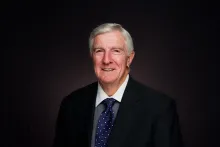
Before his retirement in 2021, Dr. Donald Ward pastored churches in Texas and Louisiana, and taught at Ambassador Bible College in Cincinnati, Ohio. He has also served as chairman of the Council of Elders of the United Church of God. He holds a BS degree; a BA in theology; a MS degree; a doctor’s degree in education from East Texas State University; and has completed 18 hours of graduate theology from SMU.
