
Robin S Webber
This transcript was generated by AI and may contain errors. It is provided to assist those who may not be able to listen to the message.
Today we're going to begin a series on prophecy. The series is going to be entitled, Not One Stone. And we are going to use what is going to be called the Olivet Prophecy, discovered in Matthew 24, as a guide to open up the future. Open up our future, and a future for all of humanity.
We're going to look at it. It's not going to be what I'm saying. It's not going to be what another televangelist is saying. It's not what somebody that has written a book is saying. It's going to be from the words of Jesus Christ Himself. Now venturing into the future, as Christ intended, means that we not only look ahead, but we look at ourselves presently as to where we stand. Let's just take for a moment the word prophecy. It's a word that we use, but it's not the original word.
It's not the language that was used in the Bible, because the language in the New Testament was out of the Greek tongue. And the word there is prophetaea. And that one word actually has two different meanings. One meaning actually means to foretell. In other words, to describe and to explain the wonderful works of God that have been and or are. So that can be a meaning for prophetaea, which simply means again to foretell. Now, at the same time, that word has another meaning. Allow me to share that with you. The other meaning is to foretell. A term that we're more familiar with, isn't it?
In other words, we think of it as foretelling the future. Looking ahead and describing that, which is yet to come, that we go into the future and meet. So we have to foretell and we have to foretell. How do we bring these words together? That and these different meanings. All of them belong to God. Whether it is to foretell and or to foretell, it is about describing the sovereignty of a creator God in the life of His creation, humanity.
And that's what we need to understand. Beyond that, beyond prophecy being about the sovereignty of God, there's another important item that we need to deal with as far as the ground rules. And that is simply this. That prophecy, while it has details and facts, figures, and sometimes because of the apocalyptic literature, a lot of imagery and a lot of different items, a lot of details, and a lot of information to access.
But let's understand something and let's do this so that we can move forward because we're going to be spending a lot of sabbath on this. Prophecy is not simply about information. If you are looking for information and information alone, that is not what prophecy is about. Prophecy is not simply then about information, neither is it just simply about inspiration.
Prophecy can indeed be inspiring because when you read the end of the book, you come to understand something very exciting and very inspiring. And that is that when you read the end of the book, God wins and that can indeed be inspiring, especially if you're a believer in God. But if we only leave it simply at information, if we simply leave it at inspiration, we will fall flat when it comes to prophecy. Prophecy at its greatest and its most effective is about transformation. Not simply transformation of this earth moving from one age to another, but your own personal transformation right now, today, in the here and now, as you begin to understand these words.
Let's go to Scripture to understand how that works. Join me, if you would, in the book of 2 Peter. 2 Peter 3. Now, this moves into the furthest details of prophecy as one age passes into another, one earth passes into the new heavens and the new earth in that sense.
But join me, if you would, in 2 Peter. Let's notice God's comment on this through the Apostle Peter. In 2 Peter 3. And let's focus, begin in verse 11. Therefore, now that you know all of these things that I have shared with you, since all of these things will be dissolved, what manner of person ought you to be in holy conduct and godliness?
Let's understand something basic about Christianity 101, please. Christianity is not about what you know. It's about who you follow and what you are. You know, when that day comes of judgment and we come before that judgment seat, what's the first question that Jesus Christ is going to ask you? Is He going to ask you what you know or what you did?
I would recommend it's not going to be what you know, but what you did with what you know.
It's going to be simply about information. It's not going to be simply about inspiration. It is going to be about transformation. So what manner of person ought we to be in holy conduct? Because Christianity was always about conduct, not about precept alone.
Conduct. How has your life literally changed in godliness? Looking for and hastening the coming of that day of God because of which the heavens will be dissolved, being on fire, and the elements will melt with fervent heat as one world moves into another.
Now, as we look at this, then, we come to a very simple conclusion.
It's not simply having eyes towards the future and wondering and worrying about everybody else, but having a hold on our own hearts and giving them to God once we recognize His purpose, His plan, His promises, and His provision. One more basic ground rule then.
Thus, when we put this all together, it's very important to understand that discussing prophecy and the biblical intent is not merely about physical deliverance.
The Bible is a book about spiritual salvation. Spiritual salvation.
How and what lens you look through, whether you simply look at prophecy about being physical deliverance or whether you look at prophecy being about spiritual salvation, not only for ourselves, but for all of humanity that will accept the name, the life, the death, the resurrection of Jesus Christ.
What lens you look through is how much you will receive out of the Bible and what God will grant you by His revelation. Understand. As we look through those lens, there's two things that we look through. We either look through the lens of God's love or we look through the lens of fear.
I have a question for you, only that you can answer. Some of you that have dealt with and handled prophecy for 40, 50, 30, 20 years. How have you always approached prophecy? Has it been about God's love or has it been simply about our human fear?
What is the great motivating factor? That's why I want to bring this presentation called Not One Stone. That's going to be the title of the series. It's designed to always bring us back to one consideration. What are we building on? What are we building with? And in whose spiritual household do you and I reside? With that stated, those are the ground rules. As I said before, we're going to go into Matthew 24. Let's start moving our fingers and moving our eyes over to the Gospel of Matthew. We're going to use Matthew 24 as a guiding light to this series. But as so often occurs when reading the Bible and I'm getting you to Matthew 24, I'm actually going to stretch you. So you've got to understand, I do this oftentimes, so I'll say, and some notates will be out there and put down Matthew 24 and verse 1. Let's say, I actually want to go further. So we're going to go further. Because what happens is, have you ever noticed the Bible that is really neat to have chapters and verses? It makes it so simple, other than that is oftentimes not where the story begins. The story actually begins in the preceding chapter, and our good friend that divided the Bible down into sections, did us a service, and at times did us a disservice. And so we're going to go back a little bit further and understand where the story begins. Because when you come to understand where the story begins, it becomes our story. Because y'all, the prophecy is basically moving off of a discussion with covenant people and then dealing in a discussion with people that are of the covenant. Matthew 24 was designed for the church. It was designed for a spiritual community to understand what God was going to do. Let's appreciate as we move into this section of Scripture what's going on. Where does Matthew 24 fit into things? Let's understand, first of all, that these are the concluding days of Jesus' earthly ministry. He's been preaching for about three and a half years. He is now in the environs of Jerusalem. He is in Jerusalem, which is very important because Jerusalem is indeed the bullseye of biblical prophecy.
It's the bullseye. It is the ultimate target. And this message, as I just said, is the spiritual message for spiritual people. Frankly, frankly, both in the previous audience that we're going to discuss in a moment and the audience that it is given, an audience that should have been further along than it was. Nonetheless, Jesus did give that message. But it really begins here in Matthew 23. And let's take a look at verse 23. Matthew 23 and verse 25. He's having a discussion with the church folk of his day, the religious community of that day, the god worshipers. And they were sincere in their worship. And they were very, very, very zealous. But they were missing some very, very important points. Matthew 23, verse 25. Woe to you, scribes and Pharisees, hypocrites, for you cleanse the outside of the cup and dish, but inside they are full of extortion and self-indulgence, blind Pharisees. First, cleanse the inside of the cup and dish, that the outside of them may be clean also. Now it's interesting, verse 27. Woe to you, scribes and Pharisees, again, the woe word, your hypocrites, your phonies, your shams, for you are like a whitewashed tomb, which indeed appear beautiful outwardly, but inside are full of dead men's bones and all uncleanliness. Basically, you look like you would smell like a posy on the outside, but you are rotten like all the cheese from Denmark on the inside. Then notice verse 28. Even so, you outwardly appear righteous to men, but inside you are full of hypocrisy and lawlessness. Verse 29. Woe to you, scribes and Pharisees, you're hypocrites because you build the tombs of the prophets and adorn the monuments of the righteous. Ah, build edifices, stones. We're moving into a discussion here. Now it's very interesting if you will look at verse 25, verse 27, verse 29. God says woe, and He's not talking to a donkey. When God says woe, that's to get our attention. Woe!
He's telling us something here. These were people that thought they were religious, thought they were on the right foundation, thought that they were full of the love of God and the purpose of God. These are not people that did not have a working knowledge of God. He's talking to a religious. He's talking to a spiritual community to wake them up.
Therefore, you are witnesses against yourself that you have you are the sons of those who murdered the prophets. Fill up, then, the measure of your father's guilt. He calls them serpents in verse 33. Notice in verse 36, it's dropped down. Assurely I say to you, all these things will come upon this generation. And then this tremendous lament that goes up from the from the from the the mouth of Jesus. Oh Jerusalem, Jerusalem, the one who killed the prophets and stones those who are sent to her. How often I wanted to gather your children together as a hen gathers her chicks under her wings. But you were not willing. Verse 38 now, after the emotional plea, comes an indictment. Comes a statement of judgment. See, your house is left to you desolate.
For I say to you, you shall see me no more until you say, blessed is he who comes in the name of the Lord. Now this is going to be setting us up for chapter 24. Jesus says your house is left to you desolate. Now when Jesus said that, he was speaking to an audience that was in the process of rejecting him as Messiah. He was in a sense dealing with real people at a real time, with real statements that were going to occur in their life. For in 30 to 35 years after that would come to Judeo Roman wars. The fall of Jerusalem would come. The destruction of the temple in 70 AD. One of the great massacres. There have been so many in history, but this city has one of the greatest massacres that ever occurred under the foot of the Romans. Later on, 50 years down the line, 134, 135 AD, you have the Barcatha Rebellion. What the Romans started in 70 AD, they basically extinguished the city of Jerusalem, as it was known. Changed the name to Aelia Capitolina. Put a temple of Jupiter on the Temple Mount. And that's how it got the name Aelia Capitolina, because the the temple of Jupiter in Rome was on the mountain of Capitoline in the Rome. And so it had the Roman beast stamped on it. And Jesus was saying, looking into the future, your house is going to be desolate. But let's understand something. I suggest that this moves even beyond 70 AD and or 135 AD, because oftentimes prophecy is what I like to call layered as types, as anti-types, as partial fulfillments, has greater fulfillments. Doesn't mean that they are not, in a sense, in tandem, but moving to a greater sum in the future. And I believe that's going to occur, because when you notice this, for I say to you, you shall see me no more till you say, blessed is he who comes in the name of the Lord. It says, you will see me no more. Now, Jesus knew that he was going to die within days, but he was telling them that he is, in that sense, coming back. He says, you will see me, but you will see me no more. Now, what is the occasion here? Notice, until, till, you say, blessed is he who comes in the name of the Lord. In other words, there has to be a spiritual awakening within the populace of Jerusalem that will not put the man of God on a hill outside, but open the gates of the city and welcome his sovereignty in the future. So, there's a lot of things that have to go on between then, which is spoken here, and the future now. And that's why he's going to lay out Matthew 24. What Jesus is basically saying here, and it's only four lines long in the verse, this verse is saying a whole lot more than at first glance. He is talking about an intervention. He is talking about a massive re-education. He is talking about a restoration of the city of Jerusalem, not against Christ, but under him. When that populace will say, blessed is he who comes in the name of the Lord. With that now, we open up into Matthew 24. We come to a startling scene, because I would suggest that as Jesus is basically chiding, correcting, and exhorting the religious community that is in Jerusalem, guess who's with him?
Now, I'm not a fly on a wall, but I would suggest that the disciples, later apostles, were hearing all of this. But notice where their head or where their heart is at. Then Jesus went out and departed from the temple. You know, it's very interesting that it's amazing that he said all of this. This was not done in a back alley. This was not done down by the riverside. This was not done out in a field. He was doing this at the epicenter of Judaism in his day in 31 A.D. Jerusalem is where X marks the spot. The temple in Jerusalem is the double X. It is the very center of the religious attention of that day and age. Jesus went to those that needed to hear that message. Now we come to Matthew 24. Then Jesus went out, departed from the temple, and his disciples came up to show him the building of the temple. Now, after this, what shall we call it? This very earth-shattering, mind-blowing, if I can use a phrase out of the 60s, for which I'm a child, heart-rending, pow! At the religious community, what are the disciples doing? They go out and they depart from the temple and said they came to show him the building of the temple. They wanted to go on a tour. They said, hey, I want to go to Disneyland. Well, Jerusalem in that day and age, a bunch of Galilee and fishermen would have seen it seem like 42nd Street or Times Square or Park Avenue or you name it. Here are the boys from the hills and they're down in the city.
They are ready to have the tour. Where's the bus? Ready to go. They're going. After Jesus had just said that your house is desolate and it is all coming down, where is the mind of his followers? Wow! Look at that! And, you know, in a sense, it's interesting what's going on here. Jesus says, your house is desolate. The disciples are saying, look, Jesus, Yeshua said, look how great, look how enduring, look how stable. Either they were in major denial and or they were not fully informed. Now, how about us? Sometimes when we've had a riveting or hopefully a transformative message that encourages us or excites us or points us to the reality of what's happening. And for the moment, he said, yeah, yeah, I need to do that. Yeah, I need to get on top of this. Yes, I need to have God help me. Yes, I need to be a pilgrim in this world. Yes, I understand that this is not my age. I look forward to the age to come. And then as soon as we get out of here, oh, it's so beautiful. You know, and your mind gets off the message, gets off the calling, and we are wowed about what humanity is doing rather than what God is doing. Am I talking to the right audience? I think so. Because I'm talking to myself. Now, the disciples.
And if you and I were there with them, we probably would have been wowed too because, you know, the temple was really marvelous. It probably would have been one of the seven wonders of the ancient world other than a Greek made up the list. And basically, it was most of the wonders of the world were either Grecian or Egyptian because the Greeks adored the Egyptians. So that tells you why the temple wasn't on the number at the time. What was that temple like? Well, let's understand that by that time, around 31 A.D., that Mount Zion had been leveled off.
And a lot of it had been leveled off into a great plateau. And on that plateau, it was a massive plateau. The plateau is actually 1,000 feet square. Let's think about that for a 1,000 feet square. How many have been on the temple mount? I'm sure somebody here has. Okay, well, we're all going to be there one day. That's why I'm here today, is that one day we'll be there. But it's about 1,000 feet. One way, 1,000 feet. That way, 1,000 feet. About 1,000 feet square. 1,000 feet to kind of get us all together. That's three football fields long. That's a lot of acreage that was leveled off, Mount Zion, and leveled off. And at one corner, at the far end, was the temple with all of its white marble. And on that marble, it was painted with gold. And by tradition, by legend, that at certain times of the day, you could not even look on the temple because as the sunlight came off that gold, it just blinded the people to even be able to gaze and to look upon it. Now, we found that Christ was up there on the temple. He's probably preaching on one of the porches. And the temple was surrounded by all sorts of porches. There was Solomon's porch. There was the the royal porch. And these porches were upheld by pillars made of one slat, one part of stone of marble. They were 38 feet high. And or if you go to the commentary, it'll say 37 and a half feet, but I'm just running off for you. Okay, they were 38 feet high. That's a lot of marble, a lot of stone, one piece. And they were so great that it would take three men with their arms stretched out. And I'm a fairly good-sized guy. I am shrinking, but I'm still fairly good-sized. About like this, you picture three men. That's how big those stones were. And to understand that also that at some of the angles of the temple itself, the stones that were there were 20 to 40 feet long. And some of them weighed up to 100 tons. And a lot of people, and you know, let's please understand, you would think that Israeli archaeologists would be pretty smart archaeologists if you have an archaeologist. And they don't even know how some of those stones were engineered to get there. In other words, the temple was a marble. And it's little wonder then that the disciples said, wow, and wanted to have Jesus join them on the tour. So now that we've been on the tour, now we're going to go to the next verse. And notice what happens. And Jesus said to them, do you not see all of these things? What was He saying? All of these things, these these porches, the temple, the porches, the patios, and there were many, many edifices that actually moved out from the temple, such as walkways and aqueducts and all sorts of different edifices around that. He said, do you see all of these things? Assuredly, I say to you, not one stone shall be left here upon another that shall not be thrown down. Oh, you're talking about a party pooper. The disciples are all excited. We're on tour.
And He says, you look at all of this. To use a modern-day parallel, be like for any of us that have ever been to New York City, Gotham, Babylon. You have never seen so much concrete on one 12-mile stretch of islands. It just, when you're from New Jersey looking over the Hudson, from the looking in, you go, unbelievable. How did it all get there? And to use a parallel, it'd be like somebody here saying, not one stone will be left standing. Jesus was making a statement here, that shall not be thrown down. That's where the title of this message comes, not one stone.
But when you obtain the fullness of the scripture, while this is very real, dealing with a real edifice in real time, I believe the dimensions of this phrase go beyond simply the temple in Jerusalem. And for you and I to understand, as students of the Bible, that ultimately everything is coming down. We might at times understand that academically. We may not understand that it needs to come down, and that Jesus Christ does need to come back to this earth.
That humanity does need a new start, does need a new beginning, and that is what Jesus Christ is going to be talking about here. He gets their attention. And what's interesting is that he is speaking about this on the Mount of Olives, because that's where he's taken them. Now, as he said, on the Mount of Olives. So, they're on the Mount of Olives. Now, that's very interesting when you think about that, because olives, the leaves were used in the reaves, oftentimes in antiquity. And they were often used to crown those that were conquerors, those that were victors, those that won in the end. God never makes an accident. There's always a reason why he does something, and oftentimes in the setting, that to recognize that for you that have been to Jerusalem, and for many of us that have been to Jerusalem, at least in books, is to understand that when you're on the Mount of Olives, you are looking down on Jerusalem. You are looking at that temple. So, as the master educator of which Jesus was, he has the prime classroom now to teach his disciples to teach his students what is going to occur from the time of his ascension until the time of his return. And that's a very simple way of bringing the all of that prophecy down to common denominator. The all of that prophecy describes the world from the time of Jesus' ascension when he goes to heaven until the time he comes back at his second coming. And so then he says, as he's on the Mount of Olives, they come to him and say, tell us when will these things be, and what will be the sign of your coming and of the end of the age? And this was very common within Jewish parlance because the Jews basically looked at the world that was, the world that is, and the world that is yet to come. They divided it down like a pie. It was real simple, like in three pieces. The world that was, the world that is, and that age that is indeed yet to come. And so they come with questions that you and I have for 50 to 40 to 30 years ourselves. We want to know who, what, where, when, why, and how, and we really want to know the when. When will it come? And Jesus answered and said to them, and this is the power of the all of that prophecy because, again, these are not going to be my words. These are not the words of a televangelist. These are not the words of a Christian author. We're going to be looking through the very words of Jesus Christ. And that's very important to realize that Jesus, being God in the flesh, could actually perceive and look into the future, meet the future, and bring it to us. Jesus was not just simply a babe and a manger. He was not just simply a Jewish man of 33 years of age that died hideously on a cross, but he was also in that sense a newscaster. He foretold the future, and he brings the future to us. Now, have you ever watched The Weatherman on television at nighttime?
Have you ever seen a weatherman try to predict what's going to happen even a day ahead, and how they can get it wrong? I remember about two years ago, I think we're where we are now, and they were predicting the storm of the century. It is hovering off of the coast. It is due to come in. Be ready at four o'clock tomorrow. You should be off the road.
You know what? The storm of the century in LA never even hit, which went another way.
And yet, here is Jesus Christ to be able to tell us, to offer us encouragement of what's going to happen for the next 2,000 years. Now, it's very important. I want to share a thought with you. May I? Here's a thought that we need to understand. There are many professing Christians that accept the messenger, but they don't accept the message. They accept the messenger.
They understand who Christ is to the degree they do, but they don't accept the fullness of the message.
They accept Him as the babe and the manger. They accept Him as the Christ on the cross.
But they think of Him simply perhaps in a stained glass window, or maybe up in a ceiling, looking up in their church. And if they've done that, they have departed wide from what God wants them to do. There are other people that will, in a sense, accept the message, but they have not accepted the messenger. Both are far wide of the mark. It is important for us as Christians to not only understand that Jesus came with a message, but He is the messenger. That He is not only the messenger, but He is the message. And understand what God gave Him, which we're going to be talking to in a few minutes. That Jesus was indeed a prophet. Join me if you would for a moment in Deuteronomy 18. Because, again, this is actually a prophecy that Moses gave 1,500 years before Christ. Deuteronomy 18. Moses speaking, the Lord your God will raise up for you a prophet like me from your midst and from your brethren in Him you shall hear. And that's what Jesus is going to do now. The Olivet Prophecy. He is going to prophesy. And the importance of the Olivet Prophecy, which is found in Matthew 24, Luke 21, and also in Mark 13, is to understand one thing and to remind this audience today, as Jesus wanted to remind the disciples of His day, that God is not just simply a first cause. God is not just a creator. He is not just simply a first cause. He did not just simply wind up the universe and let it spin out of control. There is a purpose. There's a plan. There are provisions. There are promises that He's going to carry out that are going to be found in this Olivet Prophecy. And God decides when and where and with whom He decides to intervene. This tells us that God is not just simply a first cause, but He is an intervening force in human affairs. And He chooses the when and the where and the how to do it.
Not to please you or me, but that He might be glorified. And again, that's a very important concept to understand. As we're building the foundation, we've started with Matthew 24, but now I want to, in fairness to you, because we're later going to be going back and forth, we need to understand something. Before we go any further, I want to go a step deeper and a little wider, and to help you to understand that prophecy or the words of Christ are not just simply fully understood or appreciated in just one set of scriptures. To understand that the Bible interprets the Bible and or complements the Bible. It will never contradict, but it will complement or bring out other meanings. And there are incredible parallels between Jesus' earthly ministry, as established here, and what He did later in His heavenly ministry as the ascendant Christ. What we need to understand, and some of you have maybe never heard this before, understood it, let's understand that the prophetic message of the Bible is seamless.
That from even before the time of the Noatian flood, there was the promise of the return of a Messiah, that there was going to be a rescue from that fall of Adam and Eve. Jude 14, you can jot that down, you can look at it later where it says, and even Jude said that the Lord is going to return with thousands of His army to this earth. Later on, Daniel brings us the same message. Daniel tells us about the collapse of kingdoms of man and ultimately the rise of the kingdom of God. You find it in the all of that prophecy. You also find it in the book of Revelation. And I want to go to Revelation for a moment. We're just maybe going to lay some foundation today. Join me if you would in Revelation 1. I want to show you something here. Sometimes people make the mistake of calling it the revelation of Saint John the divine. This is not the revelation of a man.
John was a good guy. He was there at the end. I think all of us appreciate John, but it is not John's revelation. Interesting, I'm going to take it a step further to understand ultimately where the revelation comes from. Verse 1, chapter 1, the revelation of Jesus Christ. And that's normally what it's called. It's called that in my Bible. Is it called that in your Bible? It says the revelation of Jesus Christ. But are you ready to take it one step further?
Here we go. Are you with me? The revelation of Jesus Christ, which God gave him. Have you ever noticed that before? The revelation of Jesus Christ that God gave him to show his servants things which must shortly take place, and he sent and signified it by his angel to his servants. So when you take it all the way up and you just allow the Bible to interpret the Bible, you come to understand as magnificent, as wonderful as Jesus Christ is, that ultimately it is even the Father that is involved and God that gives the revelation of Christ who is indeed the revelator to give to us. To see how exciting this is, join me over in Revelation 5 for a moment. In Revelation 5, and let's notice one of the great scenarios that is going to play out. And maybe you've never noticed this before, and if not, I'm glad to be able to share it with you. It's one of those gripping moments in biblical narrative. And I saw in the right hand of him who sat on the throne, a scroll written inside, and on the back sealed with seven seals. I would suggest that Revelation 5.1 bears witness of he who begins the story in Revelation 1 and verse 1. This is God. And there are seven seals. He says, and on the back is a scroll, and on are seven seals. Now that's very important. Seven seals in his hand. Let's remember that this is being written during the times of Rome. And in Rome, Roman legal documents were witnessed and sealed by seven witnesses. Boy, that made a busy day for you, didn't it? You had to ground up seven witnesses. Roman legal documents had to be bound and had to be documented by seven witnesses. Why? To denote truth and completion. It was both to testify to truth, but also that the complete evidence for legal matter was there. Now, when you take the number seven, let's think this through, because we're going to be dealing with seven and future Sabbaths and messages. Seven is a number in the scriptures itself that is synonymous with completion. Who can help me with just a very easy story out of the Bible with the number seven? This is not a trick question. You always have that look on me like I'm going to trick you. This is not a trick question. Yes, Gloria. That's very good. See? That's good. I didn't have that in my notes, but that's perfect, because it's seven. That's right. Did you ever take a test when you were younger and you gave an answer that the teacher had a different answer so he didn't accept your answer? Because, yeah, Skip, are you like that in school? Oh, boy. Okay, anyway. No, that's very good, Gloria. Thank you. See, that's why you need to come to Bible study in the middle of the week. You learn things from the members and Bible chat group. So, Gloria, you can come over anytime to the midweek Bible study.
Okay, what else is seven in the Bible? Please, somebody out. Reuben. Yeah, but you're right. It's all right. But what else, Skip?
Thank you. That's Mr. Weber's in his notes. The seven days of creation, the completion, which is actually yet to occur when you understand the fullness of the Sabbath and God's spiritual labor in us. Okay? Seven. It's completion. I knew we'd get to it. But then, let's go down a little bit longer. Then I saw a strong angel proclaiming with a loud voice, Who is worthy to open the scroll and to loose its seals? Now, it's interesting. Notice at the back, it says it's a strong angel, so even the angel could not do it. See, God never wastes a word in Scripture. He's setting up a word play in our minds. The strong angel proclaims with a loud voice, No, this guy had spiritual heft. Who can do this? And no one in heaven or on the earth or under the earth was able to open up the scroll or to look at it. Then notice verse 4, one of the one of the saddest moments leading to one of the greatest triumphal entries in history.
John's speaking, and I wept much because no one was found worthy to open and read the scroll or to look at it.
He just came undone. God was already on a roll of revealing things to him. John was had this opening and vision to what the kingdom of heaven was like. He could see this imagery. He could understand this. The story was about to unfold, and now it looks like it wasn't going to open up. Can just kind of be there with John and understand his the trauma that's going on. He's weeping.
He feels he's going to be shut out, that there's no hope. But one of the elders said to me, Do not weep. Behold, the lion of the tribe of Judah, the root of David, has prevailed to open the scrolls and to loose its seven seals.
So it begins the story about, in verse 6, about there stood the Lamb, having been slain. And then verse 9, and they sang a new song, saying, You are worthy to take the scroll, to open its seals, for you were slain, and have redeemed us to God by your blood, out of every tribe and tongue and people nation, and have made us kings, and preached to our God, and we shall reign on earth.
It's Jesus Christ that is worthy and able to reveal what is in that scroll, and to slowly unbind those seals to show the plan of God. Isn't that exciting?
And isn't that interesting that, again, just like I was talking to you about, remember, at Pentecost, let's think about this. Let's bring prophecy into our personal reality, and the reality of those that have been the saints of God. Remember those men in Jerusalem, how desperate they were when they found out, you know, after Peter's sermon, what they had done? Oh, no! What have we done? We killed God, you know. Whatever shall we do?
It was at one of those moments in human history to where there was no way out, hopelessness multiplied many times over. God offers hope through Peter. I'll tell you what to do. Repent, be baptized, and receive the Spirit, the great hope. Here again, that plays out again. No hope. John feels like he's dug in a hole. There is no sunlight coming in. Revelation is being sealed off. There's no way that we can see the future.
Be like going to the edge of the Grand Canyon and not being able to look in. You've gone the whole distance over to Williams. You know where Williams is. Some of you do. And then you take that straight line in for 60 miles, and then you run up short. You think you know what it looks like. You want to know what it looks like. Kind of have a feeling what it might look like, but you stop a day late and a dollar short and you can't look over. Frustration. And that's exactly what's happening. And then comes the great hope, Jesus Christ. Which really sets the play of prophecy of some of the things that Jesus is now going to describe in the Olivet prophecy. And as we look at the parallel accounts in Revelation, that there is some discouragement that is in the future, humanly looking. But the great hope is always Jesus Christ.
Now with that thought, we're going to move forward for a moment.
We're going to move forward. Because I want to set the stage. I don't know how far we're going to get into it today. We're going to go to about 330 and we'll conclude today. But let's move forward. Because it's very important. Let's go back to Matthew 24 now.
Matthew 24.
When you read Matthew 24, and if you just read it through one read, you might think it's all just one story about the same event.
But think so. Now the ultimate event is, yes, Jesus Christ has come back. God is victorious. And if God is victorious, thus we as the saints of God, we share in that victory. Isn't that wonderful? But let's understand something. There are three terms I want to give you here. Because really, as we go through Matthew 24, which is 51 verses after this, about 48 to go, we need to understand that there are three separate stages of prophetic development. And I'd like to share that with you. You may want to jot that down if you want to be a student of the Bible. There are three separate stages of prophetic development that are going to be occurring here. Now this is very important to understand to begin with. Because what do you do when you go to a ballpark? Have you ever been to a ballpark? What do you get at a ballpark besides peanuts? You get a program because you've got to know who is at plate. And when that ball goes out over the center field, you want to know who hit it or what's the power behind it. There are all sorts of things that are happening here, and you have to know where the balls are coming from and where the balls are going out and who are the players on deck. Because there are three different developments. Doesn't that kind of make it fun to understand it that way? Let's understand something here. Let me share that. Number one, there is the time of man. There is the time of man.
Number two, there's the time of Satan's wrath. The time of Satan's wrath. And number three, there's the time of God's judgment. See, you need to be able to explain these things, brethren. And they are explainable. The time of man, the time of Satan's wrath, and the time of God's judgment. Because there's a lot of challenging articles and events and episodes you're going to be dealing with. Some of them are man's responsibility. Some of them are Satan's responsibilities. Some of them are God's responsibility. And you need to know who to direct the attention towards. Let's put it this way. Let's understand this. The first seven... when we deal with seven seals, which are basically complementary to Matthew 24, which I will show you. The time of man is the first four seals. The first four seals.
Revealing events in a world, man's world. Man apart from God. Man confronting God. The course of human history without acknowledging God as sovereign. That is the story of the first four seals. I didn't know that. I know you do. It's that simple. The first four seals are about human history from the time of Jesus' ascension until his return. But then we have the time of Satan's wrath. That's not the same as the time of human history. That's the fifth seal. The fifth seal. That's the time that is referred to as the tribulation. The time of tribulation. It's the time of Satan's wrath. And we need to understand that. And then there is, lastly, thirdly, the time of God's judgment. That's the sixth and the seventh seal. That's the heavenly signs. You know, the heavenly signs are really just God's way of pushing his finger on the cosmic doorbell. I'm coming. And he rattles the heavens. That's just a way to think about it. To get humanity's attention. The cosmic doorbell. It's his way of entrance. The very sovereign of the universe shaking the heavens. Saying, behold, your Maker comes. Prepare to meet your Lord. We're going to be there. If I'm getting excited to be there, you don't want to miss it. But there's a lot that's going to happen in between. So we understand these things. And we need to know that because when the balls start flying, we need to know which direction they're coming from. Now, with this framework in mind, I'm going to try to lead you very quickly into some thoughts here. We're going to get right into some things that Jesus said would come. Let's notice this.
And Jesus answered and said, and take ye that no one deceives you. For many will come in my name, saying, I am the Christ, and will deceive many. And so the first thing that Jesus says here is that there are going to be individuals that are going to come at us and say, I am Christ or I am of Christ, Christian teachers with false unbiblical teachings and ways. And none other than Jesus predicted that. It's amazing how that parallels. If you'll join me in Revelation 6, and let's pick up the thought with the first seal that is mentioned that is unloosed. Now, I saw when the Lamb opened one of the seals, the first seal, and I heard one of the four living creatures say with the low voice, saying, come and see. Hey, you better look at this. See, come and see doesn't quite give it. Says, look, you better understand this. Have you ever done that with somebody when you've seen something? Say, you've got to come over here and get this.
You need to look into this. And I looked and behold a white horse.
And he who sat on it had a bow and a crown and was given to him. And he went out conquering and to conquer. Now, I have a question for you. Some of you grew up in the 50s.
Some of you grew up in the 60s. Some of you grew up in the 40s. Thought he'd get you at the end. Remember all those cowboy movies? Who was normally the guy that was on the white horse? Pardon? You're the good guy, you know, coming over the hill on what? The dapple gray pony? I don't think so. He always came over on, you know, a white horse that you've never seen before because I've never seen one white horse look that good as he did in the westerns. Maybe it's just because I was smaller and looking at my television and had my hop along Cassidy outfit on in the 50s as I watched the hop along Cassidy. Was he on a white horse? Yeah, Skip, you were alive then, yeah. You were alive before that, okay. Go, wow, well this must be the good guy.
But it says that he has a bow in his hand and he comes to conquer. This is actually matching what Jesus, his heavenly ministry and the statements there of are matching what he said in his earthly ministry. He said, be careful, not everybody that comes saying I am Christ looks like Christ or is on a white horse is the good guy. In fact, did you realize that there are two individuals where, uh, uh, riding two white horses? Do you understand that in Revelation? Join me if you would for a moment and let's go to Revelation 19.
In Revelation 19 and verse 11, now I saw heaven open and behold a white horse and he who sat on and was called faithful and true and in righteousness he judges and makes war.
Oh, here's another one on a white horse, but he is faithful and he is true. Now you say, but, but now wait a minute, God, why are you making it so difficult for me? I'm trying to follow you and now you've got two white horses out there. What's going on? And they're both things are of Christ. Well, well, how do we approach life with Christ in us? How do we approach the future in fear or in faith? Are we afraid that God will allow us to make a mistake and choose the wrong horse, the wrong guy on the white horse? Or do we have faith and confidence that God has brought us this far and that a good God with a wonderful Holy Spirit will show us how and who to follow.
And it's not always going to be easy with prophecy. Join me if you would in Revelation 13. Come with me for just a second. Revelation 13. Because he says, you know, there is going to be religious deception in the future. We need to be aware of that. Revelation 13 kind of shows how it can happen in Revelation 13. Verse 11. This is the story of how Satan, and we're going to get into this next time, about how Satan is going to be cast to this earth, which is actually what sets up the fifth seal, which starts with the time of Satan's wrath known as the tribulation and how things are just going to propel forward. And we're probably going to get to that next time. That starts in verse 9. You might want to circle that if you're there. Verse 9, Matthew 24 verse 9. The then is like where the gear shift comes in from the time of human history into spiritual intervention, both of God and of Satan into this world. But notice what it says in Revelation 13. Then I saw another beast. Well, there's what we might call a big beast, which is a temporal power. But then there's this religious power, this second beast, the smaller beast, that affiliates with this greater force in the future. Then I saw another beast coming out of the earth, and he had two horns like a lamb, and he spoke like a dragon. There you see in a sense the heart of the beast is revealed. Have you ever done that, where you've gone to somebody's house and you go, oh, there's a cute little pooch. Come here, boy.
You know, looks are deceiving. Looks are deceiving. And what Jesus Christ is telling the saints, the spiritual community of God, whether at the time of the disciples or we that are here today, is not everything that glitters is gold. And not just because they say they come and teach me and are of me, are they indeed of me? Jesus says, beware, be alert, test the fruits, know what you are getting involved with. Jesus clearly said that there would be the danger of false leaders. Let's talk about what a false leader is. What is a false religious leader? A false religious leader is a man who seeks to propagate his own version of the truth. Truth is truth. Truth comes from the words of the Bible, pure and simple. A false leader is a man who seeks to propagate his own version of the truth rather than the truth that is in Christ. Jesus said, I am the way. I am the truth. He was the glory of God. He is the image of the Father that was manifested to us on this earth.
And Jesus himself, while in this flesh and in this physical tabernacle, always lifted the glory to God. Not simply to himself. A false religious teacher is a man who tries to attract other men to himself other than to Jesus Christ.
Jesus's tongue is disciples. It's not going to quite happen, but this is what's going to happen along the way. I want you to be alert. I want you to be aware. Let's just go to one more. I think that's where I got into Redlands and we'll conclude. Let's go back to Matthew 24.
Matthew 24. And let's notice what Jesus says here. There's going to be this religious deception, and there's going to be a lot of lookalikes out there. There's going to be people that are going to sound really good. And the reason I'm sharing this with you, brethren, is simply this. That can be scary. Think, oh, you know, I could be deceived. And, you know, we could be deceived. But again, it's how you look at prophecy. Are we going to look at prophecy through the lens of God's love or through the lens of fear that somehow God is going to leave us and abandon us and just keep us down here on our own wondering? Isn't that the great hope, the great encouragement of the day of Pentecost? When Jesus said, you know, I'm going away, but I am not going to leave you what? Orphans. I'm not going to leave you alone. You're not going to be down here alone to figure this out.
My spirit will convict you and guide you and teach you. Verse 6, And you will hear of wars and rumors of wars. See that you are not troubled, for all of these things must come to pass, but the end is not yet. Jesus said that a world apart from God's way of peace is going to be consumed with war.
You know, it's interesting that the history of humanity is basically that of war with time outs for peace. Somebody, I don't know who it was, somebody's fifth cousin, there's always a fifth cousin that figures these things out, or some historian, has calculated that out of 6,000 years of recorded human history, there have only been 350 years of human history without peace.
The history of humanity is war with simply time outs for peace. Join me in Revelation 6 to find the parallel here of Jesus telling us in love and concern of what was to occur between his ascension and his return in Revelation 6 and verse 3. When he opened the second seal, I heard the second living creature saying, come and see. And another horse, fiery red, went out, and it was granted to the one who sat on it to take peace from the earth, and that people should kill one another, and that there was given to him a great sword. So here we find the complementation between the Olivet Prophecy and the Book of Revelation, the red and the fiery horse of war.
And you know, when you think about humanity, just from the time of Christ, I could go back and tell you about all the wars before, but just think of the time from Christ forward, 31 AD. You think of the great conflicts, the the Romo, Judeo conflict that brought Jerusalem down into ashes. You can think of the the great wars for hundreds of years between the the Romans and the the the the the the Alemani tribes of Germany coming across the Rhine, coming across the Danube, all the millions of people that killed. What about, in that sense, the expansion of Islam as it came up against the the the Hellenistic Byzantine Empire? The great on-slots that occurred is that that religious empire spread across North Africa, went into Spain, and even up into the doorways of Paris. All the people that died, the Crusades, which was the counter-move towards the Middle East, and the slaughter, the great slaughter, that occurred in the cities of Eastern Europe as the barbarian Franks came across the woods of Europe and killed and mauled and destroyed, whoever it was in their path, whether it be Eastern Christian or Jew or Muslim, they didn't care.
What about, as we move forward, the the great wars of the Middle Ages? What about the what about the 30 years war that left one-third of the Holy Roman Empire dead? Well, that was a long, long time ago. But we all know that the pilgrims landed in 1620. You know the guys with the funny shoes with the buckles? That's our country. But while that was occurring over in Europe and the old world, one-third of the Holy Roman Empire died because of religious warfare, religious to see, religious emotionalism often is tailed then by warfare. Let's understand that war is part and parcel of our community. Some of our grandfathers fought in World War One, the war to end all war, horrible war. Many of us in this room have the living memory of World War Two, the greatest conflict in human history. Some of you served in that war, some of you were kids during that war, 55 million people. And I think that's a really when you think about is probably a very low estimate, unfortunately, but it is said that 55 million people died in that conflict. And really, when you look at World War One, World War Two, many historians will just call it the Great World War that was just done in two sections. Why is that? Why is that? Isaiah 59 verse 8. Two verses will begin to conclude. Isaiah 59 verse 8. Jesus, who was the word, who was the one that inspired the prophets of old, inspired Isaiah with this. The way of peace they have not known. And there is no justice in their way. Of and apart from God, rejecting God, rejecting the principles of Christ, there's no peace. And there is no judgment. Notice what it says, there is no justice in their ways. Very interesting. When you look at 100 years ago, with what occurred to the German Reich, the Second Reich, at the end of the war, it was a bad peace. It was time to basically dump on the Germans and just to strip them of any nationhood. There was no real long-term thinking of keeping them afloat.
It was a bad peace that was found at Versailles. It made the Germans bitter. And out of their bitterness, then they went for a crazy man called Adolf Hitler. But it was in the judgment and it was in the justice at the peace table that set the table forward for what was going to eventually become World War II. That offers no credibility, no validation of what happened under the Third Reich. But because of what happened to the Second Reich with the Kaiser and the jump on of all of the winners and all of the victors without buying or any hope to come to the table, it set up something that created the next war. No judgment. No judgment. So war leads to war. You only leave one war undone. It leads to another war. Join me if you would again in Proverbs 14 and verse 12.
Proverbs 14 and verse 12. There is a way which seems right to a man, but the end is the way of death. Nobody wants war. Nobody longs for war. We have many, many of our diplomats going around the world on this day and in this age sincerely trying to solve the issues that confront 6.5 billion members of humanity. There is something missing that Jesus Christ is going to bring back. Now, I want to share something with you, and I conclude. You can put up your Bibles if you want to, but I share this with everybody that I go around to when I'm away from all of you.
Susan's with me sometimes, but wherever I am, whatever state, where whatever town I'm talking to, I always like to share this point, especially as we're right now going to what is called the Four Horsemen of the Apocalypse. That's oftentimes what they're called. I'm not talking about the line on the Notre Dame football team back in the 20s, but isn't it interesting that humanity, what humanity does is it basically takes what God doesn't want it to receive. And what man did out of the Book of Revelation? It took the Four Horsemen of the Apocalypse. And maybe sometimes you've seen some of those scary pictures out of the Renaissance of showing the Four Horsemen of the Apocalypse. That can just, you know, frighten you. And that's what humanity has taken out of it. But I have a question for all of you, please. How many horsemen are there in the Book of Revelation?
How many horsemen are there in the Book of Revelation? Are there only four? Kevin? That's five. That's right. You get an A. There's five. But so often, because people will look at prophecy through the lens of fear, all we see, all they focus on, are the Four Horsemen.
The whole key of all of that prophecy in the Book of Revelation is to draw our focus on the Great Horsemen. The Real Horsemen. The one on the double white horse. The one that doesn't ride over the hill, but comes from heaven above and through the clouds with the sound of the Archangel and with his own war cry when you read the book, and with the armies of heaven above. And with the armies of heaven behind him to rescue humanity from itself because it is opposed to God, confronted towards God, and has not had God in its history. The power of the Scripture is simply this. As we move into prophecy, there is only one name on the marquee when it comes to prophecy that needs to be in our heart and needs to be in our mind. It's not the false prophet. It's not the beast. It's not this obscure verse or whatever in Scripture or this obscure. We need to have front and center that God the Father above wants on the marquee of the kingdom of heaven, the kingdom of God, to come to this earth only one name. And that's the name that is manifested all the way through the Book of Revelation from Revelation 1 through Revelation 22. When you think of the Book of Revelation by the time that we're done going through this, you are going to be so excited that Jesus Christ is your Savior, is your champion, is the great revelator. He is the Father's answer for each and every one of us. You know, I was just I got to share something. It's so exciting. I was sitting down with Susan the other day and I was reading through the Living Bible translation. And it was just it's a very I got to bring it back to you. I was just so excited. Where was I the other day in that book? You know, I was reading through it. And sometimes you just read it in the King James and it just doesn't amplify the way another translation was. And it just said that Jesus Christ is the yes of God. It's just the yes. God just says yes and yes. And I've got the millers out there and they're going to start a Bible study in La Mesa and that's a yes.
And or the co-elles are going to do it in Rancho Bernardo and that's going to be a yes.
Andrew Paul Smith takes a phone call from one of you that are discouraged and he's on the phone and you know he's middle of the night, you know, he was asleep and all of a sudden he wakes up and God's spirit convicts him. And that's a yes. And that is what is so exciting about prophecy.
That we, humanly and I will suggest at times organizationally, have limited the yes, the big answer that God the Father reveals in prophecy. That when it's all said and done there will be not one stone standing, not one stone, be it a temple or be it a sepulchre of man. It will be all leveled before the Father through Jesus Christ. Now, if that doesn't get you excited, I know what can't, but that's why I'm so excited when I'm either with you today or when I can go around, I'm just kind of sharing what I strive to do when I go out on the World News and Prophecy Tour because sometimes we can just simply do a microcosm on prophecy and get down on all of these details and wonder if God knows what he's doing and, oh, look at this and we're trying to figure out this person and we're trying to figure out this event in the Bible or doing this or that. And you know, none of us have been elected to be a fly on the wall at some of those events. But God elected Jesus Christ from the foundation of this earth to be his yes.
And that's what the book of Revelation is, that when we read it at the end, because God wins, you can know that you win. And that's a mighty big yes.
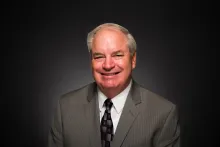
Robin Webber was born in Chicago, Illinois, in 1951, but has lived most of his life in California. He has been a part of the Church of God community since 1963. He attended Ambassador College in Pasadena from 1969-1973. He majored in theology and history.
Mr. Webber's interest remains in the study of history, socio-economics and literature. Over the years, he has offered his services to museums as a docent to share his enthusiasm and passions regarding these areas of expertise.
When time permits, he loves to go mountain biking on nearby ranch land and meet his wife as she hikes toward him.
