

Tim Pebworth
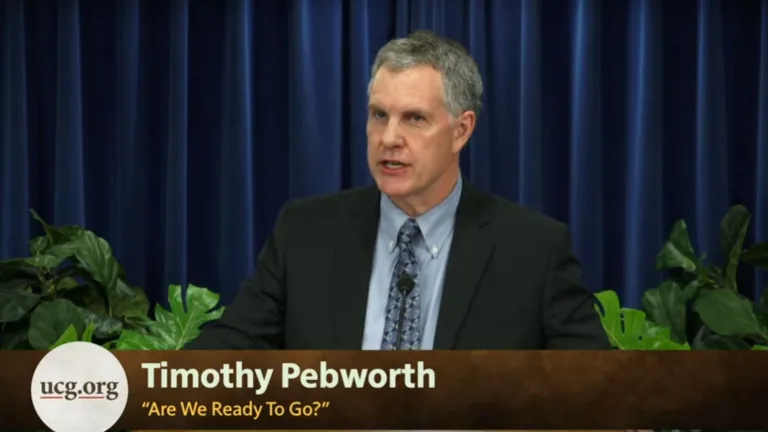
Among the many populations that are served by the United Church of God are those in French-speaking regions of the world. Mr. Tim Pebworth, the Regional Director for UCG French-speaking areas provides an overview of the outreach of God's Work.
This transcript was generated by AI and may contain errors. It is provided to assist those who may not be able to listen to the message.
First of all, yes, so my name is Tim Peberth. I am here. I'm here for the council meetings that we had. I'm also responsible for the French-speaking work of the United Church of God. I coordinate with a lot of other men in that regard, and I'll share that with you as we go along. We had great meetings here today, or excuse me, great meetings here this week, and hopefully you'll hear more about that. I'll do a short video next week and give you a little update. Thank you for your prayers for those meetings. It just went great.
I actually enjoy watching reels of surfers, and sometimes I feel like I'm in the wash and I'm wiped out, and other times I feel like I could get the wave just right, and that was definitely that. I sent that to my family. It was a great, great, great three days. You talked about several. You have to hear me both at times. Rex Exum is supposed to be up in Rome, but there's a little mix-up, so he's here, so you get to hear me twice. Hopefully you'll learn something, as one of my mentors shared with me. If you don't learn something, I'll tie your shoes.
If you don't learn something, let me know. I'll come over and tie your shoes or do something to help, but hopefully you'll learn something here today. Why am I talking about the French work? Well, my wife grew up in Paris. She was a young girl when a debar partying came and baptized her parents in the 60s. At this point, I'm a naturalized French citizen of about 10 years now, so they can't kick me out. Dual citizen, French-American citizen. I spend, actually my wife was surprised, Maurice is here with me, Marise in French, and I remind her I'm like three or four months in France or in Francophone Africa.
So this is a little bit about that area, and again, hopefully you'll learn some geography. I don't want to encourage people to be on their phones, but I'm going to probably mention places that you don't know where they are on a map. So if you want to look that up as we go along, that'd be fine. Let's see if this advances. He said the clicker would be up, but it may not work. So let's see if I'm advancing. I'm going back. Should I turn it on? Let's see.
I can press stop. I can press the top. Oh, something works! There we go. All right. So a little bit of history of the Francophone work. Actually, let me define that term. A word in English is Francophone, and Francophone is defined as a person who speaks French. We're actually Anglophones, and that's actually an English word as well, but we don't often think of ourselves as Anglophones. We're English-speaking. So that is the term that's often used, so now hopefully you'll learn something.
Francophone. So I'm going to use that term a lot regarding French-speaking countries. It was an early focus of the worldwide Church of God. Mr. Armstrong appointed actually his son, Richard Armstrong, in the 50s to be over that area, and then you might know that Richard died in a tragic car accident in 1958. And then eventually he appointed a man named Debar Partien to be responsible for the French-speaking area. So it's been a long, long time that the Church has been there. First Feast of Tabernacles in 1967, baptizing tours in the 60s. Attendance peaked in the early 90s at about 4,000 people around the world in French-speaking areas.
In 1995, most French-speaking members stayed in the worldwide Church of God. They came out of a Catholic background, and a lot of those things that they were preaching looked very different and new, and so a lot of them stayed. The United Church of God began with about 50 people in Europe and in Africa, not a lot of people. You'll see where we are today. So a little bit of history there. The Foncofoni, which is the technical term, is a group of about 56, if I get it right, 50-ish countries. They're in Brown on the map, and observer countries, which are in green, which are part of either the French-speaking world or they have affinity.
For example, Poland and Ukraine have great historical ties to France, and so they're part of that as well. There are about, I think if I've got it here, 29 countries, 350 million people. French is the fifth most spoken language in the world. It's the second most taught language in the world after English, and there are some estimates that it will eventually be the most spoken language in the world because of the birth rate of sub-Saharan Africa. 2050, 2055, it could actually be the number one spoken language in the world, or most widely spoken language in the world. We have 12 countries where we have members attending today in the francophone.
About 900, that kind of varies, 900 to 1,000. So we started with 50, we're at about 1,000 now. So obviously a lot of things happened from 1995 to now, but we're still very, very small in Europe. So most of that, as you'll see, is in Africa. So we have places like Benin, Burundi, Cameroon.
We have Canada, Quebec. We have French-speaking congregations there. Republic, the Democratic Republic of the Congo, Côte d'Ivoire, which is the official name. They changed their name from Ivory Coast to Côte d'Ivoire in the 1990s. Haiti, France, Madagascar, Rwanda, Switzerland, or in French we say Swiss and Togo. And it used to be, back in the day, there was one person responsible for this. It's just too big. So I coordinate with Chuck Smith for Haiti. I coordinate with Monique Knudsen for Rwanda, Rwanda and Burundi. I coordinate with the Canadian office with Quebec.
So there's a lot of coordination that goes on, but my wife and I have responsibility for support of the world. And then there's about, whenever you see it, it says Bureau in France. That's the French office. That would be areas where I'm directly responsible for. Is there a whole team here? And this is our francophone team. We have myself, Raphael Bonnard, Leticia Demarest, my wife, Marise, and Vernor Solozano.
Verna works in the home office. Raphael is a contractor in France, and Leticia is our office manager in our office in Bureau. And my wife, obviously, and I are constantly working together. My wife is actually the editor of the French edition of Beyond Today magazine, and this is her team.
We are, as I say, we are mighty in women. We don't have any men on her editorial team. So a great group. René Avilas is in Quebec and does a lot of translation for us. Martine is a French-Canadian, and she lives in Ohio, and then the others live in France. We have a website called Edouni.org. We have about 24,000 visitors each month to this, and it's under the umbrella of ucg.org. The name of the church in French is Église de Jourouni. So UCG does not mean anything to us in the French-speaking areas. The acronym is EDU, or ADU. So that's why we have the Edouni.org email, or excuse me, web address. And we have both our magazine, which we'll get in a moment, and then the church. So if you want to check us out, we're at eduine.org, and we have about 24,000 visitors. Actually, we've been doing a lot of work on this. If you'd seen this presentation a year or two ago, we were at 18,000 visitors, so we're pleased with the growth in that site. We have booklets and Bible correspondence lessons. Right now we're working on a five-year project to translate all the Bible commentaries. And so on our main page, as our connection to our audiences, you see a place to sign up for the weekly email, where you get three chapters to read and an official commentary from the United Church of God. And then if you want to join, you can join our weekly Bible study on Wednesday nights. And so that's kind of the first connection that people we promote for people. And then we have teaser videos and shorts and all sorts of things that you'd expect on the website as well. We have our YouTube channel, which is pretty small at this point, but it's actually a pretty important resource for our members, where we have our hymns and we have praise music. I know that term isn't so great, sorry, but you know, we're praising God through music, sermons, and other types of resources. We've been dabbling in Facebook and Instagram. I'd say we're actually doing very well in terms of our meta ads. We get typically a dozen or so comments where we're able to interact with those who are interested in this sort of every week, so dozens and dozens in a month. We're hoping that would translate into more people going on to our page and following us. It hasn't translated as fast, but we're pleased with the connections and the advertising we're doing on meta and in Google. We have the Poor Lavenir magazine. The Poor Lavenir magazine is a translation of Beyond Today. It technically means for the future, and I think we're one of the few, if not only non-English language editions that rebranded from Good News, and we've actually registered that name under the Madrid Protocol.
So it's recognized and is our branded trademark in 60 countries, plus a lot of others that are outside that we worked on. So that comes out six times a year. We have about 3,500 subscribers.
We're doing a lot of advertising and promotion around that magazine, both online and in print. The French are late adopters. You might have heard of early adopters and those in the middle and late adopters. The French are late adopters, culturally, so they love print. You see people reading hard copy books in the metro. Bookstores are still very, very popular, so print is actually an important medium for us, just given culturally where the French are at. Oh, I should mention, we're appreciative of the home office here in the United States because they let us have our own covers. Sometimes the content can be, let's say, more American. So you'll see here, both these covers are our own covers. The most recent cover was a picture of the white smoke coming out of the Vatican because the Pope is a very significant figure in Europe, so we're appreciative of that. And we have an elder in Geneva who writes for us in French directly, so we're able to create native French content as opposed to just translating at this point. In terms of member programs, we have a weekly Sabbath broadcast. That'll be 9 a.m. for you here, 3 p.m. in France, so if you want to listen in, just go on our website and you can join us. Listen to some French. We have discussions afterwards so you can practice a little bit. We have that every week. I was there this morning from my hotel in Atlanta. I gave announcements. I speak about once or twice a month. We have a great speaking schedule lined up. We have about 100 subscribers to the weekly email that we send out, letting people know who the speaker are. We have a kind of a message of the week. We also have a monthly news of the work. We have about 80 subscribers for that newsletter, which is online. And then we have our five-year Bible reading program as well, which I mentioned, which is kind of our introductory thing. There's a lot of regulation around organizations in France.
You might have heard on the news that there are some challenges in France in terms of relations, especially into the Muslim world. And so we are heavily regulated. We have to have audited financial statements. And the reason they have to be audited is they need to disclose where our contributions come from. There's a great deal of concern about, frankly, about Middle Eastern organizations funding Muslim organizations in France. And so we kind of get swept up in that. So we have audited financial statements, and we have a third-party accountant.
We have, every couple years, someone who will call us up. They may actually come visit us. They want to understand what we're doing. They'll ask for some names of people who attend.
It's a different world that we have to live in. But we're thankful to have that. And of course, we have our feast site in France. We have a national board here I'll mention as well. We're very thankful to have a French office in Bordeaux. We were able to get into this during the pandemic. It's the first office the United Church of God has ever had in the Francophone areas and the first office in France since the days worldwide. Paris used to be the headquarters for the French office, and then as things went down, they moved it to Bordeaux. And here we are again. So this is Aaron Dean actually speaking. He came to visit. He's on our national board. And then that's a night to be much observed, I think, one year there in the office.
We have a five-year plan. I don't like strategic. Probably should just call it a five-year plan.
We have a bunch of things underneath here. But one of the things that we put down, and I talked to Mr. Shaby about this, and he was like, you need to go do that, and talk to the National Council about this. And that was we really had been praying for years that we would have a congregation in Paris. We haven't been in Paris really probably ever since the United, maybe in the early days. And God opened the door for that. We now have a weekly, sorry, a monthly Bible study. The pastor from Geneva takes the train over. It's about two hours, and we've got about 10 people that are attending there. And that was one of the things that we had really prayed about and desired. So we established a new congregation. We're looking to establish a French-based humanitarian foundation. I'll show you a picture of what that, of something in Africa that we're doing around that to support literacy training. But anyway, so we're, you know, we're working on some, hopefully some big goals in the Francophone areas. In Europe, we have four congregations. So if you find yourself in France, come and come and see us. You see we've got, France is called the hexagon in French. We don't have all five corners of France, but we've got at least four. You can see those Paris, Bordeaux, Geneva, and Narbonne. And these are some pictures that you can see up there. The one right next to the map is Roland-Lococque and myself in Paris there with our Bible study group, and then in Geneva. And then the top one there is in Bordeaux and in our hall. Okay, I want to share just a little bit about Africa. And I know I'm moving quickly because I'm trying to stay within my 12 to 15 minute sermon at time here. So excuse me if I'm going quick. Let's back up one if I can. There we go. We have, when I say 24, that's kind of precise. We have 25-ish. It kind of moves around as, actually, there's a fair bit of growth. So we've got kind of numbers just keep creeping up. Looks like I'm on a timer. That might be my problem. So you see where all the stars are. West Africa, Central Africa, East Africa, Southern, and so forth. Yeah, I'm on a timer. That's my problem. We'll see if I can stay on this. Benin, you might be able to see in the upper left-hand corner of that far slide where that is in West Africa. It's right in the little corner there. We have one congregation in Cantonieux, which is the commercial capital, and we're moving that over to Porto Novo, which is the actual capital. We have about 25-ish or so people who attend in Benin. We have an elder there, Pierre Garelli, and his wife who serve there in West Africa. This is actually where our Language and Literacy Center is being built. I wish I had a more recent slide because we've got the floor and the roof and the plumbing and everything in. But in Benin, Benin is among the most illiterate countries in the world. I think it's number nine. It's kind of in the same zip code with Afghanistan and Somalia and South Sudan. If you are a woman in Benin, there is a 50-50 chance that you read. If you are over 65 in Benin, there is a 95% chance you do not read.
A woman who does not read typically has about two more children than a woman who can read. A woman who cannot read also her life expectancy is much less. It's hard to know whether that's because she had more children or because of access to education and other types of things. This is a Language and Learning Center. We are really hoping and praying that this could actually be an overseas project where two people, four people, however many, would go over and teach English at this school. The plan is this is what's called a social enterprise where you have some way of generating revenue while still doing a community good. The idea is that we can teach English for a fee because lots of parents will pay to have native speakers teach their children English because English is the key to unlock economic opportunities. With the profits from that, we can then provide French language instruction to illiterate individuals, mostly women, and also provide a library and an opportunity for reading. There's something called dialogic reading where you read to your child, and that is a very powerful bond between mother or father and child. It also stimulates brain development in a way which there's a lot of research around. We are hoping that this school will get launched. Interestingly, the wife of the pastor has her master's degree in English and is a trained instructor, so we've got some nice resources. It also provides employment opportunities for members and, of course, really sets us up in the community. So we're hoping to launch that next year. These are just pictures of members. I put Frank's picture down here at the bottom. As far as I know, Frank is the only member of the United Church of God who lives in Russia. He was studying Russian there in Benin, and then suddenly I found out he had moved to Russia. I thought he had been kidnapped, literally. I thought that he had been scammed.
I reached out to him and I talked to him on WhatsApp, and he's like, no, no, it's good. I'm like, no, really, Frank? He's like, no, no, it's good. He lives on the Black Sea, just a little south of Ukraine, and he's doing very well. It's a huge opportunity for him. Sounds odd for us, but when you're going from Benin to Russia, that's a huge step up. So far, he's been very successful. Jean-Paul here with his wife, Jean-Paul was actually a recipient of a LifeNets grant, and he is a professor of physics. So we're thankful for him and his support in the Church. Moving to Burundi. Burundi is in East Africa, next to Kenya, Rwanda. It is typically ranked the second or third poorest country in the world. This is a very, very difficult place to be.
We have 440 at the feast in 2024. I think that's about the same number in 2025 of eight different congregations. Maundi Knudsen oversees Burundi and supports them, but I work pretty closely with Maundi, supplying them with different materials. We actually are registered here. It's a very complicated registration process, which I can tell you about later if you want to know more about Burundi. Cameroon. We have two congregations in Cameroon, and again, you can see where Cameroon is on the map. We have the Diwala congregation, where we have actually a campus. We have water and electricity, and you see a picture of members there. We also have a congregation in the extreme north, right next to the border with Chad. They have church at 8 a.m. in the morning because they are basically almost at the Sahara. There are camels there. It is incredibly hot and dry, very little water. I went there, and this was early on, and then later I realized it's a level four, do not travel area. That wasn't so smart, so God was merciful because we generally in the church have a policy that we don't want men traveling to level four, do not travel areas. But it was quite eye-opening for me to be up in the north there. Going on to Cote d'Ivoire, we have three congregations in Cote d'Ivoire. Cote d'Ivoire is very, very closely tied to France.
They have skyscrapers in their downtown area of Abigene. I've worked with people in business who grew up in Abigene, French men and women who grew up there. They've benefited from that. They're actually one of the fastest growing economies in Africa today, and just incredible growth. We have three congregations there, one in Abigene, which just like London is the center or the origin of English, it is not the largest English-speaking city in the world. New York is the largest English-speaking city in the world. So Paris is the origin of French, but it is not the largest French-speaking city in the world. In fact, in the top 20 largest French-speaking cities in the world, Paris is the only one. So, Kinshasa and Abigene are one in, I think, Kinshasa is one in Paris is two and Abigene is three. So anyway, we have a congregation in Abigene and then up in the north, and I think I've got, this might be a video.
A little loud, hopefully that was okay. That is our congregation in Lame, and I think I've got a picture of Ray Clore speaking there in the congregation. We've spent a fair bit of time and funds to really upgrade this hall to have tile and paint. We have an apartment there where I stay.
We used all the time, so this is a small piece of land we have in the village there and is a great base for us. The airport, the new airport's being built and it won't be very far from there. In the north, we have the congregation of Bloulet. This is their temporary structure. We're in the middle of actually building a proper hall. This is actually where we're registered. In Ivory Coast, if you're not registered, you can't meet freely. So, with registration now, we're actually able to meet freely and keep our feast. This was actually the center of a civil war that occurred about 12 years ago. If you talk to our members, most of them have literally been at gunpoint or have had to flee or had to live in the bush. Ivory Coast, unfortunately, seems like it's going back that way. They just elected their president to a fourth term, which is a very bad sign. Typically, you're going to have some sort of revolution if that keeps going.
But these members are really remarkable. We had 80-ish for the feast this year.
So, this is in Bloulet. And then, we've been doing some work there. So, with help from LifeNet, we actually electrified a section of the village, opening it up to about 2,000 residents of the village to provide steady electricity. We also set up a source of water. That particular borehole was 160-something meters, which is like 400 or 500 feet down a very, very deep borehole. So, providing water to that community in a way that they didn't have it before.
We've seen a lot of growth. So, there's a set of baptisms, Mamadou Tokpa. Kurt Heuer accompanied me on that particular visit, where we baptized a number of people. This is a third congregation, a lonu. Everything is really by word of mouth. We had a situation where a pastor in a village south of us had a vision from God that he needed to keep the Sabbath. And, you know, I don't know what you think about that. I don't know what I think about that. But anyway, so suddenly, he's looking for a church that keeps the Sabbath, and he comes and finds us. And he's like, okay, we got to do this. And so, he goes back down and then starts talking to his entire village about how Sunday is not the day that we should observe. And lonu is similar this way. So, this is Albert Oly, one of the leaders doing a Bible study. I just listened, and Albert did great. He was able to answer the questions. Just wrapping up here, I think we have two more countries. Madagascar is actually one of the most recent places we've been in. This is no previous experience. I inherited a lot of these congregations or beginnings of these congregations. We now have three different groups meeting in Madagascar. Let me just back up. We went a little bit fast here. You might have heard they actually just had a revolution there, and I managed to get out five days before it began. I was on the phone about a week later with our leader there, and he said that he had actually been at the wrong place in the wrong time, and he had been tear gassed.
But he said he grabbed the canister as a souvenir, which I thought was like, okay, well, I'm glad you have a little humor on that. But yeah, I mean, they had many people killed, but they basically kicked out the president who had been pretty much in power since 2010 through various illegal means.
Keep going fast. Here's our national council. There's a lot of backup. The names are kind of crazy. Antin and Arrive, Ancirémé, Sirémadide, and then the other one I can't even pronounce. I say, Anpari. This is our national council, and I work with this group and ensure that they're all on the same page in terms of what we're supposed to be doing there. And then we are actually working on a project in Anpari. This is the church there. We had a number of visitors since I was there. It's not that large. Typically, it's about 20, 25 people. I think we had like 50 plus that time. But you see on the side, you see where people are standing in a field. We purchased that. That's about a thousand square meters, and we're purchasing another 4,000 square meters. We'll build our church hall there, God willing. And also with some water, we'll put in rice fields, which will provide employment and income and hopefully provide some self-sustaining income to support that local group. And then finally, Togo. We're going in alphabetical order. We have two congregations in Togo, in Lome and Mome-Agu. Unfortunately, again, political instability is quite a problem. Togo has been ruled by a father and son since independence in 1960.
There are periodic demonstrations. I've been in situations where you have to take back roads to get to the airport because the demonstration is going on within the city. So Togo is unstable because it's basically a dictatorship and a terrible lack of opportunities. Again, it ends up being among the most poorest. I think Madagascar is the ninth or tenth poorest country. The largest bill printed and in circulation in Madagascar is equivalent to a five dollar bill. And you could never use that when you go out because nobody would have changed. It would be so big. You really can't use that. You're going to go have lunch. It's going to cost you $0.25. Nobody's got change for a $5 bill at $0.25. Anyway, we have two congregations in Togo.
Here's some pictures. We've been blessed. The leader in Togo worked for the Togo Civil Aviation Authority. And essentially, over the years with his tithes, they've been able to do a lot of things. This is the church hall. And campus we have in Momayagu is where they keep the feasts. They have dormitory style feasts. And then the picture on the right is the main hall in the capital of Lome. They took a piece of our land when they were building the road. But our leader there was able to negotiate with the government and it provided more funds for us to rebuild a two-story building. So there we go. I maybe went longer than I should. Hopefully you've learned something about French-speaking Africa. And as I say, we have much work left to do. So I hope that's helpful. I'm sorry it's fast. But anyway, thank you very much.
Tim Pebworth is the pastor of the Bordeaux and Narbonne France congregations, as well as Senior Pastor for congregations in Côte d'Ivoire, Togo and Benin. He is responsible for the media effort of the French-speaking work of the United Church of God around the world.
In addition, Tim serves as chairman of the Council of Elders.
