

Robin S Webber
This transcript was generated by AI and may contain errors. It is provided to assist those who may not be able to listen to the message.
Well, thank you, Mr. Barreca, and good afternoon once again to each and every one of you. And glad to see that we have some of the audience that weren't here this morning. That probably means that we need to take up an offering this afternoon. Get them out of here. Just teasing, just teasing. And if not me, watch out for Mr. Sharp. You remember what he said this morning. He's got a big open pocket over there.
Well, thank you very much for the beautiful, beautiful special music. Wasn't that just wonderful? Our ladies and Dr. Marty ... and the Cola's really glad he met from the high desert. She's not going to be hearing any more of that, oh, oh, oh, oh, oh, oh, oh, oh, oh, oh, oh, oh, oh, oh, oh, oh, oh, oh, oh, oh, oh, oh! And actually, to let you know, I was the one that specifically asked for Dr.
Marty to sing that, because I think that is just such an approach. How is my version? Pretty good? No, I just said, no, no. That's a tough piece of music, you know, but I'll tell you, between the Elizabethan tongue and some beautiful, baroque music, that it doesn't get any better, other than Creedence Clearwater. No, just teasing. Anyway, so I am a child of the sixties. I don't want to shock you up there, okay? I want you to know that your pastor is well versed in many, many areas. Some that probably I shouldn't be versed in, I'm not sure.
But, you know, God knows how to put the high in the high day, and we've had a wonderful morning, and I hope all of you had a wonderful feast in between, and we had a great time. We had a number of people.
We went up to the thriving downtown area of Sun City. Once again, that's where we lived, and we had a great meal. We went Chinese and had a great time. Well, let's move into the message itself, because that's really what we're here for this afternoon, and that is to feast on God's Word. To begin the message, I'd like to bring you a story that I hope will ultimately drive home the point, and I'll mention it at the beginning of the message, and we'll revisit it towards the end of the message. There was a wounded soldier that was lying in a foxhole in World War I, and he knew that he was about to die, and he took out the Bible that was in his vest, and he took it out, and he opened it up to a verse that might be able to comfort him and encourage him in his last moments of existence.
And as he was reading the Bible, and as he was reading the verse, the blood was flowing down his body and flowing down his arm, so much so that the verse actually stuck to his finger. You talk about a communion with the Word.
A few hours later, the attendees came along, and they found him. And they found that the finger was still stuck to the open Bible with the blood connecting it, and it was stuck to a verse. And it is the verse that I would like to go off this afternoon. What was the verse? The verse was simply John 11 and verse 25. I am the resurrection and the life, and he who believes in me, though he may die, he shall live. What may we gain from the story of the man in the foxhole who died?
And how may that be relevant on this holy day? The Feast of Trumpets is designed to give God's children certain sticking points to hold on to both in life and in death, just like the man that was in the foxhole. Yes, wonderful truths, wonderful promises that are there to guide and encourage us, even as we eke out an existence in this world of shadows.
God's teaching through the Feast of Trumpets gives us several powerful sticking points to bind our life's energies together and to give us something that is worth our personal devotion to live by, and, yes, perhaps to die for. As we look at the sticking points of trumpets, and we've heard some of them this morning, we recognize that this is a day that foreshadows a day of war and a day of righteous judgment upon the nations of the earth. It's a day that reminds us and refreshes us every time that we observe it, that humanity has a future, that man will not drive itself into extinction, that you and I have a champion.
The world has a champion that perhaps some don't even know about yet, and that Jesus Christ is indeed going to intervene once and forever into human affairs. Oh, yes, everyone loves a good ending to a story. And, boy, we have a good one.
We know that, as was mentioned this morning when we read the end of the book, we know that we win. But it's not about we, it's about God. And if God wins, if Christ wins, then you and I know that we're going to win. The other great sticking point is that this day pictures the resurrection of God's firstfruits, of God's saints.
And when that seventh trump blows, as we just heard in the song, boy, things are going to happen.
Things are going to happen, and things are going to happen to you and to me, and it's going to be a wonderful time. And sometimes, perhaps because of the languages that we use in the Bible, the Greek and the Latin, we don't get the full sense and the full meaning of what is actually going to happen.
You know, we use the term resurrection, but consider for a moment resurrection doesn't really get a handle on our English-speaking minds.
The word resurrection, when it is translated, actually means to stand.
When we think about it, when the seventh trumpet is blown, as we heard this morning, as Mr. Sharp led us in understanding that, when the seventh trumpet blows, people are going to stand.
Well, you say, well, I was just in the restaurant.
I saw all sorts of people standing in line, and frankly, I was behind them, and I was standing.
So what's the big deal about standing?
The big deal about standing is that they're dead, and that there is going to come a time when the dead are going to stand.
Well, I said I heard that before, but I've got a question for you. Are you with me? Have you ever seen that before yet? Anybody here?
You may have made a phone call to the National Enquirer yet?
No, we have not seen anybody stand and come up from the dead and get up on all two feet, much less go up in the air.
You know, when you consider it for a moment, let's use perhaps what we might call a Weber paraphrase when it says, I am the resurrection and the life, and those that believe in me, though they were dead, yet they will live.
How about this? I am always, because that's what I am means.
I am always, and I am the standing, and I am the life.
Yes, we have been and allowed ourselves to become spiritually dead in that sense of the pool of baptism to Christ, and those that are now asleep in Christ are going to live again. But what, when, and how is it going to happen when we hear that glorious trumpet sound?
Well, this afternoon, what I'd like to do is, with you, let's take the next scriptural step beyond John 11 and verse 25, and understand what is going to occur at the moment.
You ever wonder what that moment is going to be like?
What is going to occur at that moment when the trumpet sounds and when we are changed?
Because that's what's going to happen. The Apostle Paul says, But we shall all be changed. That comes out of 1 Corinthians. What does that mean?
Another question is, why do you and I have to be changed? Have you ever had that conversation with God?
Well, I kind of like myself as I am. Why do I have to be changed?
And what would God have us do now as we prepare for that change?
Under God's inspiration, the Apostle Paul answers these questions in 1 Corinthians 15, if you'll join me in the New Testament.
In 1 Corinthians 15, and we're going to pick up the thought in verse 50.
Now, it's very interesting, before we go any further, and I begin reading from 1 Corinthians 15 a thought.
Paul starts with a startling fact to grab our attention and to wake us up.
And that is that as we are now, we are not fit for the kingdom of God.
We're not fit for the kingdom of God as we are right now. He says, well, I might as well just chuck it in, pack up my suitcase and leave.
Because I've been keeping these Holy Days all these years and going to church and going to do this and going to do that and going to do this and I and I and I and I and I and me and me and...
Well, we remember what Mr. Sharp said this morning that we're going to be granted a gift.
But the gift that we're granted, we're not prepared for as we are now. And so he gives us this revelation in verse 50. Now this I say, brethren, that flesh and blood, as we are now, cannot inherit the kingdom of God, nor does corruption inherit incorruption.
Now let's think about that for a moment, please. This is sobering, and perhaps it's also humbling.
And we can either be frustrated and move away from God, or we can embrace God all the more and recognize that he's never going to say something but that he doesn't give us the tools and the provisions and the ways.
It is startling, and it can be humbling until we recognize it's about him, and it's not about us, because the door to eternity is on the other side. Have you ever noticed that? That's kind of what Mr. Sharp was alluding to this morning. When we are given the gift of eternal life, salvation in all of its fullness, we don't get to open up the door from our side. That's the easiest way of understanding grace, like those doors back there.
We don't open it up from our side. God has the knob on his side, and he opens that door and says, Welcome! Welcome! And enter my kingdom! Now please understand, he wants us to be leaning against that door. He wants us as close as possible to that door, but the door opens from his side. We're not going to be prepared to frankly receive what he has to give us. All the spiritual wonderment of what the kingdom of heaven and the kingdom of God is like. We need to understand that right now with God's Spirit, we may be able to do and be, well, we might say, alright, in the here and now, even with some of the Christian battles that we have at hand.
But for the life of the world to come, we are totally insufficient. Did you realize that? And that is why we're going to have that change. Allow me to use an example for a moment. Let's use the example of running. You know, some of us run. Some of us practice this every morning because we don't set our alarms, and so we run for the bus. And so far, so good. Of course, that's a bad phrase. It's like the guy that jumped off the building.
They asked him, how's he doing? He said, so far, so good. So you want to be careful when you use that phraseology. Some of you, though, have made the bus every time and you haven't been late for work. And or maybe some of us in the backyard, when we have a family reunion and the kids or the grandkids are there, you can kind of do a little fake and then make a run and catch the pass. And you know, you think you're, boy, sign me up for the Chargers.
And that's one kind of running. But none of that kind of running prepares you, shall we say, for doing the marathon, for running 26 miles. There's one kind of running and there's another kind of running. And nowhere, by running for the bus, are we ready to step in and be a participant in the Olympics. The Feast of Trumpets in its fullness is not about running even 26 miles.
It's stepping into immortality. It's going to take a different kind of existence. It's going to take a different type of material, a different kind of form. But Paul doesn't leave us with the fact of our inadequacies, lingering in frustration, but then guides us to God's ultimate solution. And in so doing, is going to lovingly and excitingly tell us about the process. This is very important as we move now from verse 50 to 51.
We're going to talk about the process. Why is it important what Paul is sharing with you and I on this day? Number one, so that we do not need to be afraid to die. Number one, so that we do not need to fear death. And number two, that we don't need to fear the process of what we are going to become and how we're going to do it. Now, let's notice verse 51. Behold, I tell you a mystery, and we shall not all sleep. Now, that's biblical language for we shall not all die, but we shall all be changed.
Now, it's very interesting as we look at this. Well, he said, well, Weber, you just said that God is going to reveal it to me, and now you're saying it's a mystery. I can go and read a mystery novel tonight after sunset. I thought church was supposed to be clear and plain.
Well, yes, it is. Mystery in the Greek sense and in the Greek word, mysterion, is not in the sense of what we understand in the English. It's not in the sense of something that is being withheld or like misincludes. The term mystery in the Greek sense, mysterion, means that which is revealed, that which is granted to the initiated, to those whose minds and hearts are being worked with God. In other words, it's not about concealment, but it's about something that is revealed, something that is outside the norm and the natural human ability to apprehend, save, the intervention of God's Spirit beginning to lead with our spirit to bring us to understanding.
Now, you are here today, and I want to share a thought with you in case you're bored right now.
With this thought of the mystery that is being revealed to you is to recognize that the Feast of Trumpets has come into your life. God's visitation and God's invitation and God revealing His mysteries to you is now. It's not on the Mount of Olives.
God the Father by His invitation and His calling of us. Jesus Christ has now landed not on a mountain outside of Jerusalem, but on the mountain top of our hearts, and has brought His kingdom and its reality into our lives ahead of time as the first fruits. You've been visited by God.
This is the time of judgment upon the saints of God. I just noticed everybody woke up when I said that. Okay, ooh, judgment. Okay, we're here. It's wonderful. You wouldn't want to be anyplace else. The time is now. The things that we portray out there for the world in the Feast of Trumpets, when Christ will come back as King of Kings, when He is going to have to conquer the nations, when they're going to have to be humbled, this is what we should have and are going through in the spiritual nation of God now, the spiritual body of Christ, that we have handed over our kingdom to God, and said, you are my Lord and you are my Master, and thank you, Father, for calling me in this day and in this age. So the Feast of Trumpets is not just something that's in the future. The time of your visitation of God, the Father, through Christ is now in your life. Now, with that thought, that's good news. And God is going to give us what we need. That includes you, we, shall be changed. It's very interesting when you look at the word there, changed, in verse 51. It comes from the Greek term. It comes from the Greek word, a lasso. And the word there is offering a startling contrast. In other words, simply put, in English, to make other than it is. Well, you said, I thought that's what change was. Why do you have that in your notes? Because to make other than it is means that we're no longer going to be physical. We're no longer going to be temporal. We're no longer going to be subject to the forces of time and space.
A beginnings and endings that we are going to enter a new world from death into life. In fact, as we go forward, notice what it says. Behold, I tell you a mystery. We shall not all sleep, but we shall all be changed. In a moment, verse 52, in the twinkling of an eye at that last trumpet. For the trumpet will sound, and we just heard that in the last hymn. And the dead will be raised incorruptible, and we shall be changed. Very interesting that in one verse, God mentions the word change twice to get the point across. That as we are right now, we are not acceptable for eternity. We're not prepared for eternity. That God is going to work the final, grandest, greatest, wonderful gift of love, miracle that He's ever performed for us. And He's going to usher us into His Kingdom and into that spiritual world. Did you notice where it says in the twinkling of an eye? I want to dwell on that for just a moment. Because this transformation into this new world, out of the world of shadows, into the world of reality and light, is not going to be a long and painful process, like this human experience. You know, the human experience, oftentimes it takes us ten months to come in and ten months to go out. I've kind of noticed that as a human being and as a pastor. That there's a birth process and there's kind of a going process. And oftentimes it's about nine or ten months. Now, we weren't really knowing what was happening at the beginning of the ride, but the last ten months can be a little tough.
And sometimes we can equate, well, what is this going to be like when we are resurrected?
It's interesting, the way that it's mentioned in the Greek when the word twinkling is used. The Greek word that is translated in the English twinkling denotes from the Greek something that is being hurled or trusted at us. Just like a javelin. In other words, if I'm here, and I hope nobody's wanting to, well, use me for target practice, but that you have a javelin and you're thrusting it, you know that that baby's coming right at you. Look at his split. Boom! And it's there.
Well, in that sense, when that seventh trump sounds and God's grandest miracle, which we're going to talk about, and how important that is for the entire creation, it's just going to come at you at the speed of light. It's going to be like a spiritual javelin, but not as a weapon, but as a gift, and we are going to be changed. But even when we think about how quick it's going to be, it's important to recognize that though the process is immediate, the forethought behind it is long in coming. And I think, again, we can talk a little bit about that when we think about twinkling, or we think of the twinkling of the stars.
When we talk about stars that twinkle, actually, you know, they're not up there with a cord going, you know, like a neon sight. There's something that's happening physically that some of you can probably see, Chris Carlson, can probably explain it better than I can. But it's actually the reverberation of light entering our atmosphere from stars or suns that, frankly, are some... Are you ready for that? Are you ready to stretch? Some of them are four trillion. How do I do that? I'm out this building, four trillion miles away. And the light, when you think about it, from the nearest star to us, just the nearest star takes four years to reach us as it travels the speed of light at 160,000... What is it? One of the guys on the air? It's 160,000 miles per second, isn't it? Where are my science majors? What is it, Richard? 186... That's almost six laps around the earth in one second. So the nearest star, that light, is coming, takes four years to get there. Now, where is Weber leading us? Well, put on your seatbelts, please. Some of the twinkle of stars that you are going to see tonight and say, Oh, look at the light! Some of the twinkle or the light of the stars that you are going to see tonight has been coming our way since the time of the dinosaurs. And you thought you were old. Likewise, then, when we think about this, the Holy Days remind us that God's work, God works with a plan, that He and the Word established from the foundation. Before there were ever any dinosaurs or any Adam or any Eve, we might say, and dares say, that even before time, God was planning that resurrection for you that He wants to grant us in His love. And your ultimate transformation is not an accident, but is an eternal designing. Join me if you would in Ephesians. Stay in Corinthians, but let's go over to Ephesians for just a second. Let's notice Ephesians 1 and verse 3. Blessed be the God and the Father of our Lord Jesus Christ, who has blessed us with every spiritual blessing in the heavenly places in Christ. In a world that we have never been to yet, that world has come to us through God and the flesh, Jesus Christ. When we want to know what God is like and what God is about and what God would do on two feet, those blessings have come to us through Jesus Christ. And verse 4, just as He chose us in Him before the foundation of the world, not under the foundation, not beside the foundation, but before the foundation, that we should be holy and without blame before Him in love. And having predestined, or shall we say, predetermined and thought out and knew exactly where He was going and what He wanted to accomplish with you and me, as if we were, shall I say, individually wrapped in His loving hands, He wanted to adopt us as sons by Jesus Christ to Himself according to the good pleasure of His will, thus to the praise of the glory of His grace by which He made us accepted in the beloved. God's been thinking about this a very long time. Now, where does that take us then? Let's go to then verse 53, back to 1 Corinthians 15.
In 1 Corinthians 15, verse 53, let's notice what it says here.
Now, I think you're going to find this interesting for a moment. And it's also going to allow you and me as Christians to distinguish why there are not many, many paths to God. There is one path, there is one revelation, and there is an understanding. And what Jesus Christ and later on Paul, who followed his footsteps abroad, is utterly remarkable. Notice what it says here, It is here in His argument, and I use that in a positive sense, to the Greek community in Corinth, Paul is answering a question that appears earlier in 1 Corinthians 15 and verse 35, when it says, Paul is making a point. They do come with a body.
Now, you might have thought, well, I saw it in the resurrection, that we were going to have a body, but they didn't understand that back then. This was anathema to Greek understanding and to Greek philosophy, because the Greeks looked upon the body as being evil. They looked at it as a dead end. They looked at it as an empty tomb. Now, their belief allowed for an immortal soul, and of course, Plato addresses that. I'm not here to downplay Plato today, I'm just saying it is there. And he addressed the aspect of an immortal soul, but the immortal soul was not tied to the immortal body. The immortal soul was not tied to an immortal body, because bodies were bad.
Thus, at death, the life forces of the immortal soul then moved out of the body and migrated back to the universal being.
There was no thought of personal immortality. Now, think about that for a moment. The incredible fact laid out just in this one verse, and in Paul's complete writings, is an immense one. That in the future, as we are raised and as we are changed, there will be immortality coupled with individuality. Did you catch that? There will be immortality coupled with individuality. You will be you. Roland will be Roland. Dennis will be Dennis.
Who else can I pick on? I'm not going to be there. Why isn't he calling my name out? Okay. Elaine will be Elaine.
Robin will be Robin. We'll know one another. We'll be individuals, but we'll be glorified in the image of the Father and of the Son. And God will be God. God the Father and Jesus Christ will always be the Godhead. They are uncreated. They are eternal. They are always. You and I, we have a beginning, so we'll never be the Godhead in the sense that the Father and the Son are. We are the adopted children. We are placed into the family of God as the immortal children of God, with many of the spiritual attributes and nature and qualities of the Father and of the Son. But there's only one Father, thank you. And there's only one Son. And you and I are being grafted and adopted into the family of God. And we're going to recognize one another. Now, I'm going to see Susan right off the spot. Just like the first time I saw her, I said, I want to get to know that woman. Now, I hope to spend eternity with her. It'll be a different relationship, but it's going to be a better relationship, because what God has in store for us, and with His resurrected, totally new body, it is not going to be prone to the laws of nature, no weakness, no lax, no pain. Never to see death again. What do you pay for that? What kind of a price tag do you put on that? Well, we can't. We heard Mr. Sharp, and I agree with him, because this is going to be the gift of God. First Corinthians 15, verse 35.
And there are terrestrial, heavenly bodies, but the glory of the celestial is one, and the glory of the terrestrial is another. So, He's beginning to make this distinguishment. And there is one glory of the sun, and another glory of the moon, and another glory of the stars, for one star differs from another star in glory. And so also is the resurrection of the dead. The body is sown in corruption, and it is raised incorruptible.
It is sown in dishonor, and it is raised in glory. It is sown in weakness, and it is raised in power, and it's sown in natural body, and it is raised a spiritual body. And there is a natural body, and there is a spiritual body. And then as we go down to the very end, verse 48, Total contrast. We enter a different world with different equipment and this change that God is going to produce in us. We are going to go from the dust of the earthly man to the composition of the heavenly man, Jesus the Christ. Why is this? Verse 54. So when this corruptible has put on incorruption and this mortal has put on immortality, then shall be brought past the saying that is written, Death is swallowed up in victory. O death, where is your sting? And O grave, where is your victory? Verse 56. The sting of death is sin, and the strength of sin is the law. But then notice verse 57. As it crescendos into an anthem of praise, but thanks be to God who gives us nothing we can buy, nothing we can earn, gives us the victory through our Lord Jesus Christ. You know, today, Mr. Smith was giving that second message this morning about victory. We no longer in this world have victories as, per se, a World War I or a World War II. Ever since World War II, we have these stalemates of Korea or Vietnam or the Middle East, where there are clear-cut winners. And you recognize that when Jesus Christ comes back, did you know that Paul was a prophet? Paul said in Romans 16, verse 20, that Jesus the Christ is going to come back and crush the serpent. Jesus Christ said, what did I do? You know, I could be arrested and sent to the Society for the Prevention Against Cruelty of Animals. I just stepped on that snake. What have I done? Oh, no! I'm going to have to go to the United Nations! When Jesus Christ comes back, there is going to be no United Nations. One Kingdom, under God, indivisible, with liberty and justice for all. And He's not only going to crush the nations of this earth and the bad guys, but He's going to crush the bad things that separates us today from our parents, separates us from our loved ones, separates us from our spouses. Most of our people think He's going to crush death. There's going to be no more death. When you think about this, there's a victory. It has its antecedents all along the way in the Gospel. It was initially made plain through the resurrection of Lazarus. Would you join me for a second back in the book of John? Let's look at verse 11. In John in verse 11, this is kind of what we might call the road to resurrection. Sounds like a booklet somewhere in there. But in John 11 and verse 11, let's notice what it says here. Because there was this debate about whether or not to go to Lazarus or not, the news seemingly, humanly, and I say that in parentheses, humanly, for quotations, that had come late and somehow that Jesus was not Johnny on the spot. And these things He said, and after that He said to them, now this is going to be important to lodge into your hearts.
He said to them, our friend Lazarus sleeps, but I go that I may wake him. It's very important in our discussion. Now we see that happen over in verse 38 as He was moving along that dusty road in Bethany. And then Jesus came and groaning in Himself came to the tomb, and it was a cave and a stone lay against it.
And then Jesus said, take away the stone. But Matthew, the sister of Him, who said, Lord, by this time there's a stench. Or as the authorized version, if you have it, the old King James says, He stinketh. Lord, by this time there's a stench where He's been dead for four days, and Jesus said, or did I not say to you that if you would believe, you will see the glory of God. And then they took away the stones in the place where the dead man was lying, and lifted up his eyes and said, Father, I thank you that you have heard Me.
And I know that you always hear Me, but because of the people who are standing by, I say this, that they may believe that you sent Me. And now when He had heard these, said these things, He cried notice. Very important in the discussion with a loud voice. Leisureous! Come forth! Now there's a reason why Jesus was doing this. He was looking up to heaven. He wanted the audience around Him to know exactly the source of His devotion and the source of the power that was in Him.
And then He said it with a loud voice. Audible, clear, direct, heard by all that was in the audience. See, in the world of antiquity, there's the world of the Babylonian Mystery Religious System, a world of magic, sleight of hand, smoke and mirrors, abracadabra, gala-gazam. Hope I didn't offend anybody. I'm not sure what language that is.
But anyway, it was all of this abracadabra. Jesus is clear when He reveals Himself, and when He's coming at you, you're going to know it just like that javelin, just like a thrust. It's going to come to you, and you are going to know that you hear the words of God, and you've seen the power of God in your life.
He wanted that audience to know that He was not just another kasham or charlatan, but the power of God was in Him. And we notice then that Lazarus did come forth, and he who had died came out bound hand and foot with grave clothes, and his face was wrapped with a cloth.
And Jesus said, Loose him and let him go. Now, with this story firmly now in place, join me in 1 Thessalonians. The book of Thessalonians is interesting because, again, another Greek community that did not really have any background out of the book of Job or Daniel about the resurrection. In fact, many of them thought that maybe the time had gone past, maybe they'd missed the bus. Where was everybody? They thought that maybe they had this guilt that they had done something as a church. And so Paul painstakingly explains the resurrection and exactly what it is going to be like. And we find that over in 1 Thessalonians 4 and verse 13.
I don't want you to be ignorant, brethren, concerning those who have fallen asleep, lest you sorrow as others who have no hope. Now, we're going to sorrow as human beings. Even with the knowledge that we're talking about today, God has placed within our human experience the need to understand separation. To know that we're not going to be able to pick up a phone tonight and talk to a loved one who is no longer there is a horrible, awful human experience to go through. And so, yes, we will grieve.
And God understands our grieving, but He wants us to put the caboose of hope with it. And, ultimately, that caboose, as the days and the months go along, is going to go from a caboose to the engine of our lives. And make us move forward and want to be there when those people are going to be resurrected. For if we believe that Jesus died and rose, even so God will bring with Him those who sleep in Jesus. For this we say to you by the word of the Lord that we who are alive and remain until the coming of the Lord will not precede those who are dead.
Now, notice, specifically ordered, for the Lord Himself will descend from heaven. Now, having grown up in Pasadena, I'm an old Pasadena boy. I've seen a lot of rose parades. And this is going to be the parade of salvation. Come upon the earth. And remember how Shakespeare used to say that, you know, the whole world is a stage. Well, the whole world is going to see this. And the one that is leading the parade and the procession of salvation and of miracles, you think God is going to delegate that to somebody else? He's been waiting to do this from the foundation of the earth.
Notice what it says here, For the Lord Himself will descend from heaven. And have you ever noticed that it is Jesus that is shouting? It's not just the archangel. He is going to be shouting. He is going to be sending an audible message that is going to shake and wake up every single dot of DNA, whether it is living or dead on this earth. It is going to rattle everybody's cage. And with a shout and with the voice of an archangel, and yes, on this day, the Feast of Trumpets, the trumpet of God, and the dead in Christ will rise first.
Then we who are alive and remain shall be caught up together with them in the clouds to meet the Lord in the air. And thus we are going to be with them always. Now, let's think about this for a moment. It is Jesus Christ that shouts. It's very interesting that the word there, shout, is from the Greek. Simple word if you want to jot this down. This will be the only one that I give you to spell out today.
K-E-L-E-U-O. Kaleo. Sounds like a drink over in Hawaii for the feast. But it's Hebrew. Kaleo. And that word, interestingly, has two different meanings. One, it means to command. It means to command. Jameson Fawcett in Brown puts it this way, using this word, it is as a war shout. It is the cry of war. And Jesus is going to come.
You know, it's interesting this morning. Have you ever thought about this for a moment? We often talk, and I think Larry mentioned this, about the four horsemen. But that just is not a good story. I don't read Revelation to read about the four horsemen of the Apocalypse. Did you realize that there is a fifth horseman of the Apocalypse?
Yeah, you know, the guy that comes over and up the hill, but down from heaven, on the white horse. See, that is where, if you don't read the whole story, you get stuck on the bad news. The four horsemen of Apocalypse. You've got a champion. We have a savior. We have the captain of our salvation. There are five horsemen mentioned in the Apocalypse, which is just a fancy Greek word, which means unveiling or revealing.
That's where you get the word Revelation from Latin. See, as human beings, we get short-sighted and we get stuck about what's happening down here on earth. Are you with me? Rather than what's happening up in heaven. That's where the big headlines are being made. Jesus Christ is coming back. He's coming back with a war shout. And Mr. Smith and Mr. Shubb covered that. But there's something else more important that I want to share with you. Jameson and Fawson and Brown also share the greater sense of that shout.
It's found in the second sense or application of the Greek word kleios. It is conveyed as a summons. It's conveyed as a summons. A summons is a call to appear before a court.
I won't ask you how many of you have gotten a summons and failed to appear. Because I know I'm talking to a good Christian folk out here. So if you get a summons, you're there. Whether you believe you need to be there or not, you appear. Well, when Jesus Christ comes back and gives that loud shout, it's not only the voice of war. It is a summons to appear before the heavenly court. And it's loud and it's clear. Just as Jesus' voice was loud and clear in front of the tomb of Lazarus, when he said, Come forth, you and I are future Lazarus. Jesus said, We must go to our friend, Lazarus. And isn't that what Jesus says about us in John 15 and verse 15? I no longer call you servants. I no longer call you my disciples alone. But you are my friends. And this seventh trump and this miracle of resurrection is the fulfillment of a friendship, of a relationship, that God is the desirous of having with you and me. And it's going to be wonderful. And it's going to be marvelous. But it's not only going to be wonderful for you. I want to show you something in Romans 8. Join me over there in the epistle of Romans 8, because it's a tripwire to allow the entire creation to get excited. And I like that. This miraculous response to the divine summons ushers a pivotal turning point in the history of all creation. Romans 8 and verse 18. Let's notice it. For I consider that the sufferings of this present time are not worthy to be compared with the glory, which shall be revealed in us. Not revealed in the heavens, not revealed in the stars, not revealed in the sun, but in us, the saints of God. For the earnest expectation of the creation eagerly waits for the revealing of the sons of God. You and I are being called, yes, created out of dust, just as we are, to become the sons of God.
For the creation was subjected to futility, not willingly, but because of Him who subjected it in hope. And because the creation itself also will be delivered from the bondage of corruption into the glorious liberty of the children of God. When we are made free from the bounds of this physical existence, of a world of dust, of a world of limitations, of a world of pain, God is inspiring the Apostle Paul to sense to say, the entire world is going to begin to recognize that it is the beginning of a return to Eden that was rejected, and that the ground was cursed.
There's going to be something that's going to be happening in the psyche of creation, that as you and I are risen, risen to meet Christ, the world is going to rejoice. Oh, not humanity. We recognize that story. And actually, and I don't have time to go into it, I believe that we in that sense, as we're going up, you know we're all going to heaven, but we're all coming back down. Are you with me? We're all going up, and I believe that we are going to join that heavenly host.
We are going to be a part of that army that Mr. Smith talked about this morning. And we're coming back on the right side of history, or the one that's going to intervene in history once and forever.
Now, with all of this wonderful picture cleared in our planet firmly in our head, let's go back and see what God would ask us to do with our hearts. 1 Corinthians 15 and verse 57. And 1 Corinthians 15 and verse 57. But thanks be to God who gives us the victory through our Lord Jesus Christ. Therefore, my beloved brethren, be steadfast, immovable, and always abounding in the work of the Lord, knowing that your labor is not in vain.
If we just have this wonderful picture that you know about and we believe in, then where do the problems come in? And why sometimes do we stumble in our daily walk? Allow me to read from a book that Susan has in her library. It's called Waking the Dead, and it's by John Eldridge. There are few things more crucial than our own lives, and there are few things we are less clear about.
This journey we are taking is hardly down the yellow brick road. Then again, that's not a bad analogy at all. We may set out in the light with hope and joy, but eventually our path always seems to lead us into the woods. Where is this abundant life that Christ supposedly promised? Where is God when we need Him most? What is to become of us? The cumulative effect of days upon years that we do not really understand becomes a subtle erosion. We become to doubt our place. We come to question God's intentions towards us. And we lose track of the most important things in life. We're not fully convinced that God offers us life.
And we have forgotten that our hearts before God is what is central. And we had no idea that we were born into a world at war. The Feast of Tompets, as was mentioned to you by our two elders this morning, is a time to come to focus. That we are in a war. We are in a spiritual clash of spiritual civilizations. And as Christians, you and I have not only been called to be the friends of Jesus Christ, we are pilgrims in this world, we are sojourners, we are a spiritual nation, and at the same time, we are at war.
And that is what the message of Tompets reminds us, the sticking points of war. And then after the war comes the wonderful rewards. So what do we say about this, and what do we do? Perhaps it's best found in the words of a gentleman named Leith Inger out of the same book, Wake from the Dead. We in the world, my children, are at war. Retreat is impossible. Thus arm yourselves. And God knew that we needed to be armed. He needed to be armed by His Spirit being in us, of having knowledge of Him, of, and yes, coming together today, in a sense, to be reminded and to gain our focus of what God has in store for us.
That this is not our world. When I was baptized and I went into that pool, I said, this is not my world. I am a citizen of the Kingdom of God. Jesus is my Christ, He is my Lord, He is my Messiah, He is my Master. I walk now as a pilgrim on this earth. But God, in His wisdom, in His knowledge, has not beamed us up like Scotty out of Star Trek. We still have the fight down here below. So notice what it says. He says, be steadfast in my grace. Remember that I called you long before the foundation of the world.
I wanted you. I wanted to mold you. I wanted to shape you. I wanted to love you. I wanted to care for you. And I've taken that initiative. It starts with me, me who has no start. I am. I am always. And my grace is upon you. And it is yours. All you have to do is believe. All you do is have to understand what I have brought to you. And then accept it. And to understand that.
But that goes against the grain of our human nature. You say, I don't know if I can accept that. Maybe I'm not there yet. Well, maybe then if you're not there, then we need to ask God to do some surgery on you. Spiritual, that is. And allow you to become broken before Him. And to understand that it's all about Him. It's not about you and it's not about me. He loves us, but it starts with Him and it ends with Him. And yet He picks us up along the way and says, you can be a part of a greater story than yourself. You can be a part of a crusade. You can be a part of that world that is now. And the world that is to come now. And you can be a first fruit. You know, a lot can happen when soil is broken. You know, before you have a crop, you've got to have broken soil. And we're the soil that God plants Himself in. And we have to be broken before Him. Sometimes we have to say, you know, I've been keeping the Feast of Trumpets for 40. I personally, I've been keeping the Trumpets, Feast of Trumpets for 43 years. And I have to say now that I probably know less at my age than I did when I started. That's all right. Because I recognize that there are some things that God has not revealed to me. That it's all not just a jigsaw puzzle that I can put together by following 1, 2, 3. That I don't have all of the answers. But I know in faith and in confidence because of God's grace and the faith that I have in Him, that He has the answers for me. I just haven't met them yet. See, God cannot deal with know-it-alls. But He can deal with a humble and a contrite spirit and say, Lord, teach me. Lord, I want to know. Lord, I want to be like You. We need to be steadfast in His grace. We need to, number two, be immovable in our walk of faith. The faith that was once delivered that is mentioned in the book of Jude is not a rolodex of church doctrine. Doctrine is important. But the faith that was once delivered that the apostles were literally fighting for in 60 and 70 and 80 A.D. was that God had visited this earth in the flesh. And there was a group in the community that was trying to take that away. Oh, no. He really came, in a sense, as a spiritual being. Somehow God could not put Himself in human form. And that is why the apostles, whether it be the twelve apostles or the other apostles that came along, had to see Jesus in His life and in His death and in His resurrection. That is what qualified them to be an apostle. And the faith that was once delivered is that God, with all that He had, emptied Himself and became us so that we might be with Him forever. And people will try to take that away. We must have that faith, brethren. We must understand that as we go back to 1 Corinthians 15. Notice what it says here. In 1 Corinthians 15 and in verse 12.
Because we have testified of God that He raised up Christ, whom He did not raise up, if in fact the dead do not rise. For if the dead do not rise, then Christ is not risen. And if Christ is not risen, your faith is futile. And you are still in your sins. And we know about if we're still in our sins, then we're dead like a duck.
Then also those who have fallen asleep in Christ have perished. And if in this life only we have hope in Christ, we are of men most pitiable. But now Christ is risen from the dead and has become the firstfruits of those who have fallen asleep.
See, when you go back to Lazarus, Lazarus was raised in Bethany, which was just in the shadow of Jerusalem, about 30 days before the New Testament Passover in 31 A.D. Jesus was knocking on the door of Jerusalem. Have some of you been to Bethany? Nobody's gotten out of Riverside County, huh? Just checking, okay?
Jesus was knocking on the door and he pulled out a calling card. And he says, please look at it, I am the resurrection and the life. And he raised Lazarus as a type of what was going to occur to him 30 days down the line. That is the faith that you and I must have. That is the faith that that man had in that foxhole. When that man was in that foxhole and his last breaths were being drawn, he was not quibbling over something in the Hebrew or in the Greek, but he was imbibing and embracing and internalizing and holding on to a relationship that was precious, that would see him through the biggest moment of his life and the last moment of his life. What is your sticking point when it comes to Scripture? And what Scripture would you point to when it comes to one that would brace you for whatever is going to come in your life? What are we holding on to? Perhaps those things that we should not be holding on to. Those things that might be interesting but are secondary. And thus, because we're holding on to that, which is secondary, we don't have that primary relationship with God that he really wants us to imbibe in. One that understands his grace, one that understands that we must be in a walk of faith, and one that understands that we must be abounding in the work of the Lord. A part of what you're doing today is the body of Christ, of bearing one another's burdens. You know, it's very interesting. One thing that we do when you look at this in 1 Thessalonians 4, let's go back to 1 Thessalonians 4.
In 1 Thessalonians 4, part of the abounding of the work that we can be doing, you know, we mentioned about the whole procedure and the process of Jesus coming back to this earth as King of kings and Lord of lords and as the resurrector in chief. And we went through that. Then notice verse 18.
Therefore comfort one another with these words. I believe that one of the primary responsibilities within the body of Christ, and even when we address people that may not have the same knowledge that we have but are grieving, we have a response. Part of the work of the Lord is giving people answers that there are answers beyond this life and that there are even answers beyond death. And we are to comfort one another. Allow me to put it further this way. With everything that's going on in the world that Mr. Sharp and Mr. Smith brought out, and we're getting on the phone lines and burning up the phone lines or burning up the internets that now go around the world, what are we talking about? Are we comforting one another? Are we abounding in the work of the Lord? Are we claiming the promises and the provisions that God has fully laid out before us? Are we reminding people that there is a world yet to come, that this is not an end in itself? Do we remind them that sometimes when people are locked down in here and they see John or they see Jane and they think this is their problem, are we reminding people that there is a spiritual world that wants them to fail? Do we widen people's eyes that we come into contact with? Do we allow them to sense that there is hope? I'm talking about myself. My wife and I with our family have a lot of practice in this. Because our family is like your family. We are going through the human condition big time. Sometimes over time, it seems. And sometimes there are no answers other than to get on our knees and get on our knees and get on our knees. Susan and I have been on our knees a lot this week. Senator asked my wife the other day, she said, you know, answers come to me when I'm on my knees. And brethren, I just think that more and more as the days get worse and as the times get taught, we need to be abounding in the work of the Lord and a part of that and why He calls us to be His flock and why He calls us to be His sheep. You don't see sheep alone. Now, some of us went up to Sun City to eat, world-famous downtown Sun City. Just joking for those of you that have been there.
And we saw the sheep. We have a lot of sheep up here in this area. You never see sheep alone. You don't see sheep alone. They're together. That's why God calls the sheep. He wants us to be together. There's a strength that comes together. And seriously, brethren, more and more, we need to be picking up the phone. And beyond the phone, we need to be picking up our hearts. And rather than talking about the dodgers or the chargers or this or that, we need to be encouraging one another and being there for one another. It's going to be that important. So right here, and you might want to do a whole Bible study on it because I'm going to finish. But notice again what it says here. What is our responsibility? To be at that resurrection, therefore, my beloved brethren, be steadfast. The way I put it is be steadfast in His grace. Be immovable in our walk of faith. And number three, be abounding with the things that God wants us to do. Sixty years ago, one man's sticking point was, I am the resurrection and the life. And he who believes in me, though he were dead, yet he shall live. As we conclude these festival messages on the Feast of Trumpets 2006, I have a simple question for you. I said I would leave you where we began. What is your sticking point? And what will you cling to in life and beyond? Brethren, we are pilgrims in a world that is at war, and we can tire of the battle. I'd like to conclude my message to you this afternoon by playing a selection. And it's entitled, Let Us Run. If you'd like to turn to Hebrews 12, verses 1-2. And the words of this song by Marty Gatz come from Hebrews 1 and verse 2. And as we hear this song, I hope that we can experience the joy of God's salvation, and that God brings to us with the meaning of this festival day. So I leave you, not just simply with a walk of faith, but Let Us Run.
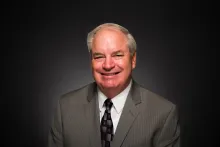
Robin Webber was born in Chicago, Illinois, in 1951, but has lived most of his life in California. He has been a part of the Church of God community since 1963. He attended Ambassador College in Pasadena from 1969-1973. He majored in theology and history.
Mr. Webber's interest remains in the study of history, socio-economics and literature. Over the years, he has offered his services to museums as a docent to share his enthusiasm and passions regarding these areas of expertise.
When time permits, he loves to go mountain biking on nearby ranch land and meet his wife as she hikes toward him.
