
Robin S Webber
This message focuses on the life-giving qualities of our relationship with God the Father and His Son by exploring the incredible dimensions of the Wave Sheaf Offering to New Covenant Christians by noting the breath and depth of our Savior's life, death, resurrection, ascension, and heavenly exaltation towards preparing a "home" (John 14:3, NLT) based on relationships for us with Him and our Heavenly Father.
This transcript was generated by AI and may contain errors. It is provided to assist those who may not be able to listen to the message.
Want to welcome everybody that is here today, and also to welcome those that are on our streaming service, and also those that may be listening to this message down the line. I always enjoy hearing from people that sometimes will write me afterwards and will write from all over the world. So it's kind of nice to know that in the modern technology of today, that these messages can get out to people in search of the truth around the world.
Well, let's go right into the message this afternoon. Here we are on the Saturday between the two high days, the days of 11 bread. And I thought it would be appropriate to speak to the wave sheaf and how important that is, and really recognize that as the ongoing fullness and completion and sense of Jesus Christ's ministry granted to him by God the Father. And of course, the touch of God the Father in all of this. During this festival, we often harken to Paul's words discovered in 1 Corinthians 5, starting in verse 7. Join me over in the Pauline epistle of Corinthians, 1 Corinthians 5, and picking up the thought in verse 7, where it says, Therefore purge out the old leaven, that you may be a new lump, since you truly are unleavened, for indeed Christ our Passover was sacrificed for us.
Therefore let us keep the feast, not with old leaven, not with the leaven of malice or wickedness, but with the unleavened bread of sincerity and truth. Those are ingredients that are incredible, and that's what we're here to explore as Christians, just as Mr. Miller was mentioning the first message, that the destination that we're headed for is the kingdom.
We are to seek that kingdom, but kingdom travel is not only about the destination, it's the way that we travel to get there, and that we seek the kingdom and His holiness. So that's very important to understand. So we look at this about the old leaven, the new leaven, the old lump, the new lump, and what's being spoken here? What is the focus? Basically, it is simply this. This new that is being talked about is not something that's from around here.
As I've often said, our ladies go to the supermarket, and they're going down the different aisles, and they're probably less snookered than we as men in this, but they'll see something that is new and improved. But the question is, is it really new and improved? Or has the box shrunk and the price gone up? Maybe that is what is new, and they think it has improved on their financial margin, but it's not helping you as the homemaker.
What's being talked about here is a whole different kind of new. A whole different kind of new that God is trying to create in us once we are baptized and as we surrender our lives to Him. I'm always familiar with the verse of 1 John 3, where it says, Behold what manner of love the Father has given us. And the Greek behind that, the understanding behind that, is that this is not from around here. This is different. This is not earth-centered, earth-bound, earth-anchored.
But this is a gift from heaven above. So, a new man, a new kind of woman, a new kind of human being, a new community in, by, and through Christ. But not alone. But not alone. As we consider Paul's further comments in Galatians 2 and verse 20. Join me if you would in Galatians 2, in picking up the thought in verse 20. That's a beautiful thing. As a disciple of Jesus Christ.
And when I find more and more a number of ministers preaching to their people about being disciples of Jesus Christ. It's always been that, but to remind ourselves that we're always still learning. We can be in this way of life. Susie and I have been in this way of life since we were tweens. 20 years ago. A long time. But we're still growing. We're still learning. We're still developing. And so it says over here in Galatians 2, in picking up the thought in verse 20, where it's, uh, Galatians 2. One second. That's not what I want. Ah, second. Galatians 2. Oh yeah, here it is.
And that we have company. That Christ is in us. But there are some steps along the way that we're going to be covering today in the wave sheep to understand now why he does come and does dwell in us. Whereas the New Testament Passover commemorates Christ's death. Unleavened bread focuses on life and a unique life. Not merely better. Not merely better. But set apart to be holy as God is holy. Be you therefore holy as I am holy is one of what I call the great echoes that come down through the pages of the Bible. It echoes throughout the Old Testament and there's the New Testament, I think of 1 Peter 1, about 15 to 16, where Peter picks up that echo and spreads it on to our generation today, 2000 years down the line. Therefore, you be holy as I am holy. And to understand that, what makes this new and living way possible? Let's go to Hebrews 10. Join me if you would, please. Let's open up our Bibles. Hebrews 10 and picking up the thought in verse 19.
In Hebrews 10 and verse 19, let's notice. Therefore, brethren, having boldness to enter the holiest by the blood of Jesus, notice, by a new and a living way. And we sung that today, thank you very much, David and Christine. We sang that by a new and a living way, which He consecrated for us through the veil.
Through the veil. And that's alluding back to the veil that was in the tabernacle. That is alluding to the veil that was in the temple in Jerusalem. The veil that separated mankind from that holy of holies, not because of God's decision, but because of man from the very beginning, Adam and Eve in the garden. But then on that day of crucifixion, that when He died, remember that the veil that was in the temple split, split and came apart.
But not from the bottom up. It came from the top down. It was what only God could do and could be done because of the sacrifice of His Son when He died. That there was an entrance, there was going to be entrance back to Eden in typology. That no longer the carobim guarding at the gate and a welcoming of relationship. The kind of relationship that God wanted from the very beginning, when He looked down and He took that clay and He molded and created the first human being, the man.
And He gave him eyes and He gave him a heart. And what God wanted at that time was to have that relationship, have that bond. And that the first thing, almost like a brand new baby, looking up at its mother's eyes, there becomes that forever connection as long as those two bond. And that's what He wanted to do. He wanted to see Adam eye to eye, from ear to ear, from his heart to Adam's heart in response to it.
That there might be a completeness, that there might be a relationship. This is my Son in whom I am well pleased. It was perchance Adam would be that physical Son. But we know the rest of the story. He didn't make the decisions, the choices that Mr. Miller just outlined in his message. He decided to go and hug a different tree rather than the tree of life. He embraced and put his arms around, along with his wife, the tree of good and evil. So in Hebrews 10, verse 19, again, by a new and a living way which he consecrated for us through the veil that is his flesh, and having a high priest over the house of God.
Verse 22, let us draw near with the true heart and full assurance of faith. And how can we have that fullness and that assurance of faith, having our hearts sprinkled from an evil conscience, and our bodies washed with pure water?
And then there's this encouragement. You know, you get the, you get the, you get the gavel down, therefore, then notice the encouragement at the end. Let us hold fast the confession of our hope without wavering, for his, for he who promised is faithful. So this is the new and the living way. How is it possible to strive towards being spiritually in love, in, in, unleavened in a world such as ours to be able to maintain the crucified life with and in Christ? Yes, we started out with the New Testament Passover and to recognize, as I'm sharing with you and as others, I believe, are sharing it more.
We're not keeping the Passover of the Old Covenant. That was a type, and types are important. We are keeping the New Covenant because we worship one. And the one that brought this knowledge to us is that Greater Moses, that Second Moses, who gave his life. And that when we were at the table the other evening up in Rancho Bernardo and the symbols, those are symbols of that Greater Moses, that Second Moses, the one who was the Word, the one who is the Son of God.
And while we appreciate the Old Testament and the type is there, we follow that since that Greater type, the type that God the Father sent his Son down to give to us, that we might have life evermore. We note that one of the primary foundational girders of our faith is found in 1 Corinthians 15. Join me if you would, please. 1 Corinthians 15. As Paul is not only instructing the Corinthians of that time, but also sharing with us.
Moreover, brethren, I declare to you the gospel which I preach to you, which also you received and in which you stand, by which you also are saved, if you hold fast that word which I preached to you, unless you believed in vain. For I delivered to you, first of all, that which I also received, that Christ died for our sins according to the Scriptures, and that he was buried, and that he rose again the third day according to the Scriptures.
And not only that, but he was seen by Cephas and by the Twelve, and after that he was seen by over five hundred brethren at once, of whom the greater part remained to the present, but some have fallen asleep, in other words, died. And after he was seen by James and all the apostles, and the last of all he was seen by me also as one born out of due time.
That's wonderful! And that's marvelous! But let's put something together here, and why the wave sheaf, and why we're discussing it today.
We had one with a capital O that came down from heaven. He's known as the Word. And that Word came dwelt with us to set us an example and to connect us with his Heavenly Father and our Heavenly Father. Born of woman, life. Slaying by man, death. He was resurrected. Wonderful! I have a question for you as we keep the wave sheaf today, Sabbath. Was he the only one born of woman that has been resurrected?
Now I know all of you, you put you all together hundreds of years of church life here, so this is not hard.
Oh! So my question is simply this. And I'm glad he was resurrected along with the others. But what is the difference with the one that we pray to that's at the right hand of God today? And I just spilled the beans right there. Pardon? Is it right? Yeah, the one that's resurrected. Okay, this is why the wave sheaf. Jesus was born miraculously.
He lived a perfect, holy life. About his father's business. Number three, he died.
But others have died and others have been resurrected. The important part of the wave sheaf is simply this. Life, death, resurrection. Are you with me? And then, why the wave sheaf? And what it tells us about, there is the ascension. And that is the focus of the wave sheaf. And where he ascended to, to the right hand of the Father, which is glorious and wonderful and the closeness. And reminding us that why did he come to earth in the first place? He came as Emmanuel, God, with us, that man might be touched by God. But also that in turn, through his sacrifice, through the humanity that he bore, even to death, that God the Father, through him, him being our advocate, might be touched by our humanity. Jesus, the Christ, is never a wall. He's a bridge between humanity and God the Father.
So there is the ascension. We're going to cover that now. And then also to recognize there's one more step. After he ascends, there is the exaltation in heaven, the exaltation of that reception by his Father and by the heavenly host. So put on your seat belts. We're ready to go. We're going to travel through the Scriptures a little bit and understand. The message that I'm talking about is this, and I think I just explained it. When and why the Word went home. Why and when the Word went home. Because heaven is more than a place. Heaven is more than a mansion that is gigantic, that Jesus is planning to fill. Heaven is home. And I'm going to explain why I call it home rather than just simply a structure. Very important. Home is where you are from. Home is what shapes you. Home is what molds you. Not a structure. Susan and I, as do most of you, you live in a house. But being married to somebody and having children and children, you want more than, oh, I live in a house. That's nice. That's nice. The Feynman for an insurance company. But God wants us to understand the importance of a home. The difference between a house, a house is a structure. A home is about relationships. And we have a father in heaven. We have an elder brother. We have that Lamb of God that we sung about. He's also the Lion of Judah. That's also in the book of Revelation. He knows how to protect the family. But that's what we're talking about. In John 17, join me if you would in John 17. Gospel thereof. Let's look at something here. John 17. And picking up the thought if we could. John 17 and in verse 1. Jesus spoke these words last evening of his physical life. Now note this is fascinating. Join me in looking at verse 3. And this is eternal life, that they may know you, the only true God and Jesus whom you have sent.
I may have shared this with you before, but here we go again. Many years as a younger minister, I used to try to kind of help people share what eternity is like. In a linear, structural, mechanical manner, kind of like with a ruler. And that's not what Jesus Christ is talking about here. He's talking about a home. He's talking about relationships. The Father and myself, and the bond and the unity that we have, like eternity. Always. That's the goal that we are developing as he continues to educate us in our walk. To have that thought of eternity, to have that thought of relationship. And it's fascinating, and we read this the other night, if you'll come down between John 17. Notice what it says in verse 20. Notice what it says. Notice what it says.
And I and you that they also may be one in us, that the world may believe that you sent me. Discipleship and being together, all of us here in San Diego, Redlands, Los Angeles, Orange County, Bakersfield, I can go right up to California to the different churches. As we are united, that is a witness that there's something different going on here than elsewhere. That this is a home of God. And our witness to the world that we believe that God the Father, that's what he's plainly saying, that God the Father sent Jesus of Nazareth to be Messiah, to be his son. Our witness of being in unity, creating not just walking into a structure, but a home is a witness. You might say, yeah, but you know, it's a big world. There's seven and a half billion people, maybe eight billion people now. Well, you can't witness to everybody, but who comes into your footsteps, who bounces into your heart steps. There is a witness, and they recognize where you were trained at home by the word and by the Spirit of God. Notice what it says here.
I'm going to make a gesture up here for a second. What Jesus is saying, being the Word who came down from heaven, this is—have you heard this little street lingo? Is that all right for a moment? Sometimes guys will get together, kind of bump into one another, and they'll go, hey, we're tight. We're just like this. Bro. That's Hebrew for bro. Well, God, what Jesus is sharing about his father and their relationship, which is eternal, is they are so tight, they're like this. They're just like this. And this is also how our Father and his Christ want us to be, to be tight. But it takes all the different aspects of the ministry of Jesus Christ from life to death to resurrection to about what we're going to get into here on the extension. No, there's an old expression. What goes up must come down. There used to be a song out of the sixties. I'm trying to get it out of my mind. I'm not going to sing it right now, okay? What goes up—I'm not going to sing it. Tell me not to sing it. Okay. What goes up must come down. But sometimes what comes down to fulfill the process must go up. And that's what the ascension of Jesus Christ is all about. Let's begin by understanding the biblical Holy Days were arranged around two major harvest seasons—the spring harvest and the fall harvest. But with that said, which most of us are familiar with, within the spring harvest there were two harvests within that spring bookending. Barley was the first to become ripe during the time of Passover and the days of Unleavened Bread. Later on there would be wheat, which would come in the late spring, pinnacles, feasts of the firstfruits. And a special ceremony took place for centuries that in type shared great significance. Join me with that. I'm going to focus now. Here's the homework. Leviticus 23. Join me if you would, please. In Leviticus 23, let's pick up the thought in verse 6. Leviticus 23 verse 6. And on the fifteenth day of the first month at twilight is the Lord's Passover. And on the fifteenth day of the seventh month is the feasts of Unleavened Bread. To the Lord's seven days you must eat Unleavened Bread. On the first day you shall have a holy convocation. You shall do no customary work on it. But you shall offer an offering made by fire to the Lord for seven days. The seven days shall be a holy convocation, and you shall do no customary work on it. So far, so good. And the Lord spoke to Moses, saying, Speak to the children of Israel and say to them, When you come into the land which I give to you, and reap its harvest, then you shall bring a sheaf of the first fruits of your harvest to the priest. Verse 11. He shall wave the sheaf before the Lord to be accepted in your behalf on the day after the Sabbath, the priest shall wave it, after the day of the Sabbath, which would be on Sunday. And you shall offer on that day when you wave the sheaf a male lamb of the first year, without blemish, as a bird offering to the Lord. It's a grain offering shall be two tenths of an ephah, of fine flour mixed with oil, and an offering made by fire to the Lord for a sweet aroma, and its drink offering shall be of wine one fourth of a hen. And it goes on to say, you shall eat neither bread, nor parched grain, nor fresh grain, until the same day that you have brought an offering to your God, and it shall be a statute forever throughout your generations, in all your dwelling. Verse 14 is extremely significant. Stay with me. This is showtime.
Everything stopped.
Still. Until this was performed in ancient Israel. In a sense, life could not be expected to go on as normal, the spiritual life, that God was calling our friends Israelites to, and we the Israel of God today, until we understand this, and until they did this of old. I'm going to explain what this is about. Everything came to a standstill. I don't know if you ever thought about that before, about the way, and some of us that grow up in this way of life, you know, as kids, and grow up, and what's the big deal about the wave sheaf? Wave sheaf. It's like a football game, you're going to... What are you going to do? Everything in the camp of Israel went still until this was performed. This was very important. Let me share what's going on here. The wave sheaf offering came from the very first sheaf of the first harvest, in other words, the first of the first fruits. And we know who that symbolizes, don't we?
The wave sheaf was cut right after sunset, after the Sabbath, between the two high days. Because it couldn't harvest on Sabbath. So there would be the maximum time to have her prepared and offered and waved at the temple at the time of the morning sacrifice, around 9 a.m. on Sunday morning. Allow me to describe what would happen in the field of harvest. A procession would occur down to a selected field. The sheaf of grain had to be standing, stay with me, had to be standing, and rooted when the wave sheaf was cut and loosened from the ground, at sunset, at the very end of the weekly Sabbath. Now it's interesting, isn't it this year that matches some... Robert, this is... We are in a typology of exactly 31 A.D., okay, of what was occurring as it's laid out right now. A procession would occur down to a selected field. The sheaf of grain had to be standing, I mentioned that already, very interesting. It had to be standing, so it had been alive, and it had to be rooted in the ground, so that would have to be taken up. And just think of the analogy that Jesus Christ was rooted in humanity. He had flesh like we had flesh. He was a human being. He was given birth. And so you see the analogy of something that's been living is now had roots, came down. But you know it's very interesting. In John 1, 1 through 14, and it said, as you know, it says that the Word was God, etc., etc. And then it says that He came down and had light, and it says that His own did not receive Him. Did not accept Him. Did not accept Him. This is going to be the reverse when we understand where this is going.
Questions would be asked. Wrote questions that every time that they did this would be asked. Is the sun down? Is this the sheath? Shall I cut with this sickle? Shall I reap it? So there is a ceremony to this. The pictures of Christ resurrected, cut loose from death, released from the belly of the earth, just before the end of the Sabbath, standing, awaiting the time of His ascension to the Father. That is the typology. It's very interesting that it says He was released from the belly of the earth.
Remember what Jesus said about the sign of, you know, people said, well, this and that. He said, the Son of Man will be in the grave for three days and three nights, just as Jonah was in the belly of the well. You know why three days and three nights? That's kind of like finality. Remember when Lazarus and Mary and Martha wanted Jesus to come and heal their brother, his friend, his brother. But he didn't get there in their time. He got there in his time. Because after three days and three nights, it was presumed that somebody was truly dead.
He came on the fourth day. God never wastes a miracle. He knows what he's doing. The same with Jesus. He was in the belly of the earth, belly of the sepulchre, for three days and three nights. And then on that Saturday eve, he rose. He did not rise on Sunday. He arose on Saturday. Because again, remember the next morning on Sunday, Mary Magdalene. And ladies, that's a really exciting thought for you. The first one that God allowed to see the resurrected Christ was a woman. That's exciting. Very interesting how he was given birth by a woman and then seen by Mary Magdalene later as a woman. Just showing the unity and the teamwork and the familyhood of both men and women in the ministry of Jesus Christ down to this day. I thought that's an interesting thought. The barley grain of the wave sheaf was parched, thrashed, and then seeped into fine flour ready to be waved the next day at the time of the morning sacrifice. I'm reading this so I don't get this out of kilter for you. What was the symbolizing of waving the offering to God? Traditionally, the ceremony of waving seems to have meant that parts of the sacrifice were swung or elevated towards the altar, signifying that they were given to God and then swung back again, indicating that they were given back by God to the priest for them to eat, to partake of, and to feast on the Christ of Christ in life. They would wave or better translate it. They would lift up. They would elevate as a typifying something yet to come, but ever purposed in God's mind. Something of the earth cut and gleaned and offered up, raised up and lifted up, offered and accepted.
About the same time Jesus Christ ascended to heaven and was accepted by the Father as the true wave sheaf, it's interesting. It's interesting.
Once done, in days of old, the people could harvest, they could eat, and they could live. Join me if you would in John 16. John 16, 5.
John 16, 5.
But now I go away to him who sent me, and none of you ask me where I am going. But because I have said these things to you, sorrow has filled your heart. Nevertheless, I tell you that truth is to your advantage that I go away. Now, let's stay with a second. But now I go away to him who sent me, and none of you ask me where are you going. But because I have said these things to you, sorrow has filled your heart. Nevertheless, I tell you that truth is to your advantage that I go away. For if I do not go away, the Helper will not come to you. That is the Holy Spirit come to you. And when he has come, he will convict you. And it goes on to that. The key phrase I want to look upon here is, for if I do not go away. For if I do... What this is talking about, he's sharing enough, but they're not understanding right now. For if I do not go away, after the life, after the death, after the resurrection, there had to be that ascension before the Holy Spirit could come to the people on the day of Pentecost 50 days later. Sometimes, God, whether it be Christian living, whether it be Christology, whether it be prophecy, God gives us... He gives us tidbits of understanding. He gives us tidbits of understanding, enough to, perchance, consider. But he'll fill in the blanks, and he will not leave us in the dark always. Jesus had this thought of going away, and if he doesn't go away, it's not going to happen for these people. In Luke 9 21, join me if you will there in Luke 9 21.
In Luke 9 verse 21, it says this, And he strictly warned and commanded them to tell this to no one, saying, The Son of Man must suffer many things, and be rejected by the elders, and the chief priests, and scribes, and be killed, and be raised the third today.
And then he said to them all, If anyone desires to come after me, let him deny, etc., etc., etc. Kind of looking at the sins, he had said, I will rise again. And here it says, let's go back to verse 20, Now let's go back further and appreciate the significance of his ascension in John 14. Join me if you would, please, John 14. And John 14, in picking up the thought in verse 18.
And so we take a look at this, and the significance of what the ascension would mean. What goes, what comes down must go up. But also recognize that, again, after that, what has gone up does come down in many marvelous ways. What makes this so very different is that others have been resurrected, as I mentioned. Only one has gone to heaven, the one who is the Word. And here's how I like to put it. He is back home. And he brings home down to us. Because he himself said, I go to prepare a place for you. That's out of the King James English, New King James English. I like how the Living Bible translation shares it. I go to prepare a home for you. Now, if you had a chance, let me ask you a question. Because sometimes, Church of God, he's going to prepare a place.
Big, plenty of room. But do we want to live eternity just in a edifice? Or do we want to live in an eternal goldfish bowl of home and relationships? We're going to see the Father. We're going to see the Son. We're going to see our loved ones, those that now sleep in Jesus Christ. We are going to see, as our understanding with prophecy, that when you look at what God shared with Abram, He says, I am going to bless you, and through your seed, the entire earth is going to be blessed.
Think about that. When you look at Genesis 12, 1-4, the greatest aspect is the spiritual aspect. I know at times we utilize that, that the nation, the tribes of Israel today, etc., prophetic. That's true. But that's secondary. When He says that through your seed, being ultimately Jesus of Nazareth, through your seed, the entire world is going to be blessed.
Always think of how God brings things into alignment and where God's focus is. So very, very important.
A story that I've shared with you before, but I think makes sense in talking about the need for the ascension. There's a story that goes like this. There's a Muslim, and he said to a Christian, we Muslims have one thing that you Christians do not have. When we go to Medina, we find a coffin, and we know whose body is in it. But when you go to Jerusalem, you find nothing but an empty tomb. The Christian politely said, thank you. Go away. No, thank you. When you say what you say is absolutely true, and that's the eternal difference. The reason we find an empty tomb is because we serve a risen Christ. It's a quote by Ralph Turnbull. My question to you, as we are in the afternoon of that Sabbath between the two high days, as we're observing the days of 11 bread, a simple question. Do you believe in a risen Christ? Do you believe? Do you act? Do you respond as if Jesus Christ is risen? That He is our Lord, that He is our Savior, that He is our, in that sense, Passover, that He is our Advocate, that He is our Elder Brother, that He is the Lamb of God? That He is our Master Teacher?
If you don't believe that there's a risen Christ, you're missing a large part of the story of our walk towards the Kingdom. And at the same time, to recognize, as Mary said, wanted to have it, He said, don't touch me. Don't touch me. I've met people like that. You probably have, too. I don't know if they're going to ascend in this lifetime, but I'm sure at one time or another, you know, you're going to, don't touch me.
But there is a purpose for that, because He had not yet ascended. And what happened with that ascension? Join me if you would in Psalms 118. Psalms 118.
Go over to Psalms 118 and verse 19.
Let's remember...
I'm going to talk to my new friend here, down here on the third row, DJ. The way that we look at it in our congregation and our teaching is that the New Testament is concealed in the Old Testament, and the Old Testament is revealed in the New Testament. It's a seamless, inspired structure of God to be able to understand Him. We notice here in first... where was I again? Where it says here... Old Notice says...
Very interesting coming out of the New Testament Passover. Gate the door. Remember the power of the door in Egypt at the time of the initial Passover. Of Jesus saying that I am the door. And now in this prophetic praise, open to me the gates of righteousness. Where does that come from? Who was righteous? Who was holy? Who never sinned? I will go through them and I will praise the Lord. This is the gate of the Lord through which the righteous shall enter. And I will praise you, for you have answered me and have become my salvation. The stone which the builders rejected has become the chief cornerstone. And this was the Lord's doing. It is marvelous in our eyes. This is the day the Lord has made and we will rejoice and be glad in it.
Acts 2.32 1 Peter 2.32 At Pentecost, Peter speaking.
This Jesus God has raised up, of which we are all witnesses. Now notice this, verse 33. Verse 33. Therefore, being exalted to the right hand of God, and having received from the Father the promise of the Holy Spirit, He poured out this which you now see and hear. For David did not ascend into the heavens, but he says himself, The Lord said to my Lord, Sit at my right hand, till I make your enemies my footstool. Revelation 5. In Revelation 5, and picking up the thought in verse 9.
And they sang a new song, saying, You are worthy to take the scrolls and to open its seals, for you were slain and have redeemed us to God by your blood, out of every tribe and tongue and people and nation, and have made us kings and priests to our God. And we shall reign on the earth. Notice, we shall reign on the earth. Then I looked and I heard the voice of many angels round the throne, the living creatures, the elders, and the number of them, was ten thousand times ten thousand and thousands of thousands, saying with a loud voice, Worthy is the Lamb, who was slain to receive power and riches and wisdom and strength and honor and glory and blessing. I'm trying to do it to the cadence of, Worthy is the Lamb. Have you ever heard that before? This is the exaltation as he was received back up into heaven.
He is worthy.
And not only that, but he is also at the right hand of the Father. When you talk about your right-hand man, are you talking about your left-hand man? I've got to be careful, Susan's left-handed. She's not a man either. But anyway, what is the... You help me.
You're not going to get away. This is class. When you say that this person is my right-hand man, what's that mean? He's your what now? Your best helper that you know of down here. But he's already proved himself, hasn't he? Skip?
The right hand is as close as you'll get to the big guy. Get to the boss. And that boss has total trust and total confidence. And not only that, but in the mouth of two or three witnesses, let every matter be established. And here's the whole court of heaven. Christ has come home. He has ascended from the earth that he is the word in the beginning made with his own hands and his own mind. And he's been down there, and now he's back home. And he's up there fighting for us. I know it's really interesting, and we're going to conclude on this point. I'm skipping about three pages of notes, but this will be the good part. Not only that, but at times he comes back down here to encourage people. And of course he's here doing, you know, the Holy Spirit is the encouragement of both God the Father and Jesus Christ. Romans 8, 11 through 14. That within us exists and has been the indwelling of what we call the Spirit. And Paul defines it there as both the Spirit of the Father and the Spirit of the Son in those verses. And so we literally have the essence of God in us. But there are times over the years of the story in the Bible when he makes his own appearance.
Not from down here, but from up there. I think of Dear Stephen the Deacon, the first martyr of the church, that as he is being pummeled, pummeled by rocks, stones, boulders, however it was, how awful it was, that the one that ascended made an appearing. Almost like cheering him on. You go. You can do it. I've been there. I've been beaten. I told you all that if you follow me, if they've crucified me, they'll crucify you. If they torture me, they're going to torture you. And to recognize that sometimes in the Christian existence, before we receive a crown, we have to carry a cross. He appeared to Stephen. He appeared to a guy who was a brutal enemy of the church on the road to Damascus.
What goes up sometimes comes down. And he met Paul, a Renaissance man, a very incredible individual, but he had to be leveled and humbled and have his sight taken away for a few days, so that he could have the true sight of who his Lord and Master was. And not merely Moses, but that greater Moses, Jesus of Nazareth. It's interesting that times he'll appear, sometimes literally, and sometimes perhaps in vision. I always think of the book of Revelation. I spoke on it recently in our Prophecy series, that you cannot deal with the whole book of Revelation until you get into chapter one. Because that allows you to put on your seatbelt. Know that it's going to be a bumpy ride to the end until God wins, and if God wins, we win. But what does he do to John? It says that, and this is in vision, but he sees it as if it's clear, it's Jesus who's in the middle of the seven candlesticks, meaning he's right in the middle of the church. In his ascension, he still is able to be down here. He's right in the middle of the seven candlesticks in Revelation 1. And then he goes over, and it says, and he put his hand on my shoulder.
Is that not cool?
He puts his hand, this is the last man standing of the original twelve. It's probably about eighty-five or ninety A.D. And that comfort that came from above of the one that ascended to the right hand of his father comes down at times to make a difference.
And in his way to us will touch us and give us a touch. He may only touch us once. I'm not going to say you're going to have the Revelation 1 touch, but there'll be a touch. And sometimes he touches you once, and he wants you to remember that for a lifetime, and to be able to share that with others.
I've told my story often enough to all of you about when I was sick as a teenager, and I know that I was divinely healed on that evening. Absolutely. And since that touch, I can't forget it. But I didn't have the trumpet of an archangel announcing that touch. It was a mockingbird at five-thirty in the morning. As my eyes were closed, and I heard that crazy mockingbird for you mockingbird lovers. They will not stop. It's like an alarm clock that won't go off. But my eyes were still closed, and I said, I am still alive.
And sixty years later, almost, I'm still alive. He will touch us. Because he lived, because he died, because he was resurrected, because he ascended, ascended at the right time, fulfilling the imagery of the Old Testament, and is now at the right hand of God the Father. And that wave sheep that sometimes is up there, that divine wave sheep known as Jesus of Nazareth, the Christ, the Word, the Redeemer, he's at the right hand of God. And perhaps one of the things that is so important is, here we are during the days of 11 bread, and we want to be like little children sometimes, because we're the children of... We want to be so good, we don't want to be like that old lump, and we know that God doesn't want us to be a mid-lump. He wants us to be a new lump. But then we blow it. We do something stupid. We're human beings.
And then to recognize that our prayers go up, Father, forgive me.
And to recognize who's listening to those prayers. We pray to our Father, but Jesus Christ, the right hand man, the right hand being, like this, remember this? They're like this. Because Satan would like to accuse us. You know, Satan, like some tabloids, likes to get a hold of a piece and blow it out of proportion. And wherever God is, Satan isn't too far behind. And he can be up there and say, yeah, see, see, see. They're the ones that say, oh, we love you. Oh, we're on your team. Oh, we're going to follow. Oh, this is the way. Oh, we're going... Now look at him.
So we know Satan's like... He's doing his Job talk. But then we recognize who the right hand man is, Jesus the Christ. And he says, Father, can I borrow you a second?
I know what they're going through down there. I know what they're going through.
I've been one of them.
But remember what I did. You and me. On that altar of Golgotha.
That sacrifice that went up. That's what I want to remind you about.
What you did and what I did for them.
Father, forgive them, for they know not what they do.
I've been down there. I've been in that territory.
Forgive them. Did you ever think that's the conversation going on when you ask forgiveness? And we say, let's start all over again.
We have some things to think about. We have two or three more days of the days of Unleavened Bread. For you that are listening, hello. And for those that are here, hello. And I hope that you will be blessed. From above. From the one that came down here with a thought and a plan that started in the beginning of time. Let us make man in our image.
And to recognize it didn't go so well the first chapter because Adam and Eve wanted to go the other way, but there was a discussion there in Genesis that said that by the seed of the serpent that it will bite and take out the heel of your seed, Eve. But your seed will stomp on the head of the serpent. Now, which would you rather have? You want to be bit in the heel or bonked on the head and put out a commission? Romans 16 and verse 20 says that Jesus Christ is coming back and is going to crush the dragon. All of God's holy days move forward. Think about this as I conclude because you're not going to see Susie and I for about two and a half weeks when we travel to the other congregations. Remember this. It's a simple thought that I learned about 35 years ago. Every day of the week leads to the Sabbath. Every Sabbath leads to a holy day. And every holy day leads to the kingdom of God, where God is wanting you to join He and His Son forever in their home.
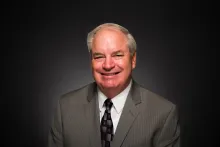
Robin Webber was born in Chicago, Illinois, in 1951, but has lived most of his life in California. He has been a part of the Church of God community since 1963. He attended Ambassador College in Pasadena from 1969-1973. He majored in theology and history.
Mr. Webber's interest remains in the study of history, socio-economics and literature. Over the years, he has offered his services to museums as a docent to share his enthusiasm and passions regarding these areas of expertise.
When time permits, he loves to go mountain biking on nearby ranch land and meet his wife as she hikes toward him.
