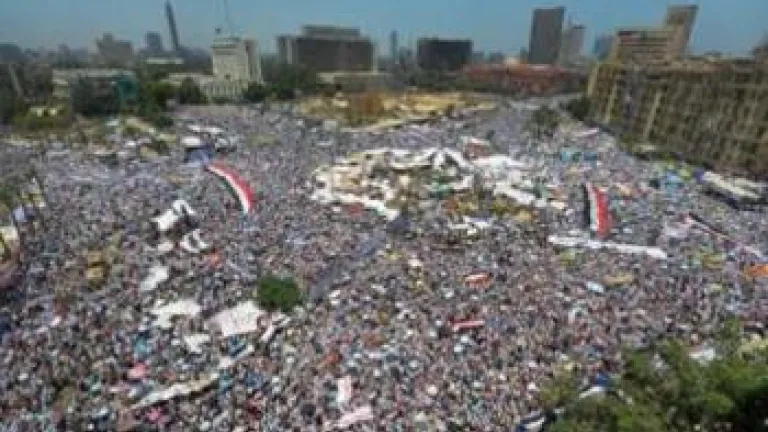
In Brief... World News Review: Moqtada al-Sadr Revolutionary or Puppet
Is Moqtada al-Sadr a genuine Shia religious leader, or is he a self-important rebel?
Is Moqtada al-Sadr a genuine Shia religious leader, guiding the righteous anger of thousands of young Iraqis in opposition to the coalition occupation of their country? Or is he a self-important rebel, either taking direct orders from Iranian mullahs or being adroitly manipulated by them?
Al-Sadr's name is gaining recognition worldwide with the recent violent actions of his "Mahdi Army" against coalition forces, but he was little known outside Iraq until recently. The name "Mahdi" has double significance. It links al-Sadr's objectives with that of the army of Mohammed Ahmed bin Abdullah of the late 19th century in Sudan. Bin Abdullah, a boat builder on the Nile by trade, changed his name to el Mahdi ("the guided one"), and led an uprising against the British occupation forces in Sudan in the 1880s.
Some Shia traditions teach that Mohammed, the founder of Islam, had a vision of a mahdi who would arise at a time when Muslims around the world were oppressed. The mahdi, says the tradition, would unite all Muslims to throw off their oppressors, thereby ushering in an age of peace and security—a sort of "Muslim messiah."
Perhaps al-Sadr sees himself as driving the coalition from Iraq and even as the prophesied Muslim "savior."
But is this young man truly a religious leader?
His only claim to "religious authority" is his father, Muhammad Sadiq al-Sadr, who was selected by Saddam Hussein to lead the main center for Shia instruction in Iraq. Even Al Jazeera reports that he lacks the religious education and degrees that Shia doctrine requires for him to qualify as a cleric ("Muqtada al-Sadr—a Profile," April 5, 2004). So he is a fraud in that regard.
Hussein's secret police are believed to have later murdered the senior al-Sadr, along with other members of his family, when he became "too popular." This makes the fact that al-Sadr now opposes the coalition that toppled those who killed his father all the stranger. Equally strange is the fact that the Mahdi Army fights alongside former Baathist loyalists.
Numerous reports describe his "army" as a group of unemployed, angry young men, who—and this is confirmed by al-Sadr himself—fight for Hezbollah and Hamas. Hezbollah is the radical Muslim terrorist group fighting Israel from Lebanon. Hamas is its twin, fighting Israel from Palestinian territories. Both are financed by Iran.
Iran, by the way, also finances about 90 percent of the financial needs of Yasir Arafat's Fatah party, replacing the support Saddam Hussein's Iraq used to give (World Tribune.com, Jan. 29, 2004). Iran is clearly putting forth great effort to promote radical Islamic interests in the region.
Respected Middle East authority Michael Ledeen, writing in The Wall Street Journal of April 16, 2004 (online edition), reports that al-Sadr recently visited Iran, where he met with the nation's number 2 man in power, the head of intelligence for Iran's Revolutionary Guards, and the Iranian general in charge of Iraqi affairs.
Ledeen also cites an Italian intelligence service (Sismi) report, prepared before the current violence, that warned of precisely what is taking place, a series of attacks by Saddam loyalists and Shiite revolts throughout Iraq. Ledeen quoted Sismi: "The strategic goal of this revolt [is] the establishment of an Islamic government of Khomeinist inspiration."
Two Arab newspapers based in London, Al-Hayat and Al-Sharq Al-Awsat, documented in early April the fact that hundreds of Iranian intelligence agents were sent into Iraq through the north before Saddam fell. Even greater numbers poured over a virtually open border after his regime fell. They went to Najaf and Karbala, pretending to be religious students or journalists. Are they part of this "popular uprising" that is actually a calculated attempt to seize control of Iraq?
What is Iran's interest in Iraq? A democracy in that country would surely encourage the already pro-democracy elements in Iran and might well lead to an overthrow of the mullahs. Whether al-Sadr fights for himself, as well as for his Iranian sponsors, is immaterial. His battle is a battle for an Islamic state, governed by sharia law.
Radical Islamists fear any reduction of their strength and of their ultimate objective in the Mideast: to free Israel from control by "infidels." See our booklet The Middle East in Bible Prophecy for the rest of the story—what Bible prophecy shows will ultimately happen with this high-stakes struggle.
There are powerful spirits of selfishness and self-interest at work in the Mideast that are going unnoticed or underreported by much of the world. Driven by an anti-American bias that splashes over the British and other coalition members, most journalists seem bent on painting al-Sadr as a popular cleric with a righteous cause.

An Article from:
World News and Prophecy: May 2004
Course Content

John Ross Schroeder
John died on March 8, 2014, in Oxford, England, four days after suffering cardiac arrest while returning home from a press event in London. John was 77 and still going strong.
Some of John's work for The Good News appeared under his byline, but much didn't. He wrote more than a thousand articles over the years, but also wrote the Questions and Answers section of the magazine, compiled our Letters From Our Readers, and wrote many of the items in the Current Events and Trends section. He also contributed greatly to a number of our study guides and Bible Study Course lessons. His writing has touched the lives of literally millions of people over the years.
John traveled widely over the years as an accredited journalist, especially in Europe. His knowledge of European and Middle East history added a great deal to his articles on history and Bible prophecy.
In his later years he also pastored congregations in Northern Ireland and East Sussex, and that experience added another dimension to his writing. He and his wife Jan were an effective team in our British Isles office near their home.
John was a humble servant who dedicated his life to sharing the gospel—the good news—of Jesus Christ and the Kingdom of God to all the world, and his work was known to readers in nearly every country of the world.
Melvin Rhodes
Melvin Rhodes is a member of the United Church of God congregation in Lansing, Michigan.
Jerold Aust
Jerold Aust has served in the ministry for 52 years, as a public speaker for 58 years, a published writer for 38 years, and is employed by UCG’s Media and Communications Services. He is a Senior Writer, interviewer, and editor for Beyond Today Magazine and has taught Speech Communication for UCG’s ministerial online program and the Book of Revelation for ABC.
Jerold holds a BA in theology from Ambassador College, Pasadena (1968), an MA in Communication from California State University, Fullerton (1995), a distance-learning Ph.D (2006), and a Famous Writers School diploma in non-fiction writing (1973). Additionally, he studied post-grad communication at University of Southern California (1995), radio, TV, voice-overs, and Public Relations at Fullerton College (1995-1996), and graduate communication at Wichita State University (1978). Jerold has taught communication at the University of South Alabama (7 years) and ABC (17 years). His published works include, Ronald Reagan’s Rhetoric: Metaphor as Persuasion and EZSpeakers: Public Speaking Made Easy in 7 Steps. Jerold's overarching goal is to share with humankind its incredible destiny!