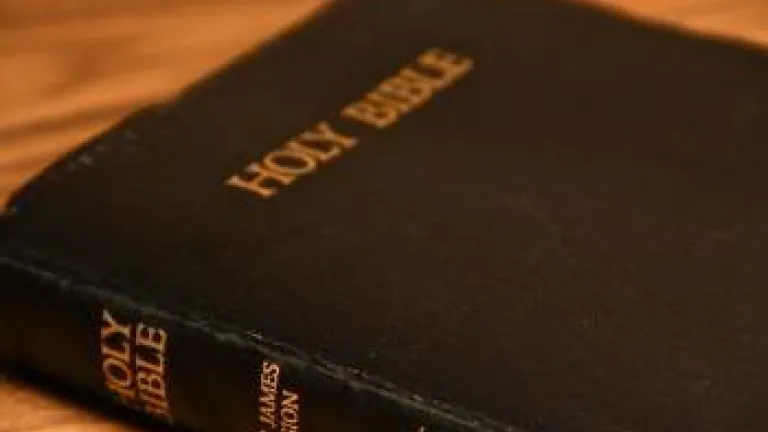
Introduction: Why The Bible is the Word of God

For many millions, God's Word is unexplored and uncharted territory. Yet the Bible is not only designed to help human beings cope in a world caught up in all kinds of crisis.
“It has been my custom for many years to read the Bible in its entirety once a year.” —John Quincy Adams (U.S. president 1825-1829)
Today a vital ingredient is sorely missing in our lives. We simply are not coping with all the stresses of the age. Our human mechanism—brain and body—is breaking down under the strain. In an overcrowded world, a deep sense of loneliness often engulfs the individual.
Perhaps the most damaging casualty has occurred in our relationships with each other, not to mention our wholesale estrangement from God. Trust is becoming a thing of the past. Long-held community values are evaporating before our eyes.
Men and women encounter tremendous difficulty keeping standards of truth intact in a climate where morality is fading fast, with people pushed to embrace more aberrant behavior. Many have noted that this age is one of striving to eliminate absolute rules.
We are also losing our sense of security. Besides obvious hot spots, unease about the world and the various nations we live in have been growing for some time. Increasing polarization has led to mounting turmoil.
Our children are truly worried about tomorrow—and rightfully so. Jobs don’t appear to last all that long, and many marriages end in divorce court.
At best the future looks uncertain.
Commenting on the rise of these troubles, British European parliamentarian Sir Fred Catherwood observed late in the 20th century, “The all-pervasive rationalism of our own century, infiltrating our whole culture and philosophy, has reduced man to an animal, condemned to a meaningless existence terminated by death.” The spread of this type of godless secularism has taken a heavy toll on society.
Lesson 1 Glossary
The Bible: The books (in Greek, biblia) that are acknowledged as canonical (authoritative) by the early Christian Church. It includes both the books of the ancient Hebrew prophets and those of the apostolic witnesses to Jesus Christ.
The languages of the Bible: Mostly ancient Hebrew for the Old Testament (Aramaic for half of Daniel), ancient Greek for the New.
The Old Testament: Those books that make up the Hebrew Bible generally accepted by Christians, Jews and to some extent Muslims. It contains a threefold division: the Law (the five books of Moses), the Prophets and the Writings.
The New Testament: The 27 authoritative books of the apostolic writings: the four Gospels about the life and teachings of Christ, Acts (Church history), 21 apostolic letters and the book of Revelation.
Oracles: In the New Testament the term means divine sayings or utterances and generally refers to the entire Old Testament or specific parts of it.
The Scripture(s): The divinely inspired writings of both the Old and New Testaments. The term Scripture is used in the New Testament to refer to both the Hebrew Bible (Luke 24:44-45) and the new apostolic writings accepted as inspired (2 Peter 3:16; 1 Timothy 5:18).
Secularism: The rejection of religion and the supernatural in public life.