
Robin S Webber
This transcript was generated by AI and may contain errors. It is provided to assist those who may not be able to listen to the message.
Well, we want to welcome everybody that's here. We're here to talk about God today and about our relationship with Him. Allow me to bring you into tow of what's going to be occurring here, is that, for those of you that are just visiting today, I pastor two congregations. One is in Redlands, and we're right here in San Diego.
And we've been going through what we call the adult Bible class. We've been going through a Bible study, and we've been covering the epistle of 1 John. And what happened is, just the way the schedule occurred with the spring festivals, and then there was the general conference, we kind of got off-mark for a while. And actually, our other congregation got ahead by two classes. And so we need to kind of catch up today, and we're just going to open up God's Word.
And when we open up the Word of God, hopefully we're bringing our hearts along, and we want to open them up as well, so that God can speak directly out of His Word to us. And then, two weeks from now, when I come back, we will literally have the class after service. And we do want to finish up 1 John before I go to camp, and then all the camp things.
So, as your parents taught you, really, you know, finish what you start. So we need to finish this, but what an assignment, and that's to be able to go. And actually, when you think of the book of 1 John, what's really happening is it's like sitting down in a living room with one of the men that have lived this way of life the longest. And we're talking about the Apostle John. And here is John at the end of his life. John is probably, I don't know, 85, 90 years of age, and been through so much.
He'd been there at the very beginning. He'd been a young man, obviously a very close associate of Jesus Christ. There seemed to have been a very dynamic, personal relationship between the two. And then everything that had transpired from Pentecost on, and to think that we've just come through Pentecost. So think of that, that, you know, Pentecost kind of started out with a boom and a bang and a wow, and let's go and let's go do the job.
And we've all been like that before sometimes, when we get a new job or we get a new assignment, and boom, boom, boom. Let's go, go, go, go, go, go, go, go, go, go. But are we still doing what we're asked to down the line? Now here's John probably writing this somewhere between the books, basically the commentaries. 85, 95, some even stretched up to 100 AD, which I tend to disagree with.
I would suggest that this is probably 85 to 90 AD, let's say 60 years, about 60 years after that first Pentecost in 31 AD. And generations have come, generations have gone. And some people now, the second and the third generation, are wondering, is this everything that it's cracked up to be? Are what our grandparents and our parents are part of, and now what we think we're a part of, is this really?
Is this really what it was meant to be? And so uncertainty was creeping into the church, and a lot of people were doubting, especially when you recognize what the government of the Roman Empire was doing, persecuting the Christians under Domician of the Flavian house. And that it was the second great wave of persecution of the Christians, first the one under Nero. And now, about 20 years later, people are being persecuted. All of the original apostles are dead. Save one! And so we might ask ourselves, well, if we were in those circumstances, what would we do? But here's John. And remember how, seemingly, there was this tradition that had gone through the church from the very beginning.
That it was possible that this man may be there to the very end. So that was always kind of in the mix, because John just kept on going and going and going, but there was a reason. Because let's remember that John was a son of thunder. He was a son of thunder along with his brother James.
And there was a certain dynamism to this gentleman. He knew what he knew. He believed what he believed in. And he was bold enough to tell the story. And so he's talking to this later generation about the certainties of God. The certainties of God. And that's what the book of 1 John is about.
About being certain about the promises of God. That what God promised he can deliver. And what he does, basically, is he goes through three dynamic elements of this certainty. He says that God reveals himself in three major veins. Number one, he reveals himself as the light.
Number two, he reveals himself as love. And number three, he reveals himself as life.
As life.
And the whole book of John... Let's go to chapter one, and then we're going to move right into chapter three. But I just kind of want to get our thoughts going. Join me, if you would, in 1 John 1.
And let's look down at verse five.
Verse five. This is the message we write to you.
This is the message.
Excuse me. This is the message. Verse five. This is the message which we have heard from him. And declare to you that God is light, and in him is no darkness at all. And if we say that we have fellowship with him, and walk in darkness, we lie, and do not practice the truth.
But if we walk in the light, as he is in the light, and we have fellowship one with another, and the blood of Jesus Christ, his Son cleanses us from all sin.
Beyond these certainties that are spoken about in the book of John, the one key word that I'd like to pin into our minds as we begin to develop this conversation and this study is that God has called us to fellowship. God has called us to a deep fellowship, a fellowship of the Father, a fellowship of the Son, and a fellowship with one another.
And you must have all three pieces of that divine puzzle, or you do not have fellowship. You cannot simply have fellowship with the Father without the Son.
You cannot have fellowship with the Father with the Son without the Brethren. You cannot just have fellowship with the Brethren looking at what's in front of you and think you're going to have fellowship with the Father and with the Son.
This is a very integral argument that John is using in this study. So he begins the study talking about this communion, this khanoneia, as it is in the Greek.
This bonded fellowship must come not only with the divine, but that which is in front of us today, those that are around us today, and those that will walk into our life. They all must come together. So the first section of John basically deals with the aspect that would have been understood in that day and age that God is light. Now you and I don't really fully appreciate that today because Mr. Smith or Mr. Colwell or Mr. Howell can walk in and flip on a switch and do to Mr. Edison, lights come on. Big deal, until you have the power out sometime in summer.
Then you really appreciate light. When God was introduced as light, the people in the ancient world really understood the difference between light and darkness. And when he said that the light came into the world. They got it. But now we're moving into chapter 3. Let's go over there. Because we're going to switch from light to something else, we're going to go right into chapter 3. We're going to cover chapter 3 in church time here. And then we're going to deal with chapter 4 in the study. I hope you will come back because there are some very specific, dynamic understandings that I want you to understand during the Bible study. Because chapter 4 is loaded with responsibility, spiritual responsibilities of the brethren, that maybe you have never seen before fully appreciated how much God holds you responsible for the truth that He has given you. Not just me, as I teach it and as I preach it, or one of our elders here, but how responsible you are for what you receive. I think you'll find it a fascinating study. Join me then in verse 1.
The commentaries put it this way that, and I know we're breaking into thought. I'm trying to get you into sync after a couple of months. The commentaries describe chapter 3, which I really appreciate as an outburst of wonder. It's all of a sudden as if this man that had actually walked the paths with Jesus, been on the lake with Jesus, had seen his life, his death, his resurrection, had been there at the Pentecost, still couldn't get over what God had brought into his life. And so there's this outburst of wonder as the thought of God being love, which is the second aspect after light is introduced. Behold what manner of love the Father has bestowed on us that we should be called the children of God. And therefore the world does not know us because it did not know him. It's just like John is telling you and me today, and here it is 19 years, 100 years after the fact. Get a hold of this. Stop everything that you're doing. Do you really appreciate the fact that I'm about to share with you what manner of love the Father has bestowed on us? As the commentaries bring out, when it says what manner of love the Father has bestowed upon us, the term manner basically means from what country does this come from? From what country does this come from? In other words, it sure doesn't come from around here. This is extraordinary. This is extraordinary. This is like something that you've never even thought about, heard about, could even consider wasn't found on your computer with all the searches. When you're pushing that button, you know, when you do a button search on the computer and everything kind of comes up, well, this didn't come up on your computer because this was not earthbound. This was heaven sent. And it says that it has been bestowed on us, bestowed on us. Very interesting phraseology. Not only shown, but given.
Not only shown, not only made clear, but was given. And we begin to see this aspect of the word bestowed, which is a longer word, that this is discussing God's grace. That this is discussing that God didn't have to, but that he wanted to. Grace is about God's desire. It's not about his duty. Duties are a byproduct of his desire. God's very attribute that resides within his divine nature is that he wants to share what he has. He's not forced into the situation. It's something that he and the word thought about from the very beginning and want to give us what they have. That we should be called the children of God, and therefore the world does not know us because it did not know him. I was thinking this weekend, as I was sobered yesterday by caring about Tim Russell's death, I guess it's just very close, same age. I watched Meet the Press a lot over the last 20-30 years, kind of what I do on a Sunday morning. I'm kind of a geopolitical wonky, as many of you know. It's kind of what I write about and what I do.
After all those attributes came in from all these people, politicals and journalists and this and that, and you know, let's face it, Tim was a man too. He had his downside, like all of us do.
But I thought, how proud his son Luke must be, as sad as he is at this moment. And in the future, when he thinks about his dad, that he's going to be able to be called Russert. That was my dad.
I hope a lot of us feel like that way about our parents. I know I was talking to Susie this morning about her dad, and she just said, I'm really glad I'm my father's daughter. We're proud of our parents, and we want to identify with them. And notice what John is saying to you and me today in this study, that he says that we can be called, not the children of Russ Leimbach or Tim Russert or whatever your name is, but that we literally can say that we are the children of God.
This is not something that's out there awaiting us in the future when the clouds part and the trumpet sounds. This is our reality. Now, let's understand something if you're just awakening to the Scriptures right now, and to recognize that the Bible always deals with what I call a positive tension between the present and the future. Now, we are not all that God will yet do with us in the future, and yet God calls us and allows us now to be called his children.
God sees things as if they already are.
Already are that you are his son and that you are his daughter, and he's put his claim on you.
Because of this, the world does not know us, because it did not know him.
Now, one thing that we want to understand and what John was trying to get across in this first verse in this set of the scroll was simply this. And I want you to think about it today as we're going to move outside of these doors later on today and back into the world that is around us, is that our validation and our worth stems and comes from God. The world did not appreciate Jesus Christ. In fact, we know in the name of peace and quiet, they put him to death, both the Gentiles and the Jews. And we're not going to gain our validity. We're not going to gain our needs from this world around us. And that's why it is so important sometimes, friends, in our studies to go right to the Word of God and recognize that God gives us worth.
Not because we're worthy of and by ourselves, but by his grace he has reached down and touched our lives, given us his spirit and his son resides in us. He's given us a fantastic revelation. And he says, one day you're going to be a part of my kingdom. You're going to be a first fruit.
And that's a beautiful and that's a wonderful thing. Let's go to verse 2. Beloved. Now, this is interesting. Notice here's this man, the senior citizen in God's way of life, named the apostle John. Notice, and I hope we as elders that are in our community here are listening to the family terms. And I hope you as members recognize the terms that you should be receiving as the children of God from your elders and from the ministry. It's in a family sense. Beloved!
Remember, an elder is in a sense the elder of a spiritual family.
We're a shepherd. We're a guide. We're an encourager. Hopefully, we're a stabilizing force. Beloved! Now we are the children of God. And it has not yet been revealed what we shall be like, but we know that when he is revealed, we shall be like him. For we shall see him as he is.
Again, very important. One thing that we notice is the words of the Bible just leap out of the Scripture at us is the term now. God always deals in the present.
God does not deal with what we call, and it's a beautiful word that can roll off the lips, he's not into manana. He's not into tomorrow. God deals with now. We are the children of God now. God already looks at us as if we are in his family. Therefore, that means opportunity. With opportunity comes what? Responsibility. And with responsibility comes what? Accountability.
And so we notice then, he says we're the children. And even as we're the children, we're not there yet. Now we have to understand that too. It says, and it has not yet been revealed what we shall be, but we know that when he is revealed, we shall be like him, and for we shall see him as he is. This is one of these little... Are you with me? Little nuggets of Christian certainty that are in this gold field called 1 John. John is telling us something very important. Number one, that Jesus is going to appear.
Number two, we are going to see him. And number three, we are going to be like him.
See, let's understand that what's happening. The background of 1 John is dealing with the Gnostic heresy, that Jesus did not really come in form... excuse me, the Son of God did not really come in form or in physical substance. That somehow is more of a spiritual, ethereal scenario. And so John is trying to crystallize this to recognize that when Jesus comes back, A, there is going to be an appearing. We are going to see him. We're going to see him. The world is going to know. That's a whole sermon on prophecy in Matthew 24. But not only that, we are going to... he's going to appear. We're going to see him. It's going to be visible. It's going to be tangible. And not only that, notice something very special, will be like him. Those are promises. I know I'm looking forward to that a whole lot more than I used to when I first studied 1 John back in college days in Bible class. You know, when we shall be like him, thought, oh, that's great. Now that I'm a grandfather and the body is starting to, well, what shall we say? Go to the south side of life. I'm really looking forward to that. You know, when I used to hear people talk about the glorified body.
That is a whole lot more exciting thought in my mind now than it was 20 or 30 years ago, to recognize what it's going to be like to be like him, to be ageless, to be forever young, to not have parts wear out and the spirit grow inside of us. That's going to be exciting.
And it says, but what is interesting? I want to come up with a thought and then I'm going to share a thought for it. Beloved, now we are the children of God and it has not yet been revealed what we shall be. Now that's kind of interesting because I just said three things that are going to happen. He's going to appear. We're going to see Him and we're going to be like Him. But God gives in part and we know in part. We don't know all and exactly what it's going to be like because let's remember something. Only God is omniscient. Only God is all-knowing. And God gives us enough to consider. In fact, when I come down here in two weeks, I'm going to be giving you a message entitled Worthy is the Lamb. And we're going to be talking about a lot of the attributes of Jesus revealed in Revelation 1, 4, and 5. It's written. I can appreciate it. It can excite me.
But I haven't been there yet. I haven't crossed over into that world. It's like telling somebody about the Grand Canyon that's never been there or seeing a picture of the Grand Canyon that's flat on a book surface. You have enough to consider, but you don't totally comprehend until you're right at the very edge of the Grand Canyon. You feel that wind coming up off the floor, zooming up thousands and thousands of feet, and you begin seeing those dimensions. For those of you that have been there, you know what it's like. You can see it in a book, but you know there's book learning, and then there's on the spot learning. So God gives us enough to consider. We don't totally comprehend. Only God is omniscient, but He gives us to us to encourage us. And because of that, and everyone who has this hope, what hope? That Jesus will appear, that we shall see Him, and that we will be like Him. Everyone who has this hope in Him purifies Himself, purifies Himself just as He is pure. God does not give us the Bible simply for information, friends, but for transformation. God doesn't just simply want to work with our head. He wants to work with our heart. And when we come to recognize that God has a claim on us, He says, your family, He says, I'm sending my son back to you, and that there is His hope. You know, when you look at this phrase, you see, I was just talking about this as we're coming down the 15th freeway. Faith is knowing that God is, and that God is true to His Word, that God is all in all, and that what God says, He is going to perform, and His kingdom is going to come to this earth. Faith is a large collective, if you might put it that way. Hope is individual. Everyone that has hope, hope is, if you want to jot this down, hope is a personalized promise from your Father on this Father's Day weekend to you.
Everyone who has this hope, hope is personal. And we can hope, and we can bank on the promises of God that He not only has a plan for this entire world, but wants to do something individually for us. And because of that, then we're going to purify ourself. Then notice verse 4, very interesting. Whoever commits sin also commits lawlessness. Whoever commits sin also commits lawlessness. Now, for some of you that are newer to the Church of God community, this is a very large verse in our mantra of dogma. There are sometimes people that have dealt in what we might call a doctrine of cheap grace, basically just believe on the name of Jesus and just kind of move forward. I'm not saying in general, but some have had it out there. And they haven't really dealt with the subject of sin.
What is sin? Now, if you have the authorized version, maybe some of you have it in front of you, it says that sin is the transgression and or the breaking of the law. Sin is out there.
And it's interesting that 1 John 3 and 4 is probably the most classic of definitions regarding sin in the entirety of the Bible. In other words, sin is alive and well. Not alive, and it's not well. It is alive. It's well. It's not good for you, but it is alive. And it is in the Bible, and it does need to be dealt by all of us. What I'd like to do in this regard is I'd like to read something that maybe you've never read before. I'd like to read out of John Stott's book on 1 John, because I think it's classic. And I hope you'll listen along. I'm going to pass this out to you later, as well as the class notes on this first class. 1 John 3, 4. John states a universal truth from which there is no escape and to which there is no exception. This passage, and indeed the whole letter, is full of such generalizations which are directed against the heretic's arrogant assumption that they constituted an initiated elite set apart from rank and file. In other words, that the rules didn't apply to them. John will admit no such distinction. A dual standard of morality is quite foreign to the Christian religion. One shoe fits all.
Now notice what it says. There follows a definition. Oh, the gospel with its moral implications concerns all people, not just some. I thought that was interesting. You know, sometimes you can hear a message and you're kind of hoping that the person in front of you or the spouse next to you is getting it. Oh, Lord, thank you. Just what I was praying about this morning. The gospel with its moral implication concerns all people, not just some. But you see the Gnostics, which means all knowing and knowledge. They had already thought they'd gone out in what it's called in their talk, eons. They'd kind of been reaching out there. This flesh no longer was their concern. There follows a definition of sin. Everyone who sins breaks the law. In fact, sin is lawlessness or anonomia. There are other definitions of sin in the New Testament, but this, far from being somewhat superficial, is the clearest and the most revealing. I remember 45 years ago hearing Mr. Armstrong, one of the first times I ever heard him talking about 1 John 3 and verse 4.
Sin is the breaking of the law.
The statement, sin is lawlessness. That is a defiant violation of God's moral law, so identifies the two as to render them interchangeable terms. Wherever one of them is read, it is possible to substitute the other. It is not just that sin manifests itself in disregard for God's law, but that sin is in its very nature. Lawlessness. Lawlessness is the essence and not the result of sin. It is not the byproduct. It is the cause of sin. Please understand, it is the cause of sin. Thus, exposed in its ugly reality, the seriousness of sin emerges. The heretics seem to have taught that, to the enlightened Christian, questions of morality were a matter of indifference. Now, listen, please, as a modern-day audience, today our sins are excused either by euphemisms like personality problems or by the plea of cultural relativity. In contrast to such under-estimates of sin, John declares that it is not just a negative failure. It is not just a negative failure. Sin literally means missing the mark and unrighteousness, but essentially an act of rebellion against God's will. It is important to acknowledge this because the first steps towards holy living is to recognize the true nature and wickedness of sin. Allow me to repeat that because it goes back to that initial point that if you have this hope that you will be pure.
Why is it important to understand that lawlessness is the cause of sin? And then what do we do with it?
It is important to acknowledge this because the first step towards holy living, and that's what all of us have been called to, is Christians. I am holy, therefore you be holy. It is the anthem of Leviticus. What is Leviticus about? Leviticus is about teaching the Levites. It's teaching those that are going to be dealing with the sacred things of God. I am holy, therefore you are holy, and we are being taught to be of service in God's temple. Therefore, we need to understand the dynamics of what sin is. Little children, no one deceives you. He who practices righteousness is righteous just as he is righteous, Christ being the standard. He who sins is of the devil, for the devil is sinned from the beginning, and for this purpose the Son of God was manifested that he might destroy the works of the devil. Now, very interesting. I'm going to bring you down a bar and elevate your thoughts. One thing that you might find interesting is that John is never mentioned in this epistle. John is thought to be the author by the proof of the way that it is written. One of the proofs that John was the author of 1 John, I know that almost sounds because it's not called 1st Andrew. So you think John. But it is his style of contrast.
And here, notice, let's set it up here so you can see how to read the Bible when you're reading and you're studying. Often look for contrast. Notice, it says, little children, let no one deceive you. He who practices righteousness is righteous just as he is righteous.
So this is set up. It's called the practice of righteousness. Not just what you know, but what you're doing. Very important in understanding the ancient world of philosophers. Philosophers had all sorts of words and sometimes they were the worst people on earth. Many a Roman philosopher talked about the freedom of man but would own hundreds and hundreds of slaves out in his plantation. There was no consistency between what he thought and what he did. What his precept was and what his practice garnished. So it says, if you do this, you're going to practice it. But now the contrast, he who sins, now we're no longer being righteous, now we're involved in human nature. We're lawless. He who sins is of a different source.
Two different sources with two different ways, with two different outcomes.
The devil who sinned from the beginning and for this purpose the Son of God was manifested. Now that's very important. That's just kind of a fancy long word with lots of syllables.
Out of the Greek, the word simply means this. Let me put it this way and use the Greek. It says, for this purpose, the Son of God was shining. That's where really the Greek root word is.
A shining occurred and or something was made visible or something was given to be open to the sight to see how God would do it if he were on earth. Manifested. Why? That he might destroy the works of the devil. Now notice verse 9. Whoever has been born of God does not sin, for his seed remains in him and he cannot sin because he has been born of God. Now that's interesting and can be a little confusing, frankly, in the translation. Stay with me to understand because it sounds like this almost sounds okay like once I'm baptized, that's it.
I'm not going to sin anymore. That's not really what this discussion is. In fact, it's very interesting that sometimes people misunderstood this even in the early church and that's why oftentimes in the second and third century people were not baptized until right before they died. Did you know that? We've often heard about Constantine that he didn't get baptized until on his deathbed and that's where the phraseology deathbed confession comes from. But do you know why they waited until the last moment to get baptized?
Just in case they sinned. Because they think this through for a moment, they thought that if they sinned, they were therefore cut off from God and damned. Are you with me? That any sin, they were approaching God and not understanding the majesty of his grace.
And therefore, they thought that they had this very iffy relationship that just one sin, one thing out of line that they would not be in the family. In other words, they were approaching their heavenly father out of fear, not out of faith. So sometimes when you fear that Constantine was baptized on his deathbed and therefore there's a reason many many people back in that day and age were not being baptized. They didn't understand that the God that is called you and I to worship here together today is a God of love. Back to the verse verse. Behold, what manner of love our Father has for us.
And that's a certainty. Perhaps this can be better rendered this way when you go through the Greek. Let me just read it. Whoever has been born of God, see God already looks at us as his family, as his children. Now again, that total birth, the final formation, the final essence is going to be in the resurrection. But in that sense, we already have that experience. Whoever has been born of God does not practice sin, would be a better way of putting it. For his seed remains in him and he cannot go on sinning because he has been born of God.
Better way, better rendering of the Greek in that that makes it applicable. Because to recognize that when we're baptized, there are going to be times when we're still going to fall down. We're going to fall flat on our kisser to use the vernacular. But it's not like we're running towards sin. We're running away from sin, but we're still going to stumble. Verse 10, In this the children of God and the children of the devil are made visible. When you are abiding in Christ and when you are not only talking a good talk, but practicing the righteousness of the way that Christ lived, in this the children and the children of the devil are manifest. It is visible. The difference is there.
And whoever does not practice righteousness is not of God, nor is he who does not love his brother.
For this is the message that you heard from the beginning that we should love one another. And that goes right back. Let's go to John 13 for a second. I'm going to take a break after this. John 13. See, John had that ability to go back 60 years. And he was there that night when Jesus spoke these words in John 13. Let's pick up the thought in verse 34. A new commandment I give to you that you love one another as I have loved you and that you also love one another. So this was at the very beginning that this is what Jesus would bring. And this is what he was about. Now, when you look at this, John 13 verse 34, a new commandment, it's really an expansion of that, which was in the Old Testament. You know, when you use the word new and new covenant, the essence is life being breathed into that, which is already existent, filling it, making it even more full. Because in the Old Testament, what did it say? It says, you shall love your neighbor as yourself. That's self-love. I'll love him the way I love me. But this is completely different. Important to understand. Let me take a break for a second. Any questions that we brought up?
Then we're going to go out another 15 minutes and skip through here. Any questions? Am I right? No questions. Let me ask you a question.
Why does God give us the Bible? I think God gives us the Bible to remind us we read to know that we're not alone. That what God promised yesterday, he promises today. And to recognize, I know that sometimes we do not feel God's love. Perhaps we are not experiencing God's love through others, even, do I dare say, in a church or in a congregation? I'll be like that student.
I'm going to come to you. It's that. I taught for 16 years. There's always this student. Not you, Mark, but there's always been a student. You want to run a flag up his hand. You know, it's just up there like a pole. Okay, I'm going to do it. It's that go to first. When you're having a bad day, you go to 1 John 3. If there's anything that you remember from this day, you make 1 John 3 and verse 1 a marker in your life. You make it an earmark and a placemark in your heart. You remember that that is God speaking to you.
Behold, what manner? What you're experiencing is out of this world, out of your mindset that you can even grasp.
You know, sometimes we're surrounded by these four walls, and we see people in front of us.
And recognize that when we invoke God's name and presence in our prayers, when we begin services, that we are invoking a world that we can't even begin to comprehend and believe. That we have, in a sense, just been given a glimmer to. You know, to recognize that it's like when we read scripture, you know, it's like adding and subtracting and multiplication, kind of the basics of math. You've got to start somewhere, and God gives us just enough in this earth to kind of put the pieces together. And yet, the kingdom that's coming our way, the Father that's answering our prayers, the Father that gave His Son for us and died for us, is like trigonometry times 6, times 10, times off the chart. That He exists in a world that, in one sense, we can't comprehend, and yet we were given enough to consider. And that's what's coming at us. And that whatever we're going through right now, to where we seem alone, to where it seems like we don't have the answers on the job between these ears in our marriage, in whatever God says, Behold, stop a moment, put on the brakes, and remember what manner of love the Father has for you and for me. You remember 1 John 3 and verse 1, and I guarantee you, your life will change. When you ask God to make 1 John, just not information, but transformation for your life, expect things to happen. Mark?
Why couldn't the Jews love Christ? Some Jews did love Christ, didn't they? When we say the Jews, and that's an over-sweeping comment, there were Jews. Let's remember that the first Christians were Jews. So, just kind of helping with the phraseology here, let's say the overall community of Jews, right? Just kind of discussing a point, because sometimes we can just use that term and feel like he was rejected and whole by all of Jews. The first Christians were Jews. Not all, but some. The overwhelming community, because at that time, God did not choose to reveal or to open their minds for one reason or another. That's in his prerogative. Basically fulfilling the prophecies, because it would say that Jesus would come to his own, but his own would not receive him, and that they would not look upon him. Just go to Isaiah 53, where it says that he was stricken, where it says he would not be recognized, talking about the suffering servant scriptures. And so, God and his mystery, mystery doesn't mean something that can't be figured out, but the way that he operates shows at that time that not all of that community. So that ultimately, that he could show that it was by his doing, and not just simply reading a book. You know, there's a lot of people that can read a book. There are a lot of people that can live a book, but the book has not been revealed to them. They haven't put the words together to change their hearts. And there were many sincere Jewish people, the church that was at that time, that were doing many things and living by the law.
But the law of and by itself, the law of and by itself, will not grant you salvation.
Salvation comes by God's grace, by God's calling. And as you are saved by that grace, as you respond to that calling, as your heart opens up, accepting Jesus Christ as your Savior and looking to the Father as the head of your life, then you look at that law in a much different way. And the law does not become an end to itself. The law becomes a byproduct of salvation. And then you do it not because you have to, but because you desire to, because it's written in your heart and in your mind, right? Is that correct? I'm just watching your eyes, just trying to connect here with you and everybody else. Thus, there were people that had the book. Book knowledge will not grant you salvation. There are many people that have been in our fellowship for years that kept this law, kept this rule, kept this commandment. Where are they today?
So, to answer your question back then, to simply be people of the book. It's one thing to have the book out here, and it's another thing to have the book in your heart, and to have God's laws written in your heart and in your mind, and to recognize that Jesus is not just an object of history, but that as the book says in, as we're going through, that Christ wants to live his life inside of you. And until that, you cannot practice the righteousness that's being talked about in 1 John.
Okay, let's take another question. Go ahead. Yeah.
I'm only going to take easy questions after 3 15.
I'm joking. You know that. Go ahead.
Yes.
We are born. We are born. I'm going to answer your question. We're born.
God, you can either use the word. We in our church community tend to use the phrase, ganal, which means born from above. We are born one way or the other. You can use other words. We'll just stick with what we use in our church community. We are born. We are given birth. We have a new identity. We are a new creation. When you go to 2 Corinthians 5 and verse 21, it says, you are a new creation. You go there and look at it. You say, we are a new creation. It doesn't say that you're going to be a new creation. We are a new creation. We are no longer just simply operating off of our organ, called the brain, and the spirit in man, which the brain plus the spirit in man equals human nature. Then we recognize that we're under the influence of Satan.
Therefore, this is what we were. We were a part of this world until God called us. Then he puts himself in us through the spirit. That's not just a screwdriver or a hammer. He's putting his essence. That's a term that Mr. Armstrong likes to use on the spirit. So, he is living inside of us now. We are of that seed now, but not in its fullness. We have a whole paper on that. Begotten is a phrase that's used. We tend to just simply use the phrase, our standard phrases, that we are born from above, out of the term canal. Begotten is a phrase that can be used.
Probably the most accurate at this point is born from above. I have personally no difficulty using born again, but that brings in connotations with people that somehow it is once saved, always saved, of which is a totally different direction because we don't believe in once saved, always saved, as we look at the Scripture. But the terminology that we specifically use in the United Church of God is born from above. We think that's the best translation. When we are changed, we are in our mind-boggling. We are in our sense of it. Yes.
Bob, I'm going to have you answer this in a moment, so I hope you're listening. Which is what the universe and all of all creation and growing, or what you have in the universe that you have found. So we're not there yet, but we are in the born-in-the-love state, paramount to the Catholic. We're born.
Now, are you making a statement, or are you trying to convince yourself?
I'm listening. I'm trying to figure out what you're saying, or you're trying to just work it through. I'm digesting this because I'm trying to reconcile and ask a teaching. Which was being forgotten versus this group that's here, who's here, about being born again. And so many people doing the incest and stuff like that.
Are you born or do you not born?
Let me talk about the past a second. When Mr. Armstrong used the analogy of conception, and just trying to think of my terms, conception, gestation, etc. That's an analogy.
And it's a good analogy. And analogies all work, but also all analogies can also break down. To use a common maxim. So it is a very good analogy. But the strength of the biblical expression and the biblical words, and we have a 90-page study paper I'd be happy to give you, is that we basically use the phraseology, born from above. And we'll stay with that.
Others can use born again. As long as we understand that we're not talking about once saved, always saved. There's not even a sidebar that's not in the discussion based upon what we believe in as people. But the reality is this, and I think this is the reality that, again, it's good, and we'll finish up on this. We won't go up. It's that the power of Scripture is that God is already actively working in our life. The fullness of the reward is at the resurrection. But we're experiencing that reward as we go along by having the Spirit of God, the Spirit of Christ, which is synonymous, and the favor of the Father imparting His love, His power, His wisdom in us day by day. We are that new creation. Allow me to use an example which you'll understand. We are a living creature in the hands of God, Reuben, and everybody else. We are not yet what we shall be. Let me use an example. Reuben, good. Four eyes connected. Good. I love eyes. Is this. You have a nice head, too. Anybody like your eyes? Is that a caterpillar? Is it alive? Or does it have a life somewhere in the future? No trick question. Just. Are you sure? Especially when you squish on it, it goes, ouch! No, okay. So the caterpillar is alive. It is living. It is a creation of God.
It's not just something ethereal in our mind, but that caterpillar is not yet all that it shall be.
For it will have that metamorphosis. It will have that newness of life and that fullness that will yet come as it comes out of the cocoon and spreads its wings and flies. Right?
Are we talking about two different worlds?
It's a different state, but in the same identity. Okay, yeah. And I think that can kind of explain, you know, right now, and I'm not calling you worms, I call you caterpillars. I hope you don't mind. Okay. Is that in that sense? We are as children of God right now, sons and daughters of God. We are in that spiritually created state of being born from above that God has granted us atonement by His Son, and therefore He begins to work His activity in us, doesn't He, by His Spirit.
And therefore, we are a very real spiritual creation in His hands, but we are not the fullness of that creation right now. Do you have a question? Okay. I did. Yeah, go ahead, please.
Please. And then we'll finish on this question because I want the Amen to come at about 3.30. Go ahead. But I, good question. Go ahead, Skip.
Okay. Well, like I said before, what you're reading is not a good translation, as I said about 15 minutes ago. Okay. Let's understand, and isn't it good that we don't need to have Greek to have salvation, but a little Greek can help along the way. The thought there is one who does not practice sin. The person that has the righteousness that's being talked about in 1st John, Skip, and everybody else is somebody that is committed to practicing, not only just talking about, but practicing righteousness. And even if perchance they do sin, which you and I will, it doesn't say that, okay, man, hey, stubble. God says, I'm out of here. You don't deserve it. You're not appreciating it. I'm gone. No. It says that even when we have sinned, His seed remains in us.
He doesn't desert us. Just like in Luke 22 and verse 31, when Jesus had that personal discussion with Peter and he says, Peter, you know what? Guess what? Satan has asked for you.
How'd you like that personal statement coming at you or me? You're going down, buddy.
He wants to sift you like so much wheat. And by the way, you're going to go down.
But when you come back, feed my sheep. God does not pull His anchor away from us.
That's why He sent Jesus Christ to live in the flesh. Christ understands the pulls of human nature. It's just that He never succumbed to them. I see a lot of thinking heads out there. That's what's good about church. It makes us think. Listen, it's been great. I'm going to conclude right now because I promised we would pick it up at 15 after. And let's have our song leader come forward. And you know, sometimes you think you know what you're going to cover, and God says you got something else. But we are going to get to 1 John 4 a little bit. So let's have our song leader come forward. We'll see in 45 minutes after a good potluck.
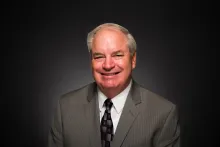
Robin Webber was born in Chicago, Illinois, in 1951, but has lived most of his life in California. He has been a part of the Church of God community since 1963. He attended Ambassador College in Pasadena from 1969-1973. He majored in theology and history.
Mr. Webber's interest remains in the study of history, socio-economics and literature. Over the years, he has offered his services to museums as a docent to share his enthusiasm and passions regarding these areas of expertise.
When time permits, he loves to go mountain biking on nearby ranch land and meet his wife as she hikes toward him.
