

Robin S Webber
This past Sabbath this was the 82nd anniversary of the invasion of the Allied forces against what seemed to be an impregnable wall surrounding Europe under Nazi occupation. It began in Normandy. The goal was to grab a foothold on a beachhead to advance the cause of liberation. As soldiers of Jesus Christ (2 Timothy 2:3-4), what may we learn from this event, as we move beyond the initial first beachhead of baptism, and climb the cliffs of life and surmount that which lies ahead? We will come to discover that it is not enough to "know Christ", but "grow in Christ" as we move through the chapters of life.
This transcript was generated by AI and may contain errors. It is provided to assist those who may not be able to listen to the message.
Something about this day that can help us to be better and more efficient and faithful soldiers of Christ. That's a term that God gives to the body of Christ members at times. Join me over there just for a moment, so we'll set the tone for this message. Second Timothy, and picking up the thought if we could in chapter 2. Second Timothy, chapter 2, and verse 3. You, that means when he says you, that means you. You therefore must endure hardship as a soldier of Jesus Christ. No one entangled in warfare entangles himself with the affairs of this life, that he may please him who enlisted him as a soldier.
And the one that has enlisted us as a soldier, which is mentioned elsewhere in scripture, is Jesus Christ, who is the captain of our salvation. And we are a part of his people, and we're here for a purpose. I'm going to be talking about what occurred in world history. It has a meaning for each and every one of us to endure and to move beyond the moment.
Eighty-two years ago, the greatest maritime amphibious offensive on enemy territory in human history occurred. Its official name was Operation Overlord. Today we simply call it D-Day. Long ago and far away, some of you, like Mr. Gartenhier, were just toddlers at that time. And sometimes, two or three generations down the line, we lose the meaning of what happened. And I don't think we should. Susan and I had a very meaningful visit last week up in Riverside National Cemetery. We visited the cemetery site of my father and my mother. It was moving, as always is. If you've never been to a national cemetery on either Memorial Day and or Veterans Day, you will see more living people than tombstones.
Because all the families come out, they bring their blankets, they bring their chaise lounge, they bring their little tents. Sometimes you'll see two, three, or four generations together honoring somebody. You may just see a lone person, a lone young guy. It might have been his parents. You might see an older widow, more so your widow. There's more widows than widowers at that age, ladies.
And it's very moving. And all of a sudden, you feel like you're... It's like we have in the church, in a sense, but it's a family. And you are going at about one mile per hour through the cemetery, trying to get across, and you go around and around. Those days are made for us so that we don't forget. But for some of you that are younger, I'd like to describe a little bit what D-Day is about. That occurred 82 years ago.
Let's understand the perspective of what was occurring. In our schools in America, we'll often say, well, that, you know, World War II went from 1941 through 1945. There's a yes and a no to that, because you've got to remember that Pearl Harbor was bombed in December. And that we did not come until late into the war. And so our forces began going over to Europe about 1942, but Europe had been at war since 1939.
1939. So the whole length of the war was six years in length. And that's coming off of the Great Depression. So I just want to give you some perspective on that. Europe had been at war for five years. And what the Nazi regime had put up was what we might call an impregnable wall around Europe. It seemed impenetrable. How were they going to get through it? America entered the war. Even as Winston Churchill, once in that very famous speech, where he speaks that we will fight on the beaches, we will fight on the farms, yes, we will fight in the cities, and on and on, and we will never surrender. And they didn't.
The British Isles were the sole nation out of what had happened to Europe, from the Atlantic to the Ukraine to Poland, etc. Fortress Europe seemed like it wasn't going to come down. The Germans had had years building up the armaments along the coast. Nearly 157,000 Allied troops, including paratroopers, dropped behind the lines, were literally thrust on the beaches, the cliffs, the farm fields of northern France, what we would know as Normandy, to break through this figurative wall of Fortress Europe and grab a hold of enemy territory to get a beachhead, to get a hold on the continent.
Now, when I say 157,000 people, that's why I asked you to look at the Escondido Valley as we are here. Can I see a show of hands? I always know that you're talking to the right audience. How many have you been through the Escondido in the entire valley? Can I see a show of hands? This is to keep you awake. Okay. Aaron will take you up after services. Escondido has about 157,000 people. Here's what I want you to think about. Think about taking, if you could, if you could grab everybody in Escondido, I don't know how you could do that, that valley with 157,000 people in that city, and then plunk them down onto the edge of Europe.
Omaha Beach. Utah Beach. Point Duhoch, which was in the middle. 157,000. They had been in training. They were wanting to do this, but the weather was very, very bad. And in part, there's a miracle in that, most likely, and I would suggest a God touch, that the weather lifted. Dwight Eisenhower, later the president, was at that time the supreme allied commander of the forces.
The moment came, it looked like there was going to be a break in the weather. It was now time to strike. There was, as we know in armies at times, there was a deceptive ploy to think that the allies were going to be coming this way. They walked in another way. Eisenhower, that night, must have done a lot of pacing, because, again, this was historic in nature. This had never been done to this magnitude.
Back to the days of the Phoenicians, the Romans, the Greeks, the Spanish, you name it. He wrote two letters that night. Two letters. One letter, and both would be utilized, if need be, after the invasion. To get that beachhead, to grab that part of dirt, that territory, to where they could move forward. He wrote two letters. This tells you the man that Eisenhower was. One letter was if they had victory, and had grabbed just a toehold, he would publish that letter.
The other letter would be that if they did not, and that he would take the blame. That he had not prepared enough for this with the Allied troops. Because it wasn't just Americans. It was Brits. It was Scots. It was Welsh. It was Kiwis from New Zealand. It was Australia. That of the British Empire.
It was Canada. All together, going in. 157,000 men. And so, early in that morning, in the wee wee wee morning hours, thousands of paratroopers were dropped over on the other side of the beach. Down into the farmland of Normandy. To wait there until the other troops might meet them. Then it came on. Some of us have seen this through the movie Private Ryan and other movies.
Can you imagine? Can you imagine being jumped into the water, waiting in? The Germans had a lot of their artillery in what is called Pointe du Ha. I hope my French... my French says it's enough. And from that vantage point at Pointe du Ha, they had artillery that could reach out at least 15 miles. That would have encompassed Utah Beach and Omaha Beach. But there is, in that famous speech, and I'd like you to see it tonight.
I'd like you to see it tonight. It's by Reagan, President Ronald Reagan, the 40th anniversary. About the boys of Pointe du Ha. And all those boys were there in front of him, those that were still living even then. And talking about how they went up those cliffs as they were being fired upon with grappling hooks. No, like mountain climbing, grappling hooks. Can you imagine that? Can you imagine that? And yet they ultimately took that.
And ultimately, the Allies were able to establish what we call a beachhead. 4,500 individuals, Allied forces would die that day. Another 5,000 would be wounded. The rest is history. We had grabbed a toehold of that on the European continent.
And the rest would be history. But it didn't happen all at once. Because that was just the beginning. After that, there would be six major battles between there and Berlin. But there would be famous battles, battles that you've heard of, at least, I think. The Battle of the Bulge, the Battle of the Rhine River. The battle to, at the end, take Berlin as we came from the west with the Brits, with the French. The Soviet Union was coming from the east.
Why do I share this with you? Because this will help us, as Christian soldiers, to understand. A very important point. Just because they got a toehold on the continent and had begun the quest, it would take time. It would take different exposures and different trials to get there. I think it's best summed up by the words of Winston Churchill. Churchill, who was brilliant when it came to words, he was the Prime Minister at that time.
And there had been a major victory in North Africa in about 1942 or 1943, if I'm not mistaken. And the British population got all excited, and the politicians and everything. Here, and listen to what I'm about to say, that Winston Churchill said after this earlier victory, which had already been now two years ago, as he strove to steady his people's perspective of what lay ahead, he wanted to steady them.
He didn't want them to have false expectations that it was now over because of one major victory. I think it was that a la mine. I may be mistaken. Listen to this man who had such a gift words as he told the British Empire and its population, this is not the end. It isn't even the beginning of the end, but it's perhaps the end of the beginning. Did you follow that? I'm going to show you one more time, okay?
This is not the end, whether in North Africa or what occurred on the coast of northern France. This is not the end. It isn't even the beginning of the end, but it's perhaps the end of the beginning. He shared that at the Lord Mayor's luncheon, mansion house in 1942. That leaves me to the title of the message that I want to share with you today.
And it's simply this advancing beyond our spiritual beachheads. Advancing beyond our spiritual beachheads. Because what we're going to be talking about is once you think you've arrived, you've only started in the Christian walk. And even if you've been in the Christian walk, like Susie and I have, haven't grown up since tweens in the church, 60 years, or maybe out of here now, 60 years, is that the walk is still opening up. Hopefully widening, but it's not over. Interesting. To understand what Winston Churchill said is to not be spiritually realistic.
In these understandings, and recognize and accept more down the road, can cause doubt, bewilderment, despair, and most importantly, can create the saddest sight of all. A defeated Christian. Not on the now occupied beach, but the valleys, the deserts, the plateaus, the mountains that are ahead. Let's think about this and the perspective that all of us in general here, except maybe Benjamin at this point, are baptized. Benjamin, one day. Benjamin, this is from the pulpit. Important. One day you're going down, you'll be baptized too. God willing. Okay? Sound good? He nodded.
Good. But sometimes we think through everything that we've been through, growing up in this way of life, maybe not growing up in this way of life, not knowing the fullness of the gospel message, not knowing the fullness of God's grace, much less also what we do in response to God's grace. And then we all of a sudden come upon it, and then we're baptized, and we think, oh, I've gotten over the finish line. Baptism is not the finish line. Baptism is the rest of the story of what you will do with a living God. I looked at that verse, David, when we were singing it, because God is a living God.
And what we will do as we grow in Christ and experience everything, and issues and matters and ways of development to become Christlike, that you and I could never dream to be able to get there. And it doesn't happen in 42 minutes. It doesn't happen in 42 hours. At times it doesn't happen in 42 months.
And sometimes it will happen in 42 chapters. Just look at the book of Job, because he finally grew in an understanding. When he said, I've heard of you by the hearing of my ear, but now my eye. That means the eye of his heart sees what God had in store for him. Obviously he had had a landing. He had perhaps grown up in this way or came to it. You look at Job 1, you look at Job 2, and the things that he said about... Remember when his wife said, you know, Job, hubby, just curse God and die. This is horrible. And he said, how can I curse God? How can I say, oh, this is nice and this is bad?
And the whole lesson of the book of Job is really starting at the beachhead of Job 1. A house, family, a wife, knowing God. But God had something in store for him. He was going to go deeper and allow Job to understand that relationship and what it meant. That he would not only be with Job in chapter 1, but chapter 20, chapter 30, chapter 40, and into chapter 42. When Job said, you know, God, there are just some things so wonderful that I'm just not going to know it right now. I'm just going to have to give that to you. But what I do know is this. I do know this, because as we know, I gave a message on this about three or four months ago. I do know this, that my Redeemer liveth. And if he lives, I will look forward to that day. So what do we do spiritually as spiritual soldiers of Christ as we move off the beach head that has been established? And that's what beach heads are for. It is to establish a contact with the territory, but then we have to travel through it. Baptism is the first beachhead of contact that we have with God and say, we're going to be with you for the journey. Now, again, why is this so important to not only you that are here, but that you of the rest of you that are going to be listening to this in the future, our people on the wire today? When we do not understand what Winston Churchill said about the beginning and the ending and etc., this can create false expectations or a lack of understanding as to number one, what is God performing? Number one, what is God performing? Number two, what are we to do? And number three, what lies before us?
They took the beach at Normandy in a day, but it would take another five or six months until they got to Berlin, of which we call VE Day, victory in Europe. Baptism is a starting point. And one thing that we need to recognize, I'll just speak bluntly to all of you, is to recognize this. Baptism does not guarantee a Teflon encasement from head-on challenges yet to occur. And by God's grace and applying some spiritual elbow grease on our part.
Do you remember? It's always kind of funny when you go to high school. There needs to be high school graduation and college graduation. It's wonderful. A lot of hard work is gone in by both the teachers and the students. But, you know, it's kind of interesting. We call it commencement. Like life is just convincing. It may be done with the graduation. Graduations, whether it's high school, whether it's college, is just a beachhead. Because the rest is coming at us that you don't learn in academia. You learn by going through life to experience it with God as our partner. So what I'm saying to all of you, considering baptism, maybe with your local pastor where you are or here, we need to embrace. And I do mean, are you ready? This is my embrace gesture. We need to embrace and appreciate that spiritual maturity is not a one-day wonder.
It's not a one-day wonder. It's timeless. To what God is doing based within two different but seamless factors in the Christian experience. Number one, here we go, is commitment to Jesus Christ.
It is commitment to Jesus Christ. And that's what baptism is about. I'm going to be counseling some of you for baptism here in the next couple of weeks. I know Skip and Susanna have been talking to some folks. We'd want to say hello to Jade and Larry this afternoon, if they're tuning in. Jade was recently baptized, the young lady that was normally sitting right over there by where Mr. Howe is right now. They're not able to come personally at this moment, but the Millers have been reaching out. Jade was baptized in Mission Bay. That's very novel. She's about a mission, and she is baptized in Mission Bay. I'm about to recognize this.
The first is commitment to Christ, and the second is growing in Christ. Here's what I want to share with you. Let's look at this equation. Let's look at what God wants and storefares. Number one is to be committed to Christ. That's well, and that is good. Yes, you are the Lord and the Savior of my life. You are the Son of God, etc. I have repented of my sins. That's a start. That's a beach hat. That's putting your feet on some spiritual soil, and you said you're ready to go up the cliffs of life. But that tells number two.
First is to commit to Christ. Number two is going to be more challenging. And that is to grow in Christ. Second Peter 3 and verse 18 tells us, Therefore, grow in the grace and the knowledge of our Lord and our Savior, Jesus Christ. These two are not the same. They are seamless. They are a part of a whole. But we need to understand something. Not to understand this is to, number one, underestimate God.
Number two, it is to underestimate the challenge of the struggle ahead. And so we're going to further understand the precious power of our position in Christ in contrast to our conditions in life. I'm going to repeat that. Simple. There are two things. We need to put this together.
Let's come to understand the precious power of our position in Christ. But also, likewise, in contrast to our conditions in life. You know, the last night of his life, and we know that very famous prayer that he gave to his disciples, what did Jesus pray?
Did he say, Scottie, to his heavenly Father? Scottie, beam them up. Let's get out of here. They've been fairly good for the last three and a half years. He said, I do not pray that you take them out of this world. I pray that you will keep them. And then he told them how they would be kept as the evening went on.
What I'd like to do for a moment is to discuss some of the beachhead experiences that God himself has landed upon. We could say, establishing a beachhead foothold. I don't like to use the word invasion. You can be used in a positive sense, but I'd rather say, let's look at God's interruptions, his interruptions that are described.
But they're interruptions that have a moving forward from it. Genesis 1, and let's go to Genesis 1 for a moment. Genesis 1 and verse 1. Let's go right to the beginning. Notice what it says. In the beginning God created the heavens and the earth, and the earth was without form and void. And darkness was on the face of the deep, and the Spirit of God was hovering over the faces of the waters.
And then notice what it says in verse 3. Then God said, let there be light. And there was light, and God saw the light, and it was good, and God divided the light from the darkness. Scripture is so well laid out. It's just incredible. This is the opening curtain. This is God's, what they call, toehold on planet earth. When you read the background translation, we can say, well, it became dark. It became dark.
To-hu, bo-hu. I will say there is that indication that the earth was perhaps the victim of Satan's rebellion against God when he went up to unseat the eternal.
And earth went dark. Earth was covered with water. There was no life.
It was like fortress satania. And God broke through that. Just think about this when things are happening. Go to Genesis 1, 1-3. God broke through the darkness, and there was light.
In the beginning was God. Major interruption. Do I dare say greater than Normandy Beach with everything that happened there? The entire world was affected. He impacted. He intruded. He landed fair and square through the creative process of this earth that would later on become whose God would be the God of this age, who would be the destroyer, who would be the deceiver, who would be Satan, who would be the devil. And God was saying something. After your rebellion, Satan and a third of the angels, I'm still here. And my toehold is going to be on this planet. And let there be light. Let me share another beachhead experience of putting a toehold on territory. We find that over in John 1. Join me if you would in John 1.
Notice what it says here.
In the beginning was the Word. And the Word was with God. And the Word was God. And He was in the beginning with God. And all things were made through Him, and without Him nothing was made that was made. And in Him was life. And the life was the light of men. Thinking again of Genesis 1, 1-3.
And the light shines in the darkness. And the darkness did not comprehend it.
So far, we might say theory, if you're a non-believer. But now, notice 14. Just as much as the Allies went in on the beaches of Normandy, there is a touchdown here. There is a beachhead established. And the Word became flesh and dwelt amongst us. And we beheld His glory, the glory of the only begotten of the Father, full of grace and truth. The One who is Creator, the I AM, the Word, in a sense executed the mission about His Father's business.
Landing on this earth as a little baby, but it was a start. Help was on the way. The salvation process that God desires for all of humanity is found in this toehold, this territory, this Bethlehem, this Nazareth, to prepare for the next step. Whenever God is establishing a beachhead experience, it is leaning towards His next step, not only in Scripture as a whole, but in your life. There is a trail that is moving towards a deeper relationship with God. Join me if you would in Mark 1. In Mark 1, verse 14. Notice what it says here in Mark 1. 14. Now, after John was put into prison, Jesus came to Galilee preaching the gospel of the kingdom of God, and saying that time is fulfilled and the kingdom of God is at hand. Repent and believe in the gospel. Jesus not only landed as an infant, but as He grew. It was about His Father's business. He announced there's a new sheriff in town coming. And you have to understand this is, when you understand the language behind it, when you understand the language, stay with me for those of you who went to a little Roman history, that when Caesar would come to the throne, he would take a coin and he would mint it, because Caesar was thought to be a god. And he would pronounce what is called the eugelion. That's a Greek term. The good news. I'm on the throne, because Rome that could conquer the world could never conquer itself. It was always having civil wars. So the coin, the Caesar, the proclamation that would go out was, I am here. Peace is now at hand. You can rely on me. A man. Read history. How did that work out? Rome that could conquer the entire Western civilization could not come at peace with itself.
That's kind of been our estimate when it comes to people. Sometimes we're good with all sorts of other people than the people that we need to be best with. Gotta think that one through for a moment, personally. Interesting. In John 19 and verse 30. In John 19 and verse 30. Gospels thereof. Notice this. Another moment of seizing territory and seizing the moment. Notice what it says here. This is when he is on the altar of Golgotha. On that mount outside of the city. Because you had to take that which was symbolically unclean outside of the city. Outside of the gate. And he died the death of a criminal. A prisoner of Rome. And turned upon by his own people. But notice what it says here in verse 30. So when Jesus had received the sour wine, he said, it is finished. It is finished. And as much as there is a victory at that time, long ago when the Allies seized a toehold of land in northern France, this was more important. Victory for us, for you, for me, for those that are yet to be, was won on Golgotha. And eternally cemented three days later at a tomb of the resurrection. The victory was won at that point. Savior in place. While we speak of Eisenhower and what he did, which was so admirable the night before, you know what? This plan was going to go. That is why God the Father could say how well he was pleased. Behold, I am pleased with my son. He knew he would go through it. And on that mount, that territory, not on the north of France, but in the midst or on the outside of Jerusalem, when he said it is finished, there would be more movement. But it was going to be okay. It was guaranteed. How could his father above ever forget what he allowed his son to have to go through? A plan that was planned from beginning, is there a beginning of eternity, but from the roots of eternity? The victory is won. Not only the details would have to be worked out. And you know, when you think of some of the names of Jesus, you think of the names of Jehovah, and you think of the names of the Old Testament, you know, one of the names is being the banner. That's one of the names of God, the banner. And here he was on a cross, not holding a piece of wood, but nailed to a piece of wood, but up higher than the audience, enough that it was audible to some. And like in a victory cry, like a high-five to God the Father, he said, it is finished. I've done what you have asked me to do.
Interesting. With all that stated, you'll be very happy. I've just passed over two pages of notes.
Had computer problems, and I can't read them anyway, so we're going to go right for the heart here, okay? That same interruption of what happens down here below, but let's say what happens to you and to me, continues to this day. You see, in a sense, I'll use a phrase out of this century. I hope it's not too catty, but God likes to mess with us sometimes. Just when we don't think he's going to do something, he knocks at our door. Well, Robin, how can you say that? Try to make sure you would in Revelation 3.21. In Revelation 3.21.
Or actually, in Revelation 3, verse 20.
Notice what it says. Behold, I stand at the door and knock. If anyone hears my voice and opens the door, I will come in to him and dine with him and he with me.
Most interesting.
We could call this a positive, evasive move. We could call it an interruption. We can call it that Jesus Christ wants to enter the door and step onto the territory of your heart. And as something to share with you by his spirit and by the spirit of his Father. To do something that maybe you've never done before, and you think it's working and it's not working. But it's come to a point where almost you're convinced it's not working. And it's about relationships. And the spirit knocks.
And Jesus is not going to knock the door down. Hear me carefully, please. He's not going to knock the door down. He's not going to take an axe and cut it down. You've got to be willing to open it from the other side. You've got to be willing to open it up from the other side. And that takes courage. Especially when everything else is not working out.
Especially when you feel like you're alone in the world.
And you say, God, I do this, and I do this, and I do this, and I do this, and I do this, and you run out of fingers on this hand, I do this, and this, and this, and this. But there's a that which God wants you yet to accomplish in your life towards Him. And a way to be able to do that is to remember our position in Jesus Christ. The same Christ who said, I am, in the Old Testament, when He was the word, and the one that led Israel, He called Himself what? I am.
I am. And then at the end of the Gospels, He says, at the end of Matthew, He says, Go, you therefore, into all of the world, preaching and teaching the gospel to everyone, and lo, I am with you always.
May I make a comment?
That's really easy to read. It's not always easy to exist in unless you have the gift of faith from above. But you can have a gift and not open it. You can have a tool and not know how to use it. And that's why we need to read the Scripture. Our position in Christ.
That framework. I love it when I'm up here speaking because this door is wide open, so I'm also the security guard because there's nobody out there today. But anyway, when this door is open, it just takes me back to the story of Esther. And I'm really into Esther, as you know. You've heard it ad nauseam by now. But when Esther was on this side of the door, she was safe. To go through that door and into the king of Persia without permission, meant death. And yet, Mordecai's advice came to her. For who knows but for now, that the kingdom has come unto you. But that was not just for 480 BC. That's for each and every one of us every day as we look at this door, or we look at the opening as to whether or not we're going to take it or not. But I just suggest this to you, and it works for me, and so I'm just sharing. I'm on the trail with you, too. I look at everything anymore through Esther, but I'm not looking at a door made of wood. I'm thinking of Jesus Christ, who is the door. He said, I am the door. I am the gate. I am that which you go out into the world to live, and I am the one that you come back through when you come back home. And I am the one that is with you when trial fits you, that you don't think that you're going to be able to bear.
He knows. He's been through it.
And so we look at this and we position ourselves in Jesus Christ.
And then number two, to remember that our position in Jesus Christ will always trump the conditions on the ground. I'm going to repeat that. If you will remember this, and if you will just be daring enough to write this down today, or maybe when you listen to this again, this will be an anchor, this will be a key, this will be a spiritual flashlight to the future. And that is simply this, that our position in Jesus Christ trumps the conditions on the ground. No matter what comes. Because if you really believe in Jesus Christ, and you really believe that He did face everything that we read about, and nobody was with Him at the end in the Garden of Gethsemane, and you think you have relationship problems, it might be mad at somebody.
Or this, or that. Four gospels are full of what makes them beautiful. And the beauty that was in Him makes us at times look so ugly, other than by God's grace. And yet He says, grab ahold of that beauty. Hold on to it. As we seize new territory, I remember when Susie and I were baptized, she was more spiritual than I in Ambassador College. She got baptized about five months ahead of me. She got baptized in her freshman year. I got baptized in my sophomore year. A hundred people came out to see me baptized. They couldn't believe it. They said, this guy? He's getting baptized? They had to have witnesses. Anyway, thankfully my mother and I, some of you knew my mom, she was baptized by Mr. David Antion, and her high school pastor back in Ohio. My mom and I were there, and it's beautiful. There's nothing like a baptism. If you're having a bad day, go to a baptism. Call me. I'll let you know where one's happening, okay? But the point is this. When you came up out of that water, which is a symbol of dying in Christ, you came up in a type of resurrection to live for Christ. And sometimes live for the conditions that you don't know. When those young men landed on that beach in Omaha Beach or Utah Beach, or those guys that climbed the cliffs, a point to Haag, under German artillery, and that was just the beginning. They would have to go through France. They would have to meet at the Battle of the Bulge. They would have to meet at the Battle of the Rhine. They would have to then, as there was this clamping in of Berlin, to take it.
We don't know what is next. When they landed, again, it was not over.
And what I'd like to just share with you, whatever you're going through right now, and you alone know this, or those that are listening, God knows.
You think of that door. I wish you could all turn around and look at it. This is so much fun for me when I'm speaking. I'll say, Joy. Because that frames what I try to share with you, which I try to share with myself, how I strive to live, and we all tumble and fumble at times. But that's what God has given us. He's given us the door towards the kingdom. And it doesn't come all at once. It says that Jesus Christ was made perfect in Hebrews 9-10 by the suffering that he went through.
Let's wrap up, then, for today.
Maybe you say, well, Mr. Weber, I haven't been there of recent date. Rather than walking towards God, embracing Christ, standing on those promises, standing on that rock, I've gone silent. All my brothers have hit the beach. I'm still in the boat. All of my brothers are climbing the cliff under fire. But I'm behind a log.
And just when you get the top of that cliff, you look down and there's a whole valley that you are not aware of that God now has prepared for you to learn more about him, to strengthen you, to make you a good soldier of Jesus Christ. And don't think that God has only led you into that valley. Matthew 4, verse 1, tells us that the Spirit itself led Jesus into the wilderness. What? Why? To learn. To be the most complete savior any human being could have, because he was God with us. He was Emmanuel. And as I've shared with you before, all of us will have wilderness experiences.
God has not promised a Teflon life for us. And sometimes some of us, perhaps, break easier than others. And don't just look at the ladies, gentlemen. Ladies are pretty tough. They're called the weaker sex. I've never figured that out yet.
They're the ones that have the babies.
Don't underestimate what Christ has done by doing all of that. And whatever you're going through right now, whatever beachhead that you're on so far, but now you're nervous about going the next step and over the hill and into that valley, let's just simply remember this as we conclude. The Lord is my shepherd. I shall not want. He leadeth me... No. He makes me lie down... What? He makes me lie down in green pastures. He leadeth me by the still waters. He leadeth me in the past with righteousness for his name's sake. And yea, though I walk through the valley of the shadow of death, I shall fear no evil for thou art with me. Thy rod, thy staff, they comfort me. Thou anointest my head with oil, my cup runneth over. And then the final part, just so you know, it's just like the climax. It's like the fourth movement of a symphony or the third movement of a concerto. It rises, for surely I know that I shall dwell in the house of the Lord forever.
Wow.
I think David got off the beach.
He climbed the cliff in front of him, and he walked to that valley of death, perhaps more than once when you read the story of David. And yet, being David, even so, he had the confidence that God would not turn his back on him. But that same God, that I am, that Jehovah of the Old Testament, that Jesus Christ of the New Testament, would be there walking with him, saying in that sense spiritually, Come on, let's do this one together. Let's walk through that door this week. Let's get off the beach. Let's keep moving. Let's do it.
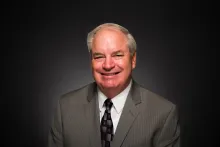
Robin Webber was born in Chicago, Illinois, in 1951, but has lived most of his life in California. He has been a part of the Church of God community since 1963. He attended Ambassador College in Pasadena from 1969-1973. He majored in theology and history.
Mr. Webber's interest remains in the study of history, socio-economics and literature. Over the years, he has offered his services to museums as a docent to share his enthusiasm and passions regarding these areas of expertise.
When time permits, he loves to go mountain biking on nearby ranch land and meet his wife as she hikes toward him.
