

Robin S Webber
This transcript was generated by AI and may contain errors. It is provided to assist those who may not be able to listen to the message.
Many of us, as we've studied the Scriptures, we read them and we come to recognize that the one that is defined as the Word in the Bible also used a self-disclosure about Himself. We find it in the book of Exodus. When Moses is on Mount Sinai and he says, Okay, I'm in the program and I'm ready to go, but by the way, when Pharaoh asked me, Well, why am I here? And who sent me? Whom shall I say sent me? And of course, the one voice came back and said, Say this, I am that I am. That is who sent you. I am that I am. Now, most of us in this audience at one time or another have gone through that series of Scriptures in the book of Exodus, and we can theologically define it, understand it, place it in our mind, and put it in our cubicle of understanding of the Bible.
But it really reads differently at times when challenges of life come up. And it's not what our eyes see. It's not what our mind understands. But it's where our heart is as we weigh the activity that is occurring in our life. Activity that maybe we can't put together right and wonder where in the world is God. And then that whom is revealed as I am, we sometimes wonder, maybe He was I was and or maybe will be. And we wonder where is the one that is the I am. Luke 14 and verse 26. Join me there for a moment as we begin to anchor ourselves in Scripture.
In Luke 14, this is the clarion invitation and call of Jesus Christ. And as always, Jesus was extremely honest. Oh my! Ever so honest at all times. And He said here in verse 26 of Luke 14, If anyone comes to me and does not loveless his father and mother, wife and children, brothers and sisters, and yes, in his own life also, well, he can't be my disciple.
And whoever does not bear his cross and come after me cannot be my disciple. Now let's understand something very succinctly. Verse 27, And whoever does not bear his cross, we are not talking about the cross of Christ. We're not talking about the one that he carried alone and only could carry alone De'Gawgotha.
But He said, if you're going to follow me, there are going to be challenges. There are going to be burdens. No, you can't carry what I carried, but in turn you will carry a cross. And it will seem weighty. And it will seem burdensome. And it will seem to make you want to just sink on your knees and to go no further.
Let's talk about that for a moment, because there's a different kind of process. The hope of the Master, as He spoke this, that what we would do is we followed along behind Him, as He said, follow Me, with that it would be a cross of righteousness. It would be one that would magnify the witness of God and glorify God by us down here below being Christ-like. And we may say, well, that might be called the cross of righteousness.
But you know, friends, if we can be blunt for a moment and be very human, there are other crosses that we carry. Crosses that sometimes just take a snap decision on our part and our life is affected for the rest of our existence. Sometimes we bear crosses of foolishness, just plain foolishness. There are other times that we bear the cross of rebellion, either rebellion against our parents, rebellion against the rules of society, and, or we that have become enlightened at one time, rebellion against our Maker, against our Creator, against our Father in Heaven, and against the example of His Son, Jesus Christ.
What do we do, then, when we come into those intersections? What do we do when we face those challenging chapters of life? Perhaps again, many that have grown up in this way of life, those that have studied Exodus, those that have even gone to the Gospel of John, which illuminates and exhibits the seven great I.M.s. For we that are here understand intellectually that the one that was defined as the Word became incarnate and became Jesus of Nazareth. And as He walked and He talked through Galilee and Samaria and through Judea, He offered the seven I.M.s.
I am the Word. I am the light of this world. I am the bread. I am the way, the truth, the life.
We all know that intellectually, but what we know in our head does not help when the great issues, the major intersections, the challenging chapters of life come along. My wife and I have, of recent date, dealt with many of those in our circuit. Sometimes these challenges seem to come in waves, in families, or in congregations, or in a circuit. And thus, I give this message because of it, because this is our anchor, and this is what we are about. And so, let's understand something. The message that I want to give to you today is simply entitled this. You might want to jot it down. Let's anchor ourselves. I am not a peer to waste your time or to bore your time. I am a minister of Jesus Christ. And I speak from the Word of God because I love you and I care for you, and I want God's best for you. And thus, I bring this message today. And this message is not just simply about the omnipresence of God. It is not just about the omniscience of God. It is not just about the omnipotence of God. We know that God is all-powerful. We know that He is all-present. We all know that He is all-knowing. What I hope to do to share with you today, more than ever, is to help you understand His everlasting and ever-present love for each and every one of us. His everlasting, ever-present, ever-approaching love towards you and towards me. And thus, the title of this message is simply this, The Ever-Present Presence of God. The Ever-Present Presence of God. Now, to begin with, the best way to bring you along as an audience is to ask a question. And I want to ask you a question. It's not an intellectual question. It's simply this. Do you feel and do you understand and do you experience the ever-present presence of God in every chapter that comes our way in this human existence? Not only when there are green pastures, not only when there are still waters, not only when God guides us down through the paths of righteousness, but in those challenging, incredible, sometimes heart-rending, isolating experiences in our life that we go through as we walk through that shadow. And sometimes it is a death. It can feel like a death. It can feel like a living death in different chapters and relationships of our life. And do you again understand, not only intellectually, but heartfelt and experience the ever-present presence of God? To help us understand that, let's anchor ourselves in Scripture. May we? And join me, if you would, in Psalm 139. In Psalm 139, to begin this message, let's open up our Bibles together on this Sabbath day. We're here to hear the Word of God. In Psalm 139, verse 1 and through 12, it is here that David shares his experience of both the expansiveness of God's nature and the intimacy of his concern for us. Now, that's very important to understand. There are many, many religions of antiquity that spoke of omnipresence of their deity and or the omniscience of their deity and or the omnipotence of their deity. But none spoke about this ever-present, ever-expanding, ever-approaching, ever-wrapping around us this love of God of the one that you and I worship on his Sabbath day. Psalm 139. Let's read through it together for a moment. Let's just go to it and allow the words of God to fall on your heart.
You're right in the room with me. You're even ahead of my mental thoughts. But behold, O Lord, you know it altogether, and you've hedged me behind and before and laid your hand upon me. Such knowledge is too wonderful for me. It is high. I cannot attain it. Where can I go from your spirit? A big question. Where do you not exist? Even if I wanted to, I can't get away from you. Or where can I flee from your presence? If I ascend into heaven, you are there. And if I make my bed in the grave, you know what? You're there. If I take the wings of the morning and dwell in the uttermost parts of the sea, even there your hand shall lead me, and your right hand shall hold me. And if I say, Surely the darkness shall fall on me, here it comes, it's coming, the darkness is going to fall on me, lights out. Even the night shall be light about me, and indeed the darkness shall not hide from you. But the night shines as the day, the darkness and the light are both alike to you. Absolutely. For God owns both worlds. He owns the dark. He owns the light. He's the one that created light. He's the one that divided the day from the night. He owns both worlds, and they are one world that He exists in and permeates in and is always in and owns. He owns the world of light when things are well and good in our life. And He also wants to come into those dark spots to help us, to guide us, to encourage us, and frankly, just to love us. And we need to understand that. Verse 12, let's take a look at this for a moment because we're going to build upon this. Indeed, the darkness shall not hide from you. But the night shines as the day, the darkness and the light are both alike to you. We lose that today after Mr. Thomas Edison came along. It's hard to sometimes grasp what this meant to the original audience. If any of you have ever gone to a museum and gone to the antiquity session and you see some of those little clay lamps that they used in the ancient world, you know, they were not a Bunsen burner. They were very, very small. They always looked really big in the books. And then you go to see an exhibition and they're like, yay, yay, yay big.
If you ever wondered what yay big looks like, this is yay big right here. And you were supposed to hold that and then there'd be a little oil there and there'd be a little light. When the sun went down, life changed. Sometimes life changes for us when it is all dark in our lives. And we do not recognize that God is also there with us. David, in part, understood the intimacy of the Creator and what he wanted from the very beginning. I'd like to have you join me, if you would, right in the book of beginnings, Genesis 3 and verse 8, to understand the ever-present presence of God. In Genesis 3 and verse 8, it speaks to the story of Adam and Eve. God's a very, very special creation. And what a creation that was, dear brethren, to understand what God did. He had made the sun, he had made the moon, he had divided the firmaments, he'd made the green things, he'd made the creepy crawly things. That's always the fun one to go through. He'd made the creepy crawly things. He even made the animal kind. But he was not done. And it was on that sixth day that he made his special creation.
You and I know the verses where it says in Genesis 1, 26 through 27, Let us make man, he who that we now know as God the Father, and the one that was the Word that became the Son, that we now know of Jesus the Christ. Let us make man in our image and after our likeness. And God went down into the clay and into the dirt of Eden and shaped and formed Adam. Later he would take out of Adam's side and make something very, very special. And he would make woman. And what he wanted, whether it was with Adam or whether it was with Eve, when those eyes first opened, can you just imagine? Wouldn't that be cool? One day in the spiritual video where you have the rewind button, and you go back and you see the first time that Adam opened up his eyes. Or Eve opened up his eyes. And the first thing that they saw was God. And that's exactly what God wanted. He wanted to love Adam. He wanted to love Eve. And he wanted to see them behind those eyes. He wanted to reach their heart. And he wanted them to know that he wanted to be with them. And it was what it was all about. They were going to have a relationship. See, the Scripture is founded on relationships. And that must have been just an awesome moment. And all that he requested of Adam and Eve is that they would give back what he had given to them. Love and honor. And to be worshipped by them. We find in Genesis 3 and verse 8 very interesting. After they had rebelled against God, had broken the rules, because rules or relationships are based on rules. They had broken the instruction of God. And notice what it says in verse 8, And they heard the sound of the Lord God walking in the garden in the cool of the day. And Adam and his wife hid themselves from the presence of the Lord of God among the trees of the garden. What's very interesting, we look at verse 8, you see that here's God walking in the garden, approaching Adam and Eve. God is always approaching, always desirous to rekindle the relationship. And it says here, and then the Lord God called and said to Adam, where are you? What we find here, what we experience, and I want you young people over here on my right to remember this. We worship a God that is not just simply on a high mountain. We worship a God that desires to walk and talk amongst his creation. Oh yes, he is omnipotent. Oh yes, he is omniscient. Oh yes, he is omnipresent. Which are just fancy words that he is everywhere. He is all-powerful, all-knowing, almighty. And yet his greatest desire, his greatest desire is to have a relationship with each and every one of us. Not just expansive in nature, but intimate by his very being and what he is. We know what occurred there, but it was always God's desire. After Adam and Eve, it was always God's desire. Stay with me for a moment. We're going to kind of do a sketch of the Bible for a moment. We recognize that as he moved away from Adam and Eve, he called a people to himself. They were called Israel. He took them out of slavery. And he made a people that were not a people, and they began a pilgrimage. Just as much as you and I are on a spiritual pilgrimage right now. We have something in common with Israel of old. We that are the Israel of God.
What God did when they encamped, when they finally would stop from time to time, his house, the tabernacle, was placed right in the middle of the camp. You can go to Numbers 2 and verse 2 if you want to research this later. It was right in the middle. It was the hub of existence for ancient Israel. And then there would be three tribes on this side and three tribes on this side. Three tribes on this side and three tribes over on this side. But the middle, the most important part, was at the hub. That's what made Israel move and breathe and live and exist.
And move from slavery in Egypt to freedom in the land of milk and honey across the Jordan.
God was right in the middle. And that is where his Shekinah presence would come down. The glory of God, the presence of God. And oh my, how Israel rejoiced when they saw that cloud come down. They knew that God was in the midst of them.
Later on when Solomon built his temple, once again the Shekinah presence came down the cloud and filled that temple. When Israel, excuse me, when the Jews later on would go back to rebuild the temple.
And we find that story where they were disappointed and we know that very famous verse, Behold the day of small things. You have to understand why, stay with me, why Israel was grieved. Or the Jews were grieved. It was not just simply because of the size of the temple.
That it did not match Solomon's, but because the Shekinah presence had not come down.
There was something that was somewhat missing.
And they were saddened. But they went on.
So we notice all of this. Ezekiel 37, join me if you would there for a moment, Ezekiel 37.
Speaking that no matter what we've done, God is never through with us. Never done!
And we notice this in the book of Ezekiel. Join me if you would in Ezekiel. And join me in Ezekiel 37. Earlier on in the chapter it speaks about the dry bones, but let's pick up verse 26. Moreover, I will make a covenant of peace with them, and it shall be an everlasting covenant with them. Speaking of Israel, because when you go to Ezekiel 37 it speaks about the house of Israel rising.
They who had no hope at all. My tabernacle also shall be with them, and indeed I will be their God, and they shall be my people. And the nations also will know that I the Lord sanctify Israel when my sanctuary is in their midst. Forevermore. In the international standard version it says, when I pitch, when I pitch my tent. I want to be amongst my people. I don't just simply want to be an expansive God. I want them to know I want to be an intimate God, and that I will be with them. And indeed I will be their shepherd, and I will be their Lord. And why then would they want? As we come up to the Passover, as we've gone through another year, sometimes we say, okay, I know about the I Am, but right now in my life it seems like He has become the I Was. Or maybe He's off and will come back in my life later on, and He'll become the I Will Be. God wants to be our I Am. He wants to walk and to talk in our lives, in our church, in our congregation. And most of all, He wants to walk and talk in our heart by the power and by the indwelling of His Spirit and the Spirit of Jesus Christ. Folks, that is what it is about, and that is what God offers His ever-present presence. And that's very important to understand. Join me if you would in John 14, verse 23. In John 14, some of Jesus Christ's last earthly comments. It's that night before He was brutalized and the next day when He was sacrificed. But notice what it says in John 14, verse 23. Jesus answered and said to Him, If anyone loves Me, if anyone loves Me, He will keep My word and My Father will love Him. Now, maybe you've never seen this mentioned before, and well, that's good. That's why we keep on coming back to church, isn't it? Notice what it says here. He will keep My word and My Father will love Him. And notice, and we, capitalized, thus this is speaking of the Father and the Son, we will come to Him and make our home with Him. I read this about two weeks ago, and to me for a moment, time stood still. Because in reading this, it reminded me what God is wanting to do. God is in the process of designing and developing children to be immortal, that He invites into eternity. But right now, not then, but right now, because sometimes we can look off in the future and say, okay, this is going to happen.
We know what we heard about Isaiah 19, 25 through 27, which is one of my favorite verses. We look at this time forward, or we look at this time forward, or we think this is going to happen, and then there's going to be the millennium, and then there's going to be the eighth day and all that comes there. No, brethren, we're talking about now. Now is the moment. Now is the time to understand what God is doing with us. Now! Yes, He will do other things with us in the future. But if we do not deal with the now, and that we crave, we understand the expansiveness of God being ever present, but understanding that He wants to walk and talk in our lives now, it says that they, we, will make our home. You know, there's a big difference between a house and a home. I know John Lyons is out here. Robert Lyons is out here somewhere, wherever you are out there.
I know of you to be two of our tradesmen. You've built lots of houses, haven't you? You can take two by fours, and you can take four by fours. You can lay cement. You can put on, on top of the, I'm an old building inspector, you can put on a tile roof, comp shingle roof, comp roll roof, you can put on gravel and tar roof, etc., etc., etc., etc. And you can build that. That's a house, and that's all it is.
It's nothing else other than a shelter. God is not building a house. He's built the earth. He doesn't need to build a house. He's building a home. A home is different than a house. A house is kept together by nails and glue. A home is kept by the heart. It is stitched with spirit, and that's what our Father above, through His Christ, wants us to have, wants us to experience, for them to be at home with us, and for we that are here below, trapped in time and space, to know that God is ever-present and presently in our lives.
Can we talk a second, and may we speak? Sometimes in our church culture, we tend to push off all the goodies to the future. Oh, everything will be better in the future when Christ comes back to this earth and then sets up the millennium, and then as we keep the last festival, the eighth day, and all that that brings about. But if we're pushing everything off to the future, dear brethren, we're missing a large part of what God wants us to experience in the present. That He is our Lord, that He is our champion, that His Son is our elder brother, that He is always with us, and as we're going to come to find at the end of this message that there is nothing that can separate us from the love of Christ.
Some of us, as we move towards the Passover, we've gone through a year, we've breathed the smog of this world, and we are just kind of affixiating ourself.
It's time to recognize the great purpose of God, how great He is, not only His nature. Get that! Got that! About how great is His attribute and His desire. Let's just put it this way. You think of everything that Jacob did in his life, reality television on the sand dunes of the Middle East, and yet God always wanted to get a hold of Him, and for Jacob to embrace Him. Later on, His children, His ancestors, Israel, everything that Israel did in the wilderness did in the nation of Israel, then Israel, then Judah, and yet God still has unfinished business with the house of Israel. God never gives up on us.
It is we down here that cannot afford to give up on God. Let's notice here a little bit further then. We find about this home, and that's very important.
Sometimes we can feel that maybe, like I said, where are you, God? Especially when we get into certain things. I'm here to remind you as one Christian to another that we are never out of the reach of God. God will come at us in every way and every fancy. We just have to be ready for it. We just have to be ready for it. You know that wonderful story where Jesus said, we're not going to turn to all of it right now. I'll give you an assignment. You can look it up. But Jesus said, you guys go out on the boat. You guys go out on the boat, and I'll join you on the the other side. I'll get to you, and I need a little downtime. Crowds have been a little big recently. I need a little downtime, so you go off on the boat. Well, we know that they went off on the boat, and they had one of those storms that come up on the Sea of Galilee. And they thought that their goose was cooked. They thought that their days were numbered. And all of a sudden, you know, they're looking out there in the dark, and here comes the light of the world. In the darkest storm on Galilee, here comes a figure. And it's Jesus the Christ, Jesus of Nazareth, walking on the water to them. Out of reach of all humanity, not natural. And He's walking on water, not walking away from them. As sometimes people will think that God has walked away from them in their deepest, darkest moments. And He's walking towards them.
And He says, do not be afraid.
The intimacy that pulled Him towards His disciples from ashore into the middle of the lake, in the darkest moment of the storm, and He was right there with them. There's other wonderful stories in the Gospel. There's the story of the young man that was healed by Jesus, a man that had been blind since birth. And it's very, very interesting. Hear me please as we go through the story that here was a man that all he did was stood still, and he let the man from Nazareth heal him. And because of that, because of that, his parents walked away from him. His neighbors walked away from him. The church of that day, His church, the synagogue, cast him out of the house of the Lord. He had nobody, and He was alone.
And the Lord of the house, the Good Shepherd, went out seeking after Him and found Him after His family, after His neighbors, and after the good church folk.
The clearing of my throat is for a purpose, because they did not get what God was doing, and the Good Shepherd found Him.
It's very interesting that nothing will stop the love of God, the work of the Father, and the mission of the Son in our lives. We know that walls can't hold out Jesus, can we? We know that story. He walked through the wall. Some of us think that we have walls in our life that somehow God doesn't know where we are. He will not only walk through a wall, He will not only walk through a wall, but He also allows us to reach into Him, just as much as Thomas had to. Thomas got things intellectually, but He even allowed Thomas to experience them fully by literally reaching into the wounds that were in His body.
The days ahead of the Passover coming up, God may allow you to reach deeper. He may allow you to reach deeper, as you will recognize that God will not allow any wall to halt His love and His concern, and His desire to walk and to talk and to be amongst us as His people.
What can keep us from God? What can stall the intimacy that God wants us to have with Him? Let's talk about that for a moment. Number one. Number one. I'm only going to give you two. Our sins, our sins, can create space between us and God. Join me if you would in Psalm 32. In Psalm 32. Again, the words of David.
In Psalms 32 and verse 1.
Picking up the thought in verse 1. Blessed is He whose transgression is forgiven, and whose sin is covered. Blessed is the man to whom the Lord does not impute iniquity, and in whose spirit there is no deceit. When I kept silent, my bones grew old. When you didn't act upon what you knew that you needed to act upon, that distance had come between you and God, and that somehow the I Am had become the I Was or the I Will, but that line of intimacy had been broken. When I kept silent, my bones grew old. Sin has results. Through my groaning all the day long, for day and night your hand was heavy upon me, and my vitality was turned into the drought of summer.
Then notice verse 5. I acknowledged my sin to you, and my iniquity I have not hidden. Boy, that really works, doesn't it? One thing I remember growing up in this way of life, going to Imperial schools over there across your royal, I think it was almost mentioned in every class growing up, numbers 32-23. 3-2-2-3. That way it was lodged in my mind.
Your sins shall find you out. For every cause there is an effect. For whatever you do, there is a shadow. Whether it be of righteousness or whether it be of ill and sin. The body of work that you perform cannot outrun its shadow. It will catch up. I acknowledged my sin to you, and my iniquity I have not hidden. And I said I will confess my transgressions to you, Lord. And you forgave the iniquity of my sin. And for this cause everyone who is godly shall pray to you. In a time when you may be found, surely in a flood of great waters they shall not come near him. Now notice verse 7. You, you are my hiding place. And you shall preserve me from trouble. And you shall surround me with songs of deliverance. God is our hiding place. But before we talk about that presence and that hiding place, one more thing. Point number two. Are you ready? The other thing that keeps us from experiencing the presence of God are our busy lives that distract us. Our busy lives that distract us.
Sometimes we can't sense God's presence or the stimulation of his spirit that dwells in us. Now stay with me for a second. I've given you a number of messages on the Spirit of God and you can read them as articles in the Beyond Today magazine four in a row. The Spirit of God today is not up in a bush per se on Sinai. We think of Mount Wilson over here to our east. We no longer have to walk up Mount Wilson trail to find the Spirit. The Spirit of God is placed inside of us.
You know, it's like sometimes when you have your smartphone and it starts buzzing. What do you do when your smartphone starts to buzz?
Especially in services. You turn it off. But beyond that, you go for it. You reach for it. You know that somebody is trying to reach you. But here we have the indwelling of God's Spirit in us and at times we are numbed by the amount of activity that is in our life. Sometimes we can't sense God's presence because there's too much of everything else going on in our life. Too much noise. Too much traffic. Too much confusion. Too many thoughts running rampant in our minds. Too much anxiety. That God does not want us to carry. He says, you put your load on me, but we get so involved and so busy that we forget the very basics of why we were called that He is our shepherd. And lovingly wants to take care of us. Is it any wonder then in Psalm 46 and verse 10, the God of heaven says, Be still and know that I am God. Brethren, how still is your life? My wife and I were just with a couple the other day. And we had, I had not seen that couple for many a year. But they had this little distraction in their hand. It's called a smartphone. And they were, as all of us can be, be very busy seeing what everybody else is thinking about us other than the person that is in front of us and engaging and walking and talking and being and existing in the moment. Not moments past, look at myself be, but the moment of the present of the man or the woman or the child that needs us as much as the guy that was robbed going down to Jericho. And that we are sensitive to God's Spirit in in us. But we get caught up in too much of nothing.
Brother and I am very concerned as your pastor about the culture present and how it is affecting Christians and affecting the church of God as much as Christ in the book of Revelation was very concerned about the cultures that were around those seven churches in Asia Minor at that time.
We have to know what we are inhaling. We have to know what we are inhaling. We need to be sure that we are inhaling what God gave us to inhale.
I remember many years ago, some of you are old enough to remember that there was a very famous historical figure that just simply said this, I didn't inhale. Some of you will remember that famous phrase. And some of you are smiling.
What are we inhaling?
What are we inhaling? I'm going to ask you again three times as a charm. What are we inhaling? We that are so busy, too much of this and too much of that and too much of this. Can you ever get too much of God? Can you ever get too much of the love of Jesus Christ? Can you ever get too much of recognizing that God has placed His laws in our hearts and our minds to to guide us and to keep us, to understand His love, to recognize that within our hearts if we will allow it and if we will learn to understand, to use it better, that God has given us the great GPS to move through this life, to honor Him, to glorify Him and to be a blessing to other people. Join me if you would in John 20 verse 21. John 20 in verse 21.
In John 20, this was after the resurrection of Jesus Christ, but it's just an interesting portion of Scripture. In John 20 and in verse 21, so Jesus said to them again, because He was always telling them that, whether it be in a dark spot on a lake, about to sink, or in this room, Jesus said to them again, peace to you. As the Father has sent me, I also will send, I also send you. And went notice this now, and when He had said this, He breathed on them and said to them, receive the Holy Spirit.
We that are Angelenos, what are we inhaling?
Just a smog of our surroundings?
Or are we inhaling?
The living love and the words that God the Father sent His Son down here for us to inhale.
I know in my life, I know in my life, I have inhaled too much of this world.
But just as much as the old cartoons of old, out goes the bad air, in comes the good, out goes the bad air, in comes the good, it's not enough to simply exhale this world. We must inhale the Word, the Love, the Commandments, the Statutes, and the Judgments, and the Words of Christ that we are to inhale. That is our only hope, and that is God's desire. I want to show just two sets of verses, and the short verses. I'm going to tell you a story, conclude with a psalm, and then we'll conclude. Matthew 7 verse 7. Brethren, I know some of you with, and I probably know most of your stories as well as anybody. In some stories, I don't know. You've kept them to yourselves, like the Psalm of David said. I've kept them silent. But I want to show you what I call, and maybe you've never heard this term before, you sometimes say, well, I wish somebody up there would tell me something new. Well, maybe this is new, and maybe it's not, because we know there's nothing new underneath the sun. But I'm going to give you a key to spiritual growth. You might want to jot this phrase down. I'm going to share with you the double knocking. The double knocking. Sometimes we just center on one. In Matthew 7 and verse 7, let's notice what says, ask, and it will be given to you. Seek, and you will find. Knock, knock, knock, and it will be opened to you.
But God has got to know that you're knocking.
Some of us in this room need to ask and seek and knock more than ever, because there is a wall that has developed between us and our God, whether by sin, sin of commission, sin of omission. Not only what we do, but what we don't do. And just simply the overwhelming wave of too much of everything.
You've all heard this, but I want to share another knocking. Revelation 3 and verse 20. Join me if you would there for a moment. Revelation 3.
In Revelation 3, and let's notice, verse 20. This is the other side of the double knocking. Behold, I stand at the door and knock.
Remember first grade jokes? Knock, knock! Yeah, we all know that. Probably the last thing we'll remember in our life, you know, when everything else goes out of our mind. Knock, knock! Behold, I stand at the door and I knock. And if anyone hears my voice, if anyone when the nation of Israel in the future, when it is raised up, repents and knocks and recognizes that their hope is not gone, or all the people of this earth have that veil lifted from them.
But let's not wait till then, for we know not when that will occur. We look through a mere darkly, but we deal with the now. We deal with understanding that God has called us now to serve Him now and in the future, but now as His living vessels, as a living temple made of flesh and blood and heart. And even sometimes hearts that are not right for the moment, but the heart that He wants. Our God above will not give up on us ever.
He did not give His Son for us to wither as simply sunshine patriots of Christ.
We must understand that no matter what dark spot you or I might be in, or the people that are listening today, God will not give up. God is love. People say, well, how do I know that God is love? And we go to Romans 5 in verse 8, 9, and 10, and it says, what do you mean you don't know that I love you? I gave you my Son. That is my love personified. There is nothing that can keep us from the love of Christ. Behold, I stand at the door and knock, and if anyone hears my voice and opens the door, we've got to open it. Christ is not going to slam our door open. There is a cooperation. There is a relationship. There is a needfulness on our part to understand that as we hear and sense the Spirit of God in us, that we need to open from our side and inhale His presence in our life, that life which is forevermore, and I will come into Him. That's a promise, and I'll dine with Him, and He with me. We need to, as we approach the spring festivals, dear brethren, friends in Christ, fellow travelers, sojourners towards the kingdom of God, we need to have that confidence. We need to have that knowing. God right now is not walking and talking in the Garden of Eden. That has come, but He wants to walk, and He wants to talk, and He wants to reside, and He wants to make our existence His home. And that we can then have every confidence that we move forward, no matter what chapter of the 23rd Psalm that we are going through, whether it is the green pastures, whether it's the still waters, whether it's when things are going well, and we feel like everything is the paths of righteousness. He even wants to work with us in those very intimate, sensitive areas within the shadow of death, because then we know that surely goodness and mercy shall follow me all the days of my life, and I will dwell in the house of the Lord forever. It's one thing to know about the Word academically. It's another thing to experience the expansiveness and the intimacy, and to understand the ever-present presence of the Lord. I want to share a story with you. It was on a late night, and the train was going down the track. There was a lot of unease amongst all the passengers that were on the train as the dark and the stormy night continued. The lightning was flashing, black clouds were rolling, and the train was traveling really, really fast. The fear and the tension among the passengers was very evident. I've been in that situation before where we were circling and myself circling and circling when we were dumping the fuel from a plane. It wasn't this week, many, many years ago. You always kind of wonder what people do when they wonder if it's their last moment, but that's another story, another time. One little fellow, however, sitting all by himself, seemed utterly unaware of the storm or the speed of the train. He was amusing himself with a few toys, and one of the passengers spoke to him, Sonny, I see you're all alone on the train. Aren't you afraid to travel alone on such a stormy night?
Out of the mouths of babes. And the lad looked up, and with a smile answered, no ma'am, I'm not afraid. My daddy's the engineer.
How confident are we as we go through the storms of life, knowing that God owns both the light and the dark? There's one experience to Him. Psalm 121, join me, we conclude. Let's allow, let's inhale, as I have spoken to today, the words of God. Wisdom from old. And let us move forward then.
Psalm 121, I will lift my eyes to the hills. From whence comes my help? My help comes from the Lord, who made heaven and earth. He will not allow your foot to be moved. He who keeps you will not slumber. Behold, he who keeps Israel shall neither slumber nor sleep. I want to remind you from the Word of God and anchor ourselves in the ever-living Word of God, the Lord is your keeper, and the Lord is your shade at your right hand. And the sun shall not strike you by day nor the moon by night. And with every confidence, brethren, with every confidence, the Lord shall preserve you from all evil. He shall preserve your soul. The Lord shall preserve your going out, and your coming in from this time forth and forevermore. Amen. Let us remember simply this about the ever-present presence of the Lord. Keep it within you always. Allow it to be your spiritual GPS. Allow it to be our guide as we move forward together towards the wonderful, wonderful kingdom of God to come.
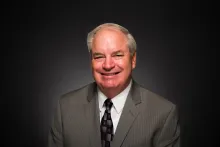
Robin Webber was born in Chicago, Illinois, in 1951, but has lived most of his life in California. He has been a part of the Church of God community since 1963. He attended Ambassador College in Pasadena from 1969-1973. He majored in theology and history.
Mr. Webber's interest remains in the study of history, socio-economics and literature. Over the years, he has offered his services to museums as a docent to share his enthusiasm and passions regarding these areas of expertise.
When time permits, he loves to go mountain biking on nearby ranch land and meet his wife as she hikes toward him.
