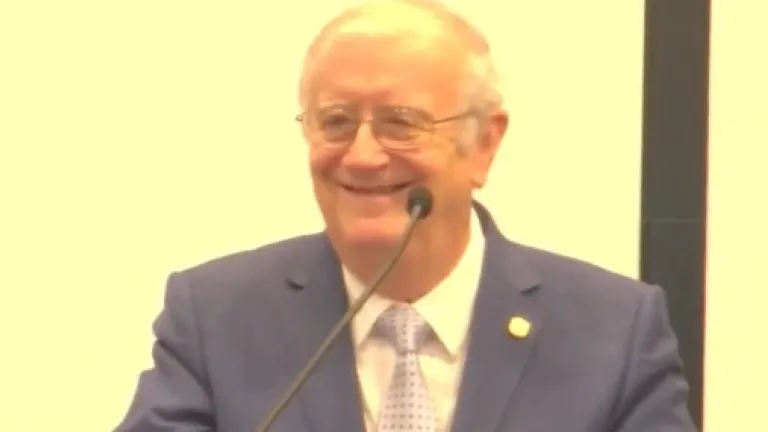
Jorge de Campos
The impressive significance of God's festivals linked to Christ’s first coming. The Feast of Harvest (Exodus 23:16)—known in the New Testament as the Day of Pentecost—holds important significance for this "Church Age."
Thank you, Matthew, and good afternoon, everyone, and welcome to some of guests and new visitors that are with us today. So very nice to see you all.
You know, we are in a countdown towards Pentecost, and it's always a good time to meditate about God's holy days, because God has set his holy days around harvest and fruit gathering, and in other words, seasonal things. We may ask, why did God do that?
And we're always learning that God does it because his plan is to ultimately have sons and daughters in his kingdom, which would then be resurrected into the kingdom as a family. And therefore, these seasonal references have very important significance. As we see, as we understand God's plan, and as we've been in the church for a few years, we can see that God's plan of salvation has various stages, and it is a glorious plan. And therefore, it is wise for us to remind ourselves of this plan on a regular basis.
Why? Because as we remind ourselves of God's plan, it re-energizes us, and it strengthens us, strengthens our hope and our vision of the kingdom of God. It is very important to have hope because hope is like an anchor to the soul and helps us, motivates us to keep going forwards. And so, as we look at God's holy days, they are really tied to two major events related to Christ. They are namely the first coming and the second coming. And therefore, the meaning of the holy days is, in fact, tied to these major events.
And today, I want to talk about the events that are linked to Christ's first coming and see how they designed to help you and I to qualify to be in the kingdom of God as first fruits. And so, I'm going to start by first looking at God's law, at God's Ten Commandments.
And so, we could start by looking at Exodus 20, but I am going to ask you to look today at Deuteronomy 5, because Deuteronomy 5 puts the Sabbath with a different example than the one in Exodus 20. And obviously, both are applicable because in Exodus 20, it looks at the Sabbath from the point of view of looking at the creation, at the physical creation, whilst in Deuteronomy 5, it looks at the Sabbath from the point of looking at how the Israelites left Egypt.
And I want to draw from that some very important points. So, we're going to start in Deuteronomy 5, verse 12. It says, Observe the Sabbath day to keep it holy, as the Lord your God commanded you. Six days you shall labor and do all your work, but the seventh day is the Sabbath of the Lord your God. In it you shall do no work, you nor your servant, you nor your son nor your daughter nor your male servant nor your female servant nor your ox nor your donkey nor any of your cattle nor your stranger within your gates, and that your male servant and your female servant may rest as well as you do.
So, you can see that the focus is not necessarily in this specific example about the creation, which is an important example, but quite often God's meanings and God's analogies is like peeling an onion. There's this, which is true, and there's that that is also true. And so Yah is drawing an example to your servants, your servants, your people, those that are under your household, under your control. And then in verse 15, it says, And remember that you were a slave in the land of Egypt, and the Lord your God brought you out from there by a mighty hand and by an outstretched arm.
Therefore the Lord your God commanded you to keep the Sabbath day. Now, you and I know that the Sabbath was blessed and sanctified right at creation. You can just read that in Genesis 2 verse 2 and 3, and we know that Abraham kept God's laws and the commandments. But this is the time, Yah, when God at Mount Sinai and Yah in Deuteronomy 5 is recalling that event, which was then about 40 years earlier, is recalling that event when God spoke to the Israelites. And so the example it's bringing Yah is the delivery from slavery.
Now, this is pretty important. Why? Because delivery from slavery, in other words, those Israelites were slaves, but you and I, in this carnal physical body, we are slaves to a law of sin in this body. And therefore, we are delivered from the bondage of sin with the help of God's Holy Spirit and God's law. This is important for us to understand, and we'll talk a little bit more about that. And so it's actually talking about spiritual salvation or spiritual creation. So in Exodus 20, the focus is on the physical creation. In Deuteronomy 5, the focus is coming out of slavery, implying beyond the physical slavery of physical slaves in Egypt to us, spiritual slaves to a law of sin that we have to be liberated from with the help of God's Holy Spirit so that you and I can be spiritually created as sons and daughters of God. So you can see how it's like peeling an onion. It's got different layers of depth of meaning, which is really very, very encouraging. Now, this is backed up by Romans chapter 7. Paul, in Romans chapter 7, he, towards the end of this chapter, is explaining how he is in bondage to this law of sin, which is in his members. In other words, it's in his physical body. And so he is bringing the point that he is a slave of this body. He says that the law is spiritual, the law is good, but he is carnal. You read that in verse 14. And then later on, he says that as he struggles through this, then he gets down to the point in verse 23 that he says, I see another law in my members. In other words, I see a law in my flesh, in my body. In other words, in my mind, physical mind, in my physical body, there is another law in my members, which is fighting or warring against the law of my mind. Because with my mind, and him having God's early spirit, and us in God's church having God's early spirit, with our minds, we want to obey God. We want to do what is right, because as he said in verse 22, he says, he delights in the law of God. There is nothing wrong with God's law. God's law is good, is spiritual, is just...
It's a good law. There's nothing wrong with it. But he says that he's in a struggle, he's in a war, because the law in his members, as we read in verse 23, is fighting against the law in his mind, which is God's law that he is thinking and he wants to obey God and his principles. Therefore, bringing Paul... Now, remember Paul, when he wrote this, was probably about 30 years of him being called to be an apostle. So now we're talking about a pillar, a physical example to you and I. Paul, being an apostle for 30 years, and he's admitting he is having this war in himself, a law of the flesh against a law of the mind. And he says, bringing me into captivity to the law of sin, which is in my members, in my flesh.
And so just like the Israelites were delivered from slavery, Paul is here giving this implying, he is not specifically drawing the analogy to that example, but you and I can draw the implication of the analogy that you and I need to also get out from the slavery of the law of our minds. And then he says in verse 24, O Richard man that I am. No, brethren, yeah, we have a man. There was a Pharisee of Pharisees, very strict about obeying the law. He never broke the Sabbath. He never did those breaking the law, but he was seeing Christians as something that they were going against God until God called him and opened his mind. And then he realized that he was wrong and he repented mightily. And because of what he did against Christians, unfortunately to him, he had to go through a lot of trials. And you know, you read through his life, he went through a lot of physical trials. But he's saying that him, a very righteous man, as far as obeying God, physically speaking, he recognizing that in his mind there's a battle.
And if he's got a battle in his mind as an apostle of over 30 years, how much more you and I? How much more you and I? And so he says, O Richard man that I am, who will deliver me from this body of death? Who will deliver me from this physical body that he has that has this human tendency, which we call human nature, to go wrong?
And then he was the answer in verse 25. I thank God through Jesus Christ our Lord. So then with the mind I serve the law of God, but with the flesh, the law of sin. But what he's saying, thanks God, because one day when you will be resurrected as a spirit being, it will be changed from corruptible to incorruptible. In other words, he will not have a body which he's referring to, which has this natural law of sin in it. So he thanks God for that.
Therefore, he says there's no condemnation on those who walk according to the Spirit.
So we see this analogy, just like the Israelites had to leave Egypt, bringing a symbolism of coming out of slavery. We also, as spiritual Israelites, have to leave spiritual Israel to come out of this slavery that is affecting our minds. And you and I may at times say things wrong or have an emotional statement, and you say, or I say, I shouldn't have said that, I shouldn't have thought that. We all go through that. And that's what we need to look at, is that, thank God that through Christ, you and I will be delivered, as it says here, from this this wretched body that we have.
You see, God delivered the Israelites with a strong hand, and God will deliver us, and is in the process of delivering us, with a strong hand. And so, in his first coming, Christ, around his first coming, there were a number of events that brought us to the point that we can leave the spiritual Egypt. A number of events. And during his second coming, he will then complete that, as we will see in a moment.
And this helps us as we, year after year, we are remembering these, let's just call it, anniversaries. The anniversaries, the Bible calls it memorials. As we know, the day of Passover is a memorial on a correct day. The day of Pentecost is a memorial on a correct day. These are memorials of key events in God's plan of salvation. And so, God's annual holy days, or sabbaths and their feasts in their seasons, are extremely important. That's why they're going to be in their seasons. That's why God's calendar is make sure that even though it works with the moon, it also works with the sun. Why? To be in the seasons. So, repeating or recapping, restating what I said so far, is the weekly Sabbath points to the physical creation, but also points to a spiritual creation by implication. Seven days of creation, a seventh day with rest, but there's a spiritual rest to come for us, as we read in Hebrews chapter 4. The annual sabbaths bring that focus. It's like zooming in into more detail about this spiritual creation. And so, there are annual anniversaries of key events. Some are events in the past, and some are events in the future. The spring holidays point to events related to Christ's first coming, and the fall holidays point to events related to Christ's second coming. And so, we need to understand that God's plan revolves around one key factor around Christ and what he's done for us and what he's doing for us. God's plan of salvation is all about what Christ is doing and he will do. For instance, the very first thing that Christ had to do for us, he had to die for us. And you and I can turn to Leviticus 23, and we're going to read a few scriptures in Leviticus, or a few verses in Leviticus, so we might as well just turn there and maybe put a marker there because we might be coming back there a few times. Leviticus 23 in verse 5, it says, on the 14th day of the first month, a twilight is the Lord's Passover. So, in you and I know that Christ died on the Passover. On that day, Christ had to suffer, and he had to die. And this is an absolutely key event that makes the rest of the plan possible.
It opens the door to the whole plan because Christ had to die for us. Why? Because the wages of sin is death. And you and I, we all have sinned. Sooner or later, we all sin. We all sin. God knew that sooner or later Adam and Eve would sin. Sooner or later, we all sin. But because God knew that, Christ was the predestined before the foundation of the world to die, because God knew that we would sin. God did this in great wisdom and insight because of a great plan that he asked for you and I. And so there's no way, no way, you and I can pay for our sins. Because the wages of sin is death. And once you're dead, how can you pay for it? How can you pay for it? You're dead!
So Christ had to come as a Passover lamb without sin to buy our lives back to forgive us, to make us right with God, to justify us. To, as I mentioned to various people when I do counseling, to free us out of jail. Our jail is death, ultimately. And he's going to free us, he's going to resurrect us. He's paid for that, for everybody, good and bad. He's paid for everybody. The worst sinner of the world, he died for that person. Whatever name you want to plug onto the worst sin, that person will resurrect. Because Christ bought his life to resurrect. But now we have to, once we quote-unquote between inverted commas, out of jail, we have to now not do the same thing. Otherwise, we get back into jail. And that means now that we've been justified freely by what Christ has done, we cannot keep on living in sin. We've got to live according to God's principles and laws. Otherwise, it was all being done in vain. And so the Passover is most critical. And if you look, for instance, at 1 Corinthians 7, verse 23, says, you and I were bought with a price, a heavy price, the price which is the very life of our Creator, Jesus Christ. And so then immediately after you and I recognize that you believe, you understand that, you and I have to make a commitment to now live God's way completely. That's why immediately after Passover, we have the days of 11 bread for seven days, which represent seven complete, that we are committing to live a life without sin.
And that's why it says in Leviticus 23, verse 6, says, on the 15th day, immediately after the 14th of the same month is the Feast of 11 Bread to the Lord, seven days you must, or you shall, eat 11 bread. And so we've got to live a life without sin. And those days of 11 bread, as you and I know, are sealed with two saps, one at the beginning and one at the end.
And so brethren, the Passover, Christ's death, triggers the events that follow. And the first one is the days of 11 bread. And during the days of 11 bread, you have a ceremony called the Wave Sheaf. And as we know, Christ died on a Wednesday and resurrected on Sabbath towards sunset, or just about sunset. And he was in the grave for three days and three nights, as you read in Matthew 12, verse 40. And so he went into the grave towards Wednesday, let's say about 6 p.m., and he resurrected then on the Sabbath around 6 p.m.
The next morning, which would then have been Sunday, he was not in the grave. And you read the story when you go there on the first day of the week. He's not there, yet already resurrected. Right, he's already risen. He reads for instance that in Matthew 28, 1 through 6, and there are other references in the Gospels. But we know that he had an official duty to perform, which was in sync or in parallel or at the same time as the high physical high priest will do the wave sheath, waving the sheath before God. And that's why he says in John 20, verse 17, says, don't hold me back, don't detain me, don't delay me, because he has a function to perform. An official duty to perform. And that official duty is referred in a way in Leviticus 23, verse 10 and 11. So let's read verse 10 and 11. And it says, speak to the children of Israel, and say to them, when you come into the land which I give you and reap its harvest, then you shall bring a sheath of the first fruits of your harvest to the priest. You know, it was that would have been the harvest of Bali. So you were to bring that sheath to the high priest.
And then it continues on verse 11, and he, the high priest, will wave the sheath that's of Bali before the Lord to be accepted on your behalf, to be accepted on your behalf.
The sheath now represents Christ presenting himself before God's throne, so that his sacrifice is accepted in our behalf. In other words, his blood is now, in figuratively, in spiritual terms, is accepted, his body, his sacrifice is accepted, and now he becomes our high priest according to the order of Melchizedek. And he's done it on our behalf. In other words, through that sacrifice, you and I are justified freely by his blood. Now, it is important to emphasize that the wave sheath offering does not represent Christ's resurrection. He did not resurrect Sunday morning. He resurrected Saturday late afternoon towards sunset. So, the wave sheath has nothing to do with Christ's resurrection, but it has to do with him being accepted on our behalf. His sacrifice, what he's done, is accepted on our behalf. And if we read in 1 Corinthians 15 verse 20, he has become the first fruits on our behalf. But continuing, therefore, on that, because that wave sheath is particularly significant towards the counting of Pentecost. And here we can see again that Pentecost is intrinsically linked to Christ's death, him being accepted on our behalf. And then from that day, from that day after that Sabbath, in other words, from that Sunday, the day of the wave sheath, we are to count seven full weeks, seven times 749. And then the next day after the Sabbath, which is a Sunday, is then the day of the harvest or of, as we call it in the New Testament, the day of Pentecost. Let's look at that in verses 15 through 17 of Leviticus 23. And you shall count for yourself from the day after the Sabbath, from the day that you brought the sheath of the wave offering, in other words, of the poly, seven Sabbaths shall be completed. In other words, seven full weeks. Seven Sabbaths, seven full weeks. Today, brethren, we are on the second Sabbath since that wave sheath. In other words, we are completing the second week of those seven. When we get to the seven, which I think it'll be on the 23rd of, what is it, May, April, I think it is, I can't remember, no, it'll be the 23rd of May, then the next day will be the Sunday, will then be on the 24th, which will be the day Pentecost. But it requires that count of 49 days, seven full weeks, and then on the day after it, then we have the day of Pentecost. So it says, yeah, seven Sabbaths shall be counted. In other words, seven full weeks. Verse 16, count 50 days to the day after the seventh Sabbath. In other words, the seventh Sabbath is the 49th day. The day after the seventh Sabbath, which is the Sunday, which is the Sunday of Pentecost, will then be the 50th day. And then it says, then you shall offer a new grain offering to the Lord, and you shall bring from your dwellings two wavelengths of two tenths of an ephah, and they shall be a fine flower, and they shall be baked with leaven, and they are the first fruits to the Lord. And so what we have here, that we have a count of 50, they are to bring in two wavelengths in this time, not a barley, but wheat, right, and they shall be a fine flower and baked with leaven. And so there are a few very interesting points here. The first one is that Pentecost is undoubtedly linked to Christ's first coming. There's no questions about that.
Christ's first coming, there's Passover related to Christ's first coming, his death, you know the words. Then there's the days of 11 bread, Julian days of 11 bread. On that Sunday, Julian days of 11 bread is the way of Sheaf. You've got now 50 days, the day of Pentecost. All those events are linked or connected with Christ's first coming. And obviously, these events did not occur over the 24-hour period. They are events related to his first coming. And by Christ being accepted on our behalf, and after 40 days, he then ascended to heaven of being on earth and witnessing and proving that he had been resurrected, after 40 days, he then went to the Father and on the day the Pentecost sent us the Holy Spirit as the helper. Now, it's interesting that according to Jewish tradition, on this day, it was when the law was given, you know, when Exodus 20 was given to the Israelites. But they did not have the capability to really obey God because they didn't have God's Holy Spirit. We, the Church, equally on this day, received some as a Church was when the Church received the Holy Spirit. And that represents the help from God, the mind of God, the power of God, the essence of God, the mindset of God to help you and I obey the law. Obey the law. You see, the law is not done away. As you read in 1 Peter 1, verse 2, says, God's Holy Spirit helps us in the sanctification towards obedience. And so there are a few other interesting connections here that I'll just mention briefly. So the first one, as I mentioned, is that Pentecost is clearly tied to Christ's first coming to Passover from the way she 50 days they together as a group, in a sense. Second, why 50? Now, the Bible doesn't tell us.
So you and I could have different meanings. One possible meaning is 50 usually is a number tied to Jubilee, and Jubilee is freedom, right? And in this way, receiving God's Holy Spirit gives us the freedom to be freed from this law of sin, and therefore we receive God's help to free us from the law of sin. That could be a meaning. Not saying it is, because the Bible doesn't say, but that could be a simple possibility. Why 50? Secondly, why two loves? What are they? Well, the Bible again doesn't tell us, so you and I can have various possibilities. In first place, we know that these two loves have 11. As we read in verse 17, they baked with 11. We also see that they are of two tenths of an ephah. In other words, they have an equal weight.
Why? So it means that one love and the other one has an equal weight. Could it mean that points to people of the Old Testament or points to people of the New Testament? Maybe. Could it mean that Jews and Gentiles are both going to be in the kingdom? Could it be that some points to kings and the other ones to lords? Because some of the resurrected people will be king of kings and the others will be lords of lords. Could be. The Bible doesn't tell us, so we just don't know.
It also, both are tried in the fire because it says, baked. This says, yeah, in verse 17, baked with 11. So they tried in the fire. And therefore, they are first fruits to the Lord. In other words, they're part of this early harvest. People that, as people, for instance, receive God's early Spirit throughout the age, you know, maybe some of your parents, maybe people that you've known, they've lived in this life and they've overcome the world. And they died, in a sense. They've been harvested from the world, but they're waiting for the resurrection. And so, it represents people like you and I with leaven having access to God. And another thing, it says, they are the first fruits, the first fruits of what? Pentecost represents that we are the first fruits, the first few that have received God's early Spirit. We are the first few that we've given to us God's early Spirit. In Romans 8, 23, it says clearly, Romans 8, 23, that we are the first fruits of the Spirit. And so, let's just get to Romans 8, 23, and read it. And it says, and it's basically talking from verse 22 about the old creation grounds and labors until now. Not only that, but we also, who have, we have the first fruits of the Spirit. We have, we are the first few that have received God's early Spirit. Even we ourselves groan within ourselves, don't we? We see a lot of people sick, a lot of people suffering. We know of other people that weren't mentioned that are suffering and are sick. And we groan, eagerly waiting for the adoption. The Greek word is heotheseia, which means being made of, as sons, could be translated, obviously, as adoption, but could also be translated as sonship. Because we are really going to be sons of God, maybe a better translation would, or a more accurate translation, will be waiting for the sonship. When? Which says the redemption of our body. We all wait for when our body will be redeemed from this mortal to immortal, from carnality to a spiritual body. We wait for that. And so we are waiting for that sonship in its full term, in its full meaning. Obviously, we are now sons and daughters of God, but we are growing. We're not yet, it's not yet revealed what we shall be. First John 3 verse 1 and 2. It's not yet revealed what we shall be. And so what are we then?
We are a kind of firstfruits in James 1 verse 17 and 18. In James 1 verse 17 and 18. It says, every good gift and every perfect gift is from above and comes down from the father of lights, with whom there is no variation, no shadow of turning. Or of his own will, he brought us forth by the word of truth that we might be a kind of firstfruits of his creatures. We're now a kind of firstfruits by his own will. God made that decision and he brought us, in other words, he brought us like a baby in a womb by the word of God, God through Jesus Christ, through the instruction, and so that we are now a kind of firstfruits, a foretaste of what you and I will be at the resurrection, because then we'll really be the firstfruits unto the Lord. But today we are a kind of firstfruits. We're not yet the firstfruits. Yes, we are the firstfruits that have God's early spirit. Yes, we are the firstfruits that have to be growing, but we're not yet spirit beings. We still have leaven in our lives. And yes, we are baked with leaven because we go through trials in this life.
In John chapter 4 verse 35, we have a scripture yard that was or a statement by Christ, which probably he gave when we look at the timings, even though John itself does not follow all the timings in sequence like the book of Luke. But by looking at how he was explaining this to to the brethren there and to the people, he's saying, you know, you say the office is going to come in four or five months, which means this was probably stated around about November. And you're saying, well, the office, in other words, of the barley and of the wheat and all that is still four months or so to happen. That's John 4 verse 35. He says, do you not say there are still four months and then comes the harvest? In other words, he was saying, well, you as physical human beings, yeah, they're still weird for instance, a few months at the beginning of winter, and there's still a few months before the harvest comes in. Before spring, and we have the harvest. But be all that I say to you, lift up your eyes and look at the fields. Now he turns it to a spiritual context from a physical to spiritual. And he says, look at the fields, for they are already white for harvest. Look at, there are people that are ready to be going through this overcoming process of maturing with the help of God's early spirit and that they can be harvested at the end of their lives. In other words, basically that's what you and I say quite often to our beloved ones that maybe have died. And we say to them, you have made it. You have qualified. You've remained faithful to the end. In other words, they have been harvested from this world, but they're waiting for the resurrection. They have not been resurrected yet. And so the word harvest does not necessarily mean a resurrection. It means that people have gone through their trials in this physical life, and at the end of their lives, some of you have mothers, fathers, friends, beloved friends, that you know they've made it. They're just waiting for the resurrection. And this is endorsed by the faith chapter, which is in Hebrews 11. So let's look at Hebrews 11. At the end of the faith chapter, we talk about all these faithful people, and it says they all have died. Look at verse 39. All these have obtained a good testimony through faith. They did not receive the promise. What is the promise? Being changed into spirit beings, being the kingdom of God, in the family of God. They have not yet inherited the promise.
God, verse 40, having provided something better for us, that they should not be made perfect, in words from this carnal body of sin, to a perfect, incorruptible body of spirit. He says they should not be made perfect apart from us. Those beloved ones of ours that have died, they are waiting. They are waiting, but they have qualified. They have qualified in this world. They are harvested from the earth, but not yet resurrected. And so the additional meaning of this day of Pentecost is that we've received God's Holy Spirit. So what does God's Holy Spirit do for us?
God's Holy Spirit is the power of God that leads us to spiritual growth.
The power from the highest. Acts 1, verse 8. God's Holy Spirit gives us all these characteristics. They read in Galatians 5, verse 22, love, joy, peace, faithfulness, goodness, kindness, etc.
God's Holy Spirit is not a spirit of fear, but it's a spirit of power, love, and a sound mind. 2 Timothy 1, verse 7. 1 Peter 1, verse 2 says the sanctification of the spirit for obedience. So as you and I are baptized, as you and I receive God's Holy Spirit, what happens? You and I are struggling and overcoming. You and I are being tested in the fire. You and I have access to God's throne. You read in Hebrews chapter 10, run about verse 20, or even verse 20. It says we have access to the Holy of Holies today by a new and living way. We all have that. So we are, like the two loves with leaven, you and I have access to God's throne.
That's Hebrews 10. Let me just quote verse 19 and 20. It says, therefore, brethren, having boldness to enter the holiest by the blood of Jesus, by a new and living way, which He consecrated for us through the veil that is the flesh. And so you and I today have boldness to get to God's throne like those two loves of leaven. You and I have leaven. But we have access to God by the blood of Jesus. And that's such a beautiful meaning. And so also in 2 Peter chapter 1, starting verse 3 through 11, it says, you know, you have be given this power, God's early Spirit. And then, well, let's just turn there so I can quote it correctly. 1 Peter, I'll be about 2 Peter, chapter 1, starting in verse 3. 2 Peter chapter 1, in verse 3. It's a scripture that I make reference quite often, and you heard me making reference. And in verse 3 of 2 Peter chapter 1, says, He is divine power. What is God's divine power? He's the Holy Spirit. He's the Holy Spirit. And He says, He has given to us all things that pertain to life. It was eternal life. God's early Spirit has given us all the capabilities, all the things that you and I need to overcome to achieve eternal life and to become like God in order to have Godliness. And that He says, therefore, in verse 4, He says that we could be partakers of the divine nature and have escaped the corruption that is in the world through us. So with God's early Spirit, we need to be overcoming. And He says, be diligent about this. And then at your faith, virtue and knowledge and self-control and perseverance and godliness and brotherly kindness and godly love, agape love. And then He says a little later in verse 10, Therefore, brethren, be even more diligent to make your call and election sure. For if you do these things, you will never stumble. That means that you will qualify at the end of your life or at the end, because we've got to go through the Spirit and overcome until the end. We've got to be overcome as persevere until the end. And then verse 11, For so an entrance will be supplied to you. In other words, you will be able to enter where? The kingdom of God! That's what it says, For an entrance will be supplied to you abundantly into the everlasting kingdom of our Lord and Savior Jesus Christ. And so God's Holy Spirit is what you and I need to use today.
Thank God, because of Christ's death and all that, proving that He was indeed resurrected for 40 days, and on the 50th day, He then gave the Church the Holy Spirit. And therefore Pentecost, in a sense, represents the Church age, represents our age today. That we are overcoming, and we with God's Holy Spirit, we are growing. Some of us qualify, but we've got to wait until Christ's Second Coming, to the fall holidays. So it is beautiful, because God's Holy Spirit helps you and I change from the old man to the new man. He helps you and I to qualify to be in the kingdom. God's Holy Spirit, in fact, is the guarantee that you will be there. God's Holy Spirit is the guarantee that you will be in the kingdom, provided you don't turn your back.
Provided you don't turn your back. If you don't turn your back, God will do everything for you to be there.
And so, what we have is then, in 1 Corinthians 15 verse 22, let's turn there. 1 Corinthians 15 verse 22.
1 Corinthians 15 verse 22. It says, Just like in Adam all die, even so in Christ, all be made alive. As I mentioned, the worst sinner will be made alive, because Christ paid for, redeemed everybody from death. But then, it depends what you do with it. Once you've known the truth, or you've known what is the right way, it does not necessarily mean you are baptized. But once you've known the truth, you better pull socks and do your part. God is gracious, gives us all time, but he says this, but, you know, all will be made alive, but each one in his own order. Christ the first fruits. Yes, on that Sabbath, after he'd been in the grave for three days and three nights. Afterwards, those who are Christ's win at his second coming.
And so, the first coming points to all the events related to help us mature and grow, and grow, and qualify. That's the meaning of this church age.
At the second coming, which is triggered by the lost trumpet, and the events that follow, which we understand and symbolize by the day of trumpets, and all the events that follow, that then points to the resurrection and all the other things which are related to Jesus Christ's second name, which is Christ, which means the Messiah, the Anointed One, that's his second coming. And therefore, that's what will then point to Christ's events that are still future. That's why they are in the fall holidays, and they are triggered by Christ's second coming, and the signal of that is the lost trump. And so, brethren, God's plan of salvation, which is God's spiritual creation, is revealed and remembered by God's early days. The weekly Sabbath points to the physical creation, but also to the spiritual creation. The annual Sabbaths give us a more detailed focus of these events related to both his first coming and events related to his second coming. Brethren, you and I are blessed.
We are blessed to be those first few that have God's early spirit. You and I are blessed because we have an opportunity to be in the first resurrection, which is a better resurrection.
Let us, therefore, be very grateful for what God has blessed us, and let us not waste it and not turn our backs. Let us remain faithful till the end.

Jorge and his wife Kathy serve the Dallas (TX) and Lawton (OK) congregations. Jorge was born in Portuguese East Africa, now Mozambique, and also lived and served the Church in South Africa. He is also responsible for God’s Work in the Portuguese language, and has been visiting Portugal, Brazil and Angola at least once a year. Kathy was born in Pennsylvania and also served for a number of years in South Africa. They are the proud parents of five children, with 12 grandchildren and live in Allen, north of Dallas (TX).