

Don Ward
We continue our study of the general epistles.
This transcript was generated by AI and may contain errors. It is provided to assist those who may not be able to listen to the message.
Well, good evening once again to everybody. We have come now to 1 Peter, and as my custom has been in covering James, I want to go back and rehearse a little bit from James, the last part of chapter 4 and chapter 5. In James 4 and verse 12, we discover, don't swear by saying, I'll do such and such on tomorrow, but say, if the Lord will, I will do whatever it is you want to do. Swearing in the Bible and cursing are two different things. Cursing is corrupt communication, and we're instructed, let no corrupt communication proceed out of your mouth. But God Himself swears, and there are many cases of swearing in the Bible in the sense of saying you're going to do something, but only God has the power to say, I'm going to do such and such on tomorrow. We only can say that if it is God's will. There are two broad types of sin, commission, commission by breaking God's immutable spiritual law, and omission, which means failing to do what we know to do. Then we went to James 5, and one of the most important promises in the Bible is being fulfilled to a certain degree today. The rich, those with a means of production, are warned not to continue on their pathable pressing the laborers. The rich live in luxury while the poor barely scrape by, living from paycheck to paycheck, and a large number living in poverty, and some even homeless. And that's even in this country. In Iran for the past several days, I think it's been going on for about two weeks. The laborers are rising up against the government, and I heard a man interviewed from Iran today who's held great offices in Iran in the past, saying that up to 50,000 people have been killed, and many of them young people in Iran. And what they do, if a person is killed in one of those protests, what the Iranian officials do is that they will not bring the body back to the family unless they buy bullets.
Bullets that were used, I guess, in killing their loved ones. What a horrible tragedy.
I heard on the news just before we started the class that Iran has stopped the killing in there and killing in the protesters. And if they were, I don't know what they were going to do, the U.S. was ready to intervene through various means of intervention from, I assume, from the air. But I think that's been put on hold for the time being.
So God is aware of what is going on, and He is going to intervene and set things right one of these days. And the rich men will weep and howl, and they will try to commit suicide and all kinds of things at the end of the age, as you read about in Revelation chapter 6, when the heavenly signs begin to appear, they will try to hide themselves from the face of God and Christ who sits on the throne, and they'll call for the rocks and stones and whatever to fall upon them, and they just won't, don't want to live through what's coming upon them. On the other hand, the laborers are told to be patient and wait for the coming of the Lord, because the coming of the Lord draws nigh, and He used the patience of Job as an example.
So we have seen what is going on and what we have mentioned in Iran. They're trying to overthrow the Atola Khomeini, who claims to have supreme authority in the Shiite Republic in both religious and governmental affairs. Some sources say that up to 50,000, as we've already mentioned, have been killed by the regime. And so Trump has threatened if they continue the bloodshed, and hopefully they have stopped, but that remains to be seen.
In verse 12, James reminds us above all not to swear at all. Let your yes be yes, and your no be no. And James instructs us that when we are sick, call the elders of the church. And by calling the elders of the church, you recognize that God has the authority to set offices in the church, and that it is one of the ways that we can maintain contact.
And it's also a way that a member can understand that God is the one who has set the men to be elders, and they anoint and pray. They anoint with oil, symbolic of the Holy Spirit, and ask God to heal them, to restore them. We talked about two different Greek words, fasthenio, which can mean a wide range of things. It can mean sickness. It can mean weariness, worn out, tired, weary, that kind of thing. And also, kamno, which definitely means to have an illness.
And it says that the prayer of faith will save the sick, and if sins have been committed, they will be remitted. Also, it talks about prayer that I think we go around thinking that the men of old were so superior to us that we cannot ever approach their loyalty and their devotion to the truth of God. And he uses the example of Elijah, and it says that Elijah was a person subject to life passions as we are. So Elijah was like us in many ways, and as soon as the great miracle occurred on Mount Carmel and the priests of Baal were consumed, he heard that Jezebel was seeking to kill him.
So he fled from the face of Jezebel, and then he finally heard the small voice of God in the place where he was hiding. He had said to himself that he was the only one left in Israel that was seeking God. And God said, that's not true. I have 7,000 who have not bowed their knee to Baal. So we don't know who is faithful or not in a lot of cases. In most cases we can, by their fruits you shall know them. But James then goes on to say that the prayer of a righteous man avails much, and uses Elijah as the example.
He prayed, and it didn't rain for three and a half years, and then he prayed, and it rained, and then he fled from Jezebel. Then he instructs us to go to our brother when we see him doing wrong and to turn him about, Epistrepho, and let him know that he who turns a brother about saves his life from YHANO fire. So that's a brief review of chapter last part of chapter four and chapter five. And now we go to the epistle of Peter. And Peter is one of the greatest men that ever lived, if there ever was what we call a saint and a holy one outside of Jesus Christ. It was the apostle Peter who from his calling to the time he was crucified upside down was a sterling example of what it meant to be a disciple and apostle of Jesus Christ.
Peter was born in Bethsaida, Bethsaida, and he was born on the north end of the Sea of Galilee in the city of Bethsaida. The Jordan River flows into the Sea of Galilee. There are natural springs in the Jordan River that feeds the Sea of Galilee. And of course, from Galilee, it flows out into the Dead Sea. But Peter was on the east side in Bethsaida, and then on the other side was Capernaum. Christ spent a lot of time in Capernaum, and Peter spent a lot of time in both Bethsaida and Capernaum.
Peter had a well-established business, fishing business, and partnership with the sons of Zebedee, James and John. That's given in Luke 5 and verse 10. And if you want to know about his home, he was a native of Bethsaida, John 144. He had a brother who also was an apostle Andrew. So Jesus many times would take Peter, James, and John with him. Now, there were two prominent James. There was a James who was an apostle who was slaughtered, was killed by Herod the Great early on in their ministry. And there was James, the Lord's half-brother. They had the same mother. Jesus and James had the same mother, Mary. But, of course, Jesus Christ was begotten by the Holy Spirit under the direction of the Father. And, of course, James, the physical being, the half-brother, I should have said that the half-brother was begotten by, apparently, by Joseph. He doesn't really see who beget him. And so we see the Catholics try to make Peter into the first pope. Now, the irony about this claim that Babylon, at the end of Peter in chapter 5, it talks about Silvanus, who was Peter's Emanueesus. Emanueesus was the one who took Peter's dictation and who wrote the script. And he said these words, we salute you from Babylon. And then the commentators, every last one that I read, said that Babylon was a metaphor for Rome. Now, that's ironic as well, because by saying that Babylon was a metaphor for Rome, that is admitting that Rome was Babylon. And they give Revelation 17 as a reference to that. But, of course, that contradicts their by saying that Babylon was another name for Rome. They're saying that Babylon, in essence, they're saying that Babylon was the great whore, or Rome was the great whore of Revelation 17. So, very interesting what they said there. Now, more about the epistle itself. The apostle Peter's epistle, both 1 Peter and 2 Peter, are a virtual goldmine of spiritual understanding. But you have to dig for the goal. The precious nuggets of spiritual understanding that can mean the difference between life and death in the spiritual sense. The spiritual understanding that is contained in the epistles of Peter are sobering to contemplate. So, what are some of those words that are related to holiness? Through hope and God's grace, we are to endure trials and go on to perfection.
We always know, if we have faith, that we are going to be delivered from our trials, whether in this life or in the life to come. You know, in James, James says, let patience have her perfect work. What does that mean? That means that you know and you know that you know, regardless of your situation or circumstance, that God is going to eventually deliver you. And you let patience have this perfect work. And God may be teaching you important lessons that you can learn no other way. So, the words in 1 Peter are related to holiness. Through hope and God's grace, we can endure trials. We can go on to perfection.
This epistle, especially 1 Peter, now listen to this, is one of the richest pieces of literature that was ever penned. It is noted for its eloquence and impeccable Greek.
This epistle digs deeply into some of the most profound theological questions, spiritual understanding of all times. It is a goal mind, as we already mentioned. Words like sanctified, sanctified, hagiadzo, which means holy. Other words that mean holiness. We're to go on to sanctification and to be holy. In 1 Peter 1, verse 16, it says, Be you holy for I am holy. There's another Greek word that is translated holy in 2 Timothy 3.15, peros, h-e-i-r-o-s, h-e-i-r-o-s. Another Greek word that is translated holiness, but it should be translated sacred. There are holy things and there are sacred things. Holy things have God's presence in them. It's the holy scriptures, the words I speak, their spirit, and their life. So God's word is holy because it has God's active presence in it.
Sacred things point to a higher reality. We're seeing sacred hymns at church services. They are praising God and recognizing who he is and what he is and how he reigns over all the earth and all the many qualities and characteristics of God. They are sacred hymns that point to a higher reality. But holy things have God's active presence within them. That's why the saints are called holy. Christ admonishes us in 1 Peter, as I've already noted, be you holy as I am holy. So Peter has a lot to say about being holy and coming out of this world.
Peter preaches for the conversion of those who repent from rejecting Jesus Christ. Peter preaches that 50 days earlier on the day of Pentecost, after Peter preached his inspired sermon, more about that later, 3,000 souls were added to the church. Peter performs a miracle that leads to interrogation by the religious leaders about preaching the gospel.
Peter conducts a confrontation with Ananias and Sophia that leads to their deaths, or lying to God really under the Holy Spirit under the direction of God. They said, we sold the property for such and such when actually they had sold the property for more. So he had two people to lie dead at his feet because they lied to God and the Holy Spirit. Because God is Spirit. Can God be separated from his Spirit? The answer is no. Anyone tries to sell the Trinity to you. That's a simple question. Can God be separated from his Spirit? Time after time in the Scriptures it says, the Spirit of God. The Spirit of God does this or that or the other. It is through the Spirit of God that God does works of power, as in Zechariah 4.6, not by might or by power, but by my Spirit. Now God's works are powerful, but it's through his Holy Spirit that he does even the creation of the universe. He spoke and the things that appear came from things that do not appear. So the very creation was spoken into existence through the Word of God. So Peter's great confrontation with Ananias and Sapphires has given him Acts chapter 5. Peter sees the need for delegation of key ministry to work through him and other apostles so they can focus on the Word and prayer. Peter travels outside of Jerusalem for verification of the work that God has been doing in Samaria. Now, about geography, these places are relatively close together in the Bible and in the Middle East, but some of them are a good distance apart. So Peter was born in the northern end of the Sea of Galilee on the east side in Besseta. And 1 Peter 5 says that Peter reached you from Babylon, but as we shall see, 1 Peter's address to those in Cappadocia, Galatia, the Strangers scattered abroad throughout that part of the Middle East. More about that a little bit later.
Now, when the apostle Paul was struck down on the road to Damascus, he went up to Jerusalem to confer with Peter and with James his brother. Let's look at Galatians 1.19 again.
We turned there before in our study of James, and we may turn there several more times. It's very important to scripture in Galatians 1. We see that Peter going up to be taught while he went into the desert to be taught of Jesus Christ. Then he went up to Jerusalem to consult with the apostles there, the leaders. We're starting 17.
Neither went I out to Jerusalem, then which were apostles before me, but I went into Arabia and returned to Damascus. Now, Damascus is an ancient city in Syria. Of course, there was a congregation in Antioch, not all that far from Damascus. Then after three years, so this is three years after spending three years in the Arabian Desert with Jesus Christ, I went out to Jerusalem to see Peter and abode with him 15 days, two weeks and one day. But other of the apostles saw none except for or saved James and the Lord's brother, James the Lord's brother.
And even in this epistle, it's pretty amazing. In this pepsi, Peter, Paul calls him the apostle to the circumcision.
So we go to chapter 2, verse 4, and because the false brethren, unawares brought in who came in privately to spy out our liberty, which we have in Christ Jesus, that they might bring us into bondage. Now the spying out the liberty had to do with, You had to be circumcised. You had to offer the various offerings and oblations at the temple, and so on. And Paul saying the justification is through faith and repentance, faith in the sacrifice of Christ, upon repentance the sins are forgiven. To whom we gave place by suggestion, though not for an hour, that the truth of the gospel might continue with you. So we didn't listen to them. But of those who seem to be somewhat whomever they even were, it makes no difference to me. God accepted no man's person, for they who seem to be somewhat in conference added nothing to me. But contrary wise, they saw that the gospel of the uncircumcision was committed unto me, so Paul went to the Gentiles who were not circumcised. Peter went to the Jews who were circumcised, as the gospel of the circumcision was unto Peter. For he that brought effectually in Peter to the apostleship of the circumcision, the same was mighty to me toward the Gentiles. And when James Cephas is another name for Peter, and when James Cephas and John, who seemed to be pillars, perceived the grace that was given unto me, they gave unto me, and Barnabas, the right hand of fellowship, that we should be under the even and they under the circumcision. It used to be after baptism, we even did this in the Baptist Church when I was there as a teenager, that after everyone was baptized, everybody in the church would shake hands with that person, only that they should remember the poor the same which I was forward to do.
But Peter was come to Antioch. Now Antioch is back in Syria. I would sit him face to face because he was to be blamed for before that an uncertain came from James. He ate with the Gentiles, but when they were come, he was through. When the Jews came up, he was through and separated himself from them which were of the circumcision or the Jews. The other Jews disassembled likewise with him, hence the much that Barnabas was carried away with their dissimulation. Dissimulation means jealousy and contempt. But when I see it, I saw that they walked that uprightly according to the truth of the Gospel. I said unto Peter, Before them all, if you being a Jew live after the men of the Gentiles and not as do the Jews, why compel you the Gentiles to live as do the Jews? So here we see the Apostle Paul rebuking Peter. That's the only time in Scripture that I remember Peter Reem being rebuked. Perhaps there are other places, but I don't recall them at present.
So Peter was rebuked for Paul for not eating with the Gentiles.
Peter experienced great persecution at the hands of Herod before being released from prison by an angel. Remember that Peter was put in prison by Herod and all of the church together together and they prayed for Peter and your discount is in Acts. I think it's chapter 12. Yes, chapter 12. Peter showed up as a doer and they couldn't believe. They were praying that he be released, showed up the doer and they could hardly believe it. They wanted some kind of proof. So Peter eventually explains the unification of Jew and Gentile in Acts 15, the great conference when it was made evident that God had given the Holy Spirit to the Gentiles as well as to the Jews. As we mentioned, Paul reviewed Peter in one case.
Now we go to remember that there are three great overriding principles in the general epistles. Peter, I mean James, focuses on faith. James focuses on faith. Peter on hope. John on love. And Jude focuses on remaining steadfast. Live all three. Faith, hope, and love. And remember the doctrine that was once delivered to you.
So here's Peter's example.
How would you feel to live your life knowing that no matter how you lived your life, your death would be through crucifixion?
Now we go to John 21, the Gospel of John, chapter 21, and verse 15.
John 21, where Jesus Christ gives Peter this prophecy. John 21, verse 15. So then when they had died, Jesus said to Simon Peter, Simon, son of Jonah, love you more than these. He said unto him, yes, Lord, you know that I love you. He said unto him, feed my lambs. He said unto him again the second time, Simon, do you love me? He said unto him, yes, Lord, you know that I love you. He said unto him, feed my sheep. He said unto him a third time, Simon, son of Jonah, do you love me? Peter was grieved because he said unto him the third time, he said unto him the third time, do you love me? And he said unto him, Lord, you know, Lord, you know all things and you know that I love you. And Jesus said unto him, feed my sheep. Bear the bear that I say unto you, when you were young, you girded yourself and walked to wherever you wanted to go. And when you are old, you shall stretch forth your hands, and another shall gird you and carry you wherever you don't want to go. This spoke he signified by what depth he should glorify God. And when he had spoken this, he said unto him, follow me. Then Peter, turning about, seeing the disciple of Jesus' love, that's John, following which also leaned on his breast, at supper, and said, Lord, which is, and he said, Lord, which is he that betrays you. Peter, seeing him, said to Jesus, Lord, what shall this man do? Jesus said unto him, if I will that he tear you, if he live a long life, and he did. And I found what, and all till I come, what is that to you? Follow you me. So that was Peter's instruction from Jesus Christ, and he did it to the nth degree. How would you like to live your life during the green and mighty works that Peter did, some of which we've already mentioned, the great and mighty works that Peter did, and yet know that the only way that you were going to get out of this life was through death by crucifixion, and that in fulfillment of a prophecy that your Lord and Master had given you, and you are serving him. So even though you are very zealous for God and quick to defend Jesus Christ, even though you are the instrument used by God, used by him to explain how to receive the gift of the Holy Spirit on the day of Pentecost, he is the one that introduced the Holy Spirit to the New Covenant Church and to the Jews that were assembled there on the day of Pentecost. Jews had traveled from all over the Mediterranean world to observe the day of Pentecost. And the famous account in Acts chapter 2 of clothing, tongues of fire lighting up on the heads of the apostles, and they spoke in a language that the people could understand. The people were not speaking in tongues. The apostles were speaking in languages that the people understood in their own tongues. You can listen lifted. You can look it up yourself. Even though great miracles were done by you, even though a deceitful man and woman would fall dead at your feet, we talked about Amnest and Sapphira as a witness to the church to show in whom God had placed his authority. Now, authority is one of the great issues of all time. The Catholics claimed that Peter was the first pope, as we mentioned. There's no evidence in the Bible that Peter ever traveled to Rome. No evidence, once forever, that he ever traveled to Rome. And the Catholics try to get around this by saying that Babylon is a metaphor for Rome, which then condemns him to be the art of woman of Revelation 17.
Even though great miracles were done by you, even though you were the one who opened the gospel to the Jews and the leading apostle and spokesman, even though you had done all these things, God would permit you to live your life knowing that your death would come through crucifixion. The apostle Peter lived his life of faith and hope with his knowledge. The life of the apostle Peter dramatically proves that God has called us to eternal life and not to physical salvation. There was a period of time in the church where a well-known evangelist went around and basically his message focused on going to the place of safety. And perhaps some of the church will be protected in a place of safety, but that is not the ultimate goal. The ultimate goal is to be a glorious radiant spirit being in the kingdom of God. So the life of Peter dramatically shows that God has called us to eternal life and not to physical salvation. Peter is the apostle of hope, yet he knew that no matter how he lived his life, the only way that he was still going to get out of this life was to be crucified, showing dramatically that his hope was not set on this world. Peter internalized what Paul wrote in Romans 15-19. If in this life only we have hope in Christ, if only in this life we have hope in Christ, we are of all men most miserable. But there is a larger picture. There is the big picture burning brightly in our minds that we're going to live and reign with Christ and all of the wonderful figures and saints that are mentioned in the Bible. Yes, we're called to be saints as well. Be you holy as I am holy. That's what the apostle Peter writes.
So this dramatically shows that his hope was not set on this world. So Peter internalized what Paul wrote, and we have hope only in this life, or of all men most miserable. The hope that permeated Peter's life comes through loud and clear in this epistle. We can contrast this with the attitude that some have today who place more value and emphasis on physical salvation, place of safety, protection from the great tribulation, and on than they do on the hope of the resurrection. So we go now to 1 Peter, 1 Peter and chapter 1. 1 Peter and chapter 1 and verse 1. 1 Peter, an apostle of Jesus Christ.
2 The strangers, and this word strangers, we're called in the apostles and apostles Peter's writings, strangers and pilgrims. We're citizens of a heavenly kingdom. It's not yet made manifest what we shall be. Strangers. It literally means a foreign resident, a foreigner who has residents in a country. So we are strangers and pilgrims scattered throughout Pontus, Galatia, Cappadocia, Asia, and Bithynia. Now Bithynia was not all that far. It was, I hesitate to say how many exact miles it was, maybe two or three hundred miles from Babylon. And it's no tall task for Peter and Mark to have been in Babylon. Now, when you introduce Mark into the life of Peter, John Mark, who also traveled with Paul and Barnabas, also was a right-hand person of Peter. Peter used John Mark for in his ministry. It is said by the commentators that the gospel of Mark was basically an outline of the sermons that the apostle Peter gave and that Mark summarized and presented them as his gospel. In order to have your mark in the Bible, no pun intended, to have your mark in the Bible, to be counted worthy to have your writings alongside of such spiritual giants as Peter and John, you would need the backing of someone else. Now, it's quite amazing to me that Peter never wrote a gospel, but yet it is said that 1 Peter is one of the most eloquent pieces of literature that was ever penned. It has impeccable Greek, and perhaps so, Sivanis, his Manueces, was responsible for that. But Peter was a very discerning person, and he, in spite of his lack of formal education, remember the story that one time the leaders of the Jews came upon the apostles and said, these men are ignorant and then learned how do they know anything about the Bible? Well, they were taught the spiritual things by Jesus Christ for 30 and a half years. They traveled with him. Now, they didn't really get it until he opened their minds of understanding in the last few verses of Luke, and I recently covered that in a sermon. So, God is the one who opens minds to the truth. So, these strangers, the foreigners alongside, see our citizenship is in heaven, and we are subject to the laws of man in a sense if it doesn't violate the law of God. And Peter makes that very clear, which we'll come to later, that Paul does too, that we're subject to the laws of the land as long as they don't interfere with the laws of God. And one of the reasons why God wants us to be subject to the laws of the land is for his name's sake, that we are not outlaws. We're not, oh, you can't tell me anything. I'm a citizen of heaven. Imagine going up to somebody and saying, well, you can't tell me how fast I can drive or whether I can stop at a soft stop sign or whether or not I have to pay taxes. I am a citizen of heaven. Well, that just won't go very far, as you know. So we're told to obey the laws of land, render under seizure the things that are seizure unto God the things that are God's. Elect according to the foreknowledge of God the Father. Now, there are verses in the Bible that seem to say that we are predestined, and no matter what we do, we're going to make it into the kingdom of God. Well, God has to call you. John 644 says, no man can come to the Father except the Father drawing. No man can come to me to Jesus Christ unless the Father draws him. So that shows you that only those that God calls now, they do as marvelous light, can repent.
The opportunity to repent is a gift from God. Now, we don't understand that as fully as we do, as we should, and especially those that hear the message. They think they can go to just any old church.
Recently, the neighbor next door came over bringing some cupcakes, which is a fine gesture, and it finally came around to churches. I asked, well, did you go to church? I told them, and I go to church and honor the Sabbath day, the Sabbath. Well, we've been going to different churches. We finally settled on one that we liked. So, and some people say, another person that was cleaning our house asked, where do you go to church? I had two people in the past two or three weeks ask, well, where do you go to church? And I said, well, we go to the Sabbath day church. Oh, is there one inner diner? Well, I said, no, we go to Big Sandy, and we have a very nice church building there. And she said, well, we go to a Sunday church. I go there mainly because of grandkids. I want them to have friends and that kind of thing. So, the people look at, have said that there's spirituality from a different perspective than those who are truly called and respond to the call of the truth. So, you see here elect according to the poor knowledge of God the Father. And maybe he did know he was going to call us, but your name can be in the Book of Life, and it can be blotted out. And for knowledge of God through sanctification of the Spirit, setting apart through this Holy Spirit. Now, if you have the Holy Spirit, the Holy Spirit of Begettle, as God gives the Holy Spirit of Begettle, that's a totally different matter than just occasionally coming in contact with the Spirit. And for a moment, the Spirit may come to you and convict you and that kind of thing, but the Spirit of Begettle is a totally different thing.
Through the sanctification of the Spirit unto, note this, unto obedience and sprinkling of the blood of Jesus Christ. You see, the sprinkling of the blood implies you have faith in the sacrifice of Christ. You have faith in the sprinkling of the blood. Life is in the blood. He gave his life that you might live in the spiritual sense. Grace unto you, divine favor unto you, and peace be multiplied. You are blessed be the God and Father of our Lord Jesus Christ, which according to his abundant mercy, hath begotten us again. See, who begets us? Now, there are Jesus Christ's and men play a role in it, but the ultimate one who begets us and who decides whether or not we are begotten, it says, blessed be the God and Father of our Lord Jesus Christ, which according to his abundant mercy, has begotten us into a living hope. By the resurrection of Jesus Christ from the dead, you see, the resurrection of Jesus Christ from the dead is the living proof that the Word of God is true. It says in the book of Corinthians that Jesus Christ was seen by 500 brethren after his resurrection. You know, he appeared at least three times to his disciples, as recorded in the Gospels, to the inheritance incorruptible and undefiled that fades not away, that fades not away, reserved in heaven for you, who are kept by the power of God through faith, see, it's through faith unto salvation, ready to be revealed in the last time. It doesn't yet appear what we shall be, but we shall be like him, as it says in the first two or three verses of John, verse John, chapter 3, where we greatly rejoice, though now for a season, if need be, you are in heaven as through manifold trials, temptations, who had greater trials than Peter, knowing that he would get out of his life through trials. I oftentimes wonder, well, how am I going to die? What will it be? Will I be killed in a car wreck? Will I have cancer? Will I have this? Will I have it? Was it experienced? That. And Peter went through many manifold temptations and trials, and some of God's people are doing that right now. That the trial of your faith being more precious than a goal that perishes, though it be tried with fire, might be found under praise and honor and glory at the appearing of Jesus Christ. See, goal under heat, you refine goal under heat. The goal goes one way and the other goes another against you. You could say, and that we through our fiery trials are refined. We are like the another metaphor is in Isaiah 64, where it says, you are the potter, we are the clay, mold us and shape us after your wave. Who having not seen yet love, we haven't seen God, in whom though now you see Him not, yet believing you rejoice was not joy unspeakable and full of glory. There are several verses in 1 Peter that are considered by the world's religions as the memory verses and this is one of them. Receiving the outcome, once again we encounter our old friend, Talos, and it's not the end of your faith. And you having not seen you love, in whom though now you see Him not, yet believing you rejoice was joy unspeakable and full of glory. Receiving the Talos, the end, the outcome, the result of your faith and the salvation of your life essence. You won't experience the second death, if you are faithful to God to the end, of which salvation the prophets have inquired and searched diligently and prophesied of the grace that should come unto you. So we reach the end of our study this evening. We will take out with verse 10 next time. I have a good bit to say about verse 10. So we have any question or comment from any of you.
We have any question or comment?
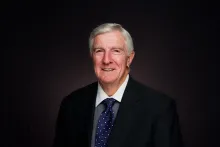
Before his retirement in 2021, Dr. Donald Ward pastored churches in Texas and Louisiana, and taught at Ambassador Bible College in Cincinnati, Ohio. He has also served as chairman of the Council of Elders of the United Church of God. He holds a BS degree; a BA in theology; a MS degree; a doctor’s degree in education from East Texas State University; and has completed 18 hours of graduate theology from SMU.
