

Robin S Webber
This transcript was generated by AI and may contain errors. It is provided to assist those who may not be able to listen to the message.
...to do what so many of the servants of God have done over the years, and that is to bring you a report of what is happening and why we went to meeting. You can pass those out now, gentlemen. Why we went to meeting. I'd like you to join me, if you would, in Acts 15 for just a second. Acts 15. Acts 15, as some of you may be aware, is an account of a major ministerial conference that was given nearly 2,000 years ago.
Paul and Barnabas and many ministers from around the Mediterranean basin went to Jerusalem to discuss about events that might affect the Word of God. Thus, they did. It's very interesting that the topic at hand when they went there, and that's about 50 AD, the topic at hand at the time was circumcision.
It was a major discussion because circumcision had been around for 1,500 years as one of the great signs of God covenanting with people. Now, we know that Paul and others, especially out of Antioch, were preaching that God was involved in an even greater circumcision, and that was the circumcision of the heart. Please understand, that had to challenge many of the people that had grown up in that way and had that understanding ever so sincerely. But they got together and made decisions so that the Gospel of Jesus Christ and the Kingdom might go forward.
I want to encourage you to think about it this way, that the ministerial conferences that have occurred ever since that time have moved beyond simply physical circumcision. But all of them basically are about the circumcision of the heart, of the Spirit, of recognizing all of us, whether we're men or women of Israel or Gentiles, all of us in the work of God, is the circumcision of the heart. It is the cutting away.
It is the molding. It is the shaping of that inner man that we might come to the full measure in the stature of Jesus Christ. When it's all said and done, these are not just business meetings, folks. This is about the work of God in the United Church of God. And that's what we are about. That we might be instruments in His hands to help His process in serving His brethren that all of us might ultimately have, as it says in the book of Romans, that circumcision of the heart that we might truly be pleasing to God.
I'd like to share a thought with you in Acts 15, as this chapter concludes, where it comes down to here in verse 30. Acts 15-30, so when they were sent off, that is the ministry out of Jerusalem, they came to Antioch, and when they had gathered the multitude together, they delivered the letter.
In other words, they explained what had been decided. And then notice what it says here, verse 31, when they had read it, they rejoiced over its encouragement. That is what the collaborative approach bears, and that is what communication bears, is that all of us that went back to Cincinnati, or those that tuned in, we are here in a sense being sent forth from you with your hopes, your ethos, your ethics, your guiding principles, your hopes that the church that we're a part of is truly a blessing to God and glorifies Him. And so we go forth, and now it's our responsibility to come back in to report, to share what the work of God is doing.
And it's very interesting, when we do that, notice what it says, they received it with encouragement. I mentioned this morning in Redlands that, let's remember that the book of Acts is written by Dr. Luke. And Dr. Luke gives the book of Acts what are called, you might want to jot this down, Lukin Commentaries. Remember, he's a doctor, and so he does checkups throughout the book of Luke. It's like it's a diagnosis of the church and how the Holy Spirit is working in the church.
And so every often, about every chapter and a half, it says, and they did this, and the church was encouraged, or it will say the church was added to, and sometimes it will say the church multiplied. In other words, he's giving a spiritual doctor's report on the health of the church. When you look at the book of Acts that way, I think you'll come away with a smile and recognize why the book of Acts is written so that it can be a pattern of what we're doing today, just as I'm coming to you today and sharing what happened back in Cincinnati.
One thing I want to bring forth this afternoon, friends here in San Diego, is simply this. I want to share with you what the General Conference of Elders approved, and that deals with the strategic plan. Now, I'm not going to be dealing with this in an organizational or business sense, in a really long way, boring strategy principles. Because basically, when it's all said and done, what was offered to the General Conference to approve was truly a spiritual strategic plan.
And you might want to jot that down so you can follow along with me. And I think this will fit in very well with Dr. Agriano's comments about ethics and ethics and the aspect of guiding principles. I want to share why. Now, I realize some of you were away last week. Not all of you are here. I'm going to take it a little bit deeper, because being involved with this, being the Chairman of the Strategic Planning Committee, I want you to fully realize what you are a part of.
Now, as a part of, here's what I want to mention, because again, a lot of this pertains to the United Church of God as an organization. But let's take that apart for a moment and spread it out a little bit. What I'm going to talk about today is directed to you as an individual, as a follower and a disciple of Jesus Christ.
Beyond that, we understand that we have been joined together by the Holy Spirit into what is called the Body of Christ. And beyond that, thirdly, to recognize that many of you have become committed members of an organization, of an instrument within the Body of Christ called the United Church of God. So let's understand it at each of those levels, and yet, are you with me? Recognize that there can be a seamlessness of guiding principles, of ethics, of what we want to be. Now, I realize again that Mr. Eddington addressed this at a major level. We're going to go further down today, because one of the reasons why we want to do this is because what was endorsed by the General Conference of Elders ultimately, we want to soak down to every level and every corner of the Church.
Whether it be the Home Office, whether it be our writers, whether it be our people behind the television cameras, whether it be our camp directors, whether it be what the kids are kind of bringing together and gaining out of the youth programs, our local pastors, our elders, our communicators, as they speak to you, visit with you, encourage you in the Word to each and every one of our members.
Because what we're going to come to find is that this is not about Cincinnati, this is not about myself as a council member, this is not about myself as a pastor or for elders. What this is talking about is for every member of the body. Let's think of it this way. You might want to jot this down, just words to kind of keep you cued. This is a spirit-led activity.
It is a whole Church effort. Let's talk about what we're dealing with here. We're going to go just through three different items today. And again, we're going to talk about a vision. We're going to talk about a mission. And we're going to talk about guiding principles. That's all the further that we can get to. One thing that Mr. Eddington brought out very well last week is to recognize that what was presented to the General Conference last week, and much of what I'm presenting to you today, is a strategic plan, a spiritual strategic plan for a Church.
Not the whole Church, not the whole body of Christ, because we can't be responsible for the whole body of Christ. That's Christ's mission. That's Christ's job as the Head. But we're talking about when we say a Church, we're talking about the United Church of God. Because one of the things is we can only be responsible for our sphere of influence. Beyond that, San Diego can only be responsible for its sphere of influence. Beyond that, you as an individual can only, are you with me?
Be responsible for your sphere of influence. And that's why we come down to the singular A rather than the big D. Because the big D is a spiritual organism. God alone knows who are His. So, when we're talking about this, we're talking about what we hope to do, where we are in affecting our sphere of influence. And the vision statement that we put forward, as Mr. Eddington said last week, is for us then. It is to mirror God's vision statement, but that's a transcendent vision statement.
That is a transcendent purpose. But I want to share with you for a moment that he does have a vision. Join me if you would in Isaiah 46. In Isaiah 46, and let's pick up the thought in verse 9. God is not merely love, which is incredible and wonderful, but because He is love, He also has a purpose. He has purposeful love. He has purposeful love. It's orchestrated, and it's moving towards a direct object. And we find that in Isaiah 46. Let's pick up the thought in verse 9. I know this is one of the key thoughts that I remember as a young person coming into the Church of God community in 1963, after some years at home keeping the Sabbath, to come to understand that God is not just simply love, but that He has a work, that He has a purpose, and that He has a plan.
His love is not accidental. And we find that in Isaiah 46.9. Remember the former things of old, for I am God, and there is no other. I am God, and there is none like me. Now notice this. Declaring the end from the beginning, and from ancient times the things that are not yet done. Saying, my counsel shall stand, and I will do my pleasure.
It's very interesting, if we just look at the words that pop out of the Scripture here. God is at work. God has a plan, and He has a purpose. But one thing that you want to link together, let's put these two words together. You might want to do it on paper, you might just want to do it in your head. And that is simply that. What He does, He loves to do. It says that He has a purpose. And it also says that He takes great pleasure in performing that purpose. God, who is love, loves what He is doing.
How many people today in modern Western civilization enjoy going to work? Wake up in the morning with almost a kick in the air, and saying, boy, I can't wait to get to work. I love what I'm doing. I can't wait to, well, I can just work overtime in what I'm doing. I love it so much. God loves what He is doing. And this personifies an element of the Spirit, of joy. It's not just a matter of drudgery.
He loves what He's doing. Let's notice Ephesians 1-9. Talking just about a purpose here for a moment. Understanding what God is doing in this purpose, in this pleasure. Ephesians. Ephesians is really a spiritual, systematic sketch of what the body of Christ should be. And we find in Ephesians 1, and let's pick up the thought in verse 9. Again, this establishes purpose, having made known to us the mystery of His will, according to the, notice again, the good pleasure which He purposed in Himself, that in the dispensation, in the fullness of the times, He might gather together, and one all things in Christ, both which are in Heaven, and are on Earth in Him.
Notice again, God is at work. And He loves what He's doing and gives Him great pleasure. And speaking of Christ, that fulcrum that brings everything together. And not only the Father, but the Son, because we know the wording in the book of Hebrews, for the joy that was set before Him. It says that Jesus endured the cross. Jot down that word, joy. You might want to write it in your...
I know I'm a really hard teacher today. I'm asking you to do a lot of writing, but we're going to keep on coming back. That's kind of what we do in council meetings sometimes. We have a whiteboard over here, and we'll put down a word, and we'll circle it, because then we get off all the way over here, and then we forget that word, and we need to get back to that word, and we're going to talk more about joy a little bit later.
Join me in one more verse. Would you please? 2 Peter 3 and verse 9. 2 Peter 3 and verse 9. This is just setting the scope of what God is doing. Again, His purpose. The Lord is not slack concerning His promise. What He stated from the beginning, He sees at the end, it is as if it is already.
As some count slackness, but as long suffering poured us, not willing that any should perish, but that all should come to repentance. We're going to talk about that a little bit later. So this is God's transcendent, overarching purpose. This is His vision of where and why He is. Now we come down to ask, how then do we as human beings lead the Spirit?
How can we mirror? How can we engage with that overall transcendent purpose as one instrument? And hopefully an instrument that God can fully use in the body of Christ. Well, that takes us down to the vision. Again, let's remember what a vision statement is about. It's a picture of a preferred future. It describes how the future will look.
If we do all that, we say that we are going to do what we are. That's what a vision is. Now, what does that mean then, as we understand what the vision is? We have to ask, where are we now? What do we want to be? How do we get there? A lot of what the doctor mentioned about guiding principles. And how do we then monitor progress? Now, the way we monitor progress is different than the way that, shall we say, the Hershey Chocolate Factory measures progress back in Pennsylvania.
As you see those little Hershey... Sound good about it right now? Anybody got a little blood sugar fit going on? You know, you have those little Hershey kisses going down the conveyor belt, dropping into... You know, going in, boxes going to trucks, and you have that kind of measurement. Out of the machine, out of the mixer, into the machine, wrapped around, going down the conveyor belt. Truck goes, customer buys. People invest in Wall Street with a really hot item.
Hershey's just teasing. What I'm saying is, that's how you monitor progress. But we're spiritual. We're spiritual. It's a much larger, much more dynamic... It's called the fruits of the spirit. It's called the fruit. It's something that has eternity tagged to it. So let's go a little bit further, then. Now, the reason why I want to share again the vision with you, I was involved as a council member, and also as the one that led the retreat that moved to this, was simply this. Historically, and I say this as one that has been in the church for nearly 50 years, historically, you and I have focused on what we call the mission statement.
And we are familiar with that. That's very comfortable to us. And remember that mission statement, coming over the radio, or coming over the pulpits in our churches, and this gospel of the kingdom shall be preached in all the world for a witness, and then shall the end come. Matthew 24, 14. Wonderful verse.
That's a part of the book, absolutely. Let me share how this works. The vision, let's understand something, the vision statement is not about what we do, but how and why. Now, you can use that on notes if you want to. Mark that up. You don't have to put that in a plaque somewhere. I can use that as an and out. The vision statement tells us why and how. Let me use an example when it comes to preaching God's Word.
Are you with me for a second? How many of you ever met Mr. Jonah in the Bible? Mr. Jonah. He was pretty effective. He was a go-go guy. Once he got the right direction and got landed in Nineveh, I mean, man, could that guy preach repentance. I mean, even the cows and even the chickens were fasting. Have you ever seen an Assyrian chicken fast? It did in the book of Jonah.
And yet, Jonah himself who preached a message of repentance, we wind up with the end of Jonah. He says, For the moment, for the moment, God is good and merciful, but the message that he gave to others he could not receive himself. He had more compassion on the gourd, his umbrella, that welded in the sun, than living human beings.
Now, I have a question for you. There were 120,000 people that didn't know their left hand from the right. Don't ask me exactly what that all means. You're a guest as good as mine. A lot of people. Let's just say there's a lot of people that were affected.
But how affected, for the moment, was the heart of Jonah? He had a mission. Can we all say that he fulfilled his mission? Yes, he did. Even the cows and the chickens were fasting along with the king of Assyria. Bring up these two words. Mission accomplished. But was God's mission accomplished in his heart? That's why we have to differentiate between what we do and who we do it towards, versus what God is doing with us, the wise and the house. That now allows us to look at the vision statement.
Let's look at a church led by God's Holy Spirit, joined and knit together by what every member supplies with all doing their share, and growing in love, in agape. When we say love, we're not talking about a Hallmark card going between a boyfriend and a girlfriend.
We're not even talking about a Hallmark card for tomorrow, on Mother's Day. What we're talking about is agape, outflowing, outgoing concern away from self. A word that was so strange to the community of antiquity, that was familiar with words dealing with brotherly love or family love or romantic love, that they either had to invent or go back to find a word that could somehow match this outflowing, outgoing, concern love that emanates from God, because, well, God is love. God doesn't have to go find love. God doesn't have to manufacture love. You and I, we have to read books about love. God is love. It is what He is. God is love.
So, we look at this agape, growing in agape to fulfill God's great purpose for humanity to bring many children to glory. The verses are stated there. Now, let's go back a second, now that we've looked at the overview. It says, a church. And then it says, led by God's Holy Spirit. Now, why is that important? Throughout the rest of this plan, we certainly affirm God, the Father's transcendence.
We certainly confirm that Jesus Christ is indeed the head of the church. But let's remember, when we say a church led by God's Holy Spirit, there's a difference. When you go to the book of Acts, I don't know if I have it in this Bible or not. Let's find out. I'm going to find out in a moment. When you go to the book of Acts, it says, yes, good. The Acts of the Apostles. Now, is that accurate? Couldn't we call this book the Acts of the Apostles? That was written by Dr. Luke. That could be good. But there's really a better name for it.
May I share it with you? We could call it the Act of the Holy Spirit. The difference between the Gospels and the book of Acts is that the Holy Spirit came. Men that had been cowards that had run from the garden of Gethsemane became conquerors in Christ. No longer running, but marching into the square of Jerusalem at Pentecost. Their whole life changed.
Their whole thought process changed. Everything changed about them. Jesus had said that when I leave and I must leave so that the Comforter, the Holy Spirit, might come. God's essence might literally be in you and through you and by you. And to recognize that that is the glue that keeps the church together.
That is why it is said, a church led by God's Holy Spirit. Romans 8.14. Let's jot that down right there. As many as are what? Led by the Spirit of God. It talks about what every member supplies. This is not a corporate document, friends. This is a member document. We have come to understand through reading the Bible, understanding the New Covenant, understanding that the Spirit of God is in our membership, and understanding by, have you noticed, necessity over the last 15 to 17 years, and keeps on getting narrower and narrower?
That the membership even more has to step up and allow the perfection of Christ to rise in them and fill them and be an active part and an active agent in the work of the Gospel. Now, when I say that, let's please understand something. We're not talking about a universal priesthood of believers. No, not at all. Our congregations in the United Church of God are, Pastor Led, by a degree, Pastor Fed, and we do have that structure. You know that.
I know that. The Pastor has a role. But to recognize that now we have to, in a sense, just out of sheer necessity and spiritual implication, bring that pyramid down some so that every member might be inflated by the example of Jesus Christ and the work of the Spirit in them to bear the burden.
Many hands, many hearts, many shoulders make a heavy load lighter. Why didn't I think that? That's what Paul was talking about 2,000 years ago when you read the book of Ephesians. Every member, every joint supplying that which is necessary. You know that, and I know that as we even think of our own local church circuit. That runs from Tijuana. I was down in Chula Vista a couple of weeks ago, and I said, oh, there's Tijuana.
I haven't seen that for a while. And I thought, oh, that's where the circuit ends. And then about a week later, I was up in Bakersfield looking up the Sierras, and I said, oh, and that's where the circuit ends. And everything in between. No one person can do that. But a church. The kind of vision that we have here. Everybody doing that which every joint can supply can strive to glorify God by what we do. Now, with that said in motion, join me if you would in Ephesians 2 and verse 10.
Ephesians 2 and verse 10. Notice again, many years ago we talked about whether we were going to be a work or do a work. And it's really an argument and folly, to be frank. Because it's really seamless. It's like having a coin in your pocket and trying to divide heads from tails. It's all a part of the same coin. It's seamless. It all has value.
Sometimes we try to... Can I ask you a question? There's a coin in front of me. How do we assign more value to one side of the coin than to the other side? Have you ever worked that through? Is one side of the coin more valuable than the other side of the coin? Or is it one coin? This is the kind of word problem that even I can solve. It's all one coin. But it has two facets. God wants us to be a work. And He also wants us to do a work. But we can't do a work unless we have His work, His Spirit, the model of His Son inside of us.
Ephesians 2 and verse 10. For we are His workmanship created in Christ Jesus for good works, which God prepared beforehand that we should walk in them. Vision statement. The reason why I share this with all of you is simply this. Before you tie your boat to a dock and throw the rope, you want to know what the dock looks like that you're going to walk on. For we're sharing with you what the dock is like. That you're considering, praying about, tithing, offering donations, being a part, to know what you are a part of and where the church is headed.
And then we have the mission statement. It's a statement of our overall purpose. It describes what we do. We do preach. The message, the mission of the church of God, is to preach the gospel of Jesus Christ and the kingdom of God in all the world, make disciples in all nations, and care for those disciples. Again, that gospel, while given dual fold, is seamless. The gospel of Jesus Christ and the kingdom of God.
Jesus Christ is the king of that kingdom. And as God, He came to this world in the flesh to show us how God would walk if He were a human being. And that same one that came to us is going to be the one that's going to bring that kingdom. And so, while we look forward to that kingdom, we also recognize that we can begin to walk that walk today. That brings us now down to the guiding principles. And I'd like to share those with you for the remainder of this message. These are the general guidelines of how we will spiritually operate.
What is our focus in working together? We notice one thing that I want to share with you that's very important as you look at this. If you'll just look at that big box, you'll see four lines there. We believe. We believe. We believe. Four times we believe is mentioned.
Then you'll notice the indention that says, therefore, therefore, therefore, therefore. There's a reason. The guiding principles are what we believe. How important is belief? Remember what it says in Romans 4? It says, Abraham believed God. And because of that, it was accounted to him righteousness. Beyond that, join me if you would for a moment. That's Romans 4, 1-2. But join me over in Hebrews 11.
Hebrews 11, if you'll join me there for just a moment. How important is faith? How important is belief? Because what we believe is then betrayed by our actions, whether good or ill. What we believe are doctor's back.
There are ethics. What we profess will come forth. You can't hide it. Frankly, it's kind of obvious. Hebrews 11, verse 6. But without faith, it is impossible to please him, for he who comes to God must believe that he is, and that he is rewarder of those who diligently seek him. Now, am I speaking about believing in this strategic plan?
Please understand, no. The strategic plan is not a holy page. But the spiritual strategic plan emanates and is a reflection of the Scriptures of God. Only the Bible is holy. I think we all understand that. But we're drawing principles out of it. Let's then understand what we are a part of as a congregation. The United Church of God, San Diego. Because we're not just a congregation. We are multiple congregations that have joined together. Seventeen years ago, one of the biggest decisions before the United Church of God and assembly in Indiana was simply this.
What were we going to call ourselves? Were we going to be the United Churches of God? An international association? Hear that. Were we going to be the United Churches of God? An international association? And or were we going to be the United Churches of God? Hear the difference? Hear the semantics? It's more than semantics. There is a difference. We do things as a whole. We are one church scattered around the world in various congregations.
But we are one in this purpose and what we believe in. Notice what it says. We believe that our Father has given us the opportunity to build a relationship with Him, with Jesus Christ, with one another and with all mankind. We believe the immutable Word of God shows us how to build those loving relationships. And it mentions Jesus' incredible prayer there on the night that He was betrayed. And you can look at that later and to become more like Jesus Christ. Join me if you would for a moment in the book of Romans. Romans 15. Let's open our Bibles together. Turn over to Paul's writings in Romans. Romans 15 and verse 7. Notice what it says.
Therefore... No, no, excuse me. I'm going to go back up here to verse 5. Pardon me. Romans 15. 5 is actually my notes. Romans 15. 5. Now may the God of patience and comfort grant you to be like-minded toward one another according to Jesus Christ. That's the mark.
That's the compass. That's the foundation. What did Jesus Christ do? Jesus Christ totally sacrificed Himself for you and for me. That you may with one mind and one mouth glorify the God and Father of our Lord Jesus Christ. Therefore receive one another just as Christ also received us to the glory... Received us while we were... what does it say in Romans 5?
While we were yet in sin. Paraventure, a man, will die for somebody that's a good man, but somebody that's... Well, hello. Agape. Thus we come to understand that Christianity is not just simply vertical in our devotion to God. Our devotion to God is made mute, is made plain, is made nil if our Christianity is not horizontal to others that are made in this image. In other words, it is not just simply the truth for truth's sake, but truthing and love as the book of Ephesians brings... ...truthing and love. In other words, our activities and activity of love that goes out to others.
And notice what it says here. We believe the immutable Word of God shows us that. It does show the way the immutable. And we do believe in the United Church of God in the immutability and the infallibility of the Word of God. That it is God-breathed. Old language, yes, can sometimes get in the way. Just choose your language, Greek or Hebrew. But you know and I know that, by and large, by and large... ...we have the full measure of God's plan.
With that stated then, oh, if that's what we believe, then what are we to do as we write articles for the Good News magazine? What are we to do as we have our presenters before our television camera? What are we to do as a pastor? How do I express myself? How does Mr. Coel or Mr. Gardenhire or any of you that are speaking... How do we express ourselves in a manner of superiority, in a manner of talking down to people? Or do we do it in a loving, in a guiding, in a humble fashion?
Notice what it says. Therefore, we will strive to live by every word of God, led by His Holy Spirit in humility. Enabling these relationships to not only grow, but to flourish, to bound, to bear fruit, as was mentioned earlier on. Did you notice one key word here? Humility.
Humility. Have we always been a humble people?
Can we grow in that attribute of Jesus Christ? When you go to Ephesians 4, join me there just for a second. I want to share why it is so important.
When we talk about the walk that God has set before us, and the walk that is worthy of His devotion towards us, it says here that we are now in a walk, in a new calling. Notice Ephesians 4, verse 2, "...with all lowliness and gentleness, with long-suffering, bearing with one another in love." That then brings about this unity. But when the Bible is written, whether it's a list of names or a list of qualities, normally priority is given. It's a priority. The first one that is priority is mentioned. That's very important in your own Bible study. Humility is mentioned first. Humility. Now, when this was written in the world of antiquity, which was basically Hellenic or Greek, humility was a non-virtue in the Greek world. It was despised. It was looked down upon. Isn't that interesting? It was a yuck!
And yet, that's the first that God puts forward as to how we are to walk and to live and to breathe, doing the work of God. In Jesus Christ as the head, then our arms are to reach and do His work. Our feet are to run His errands, and our tongue is to speak His words and praise. And each of those actions must be done in humility.
We believe God has a plan of salvation for every individual who will yield to Him in His Son Jesus Christ. That plan includes the calling and perfecting of those who are being converted now, as well as to those to be converted in the ages to come. 1 Timothy 2, verse 4, is mentioned there. Let's go over there, because the Council spent some time on this, as we were in retreat before we began to develop this spiritual strategic plan. 1 Timothy 2, verse 4. Notice what it says.
Who desires all men to be saved, and to come to the knowledge of the truth. What an incredible assignment that God has given us to express in our prayers, our donations, the way we speak, our hopes, our hopes for our family, our hope for our neighbors, our hope for those that preceded us on this pathway of humanity.
I grew up in a fundamental church. He either went to heaven, or he went to the other place. Not too much in between. Now, there are churches that have the in-between, but I wasn't a part of that church. And to recognize that even as a 12-year-old lad coming into the Church of God community, I was awakened or shaken to the immensity of God's loving plan, that He wants every individual to have an opportunity.
We're not talking about universal salvation, but we are talking about universal opportunity, with the blinders off, to be able to accept the Word of God, to be able to really understand what the Gospel is about and have our knees bow before Jesus Christ. That was not the world that I was in.
That was not the walk that my family was walking. It was one of judgment. It was even somewhat Calvinistic when you go back to Calvin, where there were vessels of honor and dishonor, and it was all over and out before He even began. He didn't really have a choice, and there was a God that was just kind of working like a puppeteer, a bunch of robots down here. You were either a vessel of honor or dishonor, over and out. Faint! But is that a father that we can love? Is that a family that we want to be a part of? Or do we want to be a part, as the Scripture shares, that God wants everybody to have an opportunity?
With that stated, therefore it is the duty of the Church to proclaim a message of hope and a call to repentance, to teach all things Christ has commanded, and to prepare members of the body to teach, lead, and serve under Him now and in the future. Did you notice that? A message of hope and repentance. Not just a message of hope, but also repentance. Not only just simply a message of repentance. We're warning you! Rome's going to hell in a handbasket! You've heard it. We now leave. We've done our job.
We've knocked on your door. Don't book everybody up. Romans 15, verse 13. Romans 15, verse 13. Now may the God of hope fill you with all joy and peace in believing that you may be abounded in hope by the power of the Holy Spirit. A church led by the Holy Spirit. Remember the vision statement? A church led by the Holy Spirit. And it says, abounded in hope by the power of the Holy Spirit. Let's understand something. God is love. Beyond that, God is the author of hope.
He doesn't have to go read a book about it like you and I do. He is hope. He does not have to find hope. He doesn't have to hope that tomorrow is a more hopeful day. God is hope. If we are mirroring that in our subordinate vision statement to his transcendent vision statement, then when people come into the United Church of God, San Diego, next week, even when we're giving a message on repentance, when they pick up a Good News magazine, when they hear Daris McNeely or Steve Myers over the television, or whether they go to our Internet, or whether they're talking to you and Shula Vista, La Mesa, San Ysidro, Fallbrook, and all parts in between, you are going to come across as a person with joy and a person with hope, a person who is excited about your calling.
I didn't say sharing all of your calling. I'm not saying sharing all the Bible in five minutes. You know that, and I know that. To be wise as a serpent and harmless as a dove.
But when we do, we will share what is right about the Bible and hopeful about the Bible and the promises of God in the Bible and the future in the Bible as much as we deal with the problems. If we only deal with the problems, we never get beyond the problems. Thus, when we're doing this, when you're reading the Good News magazine, when you are listening to the telecast, when you're going to the webpage, you recognize that there is a balance. Yes, we have to deal with what is wrong in this world that is under the God of this age, with humanity that has rejected God from the Garden of Eden.
Absolutely! You betcha! As we say in Minnesota, you betcha! But for every verse that we use about what is wrong, every headline that we use about what is wrong, we also need to give a promise of God, a scripture of God, an encouragement of God, and to let the world know that they can begin to experience the Kingdom of God now. Because if you notice, or am I the only one? I don't know if we're on a sprint. This may be a marathon. And therefore, it's not just simply enough to point to the Kingdom. We have to learn how to do that Kingdom Walk today. We need to have articles and articles on how to walk the walk.
How to walk that walk. That's why you're seeing in the Good News magazine more Christian, living articles, practical steps of encouragement, of hope to people. We believe that every individual of every race, nation, and gender will, in God's time, have the opportunity to hear the testimony of Jesus Christ, life, death, and resurrection, and the Good News of the Kingdom of God. We believe that the Gospel explicitly provides every individual an opportunity when called for membership in the family of God according to His will. That's our belief. That is the dock that you're tying your boat to.
From Scripture principle, that is where prayers, tithes, donations, and fellowship come in. Therefore, in order to maximize the effectiveness of the Gospel message, we endeavor to reach all people in a way they can understand with a balanced mix of doctrine, prophecy, and Christian living, recognizing that any lasting fruit is produced by the power of God's Holy Spirit. Now, please notice that, because these are not just words. This emanates into everything that we do in Cincinnati, in our Internet, down to the local congregation, down to how we give you a...this kind of reverberating, Greg...
how we share the Gospel with you right here, that in the course of a year, we want to share articles of salvation. We are instruments of salvation. I didn't say we are the instrument of salvation. That's Jesus Christ. But under that, we are an instrument toward salvation. God is using the saints. We also deal with doctrine. A church without doctrine is like a church that is afloat. God gives us doctrine. He gives us teaching, and we have to go over that and explain it. We recognize that many of the doctrines of this world don't even come out of the Bible.
We recognize that we have to give sermons on Christian living, articles on Christian living. And yes, we have to give messages on prophecy. One third of the Bible has been considered to be prophecy, whether it's about the coming of Jesus Christ or the second coming of Jesus Christ. It's been thought that perhaps even up to 85 to 90 percent of it is yet to occur.
We would be remiss if we did not share that large element that was in the Bible. But again, did you hear the percentage that is in the Bible? It's not 100 percent of the Bible, but it's a very important part of the Bible. We also have responsibility to share it. Thus, we have an integrated, holistic approach of sharing all that is in the Bible.
Not just prophecy, not just current events, where we get as best a read as we can in God's Holy Spirit and where we are at the moment, which can change the next year or the next decade. We need to be responsible with the articles that God presents before us. But we put all of this, and that's why again the Good News magazine is now 48 pages. And you will see this guiding principle outlined as you begin to go through, and you'll see articles about salvation, articles about calling, articles about strong articles, well-researched articles, read by many, many people. So it's not just one person's point of view, but hopefully biblically accurate. You'll see that on doctrine.
You'll see articles on Christian living. And of course, that's where my column comes in now with follow me, following Jesus Christ, following the head of the church, allowing him to live in us and trying to give very practical steps. You'll see other articles on current events and other articles, of course, on prophecy. We believe that as we near the end of the age, humanity is in urgent need of this Good News message, in advance of the events surrounding Christ's return. We believe that Jesus commissioned his church to declare what is to come to warn of the consequences of sin, to preach repentance, but notice, with all of that stated, and proclaim the hope.
There's that word again. I may or may not be mistaken, but our previous plan had no words of hope. I didn't say it was not a message of hope, but hope is important. If you don't have hope, you stop living, you stop breathing. Therefore, words have meaning. It is the Gospel that is distilled of love, of peace, of joy, and of hope. Of hope of eternal salvation. So often, unfortunately, with our human nature, which can tend to run to the negative, we can get stuck on all of the events between the goalposts and not keep our eye on the goal.
There is a time of cataclysm that is coming. We'll be dealing with some sermons on prophecy this summer. But notice something. We also need to instruct responsibly what is coming. There is the Tribulation, and there is the Day of the Lord. I have a question for you. Are they the same thing? Or is it just all bad news for humanity? Do we know which corner they're coming out of?
The Tribulation and or the Fifth Seal is the time of Satan's wrath. That's when he knows that his time is short. So there are going to be all sorts of things going on that are not humanly happy. Are you with me? It's going to be scary. But you've got to know what corner it is coming out of, or otherwise you're going to mistake that that's coming from God.
But then there's the Day of the Lord. Now, where is that coming from? The Day of the Lord now is coming as Jesus Christ comes back to this earth after the Sixth Seal, after the heavenly signs, into that Seventh Seal with the trumpets, and that's God's judgment on humanity apart from him because they have forsaken the way of God from the time of Eden. So when all of this is occurring, you have to kind of know it's like a ballgame.
You know, it's like a program. You better know who's up at the plate, or you can get confused. We have a responsibility to tell people that, and let them know that they can repent now that there is hope, not just simply to escape the wrath, to flee the wrath to come. Because that's not love. That's just saving your own skin. It's very human. Are you with me? It's very human. I want out of here! But to motivate people, the fullness of Scripture, to recognize that while they turn the course in their life, that new walk is a walk of faith and a walk in love.
Therefore, we take very seriously the Church's responsibility to boldly preach the Gospel as a witness to this world with the zeal and the sense of urgency, just as I hope I just shared with you. I want to just conclude for a moment here, and give you, and Jim was there, Susie was there, so you might have tied in. There's three things that I'd like to have you put on your prayer list. Three things. And that is simply this. It comes from a number of lectures. It's going to be very simple and right to the point. Three things that were dramatically exposed and spotlighted. Number one, Mr. Luker spoke on the subject of love.
Of Denny is speaking, you know that normally the word of love is going to come up. And he took us to 1 Corinthians 13. I would like to encourage you in the weeks to come, go through 1 Corinthians 13, and pray that you might be a reflection of 1 Corinthians 13. That our congregation can be a reflection. That our organization, the United Church of God, that the entire body of Christ, wherever God's people are, can truly understand what agape is. In a sense, a love that does not keep score. Hmm, isn't that interesting? A love that does not keep score. You scratch my back, I scratch your back. We all know how that works. We've all done the back scratching over our lifetime.
That's not agape. Pray for that. But it's very interesting. Then, Mr. Luker mentioned that, for all the years that I have been known, and he was not boasting in this, it's just a fact, if you've ever heard Mr. Luker, he'll always go to the subject of agape. He says, I now sense something very important. We need more than ever to ask, and here it is, number two, wisdom. Wisdom! And that wisdom that's being talked about is not street smarts. That's another kind of wisdom. That's prudence.
He's talking about a Greek word, sophia, S-O-H-I-A, like St. Sophia's in Constantinople, which is now that mosque museum at the tip of Istanbul. It's called St. Sophia's. It just simply means holy wisdom. Sophia. We're talking about a wisdom that comes from above. A wisdom that comes from above that is not earthly. It's interesting. Go to Luke 2. Jot that down, please. A little homework, a little hard work here. Luke 2, he talked about the prophecies regarding the Messiah. Come, that he would grow and increase and mature and nurture in what?
Sophia! Holy wisdom. Know what's interesting? Are you with me? We're almost done here. It's interesting when you go to James 3. Any of us can always say, what is James 3 known for? Can I ask, what is focused on in James 3? Anybody? This is really not a trick. What's in James 3? It's about the tongue. It's about the tongue. And it's only after the tongue is described that the whole emphasis is using wisdom and using your tongue. Using wisdom to use your tongue, whether it's collectively and preaching the gospel of Jesus Christ, the kingdom of God, to do all the therefores and we believes and to put that out to everybody.
And or how we use our tongue and how we develop Sophia, right here in church, between brethren. Love, wisdom, and one more thing I'd like to share with you. Pray for the laborers to perform the harvest. I went in early on Thursday. I had an opportunity to be in the international meetings here from these brave men and women that are going to places all around the world. I heard from the Filipino ministry that serves 7,500 islands.
Not 7,500 people right now, but 7,500 islands with different people on them. I heard from people that are serving the different countries labeled Congo. There's a couple of them. People that are serving in Benin and Togo and Ghana. People that are serving in Malaween and Zambia. And they are... I talk about Tijuana to... Are you with me? To the Sierra foothills. And I hope I said that in humility because we're all doing it together.
These are gentlemen that are... When I just mentioned one country, most of those countries are bigger than Texas. They have a Texas-sized job. And so they're asking for our prayers. The man that was conducting the meeting... I can't pull it up right now, Jim. You went there on Thursday. But he had all the different senior pastors ask to get up, What can you pray for?
And they said, Tell the brethren to pray for us. We need laborers. We need laborers to help us. It may never be the laborers that we had before in previous affiliations, previous organizations that you and I have been a part of. But when you're just one dealing with the Congo, which is bigger than Texas, two cuts Texas in half. Just think of that. And the joy is spread out.
I want to share with you exactly what we have been dealing with over this last year, that the General Conference of Elders has now proved. This is not about some change of doctrine. Our doctrines stand. They are fundamental. Number one, the most important book is the Bible. But in our Constitution, they are fundamental. It cannot be changed other than there are 75% of the elders. But what we are looking at is how to communicate, how to express, how to internalize, to not only do a work, but to be a work, to be a church when it's all said and done. When it's all said and done, to be a church that is led by the Holy Spirit, in which every joint and every member supplies what it may.
Susan and I will look forward to seeing you after church.
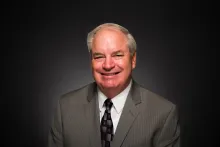
Robin Webber was born in Chicago, Illinois, in 1951, but has lived most of his life in California. He has been a part of the Church of God community since 1963. He attended Ambassador College in Pasadena from 1969-1973. He majored in theology and history.
Mr. Webber's interest remains in the study of history, socio-economics and literature. Over the years, he has offered his services to museums as a docent to share his enthusiasm and passions regarding these areas of expertise.
When time permits, he loves to go mountain biking on nearby ranch land and meet his wife as she hikes toward him.
