

Robin S Webber
This transcript was generated by AI and may contain errors. It is provided to assist those who may not be able to listen to the message.
I certainly appreciated the first message that was offered by Mr. Grinnell, and I'd like to build upon that. Mr. Grinnell talked about the need to have spiritual backbone, and he talked about a spiritual hero of his, the Deacon Stephen. I want to build upon that, and that's good. I'd like to share the title that I'm going to bring to you right up front of the message thereof. It's always good to know what we're going to be talking about. So the title is simply this. The title of today's message is, How Close is Close When It Comes to Christ? Allow me to repeat it, please. How close is close when it comes to Christ? Today, as we begin this message, I'd like to anchor our minds and our hearts in Scripture. That's why we're here. We're the people of God. We are a Bible-believing Bible reading church, so let's go right to Psalms 145. Psalms 145, and let's pick up the thought in verse 18. And before I say anything else, let's anchor ourselves in Scripture. It says here in Psalms 145, in verse 18, The Lord is near to all who, notice, call upon him, to all who call upon him in truth. He will fulfill the desire of those who fear him, and he will also hear their cry, and he will save them. The Lord preserves all who love him, but all the wicked he will destroy. My mouth shall speak the praise of the Lord, and all flesh shall bless his holy name forever and ever.
So here we are in Scripture, and God speaks to those that would call upon him, and allows them, allows us today, to know that he truly is near. God has a part, and we have a part. God calls, we are to come near. The question is, how near? Join me if you would. Let's go a little bit further and add one more spiritual plank to this foundation that we're laying.
Join me if you would in Matthew 13. In Matthew 13, the Gospel thereof, and let's pick up the thought if we could in verse 45. Jesus speaking in parables, trying to offer an idea of what the Gospel was that he was bringing. Again, the kingdom of heaven is like treasure hidden in a field, which a man found. That means the man was in the field. That means the man was on the move, and hid.
And for joy over it, he goes and sells all that he has, and he buys the field. So here we have the field, in that sense, of great price. The next verse then says in verse 45 again, because Jesus wanted to make the point. The kingdom of heaven is like a merchant seeking beautiful pearls, who, when he had found one pearl of great price, went and sold all that he had and bought it. So here we have the analogy of the field, the treasure therein, the pearl, the great pearl of price. And when God had revealed something, there was something that was to be left behind, to be able to move forward towards the kingdom of God.
So what I want to deal with here is to recognize that here we are, and the question that I want to pose is simply this. How close is close when it comes to Christ? These verses that I have just read are here to encourage us. When we have come into relationship with God, when not only our eyes are open, but our hearts have been open, and we come into the revelation of what God is doing, which first and foremost is relationship with Him and with Jesus Christ, He says then, we are to leave something behind.
And that's a little bit what I want to talk about today, is what we leave behind as we come into that revelation, and that relationship, and as we venture towards the kingdom of God. One of the things that I want to share that I think that we need to leave behind, which Bill brought up in his message, is simply this. We are to leave behind our doubts, and we are to leave behind our fears. Now, that's challenging, and I understand that. As spirit-led human beings, we sometimes walk on a tightrope between faith and fear, hope and despair.
Absolutely. And all of us at times, if we're honest, can be a little bit like that father that wanted his child miraculous healed by Christ. He said, I believe. Help thou my unbelief. So that's why we have this message today. What I want to share with you in the minutes ahead is simply this. There are three things that I want to do, hopefully.
Number one is to inform. Number two is to educate. And number three is to encourage you about the examples of those that have lived before us. And I want to share a really powerful example of somebody that is in our midst. I will not mention them by name today because we're on webcam, but I will mention them because they've been an inspiration to me. And all of this is to hopefully gear us up to be able to have the backbone that Mr.
Grinnell mentioned as we move forward. And we're going to go through four examples in the Scriptures. And I'm going to throw in this other example of somebody that we know and we love, who's been a great inspiration. And the reason why we are going to go through this, brother, in these four stories, they're marvelous stories. Stories are wonderful. Jesus shared stories, didn't he? And the people that Jesus came into contact with are the stories that we have today to encourage us to have the backbone that Mr. Grinnell talked about. And why do we read them? To realize that we're not the only ones at times that have said, Lord, I believe, but help thou my unbelief.
And so we will read these stories to understand. We read to know that we are not alone. Join me, if you would, to begin with to go to Mark 2. Let's go to Mark 2. It's a wonderful story about an individual that had a tremendous desire to be as close as possible to Jesus Christ. So let's take a look at this. In Mark 2, verse 1, one of the great stories of Scripture. I've written about this in the past in articles. It thrills me just to think about it, and I hope I can convey some of the color that is there.
And again, he entered into Capernaum after some days, and it was heard that he was in the house. Now here we're on the Sea of Galilee. Capernaum is a town, but not like the L.A. Basin. It's a small town, and word of mouth travels quickly from kid to kid, from woman to woman, from man to man.
And they understood that the rabbi had come in, this miracle worker. And he had come into town, and he'd gone into a house. And immediately many gathered together so that there was no longer room to receive them. Not even near the door. And he preached the word to them.
We have to understand that houses back then, other than kings' palaces, were very, very small in nature. They might have been 400, 500 square feet. That might have been big back then. Some of you have visited those homes in the Galilee, or perhaps in Jerusalem. Then comes the story, verse 3. Then they, that's going to be important. You might want to jot that down or circle that. Then they came to him, bringing a paralytic who was carried by four men. And when they could not come near him, because of the crowd.
And so here they are, here are, and it's identified here in Mark that there were four men.
And allow me to jump ahead to the story. There are four men that are carrying an individual that is paralyzed, the paralytic. So we have what we might call the stretcher bearers. And they move through the street, they come up to the house, all sorts of people are there. Because Jesus just attracted all sorts of people. He was a magnetic personality. And they couldn't get in. And there was the crowd. And not only that, but in that day and age, because of the cultural thoughts that paralytic, what happened to him, there must be a reason why he is that way. Perhaps himself, perhaps his parents, perhaps his grandparents. Because they looked upon it as, in a sense, being a curse. Now understand, here's the paralytic. And as they're carrying him, he's not like, I'm a little bit, I'm not quite shrinking a lot yet. I'm still, I think, a little bit over six feet. But that the paralytic is being carried down here in the stretcher. All of the people are blocking. There look, oh!
Look who's here. Do you think anybody gave way to him? No, they didn't. Thus, the rest of the story. And they could not come near him because of the crowd. So they went up and they uncovered the roof where he was. Now let's understand, back then, there would be these houses. Let's kind of think of almost like a square Spanish-style Mediterranean house, a casa. Just a house. And on the side, they would have steps that would go up the side. Because in weather like this, often times they'd be outside. And especially during the Feast of Tabernacles, they'd even maybe put a sukoth, a temporary dwelling on top. So imagine this. You're real busy here. All these people here and they're listening. You can't break their attention. Well, that didn't stop him. And the four stretcher bearers slowly went up. Now you can imagine how hard that was for them.
Because if they just went at an angle, it wouldn't look good if he slid off as they were going up, right? So there was a lot of forethought and a lot of heft and a lot of power to keep that straight and to bring him up. Now while all of this is going on, because out of sight, out of mind, the crowd's focused on the door, listening to the rabbi. They're going up. Notice the rest of the story then. And it says, then they uncovered the roof where he was.
So when they had broken through, they let down the bed on which the paralytic was lying. Now, just think about this for a moment. Imagine here I am. And again, all analogies are now off because I'm just a man. But you're listening to the speaker. Wonderful. Let's all look up for a sec. Well, first of all, let's look up for... This is your part of involvement in the message.
Let's all look up here. Let's just say where that air conditioning unit is up there. You kind of get a beat on it right there. But you're starting to hear these footsteps. Now, we all hear a foot... Sometimes you hear little critters in our attic. They're not supposed to be there.
It might be a raccoon or it might be some mice. But you hear these footsteps. Now, Jesus knew this was going on. And I bet he just had a smile in his heart at this moment. And all of a sudden, could you imagine... Just think of this... Let's bring it up for the first century. All of a sudden, you hear a jackhammer going through this roof. And then all of a sudden, Jesus is speaking, talking about big, godly things, and starting to wipe the dust off his nose.
Because they're coming through, folks! They're coming through! And you have all this bustle and hustle up there. The roof opens. There's a light coming down. Rather than, this happened. And then all of a sudden, it's like... Choo-choo-choo-choo-choo. They're lowering him. Choo-choo-choo-choo-choo-choo-choo. And all of a sudden, he's right there in front of the feet of Jesus Christ. They broke through. They let that bed down on which the paral... And when Jesus saw their faith, not just the paralytic, but the stretcher bears, that's why it's so important.
So when they saw their faith, he said to the paralytic, Son, your sins are forgiven you. And some of the scribes were sitting there and reasoning their hearts. Why does this man speak blasphemies like this? Who can forgive sins but God alone? But immediately, when Jesus perceived in his spirit that they reasoned thus within themselves... He's basically saying, here they go again. He said to them, why do you reason about these things in your hearts? Which is easier to say to the paralytic?
Your sins are forgiven you? Or to say, arise, take up your bed, and walk. But that you may know that the Son of Man has power on earth to forgive sins. He said to the paralytic, I say to you, arise and take up your bed and go to your house. And immediately he rose and took up the bed and went out into the presence of them all. He wasn't hoisted up the roof again. He went out the door. So that all were amazed and they all glorified God, saying, we never saw anything like this.
Now, what lessons can you and I learn from this story? So that you and I may be able to draw closer to Christ and understand the lessons here. First of all, let's discuss this, please. Let's be frank and understand that people and obstacles can obstruct and blind us. They just do. All of us, as was mentioned by Mr. Gannell, we have obstacles. We have trials. We have challenges. Sometimes we have crowded lives of troubles. Some that seem bigger than ourselves. And to think about that, absolutely. I realize that sometimes that there are those that are on this spiritual journey that you and I undertake, that at times people get in our way.
Over the years, I've come to recognize that the reason why oftentimes people leave this way of life is simply because of other people. Simply because of other people that have gotten in the way, have created a block between them, between coming closer to Christ and to God the Father.
Now, let's talk about this man for a moment. This man was on a mission. But also, the four structure bearers were on a mission, which is very important to understand, and we'll address that in a few minutes. He recognized that the answers that were needed in his life and that he sought were on the other side of that crowd. Are you with me? We're on the other side of that crowd, not on this side, not outside of that house, not away from the Master.
All of us need to come to understand that the answers that we need in our life, please hear me, lie on the other side of the panic that we feel, and we have to be able to go through that. And we have to need to understand that. So often, we should become paralyzed emotionally, mentally, spiritually. And these stories are given to us to understand something. A very basic thought I'd like to share with you to begin with, a lesson to learn from this, is in Jeremiah.
Join me if you would. Jeremiah 1. In Jeremiah 1, this is where Jeremiah is being called. And Jeremiah is basically following Moses, saying, No, no, no, can't, can't, can't, can't, I'm too young to die. But notice what it says, but the Lord said in verse 7, Do not say I am a youth, for you shall go all to all whom I send you, and whatever I command you to speak. Notice verse 8, Do not be afraid of their faces, for I am with you to deliver you, says the Lord.
How often can we talk? How often do we become paralyzed and mobilized because of other people? Because of other people's actions or reactions that we are simply here. We look at their eyes. We become frozen by their reactions. We become frozen by their inaction towards us. And right here, it's very important, it says, Do not be afraid of their faces. That's exactly what the paralytic and his four buddies did.
They did not look at their faces. They were people that were on a mission. They wanted to come before the face of Jesus Christ, and nothing was going to deter them from being in that field of great price. Nothing was going to deter them from being close to that jewel called Jesus Christ, that God the Father has sent to this earth.
Can we learn a lesson from this? Can we gain spiritual encouragement and courage not to look at their faces? That's a powerful lesson. Another thing that we want to learn from this is simply this. When that man was Lord, which has to be... I want to see that one day in the kingdom. I want to have that spiritual video and just see him slowly coming down. But when Christ... when that man finally came and was Lord, and that stretcher is right in front of him, Christ did not see a cripple. To use that term, Christ did not see a cripple. What Christ saw was faith.
What Christ saw was determination. Determination that was not going to be interfered with, because after all, in a sense, he had touched that field of great price. And that's very important. Another thing that we learned from this lesson is simply this. That man had gone into that home, come through that roof, as it were, to receive physical deliverance. To receive a physical miracle. And Jesus Christ forgave his sins. What did we learn from this brief encounter then? You know, it's interesting, the closer that we get to God, the more he has the opportunity to surprise us. And when we do strive, when we do care, when we are not blocked by the obstacles, when we do not look at faces at us.
It's amazing what God can do. When we draw close to him in prayer or study, fasting, coming to services like this, we can come to expect the unexpected. Just think about that. That man on that stretcher, actually he just wanted to get out of the stretcher. And yet Christ basically looked beyond the outside man and said, I'm going to heal you from the inside out. I'm not only going to treat the effect, I'm going to treat the cause.
And everybody is going to know about it. One thing that I've come to understand as I look at this, and I've spoken to myself and thought about this, and I'm going to build to a point here in a second that's simply this. What is dazzling to me are the four friends that would carry him in that stretcher. And we all have obstacles. And a lot of us want to be more than we are for God the Father and Jesus Christ, but we let people get in the way.
And one of the things that we need more than ever is to have people around us to help us on the journey. In Ecclesiastes 4, just join me there for a second looking at a book of wisdom. Ecclesiastes 4.
Ecclesiastes.
Let's take a look at this. I think this kind of says it all.
Ecclesiastes 4.
And let's take a look at verse 13. Oh, excuse me, verse 9.
And a three-fold cord is not quickly broken.
Allow me to share another verse. You might want to jot it down. I'll simply quote from it. Proverbs 18, verse 24. It says that there is a friend that sticks closer than a brother.
I dare say that these four structure bearers fit that. They were not embarrassed. They were not looking at people's eyes.
They wanted help their friend. And they believed also. And forever, that pronoun, collective, they, is in the Bible.
When you think of Jesus Christ, on that last leg of his human journey, God also gave him a sense of structure-bearer. Sometimes the burdens are just too heavy, aren't they? And even Jesus had a structure-bearer at the end. His name was Simon of Cyrene. He had a job to do for his father. He says, I'm about the Father's business.
I'm here to finish it to the end. But it became too heavy. And somebody took the weight. And somebody helped him to carry to the distance.
These people are not simply lost in Scripture, brethren. Oh yes, we read to know that we're alone, but we have structure-bearers today amongst us.
And all of us in that sense can help people gain what they need to gain to be close to Christ, by our example, by us being there.
We had a Bible study recently, and we were going out in Redlands, and we were talking about this. And it really struck me. We were in the section where it talked about Jesus praying all through the night, all through the night, for those that were going to be his companions.
And I thought to myself at the time, how often have I prayed as a person for those that will surround me, or that I might surround and turn, obviously, but that Jesus spent all night long. He recognized how important it was to have those specific individuals around him.
When is the last time that we prayed that God would bring those around us to help us on the journey? Literally, hear me, please, on the journey to help us? And also that we, in turn, might be of a help to them.
Not to look to the left. Not to look to the right. Not to look at people's faces. Not to say, look how high the obstacle is. Not to be a Joshua. Not to be a Caleb. Not to be a Simon of Cyrene. Not to be just simply the highest honor of all in this chapter that we read, to simply be a part of they.
Interesting.
Let's understand that such faith, such forbearance, such backbone, developing faith like that does not come in a vacuum. I will share something that does come in a vacuum. Fear and doubt. You don't have to do anything to have fear and to have doubt.
But God also wants us to do our part, doesn't he? When you see that, it says, draw near. So we have a responsibility. God says, come, but we also have a responsibility to do our part. I want to share a really neat story with you for a moment. We have somebody that is very special and very near to us in one of our congregations that has gone through multiple trials over the last couple of years.
A courageous individual. Susan and I went out to talk to the individual before they were going to go through yet another series of operations. And they asked me, Ms. Weber, what do you think? Because they were already tired, worn out, especially with what the individual had been through.
And I said, well, God does his part, but we've got to do our part. And I went to one of my favorite verses in the Bible, one that I've used time and again over the years, 1 Samuel 17, verse 40, which talks about David going into the valley to face Goliath.
And it says in 1 Samuel 17, verse 40, it says that David knelt down at the brook. And you'll know the rest of the story. And it says he picked up five stones. He picked up five stones. Now, it's interesting. He knelt down, went to the brook, and he picked up five stones. Now, commentaries are written about those five stones men, and you don't know, and I don't know, because neither one of us were there. But I'm going to tell you what it was really about. How's that? No. But that's simply that. Because just a few verses later, it says, as David was facing the Philistine, he says, You're coming down, and the battle is the Lord's. And how dare you have defied the armies of the living God? Now, he said the battle is the Lord's. But he reached down and was going to do his part. He had five stones. He didn't go out there and simply with that sling, it wasn't a slingshot. It was a sling. It wasn't out there just in the air. There are going to be rocks in that. And if it had been one, it would have been one. If he'd missed two, three, five or four, five or five, he was going to do his part. And that's what we have to do. As God asked us to draw near, sometimes we are just simply going to have to do our part. Do our part. Put our skin in the game, our imagination. We are going to have to reach out. We're going to have to climb those side stairs up to the top of a roof of a building. We're going to have to pray that we have friends that come alongside of us. All of this is possible and real because it's in the Scripture for us to take an example of. Absolutely.
You know, I gave that advice to that individual. You know, over 42 years as a minister, I've given a lot of advice to a lot of people. Some take it. Some don't. Some use on it. Some forget it. It was very encouraging to me that that individual came back to me and said, You know, Mr. Weber, after you left, I went out to my backyard and I picked up five stones and I keep them with me. I keep them with me because I recognize then that as I do my part in the battle is the Lord's.
That was incredibly encouraging to see that individual go into action. In a sense, that individual is climbing up those stairs on the side and ready to drop through to see God's blessings. One last thing about this is simply understand with the paralytic and the individuals, when we do encounter Christ, when we come as close as possible, and He will give us something to do. He will give us something to do. And sometimes it's very, very simple. After He healed the man, He said, Take up your bed. Rise up! You take your bed and you walk out and He glorified God. That man had something to do.
And it's a beautiful story. Let's go to Luke 19. Why do we go to Luke 19 to come to understand that, well, we read to know that we are not alone. In Luke 19, the story of an individual that God as close as possible as He could to Jesus of Nazareth. How close is close?
Then Jesus entered and passed through Jericho. Now behold, there was a man named Zacchaeus, who was a chief tax collector, and oh boy, he was rich.
And he sought to see who Jesus was, but could not because of the crowd. For he was of short stature. He was a small man. A small man.
In that way, there could have been obstacles. Everybody could have gotten in between him and Jesus of Nazareth as he approached Jericho.
But he sought to see him. So notice what he did. You know, we read this at times, maybe every several years we go through Luke 19. But notice how he put skin in the game. He put heart in the game. So he ran ahead and climbed up into Sycamore Tree to see him. For he was going to pass that way. He wasn't going to miss it. He was going to get as close as possible. But it doesn't happen by magic.
It does not happen by wishful thinking. It doesn't happen by becoming frustrated. We can't be like Scarlett O'Hara.
Oh, oh, Rat, I'm so tired. So tired. And I just don't want to think about it. And well, after all, there's always tomorrow. And then the clouds open, etc., etc.
Now, manana, tomorrow, is to edge it. And you have to know how to play it. Sometimes it's an instrument. It's an instrument. It's a tool or it can be a weapon. And sometimes we miss the moment when we need to draw. This small man shimmied up.
Didn't dance up, shimmy. But he shimmied up this sycamore tree. Notice. He ran ahead. So he was exerting. He was like that man that went into the field, that had the treasure, and left the office behind.
And so he ran ahead and climbed up. And when Jesus came to that place, I have a feeling inside of me that Jesus was already wanting to meet him. He just wanted to see if Zacchaeus was going to show up.
How often is the Christ at the right hand of our Father waiting for us just simply to show up, to climb the tree, to run the distance, to take the view?
Notice then what happens when Jesus came to the place he looked up and saw him. And he said, which is amazing, he knew his name.
As God knows our name, as Christ knows the name of everybody that he has died for, Zacchaeus, make haste and come down.
For today I must stay at your house. So he made haste. He didn't say, well, I just got up here. You don't know how hard it was to get up on this tree and you're asking me to come down.
So he came down with haste and received him joyfully.
But when they saw it, that's they, all the others, they all complained saying, he's gone to be a guest with a man who is a sinner because he was a tax collector.
He was in a sense an accomplice with the Roman conquerors.
Then Zacchaeus stood and said to the Lord, look, Lord, I give half of my goods to the poor. And if I have taken anything from anyone by false accusation, I restore fourfold.
And Jesus said to him, today salvation has come to this house because he also is a son of Abraham.
For the Son of Man has come to seek and to save that which was lost.
Luke 19.10 is the specific scriptural verse of what the Gospel of Luke is about. Christ came not to save those who think there's something, but those that understand that they are nothing as they come close to Jesus Christ and take the full measure.
Now, let's think about this for a moment. Zacchaeus, all he wanted to do was get a good seat on the grandstands over here in Colorado to see the parade go by.
I'm speaking to Pasadena's, basically.
That was going to be the end result of what he thought his day was going to be. He thought he was going to be a tourist.
Jesus said, I'm going to come to your house. I'm going to dwell with you.
And you know what? Salvation has come to this house today. It's a marvelous story.
Bottom line is simply this. Whatever we're going through right now, maybe we feel shortened in life right now because of one situation or another.
Maybe we think the obstacles are too much. But just think of the example of Zacchaeus.
He put skin—not just skin, but he put heart into getting as close as possible to Jesus Christ as possible and once again was surprised.
It's just like the story I told you about looking for a facility.
I was a little frustrated—me? Yeah, a little frustrated after a long day.
I haven't found it. I called my wife. I said, well, I know God knows who we're going to meet. I just haven't found him yet.
And then when that blessing came through with that facility, I was able to call Susan again and said, I just met him.
A life that is not expectant can expect to have nothing.
We, if we do not put skin in and go the distance, for that man that found that field of great price seemingly was walking in the midst of it.
He wasn't on the perimeter. He had already gone in and found that treasure.
And then it says that he sold everything off.
And some of us, brethren, if we're going to get closer to God and Jesus Christ, we've got to give some things away.
Give away our fears. Give away our doubts. Have the backbone that Mr. Rinal talked about. And watch the rest happen.
Why do we read Zacchaeus? To understand we read to know that we are not alone.
You know, let me just join one more verse here. Revelation 3. Revelation 3.
Revelation 3 and verse 20.
Talking about a house. We've been talking about houses here.
Behold, I stand at the door and knock.
If anyone hears my voice and opens the door, I will come into him, and I will dine with him.
You can be a modern day Zacchaeus and he with me. But you've got to show up. You've got to open the door.
But you say, well, Mr. Weber, that's too much. You don't know what I'm going through.
But we don't understand how much that God wants to give us and that he will be with us.
He is the divine structure bearer and will be there for us. Join me, if you would, in Mark 5.21. Marvelous story.
In Mark 5.21, how often have we sometimes said, okay, especially when we're going through a challenge or a trial, is there anyone up there?
Hello? Because perhaps we feel we're like a bat. You know, our prayers are just like radar. They're bouncing off the object above us.
Is there anyone up there? Does anyone even know that I exist? Well, that's why God gives us a story in Mark 5.21. Join me.
And I noticed something that I had not noticed before, which is really neat.
Because sometimes, have you ever talked to somebody, I know you're a busy, busy man.
You're a busy, busy man or a busy, busy woman. Busy, busy, busy. Busy, busy, busy. Busy, busy, busy.
That's Hebrew for busy, busy, busy.
And sometimes we think that perhaps God's forgotten us. God is a butterfingers.
God is busy. He's doing something else and He doesn't know that we exist.
Well, this story is just for us.
And behold, one of the rulers of the synagogue came, Jareus, by name.
And when he saw him, he fell at his feet and begged him earnestly, saying, My little daughter lies at the point of death, come and lay your hands on her, that she may be healed and she will live.
So Jesus went with him, and a great multitude followed him and thronged him. So, wow, let's go and find out what's happening.
Let's go. We've heard about what this man does. So this whole throng went with him.
Now, verse 25, maybe you've never seen this before.
This is an insert to help us to understand that God is never too busy, not to know what we're going through.
Now, a certain woman had a flow of blood for 12 years, had suffered many things from any physician.
She had spent all that she had, and was no better, sound like anybody out here, but rather grew worse.
And when she heard about Jesus, when she heard, she decided that nothing was going to stand between her and the Christ, and she was going to come as close as possible.
Now, let's understand a couple of things in the cultural setting of that day.
Number one, she had a blood issue.
She would have been richly unclean. Are you with me?
Number two, she was a woman, which we understand what the status of women in those days would have been basically off to the side.
The men would have been given the prime territory to be around the rabbi.
And it says here, when she heard about it, she came behind him in the crowd, touched his garment, wasn't going to allow those to be an obstacle, and did not look into other people's faces.
So often, we can look into other people's faces and have their feelings and their motives and where they're coming from land on our shoulders, weigh our hearts down, and we can melt just like the wicked witch of the West.
I'm melting!
And we melt, rather than these encouraging, dynamic examples of backbone and spine.
In which she came and touched, touched, before she said, if only I can touch his clothes, I shall be made well.
Immediately the fountain of her blood was dried up, and she felt in her body that she was healed of the affliction.
And Jesus immediately, knowing in himself that power had gone out of him, turned around in the crowd and said, Who touched my clothes?
But his disciples said, There's this whole throng of people around, and you're saying, Who touched my clothes?
And he looked around to see her, who had done this thing.
But the woman, fearing and trembling, knowing what had happened to her, came and fell down before him and told him the whole truth.
And he said to her, Daughter! Daughter!
Your faith has made you well. Go in peace and be healed of your affliction.
Just like the paralytic, just like Zacchaeus, she was going to get as close as possible to the one that God had sent.
Because that's where the answers were.
The answers were not going to be just looking at our obstacles and our trials and our Goliath.
It was not going to be looking at other people, simply having pity on us, but going to get the answers.
Now, notice verse 35.
While he was still speaking, some came from the ruler of the synagogue's house, who said, Your daughter is dead.
Remember the first guy that we picked up with?
Why trouble the teacher any further?
And as soon as Jesus heard the word that was spoken, he said, No, the ruler of the synagogue, do not be afraid, only believe.
And he goes and takes care of that individual.
So often we think, is anybody listening?
Maybe God is too busy, and here is God in the flesh to show us that he can handle it all.
He can deal with Susie, he can deal with me, he can deal with Paul, he can deal with Mr. Mueller, he can deal with Ollie, he can deal with Mr. Garnet, he can deal with Bob out there in the back, he can deal with each and every one of us, he's multitasked.
Can I share something with you, please?
He's God. That's what makes him God.
He knows exactly where we are.
And he says that my son is the Good Shepherd, who goes after the one and leaves the other ninety and nine, of which he will return to but to deal with the one.
Last story that I want to share with you is simply this.
One of my favorites. Join me if you would in Matthew 14.
In Matthew 14.
And why are we reading these stories?
United Church of God Los Angeles, we read to know that we are not alone.
In Matthew 14, verse 24, and let's pick up the thought if we could in verse 22.
Immediately Jesus made his disciples get into the boat and go before him to the other side, and while he sent them all to toots away, and when he had sent them all to toots away, he went up on the mountain by himself to pray.
Now when evening came he was alone there.
But the boat was now in the middle of the sea, tossed by the waves, for the wind was contrary.
Now in the fourth watch the night Jesus went to them walking on the sea, and when the disciples saw him walking on the sea, they said they were troubled, saying, it is a ghost, and they cried out for fear.
But immediately Jesus spoke to them, saying, be of good cheer, it is I, I, don't don't be afraid.
And Peter answered him, said, Lord, if it is you, command me to come to you on the water.
And so he said, come. And when Peter had come down out of the boat, you think about that.
I don't know if you've just frozen that. He came and went out of the boat. Have you ever done that recently? You come out of the boat, step on the water.
He walked on water to go to Jesus.
But when he saw that the wind was boisterous, he was afraid and began to sink, and he cried out, saying, Lord, save me.
And immediately Jesus stretched out his hand and caught him and said to him, O you of little faith, why did you doubt?
And when they got into the boat, the wind ceased.
Now there's a couple things as we begin to finish.
All of us have heard this message before. We've all gone through the Scripture here about Peter.
And so often we center on the point that he took his eyes off of Christ, and that's where the phrase comes.
He petered out, literally. Went down. That's where the term comes from. He petered out.
And there is a point to that.
But let's understand something about Peter that I want us to take home with us and to think about on Mondays and Tuesdays and Wednesdays that came up.
I think God gave us Peter because I think there's a little Peter in each and every one of us.
I believe, but help thou my unbelief.
I want to keep my eye on Christ, but sometimes in moving towards Christ and being as close as possible, I will falter and I will stumble.
You know what's interesting about the story here of Peter is that Peter was the only one that got out of the boat while everybody else watched.
The one thing that I want to share with you as we begin to conclude with how close is close when it comes to Christ, my question to you to kind of think about as we depart now is just how close is close for you to be to Christ?
The one thing I take away from Peter is this, that wherever Christ was and whatever Christ was doing, He wanted to be right there. He wanted to be in the action. If it meant that Christ was coming to Him in the dark of the night, walking on water, He wanted to be as close as possible while everybody else watched.
But that was only a part of Peter. We think of Peter again when, again on that night when he along with the others betrayed Jesus in the Garden of Gethsemane later on in Luke's writings.
It mentions how Peter was the one disciple that was in the courtyard.
And it says that in that moment and in this scripture, it says that his eyeballs locked with that of Jesus right after that rooster crowed for the third time.
It was Peter that before that in the Garden because he was close to Christ. He was not going to allow anything to come between him and Christ was he took the sword and he cut off Malchus' ear.
It was Peter later on after Jesus was resurrected and it was up in the Galilee and the apostles were out in the boat.
And somebody was having a fish fry on the shore.
And finally, John, the Apostle John, understood what was going on.
You know, I think he's kind of the smarter of the two. The lights came on and then all of a sudden Peter goes, It's Christ. While everybody still remained in the boat, and maybe you're not as familiar with this story, Peter was the one because they were all fishing.
He put back on his tunic and he dove and swam the shore while everybody else watched.
What's the lesson here about Peter? What's the lesson in all of this?
Peter always had a tremendous desire. He understood that this was a field of great price.
He understood the pearl of great price in the image of the Son of God that our Father sent for us to understand.
Why did God send Jesus Christ? God sent Jesus Christ that God might touch us in the flesh and that we might touch God and come to understand Him.
Here's the one thing that I draw as I now leave this message. It's simply this.
As we strive to become close to God, as we strive to come as close as possible to Christ, it's not only that we're going to find out about Christ, but we're going to find out about ourselves.
Sometimes we're going to find out as we get up nice and close, like a Zacchaeus, like the paralytic man, like the woman with the issue of blood, like Peter.
We're going to find things about us that we have hard work and homework yet to do. But if we never get close, if we stay at a distance, if we do not appreciate this field of great price, if we just look at it from a distance, we will never understand what God really wants to do with us. We will never understand ourselves.
And sometimes when we do get close through reading God's Word, hearing a message, praying to God, coming to services, just coming to services, putting skin in the game, putting a lot of skin in the game when you come to L.A. with the freeways.
But to recognize that you will always go away with something that you did not expect coming as you came this way.
So I leave you with a question, and it is simply this. How close is close when it comes to Christ? And I'd like to anchor us in Scripture one more time by just a reading. Join me, if you would, in Psalm 65.
In Psalm 65, and let's pick up the thought in verse 4.
Blessed is the man you choose and cause notice to approach you, that he may dwell in your courts.
We shall be satisfied with the goodness of your house, of your holy temple.
By awesome deeds and righteousness you will notice and answer us, O God of our salvation, you who are the confidence of all the ends of the earth and of the far off seas, who establish the mountains by his strength, being clothed with power, you who still the noise of the seas, and allow me to add to still the noise of our hearts, the noise of their waves, and the tumult of the people.
They also who dwell in the farthest parts are afraid of your signs.
You make the outgoings of the morning and the evening rejoice.
You visit the earth and water it. You greatly enrich it.
The river of God is full of water. You provide the grain, for so you have prepared it.
God knows what he has prepared for us, brethren. We just have to meet him where he is.
Come to understand the lessons along the way, and as always come to expect the unexpected from God.
I hope this has been a fitting compliment to Mr. Grinnell's message today about not only having a backbone and a spine, but one that is underlined by a heart and directed towards God.
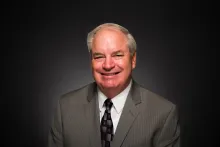
Robin Webber was born in Chicago, Illinois, in 1951, but has lived most of his life in California. He has been a part of the Church of God community since 1963. He attended Ambassador College in Pasadena from 1969-1973. He majored in theology and history.
Mr. Webber's interest remains in the study of history, socio-economics and literature. Over the years, he has offered his services to museums as a docent to share his enthusiasm and passions regarding these areas of expertise.
When time permits, he loves to go mountain biking on nearby ranch land and meet his wife as she hikes toward him.
