

Roy Holladay
This transcript was generated by AI and may contain errors. It is provided to assist those who may not be able to listen to the message.
Well, brethren, we're all looking forward to the Feast of Tabernacles. And it's going to be here before you know it. And we realize that the Feast pictures the time when God will ultimately bring peace to the whole world. And God will begin to offer salvation to all mankind. But before then, we're not going to have too much peace. Jesus Christ made a promise in John 14, 27 to us, and I think this promise extends really to the whole world, when He said in John 14, 27, Peace I leave with you. My peace I give to you.
Not as the world gives do I give to you, but not your hearts be troubled. Neither let it be afraid. Now, we know the world claims many times they have peace, but their idea of peace is they're arming to the teeth for the next battle.
Are they just signed a treaty and they're waiting for somebody to transgress the treaty? It's not real peace. God says that you and I can truly have a peace of mind that the world cannot even begin to phantom. We realize that the Holy Days picture in sequence how God is going to bring about peace on earth, harmony, establish His kingdom, that it is basically through Christ, through His sacrifice.
Brethren, how can you have peace in this world as long as nations, people, and regions hate one another? There are nations in this world that despise other nations and other people. I read about an article, I read an article series, actually.
It was being discussed in USA newspaper. The title of the article was The Politics of Hate, and talking about a worldwide phenomenon that was taking place of the rise of anti-Semitic feelings in the world today, and that this was on the increase again.
They listed and cited a number of places, not just in places like Germany, but in many of the nations of Europe, even in places like Japan and other countries. We live in a world filled with hatred and long memories, where people do not forget, but they remember what has been done to them in the past.
I'd like for you to project yourself into the future. Christ has come back. Resurrection has taken place. You're standing there before Him. He's handing out responsibilities and duties, and He's telling the apostles, go, and each one of them is responsible for a tribe. David's over all of Israel. He gets down to you, and He gives you 10 cities somewhere in Palestine. And He says, look, I want you to go there and settle the disputes between the Jews and the Arabs. What would you do? How would you resolve that conflict? Who would you shoot first? You may want to do that, but what would you do?
Then Jesus Christ begins to hand out more assignments. He says, okay, you and you and you, I want you to go over to Pakistan and India, and I want you to get the ex-Hindus and Muslims to love one another. Now, how would you accomplish that? I want you to get the Serbs, the Croats, and the Muslims to live at peace in Europe.
I'd like for you to teach the Japanese to respect the Chinese, and you, I'd like for you to go over to Russia and tell them to respect their neighbors, especially the Georgians, the Estonians, Lithuanians, all of these people. Then other assignments are handed out. You've got to go down to South Africa and talk to the Afrikaners, the English, and how they need to learn to esteem the Blacks and the Colours in that area.
And while you're there, you need to tell the Zulus and the Swazis and the Sotos that they need to love one another. Because you see, in South Africa, there's something like nine major tribes, 200 sub-tribes. They don't get along with one another. They fault each other for hundreds of years.
And so, you know, how are you going to get them to love one another? You go over to Rwanda. How are you going to get the Hatus and the Tutsis to love and to respect each other? And yet, when the millennium begins and you and I are given our assignments and duties, this is part of what is going to have to happen if you're going to have peace on Earth.
How do you overcome hatreds and animosities that nations have against each other? Over the years, I've tried to collect various articles dealing with some of these situations. You might remember the crisis in Bosnia a few years ago that came up. Let me quote from an article titled, The History of Hatred Fueling Conflict that describes some of these difficulties and some of these problems that you see.
It says, The hatred Serbs, Croats, and Muslims, and the Balkans have for each other, have been nurtured by myth, grievances handed down from generations. The Serbs have seen themselves as martyrs ever since the Ottoman Turks defeated them in the legendary battle of Kosovo in 1389. So, this isn't a problem that's gone on just for a few years.
In 1389, anybody remember back that far? The Serbs are still battling to halt the Islam spread into the heart of Europe. They lived under Turkish rule for four centuries. Serbian leaders in Belgrade cannot understand why the supposedly Christian West does not support a fight. They claim it is aimed against the Muslim nationalists in Bosnia. They're saying, you want to keep the Muslims out? We're fighting against them, so they don't understand. It goes on to give some of the history of this over the last couple of centuries, but dropping down into the article, by Bismarck's time, the European powers that made the problem worse, particularly the Austrians.
The centuries earlier had resettled Serb farmers in border areas of Croatia, so that the Serbs, who were reputed to be fierce fighters, could act as a bulwark against the Turks. The relocation mixed these populations along the Croatian-Bosnian borders, and they gradually grew in hostility to one another. Behind the religious intolerance, there has been a hunger to control the land that forms a front line between competing civilizations that have separated the Byzantine from Rome, the Ottomans from the Habsburgs, east from west.
That goes on to say in the memories of what the murderous Croatian fascist state, and at that time Muslim forces in Bosnia, did to Serbs during World War II, this is what is driving the hostilities today. Now, I want you to notice some of the words used out of this article. Hatred, says, nurtured by myths and grievances, generational problems, this is something that's going on for generations, hostility to each other, religious intolerance, competing civilization, unfair treatment. How do you overcome unfair treatment? Hurt, abuse, or wrongs? Especially those that are real.
I mean, those that actually have happened to you, or to your people, or those that are imagined. Well, we want to focus on that today, how God is going to accomplish that, how He's going to bring peace to the world, and guess what? You and I are going to be in the thick of it. That's why we're being called today. You might remember the song about peace, that there's coming a time when we pray for peace on earth and let it begin with me. Well, when you talk about peace, it's got to begin with us, because God is ultimately going to bring peace to this earth, but He's going to use His family.
He's going to use those who are in the resurrection to help Him. One of the purposes of the Feast of Tabernacles is to show mankind that God is ultimately going to reconcile all humanity to Himself, give everyone an opportunity. But again, how do you overcome the hostilities and hatreds and violence and pains that have been built up over so long a period of time? Some of these hatreds have been nurtured for millennia, and they've gone on and on. Well, let's take a look at it and get a historical perspective, especially a biblical historical perspective. What about Ishmael and Isaac?
You might remember that God promised to Abraham and Sarah that He would give them a seed, a descendant. Well, they began after 10 years or so. Sarah took matters in her own hand. She gave Hagar, her handmaid, to Abraham and said, go and have a baby by her. Okay, he had a baby named Amishmiel. Amishmiel was a wild type of an individual, and you find that he and his mom felt that they had been untreated or mistreated. They felt that Isaac had been favored over them, and so there was an animosity that began to develop. And this is where the conflict between Arab and Jew comes from, because basically the descendants of Ishmael are the Arabs today, and so you have that for many. What about Esau and Jacob? We have Jim's favorite topic over here. Let's go over to Genesis 27 and verse 41. Genesis chapter 27 and verse 41. You might remember the story. Jacob had stolen the birthright. Jacob had taken the blessing away from Esau. He did this by cunning, connivory, lying, and we find here in verse 41, so Esau hated Jacob because of the blessing with which his father blessed him, and Esau said in his heart, the days of mourning for my father are at hand. Then I will kill my brother Esau. So here we have a situation where you have an animosity between Esau and Jacob. Esau felt used, taken advantage of, and historically the Edomites, and especially the Amalekites, the chief tribe of the Edomites then, had been bitter foes of Israel. Many of the Palestinian Arabs today are probably a mixture of Ishmael and Esau.
Turkey comes from Esau also. So you see some of the problems and the hostilities actually go back millennia, go back to the very beginning. In the book of Ezekiel chapter 25, Ezekiel chapter 25 and verse 15, we find here a prophecy about the future, and God talking about the nations and some of the difficulties that they've had.
Notice here in verse 15, thus says the Lord God, because the Philistines dealt vengefully and took vengeance with a spiteful heart to destroy because of the old hatred.
And you'll notice the word old here in the margin says perpetual hatred. This is something that had been perpetuated and carried on down. If you'll go over to chapter 35, in chapter 35 here, God pronounces a curse, so to speak, on Edom and what's going to happen to them in verses 5 through 6. It says, because you have had an ancient hatred, and again the word ancient here means an everlasting hatred. It's something that they haven't given up, something they haven't let go of, and have shed the blood of the children of Israel by the power of the sword at the time of their calamity when their iniquity came to an end. Therefore, as I live, says the Lord God, I will prepare you for blood, and blood shall pursue you since you have not hated blood, therefore blood shall pursue you. In the future, as Judah, some of the descendants of Israel, try to, let's say, escape captivity, go through the Bosporus Dardanelles up through that area, they're going to be turned over by the Turks, they're going to be turned over by Esau to their enemies, to be put into slave camps. In verse 11 it says, therefore as I live, says the Lord God, I will do according to your anger, and according to the envy which you showed in your hatred against them, and I will make myself known among you when I judge you. So God shows that He is going to indeed punish them for their attitude. But what these two verses show is that nations can harbor grudges, carry envies, hatreds that are passed on from generation to generation. Now again, they can be based upon real injustices or, you know, imaginary. People are not born hating one another. A little baby is not full of hatred for some other race, some other nationality, some other people. They're taught it. They learn it. And what we have to realize is these things are passed on. And this is why one race hates another race, or one ethnic group hates another ethnic group, because it's passed on. They learn the history of how they've been mistreated, and then they want vengeance. Galatians 5 and verse 19, we find a very clear scripture that I think puts this in its perspective. Galatians chapter 5 verse 19, we read, Now the works of the flesh are evident, and it begins to enumerate what the works of the flesh are. Notice verse 20. Idolatry, sorcery, hatred. Hatred is a work of the flesh.
That it mentions, contentions and jealousies, an outburst of wrath, selfish ambition, dissensions, heresies, envies, murders, and so on. So discord, hatred, jealousies, fits, rage, selfish ambition, all of these are works of the flesh. They come from the flesh. They're exacerbated by Satan the devil, because he will certainly stir these up in human beings. Word for hatred in the Greek means malicious or unjustifiable feelings, animosity. Anyone who hates somebody else feels justified for his hatred. They feel they've been wronged. They've been hurt. They've been abused. They've been injured. And generally, they feel that they're right in their action. I've been abused. My people have been taken advantage of. Therefore, I have every right to retaliate and to get back. And so, you know, this is where they want to start. So where do you start curing this problem, healing this type of a problem? Remember, you're in the millennium.
Christ said, go! You go over to your five, ten, fifteen cities, region, whatever it is that you're responsible for. How do you start? Well, God tells us how he will start. First thing God will do is lock up the devil. He'll start with the devil. Satan will be bound in his demons, and they will no longer be free to deceive mankind, to mislead man.
Has Satan the devil ever admitted a mistake? I've never heard of him admitting a mistake or that he's wrong. Does he hate God? Does he hate everything that God stands for?
Yes, he does. I remember years ago, Dr. Hay at a conference talking to the ministry.
You have to have known Dr. Hay. He had a man come into the counseling office, had a demon. So he said, before he cast the demon out, he thought he would talk to it. And so he sat down and was talking with this man and the demon, and he asked him why they hated God, why they were against God so much.
And the first thing out of his mouth was, God was unfair. God did not treat us right. And he began to explain that God didn't tell him everything.
As God told us everything, do you know everything that there is to know about the future and the plan and everything that God's working out? Obviously not. So they felt that God was unfair. So because they felt mistreated that they weren't let in on everything, you find that Satan in his pride, in his vanity, his cockiness rebelled against God.
And he ever since has influenced man to think that man is right in his actions.
Man claims that he's for peace. That he's out killing people and fighting and warring. He thinks that's peace. Nations believe they're right just like human beings believe they're right.
In the millennium, nations are going to have to eventually come to the point of admitting they've been wrong and apologizing and asking for forgiveness of other nations, other groups. In Proverbs 14, 12, we're all familiar with the Scripture. Proverbs 14, 12, there's a way that seems right to a man, but the ends thereof are the ways of death.
Won't you just sort of change that around a little bit? There is a way that seems right to a nation, because a nation is made up of people, but the ends thereof are the ways of death. And nations go in the way that seems right to them. And yet, in Isaiah 11 and verse 9, Isaiah 11, in verse 9, we find a Scripture that describes what God is eventually going to do in the world tomorrow. God says here, "...they shall not hurt nor destroy in all my holy mountain, for the earth shall be full the knowledge of the Lord as the waters cover the sea." So, in the world tomorrow, you find there's not going to be hurt or destruction, but it won't start out that way, will it? I mean, I show you passages in the Bible.
Back in the book of Ezekiel, even after Christ is on the earth, three and a half years, the Gog and Magog, Meshach and Tubal, Rosh, all of these nations are going to come up against Jerusalem to battle, and they still haven't gotten it. The millennium won't start out like this. It'll take time to turn it around. Isaiah 11 and verse 9 is describing what it's like once God has established His kingdom on the earth. In fact, back here in Isaiah chapter 2 and verse 4, you might remember Isaiah 2 verse 4, we read that, "...nation shall not lift up sword against nation, and neither shall they learn war any more." So no more warfare going to take place.
Now, stop and consider the conditions on the earth. At the beginning of Jesus Christ's rule, there have been three and a half years of the tribulation of man's inhumanity to man.
Perhaps only 10% of mankind has been left alive. There have been wars, there have been famines, there have been starvation, earthquakes, concentration camps, oceans have been turned to blood, grass has dried up, trees are destroyed, people have witnessed the greatest military battles in earth's history. In fact, in the book of Revelation, it talks about one battle where one-third of humanity is destroyed in this one battle. The economy of the world is in total chaos at that time. And to start with, nations are going to hate one another.
Nations that have been taken captive by other nations, nations that have been made slaves by other nations, mistreated, thrown into concentration camps, sold as slavery, and all that they've done to one another. And there will be terrible emotional, psychological scars, there will be deep hurts, there will be physical pain, people who have been treated unfairly, abused, seeing their families died, mates will see their mates killed before them, raped, ripped apart, they will see horrors that no one ought to be able to ever witness. And into that mess, you and I step, into that chaos and that confusion that human beings have wrought, that Satan the devil has inspired and stirred up, will come the family of God. And you and I will be right in the middle of it to straighten it out. You and I have our marching orders in Luke 4.18. Luke 4.18. Notice what we will be asked to do here. Luke 4. This is the work that Jesus Christ and the saints will do. Reading from the King James Version, The Spirit of the Lord is upon me because he anointed me to preach the gospel to the poor. Now that's what Jesus Christ did to start with. That's what he did at his first coming. The rest of this verse has never been fulfilled. He has sent me to heal the brokenhearted, to preach deliverance to the captives and recovery of sight to the blind, and to set at liberty those that are bruised. When you talk about healing the broken heart, we use that expression today that somebody's heart was broken. That means a deep emotional scar.
You can look at the emotional and psychological scars that people will bear at that time. The pain and the suffering, just the heartache, and your heart will go out to those people because of what they've gone through. We will also bring deliverance to the captives. People will be brought out of oppression. They will be brought out of jails. They will be recovery of sight, and so people are going to have to have their health restored, their minds open. Recovery of sight in two ways. Literally, they can see, but spiritually, where they'll be able to see also and discern. And then to be set at liberty. So people have been in jail. They've been abused. They've been enslaved labor camps ever since man has been on the earth. In fact, this past week, I talked to a man who found out to have a neighbor behind me. We cut a tree down. We got to talking over the fence this past week and found out that he had gone into Dachau after the Second World War. And he actually was in charge of a prisoner camp for the Germans. They had 12,000 of the officers who had run these concentration camps in Germany that he was responsible for feeding and taking care of. And so he had gone into Dachau. He had seen some of the heartaches and the problems that those individuals had gone through. It was interesting talking to him and how they really took care of the Germans, fed them well. They had a diet of 1,800 calories a day. And he was describing what they fed them and how they fed them. Well, what you have to realize, brethren, is that people will have gone through all of this. And one of our main jobs that Jesus Christ will give to us is to heal the brokenhearted.
How good are we today at helping people who have emotional and psychological pain and suffering and helping them? How do you do this? Knowledge is not enough. It's not enough to say, well, let me tell you the truth, and then that's going to take it away. No, you need a change of heart. You need a change of mind, change of attitude, change of approach in order for this to take place. Well, Ezekiel 36, beginning in verse 25, describes this, what God is going to do, describes what God will do with Israel, and eventually this is what God will do for all nations. Ezekiel 36 verse 25, I will sprinkle clean water on you and you will be clean. I will clean you from all of your filth and from your idols. So it's talking about their sins being forgiven and they're being cleaned. And I will give you a new heart and put a new spirit within you. And I will take the heart of stone out of your flesh and give you a heart of flesh. And I will put my spirit within you and cause you to walk in my statutes and you will keep my judgments to do them. So you'll find that God will do this for all nations.
The removal of anger, of bitterness, of hatred is basically a work of God's spirit. It's what God's spirit does for an individual. Humans have proven throughout their history the last 6,000 years that we're incapable of solving these problems. We've not solved any of these type of problems where they've been obliterated, removed from existence among human beings. It will take time, but slowly the nations over a period of time will begin to respect one another. We'll come to respect each other's differences, weaknesses, and strengths. But that will not happen overnight. The Arabs aren't going to love the Jews overnight, and the Jews won't love the Arabs overnight. Blacks won't love the whites, or the whites the blacks. And what we have to realize is racial prejudice is not something that's just white and black. As I mentioned, you've got various clans and tribes in Africa who just despise and hate one another. And when you have one tribe trying to kill, totally slaughter another tribe, you begin to see what happens. But Isaiah chapter 19 describes that there is going to come a time we find that there's going to be an effective teaching of people in conversion. Isaiah 19 verse 23, when mortal enemies will one day work together, cooperate with each other, and be able to help one another. Isaiah 19 23, in that day there will be a highway from Egypt to Assyria. And the Assyrians will come into Egypt, and the Egyptians into Assyria. And the Egyptians will serve with the Assyrians. And in that day Israel will be one of three with Egypt and Assyria and a blessing in the midst of the land. Whom the Lord of hosts shall bless, saying, blessed is Egypt, my people, Assyria, the work of my hands, and Israel, my inheritance. So nations that were enemies with one another in this world will at that time come to work together. And highways will be built, and people will go and visit with each other. In order for peace to come to the earth, nations must do one thing. You know what that is? Nations have to be willing to forgive one another.
Let me quote from an article here titled, To Live in Peace, Gathering Urges World to Forgive. In a world driven by ancient hatreds, tearing at the fabric of the Balkans, flaring in daily violence in occupied territory, psychologists say one simple act may stand in the way of peace. Forgiveness. Historically, most social conflicts, wars, and family disputes are based on the unwillingness to forgive. That suggests that forgiveness may be the paramount need in our society. Now, they were holding a conference called Forgiveness in the Heartland for many scholars, many different individuals were getting together to discuss this. It says, The vision of this week's convention is making clear the connection between an individual's decision whether to forgive and the possible larger consequences, including wars such as those racking some nations of the former Soviet Union. These wars, we see dating back to the initial violation of one group by another, unwillingness to forgive, and its perpetuation for hundreds of years. So, these hurts and feelings go on for hundreds of years. Then we find forgiving is always a personal thing and always remains personal. Nations don't have a heart.
Ethnic groups don't have a heart. Only people have hearts.
So, if you're going to forgive as a nation, then it's got to start somewhere. It's got to start with each individual in their heart. See, forgiveness is going to be the key. In the world tomorrow, nations will have to admit they've been wrong. They've done wrong. And ask for forgiveness. Other nations won't punish a people for what their ancestors did. Hundreds of years ago, or millennia of years ago. In fact, God says, vengeance is mine. I will repay, says the Lord. So, if there's going to be vengeance taken, God will take vengeance at that time, and nations won't have to worry about it. Let me give you a classic example of how this will work from the Bible, showing what God will do at that time and how it will work. And let's go back to Genesis 50 verse 15. We have here an example of a young ruler named Joseph, who had every right to hate his brothers, to despise his brothers, to take vengeance against his brothers. Because remember, he'd been sold into slavery. Not only had been sold into slavery, but he had been put down, wrongly accused, thrown in jail, abused of everything you think of. For 17 years, he was subject to abuse. Joseph could have become a bitter, resentful man, wanting to get back at his brothers. Finally, they have to come down to Egypt for food. And he looked at him, and he could have said, I gotcha! And then he could have devised every evil thing you could think of to deal with his brothers. But was that his attitude? Well, in their minds, they thought that may be his attitude. Notice verse 15. When Joseph's brothers saw that their father was dead, they said, oh, oh, dad is dead. Dad's been a buffer between us and Joseph. He's gone now.
Perhaps Joseph will hate us and may actually repay us for all the evil which we did to him. He's going to get back. So they sent messengers to Joseph, saying, before your father died, he commanded, saying, Then you shall say to Joseph, I beg you, please forgive the trespasses of your brothers and their sins, for they did evil to you. Now please forgive the trespasses of the servants of the God of your fathers. And Joseph wept when they spoke to him. Then his brothers also went and fell down before his face, and they said, behold, we are your servants. And Joseph said to them, do not be afraid, for I am in the place of God. But as for you, you meant evil against me, but God meant it for good. And so he realized he'd been placed there to save them. They asked for forgiveness, and Joseph was willing to forgive them. Joseph realized that God put him there to save his family. And even though things didn't turn out well for a while, he was there to help them. Instead of doing them evil, he did them good. He helped them. Now let's translate that into, instead of Joseph, say Egypt. Instead of Joseph, say Russia. Instead of Joseph, say the Arabs. Instead of Joseph, you know, whoever you want to put in there. And even though a person may have been abused and mistreated, they are going to have to say, I forgive. God will use us to help bring about healing, to teach forgiveness. Now why will we be able to do so? You ever stop to think, you're in the kingdom, you're ruling over your cities, and you're going to have to teach them about forgiveness. What do you know about forgiveness? What do we know? How can we help these people? Let's go over to Colossians 1.24. I've mentioned this principle before, but it certainly is very applicable to what we're discussing here in its larger context. Colossians 1.24. The Apostle Paul said, I now rejoice in my sufferings for you. So Paul, as a minister, suffered for the churches. He was thrown in prison for preaching about Christ. He was beaten, and we know everything that he went through. And he said, I fill up in my flesh what is lacking in the afflictions of Christ. So he said, you know, in my flesh, I've been beaten, I've been scourged, been thrown in prison, I've been stoned, I've been left for death or dead, you know, I've been shipwrecked. You can go on and on and on, everything that he went through in his flesh. What was lacking in the afflictions of Christ? Okay, what was lacking in Christ's afflictions?
He said, for the sake of his body, that's for the sake of the church, which is the church.
So, Colossians 1.24, brethren, helps to explain why we go through suffering now, why we're faced with problems and hurts and pains, and sometimes unjust situations. You see, as a Christian, there are many times that you and I are picked on just simply because of what we believe. There are people who, because you don't keep Sunday, you keep the Sabbath, you keep the Holy Days, you don't keep Christmas and Easter, these type of things are going to make fun of you or ridicule you. How much persecution have we received from family or friends over what we believe? Jesus Christ suffered unjustly. He never sinned. He didn't deserve to die. And yet, as he was hanging on the stake, what did Jesus Christ say? He said, Father, forgive them. They don't know what they're doing. So what is lacking in the suffering of Christ? Well, it's the fact that Jesus Christ is creating a help-meet. It's called the Bride of Christ, the Church. And that help-meet is going to be on the same level as he is through the resurrection. We will be in the family of God. And you and I must come to have the same attitude that Christ has towards human beings. You go to the book of Hebrews and it talks about Christ being our High Priest. And what does it say? That He's a merciful High Priest. That we can come before Him. And He knows what we're going through because He suffered as we've suffered. He can have mercy on us. He can go before the Father and say, Father, these people are going through these problems. And let me explain, because He's gone through the same thing. And there will be someone in the family of God in the Bride of Christ who will have experience what every human being has gone through. And when we talk about, and we're required at that time to have empathy and mercy and understanding and compassion and the ability to relate, we will! Because we've experienced it ourselves. Maybe not to the extreme degrees that people will coming out of the Tribulation. But what if you've gone through a divorce? What if you've lost a mate? What if you had a child die earlier in childbirth? What if you were raped? What if you were abused physically or sexually? What if someone in your family were murdered? Or what if you were responsible in warfare for killing somebody? You see, we've all gone through problems that every other human being is experiencing. And when we talk to humans in the millennium, it will not just be from a theoretical perspective. It will be from a perspective that, yes, I've suffered also. I've been unjustly treated. And we will be able to relate to them. We will have learned how to forgive now. How are we doing? How are we doing right now when it comes to the area of forgiving? Do we forgive?
We're being prepared in advance to deal with all the problems of humanity.
Nothing occurs to us without a purpose in God's plan, that God's working out, that God is working with us. It's easy to talk about the future and how great it's going to be in the millennium and the kingdom of God. But how well is it in our kingdom today, the church?
How well do we give or get along with one another? Are we willing to forgive our mate? Are we willing to forgive each other? Well, we've got to learn to do that. One of the hardest things for us to do is to forgive. Let go of hurts, grudges, and wrongs. See, forgiveness is an individual thing. It's a personal thing. And if we're going to teach others, we better learn now how to do so. So how do you forgive?
Well, we could spend sermons on this, but let me just summarize for you here very quickly what it is we need to do to forgive. Proverbs 10, 12. Proverbs 10, verse 12 says, hatred stirs up strife. You have hatred and grudges and animosity. Bitterness is going to stir up strife. Brethren, it is God's nature to be forgiving. It's called grace. It's called mercy. To show mercy, to extend grace. The way of the flesh is to hate. Who is hurt the most by hurt feelings? Pain, guilt, hatred, and grudges. The person who hates.
The other person many times would don't even know you feel that way. If you ever had certain feelings for someone and they don't know it, the boy you sure don't like them for whatever reason. And who's hurt by that? Well, you're the one hurt. Hate is like a malignancy, like a cancer just gets in there and it rots and it grows and it destroys. Hate and wrong feelings hurt the hater more than they hurt the one who is hated. Hate is a sign of sickness, a sign that we need to be healed. The old saying that we've all heard over the years, hate to sin, love the sinner. Why is that true? Well, we're all made in God's image for one thing and secondarily, we're all potential members of the family of God. So if there's somebody you're hating and despised and you go to your grave hating that person and one day they're in God's kingdom, what are you going to say? Well, I don't know how you got here.
Why are you here? You know, you shouldn't be here. You know, of course, we're not going to save that.
When we only hate the wrongness of a thing, our hate dies when the wrong we have hated is righted. So it's corrected and so okay, you know, it's over. But when we hate people who do us wrong, our hate stays alive long after what they did is dead and gone. You know, the hatred is there because the hatred is not for the deed, the hatred is for the person. We attach our feeling to the moment when we were hurt and we endow it with immortality and it just goes on and on and on. But the Bible says love covers all sins, that we are to love. Remember Proverbs 13.10?
Proverbs 13.10 says, pride breeds contempt, breeds quarrels. Satan the devil's problem and his downfall was his pride. It separated him from God. He thought he knew more than God.
What is it that keeps us from being willing to forgive other people?
It's called pride. It's called ego. It's called vanity. Your pride gets in the way.
This is why a lot of people won't forgive.
How many times have you heard somebody say, I feel you should apologize first?
Well, let me explain something about forgiveness. There are two elements here.
When we forgive somebody, we are dealing with our emotions, with our feelings, and overcoming those.
When others acknowledge their wrongs, then we're dealing with reconciliation. You can't reconcile with somebody who doesn't want to be reconciled with, doesn't admit that they're wrong. So what we find is the person who is filled with bitterness and grudges and hatred, those type of feelings will lead to physical problems, emotional problems, psychological problems. And our being willing to forgive is what releases us from those wrong emotions.
But if we're going to reconcile, then both parties have got to be willing to say, I'm wrong. If you and your wife aren't getting along with one another and you want to reconcile, what do you normally do? You come to your mate and you say, I'm sorry. I'm sorry I got angry. I shouldn't have said those words. Will you forgive me? Now, what happens if she says, I will never forgive you? You did me wrong. So, and I'm not going to forgive you. That's it. And you're going to be hurt.
And if you're going to reconcile, she can say, well, I was wrong too. I'm sorry. And so both of you kiss, you make up, you hug, and you go on. That's what reconciliation is. But our forgiveness deals with what we personally are going through. Matthew 6, verse 12.
Matthew 6, verse 12, what is commonly referred to as the Lord's Prayer. Notice here in verse 12, forgive us our debts as we forgive our debtors. Greek word for debt means what is owed, that which is justly or legally due a debt. Now, I owe you a hundred dollars. I'm in debt to you. And maybe one day you come and you say, well, Mr. Holiday, I'm canceling the debt. The debt's what? It's forgiven. You don't owe me a hundred dollars. Now, I owed it to you.
It was due you, but because you were willing to cancel it, to overlook it, to forgive it, it's gone. It's no longer over. We see this is what happens in human relations. A child who grows up, abused by his dad or parents, neglected, not loved in the way that they should, and they grow up, you know, not really having the love and the esteem and everything that they should have. They were owed that by their parents. That was something that was due them, but they didn't get it. So, there comes a point to where instead of hating that parent, despising that parent, not loving that parent, you've got to be willing to say, I forgive them. I forgive them. They owed me this debt. This was something that was due me. Any child should have love and esteem and respect and be taken care of. And I didn't get it. I forgive them. Now, that's going to help you deal with your feelings and emotions. Now, as far as reconciling with them, well, that again is a different story. Verse 14 says, if you forgive men their trespasses, your heavenly Father will also forgive you. But if you do not forgive men their trespasses, neither will your Father forgive your trespasses. So, this has to do with our being willing to forgive and God being willing to forgive us.
You and I have to be willing to forgive our brother from our heart, from inside. Let's notice in Luke 6, verse 37, actually Luke 6, 37. Very interesting Scripture here.
It says, judge not, you shall not be judged, condemn not, you shall not be condemned, forgive, and you shall be forgiven. So, we're told to forgive and we will be forgiven.
Now, the American Standard Version translates this, judge not, you'll not be judged, condemn not, you'll not be condemned, release, and you shall be released.
If you and I release a person, we forgive that person, then we can be released or forgiven. New American Standard Bible says, do not judge, you will not be judged, do not condemn, you'll not be condemned, pardon, and you will be pardoned. West says, be setting free, and you will be set free. So, you and I can be freed from some of these problems and difficulties. When you forgive, you perform spiritual surgery inside your soul. The first stage of healing is to release, to release the debt, to forgive. Research suggests that forgiveness works in at least two ways. One is by reducing the stress or the state of unforgiveness. When I say a state of unforgiveness is a potent mixture of bitterness, anger, hostility, hatred, resentment, fear, and these have specific psychological and physiological consequences, such as a person who has these type of feelings, will have increased blood pressure, hormonal changes, linked to cardiovascular diseases, immune suppression, possibly impaired neurological functions, and memory.
So, they'll begin to have a lot of health problems as a result of this. And secondarily, forgiveness should be incorporated into one's personality. Forgiveness should be a way of life, not merely a response to a specific incident. Too often, forgiveness for us is somebody does something and after a while we say, yeah, I should forgive them. A specific incident. But it should become a way of life with us. Is grace something God does occasionally? Or does grace in God's forgiveness and mercy describe the way He is? His attributes.
Well, you and I will know that forgiveness has begun in us when you recall those who hurt you and feel the power to wish them well. Somebody's hurt you, you said you've forgiven them, and then you wish them well. Remember, Mr. Herbert Armstrong used to say he prayed for his enemies before he prayed for those who were closest to him because he was concerned about them. Well, mankind has not been willing to admit that he doesn't know the way to peace. But Romans 3, 17 says, the way of peace they've not known. So man doesn't know the way to peace.
What is, you'll notice the words, the way. What is the way to peace? Christ, in John 14, 6 said, I am the way.
So the way is through Christ. Peace is part of God's nature, His attributes.
Mankind today, as a whole, society as a whole, lives in distortion. Our thinking is twisted, corrupted, distorted. We call uneasy pieces, or truces, I should say, peace. We arm for war up to our teeth, and we call it peace. We live in distortion, and we think we are at peace. Peace comes from God. Remember, I read to you to begin with, peace I give to you. You're not as the world gives. God will give us a peace of mind. The word peace means harmonious relationships, friendliness, freedom, order. So, brethren, in the world tomorrow, in the millennium, peace will eventually come.
Hatred will be removed. You and I are the vanguard. We're the pioneers. We're the leaders. We're the ones that God is working with, training, preparing, getting ready. He's going to stick into the battle, so to speak. When the millennium begins, He's going to go sick them, and you and I are going to go out there and help humanity, and help bring peace, and help solve problems, and help people to overcome their hatreds and their bitterness. So, it must begin with us. It must begin now. So, in order to have peace now and in the future, same thing that applies in the future applies now. We must be willing to forgive.
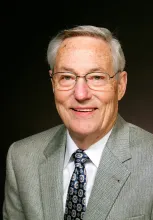
At the time of his retirement in 2016, Roy Holladay was serving the Operation Manager for Ministerial and Member Services of the United Church of God. Mr. and Mrs. Holladay have served in Pittsburgh, Akron, Toledo, Wheeling, Charleston, Uniontown, San Antonio, Austin, Corpus Christi, Uvalde, the Rio Grand Valley, Richmond, Norfolk, Arlington, Hinsdale, Chicago North, St. Petersburg, New Port Richey, Fort Myers, Miami, West Palm Beach, Big Sandy, Texarkana, Chattanooga and Rome congregations.
Roy Holladay was instrumental in the founding of the United Church of God, serving on the transitional board and later on the Council of Elders for nine years (acting as chairman for four-plus years). Mr. Holladay was the United Church of God president for three years (May 2002-July 2005). Over the years he was an instructor at Ambassador Bible College and was a festival coordinator for nine years.
