

Robin S Webber
This sermon was given at the Oceanside, California 2014 Feast site.
This transcript was generated by AI and may contain errors. It is provided to assist those who may not be able to listen to the message.
Can you just imagine the hymn sing that we're going to have in the future? It's going to go on for eternity. Thank you, thank you very much. I have new ideas, you know, I always have new ideas about how to do a feast site. Next year we're going to have that song, and on that last stanza I think we need to honor God and stand with that last stanza. In fact, I was going to break the rules of the church. I was going to leave the applause, but nobody applauded. So anyway, you never know what? No, no, that was beautiful.
Beautiful God, beautiful truth, beautiful people have all come together here in Oceanside, California, and here we are, the last message of this festival, plus one, and on this special day of days called the Eighth Day Festival. I'm sure you, like me, at one time or another have picked up a book, and it's not only that curiosity killed the cat, but it's also slaying a few of us, because we go to the the end of the book to see what's happening, as to whether or not we should read it and stay with it, because we're going to invest some time.
We've all done that, sometimes by going to the end of the book, you know that it's ruined, and we put the book down, and we move on, and we never turn to that story again. But reading this book, the book that you have in your lap, is purposely designed to have the exact opposite effect. When we go to the end of the story, it does not spoil the book, but rather enhances and magnifies every word, every step along the way, and even sometimes every bump along the way on our journey of faith.
When we consider the final words that are found in Revelation 22, I cannot help but think of a lighthouse. I think all of us intellectually understand the purpose of a lighthouse, and that lighthouses are friends, and they beckon the sailor in safely to home port. And you and I can understand that intellectually until we are actually out there on the high seas, perhaps on the rough waters, or in the fog, or in the dark of night. And you know that it's somewhere there. You know there's a destination you need to get to, but you can't quite find it.
And then comes that welcoming beacon. That welcoming beacon, and you know that you're on the right path. Well, that's just what the Bible is a little bit like. Think of it as a lighthouse. Think of what we're going to be discussing this afternoon as a welcoming beacon. A welcoming beacon that helps us get over the shoals of life's experiences, helps us cut through the fog of human nature, helps us avoid and move away from the sirens of songs of Satan's distractions.
Join me if you would. Let's go to the end of the book. Let's be daring, and I don't think I'm going to ruin the book for you. We're going to go to Revelation 22. In Revelation 22, because this is the great beacon that we are to consider on this, the eighth day. The eighth day festival was specifically designed for us by Almighty God to go to the end of the book and peek as to what is going on and what is happening.
And when we get to the end of the book, not only to glance at it, but to stop, to stare, to look at it, to internalize it, to embrace it, to keep it with us. Not only on this, the eighth day, but every day of our life.
And as Stephen Covey, the behaviorist, once said and was famous for in this maxim, begin with this end in mind. And that's going to be the goal of this message that I'm going to bring to you today.
The title of my message is An Invitation to Holiness. An Invitation to Holiness. Mr. Helge this morning talked about how God is a gift-giver and offers us salvation. God loves to give gifts and He gives an invitation to you and to me towards holiness. We look at Revelation 22. Let's pick up the thought if we could.
Beginning in verse 12. And behold, I come quickly and my reward is with me to give everyone according to his work. Who's that? Jesus speaking. I am the Alpha and the Omega, the beginning and the end, the first and the last. In that sense, what is actually being depicted is He is the source of life. Blessed are those who do His commandments in that they may have the right to the tree of life and may enter through the gates into the city.
But outside are dogs and sorcerers and sexually immoral and murderers and idolaters and whoever loves and practices a lie. I, Jesus, have sent my angel to testify to you these things in the churches. I am the root and the offspring of David the bright and the morning star. And then notice verse 17. The welcomes begin. The invitations start up and let the Spirit and the bride say, Come! And let him who hears say, Come! And let him who thirst, Come! And whoever desires, let him take of the water of life freely. For I testify to everyone who hears the words of the prophecy of this book.
If anyone adds to these things, God will add to him the plagues that are written in His book. And if anyone takes it away from the words of the book of this prophecy, God shall take away His part from the book of life from the holy city and from the things which are written in this book.
What I want to etch into your heart for a few brief minutes this afternoon is a four-letter word. It is one that we can share with every human being on earth. And it's one that this day depicts is one day going to be shared by every human being to every human being that has ever lived. And that is simply the word come. Don't you like it when somebody says come? Maybe when you don't think people notice you or even know that you exist or perhaps you have been passed over and somebody says, hey, you, you come.
It's welcoming. It's inviting. It warms the heart. It makes you feel special. And that's exactly what this day is about, is allowing God to let His creation know that is made in His image and after His likeness what He wants of them, what He wants for them, the future that's designed for them.
And He says come. Now God has always had this in mind. Join me if you would in Isaiah 46.
In Isaiah 46. And let's pick up the thought in verse 9. Isaiah 46 and verse 9, where God says this, Remember the former things of old, for I am God, and there is no other. I am God, and there is none like me, declaring the end from the beginning and from ancient times things that are not yet done.
Now notice what He says about this, saying, my counsel shall stand, and I will do all my pleasure, calling a bird of prey from the east and the man who executes my counsel from a far country.
Indeed, I have spoken it. I will also bring it to pass. I have purposed it, and I will also do it.
When God says something, He means it. And just as we talk about Steve Covey's famous maxim of begin with the end in mind, that's exactly what God had in store. From the beginning of creation, that He wanted each and every member that is made in His image and after His likeness to be able to come, to be able to experience Him, to be able to have pleasure with Him, to be able to worship Him, to be able to know Him. And He says, come. Thus, for those of you that are taking notes today, the message here, the title of my message is simply this, an invitation to holiness. And this is what this eighth day depicts. We've just completed seven days of a festival, and it's called the Feast of Tabernacles. This holy day, now that we're experiencing it, immediately follows after.
But I want to share something with you. It is separate. It is unique from the previous seven festival days that we have been going through. Scripture defines it as the eighth day. Join me, if you would, in Leviticus 23. In Leviticus 23, and let's pick up the thought in verse 35.
In Leviticus 23, in verse 35.
On the first day there shall be a holy confiscation, and ye shall do no customary work on it. For seven days ye shall offer an offering made by fire to the Lord. Now, notice verse 36.
On the eighth day ye shall have a holy convocation, and ye shall offer an offering made by fire to the Lord. And it is a sacred assembly, and ye shall do no customary work on it. Again, it calls it the eighth day. You can also find that over Numbers 29 in verse 35. Now, let's please understand, over the years some have attributed names and titles to this day which define events and activities and outcomes that surround this festival. But Scripture itself, authored by God, elects to define this festival not with any defining colorful name as we might want to have humanly devised. Simply put, God uses a numerical positional designation. The eighth day. You say, wait a minute, Mr. Weber. That's it? Because Mr. Schallenberger wanted me to say, can we talk?
That's it. Eighth day. That's what God is giving us. Where's Adam when we need him?
Adam named all the animals. Certainly Adam could come up with something better than the eighth day.
The Bible calls it the eighth day. What is the significance of the eighth day and how it is at length with an invitation to holiness? It's noteworthy that over the 2,000 years that the Jewish community, practicing the feast of Sukkot, builds Sukkotts, builds temporary dwellings.
But those temporary dwellings only stay up for seven days. We're kind of used to being in our motel room for at least eight days. But the Jews only stay in the Sukkot for seven days. Interesting.
Thus, we understand that there is something unique. There's something different. We're moving from one sphere or one realm and now into another, which is totally distinct. Different than the previous seven days. An entrance into new circumstances. Something is over. Something is done. Now something else is beginning. My question to all of us is simply this. Are you with me?
What is God telling us when it comes to the eighth day? Let's come to understand and come to appreciate that there is one particular attribute of God that every person who has ever lived, who is going to inherit eternal life, must have. Now please understand, we're going to have to think about this for a moment because you don't bump into it too much in this goldfish bowl of human nature that is trapped into time and into space. But the bottom line is this. I'm kind of a bottom line guy. Are you with me? The bottom line is simply this. God and eternity are defined by this specific attribute. And just as God's nature is what we call omnipresent or everywhere, this attribute comprises what eternity is all about. Now take a moment. You might want to draw a blank on your piece of paper that you have. Are you with me? This is called an emotional timeout in speaking. A blank? And I want you to think of what are we talking about? What is the one word that is synonymous with eternity? Now I'm going to stay up here. I don't see anybody writing it. Maybe you're thinking, I did invite you to think. Always be careful what you invite people to do. Now if you think for an hour, this sermon could go for two hours, so kind of get into it, okay? Put something down. Synonymous with eternity. That eternity is going to be comprised of.
Now this isn't too hard. This is not even multiple choice. I know you want a multiple choice. It's easier. It was in the title of my message. It's holiness. Holiness. That's what it is.
That's what it is.
Eternity and holiness are synonymous. Holiness means perfect, perfect righteousness. Join me, if you would, in 2 Peter 3 and 2 Peter 3 and verse 11.
Towards the end of the book, for those of you that are just new in the Word, 2 Peter follows 1 Peter, 2 Peter 3. Let's pick up the thought if we could in verse 11.
Therefore, since all of these things will be dissolved, speaking of the world as it was, the world of time and space, the world that initially came about, the world of Adam and Eve. What manner of person sought you to be in holy conduct, holy conduct, and godliness, looking for and hastening the coming of the day of God because of which the heavens will be dissolved, being on fire and the elements will melt with fervent heat. Nevertheless, we, according to his promise, look for new heavens and a new earth in which righteousness dwells.
A new heaven, a new earth, a new existence, a new experience, a new realm, the kingdom of God, the family of God. However, you might want to define it. It is where righteousness is going to dwell. God wants us to peek at this, and this also is towards the end of the book, so that we will stay with the book, that we will experience God's love, that we will keep his commandments, that we will walk in him towards him in faith, that we will experience his grace, and that we will not turn back. What is righteousness? Let's define some terms. Righteousness is the character, the character of being right or just, of right and just. It was formally spelled in the old Anglo-Saxon tongue, interestingly, as right-wiseness, right-wiseness, which encompasses more than just being right. Have you ever met somebody that's right and you wish they were wrong once in their life because they need an attitude adjustment? Why are you looking at me as if I'm the only one? He's always right, and he's normally right, but his attitude is rotten in being right. This is right-wiseness.
It's not only what he knows, it's not only what's emanating from his brain, but it's the motivation that's in his heart. This is the righteousness that's going to permeate eternity, the holiness thereof. Allow me to define the term holy. Are you ready? Holy comes from the word hagia. It's a Greek term, hagia. It is used in that sense depicting the sanctification and or the setting apart by God of individuals. It's the same word that is used for the word saints. Saints just simply mean holy ones that are set apart for a purpose.
It also speaks to conduct. Not just theory, but conduct. Not just theory, but practice of those that are being benefited by being separated by God for a specific purpose, by his determination. It's very interesting. The word hagia, when you look at Vine's commentary dictionary, says that God does set people apart. They are in a state of hagia to perform holy conduct.
And Vine's commentary says, and God places demands, demands upon such individuals.
When you look at it, when you look at the term righteousness, we looked at 2 Peter, when you look at the term holy, which we're going to move further into it, allow me to be blunt.
Allow me to be blunt. For we must be on this day truthful and honest and blunt. Nothing unholy and nothing unrighteous will be made welcome into eternity. Nothing. Only that which is holy. Only that which is righteous. Because again, I want you to begin to think of eternity as being synonymous with holy and or righteous. For a moment, let's consider Genesis 1 verse 26. In Genesis 1 and verse 26, we notice this.
Then God said, Let us make man in our image according to our likeness, and let them have dominion over the fish of the sea and over the birds of the air and over the cattle, over the things of the earth and all the creeping things that creep on the earth. So God made man in his own image. In the image of God, he created him. Male and female, he created them. In that beginning time, God made male and female, and he did make us after his image. But it was only the beginning. It was only the beginning of the process. He made us out of clay. He made us out of mud. He did not at that moment make us fully made out of eternity. Why did God make man? Why did God make woman? Why did he place them in that garden? You see, God didn't have to do any of this. And it's not even that God is lonely. He was not getting bored with what we call eternity. It was out of that outflowing and outgoing concern, that which is of God, that he wanted to give. And he wanted to give a gift. And so he made the man. He made the woman carefully. And then he gave them eyes so that when they came up and they were alive, that they could look into his face and he could look into their face and they could have a connection. They could have a relationship. They could have that ability to give God, which only he deserves, worship. And even in our worship, like we've had here during our time on Oceanside, it can be fun. Worship is not always boring. It's not always pedantic. It can be full of music. It can be full of youth laughing. It can be full of getting to know one other. But God made man and he made woman ultimately to have a relationship, to have God literally walk and talk and be in that garden called Eden. Oh, brethren, what a gift. And God gave that to our forebears. You and I know the rest of the story. We know that it was not enough for them at that time and they rejected the ways of God. They simply didn't believe.
But that was only the beginning of the process because when it says that we're made after his image and after his likeness and some of the translations say after his similitude, to recognize that there was more to come, that there was a fuller stature that had to yet be filled and be a part of. The bottom line is simply this. God, God has always, always wanted his special creation, you and me, to be holy. I am holy, therefore you are holy, is the steady drumbeat of the scripture from Leviticus all the way to 1 Peter.
That's why the Feast of Tabernacles is not just simple. It's not a vacation. It's a vocation. It's amazing how you just take one letter, one letter, change that letter around. It changes the whole meaning of why we meet seven days plus one. That doesn't mean that there cannot be wonderful things as byproducts of coming together because God calls us to rejoice. But you and I are here specifically, as we've been hearing, to become holy, to be a kingdom of priests, and yes, as Christ appropriates when and where to rule and to serve him in helping others. Just, I want to go very quickly through scripture. Let's go to Leviticus 11.44 for just a second. Let's hear the steady drumbeat of one of the great themes of the Bible. Leviticus 11, verse 44. Leviticus 11 and verse 44, notice what it says, "...for I am the Lord your God, and you shall therefore consecrate yourselves, and you shall be holy. For I am holy, neither shall you defile yourself with any creeping thing that creeps on the earth. For I am the Lord who brings you up out of the land of Egypt to be your God." It always goes back when it when God is talking with his covenant people, it always goes back to what I call the great rescue. God is the deliverer. He rescued ancient Israel from Egypt when they had no means of rescue on their own. And, brethren, he rescued each and every one of us when we had no means on our own. Christianity, in part, is about the great rescue. And the second Moses, not just the first Moses, but that greater lawgiver, that greater deliverer, and the one that takes us over more than a gulf and a sea and a river, but by the grace and by the will of the Father, takes us over into eternity. And thus we see here, he says, I will be your God, and you will be my people. Be holy. Leviticus 20, 26. Leviticus 20, verse 26, just a few pages over again. And you shall be holy to me. For I, the Lord, am holy, and have separated you from the peoples that you should be mine.
Oh, yes, brethren. Christianity is not just theory.
We're not just here to join a church. You don't join the church.
God has expectations. God has claims on us, our hearts, our minds, our arms, our legs, our words, as we heard this morning. We are to be a holy people. Leviticus 22, verse 32. Again, notice what it says here. Leviticus 22, verse 32. Pardon me. Is that a headache?
You shall not profane my holy name, but I will be hallowed among the children of Israel.
I am the Lord God who sanctifies you, who brought you out of the land of Egypt to be your God.
I am the Lord. Some people might say, well, that sounds kind of Old Testament. Well, let's go to the New Testament. Let's go to 1 Peter. 1 Peter 1. Join me if you would in verse 13.
1 Peter 1, verse 13.
1 Peter 1, verse 13. Therefore girdeth the loins of your mind be sober, and rest your hope fully upon the grace that is brought to you at the revelation of Jesus Christ as obedient children, not conforming yourselves to the former lust as in your ignorance, but as he who called you is holy. You also be holy in all of your conduct, because it is written, Be holy, for I am holy. What does this mean to each and every one of us? Let's begin to build.
Let's understand we are not our own person, but we are bought with the price.
Jesus Christ made himself poor, that we might become rich, as the Apostle Paul said in 2 Corinthians 8, verse 9.
He died once, that you and I might live forever. God the Father did not send his Son to this earth just simply to make good men better. If that was that alone, then he might as well stay up in heaven.
Jesus Christ came to this earth that through the work of the Father and through the work of the Spirit might take a people redeemed, might take a people that our saints sanctified, set apart to be holy, to be in training as the kingdom of priests unto our Father.
People that were serious about the calling and knew that it was more than just joining an intellectual society to study the Bible, or a social club, or going and having a vacation and taking your Bible with you, and you might get to it a little bit. Brethren, being a Christian absorbs every bit of your life, every ounce of your heart. We are not our own person, but God Almighty has a claim on us and gives us a future in the future and now to be holy.
And you know, being holy, and I know some of the kids are hearing this saying, oh boy, here goes the holy stuff.
Holy can be fun.
Holy can mean that you don't have to remember what you said because you're a person of truth.
Holy can mean that you live with the wife of your youth, as I have for 41 years, and have a faith-bound, trusting relationship. I didn't necessarily say easy. Marriage is never easy. Marriage is not for cowards and it's not for sissies, but God made marriage for a purpose.
And when you recognize that that is a holy compact, not devised by the Supreme Court of this land, and them defining what marriage is or not, but that marriage was designed by God between a man and a woman for a purpose that the two should come together and fill out the rest of the equation that's missing in a male or missing in a female. And together, not necessarily two heads, but two lives coming together, if you get over those hurdles, can be a gift back to God, can be holy, and yes, be a lot of fun along the way, just as I have with my Susie and your wife and your husband. Did you realize, brethren, that there are a lot of other eight days in the Bible that give a little meaning of why this is called the eighth day?
This eighth day is not the only eighth day that is mentioned in the Bible.
When the term the eighth day is used, it implies that there have been others seven days before them too. And is there something a little bit that we can learn about when we study other eight days that are in the Bible that have seven days preceding them immediately that allow us to get a feeling of what God, all along the line throughout the Bible, has been hinting about what this eighth day festival is about? Let's see what ties them together here for a few minutes. I'm not probably going to be able to explore them as much as I would like to, but let's just talk about it a little bit. Number one, have you ever considered the matter of circumcision that is mentioned back in the Old Testament? Join me if you would in Genesis 17 and verse 10. In Genesis 17 and verse 10, let's please take note.
This is the covenant that is being made in verse 10. This is my covenant, which you shall keep between me and you and your descendants after you. Every male child among you shall be circumcised, and you shall be circumcised in the flesh of your foreskins, and it shall be a sign of the covenant between me and you. Notice, he who is eight days old. My eyes have skipped the verse. Just let me find it here for a moment. Yes, verse 12, beginning, he who is eight days old among you shall be circumcised. Every male child in your generations, he who is born in your house or bought with money from any foreigner who is not your descendant. He who is born in your house and he who is bought with your money must be circumcised, and my covenant shall be in your flesh for an everlasting covenant. And the uncircumcised male child who is not circumcised in the flesh of his foreskin, that person shall be cut off from his people. He has broken my covenant.
Circumcision, what does it portray? It portrays being in complete surrender and total submission to God and focus on his will. God called a people who were not a people. They were a mixed scattering of families called Israel, and he made a nation out of them, and he made a covenant with them, and he said, I will be your God, and you will be my people. And oftentimes, as we know, covenants had some element of blood in them. So, on that eighth day of which, when we've come to understand the vitamin K is at its peak, that it clods blood, God said, you shall circumcise that individual. And they took covenant with God. The covenant was more than just simply the remolding of a male organ, but it is found in what is called the Shema in Deuteronomy 6 and verse 4. Hear, O Israel! Hear, O Israel! I am the Lord your God. I am one. And you shall love the Lord with all of your heart and all of your soul and all of your might. You are to be totally dedicated. I will be your God. You will be my people. Now, today we recognize that circumcision is not required under the new covenant. But join me, if you would, in Colossians for just a second in the book of Colossians 2 and verse 11.
In Colossians 2 and verse 11, notice, speaking of those under the new covenant, in him you also were circumcised with the circumcision made without hands by putting off the body of the sins of the flesh by the circumcision of Christ, buried with him in baptism, in which you also were raised with him through faith in the working of God, who raised him from the dead. And you being dead in your trespasses. And yes, we accepted that sacrifice of Christ, and we were lifted up out of that water as a sin and as a type of resurrection of that new life. And we said that we would accept Jesus Christ as our Lord and our Savior. And the Father became our God, and we became his people.
Going back to that which was in the Old Testament as a type.
Eighth-day circumcision. Join me if you would in Exodus 22 and verse 29.
Exodus 22 and verse 29. Again, fascinating what you find happens on the eighth day.
In Exodus 22 and 29, speaking of the consecration of the firstborn, both of humanity and of the animal. You shall not delay to offer the first of your ripe produce and your juices, the firstborn of your sons. You shall give to me. Likewise, you shall do so with your oxen and your sheep.
And it shall be with its mother. Notice seven days, seven days preceding. But on the eighth day, you shall give it to me. And you shall be holy men to me. And you shall not eat me torn by beast in the field. And you shall not throw it to the... And you shall throw it to the dogs. God is saying, all is mine, that which is ripened from harvest, and the firstborn of the animals, the firstborn of humanity. I have a claim. And those that are, as we look at here in verse 29, the sheep and the oxen, they are going to be dedicated to service and to sacrifice. That it ultimately is going to bring Israel into relationship with me, and I will be their God. And yes, indeed, they will be my people. Leviticus 8 and verse 30. Leviticus 8 and verse 30. Again, let's notice this eighth day.
Leviticus 8 and verse 30. And then Moses took some of the anointing oil and some of the blood, which was on the altar, and sprinkled it on air, and on his garments, and on his sons, and on the garments of his sons with him. And he consecrated Aaron, his garments, his sons, and with the garments of his sons with him. And Moses said to Aaron, his sons, boil the flesh at the door of the tabernacle of meeting, and eat it there with the bread that is in the basket of consecration offerings. As I command you, saying, Aaron and his sons shall eat it.
What remains of the flesh and of the bread ye shall burn with fire. And ye shall not go outside the door of the tabernacle of meeting. Notice for seven days, until the days of your consecration are ended. For seven days he shall consecrate you. As he has done to this day, so the Lord has commanded to do, make atonement for you. Therefore you stay at the door of the tabernacle of meeting day and night for notice seven days. And keep the charge of the Lord, so that you may not die, for I have been commanded. So Aaron and his sons did all the things that the Lord commanded by the hand of Moses. Chapter 9, verse 1. And it came to pass on the eighth day that Moses called Aaron and his sons and the elders of Israel. And he said, Aaron, take for yourself. And the offerings begin.
For seven days they prepared, and on the eighth day, Aaron and his family were accepted and allowed to service the people in their relationship towards God.
Again, join me if you would in Ezekiel 43.
And there are many other eighth days. I'm just going to allude to these for the sake of time.
In Ezekiel 43, and let's pick up the thought in verse 26. Speaking of that millennial temple, and it's interesting what happens there. In Ezekiel 43, and picking up the thought in verse 26.
Seven days, speaking of the future, they shall make atonement for the altar and purified and so consecrated. When these days over these seven days shall be on the eighth day and thereafter that the priest shall offer your burnt offerings and your peace offerings on the altar, and I will accept you, says the Eternal. Rather, let's put this word down in our notes if you would like to for a moment. When we think of the eighth day, it has much to do, A, with preparation of the days before. The eighth day has much to do with acceptance and coming into the presence of God.
There is yet one more tabernacling experience that is depicted by this eighth day that comes after the millennium. What is interesting is that this will not be a tabernacle like a tabernacle of old in the wilderness. It will not be a temple like Solomon's. It will not be a temple like Herod's. In fact, there is no temple, but there is a tabernacling. There is a coming together of the divine with His creation, that which is holy. Join me if you would in Revelation 21.
In Revelation 21, and let's pick up the thought if we could in verse 1. Beautiful words. Beautiful words, not only of welcome, but will happen when we are welcomed into eternity. Now I saw a new heaven and a new earth for the first heaven and the first earth that passed away, and also there was no more sea. Then I, John, saw that holy city, new Jerusalem, coming down out of heaven from God, prepared as a bride, adorned for her husband. And I heard a loud voice from heaven saying, Behold, the tabernacle of God is with men, and He will dwell with them, and they shall be His people, and God Himself will be with them and be their God. Brethren, on this day, in the future, this moment that is typified by the eighth day, a day which speaks of acceptance of a holy people before a holy God, for a holy purpose, that He designated from the beginning, that His purpose might stand, and that He might feel that pleasure, and that we might experience it with Him, that those that have been called to the Father through Christ, whether in this age and or the ages to come, will be accepted. And the Father is going to come down from heaven, and He will be their God, and He will be their people. It says He's coming down to tabernacle.
To tabernacle. We've just been doing the tabernacle for how many days? Tabernacle is just another word for He's coming down to tent. He's coming down to dwell. He's coming down to be. And there's never going to be separation again. There's going to be no temple, because the Father and the Son, and their presence, are going to be with those accepted people that have picked up the gauntlet, accepted the invitation to holiness that God from the very beginning wanted to have.
Why ought you and I to be holy? I remember that many years ago I watched the movie Chariots of Fire. Anybody ever see Chariots of Fire? The story of Eric Lidle, the Scotsman. And his fiancé was a little frustrated with him. And she said, Eric, Eric, why, why do you have to run? Why do you have to push yourself? Why the running? And he said, I run to feel God's pleasure.
Brother and I accept and tell you to have that same challenge. Why ought we to be holy in conduct and be separated from those that are on this earth and be true and near and dear to that calling that God has given us? I strive, and yet I fall. I move forward and then I fall backwards, but I strive to be holy. I strive to be a follower of Jesus Christ that I might experience God's pleasure in this walk of faith and on this run to the kingdom of God. Can you imagine what that day is going to be like when this eighth day is fulfilled, when all that has been made holy by God's grace is accepted of God and that new realm comes? Oh my, oh my, what a time of rejoicing that is going to be. It's going to be so wonderful, brethren. But there's one thing I want to share with you as I begin to conclude. That usually comes when I'm about an hour away from concluding, but just joking. Sorta. Romans 12 and verse 1.
I beseech you therefore, brethren, by the mercies of God that you present yourselves a living sacrifice. Remember, we are firstfruits. Firstfruits, sanctified, set apart to be holy towards God's service. That you might present yourselves a living sacrifice. Notice, holy, acceptable to God.
Which is, notice, your reasonable service. It's not asking too much.
When God the Father has poured His grace and His blessings upon us and given us His love, how do you say, how do I know that God loves me? Because He gave us His Son.
Jesus Christ is love personified.
This is our reasonable service to be holy and to be acceptable. But I want to take you beyond this for a moment and just ask you to think about this for a second. Hopefully, maybe to learn something new. I know oftentimes we as ministries, we tend to help the brethren try to understand what eternity is like with...this is almost an oxymoron. We try to help you understand eternity by using elements of time and space to describe eternity, which is actually the route that you don't want to go, but all of us have done that as pastors. I know sometimes I've got a rubber band up here and, you know, we try to stretch it, stretch your mind as to what eternity is like, stretch and stretch and stretch and...oh boy, it broke! That's what our minds do sometimes when we talk about eternity, where we talk about how, you know, if we think about this universe, there are probably what?
All the solar systems in the universe that it's been thought that it would take 200 to 500 billion years just to travel around the universe that we know. Oh, by the way, at the speed of light, 186,000 miles per second, which means with that snap of the finger, you just went around the globe seven times. Doing that, it would take 200 to 500 billion years to go around the universe.
And we use these terms and we say, well, God is beyond that. So we use these terms of time and space and realm. But I want to share John 17.1 with you for a second. John 17 and verse 1, especially on this eighth day, especially that when we consider that great invitation that went out on that last day of the Feast of Tabernacles, the day of the water ceremony. In John 7 and verse 37, when Jesus said, all of those that are hungry and thirst, come unto me and I will give to you freely. And those that accept that invitation, then you now, those in the millennium, those in the future, ultimately are going to be accepted by God on this eighth day and what it personifies.
But in John 17, rather than time and distance and geometry, consider this to be eternity. And Jesus spoke in verse 1, lifted up his eyes to him and said, Father, the hour has come, glorify your Son, that your Son also may glorify you, as you have given him authority over all flesh, that he should give eternal life to as many as you have given him. And this is eternal life.
Are you ready? Biblical definition of eternal life, that they may know you and the only true God and Jesus Christ whom you have sent.
Biblical definition by Jesus Christ of what eternal life that has nothing to do with time and space. Are you with me? And can we talk? Nothing to do with time and space and rulers, tape measures, or balances.
Eternal life spoken by Jesus Christ is to know God the Father and Jesus Christ, and to have a relationship with them. How good does that get? And what will that be like? That was God's purpose and counsel and pleasure at the beginning and before time began of this special creation. That he would be our God.
That we would be his people and that we would have a relationship with him.
Dear brethren in Christ, are you ready for that relationship?
Is that your prayer every day of your life and the way that you conduct yourself as the holy children of God, preparing for that grand acceptance? That is, it says in the book of Corinthians that when Jesus Christ has put everything under his feet.
That he then takes all in all the realm of the kingdom of God, as Mr. Helgi talked about this morning, and then hands it over to his Father and says, Father, I have been about your business.
You are supreme. They have believed. They have repented. You, Father, have accepted them through my life and death and resurrection. And now we can be one as we always hoped for when we said, let us make man in our image and our likeness. Brethren, there's going to be a lot that's going to be happening this year in your life to stop you from reading the end of that book, called the Bible. To stop you from understanding that we, each and every one of us in this room, have been given an invitation to holiness. And we need to go back to the end of that book, as I mentioned in the beginning of this message, thinking it as a lighthouse, that welcome on a hill that gets us over the shoals of life, cuts through the fog of human nature, turns down, tunes down that siren's song of Satan's distractions. And God's saying, I love you. I want you. I have repaired a kingdom for you. You have a future ahead of you. Brethren, on that road to holiness, many things are going to come our way. Let me just share very briefly and very briefly what I need to do this year as one Christian and one follower of Jesus Christ in conducting myself in holiness. Let's talk. Let's be real. You might want to jot these down. They're very short and simple. They're going to come upon me. They're going to come upon you. There will be some things that come up this year in our walk of faith that we are not going to understand. We just simply are not going to understand.
Just like Job, we are going to have to leave some things to God.
There are just some things that we are not going to understand. The older I get, the less I understand. Are any of you joining me on that bench of understanding? The older I get, the less I understand. The longer I walk down that walk of faith, I have to lean on God more and just say, God, I no longer quite understand, but I trust you inexplicably and I know that you will lead me into green pastures. Just understand there are some things that you are not going to understand, and it's an old Jewish saying, leave some things to God. Number two, there are times when we are just going to have to stand still. Stand still. Psalm 46 in verse 10 says, stand still and know that I am God. So often we want to do everything with our own hands. We need to understand that sometimes that little voice that Mr. Helge talked about will say, this is the way walk you in it.
You're going to say, as we say in Southern California, you say, what man? Are you kidding me?
Are you crazy?
And God's going to say, this is the way walk you in it. Say, I'm not going there. And then we'll read the book. We'll read a word from God.
And we'll remember that the first thing that Jesus Christ always tells a follower and a disciple, and the last thing that he will always remind us of as a disciple is, follow me. Jesus Christ doesn't just say, this is the way... Come on, boy! This is the way walk you in it. He says, follow me. And as we follow him to remember this, dear brethren, that the Spirit of God will never lead you to wherever God's grace will not uphold you, and the greater the need, the greater the grace. And that grace reminds us that there is nothing, nothing.
I love saying that. Nothing that can separate us from the love of Christ.
Eternity does not come cheaply.
Jesus lived, and Jesus died, that we might live forever with his Father and ours. And so the challenges before us, that invitation to holiness, and Jesus Christ never, never, ever said that it would be easy. But oh my, he certainly did say it would be worth it, didn't he? Right? He said it would be worth it. I'm mindful of what Theodore Roosevelt once said. He wrote it, I believe, in one of his famous books called Into the Arena, where he said, far better it is to dare mighty things, to win glorious triumphs, even though checkered by failure, than to take rank with those that neither suffer much nor know much, because they live in the great twilight that knows neither, neither victory or defeat.
Brethren of God, members of the body of Christ, God the Father, through Jesus Christ, the captain of our salvation, has called us to the victory. Let us leave this feast and resolute, spiritually dynamic, leaning on the example of Jesus Christ, filled with the Spirit, focused on the Father, looking at the kingdom, preparing to be accepted by God's gift that we might be with him forever, and know him, and experience him, and worship him, and be with him that you and I might be a part of his purpose, a part of his counsel, and that we might feel his pleasure, and in return feel pleasure as well. Brethren, as the dock would once say long ago, to the kingdom, absolutely. What a wonder it has been to be with all of you. May God bless you, may God keep you, and forever remember, go back to the back of the book. It will never ruin your day, it will lift you up, because you have been given an invitation to holiness. Now, as we always do, we begin to conclude. I'd like to have Greg Hilgen and Ingrid Helge come forward. We're going to hear them sing, and then we're going to join in with them. And Greg and Ingrid are going to be accompanied by a CD on the background, and they will be singing a song entitled, The New Jerusalem.
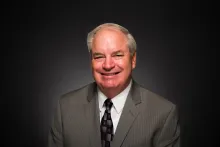
Robin Webber was born in Chicago, Illinois, in 1951, but has lived most of his life in California. He has been a part of the Church of God community since 1963. He attended Ambassador College in Pasadena from 1969-1973. He majored in theology and history.
Mr. Webber's interest remains in the study of history, socio-economics and literature. Over the years, he has offered his services to museums as a docent to share his enthusiasm and passions regarding these areas of expertise.
When time permits, he loves to go mountain biking on nearby ranch land and meet his wife as she hikes toward him.
