
Isaiah 3 and 4
Given on
Given in
Downloads
Downloads
To download a file, right-click (or long press) a link above and choose Save As.
This sermon continues the Isaiah series with Chapters 3 and 4. The setting and time frame for Isaiah 2-4 where God brings to nothing all ungodly ways and governments of this world in establishing and exalting His Kingdom, causing the nations to “flow” to Him. The prophecy of Isaiah 2, Isaiah 3 and Isaiah 4 constitutes one continued message with the timeframe being “The Day of the Lord” or just prior to the return of Jesus Christ.
Transcript
This transcript was generated by AI and may contain errors. It is provided to assist those who may not be able to listen to the message.
Today we're going to turn our attention to Isaiah chapters 3 and 4. I'd like to give you a little bit of a setting for chapters 3 and 4, and a timeframe for chapters 3 and 4. In chapter 3, we see, to me, a very interesting set of scriptures that, to me, again, just seem like they have been torn out of today's news. As we work our way through chapter 3, I think you'll find that you probably see the same thing. In chapter 3, it's a rather severe chapter. It's one of those kind of chapters that's hard to work your way through because of the severity of what is said. But God does bring to nothing all ungodly ways, all ungodly governments in this world to establish His kingdom, causing the nations to flow to Him. So before the really good news, there are some bad news, and we'll be looking at that today. Let's take a look over here in Isaiah chapter 2 to begin with. Get a little bit of context here. If you want to look at the timeframe, Isaiah chapter 2, verse 2, Now it shall come to pass in the latter days. So this is an end-time prophecy that we're seeing here. Verse 11, chapter 2, The lofty looks of men shall be humbled, the haughtiness of men shall be bowed down, and the Lord alone shall be exalted in that day. The phrase, in that day, is also a phrase representing end-time events. But it's also connected to something here in verse 12. For the day of the Lord, we understand the day of the Lord to be that very last year prior to the return of Jesus Christ. So the day of the Lord and in that day are phrases that are used here together. So it helps give us a timeframe. We look over here now to chapter 3, which we'll be getting into in just a moment, Isaiah chapter 3 and verse 7. In that day, we see the same timeframe being spoken of, and in chapter 4 of Isaiah, verse 1, and in that day. And in verse 2, in that day. So we see, as you take a look at this, that chapters 2, 3, and 4 of Isaiah constitute one continuous message. The timeframe is the day of the Lord, just prior to the return of Jesus Christ. What is the day of the Lord? In the broadest sense, the day of the Lord is a time when God the Father, Jesus Christ, intervened in world history to establish the Kingdom of God. That's a whole year period, then the Kingdom is established. I'd like to have you turn over before we get into Isaiah more. Let's turn over to Acts chapter 3.
Acts chapter 3 and verse 21.
Now let's start in verse 20. Acts chapter 3 verse 20. And that he may send Jesus Christ, who was preached to you before, whom heaven must receive until the times of restoration of all things, which God has spoken by the mouth of all the holy prophets since the world began. A time of restoration. Now as bad as Isaiah chapter 3 is, how severe it is in terms of its prophecy, chapter 4 is a wonderful discussion about the world tomorrow, beginning. It's a wonderful discussion that we like to hear at feast time. I don't know about you, but when it comes to the feast, I feel a little cheated. During the feast, I don't hear good quantities of the book of Isaiah being quoted. So here we're looking at the fact that in chapter 4 of Isaiah, we've got this restoration being spoken of. Now it's interesting the way God has packaged this. Let's go back to Isaiah again. Chapter 2.
Isaiah chapter 2. Here we have one of the most loved sections of Scripture in all of the Bible. I'm sure you have read this on so many times you couldn't even number them. Isaiah chapter 2, starting in verse 2.
People finally beginning to have an opportunity to understand God's truth in great numbers. Verse 3.
There's a desire. So here we have in that section of Isaiah a wonderful picture of what the future has in store for us. We go through chapter 3. Just as we heard in the sermon, just as Joseph had to go through his share of trials to learn various lessons, at the other end came some very marvelous blessings. So bracketed between Isaiah chapter 2 and Isaiah chapter 4, verses 2 through 6 again speak very powerfully about the world tomorrow. So you've got good news, you've got kind of a wake-up call, you've got more good news. So getting back now to chapter 3 of Isaiah, there's an overarching concept that we see in chapter 3 of Isaiah. And that is that God will clear the wreckage of his people's sins, the consequences of sin, so that he can build the world tomorrow. Got a couple examples from history for us today. I got both of these from Wikipedia. Quoting the first one, it says, Shortly after September 11, 2001, 9-11, Governor of New York George Pataki wrote a letter to Secretary of the Navy Gordon England, requesting that the Navy bestow the name New York on a surface warship involved in the war on terrorism, and now under the victims of 9-11. In his letter, the Governor said he understood state names were reserved for submarines, but he asked for special consideration so the name could be given to a surface ship. The request was approved on August 28, 2002. Symbolic amounts of steel salvaged from the World Trade Center after it was destroyed on September 11 were used in the construction of the USS New York. Specifically, that steel was put into the bow of the ship, the leading edge of the ship. In addition, the One World Trade Center, also known as One WTC, or the Freedom Tower, and again this is a quote from Wikipedia, is the main building of the rebuilt World Trade Center complex in Lower Manhattan, New York City. The Freedom Tower is the tallest building in the United States, the tallest building in the Western Hemisphere, and the sixth largest in the world. The super-tall structure has the same name as the North Tower of the original World Trade Center, which was destroyed in a terrorist attack on September 11. The new skyscraper stands in the northwest corner of a 16-acre piece of land. So again, we see that out of the rubble that we have witnessed, that we have seen, at least on television, that out of that rubble, things have progressed. Now, things have progressed in a worldly way, but things have progressed. We see the same analogy taking place here in Isaiah chapter 3 and chapter 4. We know from prophecy, before the world tomorrow starts, before the return of Christ, there's a lot of things that have to happen. And we see some of those things just jumping out at us from our newspapers today, our various news sources today. So let's now turn our attention to Isaiah chapter 3. Isaiah chapter 3. Isaiah chapter 3 talks about the judgment or the punishment on God's people. Again, as we go through this, brethren, you think about what you're reading in your local newspapers, you're watching on TV, national news, and so forth. Again, the context, let's take a look, forgive me for going back one last time here, to Isaiah chapter 2. What is the context for chapter 3? Isaiah chapter 2 and verse 12. For the day of the Lord of hosts shall come upon everything proud and lofty, upon everything lifted up, and it shall be brought low.
Dropping down to verse 17. The loftiness of man shall be bowed down, the haughtiness of men shall be brought low. The Lord alone will be exalted in that day. But the idols he shall surely abolish. Dropping down to verse 20. In that day a man will cast away his idols of silver and his idols of gold, which they have made, each for himself to worship. To the moles and the bats. You know, just get rid of those things. They are of no value. To go into the clefts of the rocks and the craigs of the rugged rocks, from the terror of the Lord and the glory of his majesty, when he arrives to shake the earth mightily. When he arrives to shake the earth mightily. So here we see the background now for chapter 3. Verse 1. For behold, the Lord of lords, the Lord of hosts, takes away from Jerusalem and from Judah the stock and the storm, the whole supply of bread and the whole supply of water. So there's coming on the land, famine. There's coming on a land, dare I say, an imposed fast. An imposed fast. Our nation is not fasting to draw close to God. But God is going to humble, as we saw there in chapter 2. God is going to humble our people with an imposed fast. You know, people won't just be able to go to the grocery store and pull off whatever they want from the shelves. You know, there are other prophecies. I just don't have time to go through all of those right now to talk about how our earth will be like iron. Things simply won't grow. Simply won't grow because God is getting our attention. Now, one of the things that, as I was reviewing some notes I had on Isaiah, I was reviewing some sermons by Dean Blackwell. Mr. Blackwell, in this section of Scripture, was talking about a need to understand how God works with prophecy. Mr. Blackwell was saying that sometimes the time element changes very quickly when it comes to prophecy. Sometimes the prophet is talking about his day and time. Then he jumps ahead. Then he comes back. Sometimes there's a matter of duality involved. And so people simply don't, as a general rule, unless God is working with their minds, people just don't understand prophecy. Why don't people understand prophecy? I want to take a little bit of a digression here and get into that just for a few moments. Why don't people understand Bible prophecy? Reason number one is they don't have God's Holy Spirit. It's not their fault. God's not called them yet. There are very brilliant people out there who write amazingly good commentaries. They're not converted. They're bright, brilliant people. They've got their PhDs and so on and so forth. But they don't have the view that you do. Why are you and I so different? Are we better? No. We're the weak of the world. We're different because God has called us. Let's take a look at 1 Corinthians. Put a marker here in Isaiah. Let me do the same thing. Let's go to 1 Corinthians 2.
1 Corinthians 2. If we don't have God's Spirit, if we don't have God's mind, we can't understand the Word of God. 1 Corinthians 2, verse 9. But as it is written, I has not seen nor ear heard, nor has entered into the heart of man the things which God has prepared for those who love Him. But God has revealed them to us through His Spirit. For the Spirit searches all things, yes, the deep things of God. So mankind, of and by himself, can't understand prophecy. He doesn't understand the keys to prophecy because man does not have God's Holy Spirit. A second reason people don't understand prophecy. They don't understand because they don't obey God.
And again, we're not talking about issues of their fault. God has not called them at this point. They don't have God's Holy Spirit because they're not obeying. Acts 5, let's turn there. Acts 5, verse 32. We grew up, spiritually speaking, on verses like this. Acts 5, verse 32. And we are witnesses to these things, and so also is the Holy Spirit whom God has given to those who obey Him.
Who obey Him. A third reason, and I'm not saying this is an exhaustive list of reasons, but a third reason people don't understand prophecy is because they have not been able to seek out the whole counsel of God. Since we're here in the book of Acts, Acts, chapter 20, Paul, you're talking to a group of elders, his last time working with them. He knows he's heading to his death. He senses this. And as he's talking to this group of elders, notice what he says here in chapter 20, verse 27.
So people don't understand prophecy because they don't have God's spirit. They don't have God's spirit because they don't obey God. They don't obey God because in large measure they've not been taught or understood the whole counsel of God. There are people who simply reject the book of Revelation. Say, it can't be understood. It can't be known. And unless you understand that book, and this group has been fortunate, Mr. Faye went through that book with you in great detail back in the day. You can go on our website, the local Chicago website, and go through his messages.
You have very... you've got tools. We've gone through the book of Daniel, two of the most important books for us to understand the flow of prophecy. Daniel talking about prophecy in the early days of man. As the book of Daniel goes forward, there's less and less material about our day-to-day.
Revelation is at the other end of the bookends, where when you go back in a time, Revelation doesn't say very much, but as you get closer to the end of the age, more is happening. It's like two wedges. Lot and Daniel, nothing much toward the end of the age. Revelation, not much at the beginning of time, but a lot at the end of the age.
Show that together, they really complement one another. You understand those things, but the people of the world don't. Again, we don't say that because of who we are. As Paul said in Romans 5, it is by the grace of God that we stand. The grace and the mercy of God. So let's go back now to Isaiah chapter 3. Isaiah chapter 3 verses 2 and 3. The mighty man and the man of war, the judge and the prophet and the diviner and the elder, the captain of 50 and the honorable man, the counselor and the skilled artisan, and the expert and chanter. We don't have those people anymore, Isaiah is saying. God is removing top leadership from all walks of life.
Brethren, think about that in terms of the news you view every day. Where are our elder statesmen who know how to cut deals with various foreign dignitaries? Where are the great men of state? Where are the great presidents that once upon a time we had, and now we don't seem to have great presidents anymore? Great generals, where are the George Pattens? Where are the Douglas MacArthur's? Where are the judges who are concerned about how to properly interpret the law? Today, we see more and more of the activist judge. We see more and more, brethren, a lawless society. When I say lawless, we're not just talking about criminals. We're talking about people who simply ignore the laws of the land.
I grew up in a sanctuary city, Detroit, Michigan. I believe, is Chicago a sanctuary city? Yeah. We have politicians today who have telescoped what the federal government was wanting to do. They were going to come and arrest numbers of people, but in this one particular case, a politician said, they want to warn you. They're coming after you. Of course, this individual thought they were doing right. They thought they were doing well. But a number of those that were going to be arrested were people who were murderers and rapists and gang members and so forth.
But they got their warning and they fled. A lawless city, a lawless state. Brethren, as your pastor, we love one another. We are family here. We have been discussing these kinds of prophecies for generations now. Many of you in this room are a part of a third or fourth generation of the church. Things we used to say, these are coming, they're now at the door.
And what is the purpose of prophecy? The purpose of prophecy is so you and I, so all of us as individuals, we get our act together. Where are you? Where am I? Do you have your act together? Do I have my act together? Where is the foundation?
Do we have a solid foundation? These are questions not just for Passover time. These are questions for all times. And especially, brethren, again, as your pastor who wants the best for you.
When you look at end time prophecy, yes, you see the bride making yourself ready. You see wonderful examples of people overcoming. But you also see where Christ said, when I come, will I find the faith on the earth? We look into Matthew 24 and it talks about the love of many. And that's a section talking about the church, the love of many growing cold. We look at a Laodicean atmosphere. You don't want that for yourself and you don't want that for your brothers and sisters who you love so dearly.
So chapter 3, as we're looking at here, is a difficult chapter to read. But it should be a wake-up call to each and every one of us to make sure that we have our act together. Isaiah 3, verse 4. I will give children to be their princes, and babes shall rule over them. I will give them children. Now, do we really have 10-year-olds running the government? No. The concept here regarding children means people who are immature, inexperienced, and incompetent.
Do we have that in our society today? Do we have people running the show, so to speak, who are immature, inexperienced, incompetent? Do we have babes in positions of authority running government, at various levels of government? In my study Bible at home, not in this Bible, but my study Bible at home, there's a little note next to the word babes. In the margin, it says capricious ones. Capricious ones. Looking at dictionary.com, the word capricious is defined this way. Subject to, led by, or indicative of sudden and odd notion, or unpredictable change. Eradic. Do we see that in society today? Sudden, odd notions, unpredictable changes, erratic behavior.
People talk about wanting various things. They don't give us direction as to how we pay for those things. People are wanting to make sure they say whatever it takes to stay in office or get in office. These are our leaders.
Daniel 4. If you don't want to turn here, I'll read it for you. Daniel 4, verse 17.
This decision is by the decree of the watchers and a sentence by the word of the holy ones, in order that the living may know that the Most High rules in the kingdom of men, and gives it to whomever he will, and sets over it the lowest of men.
That's what we have today. God setting over us some of the lowest of men and women. Isaiah 3, verse 5. The people will be oppressed, everyone by another, everyone by his neighbor. The child will be insolent toward the elder, the base toward the honorable. So exactly everyone here expressing or seeking selfish advantage, selfish gain, a state approaching, almost anarchy. As I said a moment ago, a lawless society. You know, brethren, the world is watching what we are doing here in America. There's only going to be so long the world's going to say, you know, we don't want them as the leader of the free world. We need to have better leadership than this. As they watch what's happening in our country, as they see mob violence, as they see people who should be respected. You know, God put them in office. They should be respected. Whether we agree with them or not, God put them in office.
You respect the office. You may disagree with the individual, but God put them in the office. And yet today, we've got people who walk into a restaurant. You may have somebody sitting there eating a meal, and people walk in and say all sorts of mean things, name-calling, and so forth.
If you're a conservative and you want to speak at a public institution, like a university, you're shouted down.
You know, our Constitution authorizes the expression of free speech. But not the kind of free speech we're seeing today, where our leaders are saying that they should be uncivil toward this group or that group.
Again, the unraveling of society. Verse 6, When a man takes hold of his brother in the house of his father, saying, You have clothing, you be our ruler, and let these ruins be under your power. Notice the way that's phrased. Let these ruins be under your power. So what's happening? What is Isaiah saying back in his day that he foresaw God was inspiring him to foresee? The people turning to those who appear outwardly successful. They don't have character. They don't have character because they've abandoned the principles you find in Scripture. But they look good. They look good to the voter. They say the right things. They don't have any more experience. Again, they're immature, inexperienced, and competent. They lack real value. They lack real substance.
Verse 7, In that day, he will protest, the one who looks so good, he will protest, saying, I cannot cure your ills. I can't drain the swamp, for in my houses neither food nor clothing do not make me ruler of the people. So those who might actually have some ability don't want to be in office. Look what's happened recently in our Supreme Court discussions with Brett Kavanaugh.
Verse 8 and 9, For Jerusalem stumbled, and Judah has fallen, because their tongue and their doings are against the Lord, to provoke the eyes of His glory, to look on their continents' witnesses against them, and they declare their sin as Sodom. They do not hide it, woe to their soul, for they have brought evil upon themselves.
So here we have a situation where Isaiah is talking about how ungodly lifestyles are depicted as being okay. That's the way to go. What is Hollywood doing to our nation? They're making it sound like one or two percent of the nation is 98 percent of the nation. If you watch any TV at all, you see all the various scenarios. You know, a household where there's two moms or a household where there's two dads.
A number of you do homeschooling because of what you fear will be taught to your son or daughter in school. Where they are forced to write essays about why those sort of relationships are a good thing. And we have better be on our toes as moms and dads because Satan is coming after our kids. He's been doing that for a long time, but he's really, as we see here in Isaiah, he's upping the ante here a great deal. Verse 10, Say to the righteous that it shall be well with them, for they shall eat the fruit of their doings. Woe to the wicked, it shall be ill with them, with him, for the reward of his hands shall be given him. So in your notes, I'm not going to turn, and you know, this might jot down Galatians 6, verses 7 and 8. Galatians 6, verses 7 and 8. We reap what we sow. If we're true to God, we get the blessings. If we're not true to God, we receive the curses.
Good decisions bring about good results, bring about the opportunity for a future good opportunity. Bad decisions bring bad results, and your opportunities in the future are lessened. Because you've made a bad decision in the past. Verse 12. As for my people, children are their oppressors, and women rule over them. O my people, those who lead you to cause you to err and destroy the way of your paths.
You know, I'm a Detroiter, born and bred. I was not born in a suburb, I was born in Detroit. And I remember, I was born in 1952. What am I allowed to say you'll find amusing? You'll probably say, Mr. D, you're out of your mind. But back in the early 1950s, when the great numbers of people from the South, from various southern states, were coming up north for work. The factories in Detroit were just really pushing out product, and they needed more and more labor. So from various states, people in the southern states are coming up to Michigan, to the Detroit area, to work in the factories. Back in the 1950s, this is what you might find amusing, Detroit was called the Paris of the Midwest. See, you don't believe me. I'm not insane, but that's what Detroit was called back in those days. The Paris of the Midwest. The year I was born, the population of Detroit was close to two million people. Today, less than 700,000. Detroit has lost two-thirds of its population.
When I was born, Detroit was the fourth largest city in this country. Today, it's the 23rd largest city. Why? I can tell you why. Year after year, the vote came in for more and more incompetent, inexperienced people. They looked good. They said the right things. And it's led that city to disaster.
Now, again, as a native son of Detroit, it just grieves me. I mean, I've got relatives that live in one part of the city that in the wind world I could afford. Lakeshore Drive. You know, where the old money is. Multi-multi-millionaires. Beautiful homes. Great homes. But within a couple of miles of that section, you go to another section, and it looks like part of World War II Europe that's been bombed out.
All because of poor leadership.
Verse 13, chapter 3, verse 13. The Lord stands up to plead and stands to judge the people. Notice, it says here, the Lord stands up. Time for sitting around is gone. Time to stand up and to do something. Verse 14, the Lord will enter into judgment with the elders of His people and His princes. For you have eaten up the vineyard, the plunder of the poor is in your houses. What do you mean by crushing my people and grinding their faces of the poor, says the Lord of Hosts? Seen any of that lately? Were the ruling, whoever's running the city or the state or whatever, plundering the poor? Has Social Security, which so many people depend upon, has that been plundered? Have high taxes that we've paid been wasted? Has there been fraud? Have there been kickbacks? Have those who rule over us decided they can have world-class health care but you can't?
Have the people's faces been ground into the dirt? Sure has. Verse 16, Moreover, the Lord says, Because the daughters of Zion are haughty, and walk with outstretched necks and wanton eyes, walking and mincing as they go, making it jingling with their feet, therefore the Lord will strike them with a scab, the crown of the head of the daughters of Zion, and the Lord will uncover their secret parts. Here's talking about the daughters of Zion. Is it just talking about women? I think not. I think not. I think the overview here is talking about men and women, prideful, materialistic, self-indulgent. We see various things being stripped away from them, verses 18 and on. But the daughters of Zion can stand for a couple of things. It's talking about the daughters of Zion. A daughter is one who comes from a mother and father. It's down the road. And so we're looking at down the road in history. Daughters also represent, secondly, the descendants of Israel. We're looking at Ephraim. We're looking at Manasseh. Ephraim, a company of nations. We understand that. We understand those nations. Manasseh, United States. In addition, other daughters would be France and Switzerland and Belgium, the Netherlands, Ireland, Denmark, Sweden, Finland, Norway, Iceland, the modern state of Israel. Daughters.
I want to drop down now to verse 24. Verse 24. And so what shall be, instead of a sweet smell, there'll be a stench. Instead of a sash, a rope. Instead of a well-set hair, baldness. Instead of a rich robe, greeting of sackcloth. And your branding instead of beauty. So here we see the fruits of sin.
And God dealing with a sinful group of individuals and nation. Verse 25 and 26. Your men shall fall by the sword, talking about World War III, and your mighty men in the war. Her gate shall lament and mourn, and she shall be desolate, shall sit on the ground.
Of course, we know all sorts of prophecies about that as well. Chapter 4. Again, Chapter 2, 3, and 4. Same background, same time setting. All one basic sermon here.
In that day, seven women shall take hold of one man, saying, We will eat our own food, and wear our own apparel. Only let us be called by your name to take away our reproach.
What's happening here? Well, I guess we can summarize that perhaps because of the Great War, there are very few men left. Very few men left. And notice what it says there at the beginning of verse 1. In that day, end time prophecy.
Very end of the age. Seven women taking hold of one man. Bar being very low. Being very low in those days.
Women are not expecting very much. There's not much to expect in those days.
Now, so much for the bad stuff. We've heard plenty of it, right? We've heard a lot of it. We've heard a lot of it. We've heard a lot of it. Now, so much for the bad stuff. We've heard plenty of it, right? In chapter 3, beginning here, chapter 4. Remember the bookends. Isaiah chapter 2, verses 2 through 4. Wonderful discussion about the world tomorrow. Now, starting in verse 2 here, we also have the same thing. A discussion about where we're going positively.
Verse 2, In that day, The branch of the Lord shall be beautiful and glorious, and the fruit of the earth shall be excellent and appealing for those of Israel who have escaped. So the branch of the Lord here is a dual reference. Number 1 refers to the earth now beginning to yield the fruit as God begins to take away the curse, and also the branch represents Jesus Christ. The family of David yielding spiritual fruit. In your notes, you might want to write down Jeremiah 23.5, Jeremiah 23.5, and John chapter 15 verses 1 through 8. And notice, end of verse 2, For those of Israel who have escaped. We've covered this in the past. I don't need to cover it again. I'll just simply give you the notation Amos chapter 5, verse 3 and 4, where it appears only 10% of those people who go into the great tribulation day of the Lord, only 10% come out the other end alive. Nine people out of 10 will not survive the great Holocaust at the end of the age. Verse 3, As you'll come to pass that he who was left in Zion and remains in Jerusalem will be called holy, everyone who is recorded among the living in Jerusalem. Now, there may well be two different ways of us looking at this verse as well.
Talking about those who will be called holy. God's people, physically, are holy people. We're called out. It doesn't mean we're sinless. We're called out.
In the world tomorrow, as the millennium begins, those who have survived, as we see in verse 2, as they begin to take hold of the ways of God and incorporate those into their lives, as they begin to worship God properly, getting rid of the false religion and so forth, they could be called holy.
They can be called holy. But there's another way that this can be viewed.
I want to take a look at the Brown Driver and Briggs Hebrew and English lexicon here, talking about this section of Scripture, talking about those who are recorded among the living. Recorded is the word we're focusing in on here. It's Strong's number 3789. Strong's number 3789. All those enrolled, Brown Driver and Briggs says, all those enrolled. That is, appointed unto life. Appointed unto life, or more explicitly, then Brown Driver and Briggs gives a verse reference, which I would like to turn to. Here's what Brown Driver and Briggs thinks another aspect of this could be. Let's look at Daniel 12.
Well, going the wrong direction of my Bible here. Daniel 12.
Brown Driver and Briggs says, let's look at the first three verses here. At that time, Michael shall stand up, that glorious prince who stands watch over the sons of your people, and there shall be a time of trouble, such as never since there was a nation, even to that time. At that time your people shall be delivered, everyone who is found written in the book. Time stamp here, unto the age. Notice at the end of verse 1, people being delivered who are written in the book. What book are you written in? You're written in the book of life. And many, verse 2, and many of those who sleep in the dust of the earth shall awake.
Some to everlasting life, later on. Some to shame and everlasting contempt. I've added the words later on. And so verse 3, Those who are wise shall shine like the brightness of the firmament, and those who turn many to righteousness like the stars forever and ever. So Brown, Driver, and Briggs tend to think that what we're looking at in chapter 4 of Isaiah, verse 3, is also resurrected saints.
Resurrected saints.
Those not converted people into flesh, but converted into spirit.
Verse 4, Isaiah 4, 4, When the Lord has washed away the filth of the daughters of Zion, and we saw that big time in chapter 3, a washing away of the filth of the daughters of Zion, and purged the blood of Jerusalem from her midst by the spirit of judgment and by the spirit of burning.
God's burning out the things that don't need to be there. And again, something for you and I to consider, where are we in all of this? What needs to be burned away from our lives?
Verse 5, Then the Lord will create above every dwelling place of Mount Zion, and above her assemblies a cloud and smoke by day, and is shining the flaming fire by night. Wow! What does that put you in mind of? Beginning of the millennium. A need for leadership. A need to be able to follow. God gives the people what we saw in Exodus 13. Let's turn back there. You know where we're going. Exodus 13.
Exodus 13, verse 20. So they took their journey from Succoth and Campton, Ethem, at the edge of the wilderness. And the Lord went before them by day in a pillar of cloud to lead the way, and by night in a pillar of fire to give them light. So as to go by day and night, He did not take away the pillar of cloud by day or the pillar of fire by night from before the people.
What was God doing in ancient times here in the book of Exodus? And what will He be doing in the world tomorrow? God will be leading the people, giving light so they would understand and would not fall, giving a cloud to give them shade.
Interesting that we see that taking place in the world tomorrow, where you and I are aware that this will be taking place in the world tomorrow.
Well, it's going to take place, and we see that in chapter 4 of Isaiah.
Isaiah 4, verse 6, And there will be a tabernacle for shade in the daytime from the heat, for a place of refuge, and for a shelter from the storm. So this future age is pictured by observing God's feast of tabernacles. People want to say, we don't need those days anymore. Oh, really? God seems to think we need them. They're going to be there in the world tomorrow. That pillar of cloud and fire are going to be there in the world tomorrow, to be there for leadership and all sorts of other things.
But also, think about this, brethren. Think on this. A tabernacle represents a temporary dwelling.
The Millennium, as good as it is, as good as it is, is not our final destination.
Revelation 21 and 22 talk about a new heavens and a new earth. That won't be temporary. That won't be just a thousand years.
Now, I want to show you something. As I was thinking about this, a little trip down memory lane here, how many of you remember the New World News? Remember this? I'm surprised that the hands aren't going up. In our booklet, The Wonderful World Tomorrow, what it will be like, this was an insert. Now, there's a little bit of a story behind this particular copy. When I was an ambassador of college my senior year, which was 1974, I found out that we had a department called the Archives. I never knew we had such a thing. It so happened that one of my best friends was running that department. So he said, hey, Randy, why don't you stop by? I want to show you something. And so I walked over, and now I can't even remember what building it is or where it was, but it wasn't a terribly big room. But in that room, we tried to have three copies of everything we had in print. And I don't know how many years in the rears we went back and that sort of thing, but he said, well, what would you like to have? You know, you're a senior, you're about to go head back to Detroit. What would you like to have? I said, well, I don't know what's available. He said, would you like to have something that was Mr. Armstrong's? I said, I'd love to have something that was Mr. Armstrong's. I said, what can I have? He said this. That was his personal copy. I snatched that thing right up. When you come and visit us in our home, I'll show you a picture of a very young, skinny, Randy D'Alessandro shaking her, but Armstrong's hand, and grabbing my diploma. I wanted to grab that thing fast before they realized what they were doing. But you know, you look at this in this whole, it's a mock-up of a newspaper that we would see in the millennium. Millions hail King of Kings, an awesome demonstration, Christ praised by a million-voiced choir of angels. Somewhere in there, we've got to have our Chicago choir. Kings of many nations in humble prayer.
World That Was, another headline, World That Was, science students progressing in unlearning courses.
Total disarmament achieved. Talking about how scrap metal from the wars were used to build farm implements, and the leading manufacturer of farm implements was a company in Germany called the Krupp, who, if you know anything about, or if you've read the book, The Arms of Krupp, you know they were one of the great builders of weaponry in Germany. Weather and revolution for the better. There's a weather report back here. High 85, low 65, rain and dew season. Cool breezes all day long. Worldwide, rain in Sahara, sun in Siberia. Cool breezes throughout the tropics.
You know, I wish I had a copy of this to give to all of you. Maybe there's some way I can do that. But it's just, you know, they talk about migration to the farms continuing. Jew, Arab, animosity overcome. Gather for the festival of trumpets. One little blurb here. Tragedy narrowly averted. Two young people were saved from committing a serious sin recently. When a washful concerned spirit ruler and a great family of God halted them on the brink of making serious mistakes.
We won't get into any more of that. And of course, more on the inside. Farm labor surplus. King David appoints Jew to have a Syrian farm influence factory in the rural district. Formerly the crop works. I've made mention of that. India producing a bumper wheat crop. Revolutionary Zoo opens doors in East Africa. You know, this is the good news. This is what we're working toward. Unfortunately, brethren, before we get to this, we've got Isaiah chapter 3 to get through. And I'm hoping, brethren, that you and I, all of us, will be there to be a part of this. When I think about what God has planned in the future, the wonderment of what God has in mind. The abilities that you'll be given as a spirit being. The fact that you'll be able to make a real difference. The trials you're going through right now. You pray real tears. You've got real heartache. We all have gone through those things.
Today is a little bit of an anniversary for me. Three years ago, I was able to come back to church after two months of staying away because of my open heart surgery. I was gone from services for two months, recovering. But three years ago today, I was able to go back to church. I didn't like being away from church. I didn't like being away from my brothers and sisters. It was a full feeling. Those of you who have been there, you understand that. Those of you who have had the miss of feast. I was scheduled to run the feast in Wisconsin Dells that year. Well, that didn't happen.
2015, other things happened for others of you in this room. But let's make it a point to be there. Tough times are coming. Tough times in many ways are here. But worst times are coming. Let's make it a point. Let's make it a point to make sure we never let go of the hand of God, the hand of our elder brother, Jesus Christ.
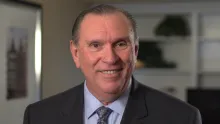
Randy D’Alessandro served as pastor for the United Church of God congregations in Chicago, Illinois, and Beloit, Wisconsin, from 2016-2021. Randy previously served in Raleigh, North Carolina (1984-1989); Cookeville, Tennessee (1989-1993); Parkersburg, West Virginia (1993-1997); Ann Arbor and Detroit, Michigan (1997-2016).
Randy first heard of the church when he was 15 years old and wanted to attend services immediately but was not allowed to by his parents. He quit the high school football and basketball teams in order to properly keep the Sabbath. From the time that Randy first learned of the Holy Days, he kept them at home until he was accepted to Ambassador College in Pasadena, California in 1970.
Randy and his wife, Mary, graduated from Ambassador College with BA degrees in Theology. Randy was ordained an elder in September 1979.
playlist
