

Don Ward
This transcript was generated by AI and may contain errors. It is provided to assist those who may not be able to listen to the message.
In 1989, my wife and I had a trip of a lifetime. As they say, we were able to visit Jordan and also Israel. That trip at that time, we had several ambassador students who were participating in education projects in Jordan. Basically, in Jordan, the king, the monarchy, is in control of the education programs and the health care programs. We were able to visit the various projects and also to, quote, rub shoulders with the royal family. At that time, the brother of King Hussein, Prince Hassan, was the crown prince. The crown prince is the one next in line to inherit the throne after the death of the king. That was instead of his oldest son, Aptela, who eventually did become king. That was because of shaky world conditions at that time. In 1992, he then designated his son, Aptela, to be his successor. We were able to attend teas at Prince Sharvath's home and other activities during that time. Of course, one of our most interesting trips was a trip down to Petra. In the near future, I hope to give a more detailed description and sermon Bible study on Petra itself. But today, we're going to focus more on the nation of Jordan. The tiny nation of Jordan is one of the most strategically located nations in the world. Let's see if we can get a map of Jordan. For those of you over there, you can see right through me, can't you? Jordan is this area here. It sort of looks like a... Imagine that being the handle of a toy gun. Or you imagine that being Louisiana sort of wopsided, with this being New Orleans down here. But, anyhow, here's Saudi Arabia, Iraq, Syria, and this little silver here is Israel. And the Mediterranean Sea, Egypt, down here. So, you see up in here is the Sea of Galilee, and then the Dead Sea. Galilee empties into the Dead Sea, and the Dead Sea is dead. Probably why they call it the Dead Sea. It has no outlet for the water there. Jordan is basically dependent upon Iraq. I didn't want that. But it's basically dependent upon Iraq for its oil. So, Jordan is one of the poorer countries in the Middle East. It has a very poor water supply, and it gets its oil from Iraq. Though, here they are neighbors with Saudi Arabia. And Saudi Arabia, of course, is rich in oil. So, Jordan, in prophecy, Jordan is referred to as Ammon and Moab. Though, there might be some debate about that. So, we see that Jordan is sandwiched there between Israel, Syria, and Iraq, and Saudi Arabia to the south. Even though Jordan has been subjected to a great deal of pressure by her neighbors, her Arab neighbors, the Islamic world, she's been a moderating voice of peace and stability in the Middle East. Ethnically, most Jordanians are Arabic by descent, and religiously, they are an Islamic nation of the Sunni denomination. About 93% of the people in Jordan are Islamic, and most of those are Sunni. The Iraqi war has done very little to solve the Middle East crisis. In fact, it has exacerbated the hostilities on all sides. The so-called Palestinian problem looms larger and larger on the geopolitical scene. And, of course, the Palestinian problem is a big part of this. The 1948 war broke out, and to back up and set the stage for this just a little bit, was that basically this part of the world, the Middle East, and there's Turkey up there. Turkey was the site of the Ottoman Empire, and the Ottoman Empire extended all the way over to the Istanbul, and in World War I, the Turks, the Ottoman Empire, was defeated. And in about 1917-1918, the British basically took control of the Red Sea, Suez Canal area, and all this part of the world. And so, Israel and Jordan became a British mandate after World War I.
And in 1947, the UN passed a resolution in November of 1947, Resolution 181, that called for the creation of two states in what used to be called Palestine. That would be Israel and a Palestinian state. The Palestinians rejected that resolution, and war broke out in May of 1948, and then Israel counter-attacked, and the 1948 war ensued. Well, in that war, Israel drove basically the Palestinians out of what we call Palestine today, and many of them fled over into Jordan. Of course, some fled to other parts all over the Middle East, but there are probably a million, well, I'm sure there are a million, Palestinians living in Jordan. That is, displaced persons who fled into that area as a result of the 1948 war. And so, that has been a big problem for Jordan within itself.
According to Bible prophecy, Jordan, Moab, and Ammon will play a significant role in end-time events. So, why would such a small country have such an impact on world events, and what is Jordan's role in prophecy? Very important in germane to Jordan's role in end-time events centers on the fact that Jordan is governed by the Hashemite family. It is called the Hashemite Kingdom. The Hashemites, the royal family of Jordan, claim that they are direct descendants of Muhammad. In fact, Abdullah is said to be a 43rd cousin or 43rd in line as a direct descendant of Muhammad. After the death of Muhammad, a great dispute arose over the question of succession. And to remotely understand the Middle East, you'd have to understand a little bit about the Islamic world and the divisions therein. So, when Muhammad died in the 600s, this question of succession was of great dispute, and many bloody battles have been fought as a result thereof. There was a group who came to be known as the Sunnis, and the Sunnis, S-U-N-N-I, the Sunni, they make up about 90% of the Islamic world, with another 8 or so percent being Shiites and the other smaller groups.
Some of the other smaller groups include the Wahhabis and Saudi Arabia. They are like the Puritans of the Islamic world. And you have the Sufis in India. The Sufi brand of Islam has been instrumental in converting a lot of Hindus to Islam. The Sunnis believe that the caliph, the successor of Muhammad, should always be elected and not conferred by heredity. In other words, you didn't have to be a direct descendant of Muhammad to be the principal prophet, the iman, the one in charge. And they claim, of course, that they are the true followers of the faith. And until 1959, they refused to even recognize the Shiites as true Muslims. The Shiites, on the other hand, believe that the caliph or the iman or the ayatollah must be a direct descendant of Muhammad. And this bitter disagreement has resulted in a lot of bloody battles. The Sunnis and the Shias have been killing each other for 1,300 years. And they kill some this week. The Sunni extremists have killed dozens of Shias in recent times. And the Shias have killed dozens and scores of Sunnis in recent times. And one of the main times that they attack one another is when they're on a religious pilgrimage, going to a particular mosque to observe some kind of important event in their religion. Shias believe that the Battle of Karbala was between the forces of good and evil. Iman Hussein, grandson of Muhammad, represented good, while the Sunni caliph Yazid represented evil. And many Shias make pilgrimages on Ashura to the Mashhad el-Husan, the shrine in Karbala, Iraq, that is traditionally held to be Hussein's tomb. So, on that several times, as pilgrims have marched toward Karbala to observe the anniversary of that battle, they have been attacked. The Shias express mourning by thumping their chests, crying after they've listened to speeches on how Hussein and his family were martyred. This is intended to connect them Hussein's suffering and death. Hussein's martyrdom is widely interpreted by Shias as a symbol of struggle against injustice, tyranny, and oppression. To express remorse for not saving Iman Hussein during the Battle of Karbala in 680 AD, thousands pour into the streets while flaying themselves with chains or slicing the front of their scouts with swords and knives. And with blood streaming from their heads and backs, men of all ages dressed in white walk toward the tomb of Iman Hussein.
They interviewed a guy named Ali Mohammed, age 30, who had cut his head with a sword. He stated, this is the least we can do for Iman Hussein who sacrificed himself with his family to save the real religion. So as we look at that, you and I may not understand the religious fervor and fanaticism there and just simply dismiss it as crazy. But if we're going to remotely understand the depth of the conviction of the forces of Islam, we must realize that this is a much different war and a much different situation than the West has faced in hundreds of years. You know, going back hundreds of years ago, the Muslims marched westward and they got all the way to France where they were defeated in the Battle of Tours by Charles Martel and turned them back. They have not given up on making the world, the religion, or making Islam the religion of the world. There's really no human solution to this problem and the West tries to defeat this and tries to win the war through man-made weapons and through man-talk, but the enemy is obsessed with and motivated by spiritual powers. So there's no human solution to this. The religious fervor is reaching a boiling point in Iran under the leadership and raka's rhetoric of both the ayatollah and the president, Mahmoud Ahmadinejad. And as noted in the news items this past week, and I read that, he predicted the destruction of Israel in the future. Now the Hashemite family, the royal family of Jordan, claims to be direct descendants of Mohammed, as we mentioned, and Mohammed claims to be a descendant of Abraham through Ishmael. Now one of the ironies of this is the fact that the Hashemites, the Jordanians, are Sunnis, whereas it's the Shias who really say that you have to be a direct descendant of Mohammed to be the caliph or the chief. So let's see if we can trace the biblical origin of these peoples. First, let's consider the origin of the Arabs in Genesis chapter 17. Genesis chapter 17 and verse 18. Quickly, as you turn there, Genesis 17 verse 18, you remember the story of how God had appeared to Abraham when Abraham was about 99 years old and Sarah was passed away of women. That is, both of them were really too old to have children and told them that they would have a son, the son of promise, and through his seed, the nations of the earth would be blessed. We know that ultimately that seed is Christ, as it says in Galatians chapter 3 verses 14 through 16. But as time went on, Abraham and Sarah were not able to conceive, so Sarah said, well, maybe we should work it out. And this, of course, was human reasoning, not according to faith. It's the way of the flesh. So Abraham, why don't you take my handmaiden, Sarah, I mean, Hagar, and go into her? And he did, and she conceived, and she bare a son named Ishmael. So we pick it up here in Genesis 17 and verse 18.
There was eventually strife between Ishmael and Isaac. Isaac eventually was born, and God told Abraham to put Hagar and Ishmael away. And in verse 18, Genesis 17, and Abraham said unto God, all that Ishmael might live before you. And God said, Sarah, your wife shall bear you a son indeed, you shall call his name Isaac. I will establish my covenant with him for an everlasting covenant and with his seed after him. And as for Ishmael, I've heard you. Behold, I have blessed him, will make him fruitful, will multiply him exceedingly, twelve princes shall he beget, and I will make him a great nation. But my covenant will I establish with Isaac, which Sarah shall bear unto you at the time set in the next year.
And of course, in another place, it says that Ishmael will be a wild man, and his hand will be against every man. So here is the father of the Arabs, a son of Abraham through Sarah's handmade Hagar, his son born of the flesh and not of faith. Now, the fact that often escapes Bible commentaries is that Esau, who is Edom in Bible prophecy, intermarries with the Ishmaelites and Arabs. So let's go to Genesis 28 and verse 9, and we'll see this. Genesis 28 and verse 9. Now, after that Jacob and Rebecca were able to deceive Isaac and persuade Isaac to give the birthright to Jacob, Esau, who is Edom, fled. And of course, he was this greatly displeased, his father and his mother.
And one of the things that he did, he took a wife of one of the neighboring tribes, and I guess he was thinking, well, that displeased my mother greatly when I took a wife of one of the non-Semitic tribes. So I'll take a wife from my own kinsmen. I'm just, I don't know what he reasoned for sure. But in Genesis 28 and verse 9, Genesis 28 verse 9, then when Esau unto Ishmael, well, let's back up. I'm sorry, but we must.
In verse 8, and Esau, seeing that the daughters of Canaan pleased not Isaac, his father, then when Esau into Ishmael unto Ishmael, and took unto the wives which he had Mahalath, the daughter of Ishmael, Abraham's son, the sister of Nabalah to be his wife. So we see that Esau or Edom married into the family of Ishmael. So the Ishmaelites and Edomites are mixed. And it's interesting to note that . . . Not moving, Steve. Go back.
I don't think you can see it. Go back one more. It's interesting to note here that . . . here is Ammon up in here, the capital of Jordan. You go straight down here. Here is Petra. Petra is the stronghold, the capital of Edom. So Moab and Ammon are up here, and the Edomites are down here at Mount Seir in the area of Petra.
. . . You know, the Church of God is very familiar with Petra because for decades many have thought, well, Petra is a place of safety. Petra is the number one tourist attraction in Jordan. They have flyers all over the place. We were able to visit Jerusalem. We left Ammon one morning on a bus, went down into the Jordan Valley on the east bank, and eventually crossed the Allenby Bridge into Israel, the west bank, where we went through a vigorous security check, and then on into eventually Jerusalem.
As we were crossing the street one day in Jerusalem, I was walking beside a couple of guys, and I heard them talking and saying, well, maybe we can go over to Jordan into Petra. And, you know, that's where a lot of the Christians think they're going to go during the Tribulation. So it's a well-known fact that a lot of people think that that's where they will go, and I hope to give a sermon on this in the near future, but that is not the main topic today. But we'll take a look here. We saw Petra there on the map, and this is the Sikh that leads into Petra. This is how you get in. It's a narrow passageway with these high rock walls. Now, the Nabataeans, after the Edomites basically disappeared from history, a lot of the Edomites migrated up northward and intermarried, in fact, with the Jews, because Edom was conquered by David, and Edom paid tribute to Israel during the days of David. This is where they put the aqueducts. There's no water supply in here. This is where they put the aqueducts to bring the water in. And after you walk through the Sikh, the first thing you see is this imposing structure here. It looks like a building, but it's not. It's just carved. All of that is carved out of rock, sandstone, red sandstone. So there's really nothing but the sandstone and the carvings. Then here is the great temple, they call it. The Nabataeans were very religious, superstitious people, and they built this temple. There's one place in Petra here where they have the high place where they offered sacrifice. And if you see pictures of Petra in which you see those little caves, that's where they buried the dead, and they left a little hole there so the evil spirits could get out. As we've already mentioned, the Hashemites are descended from Mohammed himself.
King Abdullah, Abdullah II is the head of the Hashemite family, which in addition to being directly descended from Mohammed, he represents over 1,000 years of rule in the area.
Now a little more specifically about the royal family in Jordan.
Remember that after World War I, that part of the world, the Middle East, if you would go back to that map of the Middle East, that the Middle East became a British mandate. In fact, the British were over Iraq, Jordan, Palestine, and much of that part of the world. And eventually, in 1945, Jordan was able to gain independence. So Jordan became a nation before Israel did, and it was called a Trans-Jordan area. So the Hashemite family claimed to be to represent over a thousand years of the true rulership of the nation, that is, of the Islamic world. King Hussein came to power after his grandfather King Abdullah, and King Abdullah I was the first king, beginning in 1949, of modern Jordan. In 1951, King Abdullah and King Hussein, King Hussein of Jordan, who died a few years ago, went to the Temple Mount to perform their Friday prayers, and there was an assassin there, and he shot and killed King Abdullah I. And a bullet hit Hussein had on a medal that had been given to him, and a bullet hit Hussein on this medal. And this medal was what saved his life. But upon the death of Abdullah I, his oldest son, Talaal assumed the throne, and it became readily apparent that he was not able to to be the king. And so in August of 1952, Hussein was made King of Jordan.
Then, when King Hussein died, Crown Prince Abdullah, now this is Abdullah II, became king, and he is presently the king. As a ruler of the Hashemites, he's considered the chief defender of the Islamic religion and culture. This includes the Holy Sriners and mosques of Islam. In the 1967 war, Israel gained control of East Jerusalem and the West Bank.
But the Temple Mount is located in East Jerusalem. The Temple Mount, we have a little aerial sketch of it here. Can't tell much about that. The Dome, oh that's a great temple there.
Temple Mount, an aerial view, that's the Dome of the Rock, the big one, and then the Al-Aqsa Mosque down here. It's about 20 acres here, the holy shrines of Islam. Jerusalem is said to be the third most holy site in Islam behind Mecca and Medina. It was said that Mohammed ascended from Al-Aqsa, literally means the Father is Mosque, and he said that Mohammed ascended to heaven from here, the Al-Aqsa Mosque. So after the 1967 war, Israel gained control of the Temple Mount, but they left the oversight of the Temple Mount to the Arabs and Jordan in particular. So Jordan has been responsible, the nation of Jordan, for maintaining the Temple Mount and the holy shrines. They have done a lot of work in recent years to bring it up to an acceptable level.
So now let's go back and get the biblical origins of Moab and Ammon.
Remember, there's sort of a contradiction here, somewhat of a problem in the fact that the modern-day Jordanians claimed to be descended from Ishmael, from Abraham.
The Bible speaks of Moab and Ammon, and Moab and Ammon did not descend, or not the sons of Abraham, but descended from Abraham's brothers' children. So we'll notice that right now. Let's go back to Genesis 11. Genesis 11.
Genesis 11.
Abraham was called out of the land of the Chaldees. We'll go back and put that Middle East map back up there. And that land of the Chaldees was modern Iraq. So Abraham came from across the river, as it says, from what we call Iraq today. In Genesis chapter 11 and verse 27. Genesis 11.27. Now these are the generations of Terah. Terah is Abraham's father. Terah begets Abram, Nahor, Haran, and Haran begets Lot. So we see that Lot was Abraham's nephew. Abram and Nahor took them wives. The name of Abram's wife was Sarai. The name of Nahor's wife, Melchah, the daughter of Haran, the father of Melchah, the father of Ischai. But Sarai was barren and she had no children.
And Terah took Abram his son and Lot, the son of Aran, his son's son. And Sarai, his daughter-in-law, his son Abram's wife. And they went forth from Ur of the Chaldees, what is called today modern Iraq, to go into the land of Canaan. And they came into Haran and dwelt there. And then Abraham's father died.
Now, chapter 12. Now the Lord had said unto Abram, Get you out of your country and from your kindred and from your father's house and the land that I will show you.
And so he did, verse 4, Abraham departed as the Lord had spoken unto him, and Lot went with him. And Abram was 75 years old when he departed out of Haran. So Abraham takes his nephew with him when he made his final break from his family and left his homeland. Now in Genesis 13, Genesis 13, we see that eventually Abram and Lot had large herds of cattle, and eventually strife broke out between the herdmen of Abram and Lot. In Genesis 13, verse 8, And Abram said unto Lot, Let there be no strife, I pray you, between me and you, and between my brethren and your herdmen, for we be brethren.
As not the whole land before you, separate yourself, I pray you from me, if you will take the left hand, I will go to the right, if you depart to the right, I'll go to the left. And Lot lifted up his eyes and beheld all the plain of Jordan, that it was well watered everywhere before the eternal destroyed Sodom and Gomorrah, even as the garden of the Lord, like the garden of Eden, like the land of Egypt, as you came from unto Zohar. Then Lot chose him all the plain of Jordan, and Lot journeyed east, and they separated themselves one from another, and Abraham dwelt in the land of Canaan, and Lot dwelt in the cities of the plain, and pitched his tent toward Sodom. Now, you know what Sodom and Gomorrah are reflective of and represent, and obviously if you pitch your tents toward Sodom, you will eventually wind up in Sodom. And that's why so many young people wind up where they do. They began to slowly pitch their tent toward what looks like the place of glitter, glamor, and glitz. And if you pitch your tent toward that, you will eventually wind up there. God eventually makes known to Abraham that he is going to destroy Sodom, and Abraham negotiates with God for the deliverance of Lot. You know, per adventure we find 50 righteous people and so on down, and finally God agrees to spare Lot and his family.
And so Lot and his wife, his two daughters, they began to flee from Sodom before God destroys it. And scholars believe that Sodom was located in the area of the Dead Sea, which we've already pointed out. Dead Sea is in this area in here, just below the Jordan River Valley. So, in Genesis 19, let's read. Genesis 19 and verse 29. In Genesis 19 verse 29, and it came to pass when God destroyed the cities of the plain, that God remembered Abraham and sent Lot out of the midst of the overthrow when he overthrew the cities in which Lot dwelt. Remember that Lot's wife had looked back and turned to a pillar of salt. In addition to that, apparently, Lot's son-in-laws were not even interested at all in getting out, and so they didn't even start out. In verse 30, and Lot went up out of Zor and dwelt into the mountain. Supposedly, there were five cities in this area, Sodom and Gomorrah and three others, Zor being one of them. But Zor was apparently spared. It was sort of like a city of refuge, but Lot even went out of Zor and dwelt in the mountain and his two daughters with him, for he feared to dwell in Zor and dwelt in a cave, he and his two daughters. You cannot imagine the fear that came over the peoples of that part of the world when it rained fire and brimstone from heaven. And you might think, well, this city might be the next one.
So here we have Lot and his two daughters dwelling in a cave, and once again human reasoning in the flesh takes over. And the origin of Moab and Ammon is similar to the origin of the Ishmaelites. It is of the flesh. Verse 31.
And the firstborn said unto the younger, Our father is old. There's not a man in the earth. I mean, everybody's gone, but our dad did come into us after the manner of all the earth. So if human life is going to be preserved, we better get pregnant. And the only person that can get us pregnant is our daddy. Come, let us make our father drink wine. We will lie with him that we may preserve seed of our father. They made their father drink wine that night, and the firstborn went in and lay with her father, and he perceived not when she lay down nor when she arose. Lot didn't know what was going on. Came to pass on the morrow that the same thing happened. And their excuse was that we may preserve the seed of our father.
So they made the father, verse 35, drink wine that night, and the younger rose and lay with him, perceived not when she lay down nor when she arose. Thus were both the daughters of Lot with a child by their father. And the firstborn bear a son and called his name Moab. The same is the father of the Moabites under this day.
And the younger she also bear a son and called his name Ben Ami. The same is the father of the children of Ammon or Ammon under this day. And of course, you know, Ammon is the capital of Jordan.
We know from ancient history that the Moabites and the Ammonites, and we also know from the Bible, that the Moabites and Ammonites settled in the area of modern-day Jordan.
As far as these three people that we have mentioned, we've mentioned the Moabites, the Ammonites, and the Edomites. God has nothing good to say about any one of these three.
And we note that the lineage of the Ishmaelites, or the Arabs, and Esau is also, of course, of the lineage of Ishmael, in one sense, in that he intermarried, and his father is Abraham. And then we have Moab and Ammon is related to Abraham as well.
The royal family of Jordan and many Jordananians do not trace their lineage back to Moab and Ammon, but rather they trace their lineage back to Abraham. As we've already noted, the descendants of Moab and Ammon occupied the area that is called Transjordan from north of Jericho southward to the Dead Sea. And Moab and Ammon even became bitter enemies, brother against brother, and both were bitter enemies of Israel. Both resisted Israel when they were making their trek from Egypt to the Promised Land. God has nothing good to say about the Moabites, the Ammonites, or the Edomites. The only people that are more deeply cursed in the Bible than the Moabites and the Ammonites are the Edomites.
It is of great interest to note that Abraham's son Ishmael and his grandson Esau Edom wind up in the same geographic area with a common southern border, Moab to the north and Edom to the south. Now we want to go to Numbers 22, and we see a little bit of a summary of this from the Bible. Numbers 22 verse 1. Numbers 22 and verse 1.
The children of Israel set forward and pinched in the plains of Moab on this side Jordan by Jericho.
And Balak, the son of Zipphor, saw all that Israel had done to the Ammonites, and Moab was so afraid of the people because there were many, and Moab was distressed because of the children of Israel. Then Moab said to the elders of Midian, Now shall this company look up all that are round about us, as the ox licks up the grass of the fields. And Balak, the son of Zipphor, was the king of the Moabites at that time.
He sent messengers therefore unto Balaam, the son of Peor, to Bethor, which is by the river of the land of the children of the people, to call them, saying, Behold, there is a people come out of Egypt. Behold, they cover the face of the earth, and they abide over against me. Come now therefore, I pray you, curse me this people, for they are too mighty for me peradventure I shall prevail, that we may smite them, and that I may drive them out of the land, for I don't know what would become of us, and he whom you cursed is cursed. So they hired a guy to try to curse Israel, but you know that story, that he really was not able to curse Israel.
Eventually, Ammon and Moab ceased to exist as identifiable people among the tribes of the Middle East. Yet, they are spoken of often in prophecy, as if they are in existence when Christ comes again. So let's go now to Zephaniah chapter 1. Zephaniah, Haggai, Zechariah, Zephaniah after Habakkuk. The theme of Zephaniah is the day of the Lord. The literal meaning of the word Zephaniah is hidden of God. Who will God hide during the day of the Lord? is one of the questions that Zephaniah answers. Zephaniah 1 in verse 14, The great day of the Lord is near, it is near, and hastens greatly, even the voice of the day of the Lord. The mighty man shall cry there bitterly. That day is a day of wrath, a day of tremble and distress, a day of waste-ness, desolation, a day of darkness and gloominess, a day of clouds, thick darkness, a day of the trumpet, an alarm against the fenced cities, against the high towers. And I will bring distress upon men that they shall walk like blind men, because they have sinned against the eternal, and their blood shall be poured out as dust, and their flesh is done. Neither their silver nor their gold shall be able to deliver them in the day of the Lord's wrath. But the whole land shall be devoured by the fire of his jealousy, for he shall make even a speedy riddance of all them that dwell in the land.
Gather yourselves together, yes, gather together, O nation not desired. Before the decree bring forth, before the day pass as the chaff, before the fierce anger of the Lord come upon you, before the day of the Lord's anger come upon you, seek you the Lord all you meek of the earth. This is the only verse in the Bible that I know of that just directly says, here's who will be hidden during the day of the Lord. Seek you the Lord all you meek of the earth, which have wrought his judgment. Seek righteousness, seek meekness. It may be that you shall be hid in the day of the Lord's anger.
Now we pick this up again in verse 8.
I have heard the reproach of Moab and the revelings of the children of Ammon. So here we see them appearing in prophecy in the time the day of the Lord.
Whereby they have reproach my people and magnified themselves against their border. Well, they tried to prevent Israel from going into the Promised Land, as we have read from Numbers 22.
Therefore, as I live, says the Lord of Hosts, the God of Israel, surely Moab of Ammon I'm sorry. As surely as I live, says the Lord of Hosts, the God of Israel, surely Moab shall be his Sodom. And the children of Ammon as Gomorrah, even the breeding of nettles and salt pits, and a perpetual desolation, and the residue of my people shall spoil them, and the remnant of my people shall possess them. Of course, this would tie into some who might think, well, you're going to be in Moab and Ammon, down in Petra, as a place of safety. You know, the only way you can be protected in Petra or in Houston during that time will be through God's supernatural power.
But that's not our topic, really, today. It's showing what God has to say about them. He is going to destroy them. Verse 10, This shall they have for their pride, because they have reproached and magnified themselves against the people of the Lord of Hosts. The Lord will be terrible unto them, for he will famish all the gods of the earth, and men shall worship him every one from his place, even all the isles of the nations. Then he begins to list those nations.
So is this terrible prophecy against Moab and Ammon, because of what they did against God's people in the past, or did they do something in the future? Of course, there is Psalm 83. Let's go to Psalm 83, which talks of a confederacy that comes against Israel to try to wipe them off the face of the Mount. As we've read from Numbers 22 verses 5 and 6, that Balak tried to get a contingent together that would destroy Israel before they got into the Promised Land, but was unsuccessful. Sometimes when I read Psalm 83, I think, well, maybe it's been fulfilled, and then you think, no, it's for the future. And we'll talk a little bit about that. Now, let's look at Psalm 83.
Keep not silence, O God. Hold not your peace. Be not still, O God. For, lo, your enemies make a tumult, and they that hate you have lifted up the head. They have taken crafty counsel against your people and consulted against your hidden ones. And they have said, Come and let us cut them off from being a nation, that the name of Israel may be no more in remembrance. And, of course, the Ayatollah, just as a week, said that Israel's days are numbered. Ahmadinejad has said that several times. It is to some degree the belief of the surrounding nations, many of the surrounding nations, have refused to even recognize Israel as a nation.
Verse 5, For they have consulted together with one consent their confederate against you. The tabernacles of Edom. He saw his Edom. He saw his direct descendant of Abraham. The Ishmaelites, also a direct descendant of Abraham. Of Moab, Hagarenes, Gebal, and Ammon, Amalek. The Philistines, with the inhabitants of Tyre, Asher also has joined with them. They have helped the children of Lot. Do unto them, as unto the Medianites, Do unto them, as unto the Medianites, as to Sisera, as to Jabin, at the brook of Kisan, which perished at Endor, they became as dung for the earth. Make their nobles like Orib, like Zeb, yes, all their princes as Zebai, and as Zamuna, who said, Let us take ourselves, to ourselves, possession of the houses of God. Now, when Israel was in distress and going into captivity, the surrounding nations moved into that area and tried to take possession thereof. But they were unable to do so. Amos talks about this in the very first chapter. Let's go to Amos chapter 1.
Hosea Joel Amos. Hosea Joel Amos. In Amos chapter 1, Amos was quite a story as a prophet. He was a herdsman, a gatherer of fruit of Sycamore. He was gathered figs. He was not from the school of the prophets. He was plucked right out of the working class, as it were, and made a prophet.
In Amos chapter 1 verse 2, and he said, The Lord will roar from Zion, utter his voice from Jerusalem, The inhabitants of the shepherd shall mourn, and the top of Kormel shall wither. Thus says the Lord, For three transgressions of Damascus, Damascus is the capital of Syria, and for four, I will not turn away the punishment thereof, because they have thresh Gilead with threshing instruments of iron. But I will send a fire in the houses of Huzal, which shall devour the palaces of Benedad. Benedad is like a generic name for the chief ruler, something like a Caesar. I will break also the bar of Damascus, their barriers, their fortresses, their power, cut off the inhabitants from the plain of Avon, and him that holds his scepter from the house of Eden, and the people of Syria shall go into captivity unto curse, says the Lord. Thus says the Lord, For three transgressions of Gaza, for four, I will not turn away the punishment thereof, because they carried away captive the whole captivity to deliver them to Eden. So at this particular time when Israel was in distress and being attacked, then these surrounding tribes and nations tried to come in and just literally wipe them off the face of the map. The Assyrians had come in and taken many of them captive into Assyria. Verse 7, I will send a fire on the wall of Gaza, which I will devour the palaces thereof. I will cut off the inhabitants from Ashdod, and him that holds his scepter, the king from Ascalon. I will turn mine hand against Ekron, and the remnant of the Philistine shall perish, says the Lord God. Thus says the Lord, For three transgressions of Tyreus, and for four, I will not turn away the punishment thereof, because they delivered up the whole captivity to Eden, and remembered not the brotherly covenant. I will send a fire on the wall of Tyreus, which shall devour the palaces thereof. Thus says the Lord, For three transgressions of Eden, and for four, I will not turn away the punishment thereof, because he did pursue his brother with the sword, did cast off all pity, and his anger did tear perpetually, and he kept his wrath forever. But I will send a fire upon Tyman, which shall devour the palaces of Basra. Basra was the capital of, or one of the capitals eventually of, the Edomites.
Thus says the Lord, For three transgressions of the children of Ammon, and for four, I will not turn away the punishment thereof, because they have ripped up the women with the child of Gilead, that they might enlarge their border. I will kindle a fire in the wall of Raba, shall devour the palaces thereof, with shouting in the day of battle, with the tempest and the day of the whirlwind. Their king shall go into captivity. He and his princess together, says the Lord. And it continues, Thus says the Lord, For three transgressions of Moab, and for four, I will not turn away the punishment thereof, because he burned the bones of the king of Edom into lime. But I will send fire upon Moab, it shall devour the palaces Kyriah, and Moab shall die with tumult, with shouting, and with the sound of a trumpet. And I will judge, and I will cut off the judge from the midst thereof, and will slay the princes thereof with him, says the Lord. Then it starts with Judah. What is going to do to them?
So, Psalm 83 at times, I go back in two with regard. Was it fulfilled, or is it still future? Basically, we, in the classes I've taught, and recently in the articles in our publications, we have indicated, we think it's future. But sometimes I wonder, now we go to Daniel chapter 11 verse 40, where the willful king, who is the beast power, eventually sets up his headquarters in Jerusalem. And note this very carefully, because on the one hand, if you have all of those nations trying to destroy Israel, maybe they go in first, and then the beast power comes in after that. But you'll notice here who escapes the hand of the beast power. Very interesting. Daniel 11 verse 40.
And at the time of the end shall the king of the north push at him, the king of the I'm sorry, at the time of the end, the king of the south shall push at him, the king of the north shall come against him like a whirlwind with chariots and with horsemen and many ships. Now, the king that's referred to the antecedent here is verse 36. The willful king. The king shall do according to his will, shall exalt himself and magnify himself above every god. The language from 36 through 39 is very similar to 2 Thessalonians chapter 2 verses 1 through 4, where one sits in the temple of God, claiming that he is God. Verse 41. He shall enter also into the glorious land, and that's the area we call Palestine today, Israel, and many countries shall be overthrown. Many countries shall be overthrown, but these shall escape out of his hand, even Edom and Moab and the chief of the children of Ammon. These very three that we have talked about, these very three that God has nothing good to say about, that we read about in Zephaniah 1 and 2, also in Amos 1 and 2.
These shall escape out of his hand, and he shall stretch forth his hand also upon the countries, and the land of Egypt shall not escape. So it's not just an Islamic thing, because Egypt is Islamic, and he shall have power over the treasures of gold and silver.
Of course, the Middle East is the richest area in one sense of the world today, because of petroleum reserves. Not that they hold the most gold and silver in the world. They don't, but they hold the key to the future of the world, unless Obama and many others follow through on what they said in the State of the Union message. We're going to open up offshore drilling and a lot of other things.
He shall have power over the treasures of gold and silver over all the precious things of Egypt, and the Libyans and the Ethiopians. Of course, Libya is on the west side of Egypt, Ethiopia on the east side. All that shall be at its steps. But tidings out of the east and out of the north shall trouble him. Therefore, he shall go forth with great fury to destroy, and utterly to make away many. And he shall plant the tabernacles of his palace between the seas, the Mediterranean Sea, and the Dead Sea.
Jerusalem is in between the two. In his glorious holy mountain, in the glorious holy mountain, yet he shall come to his end, and none shall help him. So, what about Moab, Edom, modern Jordan? There are a lot of questions there yet to be answered. It's interesting to note that of all the nations right now in the Middle East who are Islamic, Jordan is really the only one that is what you might you wouldn't say is necessarily an ally of Israel or of the United States, but they have been instrumentally have been a stabilizing force in that area of the world, especially since in recent decades, basically throughout the reign of Hussein and now with Abdullah II.
So, Jordan is really a place to keep your eye on to watch. So, keep your eye on the Middle East. It always has been, and it will be to the very end, a focal point of end-time events. Things are really increasing in intensity in the rhetoric in the Middle East, and many of the things we have had so many divergences that captured our attention in recent times on U.S.
media that basically are domestic problems and situation in Haiti, and then the war in Afghanistan and Pakistan, which also have great implications for the Middle East. But much of what is going on behind the scenes in the Middle East today, we really don't know much about. For example, this article that I read about Panetta being in Egypt and also in Israel, and the talk that he has been conducting there. So, there are many factors to consider, and many things to look toward in the days that lie ahead.
So, hopefully we'll not be get caught up so much in our everyday activities and just trying to survive in our everyday lives. Because, especially in the past couple of weeks, as the trials have amounted in many ways, you know, just for example, and our oldest daughter was in an automobile accident about two or three weeks ago in which she rear-ended a vehicle, but she was not seriously hurt, neither was the person she hit, and she doesn't even know how she hit the person.
Then we get a call on Thursday evening, and the first thing she says, I'm calling to tell you that I've been in another wreck, and it was like her mother gasped and was ready to go to the morgue. But she said, I'm not hurt. I'm not hurt. What had happened, they were on the way home from work, she was following her husband, and the roads in Oklahoma were iced over. They were going about 20 miles an hour, and she couldn't see this vehicle. She was following her husband, but a vehicle ahead of him had gone into a slide, and it spun around doing the 180, and was coming back at them at an angle, missed him, but hit her, and he's in critical condition, and I see you.
That's just one little thing. It was a big thing, it is a big thing, but you know, those kind of things mount, and they mount, and they mount, and other kind of problems that come into our lives. And then we, what is this life all about? You know, like you'd say, anything I get above death is a gift, so what is life about in total summation of things? Life is about preparation for the kingdom of God, of being faithful to the very end, and that's what God has called us to do, and through the grace of God, that we will be.
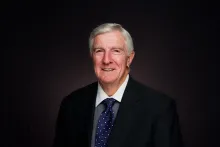
Before his retirement in 2021, Dr. Donald Ward pastored churches in Texas and Louisiana, and taught at Ambassador Bible College in Cincinnati, Ohio. He has also served as chairman of the Council of Elders of the United Church of God. He holds a BS degree; a BA in theology; a MS degree; a doctor’s degree in education from East Texas State University; and has completed 18 hours of graduate theology from SMU.
