
Robin S Webber
This transcript was generated by AI and may contain errors. It is provided to assist those who may not be able to listen to the message.
Well, we're not here to talk about ourselves. We're here to talk about the Word of God and certainly appreciate the invitation extended to us. I'm looking forward to the reception afterwards with the hills. And that is what I would like to speak to today. It's one of my favorite messages. I'd love to hopefully inspire and encourage the people of God by opening up the Word and opening up hearts, and to be able to see what God is calling us to. I'd like you to turn over to Matthew 25 for just a second to begin this message. In Matthew 25, we take a look here at what we often call the parable of the talents, the story of where the good master gives each of the servants a certain portion of talents with an expectation that they're going to do something with it. And that's one thing about God. He is not just myth. He is not just theory. He's not just a good God. He does have expectations of those that He has called. And we know the story where some of the men, some of the servants, multiplied their talents, and there was one that did not. And I'm not going to go through the entire story of the talents. That's not my point, but to point certain scriptures out to you.
And we notice here that in this story, we find a point here in the story. I'm just going to cut to the quick to get to the main point. In this story, we find four powerful points I'd like to share with you. Number one, there is a value upon what the good master gives his servants. There is a value that he valued and that he wants his servants to value.
Number two, then, we understand that there was a certain preparation that had to take place in this message. And number three, that there was a certainty of outcomes based upon what they were going to do. And that number four, then, there was going to be a future encounter. There was going to be a future encounter. Well, we know the story, basically. Let's look at verse 21 here for a second. Because this is what the master says to his servants.
His Lord said to them, Well done, good and faithful servant, you were faithful over a few things. I will make you ruler over many things. And then notice the phrase that is used. Enter into the joy of the Lord. Consider that for a moment. Enter into the joy of the Lord. Now let's drop down a couple of verses and we come to verse 23, speaking to another servant.
And his Lord said to the other servant, Well done, good and faithful servant, you have been faithful over a few things. I will make you faithful over many things. It's very interesting. If you're with me here for a second, we often stop with the thought there. If you've been faithful over little, you've been faithful over much. You've been there, I've been there in messages.
And sometimes we don't highlight as much as we need to the last part of that phrase. Enter into the joy of the Lord. And that's what I would like to center on in this message. What does that mean to enter into the joy of the Lord? What is that all about? And what does that mean to your future? Like many biblical topics, you can handle this in many, many different ways. There are many, many, many different facets of the aspect of entering into the joy of the Lord. I'm going to give a message today, and Mr. Tuck or Mr. Pabra, Mr. Taylor, somebody else will be giving a message.
I remember growing up in the Long Beach Church that a deacon type would get up and say, today I'm going to give you three reasons why David was a man after God's own heart. And they all sounded very good, and I thought that was it.
About six months later, another guy would get up and say, today I'm going to give you three reasons why David was a man after God's own heart. Well, I came to find very early on in the church there were at least six reasons why David was a man after God's own heart. Everybody approaches issues a little bit differently based upon where we're coming from. But today I want to take a particular facet of this. We're going to explore it. We're going to go into depth. We're going to talk about its meaning.
And I hope that God above will allow me to encourage you for a few minutes this afternoon about what it means to enter into the joy of the Lord. Because it deals with the preciousness of His election and our selection of us. And that it's incredible the ultimate future that He has in store for us. And so He speaks about it. He thrills us with what He wants to do with us in the future along with His Son, Jesus Christ.
Now, the entering into the joy of the Lord is part and parcel of why Susie and I are up here with you, our beloved brethren, here in San Jose this weekend. And with our friends Jonathan and Carol. They have been married. They had their honeymoon. And now this afternoon, as dear friends, we've all gathered together to celebrate and to rejoice together. This is fantastic! And we're going to talk about that because today what I want to talk about is the wedding feast. I want to talk about the wedding supper. I want to talk about what it means to be the bride of Christ. I think sometimes in doing all of this, we sometimes are asking like the old country song, we're putting all the questions in all of the wrong places or getting all the information to some things that only God will know in His time, in His way, when it comes to the wedding feast and when it comes to the wedding supper.
And so often, humanly, we can try to package God and put it, well, it's got to be here, it's got to be here, it's got to be there, it's got to be here, here, there. And that is not what God is talking about when He shares the thought of what it means to be invited to the wedding supper and into the wedding feast.
And I hope to show that point to you as we move through this message. Let's talk about that for a moment and look at it.
At many weddings, what happens is, boy meets girl, man meets woman. And we begin to go through a situation where there's dating and then there's courting, that's an old-fashioned term, older than the 50s. And we go through engagement and then there's all of the ups, the downs, the this, the that, the this, the that. Then you start preparing for the wedding and you just can't wait for this thing to be over. You want to get married, but you just can't wait for this thing to get over. Let's get it done. I do, I do. Okay, thank you very much. And then what happens after that comes the celebration. You're married. Your family is there. Your friends are there.
All of those that are near and dear are there with you at that wedding that you planned. And you have, just think about it for a moment, you have asked them to come and to be and to celebrate and to rejoice in your rejoicing. And it's so much fun and it's so incredible because now there's something that has never been before. There is now a special union that did not exist before, but now that union has come together in a holy union before God and they want us to celebrate and rejoice. Really, when you think about it in the truest sense, God reveals our future with Him. And that moment of future encounter that comes through what we call weddings, wedding ceremonies, wedding feasts. Today we're going to have a reception and there's a couple things we want to focus on. I'm going to kind of share them with you as you go along so we don't get lost, okay? That wedding supper in the future that God Almighty, our Father calls us to, there are some, do I dare say, some main players and you're one of them. Let's put them down for a moment. You might want to take a list and stay with me. Number one, there is Christ. He's the groom. Number two, there is we the bride. Guys, we the bride. And number three, there is this wedding supper. Now, there's one thing I want to share with all of you and maybe you have not thought about the wedding supper, the wedding feast, the marriage of the bride, etc., etc. For some time, I want to share something with you. God never stops thinking about it. Never stops thinking about it. There is no hesitation. There is no reservation. As He already sees that in His mind and what it's going to be like as we bring all of these parts together. So that's what we're going to focus on, the wedding of the bride, the wedding feast supper, so that you and I can understand what it means to enter into the joy of the Lord. I know just coming into the hallway this afternoon in a small semblance, and we have not seen Carol for maybe a year and a half or two years, and then to meet Jonathan again. And just to see them together as a couple. And how much we know Carol, and we're going to get to know John more. We'll see if we like him or not. No, just teasing. It was just a wonderful feeling. A wonderful feeling. And for all of you, the San Jose brethren, some of you came from the Valley, some of you came down from Oakland to rejoice with them today. That's what I want to have you focus on today, what that encounter with God Almighty, His Son Jesus Christ, and you as the bride of Christ is going to be in the future. To begin with, let's join us. Go over to Revelation 21 for a moment. In Revelation 21, and let's pick up the thought here, verses that are familiar, but now we're going to place them into this message.
In Revelation 21, 22, we find this triumphal prophetic declaration because God sees things as if they already are. And now I saw a new heaven and a new earth, and for the first heaven and the first earth had passed away. And also, there was no more sea. Now, let's remember something. The book of Revelation is written in apocalyptic form. There is imagery. There are colorful terms to describe something at times that is even greater and bigger than what is thought of in a word. We're not talking about topography or geography and draining the Pacific Ocean. We're talking about a sense that in antiquity, when this was written, seas and oceans separated people. Seas and oceans were frightening places to be on. Even the Sea of Galilee would be a frightening place to be on if one of those winds came down from the Mediterranean. Basically, people back in antiquity were coast huggers. They went along the coast until certain navigational understanding came about. Oceans separated people. Seas separated people. This is talking about a time in the future when you understand what is being spoken here, where there is going to be no more separation between God and man, man and man, man and woman. There's going to be a unique unity. Then I, John, saw the holy city, New Jerusalem, coming down out of heaven from God, prepared as a bride adorned for her husband. And so we find in the language and in the revelation of God, he makes this triumphant proclamation of a procession that is coming from above and coming down to this earth. And there is a union that is spectacular. You talk about a grand entrance. It is going to be so incredible, so wonderful and so thrilling. You don't want to miss it. You know, when you think about processions and grandeur, you know, you often think of the British, you know, they're pretty. And Americans aren't too behind it with some of the pageantry that comes out of Washington, D.C. But this is something that is going to be just utterly amazing, utterly amazing to be able to see this union towards spiritual consummation of a unity that you and I cannot even begin to understand. That does not happen at the physical level, does not happen at the honeymoon level on earth, but something that is so utterly, utterly incredible. Well, frankly, that God gave his son that you and I might be a part of that. And that's what this is talking about. And when you think about it, just imagine the size of the wedding party. You think of all of those that have been true to God through thick and thin, through persecution, down through the ages. Those that have, as it says in the book of Revelation, kept the commandments of God and had the faith of Jesus. Revelation 14, 12. And they're all going to be there. That's going to be the bride. That's going to be you, and that's going to be me. And not only that, but you think of all the heavenly hosts, all the spectators. You know, so often we think of, well, here's the officiant up here, and here's the man, and here's the woman, maybe the family here, and those that have been invited. See, we're invited to that wedding supper. We're invited to be a part of that wedding as the bride of Christ, but there's going to be all sorts of people watching. The heavenly host, the seraphim, the carabim, all of the various orders of the heavenly host. And even sometimes as scary or as wonderful or wonderment there is of thinking of those four living creatures, they're even going to be on the front row or second row. They're all going to be there. They're all going to be a part of seeing this spiritual consummation come about.
Because the bride of Christ, that heavenly Jerusalem, is synonymous with the saints of God. It's synonymous with the saints of God. The citizens, our citizenship is already in heaven, and there's going to be this spiritual consummation that is going to come about as that final compact between us and Jesus Christ as made.
And if you want to use an analogy, don't take it too far, but the analogy of thinking of God the Father watching all of this. And I'll speak to that at the end of this message. The Apostle Paul speaks of this in 2 Corinthians 11, verse 2. Join me if you would for a moment, please. 2 Corinthians 11, verse 2.
Let's notice the words of the man of God. For I am jealous for you with godly jealousy. This is Paul speaking. And the jealousy sometimes can almost sound petty, as it were, at the human level when you're jealous about something, because what are the motives underneath it? But God's motives are perfect. And you might take the word jealous, and that's a strong word, that's all right. But also you might rhyme it with zealous. I'm jealous, I'm zealous for you, for I have betrothed you to one husband, that I may present you as a chaste virgin to Christ. Simply put, we are engaged to Jesus Christ. That's how it's rendered in Scripture. When people become engaged, what happens is simply this. You can, quote-unquote, play the field. And I'm not talking about picking posies. You can play the field, you can date this person, that person. But finally, when a woman accepts a man's proposal, and that man says, I want you to marry me. And the lady says, yes. What you are doing is you are basically segregating and segmenting the rest of humanity from yourselves. You have said that you are going to become a part of a unique union. And the other 3.6 billion men, or the other 3.8 billion women, were going to set them apart. And you, the one that I am asking, you will be my darling. You will be my one and my only. And my thoughts are going to be upon you. You may not recognize that when you were in that pool of baptism, but that's what you said. That when somebody asked you simply two thoughts, have you repented of your sins? And you said, yes. And have you accepted Jesus Christ as your Lord and as your Savior? And you said, yes. That was a betrothal. You were making a commitment and a covenant before God Almighty above. That you would be His and He would be yours. As so often is, the rhythm and the cadence and the echo that comes down from the Scriptures of old. I will be your God. And you, what? You know the line. And you will be my people. An espousal, a betrothal begins to take place. This has always been a part of God's mind. This has always been the good news, the gospel of what God desires for all humanity. This is what He wanted for Adam and Eve. This is what He wanted for ancient Israel. Paul here in Corinthians is basically building upon the book of Hosea. Join me if you would in Hosea. Come with me to Hosea, and let's pick up the thought in Hosea 2.
Now, if you do not know where Hosea is, it's after Genesis. Okay. In Hosea 2, verse 18. Let's take a look here. In that day, I will make... Now, again, let's understand. I'm going to be drawing a principle out of the literality of what God was hoping for a physical covenant people. We're going to build upon that now. But notice. In that day, I will make a covenant with them, with the beasts of the field, with the birds of the air, and with the creeping things of the ground, bow and sword of battle, I will shatter from the earth to make them lie down safely. Now, notice verse 19. I will betroth you to me forever. Yes, I will betroth you to me in righteousness and justice, in loving kindness and mercy, and I will betroth you, notice three times, I will betroth you to me in faithfulness. And you shall know the Lord, and it shall come to pass in that day that I will answer, says the Lord, and I will answer the heavens, and they shall answer the earth, and the earth shall answer with grain and with new wine, with oil, and they shall answer Jezreel. Now, notice verse 23, as it begins to build in crescendo, then I will sow her for myself, this special one, this beloved one. And I will have mercy on her, who has not obtained mercy. Then I will say to those who are not my people, you are my people, and they shall say, you are my God.
How blunt, how plain does that get? You don't need to know Hebrew, you do not need to know Greek. It's just simply, I do, I do. I will be yours, and you will, are you with me? Be mine.
God has always desired that from the beginning. He hasn't seen a lot of it come his way through humanity as a whole.
That's what he wanted for Adam and Eve. That's what he wanted for ancient Israel, a physical people. Paul raises the bar now, recognizing that God is now dealing with what is called spiritual Israel and or the Israel of God, as you might jot it down in Galatians 6, 16, where he speaks of Jew and Gentile together as that Israel, that covenant people of God.
I can't give you any better news today. I don't know. I sometimes say, how can I give the people of God good news? God has a love affair with us.
We are indeed the apple of God's eye. He's made that commitment to us. He wants us to understand what is coming in the future. Now, let's take it a step further. There's simply this. Let's notice how the invitation is sent out and what it says. Join me if you would in Revelation 19. In Revelation 19.
Let's pick up the thought if we could in verse 6.
Let's see how it's sent out and what it says. You know, all weddings have an invitation. We got an invitation from Jonathan and Carol, and it just said this, and it was very high Hebrew. It just simply said, y'all come. And we came. And an invitation comes out. Here's God's invitation out of Revelation 19, verse 6.
And I heard, as it were, the voice of a great multitude. And it's the sound of many waters, and it's the sound of many thunderings, saying, Alleluia, for the Lord God omnipotent reigns, let us be glad and rejoice and give notice Him glory.
For the marriage of the Lamb has come, and His wife has made herself ready. And to her it was granted to be a raid and find linen clean and bright, for the clean linen is the righteous acts of the saints. And then He said unto me, Now notice this, for those of you that may not be attuned to how Revelation is at times written. It is not simply a book of wisdom, of which it is, because in the book of Revelation says, He that has wisdom, let him understand. The book of Revelation is also a book of blessing. So often you just think, prophecy. No, it's a book of wisdom and it's a book of blessing. And of course, prophecy is inscribed in both. But notice this is a beatitude. Just like Jesus gave the beatitudes on the Sermon on the Mount, here's a beatitude. Let's follow through. Then He said unto me, Right, blessed are those, happy and full are those who are called to the marriage supper of the Lamb. And He said unto me, These are the true sayings to God. You ever gotten an email from somebody and you wonder what the source is? You all know about that up here in San Jose in the Silicon Valley. This is computerville, right? Am I getting hacked? Is this a joke? Is somebody pulling my tail? I don't have one. What's going on here? That's why God says no matter what we're going through today in Cupertino or Sunnyvale or Santa Cruz or Oakland or wherever you're from, you can more than bet your life that this is going to happen. You can give your life. You can give your life for something that's bigger than yourself, that God wants us to be a part of His family. Remember, I'm going to talk about that at the end of this message of how much God wants you at that wedding table and at that wedding supper. Let's think about this for a moment. Why does God talk about being the bride of Christ? Why does He talk about wedding suppers and wedding festivals? I think it's important to understand that. Two, three thousand years ago, there was no Disneyland. There was no Pier 39 or Fisherman's Wharf to go down into the Bay Area if you were having a boring Sunday.
There were no Sierras to go up and to ski in. Down where we lived, there was no Disneyland. Life was fairly routine. People did not... what's the phrase I want to use? They didn't live to eat. They ate to live. Life was very different. But then, all of a sudden, when there was the announcement or the pronouncement that there was going to be a wedding, everybody knew what that was like. The entire town, the entire village came alive. They knew what was coming in this life of sweat and toil. Not that a life of sweat and toil is wrong. God bent man to work. But this was exciting. This was going to not just simply involve the bride and groom, this was going to involve the entire village. There was an incredible anticipation, and there was incredible preparation both on the part of the bride and groom and their families, as well as the entire village. And so let's talk about that for a moment. I'd like to quote a little bit and paraphrase a little bit from a gentleman named Ralph Gower, who wrote a book entitled The New Manner and Customs of Bible Times. I want to be paraphrasing from page 66 through 69 under The Wedding and The Wedding Feast. Because it grants us some perspective, because we're 2,000 years since from all of this. It gives us some perspective of what was being talked about here. Let me give you a few thoughts here. Number one, and some things never change, the wedding involved dressing up. In ancient times, and sometimes you've seen that with the still go to National Geographic, and you might see a very special wedding out of the Near East, Middle East, even the Bedouins, where the bride would literally adorn herself like a queen. And she was bathed, and her hair was braided with as many precious stones as the family possessed. Stones and those jewelry were very important. Remember Jesus' example of the woman that lost the precious piece and went looking and looking and looking and looking for it. It was kind of like a part of a dowry. It was a part of a memory. It was a part of a heritage, and that she went looking for it. And the bridegroom, too, was dressed in finery and in jewelry. Join me, if you would, in Isaiah 61, verse 10, just to highlight this scripturally for you for a moment. Let's pick up the thought, if we could, in verse 10. Notice what it says. I will greatly rejoice in the Lord. My soul shall be joyful in my God. Again, this aspect of entering into the joy of the Lord. For He has clothed me with the garments of salvation. And people dressed up back in that time for weddings. He has covered me with the robes of righteousness. As a bridegroom decks himself with ornaments. And notice, as a bride adorns herself with her jewels. So we see that. There was preparation. Now, we're going to build upon that a little bit later, too, as far as a greater meaning of Isaiah 61, verse 10. But the dressing up for the wedding was important. Why was it so important? We're going to find a scripture later on. That means you have to keep on staying with the message later on.
One of the reasons why they were to dress up and to wear their finery is so that they would never forget the moment. Never forget the moment of what they had been through. Now, another important element of preparing for the wedding was what we call the fetching.
You use that phrase, fetching your bride? The fetching. The going to get your bride. There was what we might call the fetching and the surrender. Let's talk about that for a moment. I'm going to share something that maybe you've never thought about. Another important thing was the procession at the end of the day, as illustrated in the book of Revelation. And all of a sudden, I saw God descend and the whole aspect of marriage in the bride of Christ.
What happened in the village, whether it be Nazareth or Bethlehem or Capernaum, the bridegroom set out from his house to fetch his bride from her parents' home. So there was a lot of ceremony, there was a lot of transition. Everything had a meaning, just as oftentimes in a wedding there's a lot of different meaning that goes on, just as much as when in a wedding that's before a large crowd, I as a minister will say what, or Mr. Tuck or others, who gives this woman to be wed?
And at that point, she's normally on her father's and or an honored family member's arm. And somebody will say, I do. And then what will happen, I'm going to leave the microphone for a moment, but there's a microphone in the back of my head, not just teasing. Is that what will happen as the groom will come out, going to his. And there's a transition there, isn't there? It's a very powerful transition, just ask the woman, you know, all of a sudden you go, and the father will either hug or kiss her, and then the man offers her arm, right?
The man offers his arm. The bride does what? This is important. Usually works. The bride will take the arm, and they will come down together as a couple. That is in a small sense part fashion. You go to fetch your bride. And so he went to the bride's home to fetch his bride. Now, what happened then, after that, at this point, the bride is wearing a veil, whether it should be in Nazareth or Capernaum or Bethlehem.
At some point, the veil was taken off, and it was laid on the shoulders of her betrothed, the man. And she would say, and the government is upon your shoulders. Are you familiar with that phrase out of Isaiah 9 and verse 6? She was, in a sense, moving from one life to another, one decision to giving her life to a decision maker. And the government will be upon your shoulders. What we find is there is a dedicated fetching, that is the man's job, and there is a sweet and knowing surrender in faith to this groom, that he will take care of her.
Now, after all of that occurred, isn't that interesting? And now you understand more of what Isaiah is about. Now, then the procession would begin, and it would go from the bride's home to the couple's new home, and the dark roadway from where he fetched the bride to where they would be united. The whole village would line up, and you and I are familiar with that through Matthew 25, and the story of the five wise virgins and the five unwise virgins.
They would all have their lamps out. It would be a light-filled celebration. That's what you do with celebrations. You have light. And the way would be lit for them to go from one place to another. But, as we know in the story, they didn't have enough oil to keep the lights going. So this would all occur. And then we find that as we move along, there would be singing, there would be music.
Sometimes even the bride would kick up her heels, and there would be dancing. Then would come the wedding feast, and or what we call the supper. The bride and the groom—and you've seen this, have you ever seen Fiddler on the Roof? Typical Jewish wedding where you have the canopy. They would come in and they would come underneath the canopy.
And in very wealthy families, the guests were actually provided wedding clothes. They were expected to honor the family, give honor to the family, and give honor to the bride and the groom by dressing up. And the wealthier the couple, they would expect you to put on the clothes that were provided. Again, another story in the parables of Jesus Christ. And it would be insulting not to wear that which God has provided. What is very interesting then—remember what I said back then? There was no Disneyland, there was no Pier 39. What else do you do up here in the Bay Area for fun?
No, I'm just joking with that. Going up to those beautiful Santa Cruz mountains that we came over today. You know, where I live, there are more people than trees. And so Susan and I are really enjoying all the trees up here in Northern California.
But remember what happens here is that this was the high point. And we're going to have a reception this afternoon that Jonathan and Carol are going to put on. Is it going for seven days or not? I'm not sure. When can we go home? But back then, sometimes, it would go for seven days. Just go and look at the story of Samson, where that wedding feast of his went for seven days in the Book of Judges.
I mean, this was celebration. This was party time. This was tremendous. Everybody wanted to be there. People would travel 15, 20, 25 miles away to be a part of all of this. You were expected to be there. You wanted to be there. And so they would have all of that. It was just wonderful. That's what I'm trying to get across to you in some sense of enthusiasm and definition this afternoon. You want to fulfill what God has in store for all of us. To be the bride, the elected and the selected bride of Jesus Christ. And what we are going to be a part of at that rapturous moment is going to be so incredible that it will pale into insignificance every inch of pain, every yard of sorrow, that we might be experiencing right now, that we're going to be there and in that wedding supper.
When you think about it, that God, through His Word, lifts our souls, raises our spirits to this future event. I know today in the Church of God culture, expand it and extend it, at times there are thoughts about, well, when is it all going to happen in the future?
Is it here, is it there, is it here, is it there, is it here, here, here, here, here, here, there? Here a little there a little, you know? Where is it going to be? I think that is wide of the mark, I'll just be blunt. I think that is wide of the mark. What Christ was telling us about, because only God knows the day and hour of so many different activities. And so is it in March? Is it in April? Is it here? Is it there? Is it before this feast? That feast? That feast? What? That's not the point, brethren. And I don't think that was the point of what Jesus was sharing at that time. He was trying to take just a very unique item that was in antiquity, and to blow it up with all imagination and all thrill and all excitement, and to say, you are invited. And not only that, you're not only invited, but all of a sudden you find you are the participant. You are the bride. You are the mainstay. You are the apple of God's eye. This is what it's all about.
And let Him plan the party. And just be thrilled and excited that we're going to be apart.
Sometimes very sincere people can be, again, looking for matters in all the wrong places, and they're asking the when rather than the what, rather than the how, rather than the who. The who in all of this is not you and me. It's not about us until God invites us in. It's about worshipping God. It's about glorifying God. It's about the aspect of God. I could never dream of this in my own life. Not by my works, not by my knowing, not by my deeds, not by where I come from, but because you have elected and selected me to enter into the joy of the Lord. Let's go a little bit further here for a moment. Let my eyes pick up where I want to go off on here.
What are some of those preparations include?
Well, number one, let's go to Exodus 34 again. Exodus 34. God is doing His part in Exodus 34.
And let's pick up the thought in verse 14. I've already touched on this. We're going to touch on it a little bit more. Exodus 34. 14.
This is where God defines Himself to Moses and Israel. In Exodus 34 and verse 14.
Again, in that aspect, I said you could almost rhyme it with zealous. We might even say that He is divinely driven.
That He be our God. That we be His people. And He doesn't want us to share ourselves with other people.
You know, once God has called us, and once we have surrendered ourselves to God, we don't say, Well, you know, that was kind of nice, but now, you know, I think I'm going to go over with this guy. You know, just think of it as a human plan. I think I'm going to date this person for a while.
I know we're engaged, but I'm going to date this person for a while. I know you won't mind it at all, will you?
And or the other person, well, you know, I know I have the ring on my finger, but you know, it's just kind of fun to get to know everybody.
No, God says we've made a covenant. We've made an exclusive covenant. See, there's a difference between a covenant and a contract.
One is why lawyers were born. A covenant is not a contract. A covenant is for life. A covenant is till death.
A contract is as good as the number of loopholes that you can find in it. Are you with me? Do we understand?
Covenant is for life. That's why marriage is so sacred, because it reflects again everything that we're talking about that our baptismal vow, because there's only twice that you really vow as a Christian.
Once is that baptism, the other is that at your marriage. And they're very similar, and they ought to be, because you see all of these analogies between wedding and what God has in store for us.
Because it's for life. It's through thick and thin. It's through up and down. It's through mountains and valleys.
It's hopping over creeks, and it's paddling across oceans. It's the whole... It's everything. God never gives up on us, and we never give up on Him.
And even when humanly we're tired, it says that, I will give you my spirit. So God is jealous. Not only that, but there's skin in the game on this. Join me if you would in Hebrews 12 and verse 1.
In Hebrews 12 and verse 1.
Therefore, we also, since we are surrounded by so great a cloud of witness, let us lay aside every weight and the sin which so easily ensnares us, and let us run with endurance the race that is set before us.
Now, notice verse 2. This is a wonderful set of Scripture. Looking unto Jesus. Now, who's that Jesus? It says that we are espoused to Him. We are betrothed to Him. Looking unto Jesus, the Author and the Finisher of our faith. Who for the joy that was set before Him endured the cross, despising the shame, and I sat down at the right hand of the throne of God.
Let's think about this for a moment. Are you with me?
Today, we're talking about what it means to enter into the joy of the Lord. Aren't we?
And it says that He endured even the cross for the joy that was set before Him.
That joy has a segue point, I believe, in the mind of God Almighty and in the mind of the Word incarnate, Jesus the Christ.
That what He was doing, the Father's business on Gogatha, that when He was on that cross, He saw it. He knew it. He got it.
And He saw that moment of encounter in the future. When all of God's children, all of those that have the faith of Jesus and have an obedience to the Ten Commandments, are going to come together in that spiritual consummation.
And every inch of pain in every yard of sorrow that He felt being neglected on that cross and having people turn their backs on Him when He needed them the most, it was worth it.
It was worth it.
That tells you a little bit about us, because in our Christlike way, because that's what we model ourselves after, we have to have that same vision.
We have to see ourselves already there as God Almighty does. He will never take us out of that picture. He will never drop us from that wedding list. He will always have a spot at that spot for us in the future.
You say, well, how can we tell? How can we know that? We've lived a life of disappointment with others. We're not talking about others. We're talking about God.
And sometimes, if we ever wonder if God forgets or God has spiritual amnesia, getting old up there as the ancient days, God will always come back. You ask Me? You ask Me? If I love you, I gave you My Son.
That's the marker. That's where it all begins. The same one that says, for the joy that was set before Him, He endured the cross.
Let's go to one other thing that a suitor does, that a man does. It's what a man is about. He goes and prepares a life for He and His honey, for He and His sweetheart. Notice what it says in John 14.
In John 14, verse 1, Let not your heart be troubled. You believe in God, believe also in Me. And in My Father's house are many mansions or many places, many offices. You put your word in there.
If it were not so, I would have told you. But notice, I go and prepare a place for you. That's what a man does.
I remember when I married Susan, that I went out ahead of time to find a spot for the honeymoon. I wanted the room to be just right for somebody that was very precious to me.
I went out and scouted territory. I prepared a place. I had to think through that when we were at the very old age of 22 and getting married. It looked pretty young now.
But that I had to know that I could support my wife. And she was working at the same time at another job. But as the man, I had to, in that sense, if that sounds dated, I'm sorry, just is the man.
I have a role. I take that woman. I dedicate my life to honor and to provide for her. Isn't that what it still says in the ceremony, Jim? Yeah, okay, thank you.
He was nodding. You can't see a nod on radio. Anyway, that's what I did. That's being a man. That's being a man. You man up. This is what you do. It comes to the territory.
There's other things that we can talk about, ladies. You can do that later about men. But this is what a man does. Got a home.
Our suitor, the one that we're espoused to, says that I have already gone to prepare, to set apart, to have a place for you in my father's kingdom. Isn't that neat?
Now, in all of this, there's a purpose for what we're bringing about. Let's go to Jeremiah 2, then I'm going to begin to wrap up. In Jeremiah 2, some of the things I'm sharing with you today, friends, is to remind you of how special your espousal and your betrothal and your engagement is to God's Son.
We find over in Jeremiah that he leaves an indictment with people that don't remember. In Jeremiah 2, verse 32, can a virgin forget her ornaments or a bride her attire?
Notice what it says, though. This was Disneyland. This was, in a sense, the whole enchilada, as we say in Southern California.
This was the entertainment of the year when a couple got together. And then, to prepare for this once-in-a-lifetime event of being married to somebody, the clothing, the jewelry, the ceremony, the lights being lit on the pathway, the canopy above you.
It says here, notice in verse 32, can a virgin forget her ornaments or bride her attire?
Yet, my people, a covenant people, have forgotten me, days without number.
And sometimes, friends, we may not forget, but we can have a lesson and a priority when we have the challenges of life come upon us.
It can begin to distract us. It can begin to disturb us that maybe God made a mistake with us.
It can begin to become less of a priority.
I can't wait for that day. And that's why I'm giving you this message.
That God wants you to enter into the joy of His salvation.
And this marks it, this describes it, this gives the color, this gives the substance of a wedding, of a reception, of the joy that is going to be all of ours.
Very interesting when you think about it.
About the wedding at Cana. Are you familiar with that? The wedding at Cana.
It's very interesting that Jesus was there.
It might have been that He was there because they wanted a rabbi, and Jesus was a rabbi. And that perhaps they were looking for a blessing under the canopy.
Don't know, it's not said. Simply out there, speculation. We'll put her over here on the left.
But just a thought. But one thing that we do know, and Bible trivia, isn't it?
What was the first miracle that Jesus ever performed? And it was the turning of what? Water. Oh, Jim, they're a good group. Trained thousands of years in the church, and they got that first question.
God! He changed the water into wine because it would have been looked upon as an insult if they had run out of the wine.
Because what? Again, those wedding receptions sometimes went for days.
And so He thought nothing of His first miracle was one of joy. It was one of abundance. It was one of goodness and of mirth and celebration.
Enter into the joy of the Lord.
And what did Jesus say in the Gospel of John?
I have come that they might have what? Life.
And run out of life? Not talking about wine, but run out of life?
No, I have come that they might have life and have it more abundantly.
I'm going to conclude just simply with this.
Just speaking as one Christian to another, and I may not ever be able to speak to you again.
And it's simply this, that my religion and my understanding of God is very simple.
We have a Father above that loves us so very much that He and His Son made us in His image and in His likeness.
And in all of that, He, throughout human history, said that I want to be your God and I want you to be my people.
I want you to worship me, I want you to glorify me, and as you do, you will be a blessing to others.
And I believe that, as it says in the book of Isaiah, that God sees the beginning from the end and the end from the beginning, and He sees us, each and every one of you that are out here, to be able to enter into the joy of His salvation.
In the book of Psalms, He speaks of us that are His covenant people as the very apple of His eye.
The very apple of His eye. You look at that apple, just looking at it.
We are beautiful to Him. We are special to Him, so much so that He gave us Son. And He already sees each and every one of us in there.
I've had the unique opportunity over the years to marry all three of our daughters.
It's very special in that sense to not only be a father of the bride, but to marry all of them.
It's kind of a unique role.
If I had it personally to do, I would rather be with their mother and sit down beside her, but keep on asking me to marry them and have.
It's kind of interesting because you're doing it in a two-fold manner.
You're the father, and you're bearing all that emotion of that moment and that transition.
Ladies and gentlemen, men do also shed tears at times.
At the same time, you're an officiant, and you're seeing all of this happen before you.
You see the people that are in the audience that have come to honor your family and to honor your child.
You know, that never stops.
I was telling Susan the other day, I said, Susie, and she knows this because we've talked about it before, we have the blessing of basically having our girls all live in Southern California, which is a real blessing. They're near. Not every ministerial couple has had that blessing, as I'm looking at a ministerial couple.
But we don't always see them. You know, everybody says, Oh, you see one another all the time. No, we don't. And or we see one here, we see one there. We have three daughters, Laura Beth, Julie Ann, and Amy Jo. And no, we're not Southern. Just got those names anyway.
But I will tell you something, and you parents, or sometimes you grandparents, know this more than anything else.
Seeing one is just utterly special.
You see yourself in them, and they're with you.
But there is nothing more impactful than seeing all three of our daughters together. We had an opportunity just the other Sunday to go to a stage play together.
And I was probably looking at the stage play half the time, and I was looking at our daughters the rest of the time.
Just looking at Laura, looking at Julie, looking at Amy, and they were all together.
There is nothing more special to their mother and their father than seeing our children together, just like with your children.
I know at times like Thanksgiving comes around, and we do let them go to the other side.
And we understand that. We don't make a big deal out of that at all.
But when they are with the other side, we do realize as much as we rejoice for them, because it's really hard to play both sides, just do it, go to the other side, don't worry about it.
We'll be fine. We're big people. Okay? Go to the other side.
But when we do have them all together around a table, and what the Weber's do, we gather around, about 15 or 20 of us, I forget with all the grandkids anymore, and we'll gather around the table.
Susan will play, what's your song, Susan? Pardon? Okay.
But we gather around the table, and we hold hands.
And our girls at this point are not a part of our way of life, but they know that this is our way of life. They grew up in it.
And we all hold hands together, and their husbands, and all of our grandchildren, so about sitting with my dad, the Marine, and we all get around, and there's just something that's so special.
And if one person was missing, it's not the same. You know that, I know that, right? It's not the same when you have those family gatherings.
As I leave you today, as one Christian to another, I want you to know that your Father wants each and every one of us around that table one day.
Around that table, and He loves us so much that He gave us His Son, and He knew that it'd be so very, very hard down here.
That's why this letter of encouragement was written to the first century AD with what they were going through at that time.
And for all of us, those 20th century sins, it's not easy being a Christian in a dark world.
But God says, look beyond that. Look beyond the moment. Look what I have for you.
And understand here in San Jose, if but for a moment, that you will take with you.
That our Father above says to each and every family member, enter into the joy of the Lord.
Not just simply around a Thanksgiving table, but for eternity.
Can I tell you something, brethren? It does not get any better.
Let us all remember this concept on this day as we rejoice with Carol and Jonathan.
Let us all be prepared to enter into the joy of the Lord.
Susie and I look forward to visiting with all of you after services.
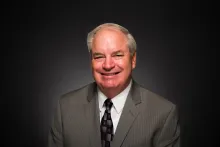
Robin Webber was born in Chicago, Illinois, in 1951, but has lived most of his life in California. He has been a part of the Church of God community since 1963. He attended Ambassador College in Pasadena from 1969-1973. He majored in theology and history.
Mr. Webber's interest remains in the study of history, socio-economics and literature. Over the years, he has offered his services to museums as a docent to share his enthusiasm and passions regarding these areas of expertise.
When time permits, he loves to go mountain biking on nearby ranch land and meet his wife as she hikes toward him.
