


Robin S Webber
One of the most vital and essential understandings in our personal Christian journey is discovered in the middle of Job. A verse that allows us to not only know our Redeemer, but grow within our Redeemer----knowing there is life beyond our human moments here and now, and beyond the grave. Job 19-23-27 shines a light on worthwhile eternity and reminds us we are not alone.
This transcript was generated by AI and may contain errors. It is provided to assist those who may not be able to listen to the message.
I'd like to begin the message today by sharing a story with you, so I think a story is always a good way to move into a message. It's one that has stuck with me for many, many years since I first used it, and it comes back to me many a time over the decades.
I'd like to share the story. It takes place actually about 140, 150 years ago, but there was a noted 19th century German conductor who was taking his orchestra and his choir through their last laps and preparing to sing the Messiah, the whole gig, all the different parts of it. They were practicing, and then finally when the solos came in on her refrain of, I know that my Redeemer liveth, she sang it amazingly, seemingly, flawlessly, note per note, word for word. Those that were around her, her fellow musicians, were in a sense and in awe as far as her technique.
But just before she finished it, the composer, Raikl, went like that with his baton, stopped everybody right in their tracks in the note that they were singing. And what surprised them was that they would have been expecting that it would be the conductor's commendation. But he motioned silence with his baton and walked over to the soloist and said, well, almost sorrowfully, my daughter, you don't really know that your Redeemer lives, do you?
Well, embarrassed, the soloist answered back and said, well, yes, I think I do. Then Raikl answered back, then sing it, sing it, and tell it to me so that I'll know that you have experienced the joy and the power of that. Well, she repeated her part again with an additional fervency that testified to her belief of the risen Lord. Fellow choir members began weeping. It was so powerful. Weeping. And the conductor, with tears in his eyes, came over to her and proclaimed, you do.
You do. For this time, you have told me. Now, that's a story about somebody else many a decade ago, but I have a question for each and every one of us today, and we're going to be exploring that. And it's simply this. Are we a little shy, like the soloist, in believing in the redemption and in the resurrection that comes with the ultimate Redeemer that God the Father has given us, which is Jesus Christ, his Son. The one who is dead, or was, and the one now that lives in glory, and whose essence, along with his fathers, presently resides in us.
What we learn from this story, and I think you know where I'm going to be taking you, but I'm taking myself as well, because this story always speaks to me, and if it speaks to me, guess what? You get to hear it, too. Because it's so powerful. And simply this, there's a difference between mouthing the words and moving your hearts. There's a difference between just showing up at services every week, like clockwork. God bless you for doing so. You're here on the Seventh-day Sabbath, not another day that man has contrived.
But you're here. We come, then we go. We come, and we go. And it can be so routine that we can potentially put ourselves spiritually asleep. Knowing, as the song goes, I know that my Redeemer liveth. Let's just break that down for a second. I, that's you, that's me, moi. That's the only friend I'll give you today, moi. I know that, notice the words always have meaning no matter how small they are. My Redeemer, my Redeemer, it's personal.
And we're going to talk about how personal it was and where it came from. And my Redeemer, we're going to be talking in this message about what it means to be redeemed. What was a Redeemer back in the days of yore during the times of the Old Testament and into that New Testament era that we're talking about? Knowing isn't simply a mental attribute, but has deep-seated roots that we are not just preparing for today.
But moment by moment, as God's grace allows us to exist, to move towards tomorrow, but also because of our Redeemer, because of my Redeemer, because of your Redeemer, that one day we will exist forever beyond ourselves, beyond the grave, beyond all the different challenges that you and I might be experiencing. Today, this week, this section, this quarter of our life, and we wonder if God cares and knows. I'd like to point to John 14, then we'll move into the message, John 14. To alert us to something, I've kind of picked this up the last year when I look at John 14, which the beginning of the chapter is very familiar to all of us.
But notice what it says here. It says, Let not your heart be troubled. You believe in God. You believe in my Father. Also believe in me. In my Father's house are many mansions, many offices. Let's just say there's a lot of space God's planning to add to his family. And if it were not so, I would have told you, and I go to prepare a place for you. I go to prepare a place for you. Where? In his Father's house. And again, if I go and prepare a place for you, I will come again and receive you to myself, that where I am, there you may be also.
So Jesus, on this last night of humanity, is informing his disciples who know him, who have been on the road. Are you with me? I've been on the road with Jesus for three and a half years. And sometimes you wonder, how much did they really know? Or understand, even at that critical moment about what was about to break loose, that was going to change human history. And where I go, you know.
And notice, the way you know. The way you know. I would say at this point that Jesus was an optimist with the disciples. And or maybe he was just challenging them. They come, they go. They walk this path, they walk this path. And that path. And this path. They've seen this miracle, this miracle. They've seen this opening. They've heard, maybe they've heard the, do I dare say, the stump speech of Jesus Christ.
The Sermon on the Mount. Do you think that was just given once? That was probably spread. It was, yes, quote. But this was what he was spreading to all of the people. And you think that they would, are you ready? They would be primed. They're ready to go. And they know what he's talking about. But you know, Thomas was always honest, wasn't he? Otherwise, no one is dead of us. No, I loved, you gotta love Thomas. He's honest. Notice what it says there.
They had not fully sunk in. They had knowledge. They had knowing. But knowledge begs to have understanding. Understanding begs then to bring that to a conclusion with wisdom. I'm not being down on them. Please understand. I'm talking to myself. How often do we just kind of go through the motions? We know all the right words. We know what Mr. Gardin Hire just spoke about. Yes, he illustrated more. Thank you, Bob. But we kind of know that. But how do we go on—the reason I'm giving this message is, how do we move from knowing to growing? And there is a difference of knowing and growing. Because in 2 Peter 3 and verse 18, it says, by God's grace, that we might grow in the grace and in the knowledge of the Lord Jesus Christ. That's a big exclamation point. And we are still in that process. Notice what Jesus said. And Jesus said to him, Thomas, with everybody else listening, I am the way. I am the truth. And I am the life. And no one comes to the Father except through me.
I am the way. I'm the path.
I am the truth. And the truth is, dear brethren, that Jesus Christ has risen.
Jesus Christ is alive and well and dynamic at his Father's right hand. And sometimes we're going to find—sometimes goes outside the throne room and leans over and looks down on some saints to give them encouragement, to give them a go-go-go. And I see he's on that bench in heaven with some of the things that are happening down here below. And I want to discuss that with you. The bottom line is, and I want to share this with you, after three and a half years, how much was still mystery to them that had not sunk in with all the things that Jesus had said about his time was limited. He was going to do this. He was going to do that and this and that. Where are you in relationship with Thomas?
I know sometimes Thomas gets a bad rap in the Bible, gets a nickname for 2,000 years. How would you like to have your middle name be Doubting, you know? And yet, Thomas is us at times. We want to believe. We think we're believing, but God wants to stretch us. But in that stretching, we are going to have to have somewhat of a foundation to believe, and that's what I want to talk about today. The title of my message is simply this. Are you ready? Knowing your personal redeemer truly lives. Knowing that your personal redeemer truly lives. I'm going to borrow on some territory that we traversed several weeks ago, but it's stuck in my mind. It means a lot to me, and I hope it will to you as we go through this again. I want to build upon it, though, more. I'm thinking about my next column for Follow Me. We'll probably be this. We'll find out. But where do you find the verse, I know that my redeemer liveth? Where do you find that? You find that in the Gospels? You find that in Paul's... ...epos-sel letters? I'm saying that exact phrase. Where does that come from? Join me if you would. Let's go back to the Old Testament, and let's go to the Book of Job. The Book of Job. We touched on this a little bit, but I'm going to expand on it, God willing, greatly this afternoon. In Job 19...
Here we go.
Verse 23. Job 19 verse 23.
Before we do this, let's remember something. Are you with me? Here we go. Job has 42 chapters.
And almost you go through that 42 chapters of woe and tribulation and disaster.
It winds up pretty powerful at the end. 42 chapters.
But I'm going to share something right now with you that I hope that you will always remember. This is simple. Because we're kind of writing our own book of 42 chapters, whether we live 42 years or 94 years, etc. The one thing reading about Job. Many, many years ago it used to be that God had, in our general teaching, Job had to be shown this. Because Job was not on par. Satan himself thought he was kind of on his own. And what I've discovered is that the book of Job is the journey of all of us. It's the journey of all of us. The challenges that face us. And will continue to face us. And stop us in our tracks. Unless we know Job 19. And recognize that those 42 chapters, here you are in the middle of the Old Testament. You're in the middle of the book of Job, and it's right here. Right here. At this point in Job 19, that allows Job 20, 21, 22, 23, 24, 25, 26, 27, 28, 29, 30, and on and on, 41, 42. It's here. This is where the finger is put, where you can tie the ribbon of what God is doing in the life of not only Job, but ourselves. And notice what is going on here. This is really incredible. It says, Oh, that my word were written. Oh, that they were inscribed in a book. That they were engraved on a rock with an iron pen and lead forever. Wow. And recognize then what else is going here. Where it says, For I know that my Redeemer lives, and he shall stand at last on the earth. My skin is destroyed. This I know. Notice what it says, That in my flesh I will see God, Whom I shall see for myself, and my eyes shall be hold, and not another. Then notice what it says here. Oh, how my heart yearns within me. I don't think at this point he's just mouthing the words. I don't think God is just simply saying, Do you really care? Do you really get it? Do you really know? Now, let's understand something. Job is living probably somewhere between 2000 to 1800 B.C. This is in the time of the patriarchs, and this is one of the very first mentions of what is coming in the future through a Redeemer. Yes, we know Genesis 3.15, the famous scenario of the seed of Eve and the seed of the serpent. But this comes next, and this magnifies, and this expands the equation with everything that Job had been through, which is quite incredible. And to recognize that, and he says, And I know that my Redeemer liveth.
Let's talk about that for a moment. At the heart of Job comes a ringing affirmation of confidence. Let's understand what a Redeemer is. In ancient Israel, a Redeemer was a family member who bought a slave's way to freedom. Or he looked after the widows, like Boaz did with Naomi, of whom he was a kinsperson. And, or even in the sense, as a kinsperson, going by the Levri law, that if a family member died and left a widow, that the closest family member—we know how that story goes, it gets kicked over a little bit— but that that family member would raise up seed to the memory of the brother, who did not have a child to carry on the name. It was somebody that was going above and beyond and directly intervened. Again, what tremendous faith Job exhibited towards God-thinking at first, that God was against him. He didn't realize at that time initially that Satan had come and had that conversation with God. But here's what I want to share with you. This is the PowerPoint, not technologically, but this speaks volumes. That faced with death and decay. And sometimes decay is a living death when you think of the boils that he had. Job was expecting to see God in body form. Have you ever seen this before? He was expecting to see God in body form. I'm going to see God face to face. He was, in a sense, ahead of the apostle John, where in 1 John 3, 1 through 2, where it says, then we shall see God and we shall see Him face to face. This is around 1800 to 2000 B.C. with a man that is going through a living blank on earth with his own body and what is going on, who loves God. And yet he says, and I know that my Redeemer lives. Raquel, the conductor, would have no problem. He wouldn't have a problem here. He'd be watching. And tears would be coming to his eyes for another reason, knowing that this man, with everything going on in his life, never lost faith and hope, that he had a Redeemer. A Redeemer is someone that comes in and helps an individual that cannot help themselves. It's like a drowning person cannot save themselves. It has to be a strong hand from elsewhere, coming from behind, coming from a safe spot, and bringing that person to safety. That's what a Redeemer is. And he not only knew that, but I want you to share, let's go over to Job 2 here for a second, okay? Let's take a look how that affected him.
Notice what it says in chapter 1, which is already leading to an amazing moment. He finds out that there's been this gigantic storm, and it struck all four corners of a house, and it fell. Notice on the young people, family members, they were dead. And a messenger came and said, I am alone. I alone escaped, and I've come to you. Then notice Job arose, tore his robe, shaved his head, and he fell to the ground and worshipped. And he said, Naked I came from my mother's womb, and naked shall I return there. The Lord gave, and the Lord has taken away. Blessed be the name of the Lord. Now, I want you to notice something. Words have meaning, verse 22, and in all of this, Job did not sin, nor did he charge God with any wrongdoing. Even in that moment, he recognized, as hard as it was for him humanly to take this, that there was a purpose that was being worked out here below. And amazingly, and I'm speaking to myself, are you with me? He did not get ahead of God on this. Sometimes God is working here in a matter. He is present. He is involved, but his hand is not necessarily stopping at this point, because he alone not only created time, but he's the master of timing, working towards a greater purpose down the line. And perhaps one of the greatest purposes here is this anthem, this anthem of, I know, I know that my Redeemer liveth. It's not idle chatter. It's not a filler in in the book, saying, well, you know, I need to really write this down right here. It kind of sounds good. He lived it, and he was growing in it. See, the book of Job is about growing on the journey that's set before us with all of its different chapters. And in life, some chapters are more pleasant than others. Some years are more pleasant than others. But they all wind towards a purpose to give God glory and honor. Job 2. And let's pick up verse 9. Mrs. Job. Mrs. Job comes to him and says in verse 9, Then his wife said to him, Do you still hold fast to your integrity? And notice what she says. Now, ladies, we've all been there. Men, we have all been there. We can all be a little bit like Mrs. Job when we see everything coming down around us. Then his wife said, Do you still hold fast to your integrity? Curse God and die. Love it. This is basically the translation. Get over it. It's over and die. And before you do, give it to the big guy upstairs. It's over. Not going down this path anymore. Verse 10. But he said to her, You speak as one of the foolish women that speaks. Shall we indeed accept good from God? And shall we not accept adversity? In all of this, Job did not sin with his lips. Now, I have a question for you.
Here's her soloist performing before the conductor Raikao, and he's not quite sure whether she gets it or not, what she's singing. She's us. I'm not down on this soloist. We've all been there. May I touch you? You're perfect. Okay. We've all been there. But now look at Job and the response, the response. The bottom line that I'm challenging you and challenging myself today with is simply as we look at the story of Job, and he knows that my Redeemer liveth. He not only knows, but he grows through this challenge. He knows, but he's growing. With the challenges that you and I are facing in our lives, big ones, I know most of your stories to one degree or another. Stories pass, stories present, and stories that are yet to happen. Do you know that your Redeemer liveth? How real is that to you?
That's the biggest question I can ask. Again, the two greatest questions that Jesus asked during his ministry comes down to very simply two things. Number one, who do you say that I am? Not the Gentiles, not the Greeks up in the Decapolis, up in the northeast part of the Galilee. He always comes back to everybody that is called of him, and he says, Who do you? Who do you? Forget everybody else. Because, you see, when God calls us and the Father calls us, we are individually wrapped. We are individually wrapped. And when we are baptized, I don't think we're going down holding everybody, you know, like a snorkel squad off Point Loma. No, we go down individually, and we take our vows before God individually. Who do you say that I am? And number two, then, the big question that he will always ask of us is simply this. Do you? Not all of you, not all of you, because that was given singularly to Peter, a disciple like we are a disciple. Do you love me? Do you love me? These are the big things that we need to think about.
Much later, later on, not mentioned in Genesis, but later on in the book of Hebrews. Join me if you would, please, in Hebrews. In the book of Hebrews, and picking up the thought if we could, in chapter 11, Stray of Abraham, in Hebrews 11 and verse 17. Now, this occurred probably 1800 years before Paul is inspired to—or not Paul, I like to say the author of Hebrews. But the author of Hebrews is putting this down, and this is a story that's 1800 years old, but now it's something that was not put in Genesis, but it's added here. Notice what it says.
This was the son, a son of promise, a type of the great anti-type that would come, which would be the sacrifice of Jesus Christ, the son of the Father. And it says, the promise is offered up to his only begotten son. God had said, through you and Sarah—not Hagar, but through you and Sarah—you're going to have this child, and the blessings are going to come through him, and ultimately the son of God would come through that later on. And he says, this one. And in Isaac your seed shall be called. Now notice this, concluding that God was able to raise him up even from the dead, from which he also received him in a figurative sense.
Resurrection. A redemption. When you are at the end of your rope, you're at the end of the road, and God comes in and supplies something that you can't supply on your own. Again, when you're thinking about this, it's incredible to recognize that God knows what's going on down here. Very, very important. And to recognize—I wanted to go here to the story. Join me if you would in Genesis 22 for just a second. Genesis 22.
Here we go. Genesis 22. If you go to Genesis 22.4 and verse 8—actually, verse 7. Let's go to Genesis 27. But Isaac, they're going up the hill, up in the hills of Moriah, and he's also carrying the wood for the sacrifice on his back, which again is a type pointing later on to Jesus carrying the cross beam to what he will be sacrificed on. And he said, Here I am, my son. And then he said, Look, the fire in the wood, but where is the lamb for a burnt offering? You know, Isaac was not seven or eight. He was not a dum-dum. He's looking around and beginning to think, Hmm, where is this going? And Abraham said, My son God will provide for himself the lamb for a burnt offering. So the two of them went together.
We just read the rest of the story. Abraham was going to go through with it, stopped at the very end. But then notice verse 14. And Abraham called the name of the place the Lord will provide. And it is said to this day, In the mount of the Lord it shall be provided. Now you and I, we have, you know, we have the Kweimacah Mountains. We have Mount Palomar. So we call it what? Mount Palomar. We call it Mount Kweimacah Peak up where we live. Up where we live we have big mountains. As you know, we have San Jacinto. We have San Bernardino. We have San Gregorio in the San Bernadino. We have Mount Baldy over LA. Now those are mountains. And to recognize, so wonder, would it be needed if right of all places in the middle of the LA Megalopolis went that instead of Mount Hollywood, we'd have, there's the mountain where God will provide. Maybe we're going to have to wait until the millennium for that one to happen. That'd be a nice one, wouldn't it? And to recognize that. And that's what happens when we recognize when we know that God has already provided a Redeemer, I know that my Redeemer liveth. That no matter what comes our way, and we're going to be buckled back sometimes, we're going to be like pushed back. Because life can be hard of and by itself in the immediate moments. But we will, through time, prayer and focus come back. And to read to know that we are not alone. Interesting. We'll do another one here. Let's go to John 11.
Gospel of John. John 11, and let's pick up the thought in verse 20. We're in Bethany.
Lazarus has died. And notice what it says here, beginning in verse 20. Then Martha, as soon as she heard that Jesus was coming, went and met him. But Mary was sitting in the house. Now notice what it said here. Now Martha said to Jesus, who was a good human friend as well, and not only a rabbi in that sense to her. Now Martha said to Jesus, Lord, if you had been here, my brother would not have died. But even now I know that whatever you ask of God, that God will give you. And Jesus said to her, your brother will rise again. And Martha said to him, now notice this, stay with me, important. Martha said to him, I know that he will rise again in the resurrection in the last day. Now notice there's that word popping out. I know that he will rise in the resurrection. Resurrection is a Latin word, which means to rise up. It comes off the Greek word of Anastasi, which means literally to rise and to walk, to stand up. Now we read this and it becomes familiar to us. Can I ask you a question? May I? When is the last time that you were around somebody that was dead? And all of a sudden they popped out of bed and were on all twos. Just asking. You sure? Okay. Our guest said never. But it has occurred. It hasn't happened now that we know of, but it occurred here for a lesson. What was going on here? It's a little bit like the book of Job. And the lesson was not only for Mary and Martha and the citizens of Bethany, but for each and every one of us. Notice what Jesus says here then. I am the resurrection, and I am the life. He who believes in me, though he may die, but he shall live. And whoever lives and believes in me shall never die. Do you believe this? And she said to him, yes, Lord, I believe that you are the Christ, the Son of God, who has come and into this world. Jesus took on with the name of God, I am, and then using the word, it would be a Hebrew word, but the Greek word astasi or I am the resurrection. How could he say that? Join me if you would over in Revelation for a second. In Revelation.
In Revelation, let's pick up the thought in verse 1.
John was given a vision.
And like I gave a message recently that if you're going to, and Wanda, you'll remember this when we talked about this in our series, that if you're going to go through the book of Revelation, you want to put on your seat belt in chapter 1. And you want to know who's riding in the front seat with you, and actually has his hands on the wheel. You get into 11, 12, and 13, it gets a little humanly scary in the book of Revelation. So you have to know who's on the ride, who is the driver, and Jesus is the driving force. Jesus died, we consider, 31 A.D. This is now probably 55 to 60 years later, and the vision comes to him. And notice what it says. John comes up against Jesus, the risen Christ, and it says, And when I saw him, I fell at his feet as dead, but he laid his right hand on me, saying to me, Do not be afraid. I am the first and I am the last. You know, you have to kind of... All we have is the vision forward, but you know, here's John, he's going, you know, going like this, you know, and then Jesus says, Don't be afraid.
And notice, I am, I am, he who lives and was dead, and behold, I am alive forevermore. Amen. And I have the keys of Hades, that's the grave, and of death. Write these things which you have seen and the things which are and the things which will take place. It says in this chapter 2 that he, Jesus, put his hand on him. It was a vision, but it was very real. Nobody had heard in that, you know, even as Christianity was moving through the empire, nobody had actually seen Jesus Christ except the Twelve. It had been a long time, and people needed fortification. They needed to know that Jesus Christ was up there, as he said he would be, this place that he was going to prepare.
They needed this, and John needed this. You know, it's interesting when you go to 1 John 1, and John is trying to give up a human plea to the audiences of Asia Minor saying, saying, we were there. We were his disciples. We actually really handled him. We touched him. We felt him. Not only in our three and a half years on the road, but when he came back, you know, did him, this was not the only—excuse me, Thomas, I'll go with Thomas.
Thomas was not the only—Thomas did the full poke, you know what I'm saying? He had to know that he had not been there at the original appearing, okay? So somebody tells you, guess who came for dinner last night? No, you go, if you're not there, you're not there. Thomas comes. Yeah, sure. And then Jesus comes, and Jesus works with Thomas just like he works with each and every one of us individually to get across his point. So they had handled Jesus, but now in this heavenly vision, Jesus literally puts his hand on John in love to calm him down and to know that everything is going to be okay.
And it tells us here that Jesus Christ owns both worlds. Both worlds. Life and death. I want to go to Hebrews 6. In Hebrews 6— Hebrews 6, maybe you have not familiarized yourself of recent date. How important it is to know that your and my Redeemer lives. If you go to Hebrews 6, therefore leaving verse 1, the discussion of the elementary principles of Christ. Elementary is not a demeaning word. It is a founding word. Elementary, basic, foundational principles of Christ. Let us go on to perfection. Don't stay where you're at. Just don't simply know, but grow. The perfection. Not laying again the foundation of repentance from dead works and of faith towards God, of the doctrine of baptisms, of the laying on of hands. Now notice, of resurrection of the dead and of eternal judgment. Knowing about resurrection is fundamental. It's important. It's the ground that we need to be able to grow upon, which is so very, very important when we think about it. In that, I'd like us to go to Philippians 3. Let's just see through it, and let's allow it to sink in here for a moment. Philippians 3. And starting in verse 7.
You notice that when letters are written to you. It's like, did they just come out of a machine, or is there a heart behind them? My Lord. Yes, indeed, I count all things lost for my Lord, for whom I have suffered the loss of all things, and count them as rubbish that I might gain Christ. Now notice powerful words here. And be found in Him. For not having my own righteousness, which is from the law, but that which is through faith in Christ, the Redeemer, the one who God the Father uses for redemption, to do for ourselves what we couldn't do on our own. He does for us through Christ. We were slaves to sin. Remember what I talked about with the different definitions of redeeming? Where one would go out and buy a slave that could not buy his own freedom. He was a goner without that hand coming from elsewhere, and that love and that concern coming from elsewhere. But that which is through faith in Christ, the righteousness which is from God by faith, that I might know Him. And notice the power of His resurrection. I know that my Redeemer liveth, the power of His resurrection. And especially when you read the Pauline writings, God always equates the power of God's Holy Spirit with the resurrection. You might want to jot that one down. The resurrection is where He puts down the gauntlet. He always refers because who else could do that? Who else could raise the dead? And He sends forth His Spirit, and things are created in life. If by any means, oh excuse me, resurrection, and the fellowship of His sufferings, like Job, like others, like Stephen, the deacon, in Jerusalem, killed, martyred, stoned. While Paul was looking on as Saul as a young man at that time. But there was somebody else looking on as well. When you go to Acts 6 and Acts 7, and it says that he looked up, he looked up, and he saw Jesus. He saw Jesus, the risen Christ, Lord Almighty, and he was looking over as a source of encouragement. And just like Job, who made those two comments in Job 1 and Job 2, which are incredible, he added two more comments, but he copied his Master. He said, Father, forgive them, for they know not what they do.
And then, with his last breath, in adversity, blood all over him, pain unimaginable when you're being stoned, he says, I commit myself into your hands.
Job knew that his Redeemer lives.
John would not only know that his Redeemer lives, but had a heavenly vision about it. Stephen, like Job, in that awful, awful moment, humanly speaking, copied his Master, an hour of Master, and he wasn't talking to something, he wasn't talking to nothing. He was directing his comments because of the vision that the risen Christ allowed to always let him know that he's not alone.
I'll just share this with you. There are other hints about the Redeemer in the Old Testament. I just want you to think about this for a moment as we go through it, as we conclude.
David, David who said, the Lord is my shepherd, I shall not want. He maketh me lie down in green pastures. He leadeth me beside the still waters. He restores my soul. He leads me in the paths of righteousness, even for his own name's sake. Chapters of life. Spring, summer, autumn, love autumn, winter, with all of its darkness, even in Minnesota.
The chapters of life. And then he says, And yea, though I walk through the valley of the shadow of death, I shall fear no evil. For thou art with me, thy rod, and thy staff, they comfort me. Thou anointest my head with oil, my cup runneth over.
Mankind might not be with him. He might have been in the outs with everybody else, but he knew that he was not alone. He knew in that sense that he knew that his Redeemer, who would take tragedy and things that are scary and things that maybe humanly he wasn't prepared for, and would walk him through that.
And then at the end he said, after all of that, For surely goodness and mercy shall follow me all the days of my life.
And he knew that his life would come to an end, just like ours will. And then he says, But I know that I will dwell in the house of the Lord forever. Well, I've got a question for you. Who opened up the door to the house of the Lord? It was the door. The one that said, I am the gate. I am the door. The one who was with us became human, became a family member, like Boaz to Naomi. And that greater Boaz, that second Boaz, did what only he could do to redeem his younger brothers and sisters in time of need.
And I shall dwell in the house of the Lord forever. Well, who's in the house, by the way? Why is it called the house of the Lord? Because the Lord is in the house. He's not dead.
And he's alive. And he's gone his way ahead of us. Because, after all, he is that way. He is that truth. And it is in him that we will have life forevermore, that our friend David tells us, from thousands of years ago, to give us courage as we walk out into this world this afternoon.
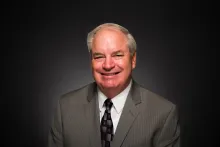
Robin Webber was born in Chicago, Illinois, in 1951, but has lived most of his life in California. He has been a part of the Church of God community since 1963. He attended Ambassador College in Pasadena from 1969-1973. He majored in theology and history.
Mr. Webber's interest remains in the study of history, socio-economics and literature. Over the years, he has offered his services to museums as a docent to share his enthusiasm and passions regarding these areas of expertise.
When time permits, he loves to go mountain biking on nearby ranch land and meet his wife as she hikes toward him.
