

Robin S Webber
This transcript was generated by AI and may contain errors. It is provided to assist those who may not be able to listen to the message.
I'd like to give you the title of my message right up front so that you'll know where we're going, what God, I think, has planted on my heart, hopefully, and that I want to share with you today. So I'm going to give you the title right up front. I'll probably be sharing it again in a few minutes just to remind you where we're going. The title of my message is simply this, Living for God Beyond the Moment. Living for God Beyond the Moment. It's almost been a year since the threat and the weight of COVID has been upon us. We stopped having services in March of 2020, and here we are in February. A lot has occurred since then, hasn't it? We recognize that many friends, many family members have been smitten with this plague, with this pandemic, to use a very fancy word. We recognize that other cultural norms have been uprooted, have challenged society as a whole, not only in this nation, but around the world. So often Americans tend to be absorbed with happening in America, rather than recognizing there's a whole big world that is out there.
We, in turn, as individuals, can become absorbed by simply thinking about ourselves and becoming paralyzed with what is happening around us, perhaps even double paralyzed by what's occurring to us. It is to that that I would speak today, because sometimes people, all of us, be included, and certain generations of human society think that, well, what is happening to them is totally unique and has never occurred before. What has occurred before are matters and events that have come upon human society that have had the capability of changing everything, and also paralyzing us with fear, tying us up in knots, so much so that we keep on, we stop worshiping the God above our Father above the Almighty, and we start worshiping and bowing and cow-towing to our fears that can paralyze us before their altar, which then distracts us from the altar and from the throne that we ought to be appearing before. I'd like to share something that Susan brought to my attention several months ago. It had a profound impact on me. I've shared it with others, but I'd like to get right into it to talk about that to the point that we are not the only ones that have faced big, big challenges that have impacted us as persons, our communities, our cities, our states, and you can think of all the things that have affected us over the last year, but we're not the only ones. It's really not all about us. Humanity for 6,000 years has been impacted, and it's not that things are not going to come our way, whether at the macro sense and or in the personal micro sense, but it's what we do with it. So allow me to share this. It's by C.S. Lewis, noted, very famous British theologian, writer. You might be familiar with his book called Mere Christianity, but he wrote this in 1948. Now 1948 is three years after World War II. It is the very genesis, the very beginning of the atomic age, which really all of humanity had to begin to grapple with, and what what were we going to do about that? So without any further ado, it's going to be a little reading. I'll try to make it interesting, but stay with me to where we get the point. C.S. Lewis saying, in one way we think a great deal too much of the atomic bomb.
How are we to live in the atomic age, which is now 70 years ago? I am tempted to reply, why, as you would have lived in the 16th century, would the plague visit at London almost every year? Or as you would have lived in a Viking age, when raiders from Scandinavia might land and cut your throat at night? Or indeed, as you already are living in an age of cancer, an age of syphilis, an age of paralysis, an age of air raids, an age of railway accidents, and of motor accidents? In other words, coming to this point, do not let us begin by exaggerating the novelty of our situation. Believe me, dear sir or madam, you and all whom you love were already sentenced to death before the atomic bomb was invented. It is perfectly ridiculous to go about whimpering and drawing long faces because the scientists have added one more chance of painful and premature death to a role which already bristled with such chances and in which death itself was not a chance at all, but a certainty. If we are all going to be destroyed by an atomic bomb, let that bomb when it comes find us doing sensible and human things, praying, working, teaching, reading, listening to music, bathing our children, playing tennis, chatting with our friends over a pint—memories in Britain—over a pint at the pub, and a game of darts, and not huddled together like frightened sheep and thinking about bombs.
They may break our bodies—even a microbe can do that, hello, this past year—but they need not dominate our minds. When the atomic bomb is really done, what the atomic bomb has really done is to remind us forcibly of the sort of world we are living in and which, during the prosperous period before, we were beginning to forget. Think of America a year ago, the economy, the unemployment, the technology, where that was headed, the sky was the limit. And this reminder is, so far as it goes, a good thing. We have been waked from a pretty dream, and now we begin to talk about the realities. We're almost done.
It is our business to live by our own law and not by our fears, to follow in private or in public life the law of love and temperance. And even when they seem to be suicidal and not the law of competition and grab, even when they seem to be necessary to our own survival, for it is part of our spiritual law never to put survival first, not even the survival of our species.
We must resolutely train ourselves to feel that the survival of man on this earth, much more of our own nation, our culture, our class is not worth having unless it can be had by honorable and merciful means. Last paragraph. Nothing is more likely to destroy a species or a nation than the determination to survive at all costs. Those who care for something else more than civilization are the only people by whom civilization is at all likely to be preserved. Those who want heaven most have served earth best. Those who love man less than God do most for man.
The end of Lewis's comment, let the bombs find you so doing. I want to share that with you because fear and self-absorption and looking at ourselves in the mirror in our mere survival as we're passing through this age and moving towards the kingdom of God, which we've been invited to by none other than God Almighty. When fear comes upon us, when worry comes upon us, we can be tied up and we can say, what's going on? Why is this happening? God, don't you realize that I'm hello? I'm one of your covenant people. Join me if you would for a moment in 1 Peter 4 and verse 12. Would you join me, please? 1 Peter 4, 12. Now we're breaking into a larger subject, but I'm just going to use this verse. I'm going to put a little bit different handle on it. We recognize this is the first century. We recognize that Christians were beginning to be martyred. There were trials. There was distress. There were real decisions that had to be made, and some of them might have said, well, this isn't what we signed up for. This wasn't supposed to happen. We were supposed to have the spiritual Teflon of God's blessings surrounding us, but they forgot that Christ had walked this earth. He had been tested. He had been challenged. He was the Son of Man, and He had to come to a greater understanding that His purpose on this earth was living for God beyond the moment.
Notice what it says in 1 Peter 4, 12. Beloved, do not think it is strange concerning the fiery trial, which is to try you. There's a purpose. When God allows trials to come upon us, it's not a dead end of and by itself. There's a purpose that is being worked out by the Master Potter on this lump of clay infused with His Spirit.
So we understand something very basic. We can either fix our eyes on our fears and allow them to paralyze us, or we can do something else. The Scripture tells us where to focus. Join me, if you would, please, over in Hebrews 12. Join me in Hebrews 12. Let's pick up the thought, if we could, please, in Hebrews 12 and verse 1. Therefore, since we are surrounded by so great a cloud of witnesses, let us lay aside every weight, and the sin which so easily ensnares us.
And fear, and lingering in fear, and holding on to fear, can be a sin, because fear is the opposite of faith. And let us run with endurance the race which is set before us, looking unto Jesus the author and finisher of our faith, who for the joy that was set before him endured the cross, despising the shame, and has sat down at the right hand of the throne of God.
It says, looking unto. Other translations say, and are fixing our eyes on Jesus Christ. So the Scripture actually tells us and offers us the invitation that when things are going the way of challenge that could move us into the pool of fear and drown us in self, says that we're to fix our eyes on Jesus Christ.
There's no better way of being able to do this other than joining me in Revelation 1. We're going to go to Revelation 1, and what I want to do is just read Revelation 1 to you for basically the course of this message. We're just going to go through it together as a church family. You know, the Scripture says, whatever, whatsoever things are lovely and just and pure and are of a good report, it says if there is anything, well then think on these. And I want to go through Revelation 1 with you because we read to know that we are not alone, and we read Scripture to know that we are not alone no matter what is occurring in our life.
Whether it's in the macro global pandemic that has killed hundreds of thousands of people, whether it be being unemployed right now because of the economy, the way that it is tilted because of the pandemic, whether it be challenges in our marriages, challenges with our children, challenges in our community, challenges at school, health challenges right now that are very, very serious.
We need to recognize that we have somebody to turn to and that we can fix our eyes on and has his eyes along with his Father, our Heavenly Father, their eyes on us. Join me if you would then as we turn to Revelation 1 and we're going to read it. And it was here for a purpose. We so often think of Revelation as a prophetic book, and indeed it is, but it's also a personal book. It's kind of a come-alongside book, and oftentimes we kind of get into Revelation 7, 8, 9, 17, and it's like entering a movie halfway through.
And you haven't been there at the start to understand what's going on. What's going on here is in Revelation, which is basically written about 90 AD. The church is being challenged big time. The church is now in its second, third generation. The Emperor Domitian is persecuting the church, and so we have to understand what it meant to the original audience, but also to recognize the way that God looks at it. It's also written to us today. So let's just stay with me, okay? We're going to read through it together.
We call this being exegetical or expository. We're going to read right out of the scriptures and learn some lessons. It says here, the revelation of Jesus Christ, which God gave him to show his servants—that's you, that's me—things which must shortly take place, and he sent and signified it by his angel to his servant John, who bore witness to the word of God and to the testimony of Jesus Christ, to all things that he saw. Very interesting. You've maybe never noticed sometimes in Bibles, it says the revelation of St.
John the Divine, but it wasn't really John's revelation. He was, in a sense, like a court reporter. We often think of the revelation of Jesus Christ, and he is the main expository sharing that. But it's actually, when you look at it, it comes from God the Father. It says right here, the revelation of Jesus Christ, which God gave to show his servants, which is interesting. And then notice what it says, because this is being written for a purpose.
Times are tough. People are being martyred. It's not just going to church. It's just not reading the Bible. Things are happening. We're having to live out the Bible, just as Jesus Christ lived in his time. People are dying then. So this is serious. But notice what it says in verse 3. Blessed is he who reads and those who hear the words of this prophecy, and keep those things which are written in it, for the time is near. Blessed. It's very interesting that the way the book of Revelation is written, that there are actually seven Beatitudes that are mentioned in the book of Revelation. I've given messages on all seven. There's a sermon out there on ucg.org on that. I've also written articles that have appeared in Beyond Today magazine. If you want to look at that, I'm not going to go through all of them right now. But right in the beginning, God throws out a blessing. The word blessing there is mikarios in the Greek, which means complete. It means fullness. Drink this in. Milk it in for all its worth. Blessed is he who reads and those who hear the word of this.
It's very interesting. John is writing this, and in the Jewish mind, John being a Jew, when you read something and or you hear the words, the automatic response then in the heart is to obey. In the Hebrew sense, Shema, to hear meant to obey. In other words, there is an immediate response here. To keep those things which are worthy that are written in, it says this prophecy.
Prophecy there, the word is prophetaea. A prophetaea can have two different meanings in the Greek language. One, it can mean to foretell, which means to share those things that have occurred and or are occurring as it is being written or spoken, and or also it can mean to foretell. In other words, the future. So there's a symmetry. There's somewhat of a seamless chord between these two of things that are actually happening. John, to the seven churches which are in Asia, grace to you, favor, softfulness, a movement towards you by God Almighty. God is grace. He is favor. He is love. And He brings peace. Not a peace that is absent of conflict, but a peace that He's going to give us the answers to be able to live for Him beyond the moment. And I understand that, and that's going to be shown here in a moment. And who was and who is to come and from the seven spirits who are before His throne. Now notice what it says in verse five. And from Jesus Christ. Jesus Christ who is, notice, the faithful witness. That's one of the works of Jesus, why He was sent to this earth.
He was the faithful witness. Let's just think of that word, martyrs, for a moment in the Greek, which means witness. Think about what it means to be a witness. A witness is one who has first-hand knowledge. In other words, been there, saw that, was able to talk about it. Jesus Christ is the only one that in His pre-existence as the Word was literally in the realm of the uncreated, with God Almighty, with the one that we now know as the Heavenly Father. He came from above. He came to us below. And now He has ascended and is exalted above. And He is that faithful witness. He's uniquely qualified, period. Absolutely. I'm just going to go to John 3, verse 11, for just a second. We're going to go out of this for just a moment, just on the aspect of witness. And I'd like to share this verse with you, okay? In John 3, verse 11, speaking to Nicodemus on that night when he and the Nicodemus were talking, Moses, surely I say to you, we speak what we know, Jesus speaking of Himself. We speak what we know and testify what we have seen.
And He made a condemnation, though, to that world of that time, and you do not receive our witness.
Jesus, if you think about it, He's not only Savior, He's not only our High Priest, He's not only the Lord of our lives, He's going to be the King of all of this world. Here's another one that you can put down and really sink your head and heart into over the week, and maybe just do a study on the Christ as being a witness. It says then, and from Jesus Christ, the faithful witness, the firstborn from the dead, and the ruler of the kings of the earth, to Him who loved us and washed us from our sins in His own blood, and has made us kings and priests to His God and Father, to Him be glory and dominion forever and ever. Amen. This is a wake-up call.
This is a wake-up call. To preach Jesus just simply as the Lamb that was sacrificed and died is only a part of His ministry and only a part of what God the Father did on His behalf as His Son.
This is telling people 60 years down the line from 31 A.D., He is alive! He is awake! He is risen! He has ascended! He is exalted! He is the one that was Messiah or preordained in the Old Testament, in the words of old. He is the one that is up there on your behalf. Now, I want to share something. I'm talking to you personally today, okay? I'm talking to me to wake me up. Wake up my heart. Get my heart going. We have an advocate and we have a witness up there.
Rather than speaking to our fears and talking to ourselves, what would you do if you see somebody on a corner and they're talking to themselves? Well, number one, you feel sorry for the situation, but they're not going to go too far because they're just talking to themselves. But how often do we just wind up as the people of God, almost like a Christless Christian, and wind up just talking and being absorbed with our fears and almost speaking to our fears as if they're alive, like they're always going to be with us, rather than fixing our eyes and fixing our attention on Jesus Christ above? Then let's come to verse 7, Behold, He is coming with clouds, and every eye will see Him, even those who pierced Him, and all the tribes of the earth will mourn because of Him, even so, Amen. Now, notice what he says here. I am the Alpha. I am the Omega. I am the beginning. I am the end, says the Eternal, who is and who was and who is to come the Almighty.
Jesus is like A and Z of an alphabet, but that really doesn't say at all because A and Z itself has limits because an alphabet only has so many letters. There's a beginning and an end. But it's really beyond that because, again, Jesus, again, in His pre-existence, was the Word. And in John 1, 1-3, it says that the Word was God, the Word was with God, and all things were created by that Word on behalf of God. So He moves before the A, and He will remain because He's eternal beyond the Z. He is. He just simply is. And He has seen it all.
He has experienced it all, being the Son of Man, having this flesh, and He's there on our behalf. How often do we turn to Him who conquered His fears, as it were, being the Son of Man, the trepidations that just naturally come with the flesh, but surmounted them because He had His eyes on His Father as we are to have our eyes on Him. Notice what it says in verse 9, I, John, both your brother in companion and the tribulation and kingdom and patience of Jesus Christ, was on the island that is called Patmos for the Word of God and for the testimony of Jesus Christ. Here's a thought. As John's world is shrinking, and his social spacing is basically on a penal facility on an island in one form or another, he's in prison. But as his world is shrinking, stay with me, he's been given this vision, and God is saying, think this way.
Live beyond your moment. Live beyond your moment and live for your God who has a purpose. What is your moment right now? What is challenging you to your very heart of hearts, bone of bones, that somehow just has you frozen and somehow has been an idol that has removed your attention and worship from God and even being able to talk about God, about what you're going through. It's not that we're not going through things, but don't leave God out of that story. He's there for you. Notice what it says here, then. Verse 10, I was in the Spirit of the Lord's Day, and I heard—excuse me, my writing's so small here—and I heard behind me a loud voice as of a trumpet. It was a loud voice. There's a reason why it's mentioned loud. It's not only because perhaps it was ultra blaring, almost deafening, could be, but the term loud there is always used that this was not hocus pocus, abracadabra. It was not some kind of code. It wasn't pig Latin. It was meant it was direct. It was true. It was loud. John knew exactly what was being spoken. It was loud as a trumpet, saying, I am the Alpha and the Omega, the First and the Last, and what you see, write in a book and send it to the seven churches which are in Asia.
Stay with me now, please. Okay, thank you. It says here, to Ephesus, to Smyrna, to Pergamos, to Thyatara, to Sardis, to Philadelphia, and to Laodicea. These were most like the churches that were under the direct charge of John before he was sent to Patmos. These were churches, as many of us are familiar, that were on a postal route, so they were somewhat connected. Then I turned to see the voice. It's one thing to hear a voice. It's another thing to turn and to give your full attention. I think oftentimes we as people of the book and people of the Spirit, we kind of hear it, but we don't turn to it. We don't give it our full attention, that when God is knocking on the door of our heart, we can hear it, but we're not opening up. That's frankly where we need to be, more than ever, if we are going to live beyond the moment to serve God and to love God, and to develop as the first fruits of God. Again, notice what it says here, and after having turned, I saw seven golden lampstands, and in the midst of the seven lampstands, one like the Son of Man, clothed with a garment, down to his feet, and girded about the chest with a golden band.
Here we have some... we look at this. We see this vision that's happening. The most important thing to really kind of understand about this, dear friends, is simply this. And the point I think that is being mentioned in the book of Revelation, as we begin to recognize what God the Father has Christ doing here, He is in the midst of the churches.
He's not over the hill. He's not on the other side of the mountain. He has not lost in outer space. He's right in the midst. He's right in the middle.
He's right in the middle of the church. Again, remember, the church is not a building. The church is the called-out ones, those that have been sanctified, set apart, given God's Holy Spirit, have been called at this time for a purpose that's beyond the moment that we might live for God. And by doing that, be a great witness that there is a God that lives and loves above and has a purpose for everybody on this earth. And He's not done with us.
And here's Jesus in the middle of that. He's in the middle. And if you really want to think about Him at the church, He's not only just in the middle. Now, if you think about the Old Testament, the tabernacle was right in the middle of the camp of Israel, and that's exactly a big point. He wasn't on the outskirts. God chose to come down and share His presence right in the middle of His people, not only for the Israel hold, but God's Israel, the spiritual Israel of today. And He knows that. He's with us, and He comes to us. He comes to us in life's storms. He knows what's going on. You know, when you think about it, you think about Him walking across the Galilee in the middle of a storm. And in the middle of the storm, as the disciples are quaking on that boat, He offers out peace to you. Peace! Be of good cheer. In life's storms, remember when He's in the hull of the ship on another time, and He's sleeping through the storm. He's right there with His disciples, but He's down in the hull. The disciples got Him. How can He sleep through this? And what's He do? He stills and quiets the storm. That's our God. That's our champion. That's our Savior. That's our High Priest. Notice what it says here, then, as it goes a little bit further. It talks about how He is dressed. It says, one like the Son of Man, clothed with a garment, down to the feet, and girded about the chest with a golden band. He's wearing a robe.
He's wearing a robe, and you know, it's interesting when you think about it. Robes were worn by different individuals in the Old Testament. A High Priest wore a robe. We understand that kings also wore robes. Even angelic messengers were often described as wearing robes. Jesus is all three of those. He's our heavenly High Priest. He bids us welcome. He takes our petitions to our Father above in Jesus' name, correct? And He is the door. When we say in His name, and we understand His role as the door to God Almighty, and that He, as the High Priest, is at the right hand of God, duly spoken as High Priest and Savior, He's wearing this robe.
He's all three of those for you and for me. That's why we need to have our eyes fixed on Him. And then notice what it says here. It says, His head and His hair were like wool, white hair.
Speaking of age, speaking of maturity, as it were, spiritually speaking. And His eyes were like a flame of fire. They were sharp. They were bright. They were alert. He knows what's going on down here. And it says here that His feet were like brass. They were firm. They were sounded. They were founded as if refined in a furnace. And His voice is the sound of many, many waters, waves crashing against the seashore. Yeah, that's one kind of water. Sometimes, as in the 23rd Psalm, we're bid by God to be by the still waters, the pleasantness and the peace that rings. And, or like I said, thirdly, sometimes a pond. God can sometimes come to us with a roaring crash. Sometimes He can come to us in a refreshing moment as still as a brook.
The running of a brook is a beautiful thing. And, or at times, He just has us be still and know that I am God, like a pond.
As I mentioned that Jesus is the living Word. He has given the spoken Word through this vision to the Apostle John. And now we have written. Brethren, I am really encouraging you to recognize that this is written for us, not only for the first century, but for every member of the Church of God down through the ages. I'm going to encourage you to grab a hold of recognizing that Christ is in the midst of those candles, the midst of His Church. After all, He is the Lord of the Church. He's the one that God has put over the Church. Whatever you are going through right now in your life, to where your fears are trying to bind you up, put you out of business, paralyze you, is to recognize all we need to do today is begin to call on the name of the Lord as much as Father Abraham, to talk to God Almighty through this Son, this one that we're talking about, and to recognize how sensitive He is. You know, it speaks about Jesus, the risen Christ being in the midst of the candlesticks, showing that He knows what we're going through. He's not a sideshow. He's not over the hill. He's not on the other side of the mountain. How about that woman that literally touched Him when He was in a crowd, and He knew immediately, immediately, that woman's needs and intervened in her life. Can we have that kind of faith that His attention is upon us and that He does know what's going on? Let's conclude here, then, with this portion, and notice what it says here as we continue. After we've discussed the power and the ability to control what's going on, He's not out of control. He has a timing. He has a purpose. We do have to go through this life. We'd like some of the things that are happening to us right now to just stop now. Take, Father, please take the pressure off. But let's remember something. God's not creating trinkets. He's creating diamonds, and diamonds are like coal under tremendous geological pressure over time. Not all trials can be timed by a stopwatch. We, as Christians, we, as people of covenant, are going to experience things to one degree or another that the world is going through, just as we have with this pandemic, just as some of you are with unemployment, just as some of us are having the challenge of the human condition outside of pandemics, outside of unemployment.
We want everything over now. God is creating and molding us, though, towards eternity. Look at verse 17, and when I saw Him, I fell at His feet as dead, but He laid His right hand on me. Jesus, the ascended Christ, literally reaches out in this vision and touches His beloved servant. Wow! Isn't that—have you ever noticed that before? You talk about up close and personal.
He laid His right hand on me, saying, don't be afraid. I am the first and the last. I am He who lives, was dead, and behold, I am alive forever. Amen. And I have the keys of Hades and death.
It's one to me. We tend to want to divide things up in our human mind.
That's not how God, and that's not how Christ operate. Heaven and earth are two elements of one sphere. They are the creators of both. It's only man that divides. It's all one to Him.
Life and death to Christ, it's one. He's experienced both. He's been in life on this earth, in time and space, and He's been encapsulated in the earth, in the tomb. And He says, this is who you're coming to. I am in control, just like He holds those seven stars, showing complete dominance, but loving dominance, love and control for a purpose.
And so we recognize this is who we turn to. This is what I want to lead you to then. Join me if you would, and join me in Hebrews 4.16, and we're going to conclude. In Hebrews 4.16, and I hope you'll think about this, dear brethren. You're all our friends. I know if Suzy were on screen, she'd want to say hello. We've lived a lot of life together, and there's more life that is coming. Some that we can anticipate, some that couldn't even believe that's happening to us or will happen to us in the future. But there's one thing that we can bank our lives, give our lives for. Know that that is what we died for figuratively in baptism. That we died that we might live for God beyond the moment, beyond what is familiar, recognizing that you and I can experience His love and His intervention in a way that we cannot even imagine.
Notice what it says in Hebrews 4 and verse 16. This is the Christ that you can pray to this afternoon as you come before your Heavenly Father and say thank you for your sacrifice. Thank you for what you've done for me. Thanking you for being the entrance to the Heavenly throne of God Almighty. And I know that you're right there by our Father's side. You love Him. He loves you. And you want both of you that are listening to this above because we've asked you to be a part of the service for us to experience that love and to be at one with you. This is what we do then. You need to pray this prayer. If you've been apart from God, if you've not talked to God, if you've not just thrown down your fears in front of Him and said, God, help me. Help me. Unloosen the grip, the bind, and allow me to experience your love. Give me the answers that come from Scripture. Give me the answers that come from the example of Jesus Christ. Help. I need it. Notice what it says here. Verse 14, seeing then that we have a great high priest. This one that is mentioned in Revelation, one that unlocks the rest of the book, who has passed through the heavens. Jesus, the Son of God, let us hold fast our confession. What we've been called to, our confession is that Jesus Christ is Lord and that He serves our Heavenly Father. That's our confession. And thus we live as if there is a Creator, a Sustainer, a Life-giver, a Law-giver, one who intervenes at times and creates miracles with our health, the one that foretells the future.
If we are tied up by fear, that binds our witness. Hold fast, for we do not have a high priest who cannot sympathize. That one with the robes that's up in heaven with our weaknesses, but was in all points tempted as we are yet without sin. Notice what it says then. This is going to go very quickly. I'm going to give you a homework assignment. Are you ready? I'm an old teacher. Let us, therefore, come boldly to the throne of grace, that we may obtain mercy and find grace to help in times of need. There's seven different points just in this one verse. Verse 16. Stay with me a second. I'm going to give you some hints. Number one, we have an invitation. It says to come. Let us, therefore, come. That's an invitation. Number one, we have to come.
Can't stare from a distance. We've got to plan our heart, our existence, our life, our sin. If there's been sin involved in our fears, we've got to come. We've got to walk through that door of Jesus Christ. Number two, when we do come, number two, boldly. That means with confidence that God has not called you by accident, but for a purpose. That his glory, his glory, might be shown through you. To the throne. That tells us where to fix our eyes. To the throne. And there is a throne. There is a Father that reigns over all and whose name is on us all.
Number four, but it's a different kind of throne. It's not the throne of Genghis Khan. It's not the throne of Charles the Fifth or Henry the Eighth. It's a different kind of throne, which leads us to number four. Of grace. Of grace. Of unmerited pardon. Of forgiveness. Of Jesus being at the right hand saying, Father, I know what they've been through. Here are the holes. They're still in my hand. This is what I did on your behalf for them so that they could come to you.
That we may then obtain mercy. Number five, mercy. Not that we deserve it, but God gives us, we deserve death, but he gives us mercy. He gives us that which we do not of our own deserve.
And then notice number six, define grace. Not just unmerited pardon, but his sustaining love, his sustaining power, his sustaining wisdom that is in us to move us from our fear.
To get back up on our feet, just like Peter when he sank in the water. Jesus got down and pulled him up, not a fish, but pulled up Peter out of the water. And they walked through the boat together hand in hand and heart and heart after Peter had taken his eye off the Christ, because he had fears and doubts about the weather, which was stormy.
Number seven, to help in time of need. To help in time of need. I'm a spiritual Christian. That is also very, very needy. You are too. We're in this together.
We're not yet with God. We have not yet become immortal by his grace. We all have needs. We all have fears. We all have doubts. Maybe they have been magnified during this past year, just as much as they were back in 1948, when C.S. Lewis made his comment. Brethren, this is Robin. I know most of you. Let's live life. Let's live fully. Let's live in the day, for it's only the day, much less the moment that we have to live. Let's give it fully to God. Let's not shrink back. Let's not hold back. Let's understand that this life alone is but a comma. It's not a period. Whatever happens to us, we already live in a sense and two worlds. Our citizenship is in heaven. It is in the kingdom, and it is coming. Keep your eyes on the goal. Keep your eyes fixed on Christ. And thank God, Almighty, our Heavenly Father, that He has given us a goal by His grace, and He's given us the model to keep our eyes fixed on, so that, when it's all said and done, we can live for God beyond the moment.
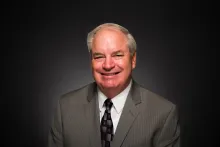
Robin Webber was born in Chicago, Illinois, in 1951, but has lived most of his life in California. He has been a part of the Church of God community since 1963. He attended Ambassador College in Pasadena from 1969-1973. He majored in theology and history.
Mr. Webber's interest remains in the study of history, socio-economics and literature. Over the years, he has offered his services to museums as a docent to share his enthusiasm and passions regarding these areas of expertise.
When time permits, he loves to go mountain biking on nearby ranch land and meet his wife as she hikes toward him.
