

Robin S Webber
This transcript was generated by AI and may contain errors. It is provided to assist those who may not be able to listen to the message.
Well, thank you very much, Omar, and appreciate the lovely flowers that we have today. And what a blessing that we have a wonderful group of instrumentalists that can play and add to and complement what we do in singing praises to God. Well, I am looking forward to offering and giving you this message today. I think it's one that each and every one of us need as we move towards the Kingdom of God. All of us at one time or another have either heard or we have imparted the wisdom, or what I might call the bumper sticker wisdom, of don't sweat the small stuff. Don't sweat the small stuff. And that is really good advice. That is, if you will take it and if you will remember it.
But let's have a full confession. I think that's a term that we'll use in the opening message. We all do, at one time or another, sweat the small stuff. We actually do all sorts of stuff. And just when we stop sweating the small stuff, we push the replay button and we start all over again sweating the small stuff. If you do not believe me, just listen to what people talk about. What we talk about. When I was growing up back in the 50s and the 60s, and I'm an optimist, I think I'm still growing up.
But to recognize back then we had 45 label records. Remember the old 45s? And they would go around and around. But then all of a sudden, you know, there'd be a piece of dust in the 45 and just start, no, again, kind of like a CD today or whatever you're listening to.
I'm probably dating myself with CDs now. I'm sorry. You're all smiling. Thank you very much. Oh, we love the young people. Okay. So anyway, but you know, get stuck and over and over and crack and over the same words and same words. And the truth is that we do sweat the small stuff. Yet, with that spoken, because I'm not just simply going to deal with sweating the small stuff today, with that spoken, there are indeed mid-weight and some heavy-duty loads of lives challenges that each and every one of us is called to deal with. Allow me just to share a few with you, if I may, to think about it.
What are some of those challenges that are confronting us, some of us today in this room, and or if not today, will confront us in the future, such as a threatening disease and or the loss of a loved one or the lack of response of a child that will not respond to our parental love? What about the loss of a cherished job that we've had for so many years or perhaps a business that has gone south that we thought we were blessed with and that we really saw a future towards for ourselves and for our family?
Or a marriage that has gone sour? And if not sour, perhaps a marriage that has just gone still? Or how about a friend that continually disappoints us? In all of these, at times, as a Christian, even our God, even our God, can seem far, far away. What I'd like to do in the course of this message is peel away that bumper sticker wisdom and go a little deeper with all of us. And probably what we're going to do, if you'll stay with me on this ride, is we'll go a couple levels deeper and we'll look at it individually and also we'll look at it collectively.
And we'll take a reality check and see where we are for the moment. I have a question for you right now. May I? That is simply, what are you worried about and what have you worn on your shoulders or in your heart as you came into this room that really has your mind fixated right now? That you are worried about? Or do I dare say you are bugged about or thinking about or just something has gotten into your head that you cannot get rid of?
I'm trying to create a wide enough net to bring us all into this message to say, he's talking to me. He knows where I'm coming from. That's right, because I am one human being and a Christian just like all of you. You know, it's very interesting that 90% of what we do worry about at one level, 90% of what we worry about never happens. And the 10% of what does happen, 90% of the time doesn't happen the way that we thought it might happen.
Now, if I've confused you with the math, I'm actually going to go a step further because the second level is there are things, there are things that get in our way in our walk towards the kingdom of God. And I want to share something with you, and that is simply this. Whatever is on your heart, whatever is in your mind right now, let's ask ourselves a very basic question. And you might want to just put this down in two points.
Number one, is it worth the energy load that you are expending right now on what you are concerned about? Is it worth the energy load? And is it worth your heart's distraction from those matters that truly are worthy of your life's devotion? See, we've been called of God. We are members of the body of Christ. God has given us a great gift. And with that gift comes responsibility and accountability with the gift that God has given us. Thus is what we are encumbered with, perchance. Is it really truly worthy of the calling of God, of the sacrifice of Christ, and what He has called us to towards the future?
With that stated, though, let's go again a little bit differently to that second step. And that is to recognize that there are some things that are not going to go away. You can't wish them away. You cannot necessarily hope them away. And for the moment, they are upon us.
And these are those matters that are mid-weight, heavy-weight, duty-weight, whatever you want to call them. And the question is, what will you and I do with that to move beyond that urgency of now that encompasses us? So what I'm going to be talking about today are not different trials and not different challenges. But I'm going to talk about a different way of thinking about what you and I are going through today. And I'd like to give you the title of this message. And it is simply this, fixing our eyes on eternity. Fixing our eyes on eternity.
It's a message that I speak to myself. It's a message that I love to give to other people. Because it's very, very important sometimes in our church culture or our understanding. And it is simply this, that the kingdom of God is not just merely a destination. So often we think of it and we see it out in the future. The kingdom of God is not merely a destination. It is a way of traveling. Today, tomorrow, Monday, Tuesday, Wednesday, it is not a destination alone.
And yes, it is. And we'll speak to that later. But it's a way of traveling in the now to invest in the calling of God. With that stated, recognizing that you and I are participants in this world of time and space. How do we handle some of these challenges that you and I are going through and that some you alone know what your challenges are?
I don't know yours. I know many of yours as a pastor, but that, and you don't necessarily know Susan's and mine. But all of us are challenged. Nobody has a silver spoon in this life. How do we deal with these challenges in the light of eternity? Let's begin by number one, going to Philippians 4 and verse 13. Join me, if you would, please, in the New Testament, Philippians 4 and verse 13. And let's center on a verse. Look at that for a moment. Then we're going to build upon that with another verse in the epistle of Paul, Philippians 4.
How do we move forward, even with the challenges that are upon us? Notice what it says here in verse 13. Paul comes to point, a man that was challenged all of his adult life, and especially as he was called into the ministry of Jesus Christ. And he makes a very bold statement. He says, I can do all things through Christ who strengthens me. I can do all things, but I can't do it by myself.
But I can do it through Jesus Christ who strengthens me. I submit to all of you that that is a promise on the lips and on the pen of Paul. It's a promise from God that no matter what happens in this time and in this age, in our story, in our time, that God will make a will, that God will make a way and help us through Jesus Christ.
It doesn't mean that we're going to be storm free. It does not mean that we're going to be challenge free. But that is a promise that we can take to the bank. And I would submit to this. It is a promise that we can, yes, indeed, not only bet our life on, but give our life for.
Which then allows me to take us to Luke 9. Join me if you would in Luke 9 and let's focus on this for a moment.
In Luke 9, and let's pick up the thought if you could in verse 23. What I just shared with you in Philippians 4 and verse 13 is a promise. But the promise is based on a premise. The promise is based upon a premise. And in Philippians 4 and verse 13, notice what it says, excuse me, in Luke 9 and verse 23. Notice what it says, then He said to them all, that is speaking of Christ, if anyone desires to come after me, let him deny himself and take up his cross daily and follow me. It's very specific. We know that Jesus picked up a cross, the cross of salvation. We do not bear that cross. He alone was worthy to bear that cross. And that's the cross that the Father sent him to this earth to bear, that we might have a way and a bridge to the Father. This is a different cross. This is the cross that we have to bear. Some of the issues that I brought out earlier. And nonetheless, so it says, and follow me, for whoever desires to save his life will lose it. But whoever loses his life for my sake will save it. For what profit is it to a man if he gains the entire world and is himself destroyed or lost? For whoever is ashamed of me and my words of him the Son of Man will be ashamed when he comes in his own glory and in his Father's and of the holy angels. But I tell you truly, there are some standing here who shall not taste death until they see the Kingdom of God. That is often thought to be an allusion to the Apostle John. An allusion that was actually a reality when the vision of the Kingdom of God came to him with the Book of Revelation. But I want to share a thought with you, if I could please. You might want to be daring enough in your Bible to circle that word, see. Because that is going to be incredibly important as we learn how to fix our eyes, how we have the vision that God wants us to have. To see, to fix our eyes on that which is the Kingdom of God.
These eyes that God gives us. These eyes that are to be fixated on that Kingdom, I want to share something with you. It's very important to understand. If we do not understand this, we cannot move forward in this message. So we're going to go step by step. The eyes that I speak about are not natural eyes. These eyes are a gift. Well, where did you find that, Mr. Weber? I found it over in the Gospel of John. Join me if you would for a moment. In John 3, let's go over to the Gospel thereof. In John 3. And we're acquainted with this story. It's the story where a good man, a man who is a Pharisee, a man who is of the Old Covenant, a man who sincerely wants to understand and know, approaches Jesus in the middle of the night. His name is Nicodemus. And he comes. And he speaks to the Christ. And he says, this man came to Jesus by night, verse 2, and said, Rabbi, or teacher, we know that you are a teacher come from God, for no one can do those signs that you do unless God is with him. And Jesus answered and said to him, most assuredly, I say to you, unless one is born again, unless one is born again, he cannot see the kingdom of God. The literature here says, born again. You can also use the phrase, born from above. Whether you use one term or whether you use another term, here's the bottom line. Unless something miraculous and the intervention of God comes into your life, you are stuck with the pair of eyes that you were born with. Remember when you were born, they always put down your head, blue eyes, brown eyes, purple eyes. No, it usually goes down. People are identified with the color of their eyes. Think about your eyes, whether they're blue, whether they're brown, whether they're green, whether they turn on and off, I'm not sure. This is not what we're talking about here. What is specifically being spoken about here are not the natural eyes that you were born with at your physical birth. You realize that God gave us new eyes when his miracle came upon us, when God the Father called, when we surrendered our life to him through the life, the death, the resurrection of Jesus Christ, and accepted in faith that God above sent his Son. And we said we are no longer going to be our own person, our own man, our own woman, and we are going to give ourselves to God in faith. And at that time when he gives us his Spirit, he gives us a new vision. And just as that baby, that natural baby, is born with natural eyes that serve him in time and space, you and I are given... notice again, this is a wonderful verse. Notice what it says, Most assuredly I say to you, unless one is born again, born from above, has this miracle... notice, he cannot see the kingdom of God.
I'm here to remind all of us today, dear friends, that you and I have been given a gift. How neat is that? How wonderful is that? And yet the reality is even the people of God can live as if they don't exist. Let's consider a few thoughts here for a moment.
Number one, some of us may not know that they do exist. And we haven't been using them. Number two, some of us have forgotten how to use them. And number three, unfortunately, some of us, per chance, because of life circumstances, have chosen not to use them.
But consider this. What advantage is it to utilizing the eyes that God gives us at that new spiritual birth? You ever thought what an advantage that is? Just imagine for a moment, let's do some Imagineering. Do a little bit like John Lennon's song to imagine. But this is even better imagining.
What advantage, using these eyes from above that are given to us now, to understand that the kingdom of God is not just simply a destination in the future, but it's a way of traveling now, that we might be alight, that we might worship God daily, that we might glorify God in our actions, and that we might be a blessing to other people. What advantage? Just imagine.
Just imagine seeing consequences of your words, your thoughts, and your actions roll out and see the consequences before they're done. Just imagine avoiding temptation. Imagine establishing correct priorities, perhaps for the first time in your life. How about making the best of our time? How about loving unlovable people? How about avoiding the tyranny of the urgent? Everything is so urgent these days. Am I the only one that noticed?
When I go through the airport, I'm always reminded how urgent life is. People have this little thing in front of them. It's always in their hand. Don't leave home without it. And they're doing this, and sometimes they do the sign of the cross. You've seen that on those little smartphones, going like this, going like that. And they just have to know what is happening around the world.
Or does somebody like me? Is it thumbs up or thumbs down? Or is somebody calling me? Or am I about to miss something? Sometimes I try to remember what was life like back in the 1950s when it was just sunbeam toasters and three stations. How primitive. But everybody's got to know right now, and we're not going to know everything right now. I am not dissing, to use a phrase, technology.
It can be used well. But it's created this. How about discerning people's intentions and having those spiritual eyes, those eyes that come from above? How about being able to understand motivations and intentions? How about accepting the uncontrollable and or living in a contented life without sweating the small stuff? When we are baptized and we receive the Holy Spirit, God gives us a new set of eyes. He gives us a vision. Many of you that are in San Diego have heard me say this before, but some of you are new.
Back in the 1960s, during the Vietnam War, those nighttime vision goggles were invented. It allowed our service people to go into the jungles of Southeast Asia. They were able to see things that could not be seen readily with the human eye. That is what allowed them the American Armed Forces, whether it was in Southeast Asia of old, or over in the Middle East today, or wherever the Delta Force or wherever the seals are sent. It allows America to own the night and to fight in the night and to become victorious.
That is exactly what that new pair of eyes that God has given us is all about. It allows us to see the light in a jungle. It allows us to see beyond the darkness that can sometimes enshroud us or encompass us. We've got to be willing to use it. We've got to see the ability and what God wants us to do with all of this. If we do use those, what can we do and how will it affect us?
By fixing our eyes on eternity and using those new eyes, what will it allow? I'm going to give you three simple points. Are you ready? Number one, by using those eyes that are fixed on eternity, it grants us God's perspective. God's perspective on our past and on our present. Sometimes, like I said earlier, because of the challenges that we are on and the storms of life that have encompassed us, sometimes we can feel like we're out on a boat, tossed to and fro on the waves of the sea.
God never promised that we would live a storm-free existence as a Christian. But He did say that by His grace and by His power and by our participation, that those storms could be transformed. Join me, if you would, in Colossians 1. Let's pick up the thought here again in another epistle of the Apostle Paul. Colossians 1. In Colossians 1, let's just do a reading for a second and allow these words to fall upon the ears of our heart.
Notice what it says, giving thanks to the Father who has qualified us. We don't qualify ourselves. There's nothing by our human works that grants us the grace of God. It says, giving thanks to the Father who has qualified us to be partakers of the inheritance of the saints in the light. He has delivered us from the power of darkness and conveyed unto us into the kingdom of the Son of His love, in whom we have redemption through His blood, the forgiveness of sins.
And He is the image of the invisible God, the firstborn, over all creation. For by Him all things were created that are in heaven and that are on earth. Visible? We can deal with that. Oh, wait a minute. And invisible. Whether it's thrown to minions or principalities of power, all things were created through Him, speaking of Christ and for Him. And He is before all things. And notice, and in Him all things exist. All things exist. What this set of verses does for us, friends, it brings us into total alignment of the incredible purpose that is being worked out here below and that you and I are a part of it.
All things were created by Him and through Him consist of Him. He is not a part. Stay with me. He is not a part from what we are going through. Whatever we are going through in life before God the Father and Jesus Christ, it is within their consistency. It is within their vision. There are many people that can be satisfied with an absentee cosmic landlord. In other words, that God created earth and He's got it spinning like a top and it's still spinning, but He's up there and leaving hands off.
God is not an absentee landlord. He is not merely just simply first cause. He's not first cause. Some people get benevolent with their thoughts and think, well, yes, I believe in a God with first cause. God is more than first cause. He is every cause. He wants every human being that is made in His image and after His likeness. See, we are not a part of something that comes out of a slimy pond back in the Pleistocene period.
My ancestors are not apes. My ancestors are not lizards. My ancestors are not lovesick amoeba in some slimy pond that got to going through photosynthesis on a tropical day long ago and far away. We are a creation of God for a purpose. Let us make man in our image and after our likeness. There is indeed a purpose that is being worked out here below. And the one thing that we have to understand, especially when we have these storms of life come upon us, those things that are bigger than just simply the small stuff, but the mid-level stuff and the big nuclear stuff that's happening in our life, is that God is in the storm.
God is with us and He's shaping and He's molding us for His purpose and for His reasons. Join me if you would in Revelation 4. Again, we go from Paul to the Revelation of Christ through John in Revelation 4. And let's take a look at here for a moment. In Revelation 4 and verse 11, we're breaking into Revelation and there's some concern because of the seals.
Because remember there's a scroll and it has seven seals and everybody's kind of getting a little bit worried with all of this that's happening. Who is worthy to be the revealer, the revelator? Who is worthy to unbreak the seals? And we find this in Revelation 4.11. You are worthy, O Lord, to receive glory and honor and power. You can hear that coming through Handel's Messiah.
For you created all things and by your will they exist and notice and were created. Right now, in this room, and sometimes there can be utmost loneliness even within a crowd, some of us may feel distanced from God this day. And or perhaps we feel unworthy of His love. I know oftentimes this comes up as we approach the New Testament Passover and partake of the bread and the wine. People just say, oh, no, no, I just shouldn't go to the meeting. I shouldn't take of the bread and wine because I'm just not worthy. No! Often by ourselves we are not worthy.
And when we can get that in our mind and in our heart, things can begin to happen. We're not worthy by ourselves, absolutely. But we're worthy because of God. I'd like to share an expression or saying by a gentleman named Ian Pitt Watson. Listen to this for a moment. Maybe this will help some of us. Some things are loved because they are worthy.
And some things are worthy because they are loved. I'm going to read that one more time. If we can begin to understand that, we can better have our eyes fixed towards eternity. Some things are loved because they are worthy. We have no worth of and by ourselves in this human framework. But, and some things are worthy because they are loved. Revelation 4 verse 11 says, You are worthy, He who became Jesus of Nazareth, the one that was the Word, the one that was sent by the Father to this world. For God so what loved the world, John 3 16, that He gave His only begotten Son, that whosoever believeth on Him should not perish but be saved. God's grace extends from His throne. It is a spiritual, in a sense, you might even say, tsunami of love that comes our way and touches every shore of our existence. It is He that allows us to be worthy, no worth by ourselves. When we move from head knowledge to rejoicing in our hearts what God is doing, our lives begin to change. Join me, if you would, for a moment in the Old Testament. For those of you that are here for the first time, we use the entirety of the Bible. We look at the Bible as being God's revelation bound in two covers. Zephaniah, at the end of Old Testament. Join me, if you would, in chapter 3. Zephaniah 3, and let's look at verse 17. If you don't know where Zephaniah is, it's on page 1088 of my Bible. That may not work for you, though. Zephaniah 3, 17, notice it says, The Lord your God in your midst, the One, the mighty One, will save and notice, and He will rejoice over you with gladness. He will notice quiet you, quiet you, with His love, and He will rejoice over you with singing. Have you ever noticed that verse before? I love it. God makes a promise in Scripture. No matter what we're going through, the small stuff, the mid stuff, or the heavy-duty, nuclear stuff in life, it says that His love will quiet us. That is, if our eyes are fixed on eternity and we are using the eyes that we are given at that new birth. Notice again what it says here. He will rejoice over you. He says that twice in that verse. But we don't get something for nothing. That rejoicing, you know, it's interesting. Sometimes we look at Isaiah 46, 9-10, where it says that God will declare the beginning from the end of the end from the beginning. And He says that, My purpose shall stand. Are we all familiar? Most of us are familiar with that verse.
We see the purpose. We see the heavy-duty stuff. And it says, And I will do my pleasure. We get so purpose-focused that we don't realize the pleasure that we bring our Father above when we emulate the example of His Son. There is sheer pleasure. That pleasure does not come through not moving through this life. There is no gain without pain. The good book itself says that each and every one of us must carry a cross. I've always remember Eric Lidle in the story of Chariots of Fire, a Scottish missionary, a Scottish athlete during the 1920s, going up against the Olympics. And his fiancé is saying, God is calling you to be a missionary. And actually, he did become a missionary over in China later, and actually died in World War II in a prison. But at that time, he was one of the great athletes. And he looked at his fiancé who was kind of going at him, saying, is this really worth it? And he said, I run to feel God's pleasure. That line has always stuck with me. I have a question for you. Why do you walk the walk of faith?
Why do we run that run towards the kingdom of God, just to get across the finish line? Or are we a part of this life? Do we embrace the calling that God has given us to feel his pleasure, to internalize the joy that Jesus had, when it says in Hebrews 12, that for the joy that was set before him, he endured the cross.
Those eyes that are fixed on eternity will understand that it is not just God's purpose that we are living out, but that you and I, no matter what comes our way, have been called to experience his pleasure.
And that will not always mean a smile on our face, especially what some of us are going through. But understand that God will never be late. He will always be on time, not our time in this world of time and space, but on that time to make sure that one day he will bid us into eternity if we have faith in him. So we need to understand that. Number two.
Eyes that are fixed on eternity view time differently. View time differently. They just do. They don't just simply view their calling differently and understand that their worth comes from God, but they view time differently. And that's very important to understand.
When you go through the Word of God, I'm not going to have time to do it.
Come back again. We'll talk about it. But we all live a certain number of days on this earth.
The Bible tells us that. In contrast to that, God says that he's offering us eternal life.
But for now, you and I, as human beings, we're locked into this world that has beginnings and endings, clocks, schedules, deadlines, and alarms.
Here's the reality of all this, dear friends, is that our human reality is that our days are numbered.
Our days are numbered. They're numbered for each of us. And each of us have a different number.
And yes, one more thing. We don't know when our number is up. Did you follow all that number stuff? I'm going to repeat it.
Our human reality is that our days are numbered for each of us. And each of us have a different number.
And none of us know when our number is up. And yet, all of us, having said this, and I think we're all in an agreement.
I didn't see anybody walk out on me, and I didn't see anybody walk towards me. That means you're all in an agreement.
So far, so good. But we live our lives as if our number is not up, and that we have all the time in the world to do what we do without serving God's purpose and living in His pleasure.
But what does God say about all of this? Jeremy, if you would for a moment in Psalm 39 verse 5. Psalm 39 verse 5.
You know, when you think about numbers, when you think about life, most of us think that our number is going to go on forever.
Have you ever noticed, or am I the only one, that the younger generation thinks that they're immortal?
Especially young boys when they jump off roofs, or these young guys that swerve in and out of a freeway and are willing to give your all for their cause, and even if they go over on their motorcycle.
Or am I the only one that sees that going up and down the 15? So the young people think that they're immortal, and the older people never think they're getting old. Have you ever noticed you get older?
You talk about all the old people, and all the old people are 15 years older than you. That's old. Somehow you retain this 14-year image in your mind.
Notice what it says in Psalm 39 verse 5.
Indeed, you have made my day as hand-brass, and my age is as nothing before you. Certainly every man at his best state is but a vapor.
Then notice verse 4 in front of it.
Lord, make me to know my end, and what is the measure of my days, that I may know how frail I am.
This is not the natural mode. This is not the natural bent.
What David was mentioning here is allow me to have eyes that are fixed on eternity while I at the same time recognize how short my life is in this time.
Psalm 90 in verse 12. Again, the wisdom of Moses coming out of the wilderness. One of the great wilderness Psalms in Psalm 90 in verse 12.
So teach us to number our days that we might gain a heart of wisdom.
Teach us to number our days, that which is ahead of us. We cannot change the past.
The present is here and will be gone. All we have is to be responsible for the future.
So what are our plans? What is ahead?
And sometimes whatever you and I are going through is inconsequential to the worthwhile eternity that we read about in the Bible.
Sometimes when we mention that word eternity, people say, well, you know, this life isn't going so great to begin with.
I cannot imagine it being stretched out beyond time and space and going on and on and on, because we're thinking of the life that we're living right now in this life.
Some of the horrendous experiences that we've had in this life in our youth or in our middle age.
And so we transpose that to what worthwhile eternity is, where there is no tear, there is no sorrow, there is no pain.
There will be no more curse from Genesis. Everything will be relationships that are not on hold, but are whole and holy and upbeat and uplifting.
And to literally be in the presence of God Almighty and Jesus Christ. There's going to be so much activity, there's going to be so much dynamism, there's going to be so much work that is happening in that realm of eternity that brethren, our minds just can't absorb it.
We don't have the instrumentation, we don't have the eyes, the ears to understand right now what eternity is going to be like. But we can't have a glimpse, we can have an understanding that it is in contrast to this world that you and I are existing in.
If I state that, my question is simply this, what are we wasting our time on today when God has given us so much?
Is what we are involved in, what we are worried about, what we are concerned about, that is just like a knot in our tummy, that is a brain drain in our head, that is dominating our thinking.
What is that in light of what eternity is going to be like?
Whatever you are worrying about right now, whatever your goals are, whatever you are putting your life's energies in, I have a question for you, may I ask?
Will what you are working on right now, what is fostered in your thoughts, what is dominating your heart, just ask yourself a question, please.
Will God allow that into eternity?
Will your energy, your time, and your space be fixed? If not, what will you do about it after this message?
You do it by having eyes that are fixed on eternity.
When you think about that and have your eyes fixed on eternity, it will affect everything you do. Your time, how much time we waste, our priorities. It will also, think about this, it will guide you in how often you say yes to people and how often you say no to people.
Often, some of us say yes too much and not know enough, the things that dominate our life.
Conversely, some of us need to say yes, less, and no.
I've stated this before, I've kind of gotten this awareness that my days are numbered. I'm 64 years of age.
My wife and I are grandparents seven times over.
Much of our physical existence is over, but boy, I've got a lot of spirit on the other side. Can't get enough.
But my time is limited. I think sometimes over the years, I've allowed people to come into my life and dominate my mind or get into my head or get into my thinking or make me go over in this detour or go over in this detour.
Rather than serving God Almighty and Jesus Christ and allowing things to dominate me.
And then I just keep it on the shelf of my life. I can't afford that anymore. I'm just being very, very honest with all of you.
Oh, I can be with people. I will deal with people. But I will deal with them as Jesus did because so often what Jesus did in His teaching the disciples, He taught them time management.
He taught them time management of what will come in and out of their life as they themselves fixated their eyes on eternity and had a mission.
We're given that mission to accomplish. And that's not just me as a pastor. That's not just me as an educator. That is given to each and every one of us.
We only have so much time.
What are you doing with your time? And where are your eyes placed on the kingdom of this world or on the kingdom of God that is going to come?
And how are you traveling through this world? Let's go to point number three. Eyes fixed on eternity transform how we view people.
How we view people. You know, most of our challenges are with other people.
We intend to intertwine our solutions on their problems and vice versa.
And it's hard enough, as Will was bringing out in his first message, it's hard enough to change ourselves, much less other people. But have you ever noticed? We don't stop trying. We try to get our fingers into their minds and into their hearts.
So what do we do about that? What do we do about that?
What do we do when our eyes are fixed on eternity?
You know, in dealing with some people, even people that are in sin or in a wrong lifestyle.
I think Will spoke to this a little bit. Confrontation, which we are so good at, both men and women, boys and girls, even when well constructed and we have the best strategy to make the other person see our way, can fail.
Negotiations can fail. Even sympathy and empathy can fail.
But I want to share a thought with you out of Paul's words in 1 Corinthians 13, verse 8.
Join me if you would, please. We have to sometimes just simply have the long game and the big picture in 1 Corinthians 13, verse 8.
It says that love never fails, but where there are prophecies, they will fail.
Where there are tongues, they will cease. Where there is knowledge, it will vanish away.
Where perhaps we want to superimpose all of our good solutions on somebody that is not ready to receive them right now.
Even though they ought to. That too can fail. But love never fails.
The greatest benefit of viewing people through eyes fixed on eternity is that you will begin to see their potential.
You will begin to see their possibilities even beyond that sticky moment that you and they are in right now.
When we remember where God picked us up. He picked us up even sometimes when we were boasting of our zeroness.
Because that's how Paul puts it, with all human beings.
Paul said that at the end of the day when we look at everything we are like filthy rags.
Yet, we've never had any problem putting our filthy rags in front of people and saying, look how good they are!
Paul warned us not to boast of our own zeroness.
Remembering that God sent Jesus Christ to this earth not to make good men better, but to allow dead men to live now and forever.
Let's notice something here, and I'll just share this with you for a moment.
The great benefit of viewing people with such eyes is to recognize this, that things begin to happen.
We look at David being more than a shepherd boy. We look at Jacob.
We look at Jacob.
And remember that he didn't really begin to get his act together with God until that wrestling at nighttime. You know how old he was? Not as old as I was.
You say, but Mr. Weber, you don't look like those Renaissance pictures of Jacob wrestling the...
No! Jacob was a grandfather. Remember, he left his whole family down at the river, right?
Down at the river. Because he didn't quite know what his brother was going to do to him.
Jacob was an old guy. Jacob had always looked to God as being the God of Abram and the God of Isaac.
Jacob never quite felt like he was in. Because, you know, what do you do when your granddaddy is the father of the faithful and your father is the son of promise?
What part of life can be carved out for you? Are you with me?
Sometimes we think we don't measure up. God had a purpose and God had a pleasure in Jacob.
And he had a long view of recognizing that Jacob was going to be used.
I have a question for the people that we are dealing with right now. Whether it's our wife, whether it's our husband, whether it's our child, whether it's our adult child, whether it's our employer, whether it's our employee, whether it's a teacher that we have at school.
Do we have a long range view?
And are praying about it specifically? That God will deal with that individual?
Remember how we talked and had the series on prayer? Are we specific that God will act not on what we want but what he wants and begin to make things happen?
What about John Mark in the New Testament? Paul had had enough of him. Barnabas stuck with him.
And we read in the story later on, the last person that Paul wanted to see, when John Mark, he didn't think he could do anything, he says, you have John Mark come and see me.
And that young guy that he gave up over in Asia Minor was one of the great contributors to the Gospel story.
We read his story in Mark. God never gives up on anybody. He's got a long-term view.
He's got a long-term view even with that thief on the right hand of Christ when he was dying, what we call the good thief, colloquially.
He had a long-term view of that man. He said, this day I say unto you.
And he gave that man hope and he gave that man encouragement. He saw beyond Jerusalem, he saw beyond Golcotha, and he saw, here's a man that I can have a relationship with and deal with when all the religious folk were down below him, scorning him, and vilifying him. See, that's what eyes fixed on eternity do. They have a different vision. They go deeper.
They're like those Vietnam goggles. They make things come to light even in the darkness, even with people that sometimes we just simply don't understand.
Sometimes we think about our children that may not be in the way, might not be abiding in the truth that we raise them up in at this time.
I take great encouragement that God has given me personally and some of you and all of us in that sense, eyes that are fixed on eternity.
The story is not over. Every knee, every heart, our children, our adult children perchance that have not accepted the way, will one day have to surrender.
They will have to bend their hearts and they will have to bend their knees because God does not have grandchildren. He has children.
We're called the children of God. So each and every one of us must come up against that moment of surrender and give ourselves up and recognize He that saves his life loses it and He that will lose his life will save it.
I'm going to conclude with the story. I'm going to conclude with the verse. Just going to go five minutes here. Okay? Are you with me?
I want to share a story with you. It's one of my favorite stories by H.G. Wells. This is where you can just lean back and listen for a moment. It's short.
H.G. Wells we know is a very famous science fiction writer, but he also wrote a lot of essays. Listen to this for a moment. He wrote a story called The Country of the Blind.
It was about a man who fell over a precipice into a valley, isolated from the rest of the world. He discovered that there were people there that were completely blind.
In fact, they had no eyes in their faces. No one had ever seen the sky, and they didn't know what sunlight was like.
They were incredibly inventive and clever with their hands, but they only believed in what they could taste, touch, and feel.
They told the visitors there was a solid ceiling above the valley with some mechanical arrangement affixed to it, which caused water to fall at certain times and had to be turned off and on at other times.
When he assured them that there was no solid ceiling, but a glorious infinity of sky, filled with stars by night and the glory of the sun by day, and that water fell from cloud-gallions sailing in the marvelous ocean of the sky, and that warmth streamed upon them from a flowing heavenly body millions of miles away, they first of all mocked him for supposing that they were gullible enough to believe such childish fantasies.
And they said he was obviously a lunatic. He might even be dangerous.
Finally, they insisted that he must undergo a surgical operation. They had skilled doctors.
And let them remove the two soft, twitching, bulging objects which they could feel in his face by means of which he insisted he could perceive the things that he told them about.
Evan and these eyes were the cause of his mad delusions. Once removed, he would be just like them, happily unaware of a dream world of fantastic nonsense and satisfied with the practical world of things that are eaten and touched.
But rather than lose his precious sight, the man chose to climb up against to the foot of the precipice over which he had fallen, and there, in the freezing cold of the mountain night, he lay down, and his eyes were lifted up to the coming sunrise in the country of the blind.
People of God, you and I have been given a precious gift. Eyes that come from above. 1 Corinthians 2, verse 9, I hath not seen, neither has ear heard. I have not seen, neither has ear heard. Natural eyes, the human existence alone, not touched by God, cannot see the things of God, cannot understand that the kingdom of God is not just simply a destination, but a place of peace. Therefore, we do not lose heart. Even though our outward man is perishing at the inward man is renewed. Notice our light affliction. Are you kidding me? You don't realize that my problems, my challenges, have gone nuclear, thermonuclear. Well, this is a guy who knew about thermonuclear affliction in his life. For our light affliction, why could he call it light? Because it was in contrast to eternity. Which is but for a moment, oh, this just does not seem like it's ever going to go away. On and on and on. Almost like the saints in Revelation 6. Lord, how long, how long? So it's light, it's but for a moment. But it's not just simply for naught. Notice what it says here. You might want to circle this. It is working for us, a far more exceeding and eternal weight of glory. We are not going through what we're going through for naught. It is for a purpose. It is for completing us in the image of Jesus Christ. That we might worship God, not only in the sunshine but in the dark. That we might be able to glorify Him, not only on a mountaintop but in a prison. As we talked about with Paul and Sylvanas a couple of weeks ago. While we do not look at the things which are seen but at the things which are not seen. For the things which are seen are temporary. But the things which are not seen are eternal. Dear friends here in San Diego, once God gives us this gift, He expects us to hold on to it. But not just hold on to it, He expects us to use it. One thing I want to remind you about eyes that are fixated on eternity. They're a gift because at the end of the day and towards eternity, remember this. These eyes are on loan to us. For they are the eyes of God who is ageless and eternal. To whom all praise, all honor, all worship, and all glory are due. And if they are due, let's use those eyes. Move forward, remembering that the Kingdom of God is not just simply a destination, but it is a way of traveling that God has ordained. Look forward to seeing all of you after services.
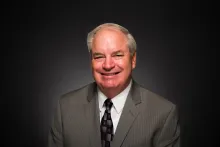
Robin Webber was born in Chicago, Illinois, in 1951, but has lived most of his life in California. He has been a part of the Church of God community since 1963. He attended Ambassador College in Pasadena from 1969-1973. He majored in theology and history.
Mr. Webber's interest remains in the study of history, socio-economics and literature. Over the years, he has offered his services to museums as a docent to share his enthusiasm and passions regarding these areas of expertise.
When time permits, he loves to go mountain biking on nearby ranch land and meet his wife as she hikes toward him.
