

Robin S Webber
This transcript was generated by AI and may contain errors. It is provided to assist those who may not be able to listen to the message.
Allow me to move into the message this afternoon. It's been a wonderful Days of Unleavened Bread 2016. For Susie and myself, I think Susie has been observing the Days of Unleavened Bread since 1962. I believe the first time I kept it was in 1963. We both feel that this has been the most spiritually rich, dynamic, and wonderful Days of Unleavened Bread that we've ever been able to experience. That's why we keep on coming back again and again. That's why God wants us to absorb this revelation that He shares with us in this spiritual GPS towards the Kingdom of God called the Festivals. We have an outline. We have a general understanding. We don't always know every twist, turn, curve, and bump along the way, just like with your GPSes. But to recognize that God has given us a grand revelation to understand what He and Jesus Christ are doing. I want to talk specifically this afternoon about the Days of Unleavened Bread. I realize that we have some individuals that will be hearing this message for the very first time. It's always good to get right into some of the activities and sequences and events that occurred during these days. Here we are on the seventh day of the Days of Unleavened Bread. We believe that by tradition it's on this day in which ancient Israel walked through the sea on dry land.
Last night, while we were in our homes, or maybe feasting and having fellowship, we were reminded in the Book of Exodus that a mighty blowing wind came up to begin to work with the ocean. And then when Moses gave the command, the sea was opened up before Israel.
Then they entered, and then the Egyptian army, in their rage and in their anger, entered. They took the bait, and we know that they were destroyed. When we think about that sequence, we think of Israel in just a few hours, because it's a mighty wide sea, that they went from the shore of slavery and death, they crossed through the sea. And as Corinthians says, that they were baptized unto Moses, and they were all under the cloud. And they came up upon the shore, the sure shore of freedom, from slavery to freedom, with that gulf in between them as the water came back. We know the Psalms of Hosanna, the songs of praise, the ladies with Miriam with joy, and were almost hilarious in praising God with what He had done before them. And seemingly, it was all over as they viewed that miracle from dry land, from the other shore, and understood what God had done for them. After that, they thought that it would be a cakewalk to the promised land. Here we come. But little did they know what God had in store for them, to prepare their hearts for that which He had promised. Which begs the question of each and every one of us, and I ask you, do you know what God has in store for you to shape and mold your heart as we begin to move away from this, the days of Unleavened Bread? They thought it was going to be a cakewalk. They thought it was just going to be a glide towards Jericho. Historically, they were not alone in their assumption. I'd like to share a story out of World War II. It's a story about the man of the first half of the 20th century, or so he was called. It was Winston Churchill. On November 10, 1942, Winston Churchill gave an address at Mansion House, London. And it was entitled, The Bright Gleam of Victory. As Winston Churchill did in his inimitable style, if you've ever seen him on YouTube or a documentary in school, he followed the Lord Mayor. And he said, I noticed, my Lord Mayor, by your speech that you had reached the conclusion that the news from the various fronts has been somewhat better lately. Let's understand. This is November of 1942. England had been, and the Empire then, had been in the war for three years. Many years in Europe had been on the side of the Axis Powers, country after country, was falling. And of course, much of the British Empire lost a lot of their outposts in Southeast Asia, as we had Pearl Harbor bombed. It was seemingly one thing after another, even as they sent young lads up there to fight the Battle of Britain and every plane that they could muster, or to take their soldiers from the shores of France and Dunkirk and took every boat available to bring back their lads from France and to give them safe escape. So it had been a long haul for the British Empire. And so now he said this, he said that it seems like some good news has finally come in. He then said, I never promised anything but blood, tears and poil and sweat. Now, however, and he was referring to what would later on be called the Battle of Egypt, where Rommel was defeated, he says, now we have a new experience. We have a victory. In fact, we have a remarkable and a definite victory. The bright gleam has caught the helmets of our soldiers and warmed and cheered all of our hearts.
But then he gave a warning. He gave an admonition. Now, this is not the end. It is not even the beginning of the end, but perhaps it is the end of the beginning. Now, how does all of this relate to us, whether it be those that were on the sure shore of freedom on the other side of the Red Sea and or what Winston Churchill said, that it is not even the beginning of the end, but it is perhaps the end of the beginning. As we begin to close this chapter on the New Testament Passover and the days of Unleavened Bread 2016, and we have been thrilled, we have been admonished, we have been informed, we have been inspired, and hopefully transformation is actually, truly happening in our lives, that we're not just going through this as Ritt wrote, but things are really happening here, that we recognize that the pilgrimage does continue. What Paul coins as the walk by faith. And just as God had more in store for ancient Israel to prepare their hearts, for the promises that He had assured and said would be theirs, we also, as the Israel of God, need to be prepared, recognizing that this is not the beginning of the end. It may even be the end of the beginning, but the story, the journey, your journey, my journey, not alone, but with God the Father looking down, and with Jesus Christ saying, lo, I am always with you, even to the end, that we look forward to a promise greater than the promised land of milk and honey. We look forward to God's invitation of entering eternity, entering eternity, as the immortal children of God, to have relationship with God the Father and Jesus Christ for the rest of forever.
To spiritually move forward and display our love and our honor for God behooves us to learn some very specific lessons from ancient Israel's initial deliverance and the journey that was set before them. Coming to understand that once on the other side, God went to work more so, and that there are specific cycles and understandings that we can draw upon with some of the episodes that preceded and happened during this, the Days of Unleavened Bread, at different times. I'd like to give you the title of my message so you'll know where we're heading.
It's called, simply, this. Moving spiritually forward by looking back. Moving spiritually forward by looking back. You say, Weber, where are you going? Because we know the story of Lot's wife. She looked back.
We also recognize that ancient Israel looked back, and in their hearts, they looked back to Egypt. But there is a time, and there is a place, to be able to look back, to understand, to be reminded, to be refreshed, and to recognize that all of these things that preceded us, other covenant people, were done, for example, for those upon whom the end of the earth has come.
So let's begin by understanding why we've been observing the Days of Unleavened Bread, and how it got its name. That is so fundamental. How did the Days of Unleavened Bread even get this tag, and why do we not eat Unleavened Bread during these seven days?
Join me if you would, Deuteronomy 16. In Deuteronomy 16 and verse 1, let's notice this.
Deuteronomy 16, let's pick up the thought in verse 1. Now let's understand, for those that are just new to the Word, just becoming Bible students, that Deuteronomy actually in the Greek means the second giving of the law.
Initially, Israel had come out of Egypt 40 years before, and they were given the law at Sinai.
And some of the earlier books were written, but now they are moving from being a people of pilgrimage, but now they're going to become a settled people.
And 40 years has elapsed.
And some of them had not experienced what their parents or their grandparents had experienced.
And it says here, observe the month of Abib and keep the Passover to the Lord your God, for in the month of Abib, the Lord your God brought you out of the land of Egypt by night.
Therefore you shall sacrifice the Passover to the Lord your God from the flock and the herd in the place where the Lord chooses to put His name. And you shall eat no leavened bread with it, seven days you shall eat unleavened bread with it, that is the bread of affliction.
Not that it tasted that bad, please understand, but that for you came out of the land of Egypt, notice in haste, that you may remember the day, not even the weeks, not the months, but the day in which you came out of the land of Egypt, all the days of your life.
Here's the thing I want to get across to all of you, dear friends. God is sovereign, and God has a purpose, and He has a plan, and He has great pleasure towards all of those that love His Word, that are His people, that He has chosen. And sometimes it can seem like time goes on and on, and as we know that the cry of Israel went up to God. But here's the point I want to make to you, simply this, verse 1, and the point is made here. Your God brought you out of Egypt by night. It was not Moses, it was not Aaron, it was not Miriam singing a pretty tune.
It was not a credit to man. Oh yes, Moses and Aaron had their part. It was God, the sovereign God, the God above all gods, our God, that brought Israel out of Egypt. And when He did it, it happened so quickly that when God acts, you've got to be ready, you've got to be prepared, because He is so mighty, and He is so incredible, that when He finally sticks His finger into human history, things happen just like that. And in one night, these people went from slavery to begin their trek towards freedom. Join me if you would in Exodus 12 and verse 11. In Exodus 12 and verse 11, which speaks more to this occasion, because the Passover and the days of love and bread are intricately linked. They kind of move into one another. And you notice what it says here in Exodus 12 verse 11.
Exodus 12 and 11.
See if that's where it went on here.
And it says, speaking of the Passover meal, notice verse 11, it says, And you shall eat it. That was the Passover meal that night. And notice, with a belt on your waist, your sandals on your feet, and your staff in your hand. And so you shall eat it in haste. It is the Lord's Passover.
So God passed over Israel, but He passed through Egypt.
One people were spared, the other were decimated. And what God was telling His people is that when I come into your midst, I am your Savior, I am your God, and when I come, I want you to be ready.
When I speak to you, I want you to be ready. When I act on your behalf, I want you to be ready. When I say, come, I want you to come. I do not want you to dilly-dally. I want you to be my people, and I will be your God. But this is how it works. And you've always got to be ready. You've got to be attentive. Notice what it says here again, verse 11. You had to have a belt on your waist. You had to be put together. You had to be ready.
It says that you had to have the shoes on your feet. You had to be ready to travel wherever God took you. And you had to have a staff on your hands, something to support you. Because this may not be a cakewalk. We may be about my business for a long, long time. And when God delivered ancient Israel, it occurred so quickly that the bread was not able to rise. It didn't have time. The leavening ancient did not allow the bread to rise.
It was that quick. And thus, one of the great lessons of the Days of Unleavened Bread, as we're now on the end of it, but it's just the end of the beginning, is to recognize that my question to all of you, what have we gained out of this? Are we prepared and are we ready as God enters our life?
And what is our response going to be to God's Spirit prompting us? What is going to be our response when we read from the Word of God? Do we have, in that sense, a belt about our waist?
Do we have shoes on our feet? Do we have staff in our hand? Where is our willingness? Where is our desire to go wherever God's Word tells us to go? Or wherever God's Spirit prompts us to go?
And or like Paul with Bithynia in Asia, where not to go? How ready are we listening? Are we hearing? Are we ready? Or do we just kind of get in a cycle? And I've been observing the days of 11 bread for 40 years, 50 years. Brethren, this is life! This is life! That great life, God, inherent with life, has come into our midst and come into your heart, come into your mind, come into your being.
Christ lives in us. How can any of this be boring? And to recognize that, no, none of us are yet perfected. And yet, like the Apostle Paul, we keep on saying, okay, I have not yet obtained, but I continue to hear the call of that heavenly call. I continue to strive. I continue to stride. I'm ready whenever, however God enters my life.
And we've always got to be ready. I know today, both Mr. Homer Moore and Ted gave wonderful messages. I better say his full name, Ted Budge. I was trying to simplify Ted's, just the first name. But they both gave wonderful messages. How simple is our life in this world that's around us?
That when God's Word speaks to us, we drop everything else. You had very specific points today. Specific points. Number one, to be a Hezekiah. Forget Ahab. Be a Hezekiah. Then Mr. Budge gave us three specific points of how to come out of this world. Which is the clarion call to all of God's covenant people down through the ages.
Come out of this age, this society, this cosmos. Have your belt on. Have your shoes on. Have your staff in your hand. Get up. Get out. Get going. Be my people. This is the lesson of Passover. This is the lesson of the Days of Unleavened Bread that we are to respond with haste. With haste. When God's Word comes upon you and convicts your heart, as it says that His Spirit would in John 16, that it would convict us of sin, it would also convict us of righteousness.
What happens first? Your response? Or do you time it with the bread rising with the leaven? These are the days of Unleavened Bread. It's all about how God intervenes in our life and our hasty response in faith and in obedience to the ways of God. Let me take you to another lesson, and that is the crossing of the Red Sea. Join me, if you would, in Exodus 14. In Exodus 14. I'd like to talk about the Red Sea a little bit, because again, this is a day which is reflective of one of the greatest miracles that ever occurred. The Creator God blew with a wind and made a highway for His people.
There's lessons to learn about this, and there are specific spiritual principles that New Covenant Christians can use today. Notice Exodus 14. Allow me to read it, if you're there. Now the Lord spoke to Moses, saying, Speak to the children of Israel, that they turn and camp before Piharoth, between Migdall and the sea, opposite Beo Cephon, and you shall camp before it by the sea. For Pharaoh will say of the children of Israel, They are bewildered by the land. They're boxed in. Their back is actually up against the wall. And the wilderness is closed in on them.
And then I will harden Pharaoh's heart, so that he will pursue them. And I will gain honor over Pharaoh and over his army. And the Egyptians notice, may know that I am the Lord. And they did so. And so we notice that. Israel was boxed in. We know the complaints that come up out of Exodus 14. You know, Moses, weren't there enough graves in Egypt? Do we have to do it here? Our back is literally up against the wall.
We're cooked. We're going to be slaughtered. But let's notice the rest of the story. Verse 13. Because this is what's going to be important for us to understand as we now move... Are you with me? As we move from the days of Unleavened Bread, back into society. And it says, And Moses said to the people, Do not be afraid. Whoa! What do you mean? What do you mean not? No. Here, you go in front of me. You can just imagine the human emotions that were occurring there. Do not be afraid. You know, that term is used over 350 times in the Scriptures.
I wonder why. I think we need to be reminded. I think we need to be refreshed. I think we need to be encouraged. And that's why God gives us the days of Unleavened Bread and the marvelous events that He wrought for His people that followed Him in faith.
The days of Unleavened Bread is not just simply about going without bread and starch. It's not enough simply to do away with something. God does not work in a vacuum. We have to fill with the stories and the miracles and the interventions of God. So He says, don't be afraid. Stand still and see the salvation of the Lord, which He will accomplish for you today. For the Egyptians, whom you see today, you shall again never see again forever. And the Lord will fight for you, and you shall hold your peace.
Now notice something very interesting here. God is speaking through Moses, but I want you to understand the sequence. Are you with me? You've got to stay with us. Let's look down here. It says, first of all, it says, don't be afraid. Okay? We won't be afraid. We'll be good campers. We won't be afraid. We'll be in the zone. We will not be afraid. Everybody's chance, we will not be afraid.
First of all, He says, stand still. Can we talk? When the pressure is on, when everything seems to be collapsing all around us, when we think our back is literally up against the wall, and we don't have any, because there's no room to move, what's the hardest thing in the world to do? It's to stand still. Because just like Eve in Eden, we want to reach. Just like Adam and Eden, we want to bite. We want to bring everything towards us. We want to be in control of our life.
And God says, stand still. And I'm going to show you what I'm going to do for you. So let's understand. The first thing here is stand still. Now let's go to the rest of the story. And the Lord is going to fight for you.
I mean, I don't even have to raise a hand. God says, no, not this time. I'll take care of it. And it says, as I fight for you, you shall hold your peace. You know, it's like today when Ted was talking about simplifying your life. Are you with me? You know, by cutting down the number of words that you say, you know, you give a speech when you're angry and you'll give the best speech, you'll regret forever. To hold your peace. Is that like, is that human? But I've got to say my thing.
I've got to really tell them. I've really got to tell my wife. I've really got to tell my husband. I've really got to tell my boss. I've really got to tell that person that's five rows in front and three rows over. Ooh, no. Anyway, that I've got to really tell them. I am God's agent today. I'm going to tell them. Probably going to tell them more than even God wants to tell them, but I'm going to tell them.
As we move from the sure shore of freedom towards the world that's out there tomorrow and the next day, are we going to hold our peace or are we going to try to control everything in our world rather than give it to God? Let's notice in what happens here. So once they got trained on that, okay, we're going to stand still. We're going to hold our peace. Okay, Moses, we got it. And then you said that God is going to fight for us.
Then notice, and the Lord said to Moses, why do you cry to me? Tell the children of Israel to go forward. What? Wait a minute. He just said to say stop. Stay still. Now he says to move. Now he says to go forward. Well, that's something that we need to understand. In verse 15, he once again told the people to get to moving. Let's notice the results in verse 21.
Then Moses stretched out his hand over the sea, and the Lord caused the sea to go back by a strong east wind. All that night made the sea into dry land, and the waters were divided. So the children of Israel went into the midst of the sea on the dry ground, and the waters were a wall to them on the right and on their left. And the Egyptians pursued and went after them into the midst of the sea. All Pharaoh's horses and his chariots and his horsemen.
Now it came to pass in the morning watch that the Lord looked down upon the army of the Egyptians to the pillow of fire and cloud, and he troubled that army of the Egyptians. And basically what happened was the Egyptians were ultimately destroyed. Verse 27, And Moses stretched out his hand over the sea, and when the morning appeared, the seas returned to its full depth, while the Egyptians were fleeing into it.
So the Lord overthrew the Egyptians in the midst of the sea. And brethren, I'm here to tell you something.
Israel didn't even have to lift the hand.
But they did have to lift a heart and give it to God and watch what God could do rather than what they could do.
How often, when we think about that, do we settle for our best rather than waiting upon and watching God's perfection work out in our life?
Now, when we look at this, we learn a few things here.
The overriding lesson that I'd like to share with you as you take this out from the Days of Unleavened Bread, because we've just gone through the aspect now of where we're going to head into the world. Here's what I learned from this as I thought about it this morning. The overriding lesson is this. We must be attentive, and we must be listening, and we must be flexible. Allow me to say those three things again. We must be attentive, we must be listening, and we must be flexible towards God working in our lives. Why is that? The lesson is plainly here in this story in Exodus 14, that God will ask us and guide us by the prompting of His Spirit to perform different things at different times, perform His will. There are times when He'll say, stop! And there'll be times when He'll say, go! And we have to be listening. We have to be listening very attentively, very carefully, and have that flexibility within us to respond to God's call and seek and wait on Him quietly. Join me if you would in Lamentations. When is the last time you've been in Lamentations in church here? But we're going to go there. The Book of Lamentations, credited to Jeremiah. You say, where is Lamentations? It's on page 947 in my Bible. Lamentations. Let's notice Lamentations 3, verse 25. The Lord is good to those who wait for Him, and to the soul who seeks Him. It is good that one should hope and wait quietly. As Mr. Budge said today, too many voices, too many distractions. You were given an admonition from one of God's servants this morning. Some of the best advice I've heard. And that's not to diminish technology and all the gifts that it does give on the other side. But I see it every day in the lives of our fellow Americans and in our church brethren. The level of distraction, the inability to focus, to concentrate. And you and I have been called as a covenant people to concentrate and devote ourselves to the worship of God. Every day of our lives. Just as Adam and Eve were created, they were created to worship God.
When their eyes opened and they looked and they saw the Creator, the one that was the Word, who had molded and shaped them out of clay and then took the rib out of Adam and made Eve. They were designed for one purpose and one purpose alone. And that was to worship God, to glorify God, and to be a blessing to one another as a husband and a wife. How much of this world has distracted you from the simple truths of God?
Notice, allow me to read this again in Lamentations 3. The Lord is good to those who wait for Him, not waiting for a text message, not waiting for a like on Facebook.
Let's understand something. Obeying God is not passive and it's not meant to be boring. It is poised to hear and to follow. Join me if you would in Deuteronomy 6 and verse 4. In Deuteronomy 6 and verse 4, this is what God spoke to the covenant people of old. It's a part of what is called the Shema. Hear, O Israel, the Lord our God, the Lord is one.
The word is Shema. It is to hear. And ye shall love the Lord your God with all of your heart, with all of your soul, and with all of your strength. And these words which I command you today shall be in your heart.
In the culture of that day, when the word Shema was used to hear, it literally meant to respond. It was not just something that was done with the auditory nerves, but then it was connected to your whole being that as we heard and we heard properly, stop, stand still, go, that there was a response.
Jesus himself in Mark 12. Let's go over there a second. Mark 12.
And let's pick up the thought in verse 29.
Notice, and this is different than Matthew's account in Mark 12, verse 29.
And Jesus answered him the first of all the commandments, Hear, O Israel, the Lord our God, the Lord is one. And then he gave what is called the first, or excuse me, the two great commandments.
Jesus, the word Jehovah of old, the rock that Israel followed in the wilderness, as Paul says in 1 Corinthians 10, verse 1, Hear, as Jesus of Nazareth said, respond. What I want to ask you before we move to the next point, just a very simple lesson, is simply this. How often are you right now, as you hear the Word of God, as you are prompted by God's Holy Spirit, as you have the Spirit of Christ in you, living in us. How quick is your response? How hasty are you to run towards God rather than run to this world?
When God says go, is that when you stop?
When God says stop, that's where you go to places that you ought not go as a Christian.
Likewise, as people come into our life and there are distractions and or opportunities, some of us, as we know, sometimes say yes too often and no not enough. Conversely, some of us say no too often, to genuine needs, and not yes enough. Where will you be as we move forward from this sure shore of freedom on this the last day of Days of Unleavened Bread? Are you going to be a different individual? Are you going to allow God's Spirit to galvanize you? Or have we just gone through seven days for naught? Have you just simply been informed? Have you been inspired? I, as a minister of Jesus Christ, am not here just simply to inform you. I am not just simply here to inspire you for a minute or for an hour. I am here, as God's servant, along with the other servants here, to help His Spirit work inside of you, to make you something even further along the path towards the promises of God, to be His child, to be His agent, to be His witness, to be His light in this world, to share His love in this world, to be something different than you were at the beginning of this, the Days of Unleavened Bread. Allow me to share another story here. I'm going to skip one story for sake of time. We'll do that next year. I'd like to go to Joshua 5, and you're saying, well, what story is that? We'll come back next year. Joshua 5. Because I love this story. In Joshua 5, it's the story of Israel crossing the Jordan River.
Israel had been in the wilderness for 40 years, and now the time had ripened.
They were prepared, and they were ready, and God was going to open up the Promised Land to them. But two things were stood in the way. Number one was the Jordan River, and on the other side was the city of Jericho. Just to make a long story short, to cut the suspense, it is thought by what we read in Scripture that this setting actually occurred just before the Passover, and there is understanding that as they walked around Jericho for those seven days, that was during the days of Unleavened Bread.
And that's why I bring this to you to be relevant for some of the lessons that we need to learn. So we know here in Joshua 5 and verse 10, notice what it says here. Now the children of Israel camped in Gilgal and kept the Passover on the fourteenth day of the month at twilight on the plains of Jericho. So we kind of have the setting here. Also in Joshua 3, just go over a couple pages. Let's notice something else. In Joshua 3 and verse 15, notice what it says, And as those who bore the ark came to the Jordan River, and the feet of the priest who bore the ark dipped in the edge of the water, for the Jordan overflows all of its banks during the whole time of harvest.
This was the spring harvest. Again, I know Mr. Garnet just gave us a presentation, and meaningful, and so glad that he did, on the wave sheaf. So this is around Passover time. This is around the days of Love and Bread. And here Israel stood on the threshold of the Promised Land. Imagine the excitement. Imagine the burst of energy. Now just think about it this way. If you've been out in the desert for forty years, just think of being out by Palm Springs without Palm Springs, and Palm Desert being there.
Yuck! Brown, dry, and boulders, and scorpions, and snakes. And now they're going to enter the Promised Land. Can you just imagine the burst of energy? Some of us have seen movies where there are seafarers, and there's been a ship out, and then all of a sudden, you know, somebody says, Land! Land Ahoy! And everybody rushes over to that side of the ship, and it sinks. No, it's just teasing. Okay. Imagine the energy that was Israel's. But there was an important lesson that God wanted them to learn during the days of Love and Bread.
And by learning this lesson, it may help us to avoid mistakes in our own life. God wanted them to understand, if you're given opportunity, there's going to have to be responsibility. And again, God wanted them to pause and consider, not rush into things. Why is that so important? Why did He have them pause on the other side of the Jericho? Well, let's understand something here. And this is important for we that are the Israel of God, the Christians of the New Covenant.
It's been 40 years since the Red Sea had opened. They had not seen God's miracle. As we know, most of that generation died in the wilderness because of their unbelief, correct? That's when you're supposed to nod. That is what it says in the Bible. Okay, thank you. There had been a generation that had come up that had not seen the absolute power of God, what He can do, in that sense with nature. What is that point that we're left with during the Days of Unleavened Bread?
It is every generation that has to come to an understanding, ultimately, in their life, that God is sovereign, that God is your personal deliverer, that when God says that He's going to do something, He's going to do it. It may not be in your time, it may not be in my time, but He will do it. See, God doesn't have grandchildren. Do you see anywhere in the Scripture it says, and the grandchildren of God, He does not have grandchildren.
Each and every one of us, as we come up in this way of life, even if we've come up underneath the law, and understand the Ten Commandments, that all of us have got to move beyond simply what is black and white in front of us and come to a relationship of knowing that God is sovereign, God is deliverer, and what He says He will do, He will do, and that we are never alone, and that we can trust, and we can confide in Him, no matter what.
This is the story of Jericho. Let's take it a little bit further here. In verse 3, in verse 3, Joshua 3, and verse 3, and then Joshua, well, let's start in verse 1, and then Joshua rose up early in the morning, and they set out for the Acacia Grove, and came to the Jordan, and he and all the children of Israel, and lodged there before they crossed over.
So it was after three days that the officers went through the camp, and they commanded the people, saying, When you see the ark of the covenant of the Lord your God, and the priest, the Levites, bearing it, then you shall set out from your place, and go after it. And yet there shall be a space between you and it, about 2,000 cubits by measure.
Do not come near it, that you may know the way by which you must go. For you have not passed this way before. And Joshua said to the people, Sanctify yourself, for tomorrow the Lord will do wonders among you. And then Joshua spoke to the priest, saying, Take up the ark of the covenant, and cross over before the people.
So they took up the ark of the covenant, and went before the people. Here's a very basic concept, if you're hearing this for the very first time. God is the God of Israel. He is the one that brought them out of the land of Egypt.
He goes before His people. Wherever God is, God's love is there. God's love is defined by His law. The Ten Commandments were in the ark of the covenant. Got the picture? God is in front of His people. He's going to make things happen.
He asked His priest to carry the ark of the covenant. There is God, there is law, and there are His people following God, and obeying His law, and keeping His instructions. Can I say something? This is better than the rose parade. This is something that one day we're going to be able to see on that screen in the kingdom. You know, we can do a rewind, and we can do a YouTube. I don't know if it'll be called YouTube. Yeah, it'll be YouTube. No, I don't know what it'll be. Anyway, we'll figure it out then.
We'll be able to see that. So what is going on here? Let's continue with the story here. In verse 6, Then Joshua spoke to the priest, saying, Take up the ark of the covenant, cross before the people. So they took it up, and went before the people. Now, let's go to verse 13. And it shall come to pass, and this is speaking to the priest, As soon as the souls of the feet of the priest, Who bear the ark of the Lord, the Lord of all the earth, Shall rest in the waters of the Jordan, That the waters of the Jordan shall be cut off, The waters that come down from upstream, And they shall stand as, notice, a heap.
Chapter 4, verse 10. So the priest, who bore the ark, Stood in the midst of the Jordan, Until everything was finished, That the Lord had commanded Joshua to speak to the people, According to all that Moses had commanded, Joshua and the people hurried, and crossed over. So we see that.
Verse 17. Let's go to verse 17 of chapter 3. Then the priest, Who bore the ark of the covenant, Stood firm on the dry ground, And all Israel called him, and told him, Okay, I think I already mentioned that. But notice verse 15. That's where I want to pick up.
As they bore the ark, Came to the Jordan, And the feet of the priest, Who bore the ark, Dipped in the edge of the water, For the Jordan overflows. What happened here is simply this. God really put a test on these people. And what happened is, Let's just pretend that I'm on the bank. I'm over here in the wilderness. The Promised Land is over there. And what the priest had to do, As they bore the ark, Or the Levites bore the ark, you know, with the poles, That they actually had to step into the water.
They had to step into the water. Think of you going into a swimming pool. They had to step into the water. The water had not parted. Are you with me? You all know this story? I'm watching your faces. They actually had to step into the water. A little bit different than the Red Sea. They had to step... Because they had 40 years of following God. So, you know, the longer you follow God, The bigger the lesson.
And these men that were teaching everybody else about God, They had to practice what they preach. How do you like that? About having faith in God. So they had to step into the water. The water had not parted. The water did not part, Until they began to move into the river. And then the river parted.
And then what God told them was this. Now, by the way, don't scamper to the other side. Don't scamper to the other side. You are to stand in the midst of the river with the ark, As the people pass you by. Now, I don't know how big the Jordan River was in that area. You know, it might have been, I'm not sure, Flood time, it might have been as wide as this room.
I'm not sure, but it was probably running pretty good. You know, remember when the LA River used to run in wintertime? Hasn't happened for a lot of years, right? So, you know, they're there in the middle. Okay, I wish I could go too, but God told me to stay in this. There's the river. There, oh, it's still there. Good, okay. Everybody's going by. Everybody's going by. The priest, they could not leave with the ark of the covenant until the job was done.
Did you know that's how Israel entered into the promises of God, the Promised Land? Was that kind of a miracle? And to understand that, then I want to share a thought with you here. Notice chapter 4, verse 1. And it came to pass when all the people had completely crossed over the Jordan, that the Lord spoke to Joshua, saying, This is after everybody had crossed over, Take for yourself twelve men from the people, one man from every tribe, and command them, saying, Take for yourself twelve stones from here, out of the midst of the Jordan, from the place where the priest's feet stood firm.
You shall carry them over with you, and leave them in the lodging place where you lodge tonight. Verse 5, And Joshua said to them, Cross over before the ark of the LORD your God, in the midst of the Jordan, and each one of you take up a stone on his shoulder, according to the number of the tribes of the children of Israel. Be twelve. And that this may be a sign among you when your children ask in time, for those who did not see it in person, to come, saying, What do these stones mean?
It means that Jehovah, God, intervened, and created a path where there was no path into his promises. That is the encouragement that I want to share with you during this. Dear brethren, during the days of Unleavened Bread, can I share something with you after these seven days? We worship an awesome God. We really do. He is a God that opens seas.
He is a God that opens waters. But the most important thing that he does is that he opens hearts in people that were lost, that were going nowhere, that were in slavery, that has transformed us from being slaves of sin to slaves of righteousness. And that we, you and me, when we think about these days of Unleavened Bread, when we partook of the past, or we partook of that bread, and we sucked on that glass of wine as the symbols of the sacrifice that was sung about in the special music this afternoon.
And we imbibe symbolically of that sacrifice for you and me. But there is something that moves beyond symbolism, and that is that you and me, more than just Unleavened Bread and wine, we truly, literally have Jesus Christ living in us. Join me, if you would, for the final Scripture of this days of Unleavened Bread that a minister will share with you in Galatians 2 and verse 20. And let's allow these days of Unleavened Bread to make a mark on us, to dedicate ourselves, because we have every reason to do so. Notice in Galatians 2, verse 20.
Bringing the New Testament Passover and the days of Unleavened Bread together.
The New Testament Passover memorializes, as Jesus asked his disciples to do so, in memory of his death. That is so incredibly precious. But the days of Unleavened Bread are about life. They're about opportunity. They are about seas that open, rivers that open, tombs that opened during the days of Unleavened Bread.
And if our back is up against a wall, and if it doesn't seem like we can go any further, rest and be founded on these events, these lessons, these principles that come out of the days of Unleavened Bread. And it recognizes, it says in Galatians 2 and verse 20, I have been crucified with Christ.
Reminding us of the New Testament Passover. And not only on a given evening, or when we think of the life of Christ and us, not just during the days of Unleavened Bread, these are markers on the walk of faith towards the kingdom of God. But those thoughts, that reality of the death of Christ and the life of Christ in us, that God the Father has allowed, needs to be our daily reality. And when it is our daily reality, we're going to want to worship God with every fiber of our being. We will be that slave of righteousness. We will look at people differently, as Mr. Budge brought out. You and I will look at every individual as an individual that has made the image of God after his similitude. That most likely we will one day be sharing eternity with. And that whatever we might do as we come in contact with them, that they see something different. They see the people of God. They see the heart of Christ in us. And everything that we do, just as when God slew Egypt's army, it was to give him glory. When he opened up the Red Sea, it was to give him glory. It wasn't about Moses. And it's not about me, and it's not about you. It's to give God glory. And in that process, as you and I worship him by every thought, word, deed, and underlying motive that produces those words, and where we calibrate our thoughts, where we measure our motives, where we measure our words, where we calibrate our actions, it all becomes a blessing to our fellow person. Because it says here in Galatians 2, verse 20, it says this again, It is no longer I who live, but Christ lives in me, and the life which I now live in the flesh, I live by faith in the Son of God. He who alone in flesh was righteous, he who alone in flesh was unleavened, and I live by faith in the Son of God, who loved me and gave himself for me. These last eight, nine days have been to stand back and behold the greatness of the sacrifice of Jesus Christ. We have been allowed to stand back and understand the love of our Heavenly Father, a love that of and by ourselves we do not deserve. And we stand back, recognizing that as we now move from that sure shore of freedom into the wilderness of this world, that Jesus the Christ said, I will never leave you nor forsake you. Lo, I am with you always, even to the end. Let us go forward together, individually and collectively, and continue the greatest adventure given to a human being, and that is to move towards the Kingdom of God. Susie and I look forward to seeing so many of you after services. God bless you. God keep you until we come back again. I think I'm scheduled to come back right after the general conference of elders. I would certainly appreciate your prayers as we begin to develop and to move towards that major meeting for the ministry during the year, and that you might ask God's blessings upon all the proceedings, all the decisions, as we move forward as the people of God, to preach the Gospel of Jesus Christ and the Kingdom of God, to make disciples in all nations, and to care for those disciples. Happy High Day.
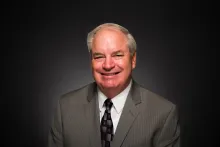
Robin Webber was born in Chicago, Illinois, in 1951, but has lived most of his life in California. He has been a part of the Church of God community since 1963. He attended Ambassador College in Pasadena from 1969-1973. He majored in theology and history.
Mr. Webber's interest remains in the study of history, socio-economics and literature. Over the years, he has offered his services to museums as a docent to share his enthusiasm and passions regarding these areas of expertise.
When time permits, he loves to go mountain biking on nearby ranch land and meet his wife as she hikes toward him.
